TESTING PRESENTATION
1. What kind of decisions do you make based on the results of students test performance?
2. Do you tell students, before they take a test, how you will judge their test performance?. If not why not? How do you report students’ test results, and how do you use those results?
3. Have you ever had a  student or a group of students who just couldn’t do well on tests? What is your explanation of their difficulty? What did you or could you do about it?
4. How do you decide when and how often to test? 5. Do you personally like taking tests? Explain
Testing is one component in the evaluation process which provides information to make decisions. The test should be  about:  1.  What has been done? 2. How has it been done ?– performance 3. What should I do with the results?
A method for collecting information. A task or set of tasks that elicits observable behaviour from the test taker. Tests produce scores that represents attributes or characteristics of individuals.
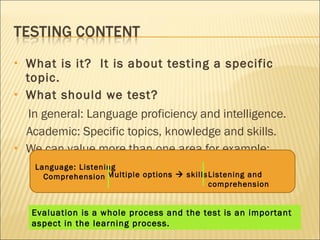
What is it?  It is about testing a specific topic. What should we test?  In general: Language proficiency and intelligence. Academic: Specific topics, knowledge and skills. We can value more than one area for example: Language: Listening Comprehension Multiple options    skills Listening and comprehension Evaluation is a whole process and the test is an important  aspect in the learning process.
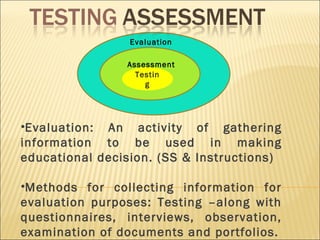
Evaluation: An activity of gathering information to be used in making educational decision. (SS & Instructions) Methods for collecting information for evaluation purposes: Testing –along with questionnaires, interviews, observation, examination of documents and portfolios. Testing Assessment Evaluation
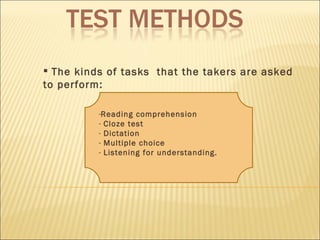
The kinds of tasks  that the takers are asked to perform: Reading comprehension Cloze test Dictation Multiple choice Listening for understanding.
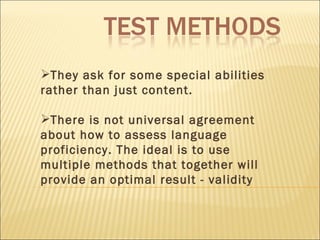
They ask for some special abilities rather than just content. There is not universal agreement about how to assess language proficiency. The ideal is to use multiple methods that together will provide an optimal result - validity
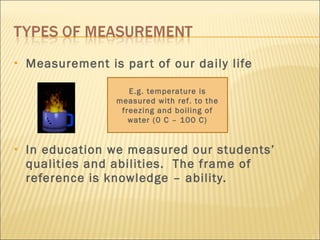
Measurement is part of our daily life In education we measured our students’ qualities and abilities.  The frame of reference is knowledge – ability. E.g. temperature is measured with ref. to the freezing and boiling of water (0 C – 100 C)
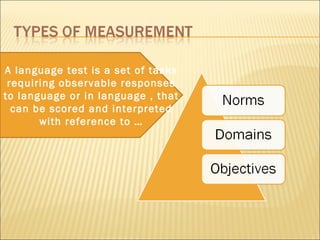
A language test is a set of tasks requiring observable responses to language or in language , that can be scored and interpreted with reference to …
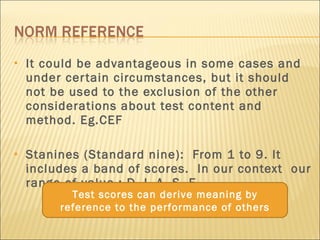
It could be advantageous in some cases and under certain circumstances, but it should not be used to the exclusion of the other considerations about test content and method. Eg.CEF Stanines (Standard nine):  From 1 to 9. It includes a band of scores.  In our context  our range of value : D, I, A, S, E.  Test scores can derive meaning by reference to the performance of others
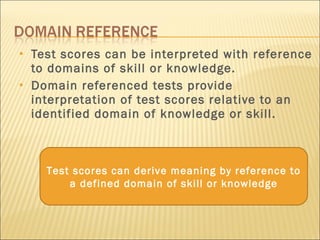
Test scores can be interpreted with reference to domains of skill or knowledge. Domain referenced tests provide interpretation of test scores relative to an identified domain of knowledge or skill. Test scores can derive meaning by reference to a defined domain of skill or knowledge
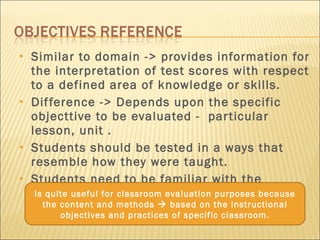
Similar to domain -> provides information for the interpretation of test scores with respect to a defined area of knowledge or skills. Difference -> Depends upon the specific objecttive to be evaluated -  particular lesson, unit . Students should be tested in a ways that resemble how they were taught. Students need to be familiar with the instruction. Is quite useful for classroom evaluation purposes because the content and methods    based on the instructional objectives and practices of specific classroom.
1. LINGUISTIC COMPETENCE: Linguistic abilities or knowledge of the language. It is inferred from linguistic performance.
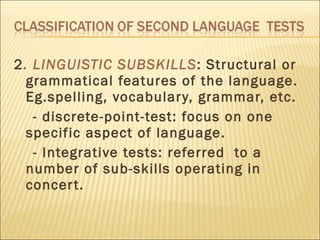
2 . LINGUISTIC SUBSKILLS : Structural or grammatical features of the language. Eg.spelling, vocabulary, grammar, etc. - discrete-point-test: focus on one specific aspect of language. - Integrative tests: referred  to a number of sub-skills operating in concert.
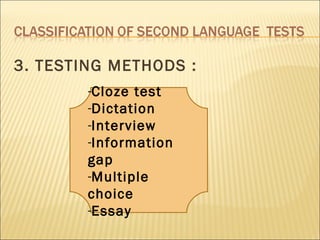
3. TESTING METHODS :  Cloze test Dictation Interview Information gap Multiple choice Essay
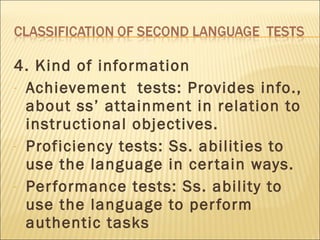
4. Kind of information Achievement  tests: Provides info., about ss’ attainment in relation to instructional objectives. Proficiency tests: Ss. abilities to use the language in certain ways. Performance tests: Ss. ability to use the language to perform authentic tasks
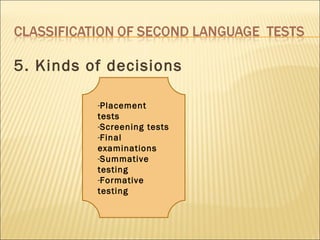
5. Kinds of decisions Placement tests Screening tests Final examinations Summative testing Formative testing
 

Testing presentation

  • 1.
  • 2.
    1. What kindof decisions do you make based on the results of students test performance?
  • 3.
    2. Do youtell students, before they take a test, how you will judge their test performance?. If not why not? How do you report students’ test results, and how do you use those results?
  • 4.
    3. Have youever had a student or a group of students who just couldn’t do well on tests? What is your explanation of their difficulty? What did you or could you do about it?
  • 5.
    4. How doyou decide when and how often to test? 5. Do you personally like taking tests? Explain
  • 6.
    Testing is onecomponent in the evaluation process which provides information to make decisions. The test should be about: 1. What has been done? 2. How has it been done ?– performance 3. What should I do with the results?
  • 7.
    A method forcollecting information. A task or set of tasks that elicits observable behaviour from the test taker. Tests produce scores that represents attributes or characteristics of individuals.
  • 8.
    What is it? It is about testing a specific topic. What should we test? In general: Language proficiency and intelligence. Academic: Specific topics, knowledge and skills. We can value more than one area for example: Language: Listening Comprehension Multiple options  skills Listening and comprehension Evaluation is a whole process and the test is an important aspect in the learning process.
  • 9.
    Evaluation: An activityof gathering information to be used in making educational decision. (SS & Instructions) Methods for collecting information for evaluation purposes: Testing –along with questionnaires, interviews, observation, examination of documents and portfolios. Testing Assessment Evaluation
  • 10.
    The kinds oftasks that the takers are asked to perform: Reading comprehension Cloze test Dictation Multiple choice Listening for understanding.
  • 11.
    They ask forsome special abilities rather than just content. There is not universal agreement about how to assess language proficiency. The ideal is to use multiple methods that together will provide an optimal result - validity
  • 12.
    Measurement is partof our daily life In education we measured our students’ qualities and abilities. The frame of reference is knowledge – ability. E.g. temperature is measured with ref. to the freezing and boiling of water (0 C – 100 C)
  • 13.
    A language testis a set of tasks requiring observable responses to language or in language , that can be scored and interpreted with reference to …
  • 14.
    It could beadvantageous in some cases and under certain circumstances, but it should not be used to the exclusion of the other considerations about test content and method. Eg.CEF Stanines (Standard nine): From 1 to 9. It includes a band of scores. In our context our range of value : D, I, A, S, E. Test scores can derive meaning by reference to the performance of others
  • 15.
    Test scores canbe interpreted with reference to domains of skill or knowledge. Domain referenced tests provide interpretation of test scores relative to an identified domain of knowledge or skill. Test scores can derive meaning by reference to a defined domain of skill or knowledge
  • 16.
    Similar to domain-> provides information for the interpretation of test scores with respect to a defined area of knowledge or skills. Difference -> Depends upon the specific objecttive to be evaluated - particular lesson, unit . Students should be tested in a ways that resemble how they were taught. Students need to be familiar with the instruction. Is quite useful for classroom evaluation purposes because the content and methods  based on the instructional objectives and practices of specific classroom.
  • 17.
    1. LINGUISTIC COMPETENCE:Linguistic abilities or knowledge of the language. It is inferred from linguistic performance.
  • 18.
    2 . LINGUISTICSUBSKILLS : Structural or grammatical features of the language. Eg.spelling, vocabulary, grammar, etc. - discrete-point-test: focus on one specific aspect of language. - Integrative tests: referred to a number of sub-skills operating in concert.
  • 19.
    3. TESTING METHODS: Cloze test Dictation Interview Information gap Multiple choice Essay
  • 20.
    4. Kind ofinformation Achievement tests: Provides info., about ss’ attainment in relation to instructional objectives. Proficiency tests: Ss. abilities to use the language in certain ways. Performance tests: Ss. ability to use the language to perform authentic tasks
  • 21.
    5. Kinds ofdecisions Placement tests Screening tests Final examinations Summative testing Formative testing
  • 22.