Occupational
infections
Shalom Nwachukwu
Definition
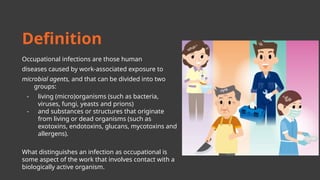
Occupational infections are those human
diseases caused by work-associated exposure to
microbial agents, and that can be divided into two
groups:
- living (micro)organisms (such as bacteria,
viruses, fungi, yeasts and prions)
- and substances or structures that originate
from living or dead organisms (such as
exotoxins, endotoxins, glucans, mycotoxins and
allergens).
What distinguishes an infection as occupational is
some aspect of the work that involves contact with a
biologically active organism.
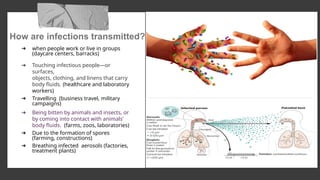
How are infections transmitted?
āž” when people work or live in groups
(daycare centers, barracks)
āž” Touching infectious people—or
surfaces,
objects, clothing, and linens that carry
body fluids. (healthcare and laboratory
workers)
āž” Travelling (business travel, military
campaigns)
āž” Being bitten by animals and insects, or
by coming into contact with animals’
body fluids. (farms, zoos, laboratories)
āž” Due to the formation of spores
(farming, constructions)
āž” Breathing infected aerosols (factories,
treatment plants)
TYPES of
occupational
infections
1. Anthroponosis: Infections due to
exposure to infected human or
their tissues
2. Zoonoses – infections
transmitted from animals to
humans
3. Travel associated infectious
diseases
Bloodborne and
Other
Common Infectious
Diseases
Bloodborne Diseases:
ā— HIV/AIDS.
ā— Hepatitis B and C.
Other common infectious disease
• Bacterial:
– ā€œStaphā€ skin infection.
– Pneumonia.
– Tuberculosis.
• Parasitic—Giardia
• Viral:
– Influenza, or the flu.
– Respiratory infections.
– Diarrhea.
– Chickenpox, measles, mumps.
Anthroponosis
Viral hepatitis:
The main routes of exposure are percutaneous through needle stick injuries, and across mucous membranes or
damaged skin, through contact with contaminated body fluids a wide range of occupations are at increased risk
of exposure to HBV and HCV eg health care workers, embalmers, persons who handle body substances, clinical
laboratory staff, workers in long-term correctional facilities, police, members of the armed forces and
emergency services workers, and business travellers
Tuberculosis:
Tuberculosis is an infection caused by Mycobacterium bacilli (usually Mycobacterium tuberculae). It can affect
many organs, but respiratory tuberculosis is the most common form of the disease. Health care workers are the
occupational group at highest risk of developing tuberculosis from a work-related exposure. Clinical laboratory
workers, funeral parlour staff, farmers and veterinarians are probably also at increased risk
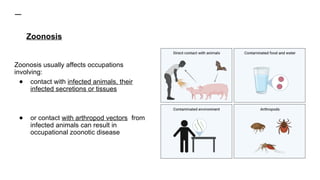
Zoonosis
Zoonosis usually affects occupations
involving:
ā— contact with infected animals, their
infected secretions or tissues
ā— or contact with arthropod vectors from
infected animals can result in
occupational zoonotic disease
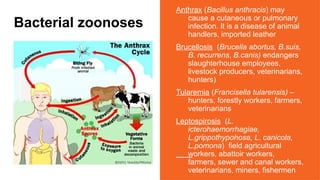
Bacterial zoonoses
Anthrax (Bacillus anthracis) may
cause a cutaneous or pulmonary
infection. It is a disease of animal
handlers, imported leather
Brucellosis (Brucella abortus, B.suis,
B. recurrens, B.canis) endangers
slaughterhouse employees,
livestock producers, veterinarians,
hunters)
Tularemia (Francisella tularensis) –
hunters, forestly workers, farmers,
veterinarians
Leptospirosis (L.
icterohaemorrhagiae,
L.grippothypohosa, L. canicola,
L.pomona) field agricultural
workers, abattoir workers,
farmers, sewer and canal workers,
veterinarians, miners, fishermen
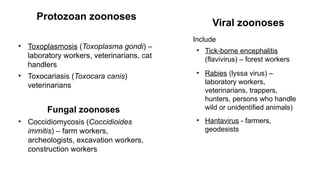
• Toxoplasmosis (Toxoplasma gondi) –
laboratory workers, veterinarians, cat
handlers
• Toxocariasis (Toxocara canis)
veterinarians
Fungal zoonoses
• Coccidiomycosis (Coccidioides
immitis) – farm workers,
archeologists, excavation workers,
construction workers
Protozoan zoonoses
Include
• Tick-borne encephalitis
(flavivirus) – forest workers
• Rabies (lyssa virus) –
laboratory workers,
veterinarians, trappers,
hunters, persons who handle
wild or unidentified animals)
• Hantavirus - farmers,
geodesists
Viral zoonoses
Travel – associated infectious
diseases
All travelers should have routine
immunisations updated
Educational programs for health and safety
should include information on common
sense prevention, specific immunisations or
chemoprophylaxis, source of medical care,
and medical clearance based on particular
hazards that may be present in the
destination country as well as availability of
appropriate health care.
Example of such infection: legionelosis
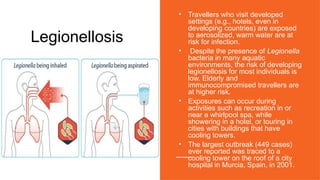
• Travellers who visit developed
settings (e.g., hotels, even in
developing countries) are exposed
to aerosolized, warm water are at
risk for infection.
• Despite the presence of Legionella
bacteria in many aquatic
environments, the risk of developing
legionellosis for most individuals is
low. Elderly and
immunocompromised travellers are
at higher risk.
• Exposures can occur during
activities such as recreation in or
near a whirlpool spa, while
showering in a hotel, or touring in
cities with buildings that have
cooling towers.
• The largest outbreak (449 cases)
ever reported was traced to a
cooling tower on the roof of a city
hospital in Murcia, Spain, in 2001.
Legionellosis
ā— Respecting the hierarchy of prevention measures:
designing work processes so as to avoid or minimise exposure, developing technical
measures at the design stage of work premises and work procedures, appropriate signage,
plans to deal with accidental exposure, and measures for safe waste collection and handling
and transport of biological agents, all measures that are included in the biological agents
directive.
ā— Vaccination and how to address low vaccination rates
According to the biological agents directive, workers should be informed of the benefits and
drawbacks of both vaccination and non-vaccination, and vaccination must be offered free of
charge to workers
Improving the prevention at the
workplace
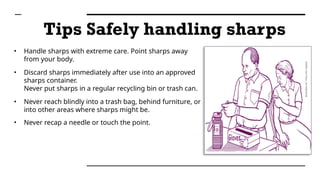
• Handle sharps with extreme care. Point sharps away
from your body.
• Discard sharps immediately after use into an approved
sharps container.
Never put sharps in a regular recycling bin or trash can.
• Never reach blindly into a trash bag, behind furniture, or
into other areas where sharps might be.
• Never recap a needle or touch the point.
Tips Safely handling sharps
Illustration
by
®Mary
Ann
Zapalac
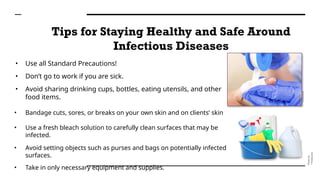
Tips for Staying Healthy and Safe Around
Infectious Diseases
• Use all Standard Precautions!
• Don’t go to work if you are sick.
• Avoid sharing drinking cups, bottles, eating utensils, and other
food items.
• Bandage cuts, sores, or breaks on your own skin and on clients’ skin
• Use a fresh bleach solution to carefully clean surfaces that may be
infected.
• Avoid setting objects such as purses and bags on potentially infected
surfaces.
• Take in only necessary equipment and supplies.
Photo
by
®Thinkstock
Photo
by
®Thinkstock
Case study
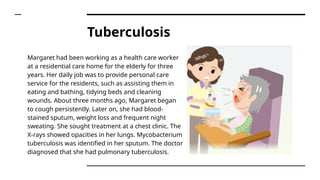
Tuberculosis
Margaret had been working as a health care worker
at a residential care home for the elderly for three
years. Her daily job was to provide personal care
service for the residents, such as assisting them in
eating and bathing, tidying beds and cleaning
wounds. About three months ago, Margaret began
to cough persistently. Later on, she had blood-
stained sputum, weight loss and frequent night
sweating. She sought treatment at a chest clinic. The
X-rays showed opacities in her lungs. Mycobacterium
tuberculosis was identified in her sputum. The doctor
diagnosed that she had pulmonary tuberculosis.
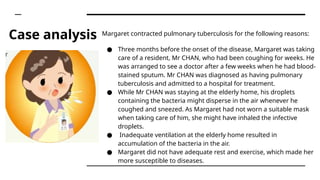
Case analysis Margaret contracted pulmonary tuberculosis for the following reasons:
ā— Three months before the onset of the disease, Margaret was taking
care of a resident, Mr CHAN, who had been coughing for weeks. He
was arranged to see a doctor after a few weeks when he had blood-
stained sputum. Mr CHAN was diagnosed as having pulmonary
tuberculosis and admitted to a hospital for treatment.
ā— While Mr CHAN was staying at the elderly home, his droplets
containing the bacteria might disperse in the air whenever he
coughed and sneezed. As Margaret had not worn a suitable mask
when taking care of him, she might have inhaled the infective
droplets.
ā— Inadequate ventilation at the elderly home resulted in
accumulation of the bacteria in the air.
ā— Margaret did not have adequate rest and exercise, which made her
more susceptible to diseases.
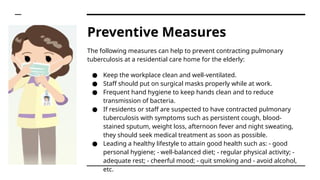
Preventive Measures
The following measures can help to prevent contracting pulmonary
tuberculosis at a residential care home for the elderly:
ā— Keep the workplace clean and well-ventilated.
ā— Staff should put on surgical masks properly while at work.
ā— Frequent hand hygiene to keep hands clean and to reduce
transmission of bacteria.
ā— If residents or staff are suspected to have contracted pulmonary
tuberculosis with symptoms such as persistent cough, blood-
stained sputum, weight loss, afternoon fever and night sweating,
they should seek medical treatment as soon as possible.
ā— Leading a healthy lifestyle to attain good health such as: - good
personal hygiene; - well-balanced diet; - regular physical activity; -
adequate rest; - cheerful mood; - quit smoking and - avoid alcohol,
etc.
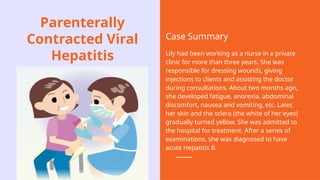
Parenterally
Contracted Viral
Hepatitis
Case Summary
Lily had been working as a nurse in a private
clinic for more than three years. She was
responsible for dressing wounds, giving
injections to clients and assisting the doctor
during consultations. About two months ago,
she developed fatigue, anorexia, abdominal
discomfort, nausea and vomiting, etc. Later,
her skin and the sclera (the white of her eyes)
gradually turned yellow. She was admitted to
the hospital for treatment. After a series of
examinations, she was diagnosed to have
acute Hepatitis B.
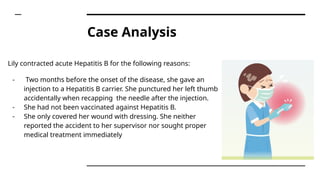
Case Analysis
Lily contracted acute Hepatitis B for the following reasons:
- Two months before the onset of the disease, she gave an
injection to a Hepatitis B carrier. She punctured her left thumb
accidentally when recapping the needle after the injection.
- She had not been vaccinated against Hepatitis B.
- She only covered her wound with dressing. She neither
reported the accident to her supervisor nor sought proper
medical treatment immediately
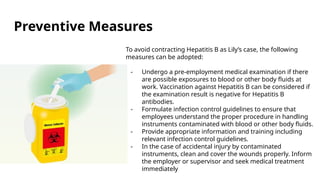
Preventive Measures
To avoid contracting Hepatitis B as Lily’s case, the following
measures can be adopted:
- Undergo a pre-employment medical examination if there
are possible exposures to blood or other body fluids at
work. Vaccination against Hepatitis B can be considered if
the examination result is negative for Hepatitis B
antibodies.
- Formulate infection control guidelines to ensure that
employees understand the proper procedure in handling
instruments contaminated with blood or other body fluids.
- Provide appropriate information and training including
relevant infection control guidelines.
- In the case of accidental injury by contaminated
instruments, clean and cover the wounds properly. Inform
the employer or supervisor and seek medical treatment
immediately
Conclusion
the prevention of occupational infection is mainly based on the following principles:
ā— Keep the workplace clean and hygienic, and eliminate or control the sources of infection to reduce the risk of
disease transmission.
ā— Ensure adequate ventilation in the workplaces.
ā— Formulate, provide and monitor safety management system and guidelines.
ā— Provide appropriate information and training to employees.
ā— Employees with symptoms of infectious diseases should seek medical treatment as soon as possible to
reduce the risk of disease transmission.
ā— Adopt preventive measures and use personal protective equipment (PPE) that are appropriate for the work
nature. PPE should be properly maintained and promptly replaced if they have defects.
ā— If there is a wound, clean and dress it properly to avoid infection.
ā— Vaccinations can prevent certain infectious diseases (e.g. Hepatitis B). Employees who are not immune to
these infectious diseases can consider receiving the appropriate vaccinations.
Employers and employees can take appropriate preventive measures in accordance with the above principles to
minimize the risk of contracting infections.
The end, thank you for
your attention :)

Occupational disease the presentation.pptx

  • 1.
  • 2.
    Definition Occupational infections arethose human diseases caused by work-associated exposure to microbial agents, and that can be divided into two groups: - living (micro)organisms (such as bacteria, viruses, fungi, yeasts and prions) - and substances or structures that originate from living or dead organisms (such as exotoxins, endotoxins, glucans, mycotoxins and allergens). What distinguishes an infection as occupational is some aspect of the work that involves contact with a biologically active organism.
  • 3.
    How are infectionstransmitted? āž” when people work or live in groups (daycare centers, barracks) āž” Touching infectious people—or surfaces, objects, clothing, and linens that carry body fluids. (healthcare and laboratory workers) āž” Travelling (business travel, military campaigns) āž” Being bitten by animals and insects, or by coming into contact with animals’ body fluids. (farms, zoos, laboratories) āž” Due to the formation of spores (farming, constructions) āž” Breathing infected aerosols (factories, treatment plants)
  • 4.
    TYPES of occupational infections 1. Anthroponosis:Infections due to exposure to infected human or their tissues 2. Zoonoses – infections transmitted from animals to humans 3. Travel associated infectious diseases
  • 5.
    Bloodborne and Other Common Infectious Diseases BloodborneDiseases: ā— HIV/AIDS. ā— Hepatitis B and C. Other common infectious disease • Bacterial: – ā€œStaphā€ skin infection. – Pneumonia. – Tuberculosis. • Parasitic—Giardia • Viral: – Influenza, or the flu. – Respiratory infections. – Diarrhea. – Chickenpox, measles, mumps.
  • 6.
    Anthroponosis Viral hepatitis: The mainroutes of exposure are percutaneous through needle stick injuries, and across mucous membranes or damaged skin, through contact with contaminated body fluids a wide range of occupations are at increased risk of exposure to HBV and HCV eg health care workers, embalmers, persons who handle body substances, clinical laboratory staff, workers in long-term correctional facilities, police, members of the armed forces and emergency services workers, and business travellers Tuberculosis: Tuberculosis is an infection caused by Mycobacterium bacilli (usually Mycobacterium tuberculae). It can affect many organs, but respiratory tuberculosis is the most common form of the disease. Health care workers are the occupational group at highest risk of developing tuberculosis from a work-related exposure. Clinical laboratory workers, funeral parlour staff, farmers and veterinarians are probably also at increased risk
  • 7.
    Zoonosis Zoonosis usually affectsoccupations involving: ā— contact with infected animals, their infected secretions or tissues ā— or contact with arthropod vectors from infected animals can result in occupational zoonotic disease
  • 8.
    Bacterial zoonoses Anthrax (Bacillusanthracis) may cause a cutaneous or pulmonary infection. It is a disease of animal handlers, imported leather Brucellosis (Brucella abortus, B.suis, B. recurrens, B.canis) endangers slaughterhouse employees, livestock producers, veterinarians, hunters) Tularemia (Francisella tularensis) – hunters, forestly workers, farmers, veterinarians Leptospirosis (L. icterohaemorrhagiae, L.grippothypohosa, L. canicola, L.pomona) field agricultural workers, abattoir workers, farmers, sewer and canal workers, veterinarians, miners, fishermen
  • 9.
    • Toxoplasmosis (Toxoplasmagondi) – laboratory workers, veterinarians, cat handlers • Toxocariasis (Toxocara canis) veterinarians Fungal zoonoses • Coccidiomycosis (Coccidioides immitis) – farm workers, archeologists, excavation workers, construction workers Protozoan zoonoses Include • Tick-borne encephalitis (flavivirus) – forest workers • Rabies (lyssa virus) – laboratory workers, veterinarians, trappers, hunters, persons who handle wild or unidentified animals) • Hantavirus - farmers, geodesists Viral zoonoses
  • 10.
    Travel – associatedinfectious diseases All travelers should have routine immunisations updated Educational programs for health and safety should include information on common sense prevention, specific immunisations or chemoprophylaxis, source of medical care, and medical clearance based on particular hazards that may be present in the destination country as well as availability of appropriate health care. Example of such infection: legionelosis
  • 11.
    • Travellers whovisit developed settings (e.g., hotels, even in developing countries) are exposed to aerosolized, warm water are at risk for infection. • Despite the presence of Legionella bacteria in many aquatic environments, the risk of developing legionellosis for most individuals is low. Elderly and immunocompromised travellers are at higher risk. • Exposures can occur during activities such as recreation in or near a whirlpool spa, while showering in a hotel, or touring in cities with buildings that have cooling towers. • The largest outbreak (449 cases) ever reported was traced to a cooling tower on the roof of a city hospital in Murcia, Spain, in 2001. Legionellosis
  • 12.
    ā— Respecting thehierarchy of prevention measures: designing work processes so as to avoid or minimise exposure, developing technical measures at the design stage of work premises and work procedures, appropriate signage, plans to deal with accidental exposure, and measures for safe waste collection and handling and transport of biological agents, all measures that are included in the biological agents directive. ā— Vaccination and how to address low vaccination rates According to the biological agents directive, workers should be informed of the benefits and drawbacks of both vaccination and non-vaccination, and vaccination must be offered free of charge to workers Improving the prevention at the workplace
  • 13.
    • Handle sharpswith extreme care. Point sharps away from your body. • Discard sharps immediately after use into an approved sharps container. Never put sharps in a regular recycling bin or trash can. • Never reach blindly into a trash bag, behind furniture, or into other areas where sharps might be. • Never recap a needle or touch the point. Tips Safely handling sharps Illustration by Ā®Mary Ann Zapalac
  • 14.
    Tips for StayingHealthy and Safe Around Infectious Diseases • Use all Standard Precautions! • Don’t go to work if you are sick. • Avoid sharing drinking cups, bottles, eating utensils, and other food items. • Bandage cuts, sores, or breaks on your own skin and on clients’ skin • Use a fresh bleach solution to carefully clean surfaces that may be infected. • Avoid setting objects such as purses and bags on potentially infected surfaces. • Take in only necessary equipment and supplies. Photo by Ā®Thinkstock Photo by Ā®Thinkstock
  • 15.
  • 16.
    Tuberculosis Margaret had beenworking as a health care worker at a residential care home for the elderly for three years. Her daily job was to provide personal care service for the residents, such as assisting them in eating and bathing, tidying beds and cleaning wounds. About three months ago, Margaret began to cough persistently. Later on, she had blood- stained sputum, weight loss and frequent night sweating. She sought treatment at a chest clinic. The X-rays showed opacities in her lungs. Mycobacterium tuberculosis was identified in her sputum. The doctor diagnosed that she had pulmonary tuberculosis.
  • 17.
    Case analysis Margaretcontracted pulmonary tuberculosis for the following reasons: ā— Three months before the onset of the disease, Margaret was taking care of a resident, Mr CHAN, who had been coughing for weeks. He was arranged to see a doctor after a few weeks when he had blood- stained sputum. Mr CHAN was diagnosed as having pulmonary tuberculosis and admitted to a hospital for treatment. ā— While Mr CHAN was staying at the elderly home, his droplets containing the bacteria might disperse in the air whenever he coughed and sneezed. As Margaret had not worn a suitable mask when taking care of him, she might have inhaled the infective droplets. ā— Inadequate ventilation at the elderly home resulted in accumulation of the bacteria in the air. ā— Margaret did not have adequate rest and exercise, which made her more susceptible to diseases.
  • 18.
    Preventive Measures The followingmeasures can help to prevent contracting pulmonary tuberculosis at a residential care home for the elderly: ā— Keep the workplace clean and well-ventilated. ā— Staff should put on surgical masks properly while at work. ā— Frequent hand hygiene to keep hands clean and to reduce transmission of bacteria. ā— If residents or staff are suspected to have contracted pulmonary tuberculosis with symptoms such as persistent cough, blood- stained sputum, weight loss, afternoon fever and night sweating, they should seek medical treatment as soon as possible. ā— Leading a healthy lifestyle to attain good health such as: - good personal hygiene; - well-balanced diet; - regular physical activity; - adequate rest; - cheerful mood; - quit smoking and - avoid alcohol, etc.
  • 19.
    Parenterally Contracted Viral Hepatitis Case Summary Lilyhad been working as a nurse in a private clinic for more than three years. She was responsible for dressing wounds, giving injections to clients and assisting the doctor during consultations. About two months ago, she developed fatigue, anorexia, abdominal discomfort, nausea and vomiting, etc. Later, her skin and the sclera (the white of her eyes) gradually turned yellow. She was admitted to the hospital for treatment. After a series of examinations, she was diagnosed to have acute Hepatitis B.
  • 20.
    Case Analysis Lily contractedacute Hepatitis B for the following reasons: - Two months before the onset of the disease, she gave an injection to a Hepatitis B carrier. She punctured her left thumb accidentally when recapping the needle after the injection. - She had not been vaccinated against Hepatitis B. - She only covered her wound with dressing. She neither reported the accident to her supervisor nor sought proper medical treatment immediately
  • 21.
    Preventive Measures To avoidcontracting Hepatitis B as Lily’s case, the following measures can be adopted: - Undergo a pre-employment medical examination if there are possible exposures to blood or other body fluids at work. Vaccination against Hepatitis B can be considered if the examination result is negative for Hepatitis B antibodies. - Formulate infection control guidelines to ensure that employees understand the proper procedure in handling instruments contaminated with blood or other body fluids. - Provide appropriate information and training including relevant infection control guidelines. - In the case of accidental injury by contaminated instruments, clean and cover the wounds properly. Inform the employer or supervisor and seek medical treatment immediately
  • 22.
    Conclusion the prevention ofoccupational infection is mainly based on the following principles: ā— Keep the workplace clean and hygienic, and eliminate or control the sources of infection to reduce the risk of disease transmission. ā— Ensure adequate ventilation in the workplaces. ā— Formulate, provide and monitor safety management system and guidelines. ā— Provide appropriate information and training to employees. ā— Employees with symptoms of infectious diseases should seek medical treatment as soon as possible to reduce the risk of disease transmission. ā— Adopt preventive measures and use personal protective equipment (PPE) that are appropriate for the work nature. PPE should be properly maintained and promptly replaced if they have defects. ā— If there is a wound, clean and dress it properly to avoid infection. ā— Vaccinations can prevent certain infectious diseases (e.g. Hepatitis B). Employees who are not immune to these infectious diseases can consider receiving the appropriate vaccinations. Employers and employees can take appropriate preventive measures in accordance with the above principles to minimize the risk of contracting infections.
  • 23.
    The end, thankyou for your attention :)