
ARTERIAL HYPERTENSION
INTRODUCTION
 Arterial hypertension is defined as borderline when it
reaches 140/95mmHg and hypertensive when its
165/95mmHg.
 The elevation of systolic pressure alone (systolic
hypertension) or elevation of both systolic and diastolic
pressure (diastolic hypertension), both have an increased risk
of complication, but diastolic hypertension is more
dangerous.
CLASSIFICATION
 Primary or essential hypertension in which the cause of
increase in blood pressure is unknown. This hypertension
constitutes about 90-95% patient with hypertension.
 Secondary hypertension, remaining 5–10% of cases are
caused by other conditions that affect the kidneys, arteries,
heart, or endocrine system.
 Essential arterial hypertension is arterial hypertension of
unknown origin and not associated with other diseases.
 Symptomatical (secondary) arterial hypertension is symptom
disease of the kidneys, endocrine system, heart, nervous
system, exogenous(salt-,alcohol-,medicament drugs-,toxin
associated),pregnancy associated and other.
CAUSES
 Unknown cause (idiopathic pulmonary arterial hypertension)
 A genetic mutation passed down through families (heritable
pulmonary arterial hypertension)
 Use of some prescription diet drugs or illegal drugs such as
methamphetamines — and other drugs
 Heart problems present at birth (congenital heart disease)
 Other conditions, such as connective tissue disorders
(scleroderma, lupus, others), HIV infection or chronic liver
disease (cirrhosis)
FACTORS OF BLOOD REGULATION
• Cardiac output,
• Peripheral vascular resistance,
• Blood circulating volume.
RISK FACTORS
 A family history of the condition
 Being overweight
 Blood-clotting disorders or a family history of blood clots in
the lungs
 Exposure to asbestos
 Genetic disorders, including congenital heart disease
 Living at a high altitude
 Use of certain weight-loss drugs
 Use of illegal drugs such as cocaine
COMPLICATION
 Right-sided heart enlargement and heart failure (cor
pulmonale)
 In cor pulmonale, your heart's right ventricle becomes
enlarged and has to pump harder than usual to move blood
through narrowed or blocked pulmonary arteries.
 Blood clots
 Having pulmonary hypertension makes it more likely you'll
develop clots in the small arteries in your lungs, which is
dangerous if you already have narrowed or blocked blood
vessels.
 Arrhythmia
 Pulmonary hypertension can cause irregular heartbeats
(arrhythmias), which can lead to a pounding heartbeat
(palpitations), dizziness or fainting. Certain arrhythmias can
be life-threatening.
 Bleeding in the lungs
 Pulmonary hypertension can lead to life-threatening bleeding
into the lungs and coughing up blood (hemoptysis).
 Pregnancy complications
 Pulmonary hypertension can be life-threatening for a woman
and her developing baby.
DIAGNOSIS
 Blood tests
 Include HIV, thyroid tests, autoimmune disease panels (test for
systemic lupus erythematosus, scleroderma, and rheumatoid
arthritis), liver tests and blood chemistry tests.
 Electrocardiogram
 Shows the electrical activity of the heart and may help detect
abnormalities. Doctors may also be able to detect signs of strain
on the right side of the heart.
 Lung function tests (breathing tests)
 Check for diseases like asthma or emphysema.
 6-Minute Walk Test
 Objectively measures how far you can walk and to see if your
oxygen levels drop when you exert yourself.
 Echocardiogram
 Ultrasound of the heart to check the size and condition of the
chambers of the heart. It can also be used to estimate the blood
pressure in the pulmonary arteries.
 Right Heart Catheterization
 This test is invasive, so it is not usually performed unless other
tests cannot produce a firm diagnosis. It involves inserting a
catheter (small tube) into a large vein in either the neck, arm, or
groin, and threading it through the right side of the heart and
into the pulmonary artery.
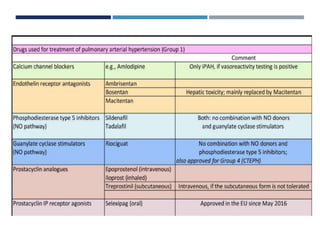
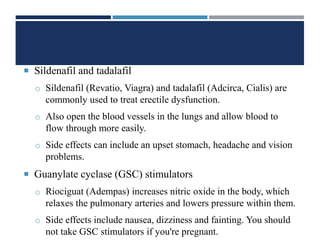
 Sildenafil and tadalafil
o Sildenafil (Revatio, Viagra) and tadalafil (Adcirca, Cialis) are
commonly used to treat erectile dysfunction.
o Also open the blood vessels in the lungs and allow blood to
flow through more easily.
o Side effects can include an upset stomach, headache and vision
problems.
 Guanylate cyclase (GSC) stimulators
o Riociguat (Adempas) increases nitric oxide in the body, which
relaxes the pulmonary arteries and lowers pressure within them.
o Side effects include nausea, dizziness and fainting. You should
not take GSC stimulators if you're pregnant.
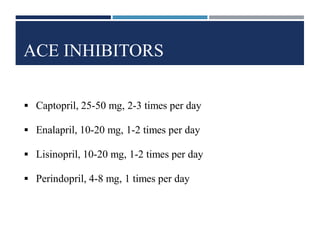
ACE INHIBITORS
 Captopril, 25-50 mg, 2-3 times per day
 Enalapril, 10-20 mg, 1-2 times per day
 Lisinopril, 10-20 mg, 1-2 times per day
 Perindopril, 4-8 mg, 1 times per day
CALCIUM CHANNEL BLOCKERS
 High-dose calcium channel blockers
o These drugs help relax the muscles in the walls of your blood vessels.
o They include amlodipine (Norvasc), diltiazem (Cardizem, Tiazac,
others) and nifedipine (Procardia, others).
o Although calcium channel blockers can be effective, only a small
number of people with pulmonary hypertension improve while taking
them
 Digoxin
o Digoxin (Lanoxin) helps the heartbeat stronger and pump more blood.
It can help control the heart rate if you have arrhythmias.
Anticoagulant
 Warfarin
o Doctors generally prescribe warfarin (Coumadin, Jantoven) to
help prevent blood clots in the lung's arteries. This medication
delays the clotting process and might put you at risk of
bleeding, especially if you're having surgery or an invasive
procedure.
o Blood tests while taking warfarin are suggested to check how
well it's working.
Diuretics
 Diuretics
o Commonly known as water pills, these medications help
kidneys remove excess fluid from the body.
o This reduces the amount of work your heart has to do
o They may also be used to limit fluid buildup in your lungs, legs
and abdomen.
 Oxygen therapy
o doctor might suggest to breathe pure oxygen to help treat
pulmonary hypertension, especially if you live at a high altitude
or have sleep apnea.
o Some people who have pulmonary hypertension eventually need
continuous oxygen therapy.
Arterial hypertension

Arterial hypertension

  • 1.
  • 3.
    INTRODUCTION  Arterial hypertensionis defined as borderline when it reaches 140/95mmHg and hypertensive when its 165/95mmHg.  The elevation of systolic pressure alone (systolic hypertension) or elevation of both systolic and diastolic pressure (diastolic hypertension), both have an increased risk of complication, but diastolic hypertension is more dangerous.
  • 4.
    CLASSIFICATION  Primary oressential hypertension in which the cause of increase in blood pressure is unknown. This hypertension constitutes about 90-95% patient with hypertension.  Secondary hypertension, remaining 5–10% of cases are caused by other conditions that affect the kidneys, arteries, heart, or endocrine system.
  • 5.
     Essential arterialhypertension is arterial hypertension of unknown origin and not associated with other diseases.  Symptomatical (secondary) arterial hypertension is symptom disease of the kidneys, endocrine system, heart, nervous system, exogenous(salt-,alcohol-,medicament drugs-,toxin associated),pregnancy associated and other.
  • 6.
    CAUSES  Unknown cause(idiopathic pulmonary arterial hypertension)  A genetic mutation passed down through families (heritable pulmonary arterial hypertension)  Use of some prescription diet drugs or illegal drugs such as methamphetamines — and other drugs  Heart problems present at birth (congenital heart disease)  Other conditions, such as connective tissue disorders (scleroderma, lupus, others), HIV infection or chronic liver disease (cirrhosis)
  • 7.
    FACTORS OF BLOODREGULATION • Cardiac output, • Peripheral vascular resistance, • Blood circulating volume.
  • 8.
    RISK FACTORS  Afamily history of the condition  Being overweight  Blood-clotting disorders or a family history of blood clots in the lungs  Exposure to asbestos  Genetic disorders, including congenital heart disease  Living at a high altitude  Use of certain weight-loss drugs  Use of illegal drugs such as cocaine
  • 9.
    COMPLICATION  Right-sided heartenlargement and heart failure (cor pulmonale)  In cor pulmonale, your heart's right ventricle becomes enlarged and has to pump harder than usual to move blood through narrowed or blocked pulmonary arteries.  Blood clots  Having pulmonary hypertension makes it more likely you'll develop clots in the small arteries in your lungs, which is dangerous if you already have narrowed or blocked blood vessels.
  • 10.
     Arrhythmia  Pulmonaryhypertension can cause irregular heartbeats (arrhythmias), which can lead to a pounding heartbeat (palpitations), dizziness or fainting. Certain arrhythmias can be life-threatening.  Bleeding in the lungs  Pulmonary hypertension can lead to life-threatening bleeding into the lungs and coughing up blood (hemoptysis).  Pregnancy complications  Pulmonary hypertension can be life-threatening for a woman and her developing baby.
  • 11.
    DIAGNOSIS  Blood tests Include HIV, thyroid tests, autoimmune disease panels (test for systemic lupus erythematosus, scleroderma, and rheumatoid arthritis), liver tests and blood chemistry tests.  Electrocardiogram  Shows the electrical activity of the heart and may help detect abnormalities. Doctors may also be able to detect signs of strain on the right side of the heart.  Lung function tests (breathing tests)  Check for diseases like asthma or emphysema.
  • 12.
     6-Minute WalkTest  Objectively measures how far you can walk and to see if your oxygen levels drop when you exert yourself.  Echocardiogram  Ultrasound of the heart to check the size and condition of the chambers of the heart. It can also be used to estimate the blood pressure in the pulmonary arteries.  Right Heart Catheterization  This test is invasive, so it is not usually performed unless other tests cannot produce a firm diagnosis. It involves inserting a catheter (small tube) into a large vein in either the neck, arm, or groin, and threading it through the right side of the heart and into the pulmonary artery.
  • 14.
     Sildenafil andtadalafil o Sildenafil (Revatio, Viagra) and tadalafil (Adcirca, Cialis) are commonly used to treat erectile dysfunction. o Also open the blood vessels in the lungs and allow blood to flow through more easily. o Side effects can include an upset stomach, headache and vision problems.  Guanylate cyclase (GSC) stimulators o Riociguat (Adempas) increases nitric oxide in the body, which relaxes the pulmonary arteries and lowers pressure within them. o Side effects include nausea, dizziness and fainting. You should not take GSC stimulators if you're pregnant.
  • 15.
    ACE INHIBITORS  Captopril,25-50 mg, 2-3 times per day  Enalapril, 10-20 mg, 1-2 times per day  Lisinopril, 10-20 mg, 1-2 times per day  Perindopril, 4-8 mg, 1 times per day
  • 16.
    CALCIUM CHANNEL BLOCKERS High-dose calcium channel blockers o These drugs help relax the muscles in the walls of your blood vessels. o They include amlodipine (Norvasc), diltiazem (Cardizem, Tiazac, others) and nifedipine (Procardia, others). o Although calcium channel blockers can be effective, only a small number of people with pulmonary hypertension improve while taking them  Digoxin o Digoxin (Lanoxin) helps the heartbeat stronger and pump more blood. It can help control the heart rate if you have arrhythmias.
  • 17.
    Anticoagulant  Warfarin o Doctorsgenerally prescribe warfarin (Coumadin, Jantoven) to help prevent blood clots in the lung's arteries. This medication delays the clotting process and might put you at risk of bleeding, especially if you're having surgery or an invasive procedure. o Blood tests while taking warfarin are suggested to check how well it's working.
  • 18.
    Diuretics  Diuretics o Commonlyknown as water pills, these medications help kidneys remove excess fluid from the body. o This reduces the amount of work your heart has to do o They may also be used to limit fluid buildup in your lungs, legs and abdomen.  Oxygen therapy o doctor might suggest to breathe pure oxygen to help treat pulmonary hypertension, especially if you live at a high altitude or have sleep apnea. o Some people who have pulmonary hypertension eventually need continuous oxygen therapy.