Presented by: GONGORA, CHLAIRE R.
JASON, ROSE BELLE P.
MASULA, GLENNITH B.
URGEL, ROSELLE C.
• Types of Instructional
Materials
• Classification of
Materials
• Advantages Claimed
for Authentic and
Created Materials
• Qualities of a Good
Material
• Factors to Consider in
Writing Instructional
Materials
• Principles in Materials
Design
• Design, Development
and Dissemination of
Materials
• Guidelines for
Developing Materials
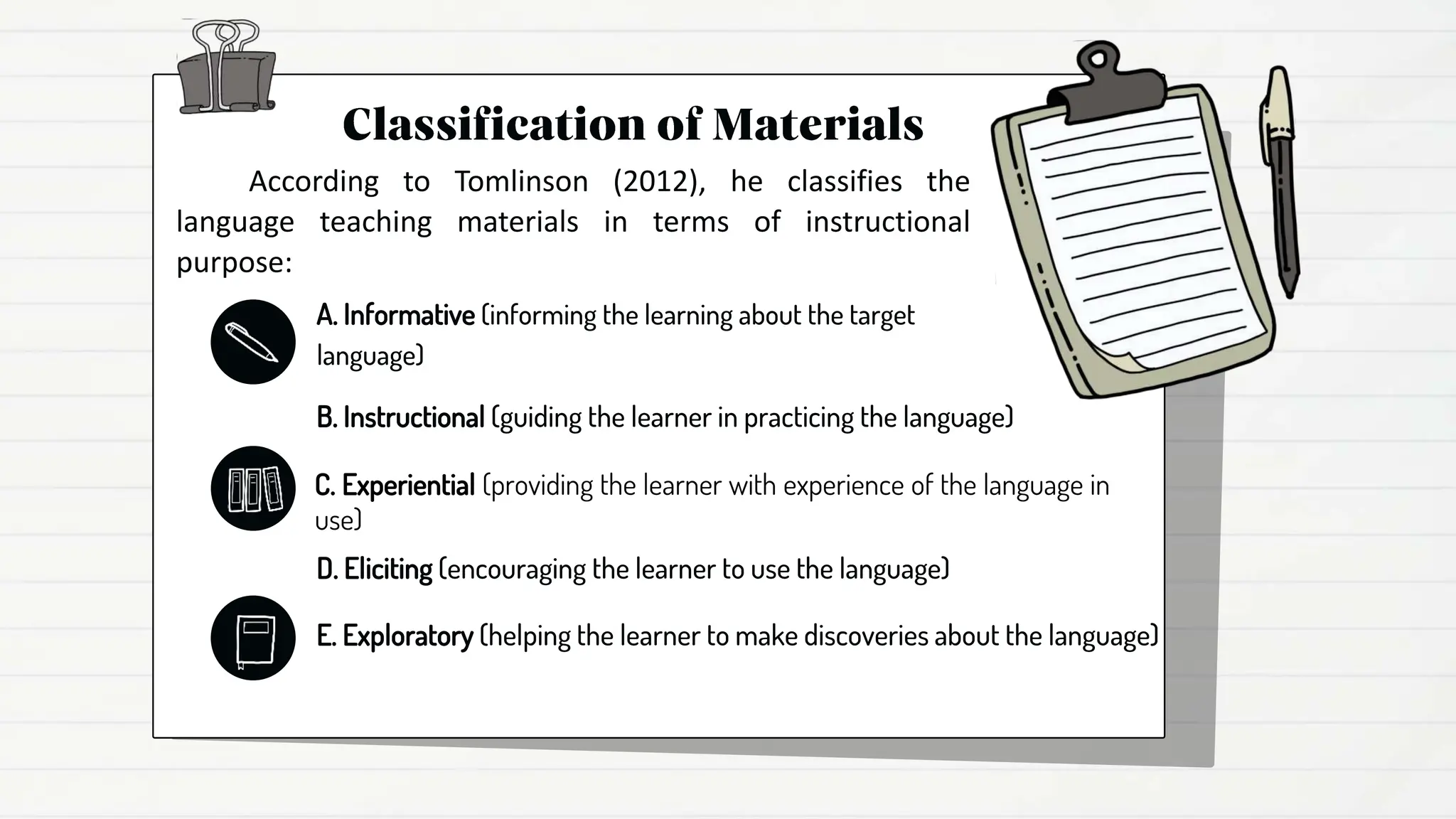
A. Informative (informing the learning about the target
language)
B. Instructional (guiding the learner in practicing the language)
C. Experiential (providing the learner with experience of the language in
use)
D. Eliciting (encouraging the learner to use the language)
According to Tomlinson (2012), he classifies the
language teaching materials in terms of instructional
purpose:
E. Exploratory (helping the learner to make discoveries about the language)
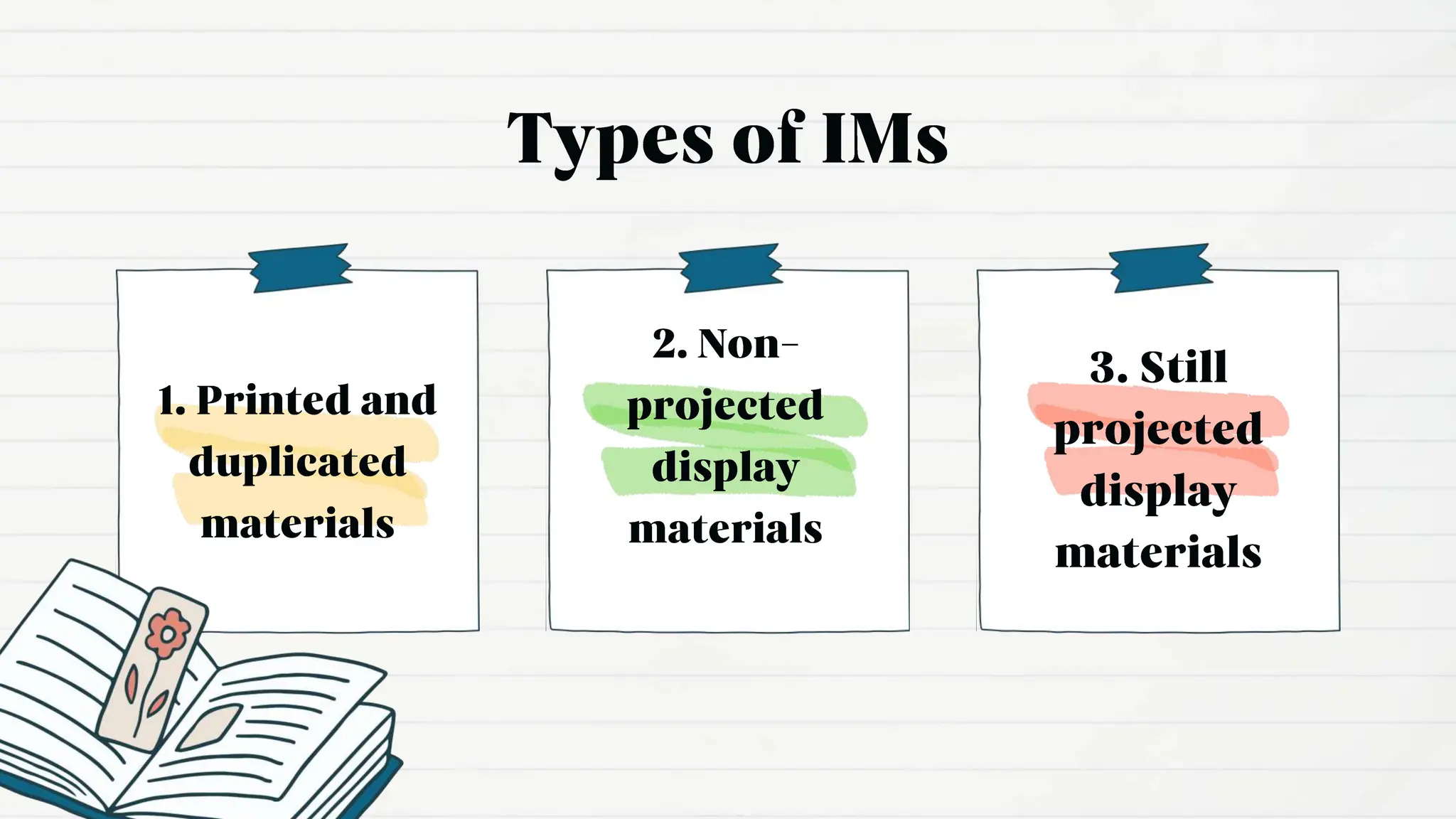
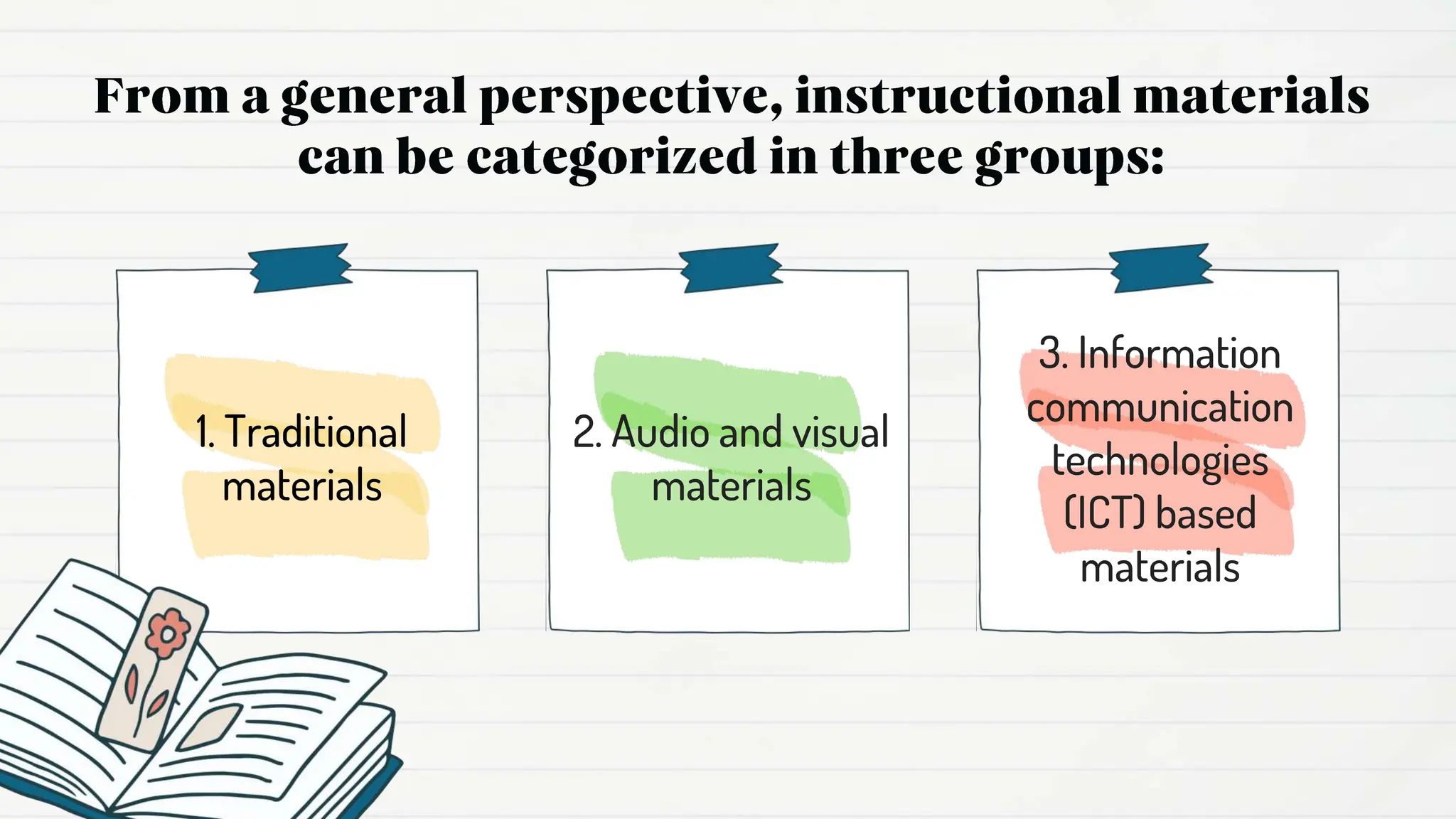
2. Audio and visual
materials
3. Information
communication
technologies
(ICT) based
materials
1. Traditional
materials
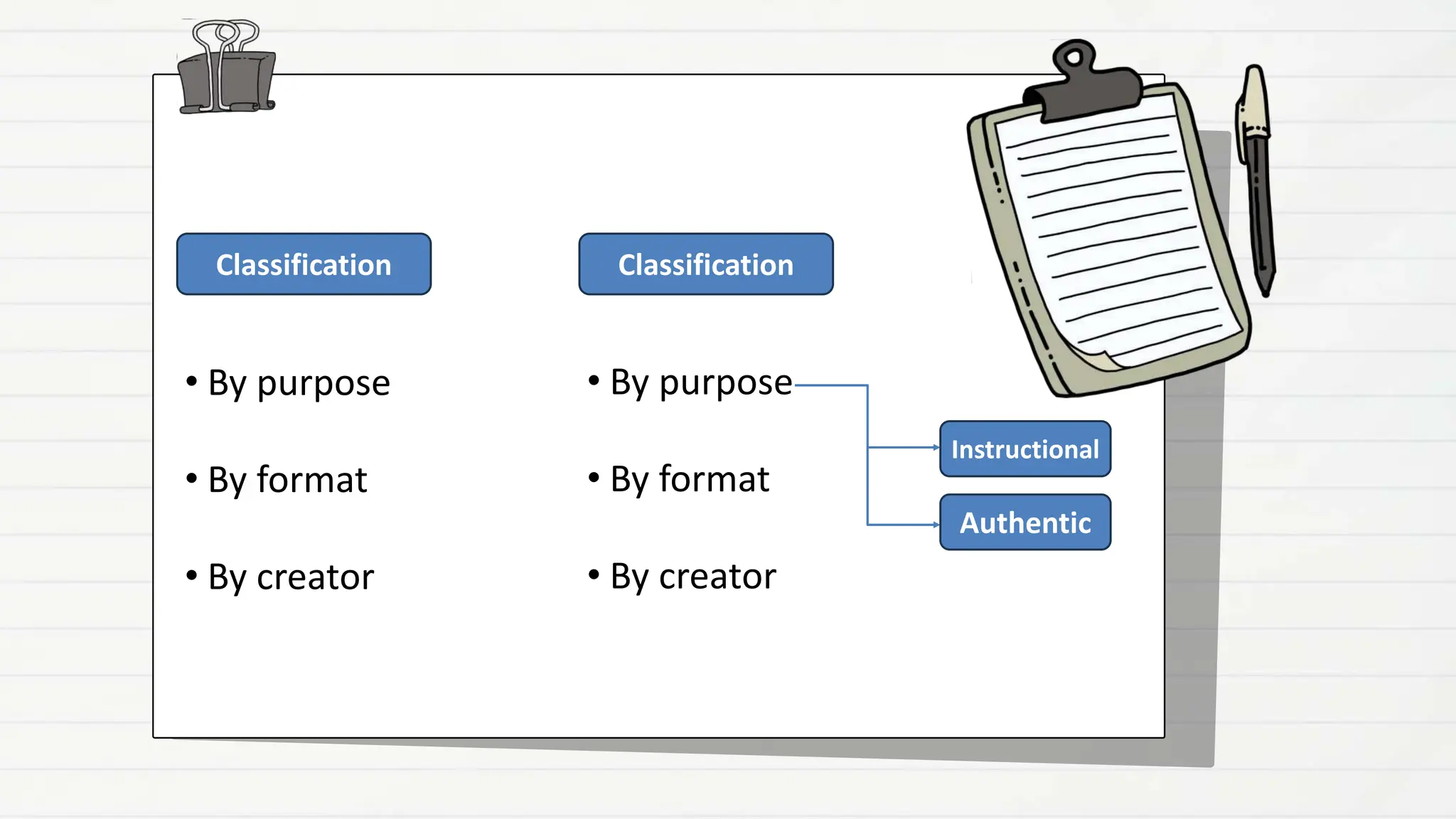
Classification
• By purpose
• By format
• By creator
Classification
• By purpose
• By format
• By creator
Authentic
Instructional
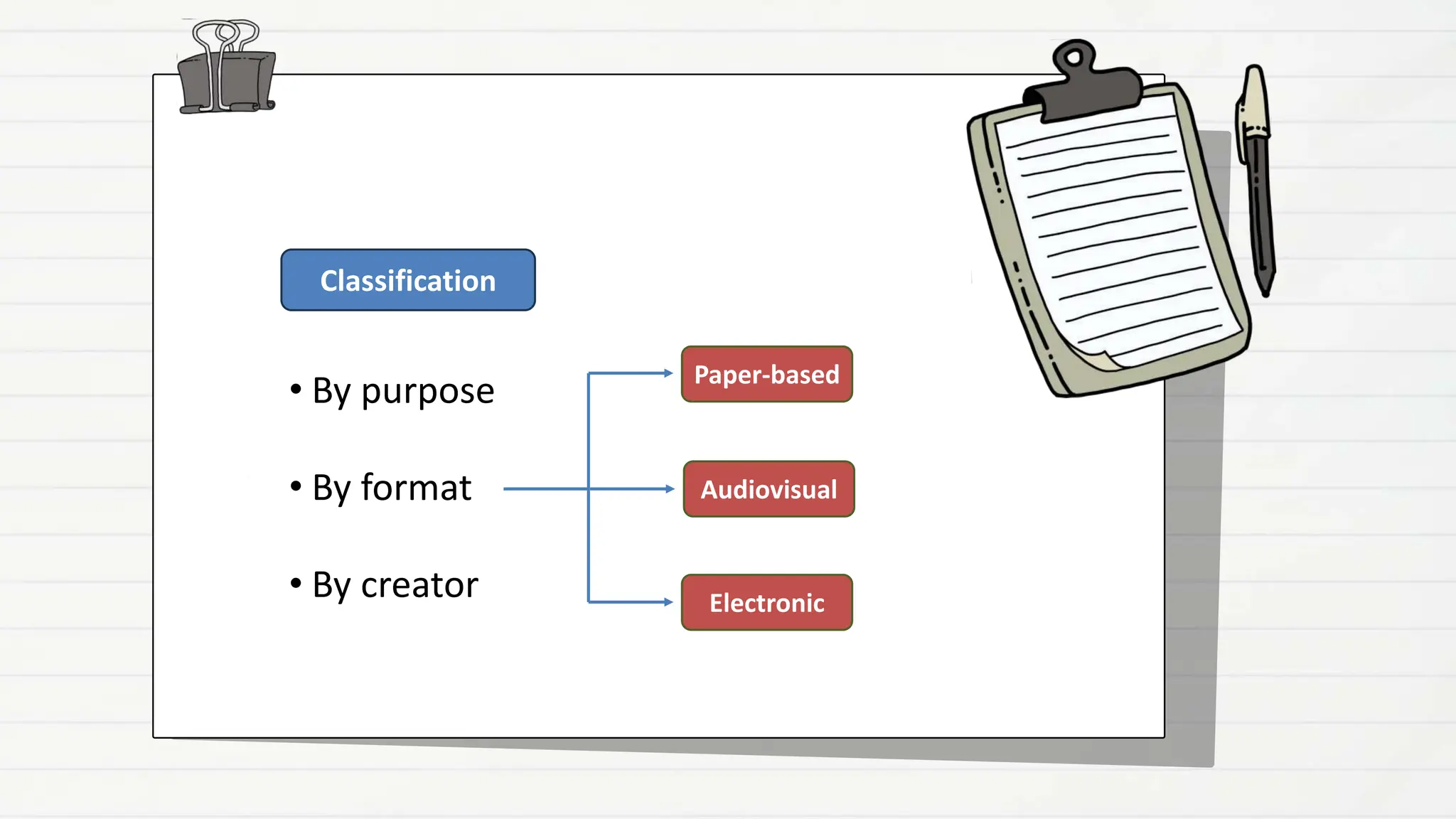
Classification
• By purpose
• By format
• By creator
Audiovisual
Paper-based
Electronic
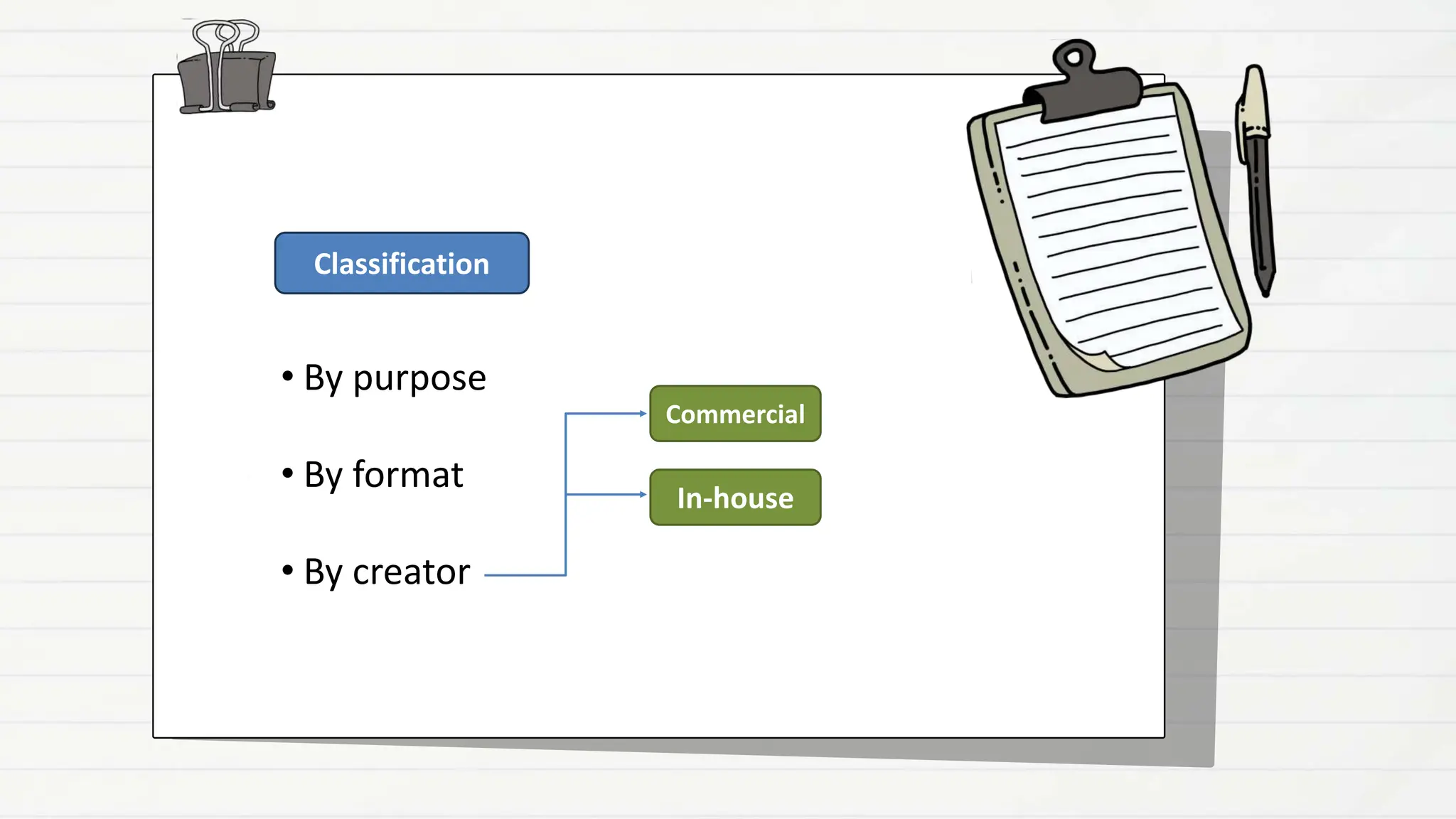
Classification
• By purpose
• By format
• By creator
In-house
Commercial
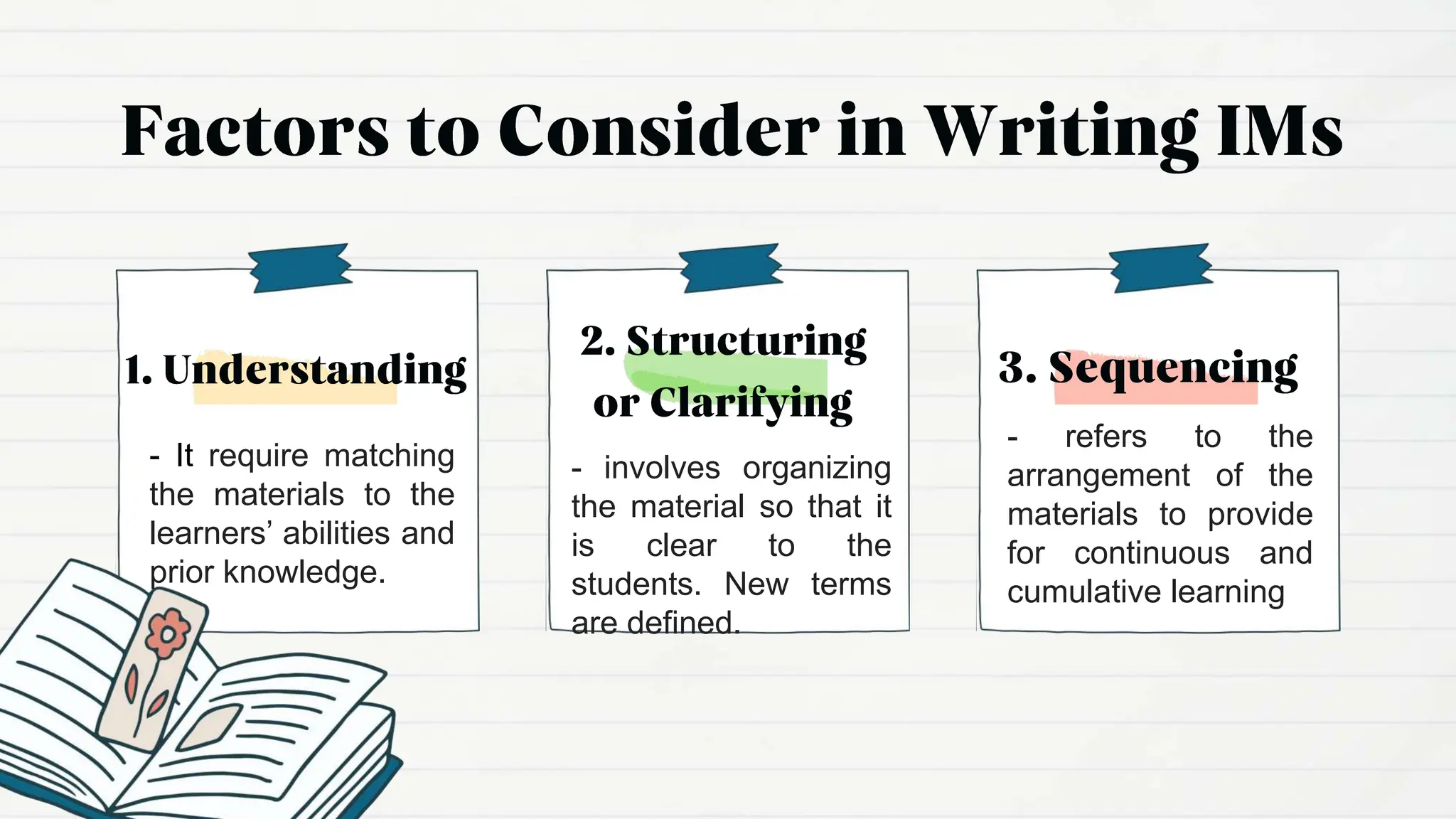
- involves organizing
the material so that it
is clear to the
students. New terms
are defined.
- refers to the
arrangement of the
materials to provide
for continuous and
cumulative learning
- It require matching
the materials to the
learners’ abilities and
prior knowledge.
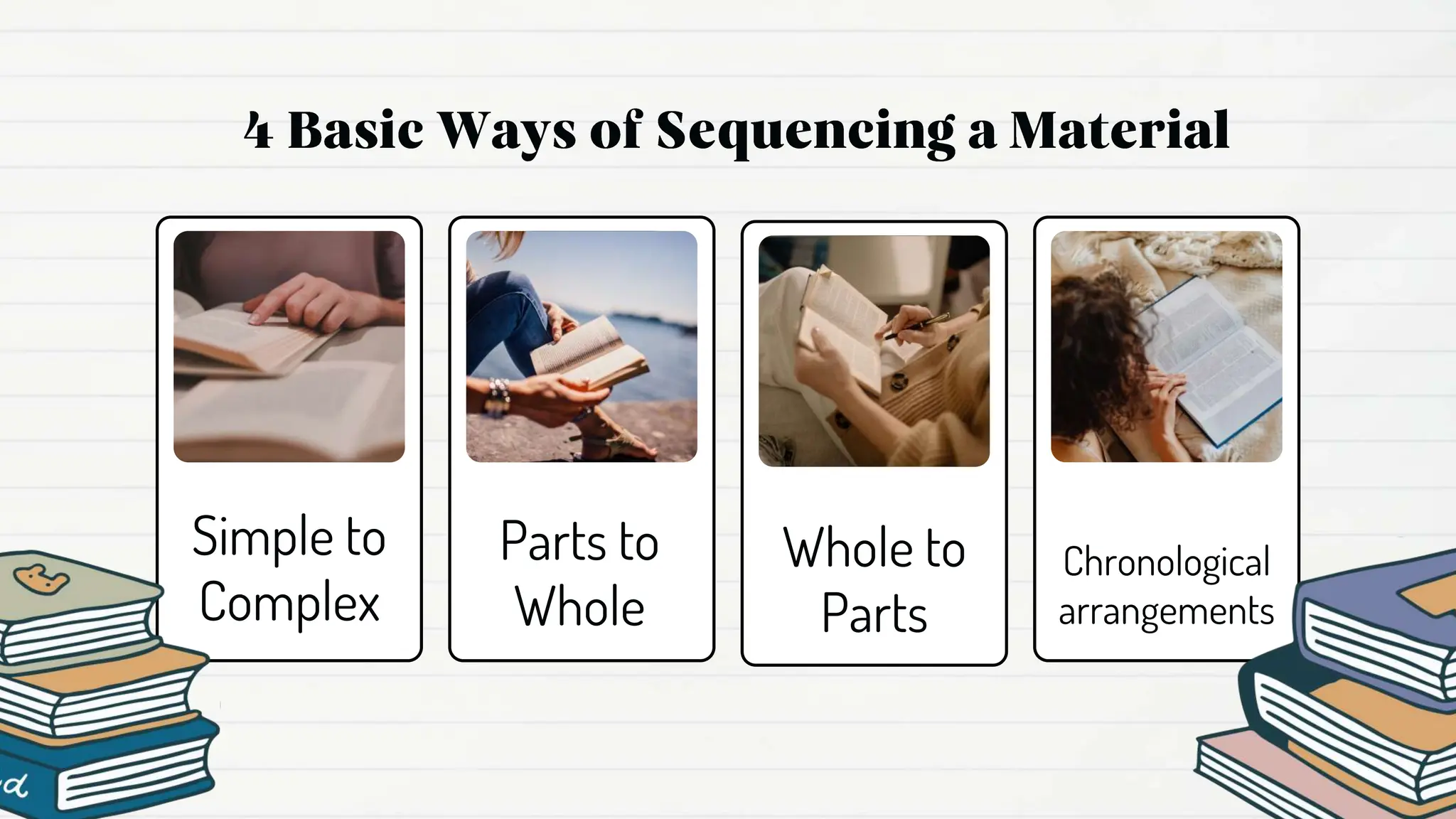
Simple to
Complex
Parts to
Whole
Whole to
Parts
Chronological
arrangements
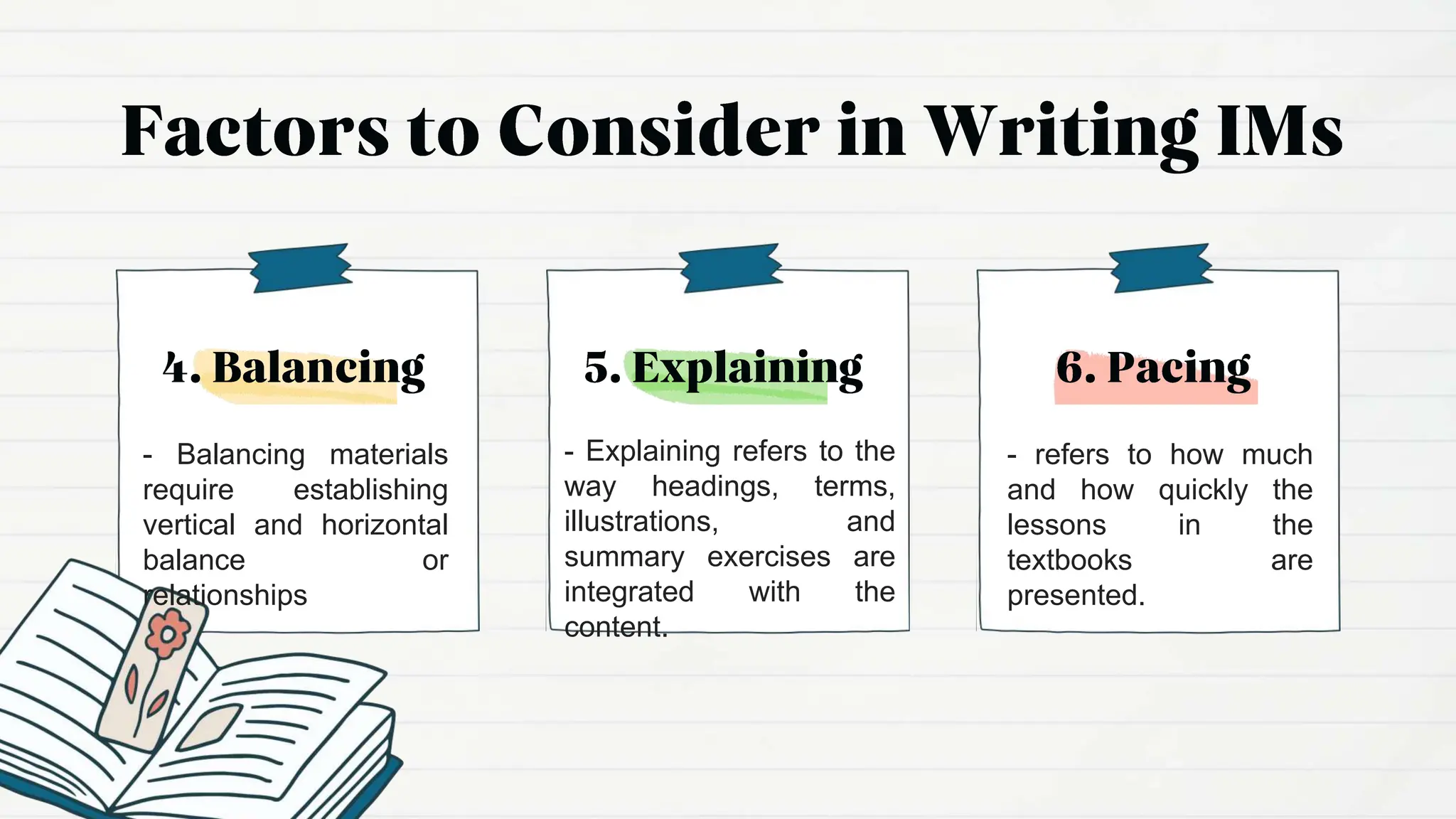
- Explaining refers to the
way headings, terms,
illustrations, and
summary exercises are
integrated with the
content.
- refers to how much
and how quickly the
lessons in the
textbooks are
presented.
- Balancing materials
require establishing
vertical and horizontal
balance or
relationships
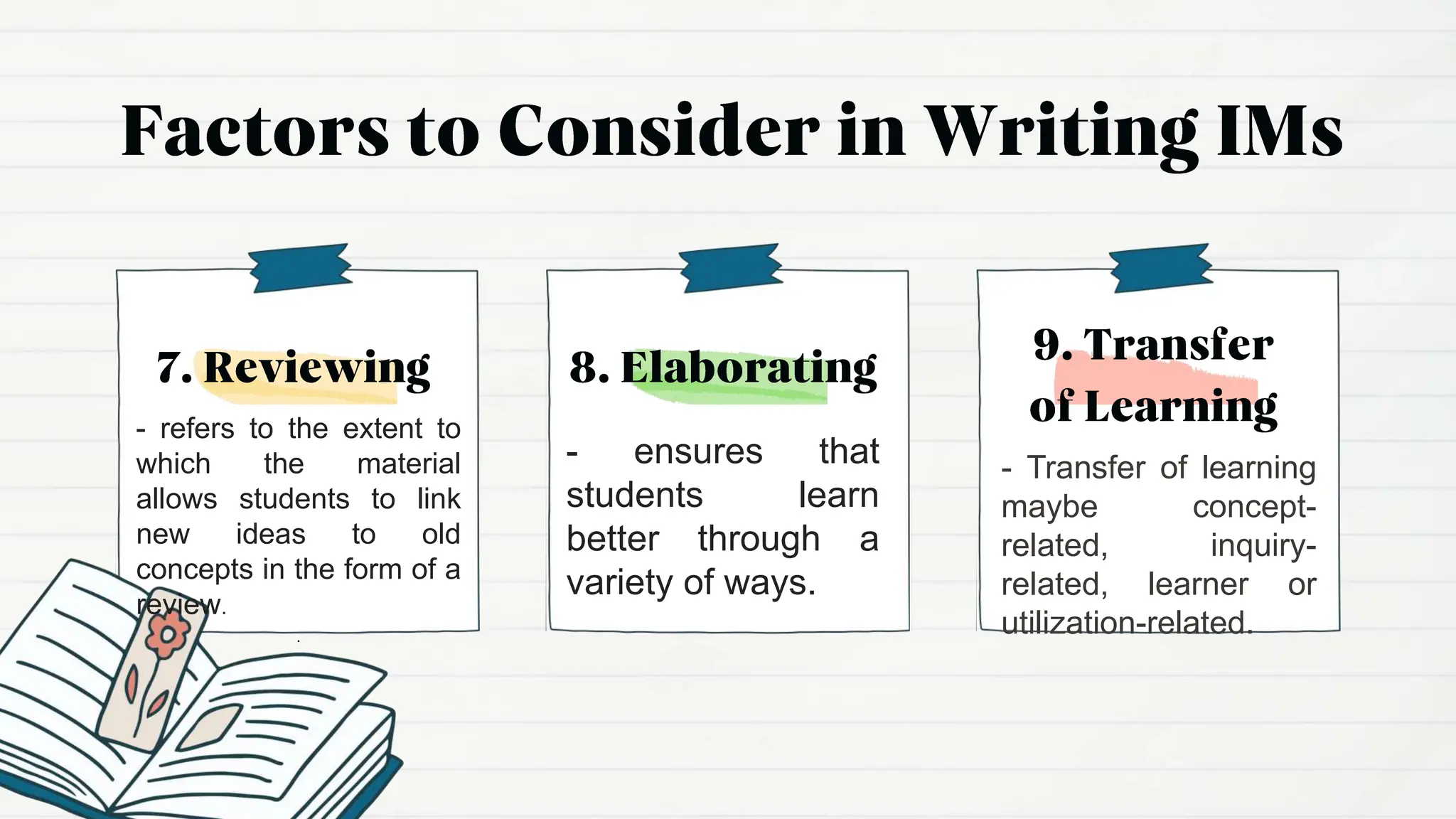
- ensures that
students learn
better through a
variety of ways.
- Transfer of learning
maybe concept-
related, inquiry-
related, learner or
utilization-related.
- refers to the extent to
which the material
allows students to link
new ideas to old
concepts in the form of a
review.
.
1. Materials
should
achieve
impact.
2. Materials
should help
learners to
feel at ease.
3. Materials
should help
learners to
develop
confidence.
4. What is being
taught should be
perceived by
learners as relevant
and useful.
5. Materials
should require
and facilitate
learner self-
investment.
6. Learners
must be
ready to
acquire the
points being
taught.
7. Materials
should expose
the learners to
language in
authentic use.
8. The learners’
attention should be
drawn to linguistic
features of the
input.
9. Materials should provide learners with opportunities to
use the target language to achieve communicative
purposes.
10. Materials should take into account that the positive
effects of instruction are usually delayed.
11. Materials should take into account that learners differ in learning
styles.
12. Materials should take into account that learners differ in affective
attitudes.
14. Materials should maximize learning potential by
encouraging intellectual, aesthetic and emotional involvement,
which stimulates both right – and left – brain activities.
15. Materials should not rely too much on controlled practice.
16. Materials should provide opportunities for outcome feedback.
13. Materials should permit a silent period at the beginning
of instruction.
1. Materials should be clearly linked to the curriculum they
serve.
2. Materials should be authentic in terms of text and task.
3. Materials should stimulate interaction.
4. Materials should allow learners to focus on formal aspects of
language.
5. Materials should encourage learners to develop learning skills and
skills in learning.
6. Materials should encourage learners to apply their development
language skills to the world beyond the classroom.
 Identify learner needs
 Set goals and objectives
 Write materials
 Write tests
PHASE 1
Curriculum Planning
 Instruct learners
 Monitor and adapt instruction
 Write supplementary materials
PHASE 2
Curriculum Implementation
 Test learners
 Evaluate curriculum
 Plan changes in the curriculum
PHASE 3
Curriculum Evaluation
1. Good materials provide stimulus to learning and encourage
student to learn.
2. Good materials should help the teaching-learning process.
3. Materials embody view of the nature of the language learning.
4. Materials reflect the nature of the learning task.
5. Materials function to broaden the basis of teacher training by
introducing teachers to new techniques.
6. Materials provide correct models of appropriate language use.
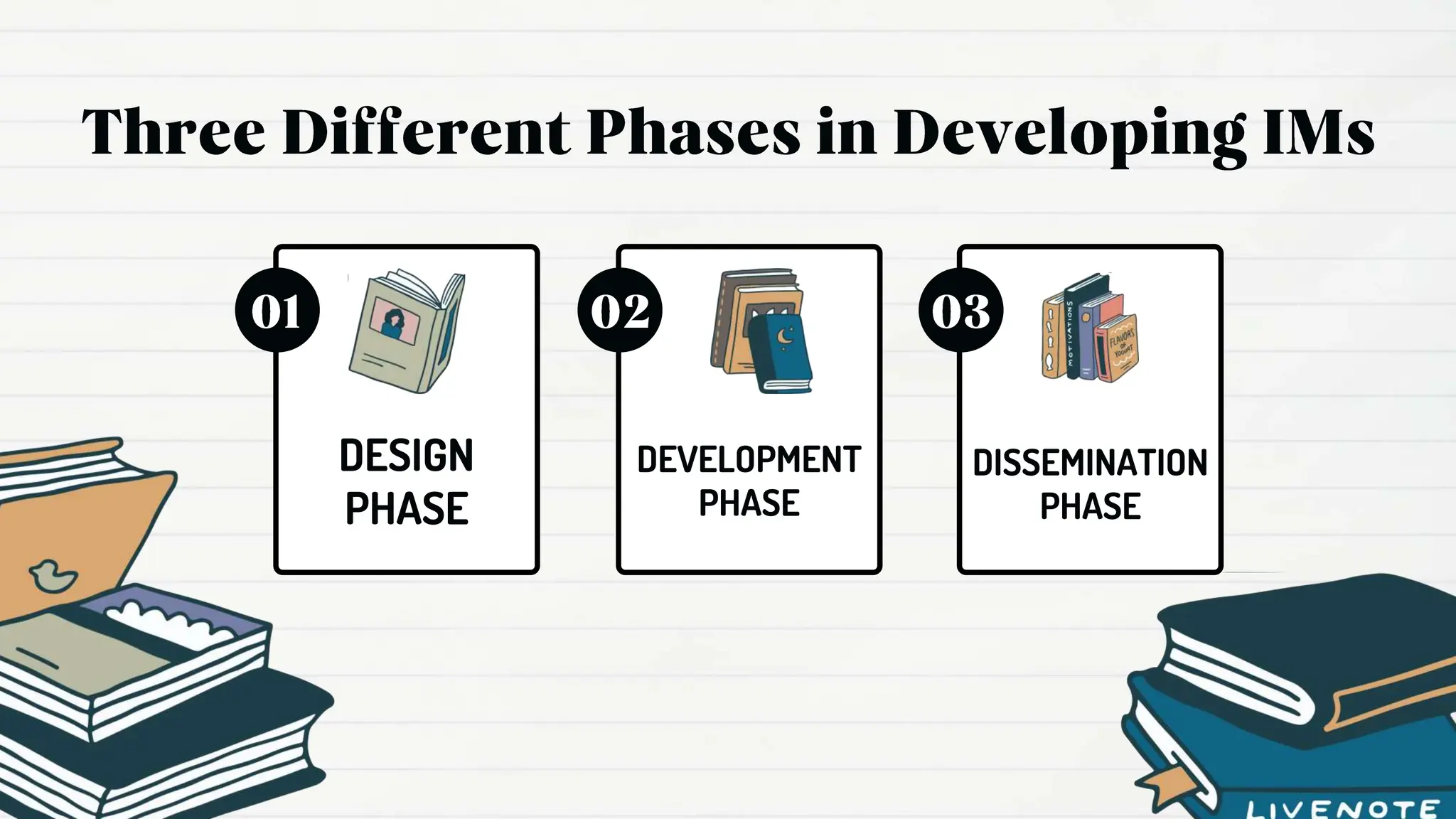
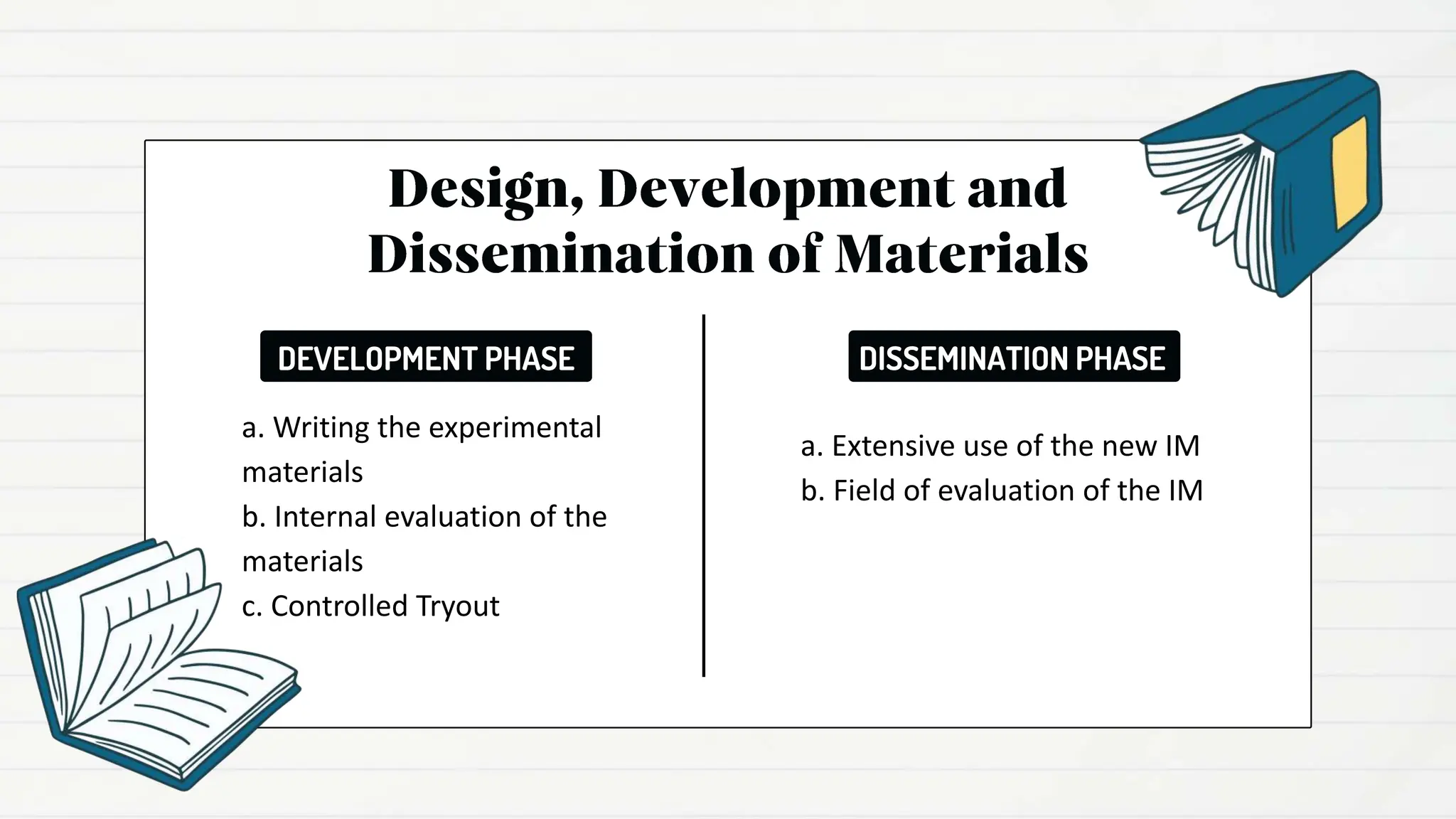
DESIGN
PHASE
DEVELOPMENT
PHASE
DISSEMINATION
PHASE
A. Accumulated Experience
• the writer reviews or surveys existing materials which can
give useful information about the demands and the needs in
the field.
B. Rationale of the design
• identifies the shortcomings of existing materials to ensure that such
shortcomings are not repeated in the present materials.
C. Conceptual Framework
 combines major and minor concepts regarding language learning,
teaching theories, and materials design principles upon which material
is anchored.
I. DESIGN PHASE
D. Detailed writing specification for new materials
 Goals of the materials
 Subject matter, language content to be covered,
and skills to be acquired through the content
 Techniques and mode of presentation, practice,
use and management associated with the
learning of the content
 Format of the materials including how learning
units are divided
 Technical details for the writing of the materials
I. DESIGN PHASE
a. Writing the experimental
materials
b. Internal evaluation of the
materials
c. Controlled Tryout
DEVELOPMENT PHASE
a. Extensive use of the new IM
b. Field of evaluation of the IM
DISSEMINATION PHASE
 Helps materials developers and teachers to know learners’
needs and to decide on the content and the level of
materials to be produced.
2. Development of Curriculum Grid
1. Needs Assessment
• Surveys and identifies the concerns of the target learners because the
objectives of the materials should be carefully drafted based on the interests,
problems, and need of the target learners.
a.Goals of national literacy program
b.Core content based on national concerns
c. Locally relevant content based on the identified needs of the learners
d.Prescribed levels in the three Rs(Reduce, Reuse, Recycle)
e. Levels of literacy skills of learners
2. Development of Curriculum Grid
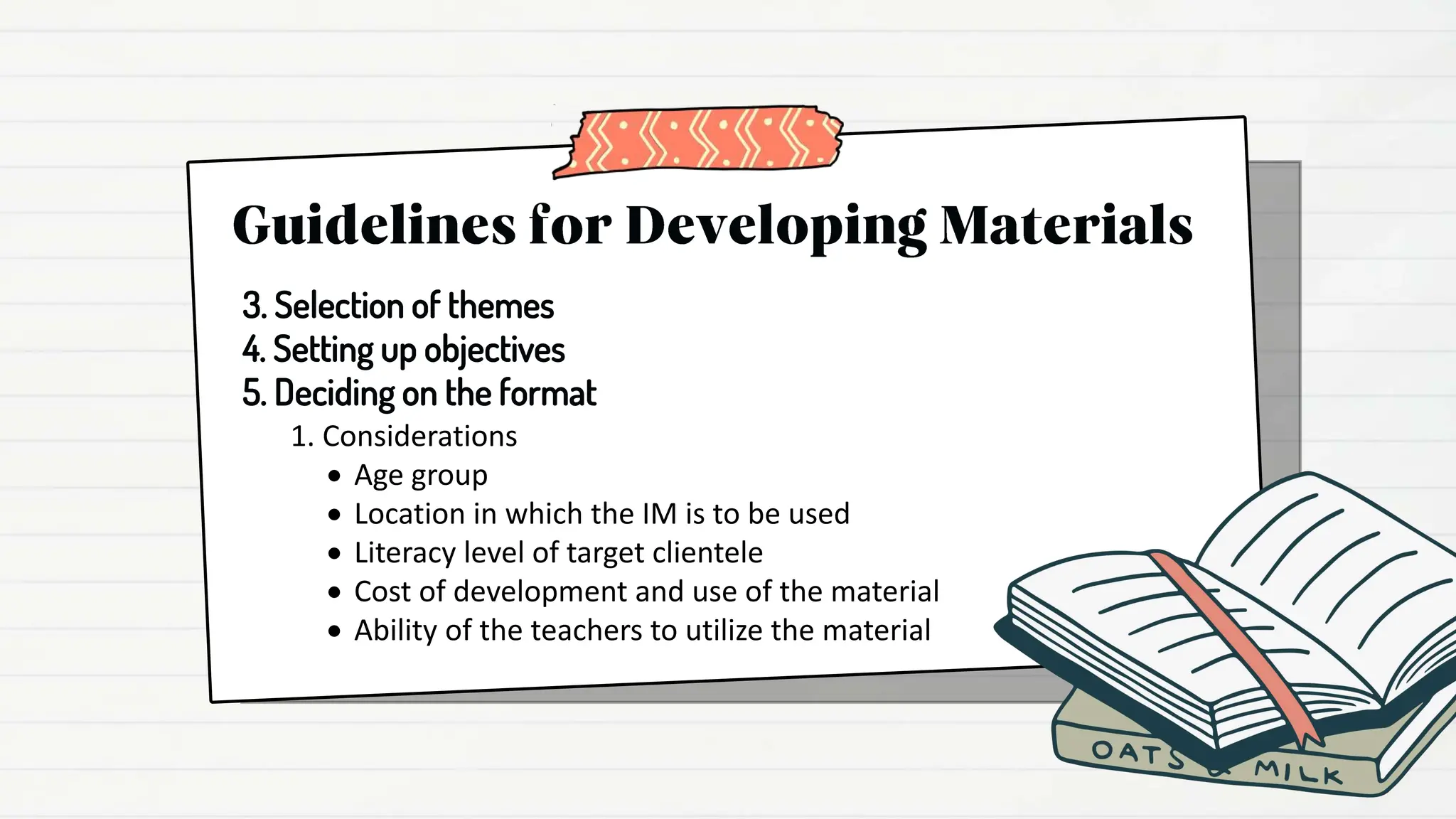
1. Considerations
 Age group
 Location in which the IM is to be used
 Literacy level of target clientele
 Cost of development and use of the material
 Ability of the teachers to utilize the material
3. Selection of themes
4. Setting up objectives
5. Deciding on the format
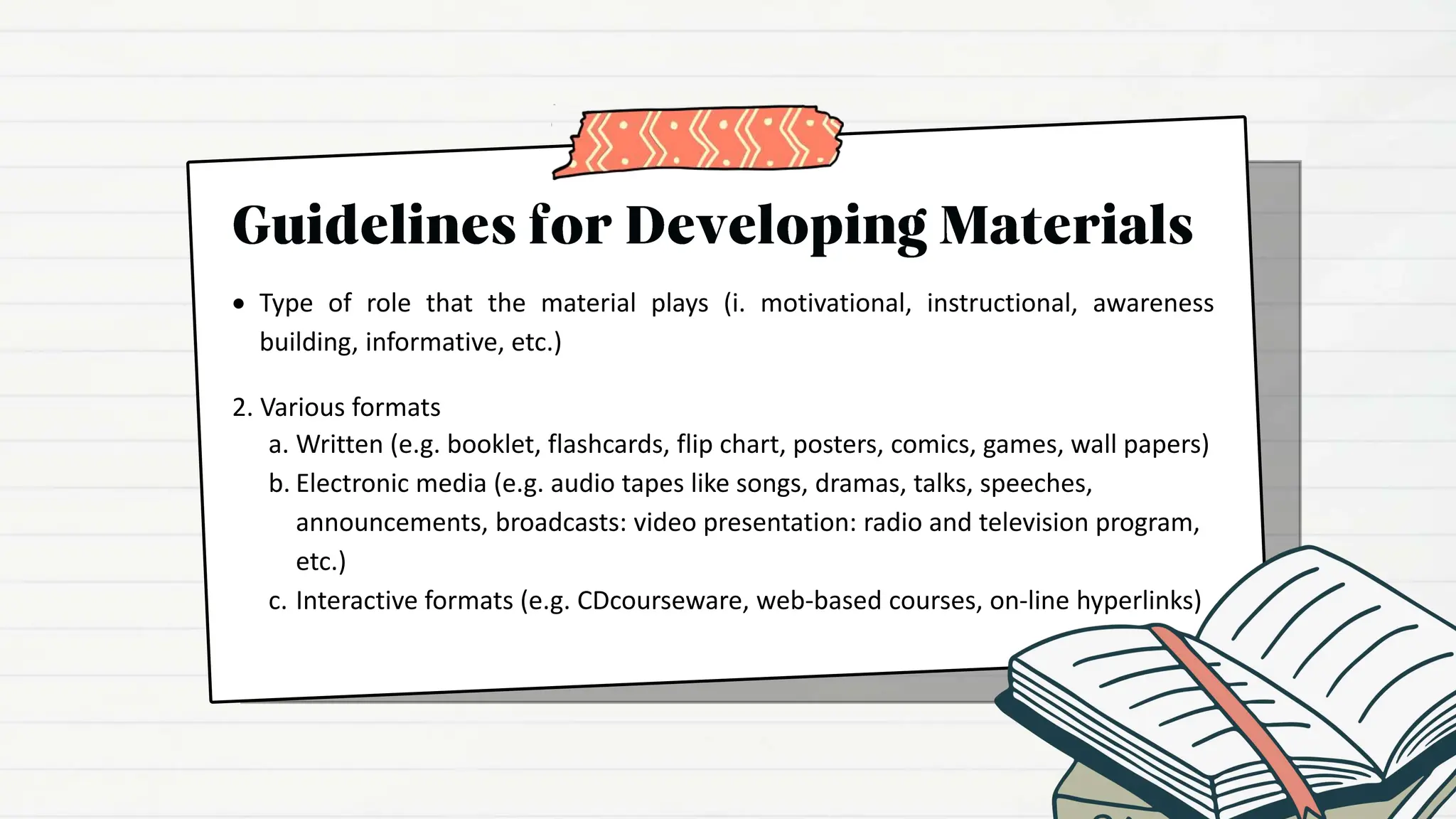
 Type of role that the material plays (i. motivational, instructional, awareness
building, informative, etc.)
2. Various formats
a. Written (e.g. booklet, flashcards, flip chart, posters, comics, games, wall papers)
b. Electronic media (e.g. audio tapes like songs, dramas, talks, speeches,
announcements, broadcasts: video presentation: radio and television program,
etc.)
c. Interactive formats (e.g. CDcourseware, web-based courses, on-line hyperlinks)
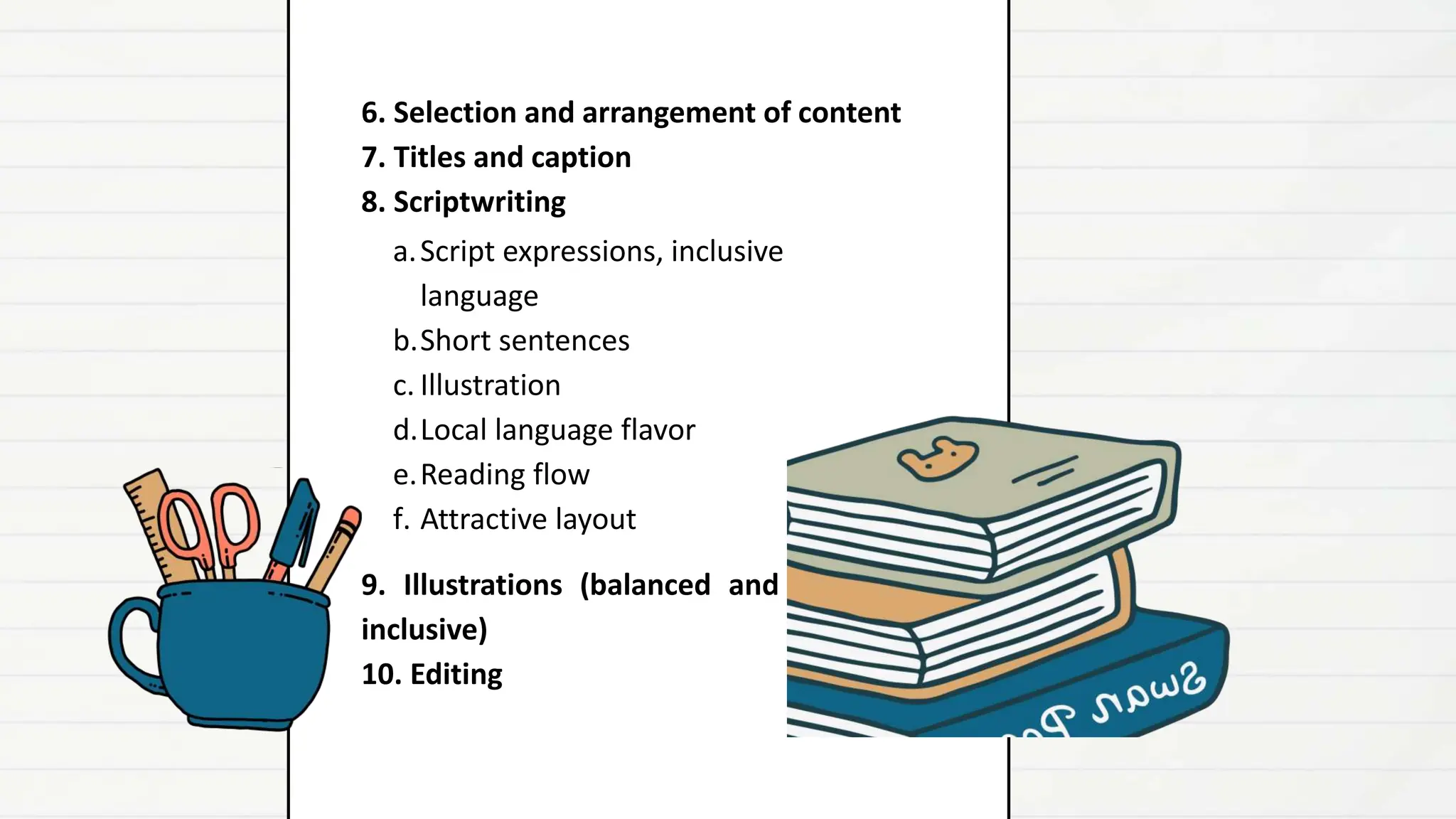
a.Script expressions, inclusive
language
b.Short sentences
c. Illustration
d.Local language flavor
e.Reading flow
f. Attractive layout
9. Illustrations (balanced and
inclusive)
10. Editing
6. Selection and arrangement of content
7. Titles and caption
8. Scriptwriting
PREPARATION OF MATERIALS in Language Learning Materials

PREPARATION OF MATERIALS in Language Learning Materials

  • 1.
    Presented by: GONGORA,CHLAIRE R. JASON, ROSE BELLE P. MASULA, GLENNITH B. URGEL, ROSELLE C.
  • 2.
    • Types ofInstructional Materials • Classification of Materials • Advantages Claimed for Authentic and Created Materials • Qualities of a Good Material
  • 3.
    • Factors toConsider in Writing Instructional Materials • Principles in Materials Design • Design, Development and Dissemination of Materials • Guidelines for Developing Materials
  • 7.
    A. Informative (informingthe learning about the target language) B. Instructional (guiding the learner in practicing the language) C. Experiential (providing the learner with experience of the language in use) D. Eliciting (encouraging the learner to use the language) According to Tomlinson (2012), he classifies the language teaching materials in terms of instructional purpose: E. Exploratory (helping the learner to make discoveries about the language)
  • 8.
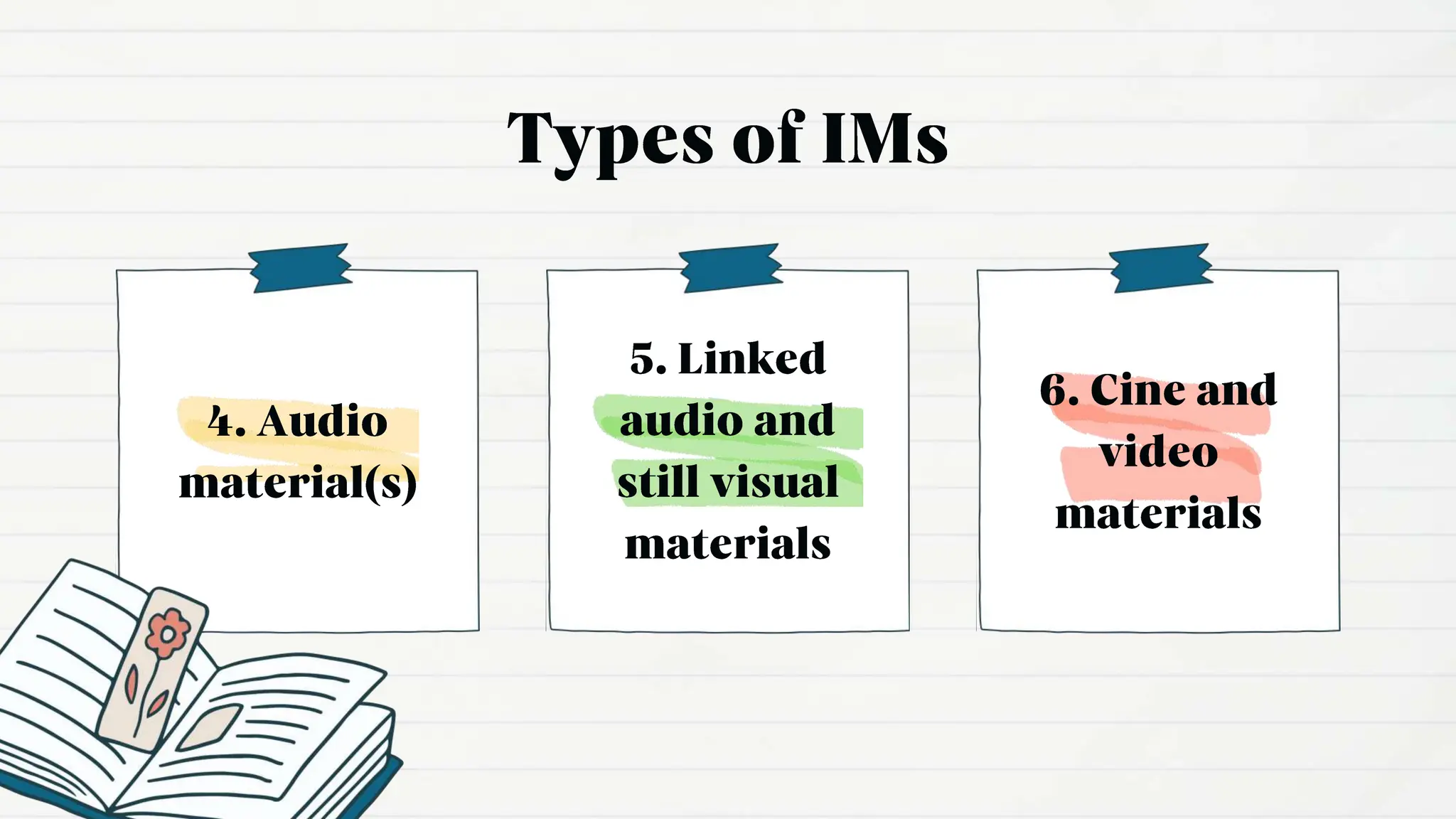
    2. Audio andvisual materials 3. Information communication technologies (ICT) based materials 1. Traditional materials
  • 9.
    Classification • By purpose •By format • By creator Classification • By purpose • By format • By creator Authentic Instructional
  • 10.
    Classification • By purpose •By format • By creator Audiovisual Paper-based Electronic
  • 11.
    Classification • By purpose •By format • By creator In-house Commercial
  • 12.
    - involves organizing thematerial so that it is clear to the students. New terms are defined. - refers to the arrangement of the materials to provide for continuous and cumulative learning - It require matching the materials to the learners’ abilities and prior knowledge.
  • 13.
    Simple to Complex Parts to Whole Wholeto Parts Chronological arrangements
  • 14.
    - Explaining refersto the way headings, terms, illustrations, and summary exercises are integrated with the content. - refers to how much and how quickly the lessons in the textbooks are presented. - Balancing materials require establishing vertical and horizontal balance or relationships
  • 15.
    - ensures that studentslearn better through a variety of ways. - Transfer of learning maybe concept- related, inquiry- related, learner or utilization-related. - refers to the extent to which the material allows students to link new ideas to old concepts in the form of a review. .
  • 16.
    1. Materials should achieve impact. 2. Materials shouldhelp learners to feel at ease. 3. Materials should help learners to develop confidence. 4. What is being taught should be perceived by learners as relevant and useful.
  • 17.
    5. Materials should require andfacilitate learner self- investment. 6. Learners must be ready to acquire the points being taught. 7. Materials should expose the learners to language in authentic use. 8. The learners’ attention should be drawn to linguistic features of the input.
  • 18.
    9. Materials shouldprovide learners with opportunities to use the target language to achieve communicative purposes. 10. Materials should take into account that the positive effects of instruction are usually delayed. 11. Materials should take into account that learners differ in learning styles. 12. Materials should take into account that learners differ in affective attitudes.
  • 19.
    14. Materials shouldmaximize learning potential by encouraging intellectual, aesthetic and emotional involvement, which stimulates both right – and left – brain activities. 15. Materials should not rely too much on controlled practice. 16. Materials should provide opportunities for outcome feedback. 13. Materials should permit a silent period at the beginning of instruction.
  • 20.
    1. Materials shouldbe clearly linked to the curriculum they serve. 2. Materials should be authentic in terms of text and task. 3. Materials should stimulate interaction. 4. Materials should allow learners to focus on formal aspects of language. 5. Materials should encourage learners to develop learning skills and skills in learning. 6. Materials should encourage learners to apply their development language skills to the world beyond the classroom.
  • 21.
     Identify learnerneeds  Set goals and objectives  Write materials  Write tests PHASE 1 Curriculum Planning
  • 22.
     Instruct learners Monitor and adapt instruction  Write supplementary materials PHASE 2 Curriculum Implementation
  • 23.
     Test learners Evaluate curriculum  Plan changes in the curriculum PHASE 3 Curriculum Evaluation
  • 24.
    1. Good materialsprovide stimulus to learning and encourage student to learn. 2. Good materials should help the teaching-learning process. 3. Materials embody view of the nature of the language learning. 4. Materials reflect the nature of the learning task. 5. Materials function to broaden the basis of teacher training by introducing teachers to new techniques. 6. Materials provide correct models of appropriate language use.
  • 25.
  • 26.
    A. Accumulated Experience •the writer reviews or surveys existing materials which can give useful information about the demands and the needs in the field. B. Rationale of the design • identifies the shortcomings of existing materials to ensure that such shortcomings are not repeated in the present materials. C. Conceptual Framework  combines major and minor concepts regarding language learning, teaching theories, and materials design principles upon which material is anchored. I. DESIGN PHASE
  • 27.
    D. Detailed writingspecification for new materials  Goals of the materials  Subject matter, language content to be covered, and skills to be acquired through the content  Techniques and mode of presentation, practice, use and management associated with the learning of the content  Format of the materials including how learning units are divided  Technical details for the writing of the materials I. DESIGN PHASE
  • 28.
    a. Writing theexperimental materials b. Internal evaluation of the materials c. Controlled Tryout DEVELOPMENT PHASE a. Extensive use of the new IM b. Field of evaluation of the IM DISSEMINATION PHASE
  • 29.
     Helps materialsdevelopers and teachers to know learners’ needs and to decide on the content and the level of materials to be produced. 2. Development of Curriculum Grid 1. Needs Assessment • Surveys and identifies the concerns of the target learners because the objectives of the materials should be carefully drafted based on the interests, problems, and need of the target learners.
  • 30.
    a.Goals of nationalliteracy program b.Core content based on national concerns c. Locally relevant content based on the identified needs of the learners d.Prescribed levels in the three Rs(Reduce, Reuse, Recycle) e. Levels of literacy skills of learners 2. Development of Curriculum Grid
  • 31.
    1. Considerations  Agegroup  Location in which the IM is to be used  Literacy level of target clientele  Cost of development and use of the material  Ability of the teachers to utilize the material 3. Selection of themes 4. Setting up objectives 5. Deciding on the format
  • 32.
     Type ofrole that the material plays (i. motivational, instructional, awareness building, informative, etc.) 2. Various formats a. Written (e.g. booklet, flashcards, flip chart, posters, comics, games, wall papers) b. Electronic media (e.g. audio tapes like songs, dramas, talks, speeches, announcements, broadcasts: video presentation: radio and television program, etc.) c. Interactive formats (e.g. CDcourseware, web-based courses, on-line hyperlinks)
  • 33.
    a.Script expressions, inclusive language b.Shortsentences c. Illustration d.Local language flavor e.Reading flow f. Attractive layout 9. Illustrations (balanced and inclusive) 10. Editing 6. Selection and arrangement of content 7. Titles and caption 8. Scriptwriting