SYNTHETIC
REAGENTS &
APPLICATIONS
Presented by : Alfisha Mustafa ,
M.PHARM - Pharmaceutical chemistry
( 1st SEM )
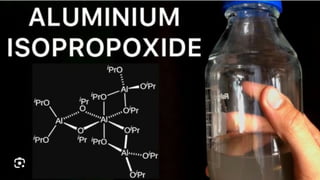
ALUMINIUM ISOPROPOXIDE
INTRODUCTION
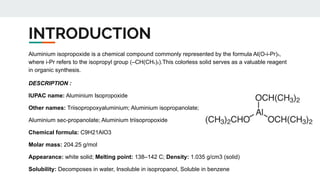
Aluminium isopropoxide is a chemical compound commonly represented by the formula Al(O-i-Pr)₃,
where i-Pr refers to the isopropyl group (–CH(CH₃)₂).This colorless solid serves as a valuable reagent
in organic synthesis.
DESCRIPTION :
IUPAC name: Aluminium Isopropoxide
Other names: Triisopropoxyaluminium; Aluminium isopropanolate;
Aluminium sec-propanolate; Aluminium triisopropoxide
Chemical formula: C9H21AlO3
Molar mass: 204.25 g/mol
Appearance: white solid; Melting point: 138–142 C; Density: 1.035 g/cm3 (solid)
Solubility: Decomposes in water, Insoluble in isopropanol, Soluble in benzene
SYNTHESIS
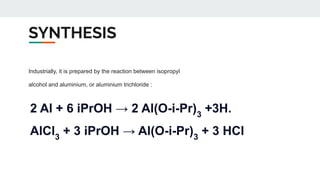
Industrially, it is prepared by the reaction between isopropyl
alcohol and aluminium, or aluminium trichloride :
2 Al + 6 iPrOH → 2 Al(O-i-Pr)3
+3H.
AlCl3
+ 3 iPrOH → Al(O-i-Pr)3
+ 3 HCl
APPLICATIONS OF ALUMINIUM ISOPROPOXIDE
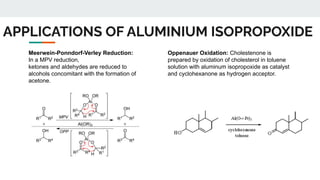
Meerwein-Ponndorf-Verley Reduction:
In a MPV reduction,
ketones and aldehydes are reduced to
alcohols concomitant with the formation of
acetone.
Oppenauer Oxidation: Cholestenone is
prepared by oxidation of cholesterol in toluene
solution with aluminum isopropoxide as catalyst
and cyclohexanone as hydrogen acceptor.
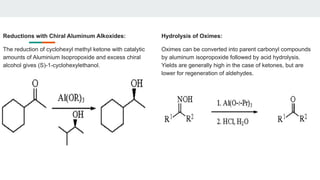
Reductions with Chiral Aluminum Alkoxides:
The reduction of cyclohexyl methyl ketone with catalytic
amounts of Aluminium Isopropoxide and excess chiral
alcohol gives (S)-1-cyclohexylethanol.
Hydrolysis of Oximes:
Oximes can be converted into parent carbonyl compounds
by aluminum isopropoxide followed by acid hydrolysis.
Yields are generally high in the case of ketones, but are
lower for regeneration of aldehydes.
DIAZOMETHANE
DIAZOMETHANE
INTRODUCTION
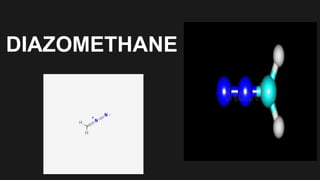
Diazomethane, with the chemical formula CH₂N₂, was discovered by the German chemist Sir Hans von
Pechmann in 1894. It is a yellow, toxic, and potentially explosive compound that exists as a gas at room
temperature.
DESCRIPTION :
IUPAC name: Diazomethane
Other names: Azimethylene, Azomethylene, Diazirine
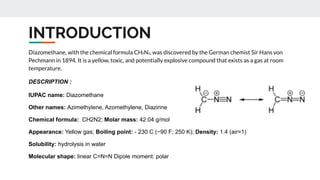
Chemical formula: CH2N2; Molar mass: 42.04 g/mol
Appearance: Yellow gas; Boiling point: - 230 C (−90 F; 250 K); Density: 1.4 (air=1)
Solubility: hydrolysis in water
Molecular shape: linear C=N=N Dipole moment: polar
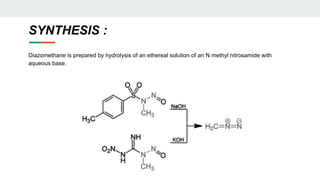
SYNTHESIS :
Diazomethane is prepared by hydrolysis of an ethereal solution of an N methyl nitrosamide with
aqueous base.
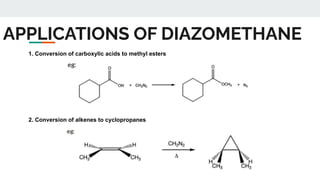
APPLICATIONS OF DIAZOMETHANE
1. Conversion of carboxylic acids to methyl esters
2. Conversion of alkenes to cyclopropanes
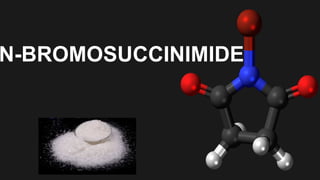
N-BROMOSUCCINIMIDE
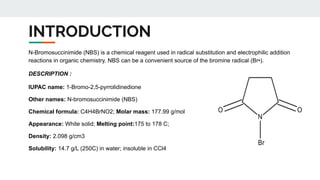
INTRODUCTION
N-Bromosuccinimide (NBS) is a chemical reagent used in radical substitution and electrophilic addition
reactions in organic chemistry. NBS can be a convenient source of the bromine radical (Br•).
DESCRIPTION :
IUPAC name: 1-Bromo-2,5-pyrrolidinedione
Other names: N-bromosuccinimide (NBS)
Chemical formula: C4H4BrNO2; Molar mass: 177.99 g/mol
Appearance: White solid; Melting point:175 to 178 C;
Density: 2.098 g/cm3
Solubility: 14.7 g/L (250C) in water; insoluble in CCl4
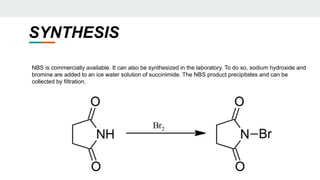
SYNTHESIS
NBS is commercially available. It can also be synthesized in the laboratory. To do so, sodium hydroxide and
bromine are added to an ice water solution of succinimide. The NBS product precipitates and can be
collected by filtration.
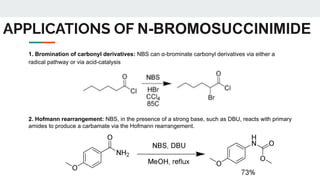
APPLICATIONS OF N-BROMOSUCCINIMIDE
1. Bromination of carbonyl derivatives: NBS can α-brominate carbonyl derivatives via either a
radical pathway or via acid-catalysis
2. Hofmann rearrangement: NBS, in the presence of a strong base, such as DBU, reacts with primary
amides to produce a carbamate via the Hofmann rearrangement.
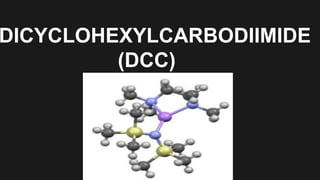
DICYCLOHEXYLCARBODIIMIDE
(DCC)
INTRODUCTION
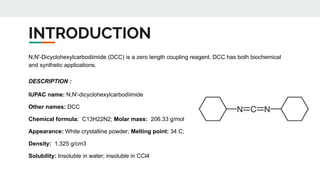
N,N'-Dicyclohexylcarbodiimide (DCC) is a zero length coupling reagent. DCC has both biochemical
and synthetic applications.
DESCRIPTION :
IUPAC name: N,N'-dicyclohexylcarbodiimide
Other names: DCC
Chemical formula: C13H22N2; Molar mass: 206.33 g/mol
Appearance: White crystalline powder; Melting point: 34 C;
Density: 1.325 g/cm3
Solubility: Insoluble in water; insoluble in CCl4
SYNTHESIS
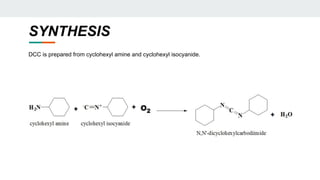
DCC is prepared from cyclohexyl amine and cyclohexyl isocyanide.
APPLICATIONS OF Dicyclohexylcarbodiimide (DCC)
- DCC is mainly used in amikacin, glutathione dehydrants, as well as in synthesis of acid
anhydride, aldehyde, ketone, isocyanate; when it is used as dehydrating condensing agent.
- DCC is a carbodiimide used to couple amino acids during peptide synthesis.
- Dicyclohexylcarbodiimide is an imide. Amides/imides react with azo and diazo compounds to
generate toxic gases.
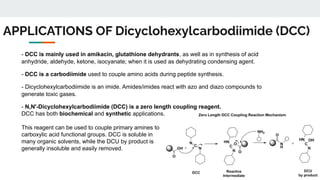
- N,N'-Dicyclohexylcarbodiimide (DCC) is a zero length coupling reagent.
DCC has both biochemical and synthetic applications.
This reagent can be used to couple primary amines to
carboxylic acid functional groups. DCC is soluble in
many organic solvents, while the DCU by product is
generally insoluble and easily removed.
WITTIG REAGENT
INTRODUCTION
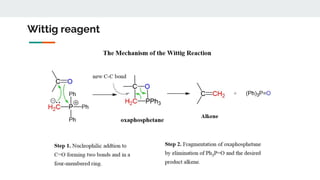
The Wittig reaction, also known as Wittig olefination, is a chemical process in which an aldehyde or
ketone reacts with a triphenylphosphonium ylide (commonly referred to as a Wittig reagent) to produce
an alkene and triphenylphosphine oxide.
DESCRIPTION :
IUPAC name: Alkylidene phosphorane ylide
Chemical formula: Ph3P=CH2;
Molar mass: 493.38 g/mol
Melting point: 234-236°C;
Density: Approximately 1.28 g/cm³
Solubility: Slightly soluble in water; insoluble in polar solvents ( Hexane , benzene etc )
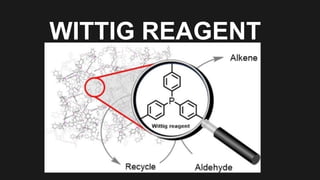
Wittig reagent
SYNTHESIS
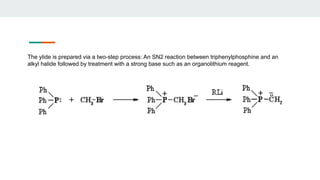
1. Preparation of Phosphorus Ylides - Wittig reagents are usually prepared from a phosphonium salt, which is in
turn prepared by the quaternization of triphenylphosphine with an alkyl halide.
The alkyl phosphonium salt is deprotonated with a strong base such as n-butyllithium:
[Ph3P+CH2R]X− + C4H9Li → Ph3P=CHR + LiX + C4H1
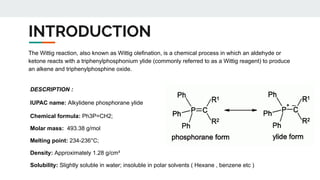
2. Structure of the Ylide - The Wittig reagent may be described in the phosphorane form (the more familiar
representation) or the ylide form.
- The ylide form is a significant contributor, and the carbon atom is nucleophilic.
The ylide is prepared via a two-step process: An SN2 reaction between triphenylphosphine and an
alkyl halide followed by treatment with a strong base such as an organolithium reagent.
APPLICATIONS OF WITTIG REAGENT
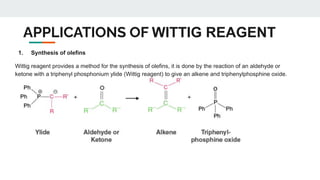
1. Synthesis of olefins
Wittig reagent provides a method for the synthesis of olefins, it is done by the reaction of an aldehyde or
ketone with a triphenyl phosphonium ylide (Wittig reagent) to give an alkene and triphenylphosphine oxide.
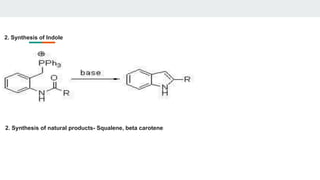
2. Synthesis of Indole
3. Synthesis of natural products
2. Synthesis of natural products- Squalene, beta carotene
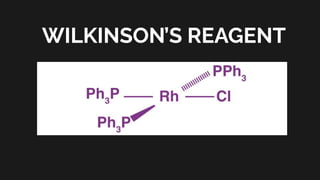
WILKINSON’S REAGENT
INTRODUCTION
Wilkinson's reagent is a well-known organometallic compound, primarily used as a catalyst for the
hydrogenation of alkenes. It is a red solid and a coordination complex of rhodium with
triphenylphosphine ligands. Its efficient catalysis in homogeneous systems makes it valuable in
synthetic chemistry.
DESCRIPTION :
IUPAC name: Chloridotris(triphenylphosphine)rhodium(I)
Chemical formula: [RhCl(PPh₃)₃]
Molecular mass: 925.22 g/mol
Density: Approximately 1.55 g/cm³
Solubility: Soluble in organic solvents like benzene, toluene, and dichloromethane; insoluble in water
SYNTHESIS
Wilkinson's reagent is synthesized by reacting
rhodium(III) chloride hydrate(RhCl₃·3H₂O) with
triphenylphosphine (PPh₃) in ethanol or similar solvents.
The reaction involves reducing rhodium from the
+3 oxidation state to the +1 state. After stirring the mixture,
the product, [RhCl(PPh₃)₃], is isolated as a red crystalline solid.
APPLICATIONS OF WILKINSON’S REAGENT
Wilkinson's catalyst is a chemical reagent used in a variety of applications, including:
Hydrogenation of olefins
Wilkinson's catalyst is most well-known for its ability to catalyze the hydrogenation of olefins, or
unsaturated hydrocarbons, with molecular hydrogen.
Selective reduction
Wilkinson's catalyst is particularly useful for selectively reducing a single alkene in a molecule,
especially when there are multiple alkenes. It's most effective at reducing the least hindered alkene.
Hydroacylation of alkenes
Wilkinson's catalyst can be used to hydroacylate alkenes.
Hydroboration and hydrosilylation of olefins
Wilkinson's catalyst can be used to achieve the hydroboration and hydrosilylation of olefins.
REFERENCES
Mondal, S. (2018). Advanced organic chemistry-I (MPC 102T) unit-III: Synthetic
reagents & applications.
THANK YOU

SYNTHETIC REAGENTS AND APPLICATIONS PRESENTATION

  • 1.
    SYNTHETIC REAGENTS & APPLICATIONS Presented by: Alfisha Mustafa , M.PHARM - Pharmaceutical chemistry ( 1st SEM )
  • 2.
  • 3.
    INTRODUCTION Aluminium isopropoxide isa chemical compound commonly represented by the formula Al(O-i-Pr)₃, where i-Pr refers to the isopropyl group (–CH(CH₃)₂).This colorless solid serves as a valuable reagent in organic synthesis. DESCRIPTION : IUPAC name: Aluminium Isopropoxide Other names: Triisopropoxyaluminium; Aluminium isopropanolate; Aluminium sec-propanolate; Aluminium triisopropoxide Chemical formula: C9H21AlO3 Molar mass: 204.25 g/mol Appearance: white solid; Melting point: 138–142 C; Density: 1.035 g/cm3 (solid) Solubility: Decomposes in water, Insoluble in isopropanol, Soluble in benzene
  • 4.
    SYNTHESIS Industrially, it isprepared by the reaction between isopropyl alcohol and aluminium, or aluminium trichloride : 2 Al + 6 iPrOH → 2 Al(O-i-Pr)3 +3H. AlCl3 + 3 iPrOH → Al(O-i-Pr)3 + 3 HCl
  • 5.
    APPLICATIONS OF ALUMINIUMISOPROPOXIDE Meerwein-Ponndorf-Verley Reduction: In a MPV reduction, ketones and aldehydes are reduced to alcohols concomitant with the formation of acetone. Oppenauer Oxidation: Cholestenone is prepared by oxidation of cholesterol in toluene solution with aluminum isopropoxide as catalyst and cyclohexanone as hydrogen acceptor.
  • 6.
    Reductions with ChiralAluminum Alkoxides: The reduction of cyclohexyl methyl ketone with catalytic amounts of Aluminium Isopropoxide and excess chiral alcohol gives (S)-1-cyclohexylethanol. Hydrolysis of Oximes: Oximes can be converted into parent carbonyl compounds by aluminum isopropoxide followed by acid hydrolysis. Yields are generally high in the case of ketones, but are lower for regeneration of aldehydes.
  • 7.
  • 8.
    INTRODUCTION Diazomethane, with thechemical formula CH₂N₂, was discovered by the German chemist Sir Hans von Pechmann in 1894. It is a yellow, toxic, and potentially explosive compound that exists as a gas at room temperature. DESCRIPTION : IUPAC name: Diazomethane Other names: Azimethylene, Azomethylene, Diazirine Chemical formula: CH2N2; Molar mass: 42.04 g/mol Appearance: Yellow gas; Boiling point: - 230 C (−90 F; 250 K); Density: 1.4 (air=1) Solubility: hydrolysis in water Molecular shape: linear C=N=N Dipole moment: polar
  • 9.
    SYNTHESIS : Diazomethane isprepared by hydrolysis of an ethereal solution of an N methyl nitrosamide with aqueous base.
  • 10.
    APPLICATIONS OF DIAZOMETHANE 1.Conversion of carboxylic acids to methyl esters 2. Conversion of alkenes to cyclopropanes
  • 11.
  • 12.
    INTRODUCTION N-Bromosuccinimide (NBS) isa chemical reagent used in radical substitution and electrophilic addition reactions in organic chemistry. NBS can be a convenient source of the bromine radical (Br•). DESCRIPTION : IUPAC name: 1-Bromo-2,5-pyrrolidinedione Other names: N-bromosuccinimide (NBS) Chemical formula: C4H4BrNO2; Molar mass: 177.99 g/mol Appearance: White solid; Melting point:175 to 178 C; Density: 2.098 g/cm3 Solubility: 14.7 g/L (250C) in water; insoluble in CCl4
  • 13.
    SYNTHESIS NBS is commerciallyavailable. It can also be synthesized in the laboratory. To do so, sodium hydroxide and bromine are added to an ice water solution of succinimide. The NBS product precipitates and can be collected by filtration.
  • 14.
    APPLICATIONS OF N-BROMOSUCCINIMIDE 1.Bromination of carbonyl derivatives: NBS can α-brominate carbonyl derivatives via either a radical pathway or via acid-catalysis 2. Hofmann rearrangement: NBS, in the presence of a strong base, such as DBU, reacts with primary amides to produce a carbamate via the Hofmann rearrangement.
  • 15.
  • 16.
    INTRODUCTION N,N'-Dicyclohexylcarbodiimide (DCC) isa zero length coupling reagent. DCC has both biochemical and synthetic applications. DESCRIPTION : IUPAC name: N,N'-dicyclohexylcarbodiimide Other names: DCC Chemical formula: C13H22N2; Molar mass: 206.33 g/mol Appearance: White crystalline powder; Melting point: 34 C; Density: 1.325 g/cm3 Solubility: Insoluble in water; insoluble in CCl4
  • 17.
    SYNTHESIS DCC is preparedfrom cyclohexyl amine and cyclohexyl isocyanide.
  • 18.
    APPLICATIONS OF Dicyclohexylcarbodiimide(DCC) - DCC is mainly used in amikacin, glutathione dehydrants, as well as in synthesis of acid anhydride, aldehyde, ketone, isocyanate; when it is used as dehydrating condensing agent. - DCC is a carbodiimide used to couple amino acids during peptide synthesis. - Dicyclohexylcarbodiimide is an imide. Amides/imides react with azo and diazo compounds to generate toxic gases. - N,N'-Dicyclohexylcarbodiimide (DCC) is a zero length coupling reagent. DCC has both biochemical and synthetic applications. This reagent can be used to couple primary amines to carboxylic acid functional groups. DCC is soluble in many organic solvents, while the DCU by product is generally insoluble and easily removed.
  • 19.
  • 20.
    INTRODUCTION The Wittig reaction,also known as Wittig olefination, is a chemical process in which an aldehyde or ketone reacts with a triphenylphosphonium ylide (commonly referred to as a Wittig reagent) to produce an alkene and triphenylphosphine oxide. DESCRIPTION : IUPAC name: Alkylidene phosphorane ylide Chemical formula: Ph3P=CH2; Molar mass: 493.38 g/mol Melting point: 234-236°C; Density: Approximately 1.28 g/cm³ Solubility: Slightly soluble in water; insoluble in polar solvents ( Hexane , benzene etc )
  • 21.
  • 22.
    SYNTHESIS 1. Preparation ofPhosphorus Ylides - Wittig reagents are usually prepared from a phosphonium salt, which is in turn prepared by the quaternization of triphenylphosphine with an alkyl halide. The alkyl phosphonium salt is deprotonated with a strong base such as n-butyllithium: [Ph3P+CH2R]X− + C4H9Li → Ph3P=CHR + LiX + C4H1 2. Structure of the Ylide - The Wittig reagent may be described in the phosphorane form (the more familiar representation) or the ylide form. - The ylide form is a significant contributor, and the carbon atom is nucleophilic.
  • 23.
    The ylide isprepared via a two-step process: An SN2 reaction between triphenylphosphine and an alkyl halide followed by treatment with a strong base such as an organolithium reagent.
  • 24.
    APPLICATIONS OF WITTIGREAGENT 1. Synthesis of olefins Wittig reagent provides a method for the synthesis of olefins, it is done by the reaction of an aldehyde or ketone with a triphenyl phosphonium ylide (Wittig reagent) to give an alkene and triphenylphosphine oxide.
  • 25.
    2. Synthesis ofIndole 3. Synthesis of natural products 2. Synthesis of natural products- Squalene, beta carotene
  • 26.
  • 27.
    INTRODUCTION Wilkinson's reagent isa well-known organometallic compound, primarily used as a catalyst for the hydrogenation of alkenes. It is a red solid and a coordination complex of rhodium with triphenylphosphine ligands. Its efficient catalysis in homogeneous systems makes it valuable in synthetic chemistry. DESCRIPTION : IUPAC name: Chloridotris(triphenylphosphine)rhodium(I) Chemical formula: [RhCl(PPh₃)₃] Molecular mass: 925.22 g/mol Density: Approximately 1.55 g/cm³ Solubility: Soluble in organic solvents like benzene, toluene, and dichloromethane; insoluble in water
  • 28.
    SYNTHESIS Wilkinson's reagent issynthesized by reacting rhodium(III) chloride hydrate(RhCl₃·3H₂O) with triphenylphosphine (PPh₃) in ethanol or similar solvents. The reaction involves reducing rhodium from the +3 oxidation state to the +1 state. After stirring the mixture, the product, [RhCl(PPh₃)₃], is isolated as a red crystalline solid.
  • 29.
    APPLICATIONS OF WILKINSON’SREAGENT Wilkinson's catalyst is a chemical reagent used in a variety of applications, including: Hydrogenation of olefins Wilkinson's catalyst is most well-known for its ability to catalyze the hydrogenation of olefins, or unsaturated hydrocarbons, with molecular hydrogen. Selective reduction Wilkinson's catalyst is particularly useful for selectively reducing a single alkene in a molecule, especially when there are multiple alkenes. It's most effective at reducing the least hindered alkene. Hydroacylation of alkenes Wilkinson's catalyst can be used to hydroacylate alkenes. Hydroboration and hydrosilylation of olefins Wilkinson's catalyst can be used to achieve the hydroboration and hydrosilylation of olefins.
  • 30.
    REFERENCES Mondal, S. (2018).Advanced organic chemistry-I (MPC 102T) unit-III: Synthetic reagents & applications.
  • 31.