1
Alkylation
• Introduction
• Types of Alkylated Compounds
• Alkylation may be defined as the introduction of an
alkyl radical by substitution or addition into an
organic compound.
• We also include under this procedure the introduction
of an aralkyl radical, such as benzyl, and those
alkylations presented in discussions of the Friedel-
Crafts reaction.
• Alkylation is of six general types, depending on the
linkage effected. 2
• Substitution for hydrogen in carbon compounds
• This is nuclear alkylation when aromatic hydrogen is
substituted.
• The carbon of the alkyl is bound to carbon of either
aliphatic or aromatic compounds.
• This is carbon-to-carbon alkylation and includes the
alkylations hereto classified under the Friedel-Crafts
reaction, e.g.,
3
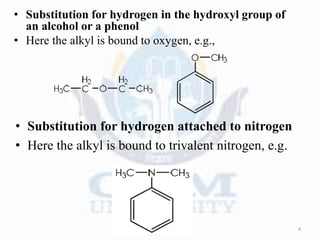
• Substitution for hydrogen in the hydroxyl group of
an alcohol or a phenol
• Here the alkyl is bound to oxygen, e.g.,
4
• Substitution for hydrogen attached to nitrogen
• Here the alkyl is bound to trivalent nitrogen, e.g.
• Addition of an alkyl halide or an alkyl ester to a tertiary
nitrogen compound
• Here the binding of the alkyl is to the nitrogen, and the trivalent
nitrogen is often assumed to be converted to a pentavalent
linkage.
• In reality, the nitrogen possesses four ordinary covalencies and
one electrostatic bond, e.g.,
5
• Alkyl-metallic compounds
• Here the alkyl is bound to the metal, e.g.,
• Pb(C2H5)4 and C6H4(COONa)S.Hg-C2H5
• Miscellaneous alkylations
• In mercaptans, the alkyl group is bound to sulfur; in the
alkyl silanes, it is bound to silicon: n-C12H25-SH and
C2H5-SiCl3
• While the number of possible different alkyl radicals is
very large, the following are the principal ones of
technical importance: methyl, ethyl, propyl, butyl, amyl,
and hexyl.
• The introduction of the aralkyl or benzyl radical, as well
as the unsaturated allyl group, also is included here, for
they are technically important.
• There are many other miscellaneous alkylations, e.g.,
involving bonding to lithium, boron, phosphorus,
germanium, thallium, selenium, etc.
6
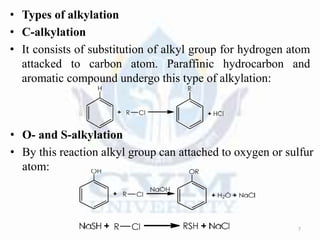
• Types of alkylation
• C-alkylation
• It consists of substitution of alkyl group for hydrogen atom
attacked to carbon atom. Paraffinic hydrocarbon and
aromatic compound undergo this type of alkylation:
7
• O- and S-alkylation
• By this reaction alkyl group can attached to oxygen or sulfur
atom:
• N-alkylation
• Replacement of hydrogen atom present in ammonia by
alkyl group:
R—OH + NH3→R-NH2 + H2O
• N-alkylation is also known as ammonolysis or aminolysis.
• > Si and Pb alkylation
• By this reaction organometalic compound is produced.
2 R—Cl + Si → R2SiCI2
8
Alkylating agent
• Olefins
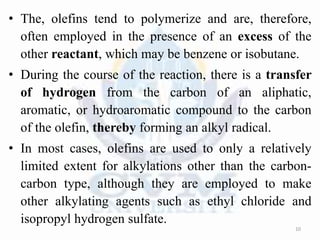
• The alkylating agents employed most extensively for carbon-carbon
alkylations are ethylene, propylene, butylenes, and amylenes(2M2B).
• Ethylene and propylene are obtained from petroleum-cracking
operations.
• These olefins as well as butylenes and amylenes are also obtained by
dehydrogenating ethane, propane, butanes, and pentanes, respectively.
• In general, the olefins of higher molecular weight, e.g., amylene, and
most branched chains, e.g., tert/-butyl derivatives, react more readily
than do propylene and ethylene.
9
• The, olefins tend to polymerize and are, therefore,
often employed in the presence of an excess of the
other reactant, which may be benzene or isobutane.
• During the course of the reaction, there is a transfer
of hydrogen from the carbon of an aliphatic,
aromatic, or hydroaromatic compound to the carbon
of the olefin, thereby forming an alkyl radical.
• In most cases, olefins are used to only a relatively
limited extent for alkylations other than the carbon-
carbon type, although they are employed to make
other alkylating agents such as ethyl chloride and
isopropyl hydrogen sulfate.
10
• Alcohols
• Methanol and ethanol have long been important alkylating
agents, especially for nitrogen bonding.
• In practically every case, a catalyst is necessary to cause the
alkylation to proceed smoothly, and in many instances, this
is a mineral acid.
• Alcohols are used in the manufacture of ethers, such as
ordinary ethyl ether, isopropyl ether, carbitol (2-(2-
Ethoxyethoxy)ethanol), cellosolve (2-Ethoxyethanol), and
naphthyl methyl ether.
• It should be noted that, although naphthols react with
alcohol in the presence of a mineral acid, the aryl alkyl
ethers cannot be formed by this reaction in the case of
phenols.
11
• Dimethylaniline is made from aniline and methanol in the
presence of a small amount of sulfuric acid,
• Diethylaniline is prepared from aniline and ethyl alcohol using
hydrochloric acid.
• The ethylation does not proceed so completely as the
methylation.
• The alcohols are employed to effect the replacement of
aromatically bound halogen atoms by heating in the presence of
an alkali.
• p-nitrophenetole is synthesized by treating p-nitro chlorobenzene
with ethanol
• o-nitroanisole is synthesized by treating o-nitrochlorobenzene
with methanol.
• The lower alcohols have also been employed extensively for the
catalytic vapor phase synthesis of alkylamines and for the
alkylation of phenols. 12
• Alkyl halides
• The alkyl halides are probably the most commonly
used laboratory alkylating agents.
• and are also employed for certain manufacturing
processes whore the alkyl halide is available
economically, as in making tetraethyllead.
• Most of the lower alkyl halides are now abundant
and cheap because of recent developments relating
to:
Addition of HCl to olefins
Chlorination of paraffins
13
• Certain of the lower alkyl halides are so volatile that they
must be used in autoclaves.
• While the chlorides are frequently employed because of their
cheapness, other alkyl halides have occasionally given
sufficiently higher yields to justify their increased cost.
• This has been true of alkyl bromides in certain carbon-to-
carbon alkylations for the preparation of barbiturates.
• The tertiary alkyl halides react vigorously and, in the case of
tert-amyl chloride, can alkylate phenols without the
intervention of a catalyst.
• Methyl iodide is used in the preparation of such methylated
products as Pinaverdol and other sensitizing dyes, which
possess pentavalent nitrogen.
14
• Phenols, such as o-nitrophenol (cf.
Acetophenetidine), are alkylated by heating with
alkyl chlorides in the presence of aqueous alkali.
• Methyl and ethyl bromides or iodides react very
smoothly and, in spite of their cost, find
application in the field of dyes and medicinal
products, e.g., pyramidone and antipyrine, for the
preparation of simple and mixed ethers and for the
alkylation of phenols and amines.
• Allyl bromide is employed for making
diallylbarbituric acid (Dial).
15
• Alkyl Sulfates
• The alkyl sulfates used most frequently are
dimethyl sulfate, methyl hydrogen sulfate, and
diethyl sulfate.
• Sulfates with longer alkyl groups are employed,
however, in some cases.
• Dimethyl sulfate is very toxic and should be
handled with care.
• The alkyl sulfates often give higher yields than the
alkyl halides but except for methyl and ethyl
sulfates are more expensive. 16
• The alkyl sulfates are frequently employed for carbon-
oxygen type alkylations to obtain compounds such as dialkyl
ethers, alkyl aryl ethers, ethyl cellulose, cellosolve, and
polyvinyl ethers.
• Alkyl sulfates have also been employed to alkylate nitrogen
atoms for such compounds as caffeine, acriflavine, and
diethylaniline.
• Both alkyl groups of dialkyl sulfates react if the reaction
system is practically anhydrous.
• In the presence of a substantial amount of water, however,
only one group reacts.
• In certain instances, monoalkyl sulfate may be regarded as
the active Alkylating reagent as, for example, in the
formation of ether from ethyl alcohol and sulfuric acid.
17
• Aralkyl Halides
• Benzyl chloride is almost universally used for the
introduction of the benzyl group, for instance, in
the preparation of benzyl ethylaniline from
ethylaniline.
• In actual practice, the benzyl ethylaniline is usually
obtained by treating a mixture of ethylaniline and
diethylaniline and fractionating.
• Benzyl chloride is also used in the preparation of
benzyl cellulose.
18
• Arylsulfonic Alkyl Esters
• The methyl or ethyl esters of p-toluene-sulfonic acid are
used to alkylate certain amines for which alcohols give
unsatisfactory yields.
• Under Codeine (q.v.) is described the use of methyl
benzenesulfonate and of methyl toluene sulfonate in the
preparation of tetra- alkylammonium compounds.
• The higher alkyl (C10 and above) esters of p-toluene
sulfonic acid have been used as alkylating agents for amines,
mercaptans, and thiophenols and for phenolic groups.
• These higher alkyl esters of p-toluene sulfonic acid are more
satisfactory than the sluggish higher alkyl halides and are
more easily obtained than the higher alkyl sulfates.
19
• Alkyl Quaternary Ammonium Compounds
• These have long been applied in certain special
fields, and their further use may well be warranted
in many instances.
• A detailed specific example of this application s
given under Codeine, where the preparation and
use of phenyltrimethyl ammonium chloride,
C6H5N(CH3)3Cl, is described.
• These quaternary alkyl substances have also been
recommended for alkylations leading to phenetole,
antipyrine, pyramidone, acriflavine, and caffeine.
20
• Metallic Alkyl Derivatives
• The alkyl magnesium halides are frequently
expensive for commercial application, but they
can be used to make alkyl phenols, to prepare
other metal alkyls and silicon alkyls from the
corresponding halides, and in many laboratory
syntheses.
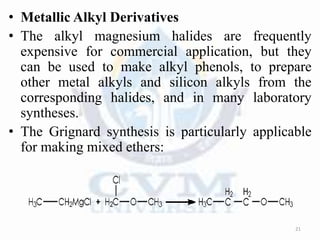
• The Grignard synthesis is particularly applicable
for making mixed ethers:
21
• Effect of alkylation
• Although the effect of alkylation on the properties
of organic compounds is sometimes contradictory,
there are some general observations that are of
value, particularly in the field of motor fuels,
medicinals, dyes and solvents.
• High-octane motor fuels are manufactured in large
amounts by alkylation because the desired
branched chains are thus economically obtained.
22
• Schmiedeberg formulated a series of rules
regarding the effect of alkyl groups on
physiological activity, which May summarizes as
follows.
• In the first place, a close connection exists
between "medical" action and the ordinary
physical properties of volatility and solubility.
• In the aliphatic paraffin series, the lower members,
which are more volatile, exhibit a narcotic effect
that is absent in the insoluble, nonvolatile higher
members.
23
• Alkylation often causes very poisonous compounds to lose
this effect; e.g., the nitriles (RCN) and isonitriles are
poisonous only when HCN is split off.
• The action of alkyl radicals can be masked or inhibited by
the presence of other radicals; this is illustrated by the
behavior of methyl-, dimethyl-, and trimethylamine, which
react like ammonia but have no narcotic effect.
• In this conduct, these amines follow Schmiedeberg's
preceding rule and are less toxic than ammonia.
• The physiological action of alcohols and ethers is ascribed
to the nature of the alkyl groups.
• For the ethers, single or mixed, the effect is due to the
presence of the alkyls, each of which acts independently of
the other.
24
• One of the most interesting studies of the effect of
various alkyl groups on physiological activity is
illustrated by the alkyl derivatives of resorcinol,
which are discussed under Hexylresorcinol.
• The bactericidal action at first increases with the
length of the side chain and then diminishes
because of decreased solubility of the alkyl
resorcinol.
• Coincident with this increase is found a decrease
in toxicity.
25
• Phenol was the first antiseptic used, and a thorough
study of its derivatives has been made.
• The substitution of a methyl group for the hydrogen
in the ring of phenol, forming the cresols, increases
the antiseptic action.
• In the case of the dihydroxy benzenes, the alkyl
derivatives of resorcinol have been carefully
investigated, and it is found that the entrance of the
methyl group into the ring, forming orcinol, depresses
the bactericidal power.
• The influence of higher alkyl groups on the nucleus of
the resorcinol molecule is considered under
Hexylresorcinol (q.v.).
26
• Reactors used in alkylation
> Tubular reactor
27
• After completion of reaction, mass is entered in to
separator and alkylated product can be separated
from catalyst mixture from upper side of the
separator.
• It is made up of vertical tube
containing stirrer for the mixing
purpose.
• Benzene, olefins are introduced
from the bottom of the reactor.
• Reactor contains number of pipes
for water circulation which
removes the heat, produced
during the reaction. Figure: Tubular reactor
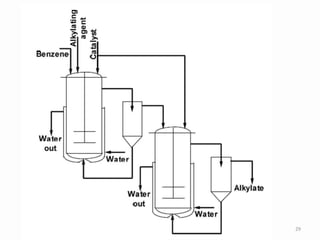
Cascade of stirred reactor
• It consist series of reactors which are joined with each
other.
• Proper mixing can be done by stirrer installed in it.
• Water jacket is also provided through which reaction
heat is removed.
• Benzene, alkylating agents and catalyst mixture are
entered from the top of the reactor.
• Through overflow pipe extra reaction mixture is
transferred to second reactor.
• Followed by separator alkylated product can be
separated from catalyst mixture. Catalyst is recycled.
28
29
> Column type reactor
• It is made up of single
vertical column. Benzene,
olefin and catalyst mixture
is reacted in the reactor.
• After completion of
reaction alkylated product
is separated via separator
while catalyst mixture can
be reused.
30
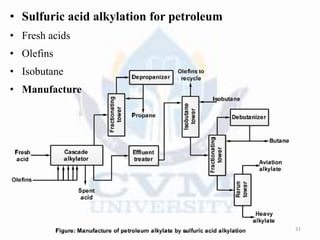
• Sulfuric acid alkylation for petroleum
• Fresh acids
• Olefins
• Isobutane
• Manufacture
31
• Despite some disadvantages, such as acid-
recovery expense and refrigeration to minimize
oxidation, about four fifths of the alkylate
produced for motor fuels is based on sulfuric acid
as a catalyst.
• As with HF alkylation, isobutane is alkylated with
olefins (other than ethylene), and a flow diagram
for such a process is given in Figure.
• The alkylation is exothermic, and means must be
provided to control the temperature and to secure
good contact with the reactants and the catalyst.
32
• This is done by having the sulfuric acid saturated
with the isobutane and by feeding the olefins into
the system in such a manner to provide the
isobutane in excess.
• This procedure and keeping the temperature down
minimize any polymerization of the olefins used.
• As practically employed, an emulsion of the acid
and the isobutane is circulated in large volume
past the point of olefin injection.
33
• Isobutane is charged and is also returned from the
deisobutanizer tower.
• The olefins are injected in small amounts in each
of the five successive zones of the reactor, thus
maintaining a high ratio of isobutane olefin in the
reaction zones with a low isobutane concentration
in the effluent.
• The settling zone of this cascade reactor serves to
separate isobutane vapors going to the
refrigeration system from the spent and recycle
acid, and the effluent.
34
• The effluent is fractionated in the series of four
towers shown in the flow diagram.
• “The higher the isobutane concentration, isobutane
to olefin ratio, acid to olefin ratio and acid
strength, and the lower the reaction temperature,
the higher the octane rating of the 3380F end-point
material and the lower the acid consumption and
the quantity of heavy polymer formed."
• As the sulfuric acid is contaminated, a portion is
withdrawn and replaced by fresh acid. The effluent
treater is to remove acidic material.
35
Alkyl aryl detergents
• Raw materials
Benzene
Dodecene
• Reaction
36
37
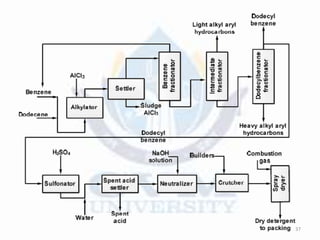
• Figure represents a continuous-flow diagram for
manufacturing alkyl aryl detergents.
• The benzene is alkylated with dodecene catalyzed by
AlCb continuously introduced.
• The temperature is kept at 460C as a maximum, this
being controlled by cooling coils or by circulating a
part of the benzene alkylate through an external
cooler and back to the agitated alkylator.
• The alkylator is followed by a continuous settler.
• The benzene is in excess to suppress the formation of
isomers ("heavy" alkyl aryl hydrocarbons).
38
• After separation of the AlCl3 sludge, the charge goes
to a benzene fractionator where the excess benzene is
distilled overhead and recycled.
• The bottoms from the benzene fractionator as shown
in Figure are passed the intermediate fractionator,
furnishing as overhead a small quantity of a light
alkyl aryl hydrocarbon, then to the dodecylbenzene
vacuum fractionator.
• The dodecylbenzene has a boiling range of 275-
315oC and is a blend predominantly of monoalkyl
benzenes with a saturated side chain averaging 12
carbons.
39
• The solubilities of sodium alkyl benzene
sulfonates were found to decrease considerably
with the length of the alkyl group.
• The surface tension showed a minimum value for
the dodecyl group, however.
• Naphthalene and phenol and its homologues are
also alkylated to produce synthetic detergents
which have excellent properties but are more
expensive than detergents produced from
benzene.
40
Ethyl benzene
• Ethyl benzene has been made in a very large quantity in
recent years as a step in the manufacture of styrene for GR-
S synthetic rubber and for plastics.
• The reactions involved are essentially
• Raw materials
• Benzene
• Ethylene
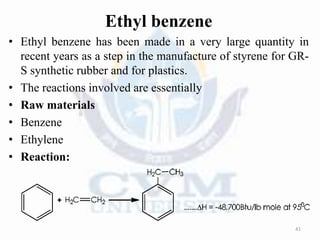
• Reaction:
41
42
• Gaseous ethylene is passed into the liquid benzene in the
presence of a metal chloride catalyst, such as aluminum
chloride, at moderate temperatures (40-1000C).
• The reaction is promoted by hydrogen chloride.
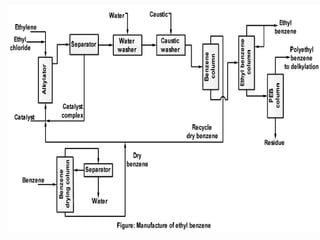
• A continuous process for ethylbenzene is shown in figure.
• Anhydrous conditions must prevail; hence the 99+ percent
purity benzene is pumped through an azeotropic drying
column from which benzene with less than 30ppm water is
withdrawn.
• This benzene is mixed with recirculated "catalyst complex"
and fresh catalyst (anhydrous AlCl3).
• The hydrogen chloride which serves as a promoter is
furnished indirectly from the ethyl chloride previously
mixed with the ethylene (90-95mole % purity).
43
• The catalyst complex consisting of heavy
organics and solid anhydrous aluminum chloride
is separated and recycled after mixing with
needed fresh AlCl3.
• An approximate composition is:
44
Percent
AlCl3 (combined with hydrocarbons) 26
AlCl3 (free) 01
High-molecular-weight hydrocarbons 25
Benzene and ethylbenzene 46
• In the alkylation, the benzene is
converted to ethyl- and polymethyl
benzenes (Figure a) at 93-940C and a
pressure slightly above atmospheric.
• As the reaction is exothermic, heat
must be removed by evaporation or
cooling.
• The crude alkylate is separated from
the catalyst complex, cooled, and
washed with water and then with
caustic soda solution.
• This crude product contains 40-45%
benzene, 15-20% polymethyl benzene,
and a small amount of tar, the rest
being ethylbenzene
45
Figure a: Equilibrium relation in the
ethylation of benzene at 950C
• Separation is effected by a train of conventional
columns, with the third one operated at a head
pressure of about 50mmHg absolute, furnishing
an overhead of the polymethyl benzenes which
is charged to the dealkylator-realkylator (using
AICh and excess benzene at higher temperature
and different catalyst ratio).
• Ethylbenzene and dimethyl benzene result.
46
• Tetraethyllead (TEL)[Pb(C2H5)4]
• Tetraethyllead is widely used for the prevention of
knocking in high-compression gasoline engines,
0.04% TEL being as efficient in this respect as 25%
benzene.
• In order to prevent the deposition of lead in the
exhaust sections of the engine, 3-parts by volume of
TEL are mixed with 2-parts of ethylene bromide
(CH2BrCH2Br) or a mixture of ethylene bromide and
ethylene chloride.
• The ethylene halide converts the lead oxide formed
during the combustion into the volatile lead halide. 47
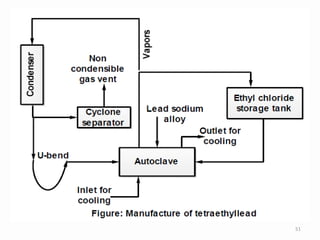
• Manufacture
• The mechanism of reaction is not known but the
following is a simplified representation of the main
reaction.
• 4PbNa + H3C-CH2Cl → Pb(C2H5)4 + 3Pb + 4NaCl
• In the commercial production of tetraethyllead, lead-
monosodium alloy is placed in a jacketed autoclave
equipped with an agitator; nitrogen and ethyl chloride
are then added.
• As the reaction between the ethyl chloride and the
alloy begins, heat is evolved and the pressure of the
system begins to rise because of the vapor pressure of
the ethyl chloride. 48
• At optimum reaction conditions, about 65-750C
and about 50-65psi, a cooling medium is
introduced to the autoclave jacket and condenser.
• About this time the autoclave, condenser, liquid-
gas separator, and connecting pipes are filled with
ethyl chloride vapor.
• The ethyl chloride in the condenser is condensed
and flows back into the autoclave.
• This condensation causes a decrease in pressure,
drawing more vapors into the condenser so that the
side reaction gases may be removed.
49
• As the ethyl chloride is added, the pressure should
be about 60-75psi and should not rise over 80psi.
• This is done by regulating the feed rate.
• When all the ethyl chloride is added, the pressure
will decrease rapidly to 50psi.
• At this point, the flow of the cooling media is
stopped and the reaction is permitted to go to
completion.
50
51
• The product from the autoclave reactor is
discharged to a batch-type steam still, partly
filled with water, where the ethyl chloride and
the TEL are distilled off and fractionated from
the solution of NaCl and the unreacted lead.
• The yield of TEL is 85-90% based on sodium
used; approximately 10% of the sodium is
involved in side reactions, leading to the
formation of C2H6, C2H4 and C4H10.
52

Alkylation

  • 1.
  • 2.
    Alkylation • Introduction • Typesof Alkylated Compounds • Alkylation may be defined as the introduction of an alkyl radical by substitution or addition into an organic compound. • We also include under this procedure the introduction of an aralkyl radical, such as benzyl, and those alkylations presented in discussions of the Friedel- Crafts reaction. • Alkylation is of six general types, depending on the linkage effected. 2
  • 3.
    • Substitution forhydrogen in carbon compounds • This is nuclear alkylation when aromatic hydrogen is substituted. • The carbon of the alkyl is bound to carbon of either aliphatic or aromatic compounds. • This is carbon-to-carbon alkylation and includes the alkylations hereto classified under the Friedel-Crafts reaction, e.g., 3
  • 4.
    • Substitution forhydrogen in the hydroxyl group of an alcohol or a phenol • Here the alkyl is bound to oxygen, e.g., 4 • Substitution for hydrogen attached to nitrogen • Here the alkyl is bound to trivalent nitrogen, e.g.
  • 5.
    • Addition ofan alkyl halide or an alkyl ester to a tertiary nitrogen compound • Here the binding of the alkyl is to the nitrogen, and the trivalent nitrogen is often assumed to be converted to a pentavalent linkage. • In reality, the nitrogen possesses four ordinary covalencies and one electrostatic bond, e.g., 5 • Alkyl-metallic compounds • Here the alkyl is bound to the metal, e.g., • Pb(C2H5)4 and C6H4(COONa)S.Hg-C2H5
  • 6.
    • Miscellaneous alkylations •In mercaptans, the alkyl group is bound to sulfur; in the alkyl silanes, it is bound to silicon: n-C12H25-SH and C2H5-SiCl3 • While the number of possible different alkyl radicals is very large, the following are the principal ones of technical importance: methyl, ethyl, propyl, butyl, amyl, and hexyl. • The introduction of the aralkyl or benzyl radical, as well as the unsaturated allyl group, also is included here, for they are technically important. • There are many other miscellaneous alkylations, e.g., involving bonding to lithium, boron, phosphorus, germanium, thallium, selenium, etc. 6
  • 7.
    • Types ofalkylation • C-alkylation • It consists of substitution of alkyl group for hydrogen atom attacked to carbon atom. Paraffinic hydrocarbon and aromatic compound undergo this type of alkylation: 7 • O- and S-alkylation • By this reaction alkyl group can attached to oxygen or sulfur atom:
  • 8.
    • N-alkylation • Replacementof hydrogen atom present in ammonia by alkyl group: R—OH + NH3→R-NH2 + H2O • N-alkylation is also known as ammonolysis or aminolysis. • > Si and Pb alkylation • By this reaction organometalic compound is produced. 2 R—Cl + Si → R2SiCI2 8
  • 9.
    Alkylating agent • Olefins •The alkylating agents employed most extensively for carbon-carbon alkylations are ethylene, propylene, butylenes, and amylenes(2M2B). • Ethylene and propylene are obtained from petroleum-cracking operations. • These olefins as well as butylenes and amylenes are also obtained by dehydrogenating ethane, propane, butanes, and pentanes, respectively. • In general, the olefins of higher molecular weight, e.g., amylene, and most branched chains, e.g., tert/-butyl derivatives, react more readily than do propylene and ethylene. 9
  • 10.
    • The, olefinstend to polymerize and are, therefore, often employed in the presence of an excess of the other reactant, which may be benzene or isobutane. • During the course of the reaction, there is a transfer of hydrogen from the carbon of an aliphatic, aromatic, or hydroaromatic compound to the carbon of the olefin, thereby forming an alkyl radical. • In most cases, olefins are used to only a relatively limited extent for alkylations other than the carbon- carbon type, although they are employed to make other alkylating agents such as ethyl chloride and isopropyl hydrogen sulfate. 10
  • 11.
    • Alcohols • Methanoland ethanol have long been important alkylating agents, especially for nitrogen bonding. • In practically every case, a catalyst is necessary to cause the alkylation to proceed smoothly, and in many instances, this is a mineral acid. • Alcohols are used in the manufacture of ethers, such as ordinary ethyl ether, isopropyl ether, carbitol (2-(2- Ethoxyethoxy)ethanol), cellosolve (2-Ethoxyethanol), and naphthyl methyl ether. • It should be noted that, although naphthols react with alcohol in the presence of a mineral acid, the aryl alkyl ethers cannot be formed by this reaction in the case of phenols. 11
  • 12.
    • Dimethylaniline ismade from aniline and methanol in the presence of a small amount of sulfuric acid, • Diethylaniline is prepared from aniline and ethyl alcohol using hydrochloric acid. • The ethylation does not proceed so completely as the methylation. • The alcohols are employed to effect the replacement of aromatically bound halogen atoms by heating in the presence of an alkali. • p-nitrophenetole is synthesized by treating p-nitro chlorobenzene with ethanol • o-nitroanisole is synthesized by treating o-nitrochlorobenzene with methanol. • The lower alcohols have also been employed extensively for the catalytic vapor phase synthesis of alkylamines and for the alkylation of phenols. 12
  • 13.
    • Alkyl halides •The alkyl halides are probably the most commonly used laboratory alkylating agents. • and are also employed for certain manufacturing processes whore the alkyl halide is available economically, as in making tetraethyllead. • Most of the lower alkyl halides are now abundant and cheap because of recent developments relating to: Addition of HCl to olefins Chlorination of paraffins 13
  • 14.
    • Certain ofthe lower alkyl halides are so volatile that they must be used in autoclaves. • While the chlorides are frequently employed because of their cheapness, other alkyl halides have occasionally given sufficiently higher yields to justify their increased cost. • This has been true of alkyl bromides in certain carbon-to- carbon alkylations for the preparation of barbiturates. • The tertiary alkyl halides react vigorously and, in the case of tert-amyl chloride, can alkylate phenols without the intervention of a catalyst. • Methyl iodide is used in the preparation of such methylated products as Pinaverdol and other sensitizing dyes, which possess pentavalent nitrogen. 14
  • 15.
    • Phenols, suchas o-nitrophenol (cf. Acetophenetidine), are alkylated by heating with alkyl chlorides in the presence of aqueous alkali. • Methyl and ethyl bromides or iodides react very smoothly and, in spite of their cost, find application in the field of dyes and medicinal products, e.g., pyramidone and antipyrine, for the preparation of simple and mixed ethers and for the alkylation of phenols and amines. • Allyl bromide is employed for making diallylbarbituric acid (Dial). 15
  • 16.
    • Alkyl Sulfates •The alkyl sulfates used most frequently are dimethyl sulfate, methyl hydrogen sulfate, and diethyl sulfate. • Sulfates with longer alkyl groups are employed, however, in some cases. • Dimethyl sulfate is very toxic and should be handled with care. • The alkyl sulfates often give higher yields than the alkyl halides but except for methyl and ethyl sulfates are more expensive. 16
  • 17.
    • The alkylsulfates are frequently employed for carbon- oxygen type alkylations to obtain compounds such as dialkyl ethers, alkyl aryl ethers, ethyl cellulose, cellosolve, and polyvinyl ethers. • Alkyl sulfates have also been employed to alkylate nitrogen atoms for such compounds as caffeine, acriflavine, and diethylaniline. • Both alkyl groups of dialkyl sulfates react if the reaction system is practically anhydrous. • In the presence of a substantial amount of water, however, only one group reacts. • In certain instances, monoalkyl sulfate may be regarded as the active Alkylating reagent as, for example, in the formation of ether from ethyl alcohol and sulfuric acid. 17
  • 18.
    • Aralkyl Halides •Benzyl chloride is almost universally used for the introduction of the benzyl group, for instance, in the preparation of benzyl ethylaniline from ethylaniline. • In actual practice, the benzyl ethylaniline is usually obtained by treating a mixture of ethylaniline and diethylaniline and fractionating. • Benzyl chloride is also used in the preparation of benzyl cellulose. 18
  • 19.
    • Arylsulfonic AlkylEsters • The methyl or ethyl esters of p-toluene-sulfonic acid are used to alkylate certain amines for which alcohols give unsatisfactory yields. • Under Codeine (q.v.) is described the use of methyl benzenesulfonate and of methyl toluene sulfonate in the preparation of tetra- alkylammonium compounds. • The higher alkyl (C10 and above) esters of p-toluene sulfonic acid have been used as alkylating agents for amines, mercaptans, and thiophenols and for phenolic groups. • These higher alkyl esters of p-toluene sulfonic acid are more satisfactory than the sluggish higher alkyl halides and are more easily obtained than the higher alkyl sulfates. 19
  • 20.
    • Alkyl QuaternaryAmmonium Compounds • These have long been applied in certain special fields, and their further use may well be warranted in many instances. • A detailed specific example of this application s given under Codeine, where the preparation and use of phenyltrimethyl ammonium chloride, C6H5N(CH3)3Cl, is described. • These quaternary alkyl substances have also been recommended for alkylations leading to phenetole, antipyrine, pyramidone, acriflavine, and caffeine. 20
  • 21.
    • Metallic AlkylDerivatives • The alkyl magnesium halides are frequently expensive for commercial application, but they can be used to make alkyl phenols, to prepare other metal alkyls and silicon alkyls from the corresponding halides, and in many laboratory syntheses. • The Grignard synthesis is particularly applicable for making mixed ethers: 21
  • 22.
    • Effect ofalkylation • Although the effect of alkylation on the properties of organic compounds is sometimes contradictory, there are some general observations that are of value, particularly in the field of motor fuels, medicinals, dyes and solvents. • High-octane motor fuels are manufactured in large amounts by alkylation because the desired branched chains are thus economically obtained. 22
  • 23.
    • Schmiedeberg formulateda series of rules regarding the effect of alkyl groups on physiological activity, which May summarizes as follows. • In the first place, a close connection exists between "medical" action and the ordinary physical properties of volatility and solubility. • In the aliphatic paraffin series, the lower members, which are more volatile, exhibit a narcotic effect that is absent in the insoluble, nonvolatile higher members. 23
  • 24.
    • Alkylation oftencauses very poisonous compounds to lose this effect; e.g., the nitriles (RCN) and isonitriles are poisonous only when HCN is split off. • The action of alkyl radicals can be masked or inhibited by the presence of other radicals; this is illustrated by the behavior of methyl-, dimethyl-, and trimethylamine, which react like ammonia but have no narcotic effect. • In this conduct, these amines follow Schmiedeberg's preceding rule and are less toxic than ammonia. • The physiological action of alcohols and ethers is ascribed to the nature of the alkyl groups. • For the ethers, single or mixed, the effect is due to the presence of the alkyls, each of which acts independently of the other. 24
  • 25.
    • One ofthe most interesting studies of the effect of various alkyl groups on physiological activity is illustrated by the alkyl derivatives of resorcinol, which are discussed under Hexylresorcinol. • The bactericidal action at first increases with the length of the side chain and then diminishes because of decreased solubility of the alkyl resorcinol. • Coincident with this increase is found a decrease in toxicity. 25
  • 26.
    • Phenol wasthe first antiseptic used, and a thorough study of its derivatives has been made. • The substitution of a methyl group for the hydrogen in the ring of phenol, forming the cresols, increases the antiseptic action. • In the case of the dihydroxy benzenes, the alkyl derivatives of resorcinol have been carefully investigated, and it is found that the entrance of the methyl group into the ring, forming orcinol, depresses the bactericidal power. • The influence of higher alkyl groups on the nucleus of the resorcinol molecule is considered under Hexylresorcinol (q.v.). 26
  • 27.
    • Reactors usedin alkylation > Tubular reactor 27 • After completion of reaction, mass is entered in to separator and alkylated product can be separated from catalyst mixture from upper side of the separator. • It is made up of vertical tube containing stirrer for the mixing purpose. • Benzene, olefins are introduced from the bottom of the reactor. • Reactor contains number of pipes for water circulation which removes the heat, produced during the reaction. Figure: Tubular reactor
  • 28.
    Cascade of stirredreactor • It consist series of reactors which are joined with each other. • Proper mixing can be done by stirrer installed in it. • Water jacket is also provided through which reaction heat is removed. • Benzene, alkylating agents and catalyst mixture are entered from the top of the reactor. • Through overflow pipe extra reaction mixture is transferred to second reactor. • Followed by separator alkylated product can be separated from catalyst mixture. Catalyst is recycled. 28
  • 29.
  • 30.
    > Column typereactor • It is made up of single vertical column. Benzene, olefin and catalyst mixture is reacted in the reactor. • After completion of reaction alkylated product is separated via separator while catalyst mixture can be reused. 30
  • 31.
    • Sulfuric acidalkylation for petroleum • Fresh acids • Olefins • Isobutane • Manufacture 31
  • 32.
    • Despite somedisadvantages, such as acid- recovery expense and refrigeration to minimize oxidation, about four fifths of the alkylate produced for motor fuels is based on sulfuric acid as a catalyst. • As with HF alkylation, isobutane is alkylated with olefins (other than ethylene), and a flow diagram for such a process is given in Figure. • The alkylation is exothermic, and means must be provided to control the temperature and to secure good contact with the reactants and the catalyst. 32
  • 33.
    • This isdone by having the sulfuric acid saturated with the isobutane and by feeding the olefins into the system in such a manner to provide the isobutane in excess. • This procedure and keeping the temperature down minimize any polymerization of the olefins used. • As practically employed, an emulsion of the acid and the isobutane is circulated in large volume past the point of olefin injection. 33
  • 34.
    • Isobutane ischarged and is also returned from the deisobutanizer tower. • The olefins are injected in small amounts in each of the five successive zones of the reactor, thus maintaining a high ratio of isobutane olefin in the reaction zones with a low isobutane concentration in the effluent. • The settling zone of this cascade reactor serves to separate isobutane vapors going to the refrigeration system from the spent and recycle acid, and the effluent. 34
  • 35.
    • The effluentis fractionated in the series of four towers shown in the flow diagram. • “The higher the isobutane concentration, isobutane to olefin ratio, acid to olefin ratio and acid strength, and the lower the reaction temperature, the higher the octane rating of the 3380F end-point material and the lower the acid consumption and the quantity of heavy polymer formed." • As the sulfuric acid is contaminated, a portion is withdrawn and replaced by fresh acid. The effluent treater is to remove acidic material. 35
  • 36.
    Alkyl aryl detergents •Raw materials Benzene Dodecene • Reaction 36
  • 37.
  • 38.
    • Figure representsa continuous-flow diagram for manufacturing alkyl aryl detergents. • The benzene is alkylated with dodecene catalyzed by AlCb continuously introduced. • The temperature is kept at 460C as a maximum, this being controlled by cooling coils or by circulating a part of the benzene alkylate through an external cooler and back to the agitated alkylator. • The alkylator is followed by a continuous settler. • The benzene is in excess to suppress the formation of isomers ("heavy" alkyl aryl hydrocarbons). 38
  • 39.
    • After separationof the AlCl3 sludge, the charge goes to a benzene fractionator where the excess benzene is distilled overhead and recycled. • The bottoms from the benzene fractionator as shown in Figure are passed the intermediate fractionator, furnishing as overhead a small quantity of a light alkyl aryl hydrocarbon, then to the dodecylbenzene vacuum fractionator. • The dodecylbenzene has a boiling range of 275- 315oC and is a blend predominantly of monoalkyl benzenes with a saturated side chain averaging 12 carbons. 39
  • 40.
    • The solubilitiesof sodium alkyl benzene sulfonates were found to decrease considerably with the length of the alkyl group. • The surface tension showed a minimum value for the dodecyl group, however. • Naphthalene and phenol and its homologues are also alkylated to produce synthetic detergents which have excellent properties but are more expensive than detergents produced from benzene. 40
  • 41.
    Ethyl benzene • Ethylbenzene has been made in a very large quantity in recent years as a step in the manufacture of styrene for GR- S synthetic rubber and for plastics. • The reactions involved are essentially • Raw materials • Benzene • Ethylene • Reaction: 41
  • 42.
  • 43.
    • Gaseous ethyleneis passed into the liquid benzene in the presence of a metal chloride catalyst, such as aluminum chloride, at moderate temperatures (40-1000C). • The reaction is promoted by hydrogen chloride. • A continuous process for ethylbenzene is shown in figure. • Anhydrous conditions must prevail; hence the 99+ percent purity benzene is pumped through an azeotropic drying column from which benzene with less than 30ppm water is withdrawn. • This benzene is mixed with recirculated "catalyst complex" and fresh catalyst (anhydrous AlCl3). • The hydrogen chloride which serves as a promoter is furnished indirectly from the ethyl chloride previously mixed with the ethylene (90-95mole % purity). 43
  • 44.
    • The catalystcomplex consisting of heavy organics and solid anhydrous aluminum chloride is separated and recycled after mixing with needed fresh AlCl3. • An approximate composition is: 44 Percent AlCl3 (combined with hydrocarbons) 26 AlCl3 (free) 01 High-molecular-weight hydrocarbons 25 Benzene and ethylbenzene 46
  • 45.
    • In thealkylation, the benzene is converted to ethyl- and polymethyl benzenes (Figure a) at 93-940C and a pressure slightly above atmospheric. • As the reaction is exothermic, heat must be removed by evaporation or cooling. • The crude alkylate is separated from the catalyst complex, cooled, and washed with water and then with caustic soda solution. • This crude product contains 40-45% benzene, 15-20% polymethyl benzene, and a small amount of tar, the rest being ethylbenzene 45 Figure a: Equilibrium relation in the ethylation of benzene at 950C
  • 46.
    • Separation iseffected by a train of conventional columns, with the third one operated at a head pressure of about 50mmHg absolute, furnishing an overhead of the polymethyl benzenes which is charged to the dealkylator-realkylator (using AICh and excess benzene at higher temperature and different catalyst ratio). • Ethylbenzene and dimethyl benzene result. 46
  • 47.
    • Tetraethyllead (TEL)[Pb(C2H5)4] •Tetraethyllead is widely used for the prevention of knocking in high-compression gasoline engines, 0.04% TEL being as efficient in this respect as 25% benzene. • In order to prevent the deposition of lead in the exhaust sections of the engine, 3-parts by volume of TEL are mixed with 2-parts of ethylene bromide (CH2BrCH2Br) or a mixture of ethylene bromide and ethylene chloride. • The ethylene halide converts the lead oxide formed during the combustion into the volatile lead halide. 47
  • 48.
    • Manufacture • Themechanism of reaction is not known but the following is a simplified representation of the main reaction. • 4PbNa + H3C-CH2Cl → Pb(C2H5)4 + 3Pb + 4NaCl • In the commercial production of tetraethyllead, lead- monosodium alloy is placed in a jacketed autoclave equipped with an agitator; nitrogen and ethyl chloride are then added. • As the reaction between the ethyl chloride and the alloy begins, heat is evolved and the pressure of the system begins to rise because of the vapor pressure of the ethyl chloride. 48
  • 49.
    • At optimumreaction conditions, about 65-750C and about 50-65psi, a cooling medium is introduced to the autoclave jacket and condenser. • About this time the autoclave, condenser, liquid- gas separator, and connecting pipes are filled with ethyl chloride vapor. • The ethyl chloride in the condenser is condensed and flows back into the autoclave. • This condensation causes a decrease in pressure, drawing more vapors into the condenser so that the side reaction gases may be removed. 49
  • 50.
    • As theethyl chloride is added, the pressure should be about 60-75psi and should not rise over 80psi. • This is done by regulating the feed rate. • When all the ethyl chloride is added, the pressure will decrease rapidly to 50psi. • At this point, the flow of the cooling media is stopped and the reaction is permitted to go to completion. 50
  • 51.
  • 52.
    • The productfrom the autoclave reactor is discharged to a batch-type steam still, partly filled with water, where the ethyl chloride and the TEL are distilled off and fractionated from the solution of NaCl and the unreacted lead. • The yield of TEL is 85-90% based on sodium used; approximately 10% of the sodium is involved in side reactions, leading to the formation of C2H6, C2H4 and C4H10. 52