RUBIDIUM STRONTIUM DATING
Department of Geology
Panjab University, Chandigarh.
Submitted To: Submitted By:
Prof. Naveen chaudhari Jaideep Kaur Tiwana
M.Sc.(H.S)- II
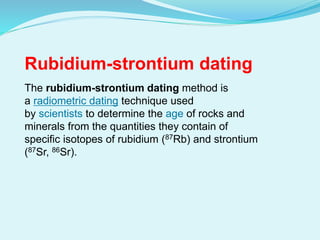
Rubidium-strontium dating
The rubidium-strontium dating method is
a radiometric dating technique used
by scientists to determine the age of rocks and
minerals from the quantities they contain of
specific isotopes of rubidium (87Rb) and strontium
(87Sr, 86Sr).
Chemical properties
Strontium
 Alkaline earth element (group II A)
 +2 valency
 Ionic radius1.13 angstrom which is
close to Ca i.e. 0.99A°, so Sr can
replace it in Ca containing minerals
like in plagioclase, CPX and
carbonate minerals especially
aragonite..
 Less incompatible than Rb
 Its concentration in crust is less than
Rb.
Rubidium
 Alkali element (group I)
 +1 valency
 Ionic radius 1.48 angstrom which
is close to “K” i.e. 1.33 A° so it
substitute for K e.g. in K-feldspar
mica(muscovite biotite ) clay
minerals , and evaporite
minerals.
 More incompatible
 Its concentration is high in crust
than in mantle.
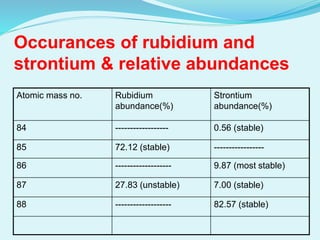
Atomic mass no. Rubidium
abundance(%)
Strontium
abundance(%)
84 ------------------ 0.56 (stable)
85 72.12 (stable) -----------------
86 ------------------- 9.87 (most stable)
87 27.83 (unstable) 7.00 (stable)
88 ------------------- 82.57 (stable)
Occurances of rubidium and
strontium & relative abundances
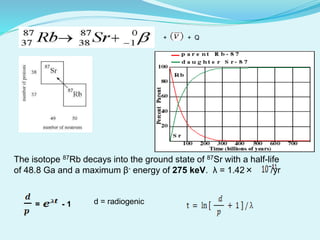
The isotope 87Rb decays into the ground state of 87Sr with a half-life
of 48.8 Ga and a maximum β- energy of 275 keV. λ = 1.42× /yr
d = radiogenic
+ + Q
= - 1
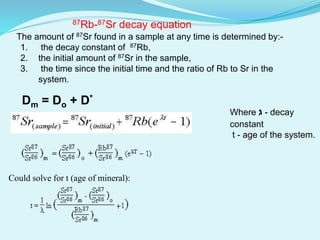
The amount of 87Sr found in a sample at any time is determined by:-
1. the decay constant of 87Rb,
2. the initial amount of 87Sr in the sample,
3. the time since the initial time and the ratio of Rb to Sr in the
system.
Where ‫ג‬ - decay
constant
t - age of the system.
Could solve for t (age of mineral):
87Rb-87Sr decay equation
Dm = Do + D*
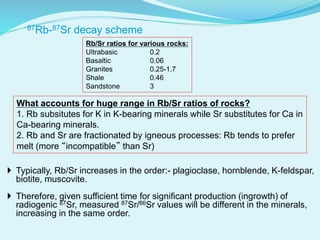
87Rb-87Sr decay scheme
What accounts for huge range in Rb/Sr ratios of rocks?
1. Rb subsitutes for K in K-bearing minerals while Sr substitutes for Ca in
Ca-bearing minerals.
2. Rb and Sr are fractionated by igneous processes: Rb tends to prefer
melt (more “incompatible” than Sr)
Rb/Sr ratios for various rocks:
Ultrabasic 0.2
Basaltic 0.06
Granites 0.25-1.7
Shale 0.46
Sandstone 3
 Typically, Rb/Sr increases in the order:- plagioclase, hornblende, K-feldspar,
biotite, muscovite.
 Therefore, given sufficient time for significant production (ingrowth) of
radiogenic 87Sr, measured 87Sr/86Sr values will be different in the minerals,
increasing in the same order.
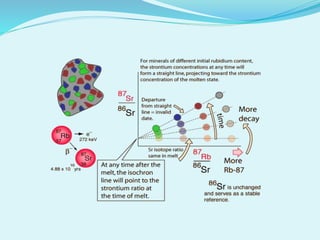
87Rb-87Sr isochrons
87 87 87
86 86 86
( 1)
t
i
Sr Sr Rb
e
Sr Sr Sr

 
  
 
 
measured measured
when you crystallize a rock,
you will always have some Sr
present
Sample with
lower [Rb]
A schematic Rb-Sr isochron
Sample with
higher [Rb]
If x=(87Rb/86Sr)m
And y=(87Sr/86Sr)m
We have y=b+mx
Where intercept b=(87Sr/86Sr)i
And slope m=( )
b
- 1
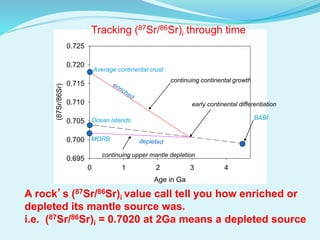
Age in Ga
0 1 2 3 4
(87Sr/86Sr)
0.695
0.700
0.705
0.710
0.715
0.720
0.725
BABI
Average continental crust
MORB
early continental differentiation
continuing continental growth
continuing upper mantle depletion
Ocean islands
A rock’s (87Sr/86Sr)i value call tell you how enriched or
depleted its mantle source was.
i.e. (87Sr/86Sr)i = 0.7020 at 2Ga means a depleted source
Tracking (87Sr/86Sr)i through time
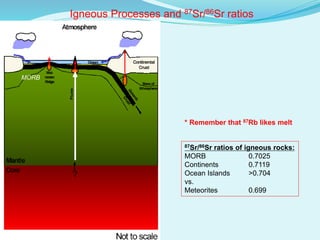
Igneous Processes and 87Sr/86Sr ratios
87Sr/86Sr ratios of igneous rocks:
MORB 0.7025
Continents 0.7119
Ocean Islands >0.704
vs.
Meteorites 0.699
* Remember that 87Rb likes melt
MORB
Sources of error
Rb-Sr dating relies on correctly measuring the Rb-Sr ratio
and 87Sr/86Sr ratio for the mineral .
Several preconditions must be satisfied as representing the
time of emplacement or formation of a rock.
The system must have remained closed to Rb and Sr
diffusion from the time at which the rock formed.
The minerals which are taken from a rock to construct an
isochron must have formed in chemical equilibrium with one
another.
The rock must not have undergone any metamorphism.
Rb and Sr are mobile alkaline elements.
These fluids may metasomatically alter a rock, introducing new
Rb and Sr into the rock (generally during Potassic alteration or
sodic (albitisation) alteration. Rb-Sr can then be used on the
altered mineralogy to date the time of this alteration, but not
the date at which the rock formed.
Basaltic rocks are more altered than granitic rocks therefore
those are not preferred for dating.
DRAWBACKS-
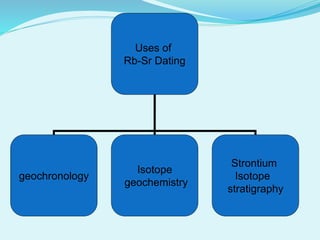
Uses of
Rb-Sr Dating
geochronology
Isotope
geochemistry
Strontium
Isotope
stratigraphy
Rubidium Strontium Dating

Rubidium Strontium Dating

  • 1.
    RUBIDIUM STRONTIUM DATING Departmentof Geology Panjab University, Chandigarh. Submitted To: Submitted By: Prof. Naveen chaudhari Jaideep Kaur Tiwana M.Sc.(H.S)- II
  • 2.
    Rubidium-strontium dating The rubidium-strontiumdating method is a radiometric dating technique used by scientists to determine the age of rocks and minerals from the quantities they contain of specific isotopes of rubidium (87Rb) and strontium (87Sr, 86Sr).
  • 3.
    Chemical properties Strontium  Alkalineearth element (group II A)  +2 valency  Ionic radius1.13 angstrom which is close to Ca i.e. 0.99A°, so Sr can replace it in Ca containing minerals like in plagioclase, CPX and carbonate minerals especially aragonite..  Less incompatible than Rb  Its concentration in crust is less than Rb. Rubidium  Alkali element (group I)  +1 valency  Ionic radius 1.48 angstrom which is close to “K” i.e. 1.33 A° so it substitute for K e.g. in K-feldspar mica(muscovite biotite ) clay minerals , and evaporite minerals.  More incompatible  Its concentration is high in crust than in mantle.
  • 4.
    Atomic mass no.Rubidium abundance(%) Strontium abundance(%) 84 ------------------ 0.56 (stable) 85 72.12 (stable) ----------------- 86 ------------------- 9.87 (most stable) 87 27.83 (unstable) 7.00 (stable) 88 ------------------- 82.57 (stable) Occurances of rubidium and strontium & relative abundances
  • 5.
    The isotope 87Rbdecays into the ground state of 87Sr with a half-life of 48.8 Ga and a maximum β- energy of 275 keV. λ = 1.42× /yr d = radiogenic + + Q = - 1
  • 6.
    The amount of87Sr found in a sample at any time is determined by:- 1. the decay constant of 87Rb, 2. the initial amount of 87Sr in the sample, 3. the time since the initial time and the ratio of Rb to Sr in the system. Where ‫ג‬ - decay constant t - age of the system. Could solve for t (age of mineral): 87Rb-87Sr decay equation Dm = Do + D*
  • 7.
    87Rb-87Sr decay scheme Whataccounts for huge range in Rb/Sr ratios of rocks? 1. Rb subsitutes for K in K-bearing minerals while Sr substitutes for Ca in Ca-bearing minerals. 2. Rb and Sr are fractionated by igneous processes: Rb tends to prefer melt (more “incompatible” than Sr) Rb/Sr ratios for various rocks: Ultrabasic 0.2 Basaltic 0.06 Granites 0.25-1.7 Shale 0.46 Sandstone 3  Typically, Rb/Sr increases in the order:- plagioclase, hornblende, K-feldspar, biotite, muscovite.  Therefore, given sufficient time for significant production (ingrowth) of radiogenic 87Sr, measured 87Sr/86Sr values will be different in the minerals, increasing in the same order.
  • 8.
    87Rb-87Sr isochrons 87 8787 86 86 86 ( 1) t i Sr Sr Rb e Sr Sr Sr           measured measured when you crystallize a rock, you will always have some Sr present Sample with lower [Rb] A schematic Rb-Sr isochron Sample with higher [Rb] If x=(87Rb/86Sr)m And y=(87Sr/86Sr)m We have y=b+mx Where intercept b=(87Sr/86Sr)i And slope m=( ) b - 1
  • 10.
    Age in Ga 01 2 3 4 (87Sr/86Sr) 0.695 0.700 0.705 0.710 0.715 0.720 0.725 BABI Average continental crust MORB early continental differentiation continuing continental growth continuing upper mantle depletion Ocean islands A rock’s (87Sr/86Sr)i value call tell you how enriched or depleted its mantle source was. i.e. (87Sr/86Sr)i = 0.7020 at 2Ga means a depleted source Tracking (87Sr/86Sr)i through time
  • 11.
    Igneous Processes and87Sr/86Sr ratios 87Sr/86Sr ratios of igneous rocks: MORB 0.7025 Continents 0.7119 Ocean Islands >0.704 vs. Meteorites 0.699 * Remember that 87Rb likes melt MORB
  • 12.
    Sources of error Rb-Srdating relies on correctly measuring the Rb-Sr ratio and 87Sr/86Sr ratio for the mineral . Several preconditions must be satisfied as representing the time of emplacement or formation of a rock. The system must have remained closed to Rb and Sr diffusion from the time at which the rock formed. The minerals which are taken from a rock to construct an isochron must have formed in chemical equilibrium with one another. The rock must not have undergone any metamorphism.
  • 13.
    Rb and Srare mobile alkaline elements. These fluids may metasomatically alter a rock, introducing new Rb and Sr into the rock (generally during Potassic alteration or sodic (albitisation) alteration. Rb-Sr can then be used on the altered mineralogy to date the time of this alteration, but not the date at which the rock formed. Basaltic rocks are more altered than granitic rocks therefore those are not preferred for dating. DRAWBACKS-
  • 14.