Santa Ana de Coro, January 2010 UNIVERSIDAD NACIONAL EXPERIMETAL “ FRANCISCO DE MIRANDA” AREA CIENCIAS DE LA Educación PROGRAMA DE EDUCACION MENCION INGLES LCDO. JULIO REYES
Grammar Lcdo. Julio Reyes.
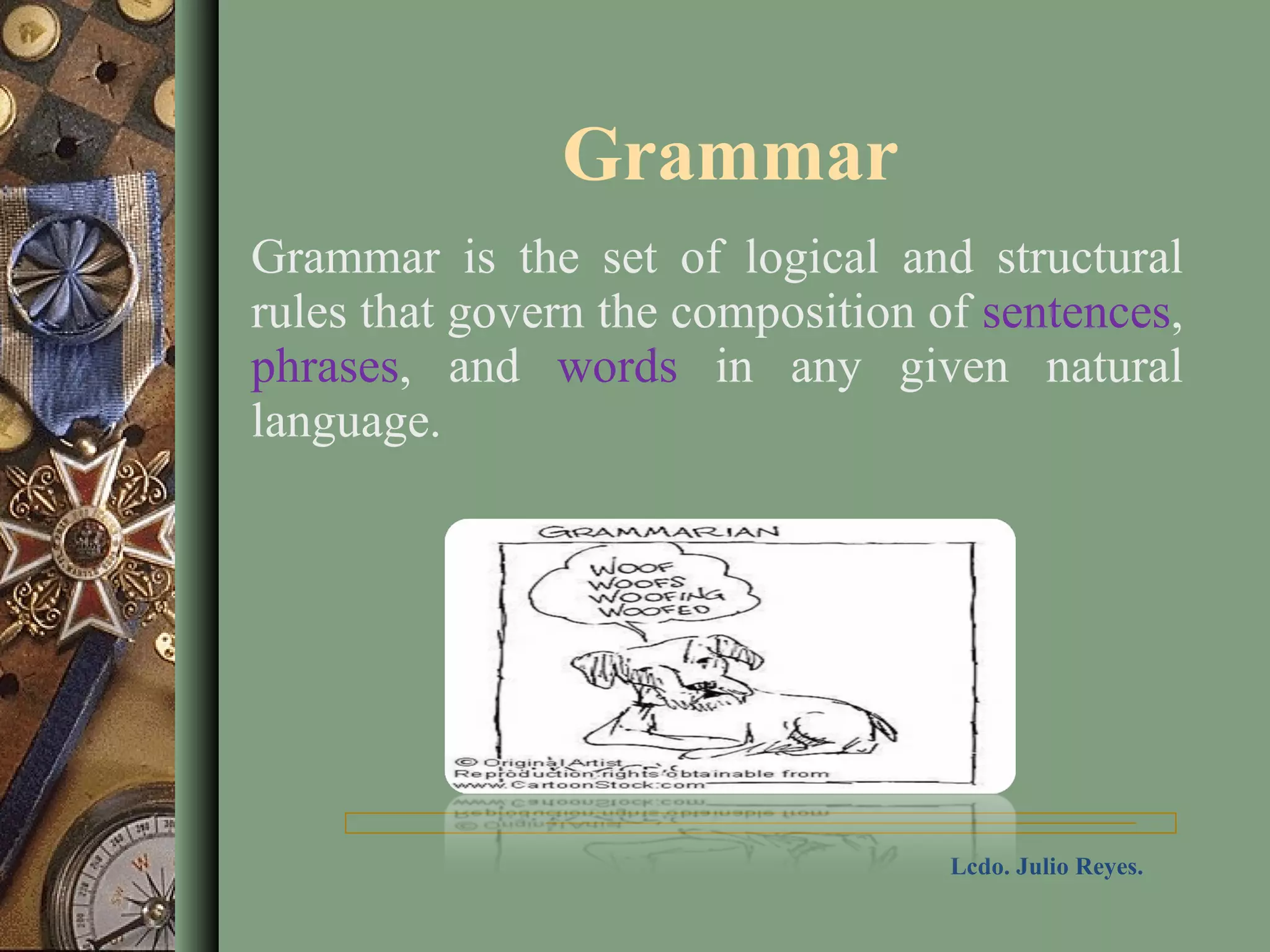
Grammar Grammar is the set of logical and structural rules that govern the composition of  sentences ,  phrases , and  words  in any given natural language.  Lcdo. Julio Reyes.
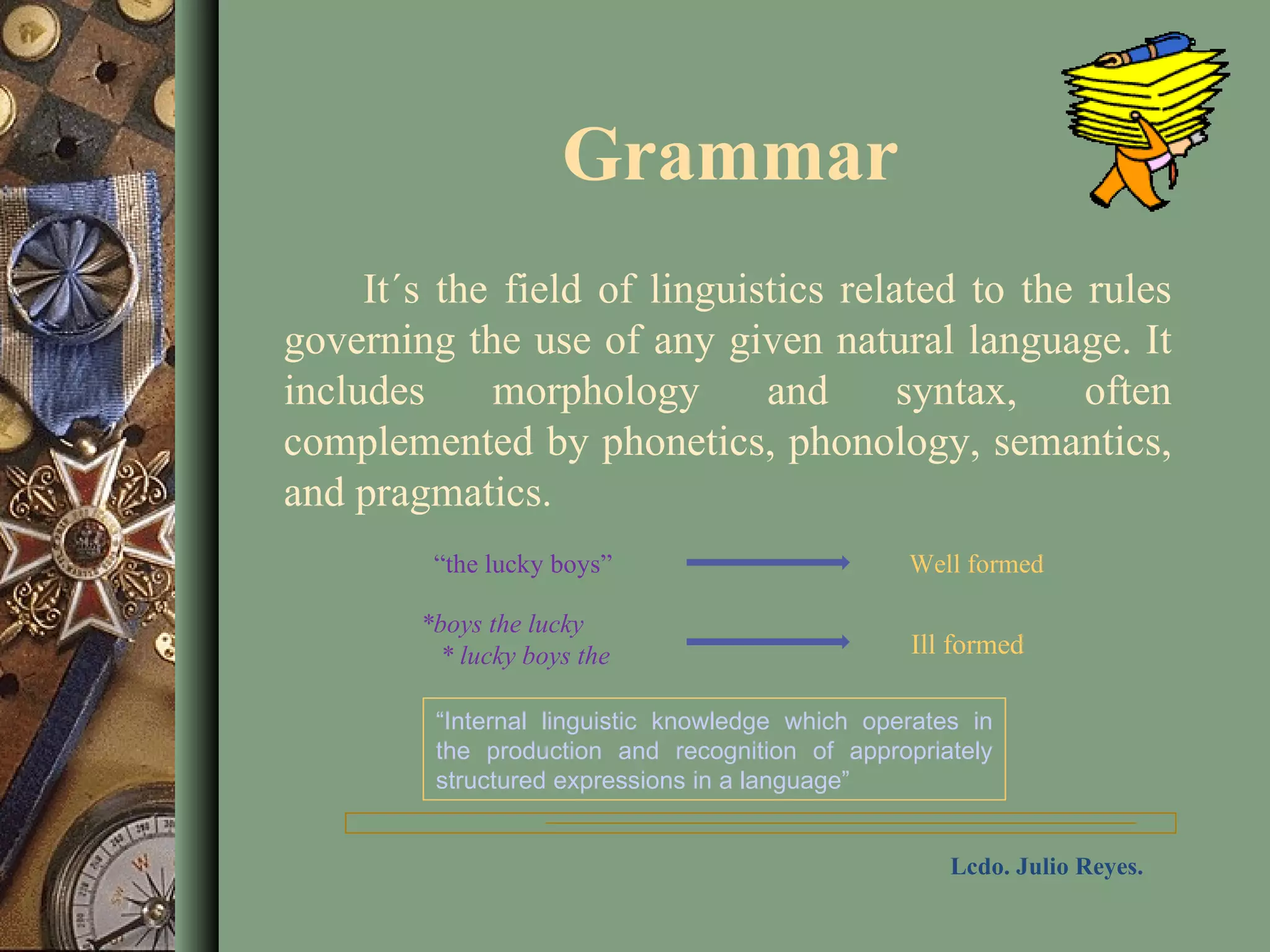
Grammar It´s the field of linguistics related to the rules governing the use of any given natural language. It includes morphology and syntax, often complemented by phonetics, phonology, semantics, and pragmatics. “ Internal linguistic knowledge which operates in the production and recognition of appropriately structured expressions in a language”  Lcdo. Julio Reyes. “ the lucky boys”  Well formed   *boys the lucky  * lucky boys the Ill formed
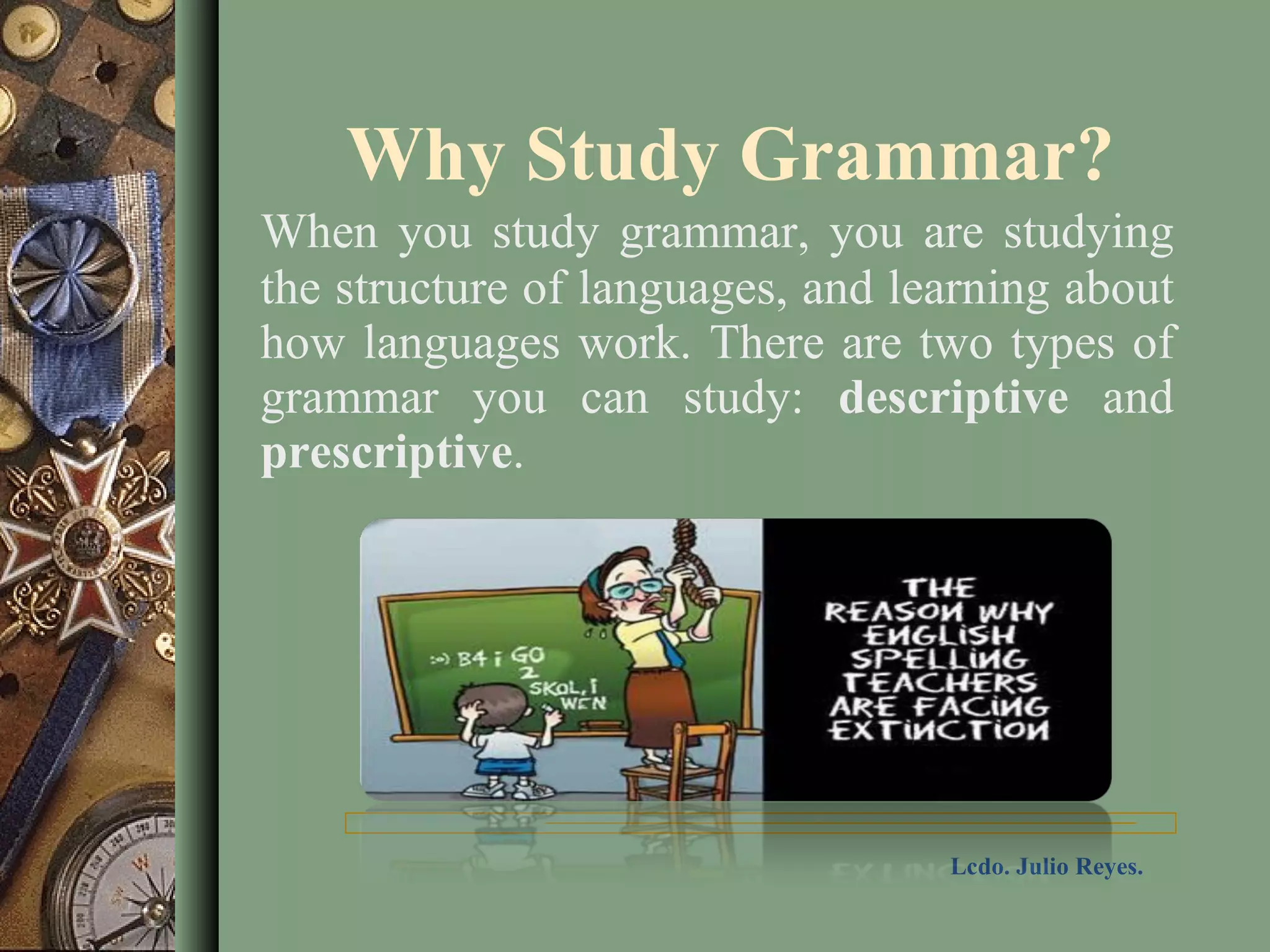
Why Study Grammar? When you study grammar, you are studying the structure of languages, and learning about how languages work. There are two types of grammar you can study:  descriptive  and  prescriptive . Lcdo. Julio Reyes.
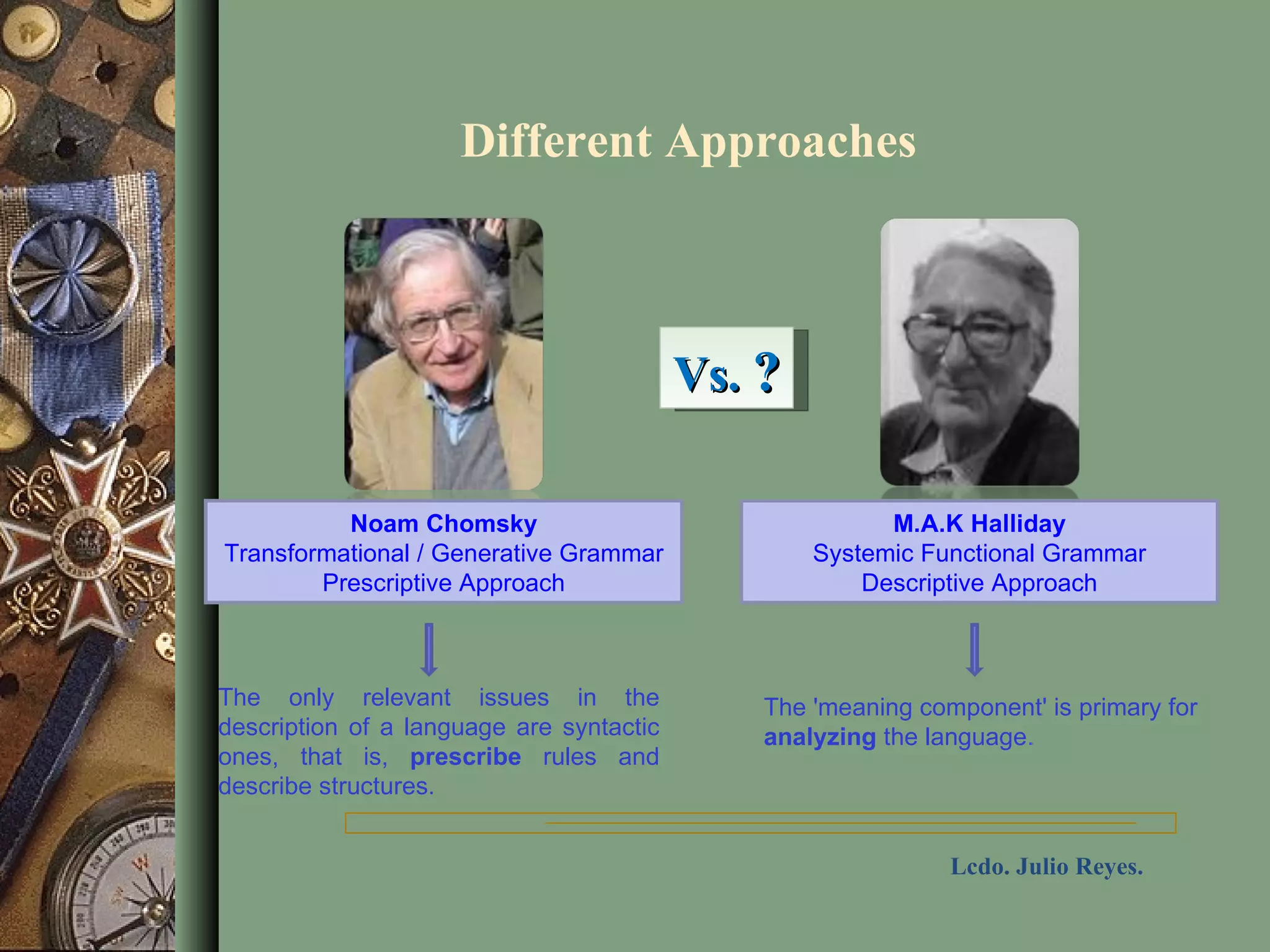
Different Approaches Noam Chomsky Transformational / Generative Grammar Prescriptive Approach M.A.K Halliday Systemic Functional Grammar Descriptive Approach The only relevant issues in the description of a language are syntactic ones, that is,  prescribe  rules and describe structures. The 'meaning component' is primary for  analyzing  the language. Vs.  ? Lcdo. Julio Reyes.
Descriptive Grammar Descriptive grammar , on the one hand, refers to the structure of languages  as they are  actually used . Descriptive grammar is generally produced by  linguists  interested in specific languages or the nature of language in general. Lcdo. Julio Reyes.
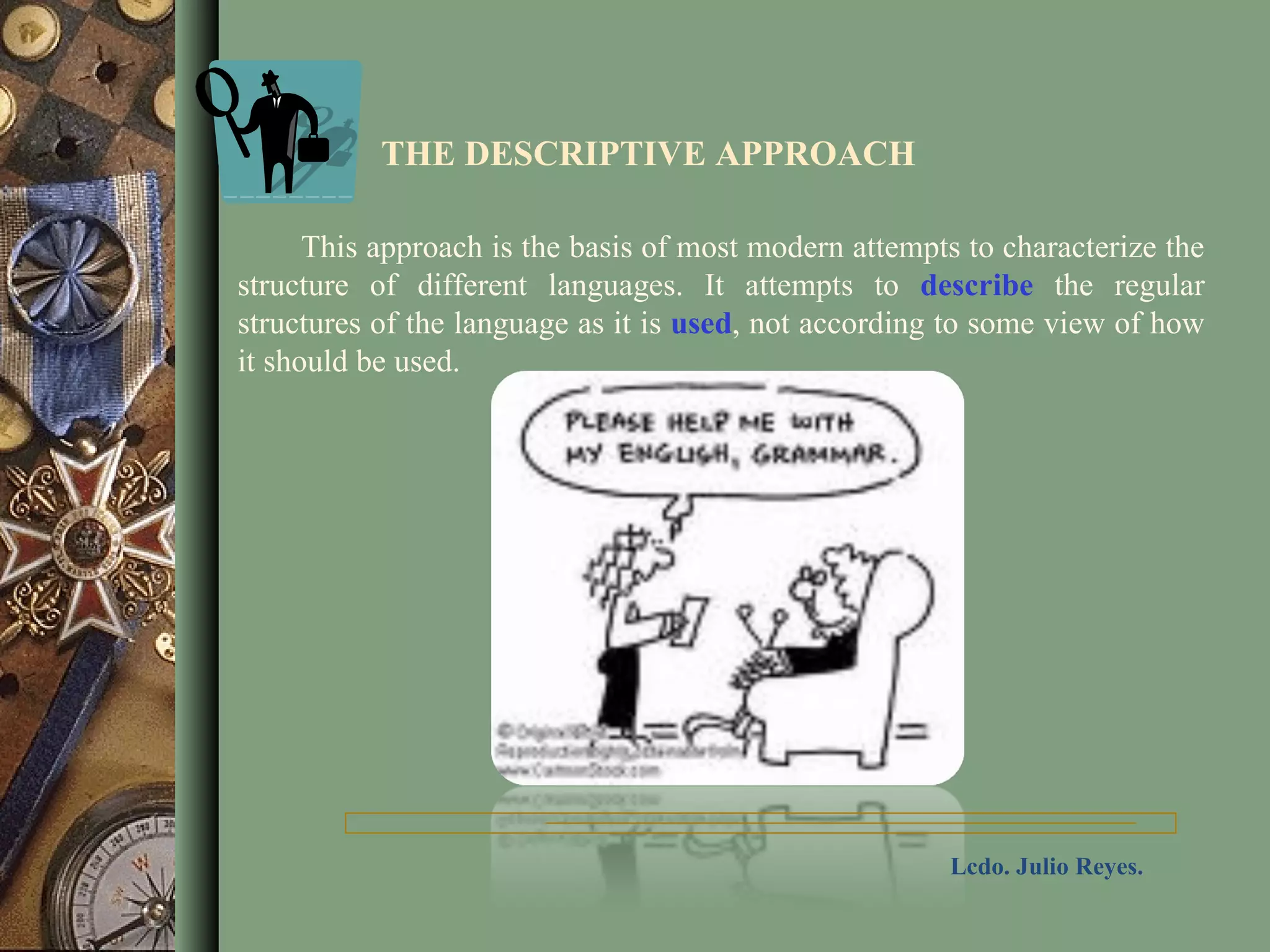
THE DESCRIPTIVE APPROACH This approach is the basis of most modern attempts to characterize the structure of different languages. It attempts to  describe   the regular structures of the language as it is  used , not according to some view of how it should be used.  Lcdo. Julio Reyes.
Prescriptive Grammar Prescriptive grammar  refers to the structure of languages  as people think they  should be used . These grammars are generally developed by  writing and language teachers (grammarians)  who are responsible for instruction in standard forms of expression. They are most frequently applied to the standard written forms of language. Lcdo. Julio Reyes.
The Prescriptive Approach This was an approach taken by some grammarians, mainly in eighteenth-century in England, who set out rules for the correct or  'proper'  use of English.  Structure of English sentences Structure of sentences in Latin. (1) You must not split an infinitive. (2) You must not end a sentence with a preposition. Lcdo. Julio Reyes.
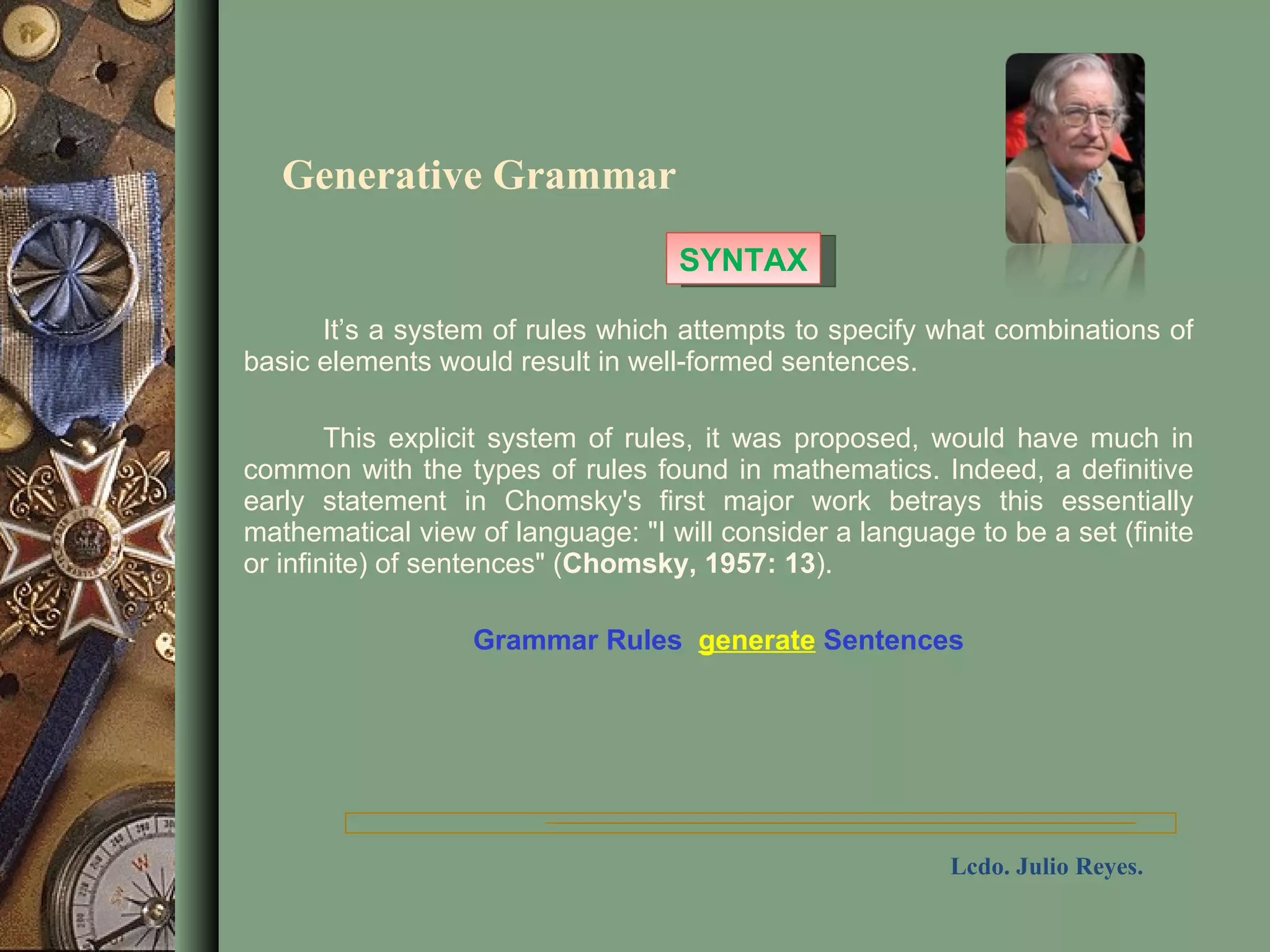
Generative Grammar It’s a system of rules which attempts to specify what combinations of basic elements would result in well-formed sentences. This explicit system of rules, it was proposed, would have much in common with the types of rules found in mathematics. Indeed, a definitive early statement in Chomsky's first major work betrays this essentially mathematical view of language: "I will consider a language to be a set (finite or infinite) of sentences" ( Chomsky, 1957: 13 ). Grammar Rules  generate  Sentences SYNTAX Lcdo. Julio Reyes.
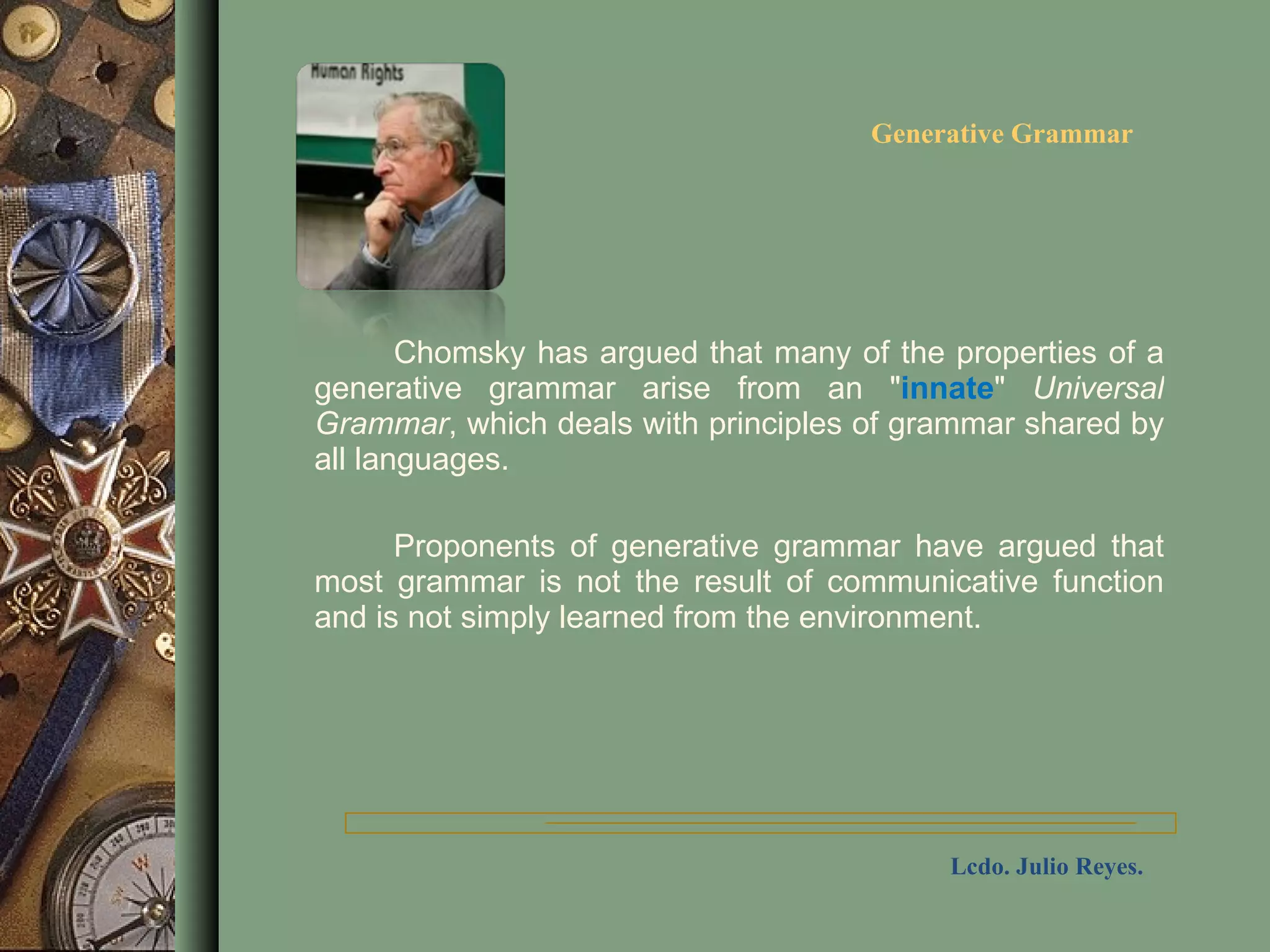
Chomsky has argued that many of the properties of a generative grammar arise from an " innate "  Universal Grammar , which deals with principles of grammar shared by all languages.  Proponents of generative grammar have argued that most grammar is not the result of communicative function and is not simply learned from the environment. Generative Grammar Lcdo. Julio Reyes.
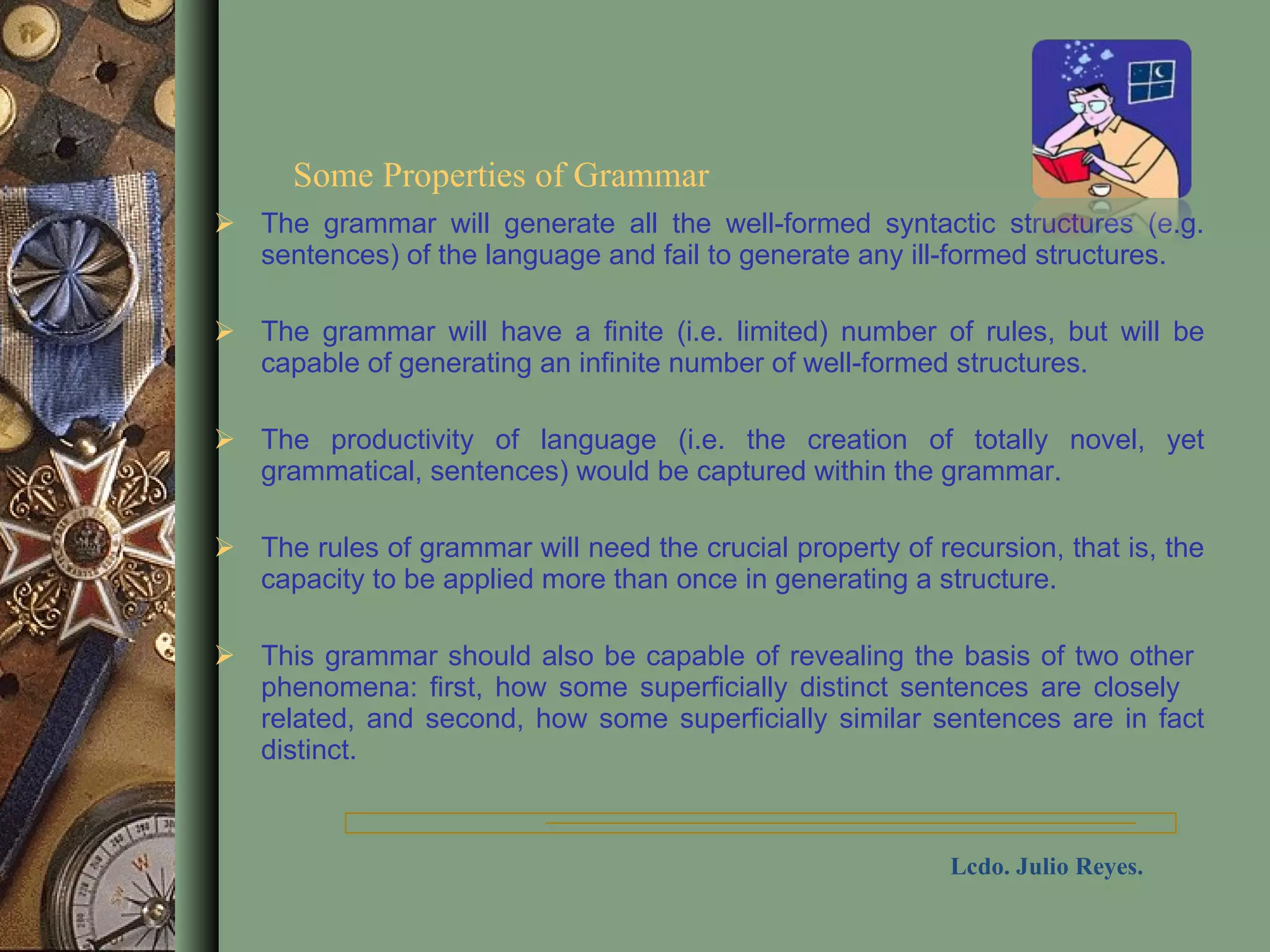
The grammar will generate all the well-formed syntactic structures (e.g. sentences) of the language and fail to generate any ill-formed structures.  The grammar will have a finite (i.e. limited) number of rules, but will be capable of generating an infinite number of well-formed structures. The productivity of language (i.e. the creation of totally novel, yet grammatical, sentences) would be captured within the grammar.  The rules of grammar will need the crucial property of recursion, that is, the capacity to be applied more than once in generating a structure. This grammar should also be capable of revealing the basis of two other  phenomena: first, how some superficially distinct sentences are closely  related, and second, how some superficially similar sentences are in fact distinct.  Some Properties of Grammar Lcdo. Julio Reyes.
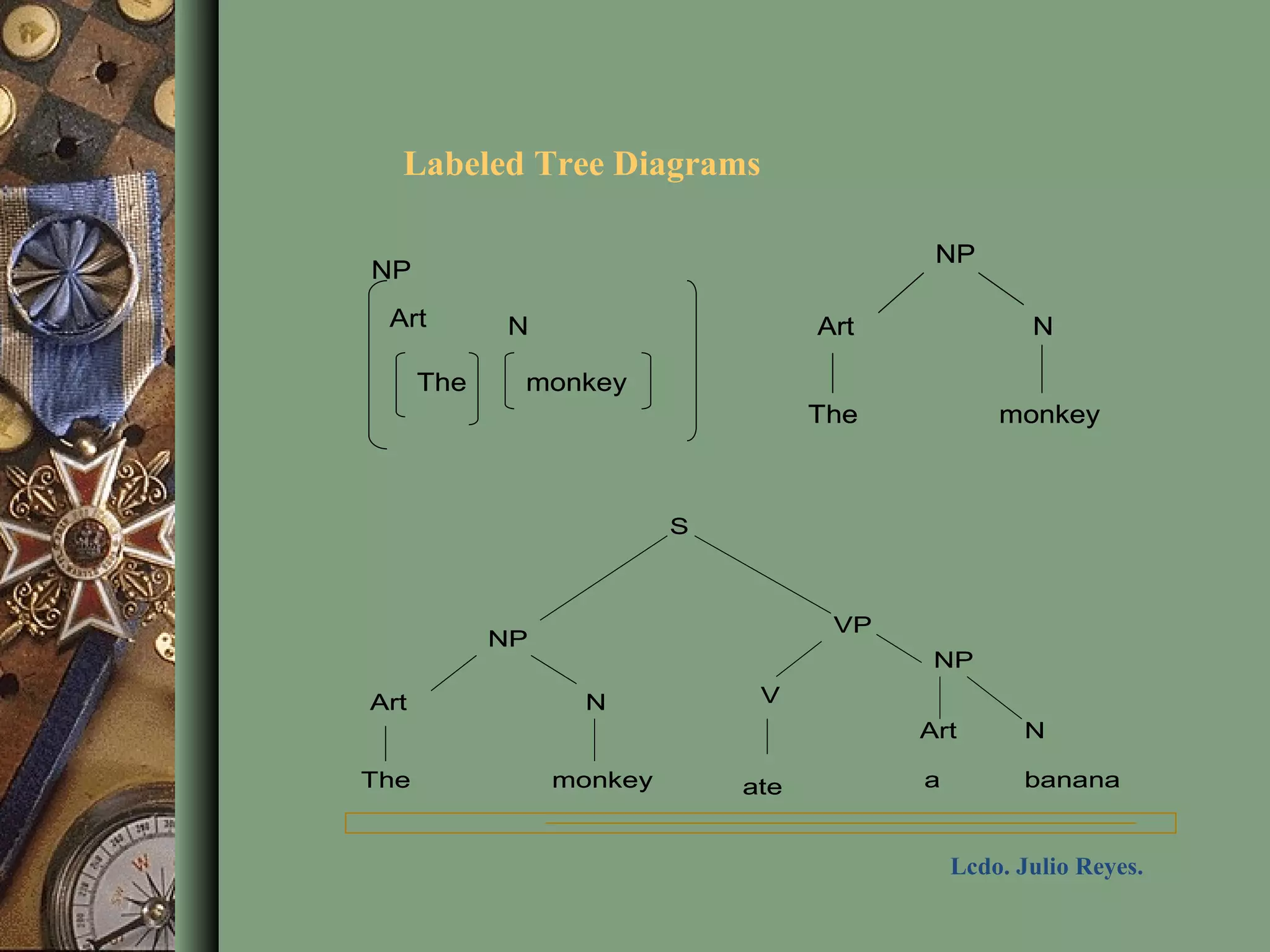
Labeled Tree Diagrams Lcdo. Julio Reyes.
Phrase Structure Rules S  -> NP  VP N  ->  {boy, girl, dog]  V  -> {saw, followed, helped} PN  ->  (George, Mary]  Prep  -> {with, near} Art  ->  {a, the]  Adv  ->  (yesterday, recently} Adj   ->  (small, crazy} Lcdo. Julio Reyes.
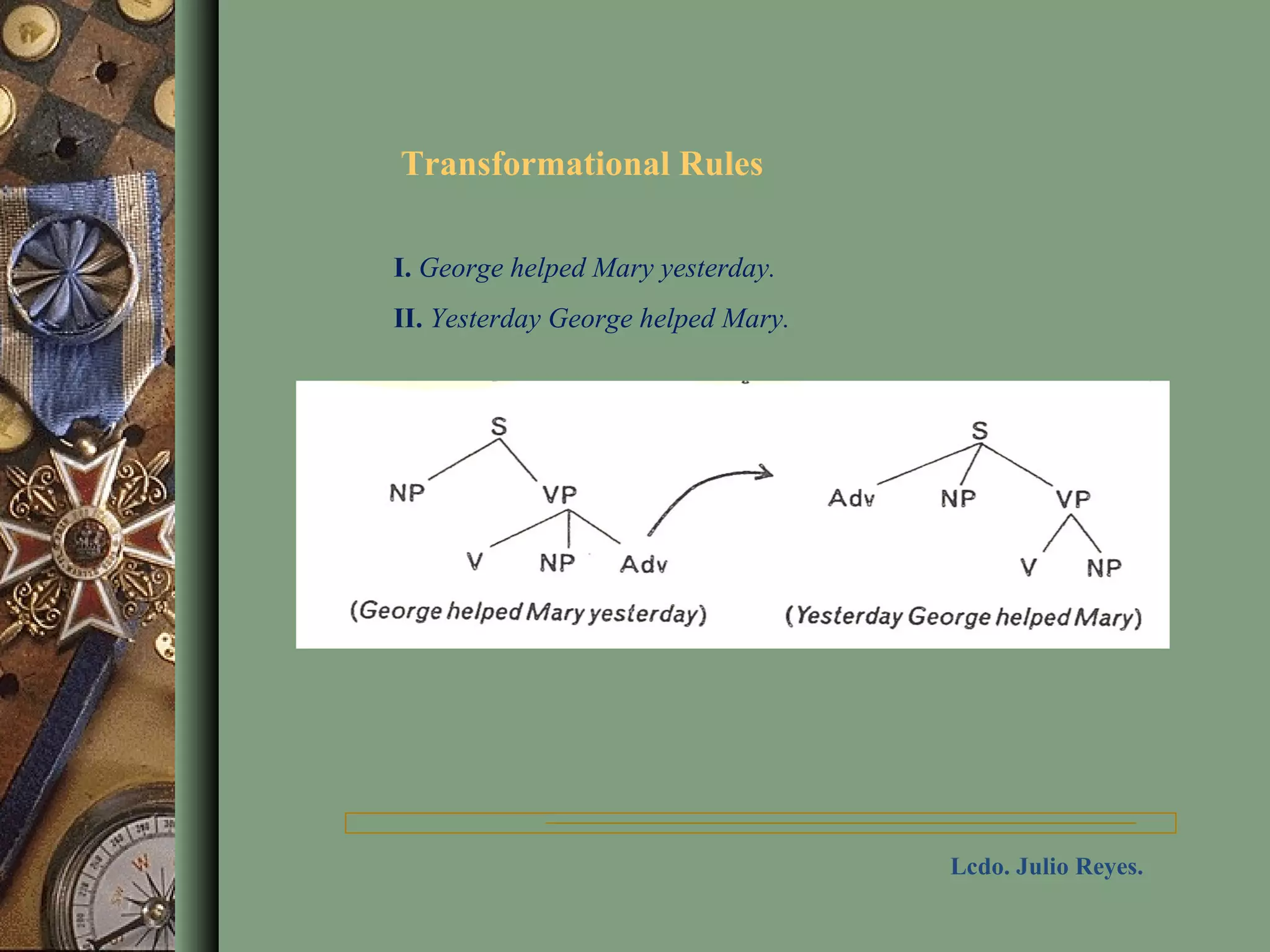
Transformational Rules I.  George helped Mary yesterday.  II.  Yesterday George helped Mary. Lcdo. Julio Reyes.
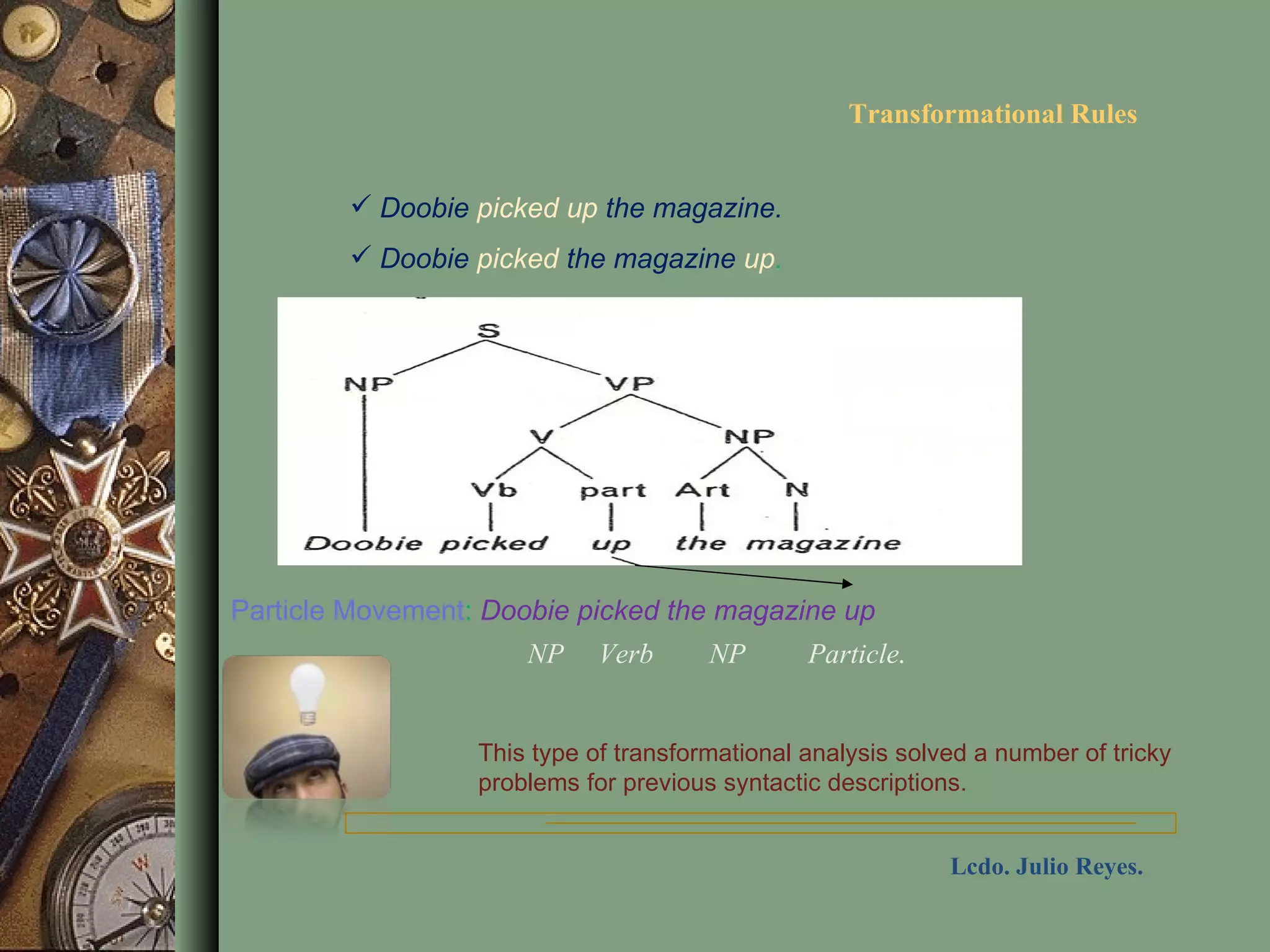
Transformational Rules Particle Movement :  Doobie picked the magazine up Doobie  picked up  the magazine. Doobie  picked  the magazine  up . This type of transformational analysis solved a number of tricky problems for previous syntactic descriptions.  NP  Verb  NP  Particle .  Lcdo. Julio Reyes.
Questions ? Lcdo. Julio Reyes.
 
An English professor wrote the sentence:  “ A woman without her man is nothing” On the blackboard and then asked his students to punctuate it correctly. All of the male students in the class wrote: “ A woman, without her man, is nothing. All of the females in the classroom wrote: A woman: without her, man is nothing. Lcdo. Julio Reyes.
Lcdo. Julio Reyes.
 

structure-vs-function-TRIAL

  • 1.
    Santa Ana deCoro, January 2010 UNIVERSIDAD NACIONAL EXPERIMETAL “ FRANCISCO DE MIRANDA” AREA CIENCIAS DE LA Educación PROGRAMA DE EDUCACION MENCION INGLES LCDO. JULIO REYES
  • 2.
  • 3.
    Grammar Grammar isthe set of logical and structural rules that govern the composition of sentences , phrases , and words in any given natural language. Lcdo. Julio Reyes.
  • 4.
    Grammar It´s thefield of linguistics related to the rules governing the use of any given natural language. It includes morphology and syntax, often complemented by phonetics, phonology, semantics, and pragmatics. “ Internal linguistic knowledge which operates in the production and recognition of appropriately structured expressions in a language” Lcdo. Julio Reyes. “ the lucky boys” Well formed *boys the lucky * lucky boys the Ill formed
  • 5.
    Why Study Grammar?When you study grammar, you are studying the structure of languages, and learning about how languages work. There are two types of grammar you can study: descriptive and prescriptive . Lcdo. Julio Reyes.
  • 6.
    Different Approaches NoamChomsky Transformational / Generative Grammar Prescriptive Approach M.A.K Halliday Systemic Functional Grammar Descriptive Approach The only relevant issues in the description of a language are syntactic ones, that is, prescribe rules and describe structures. The 'meaning component' is primary for analyzing the language. Vs. ? Lcdo. Julio Reyes.
  • 7.
    Descriptive Grammar Descriptivegrammar , on the one hand, refers to the structure of languages as they are actually used . Descriptive grammar is generally produced by linguists interested in specific languages or the nature of language in general. Lcdo. Julio Reyes.
  • 8.
    THE DESCRIPTIVE APPROACHThis approach is the basis of most modern attempts to characterize the structure of different languages. It attempts to describe the regular structures of the language as it is used , not according to some view of how it should be used. Lcdo. Julio Reyes.
  • 9.
    Prescriptive Grammar Prescriptivegrammar refers to the structure of languages as people think they should be used . These grammars are generally developed by writing and language teachers (grammarians) who are responsible for instruction in standard forms of expression. They are most frequently applied to the standard written forms of language. Lcdo. Julio Reyes.
  • 10.
    The Prescriptive ApproachThis was an approach taken by some grammarians, mainly in eighteenth-century in England, who set out rules for the correct or 'proper' use of English. Structure of English sentences Structure of sentences in Latin. (1) You must not split an infinitive. (2) You must not end a sentence with a preposition. Lcdo. Julio Reyes.
  • 11.
    Generative Grammar It’sa system of rules which attempts to specify what combinations of basic elements would result in well-formed sentences. This explicit system of rules, it was proposed, would have much in common with the types of rules found in mathematics. Indeed, a definitive early statement in Chomsky's first major work betrays this essentially mathematical view of language: "I will consider a language to be a set (finite or infinite) of sentences" ( Chomsky, 1957: 13 ). Grammar Rules generate Sentences SYNTAX Lcdo. Julio Reyes.
  • 12.
    Chomsky has arguedthat many of the properties of a generative grammar arise from an " innate " Universal Grammar , which deals with principles of grammar shared by all languages. Proponents of generative grammar have argued that most grammar is not the result of communicative function and is not simply learned from the environment. Generative Grammar Lcdo. Julio Reyes.
  • 13.
    The grammar willgenerate all the well-formed syntactic structures (e.g. sentences) of the language and fail to generate any ill-formed structures. The grammar will have a finite (i.e. limited) number of rules, but will be capable of generating an infinite number of well-formed structures. The productivity of language (i.e. the creation of totally novel, yet grammatical, sentences) would be captured within the grammar. The rules of grammar will need the crucial property of recursion, that is, the capacity to be applied more than once in generating a structure. This grammar should also be capable of revealing the basis of two other phenomena: first, how some superficially distinct sentences are closely related, and second, how some superficially similar sentences are in fact distinct. Some Properties of Grammar Lcdo. Julio Reyes.
  • 14.
    Labeled Tree DiagramsLcdo. Julio Reyes.
  • 15.
    Phrase Structure RulesS -> NP VP N -> {boy, girl, dog] V -> {saw, followed, helped} PN -> (George, Mary] Prep -> {with, near} Art -> {a, the] Adv -> (yesterday, recently} Adj -> (small, crazy} Lcdo. Julio Reyes.
  • 16.
    Transformational Rules I. George helped Mary yesterday. II. Yesterday George helped Mary. Lcdo. Julio Reyes.
  • 17.
    Transformational Rules ParticleMovement : Doobie picked the magazine up Doobie picked up the magazine. Doobie picked the magazine up . This type of transformational analysis solved a number of tricky problems for previous syntactic descriptions. NP Verb NP Particle . Lcdo. Julio Reyes.
  • 18.
    Questions ? Lcdo.Julio Reyes.
  • 19.
  • 20.
    An English professorwrote the sentence: “ A woman without her man is nothing” On the blackboard and then asked his students to punctuate it correctly. All of the male students in the class wrote: “ A woman, without her man, is nothing. All of the females in the classroom wrote: A woman: without her, man is nothing. Lcdo. Julio Reyes.
  • 21.
  • 22.