DEFINITION
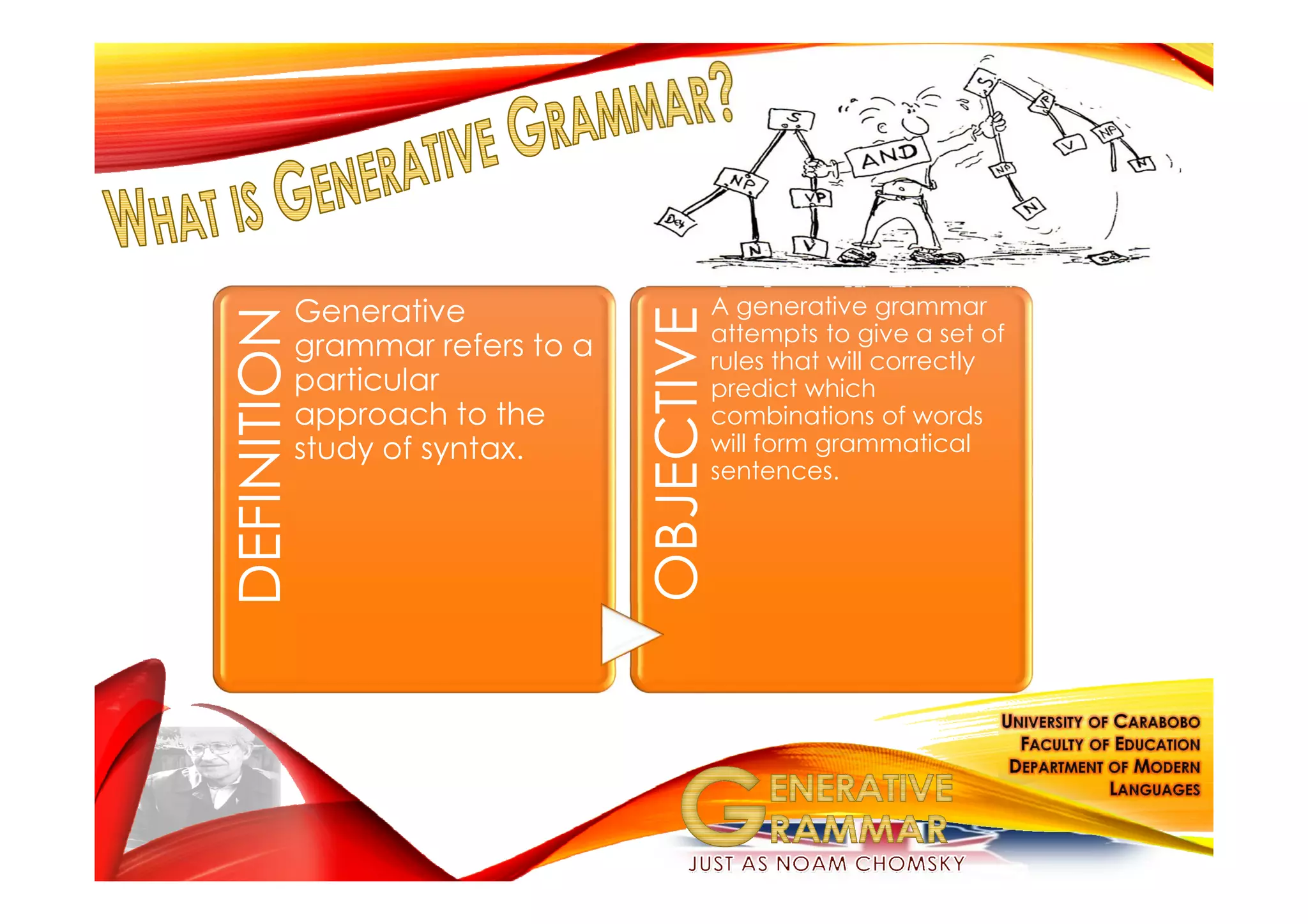
Generative
grammar refers to a
particular
approach to the
study of syntax.
OBJECTIVE
A generative grammar
attempts to give a set of
rules that will correctly
predict which
combinations of words
will form grammatical
sentences.
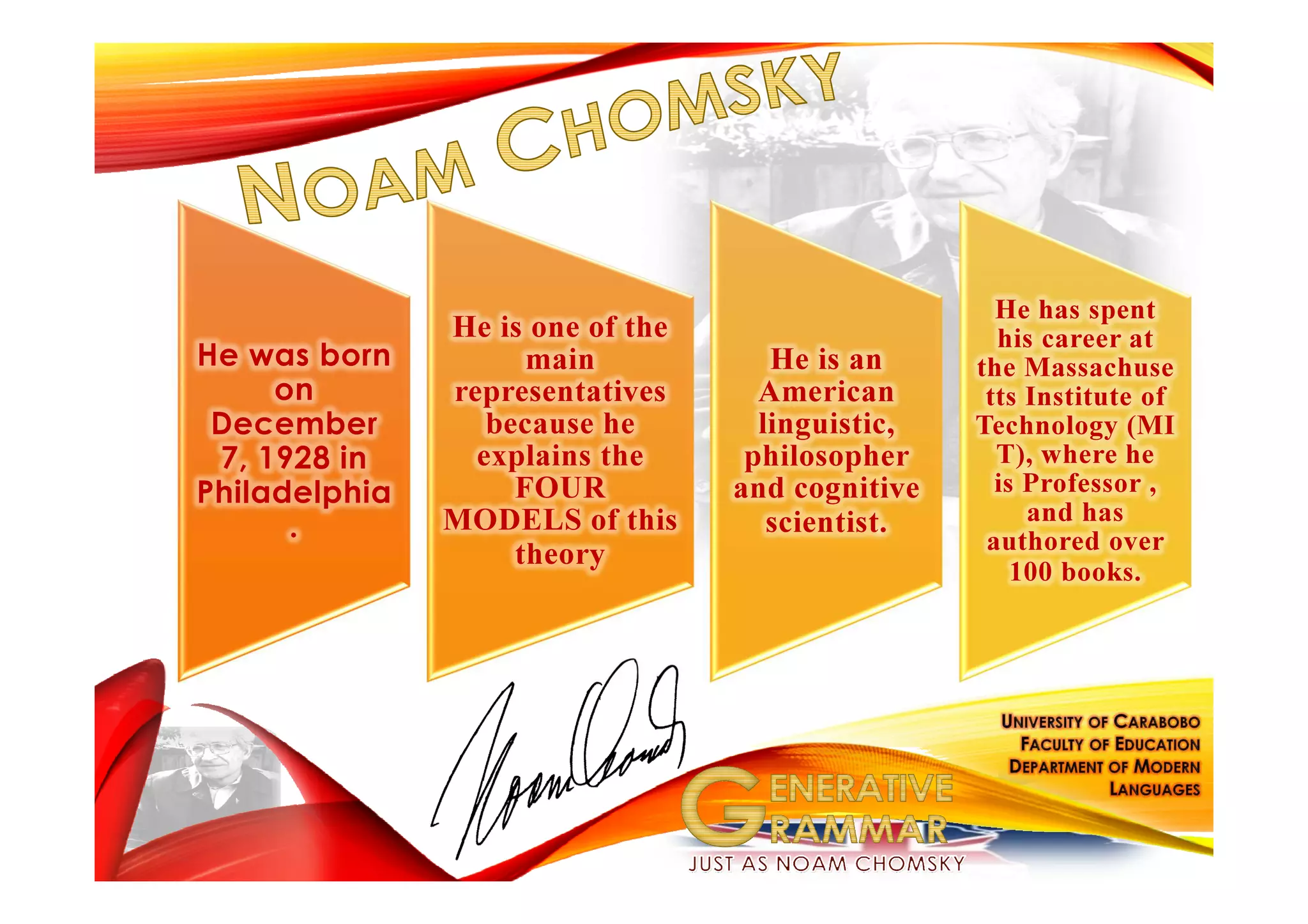
He was born
on
December
7, 1928 in
Philadelphia
.
He is one of the
main
representatives
because he
explains the
FOUR
MODELS of this
theory
He is an
American
linguistic,
philosopher
and cognitive
scientist.
He has spent
his career at
the Massachuse
tts Institute of
Technology (MI
T), where he
is Professor ,
and has
authored over
100 books.
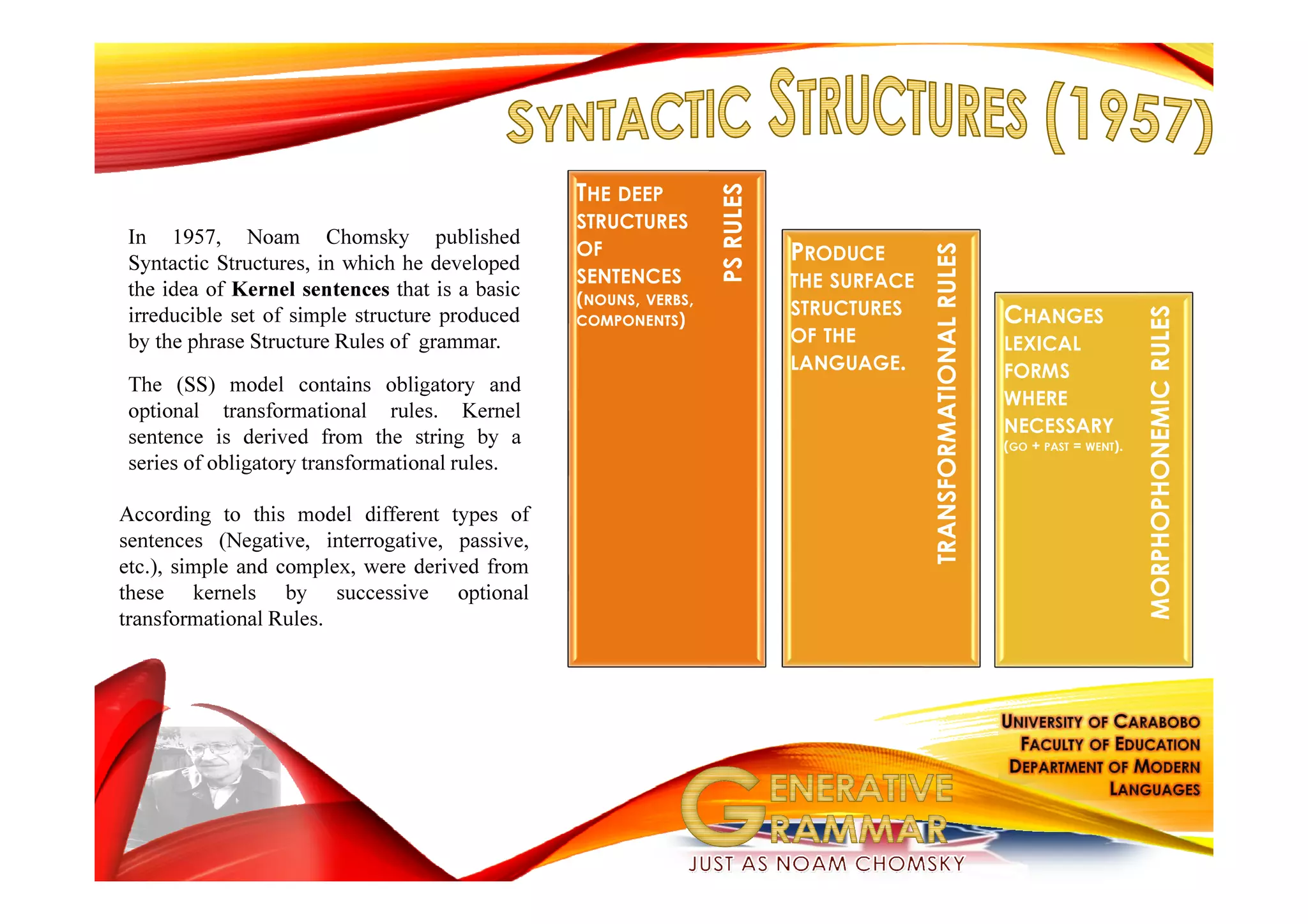
In 1957, Noam Chomsky published
Syntactic Structures, in which he developed
the idea of Kernel sentences that is a basic
irreducible set of simple structure produced
by the phrase Structure Rules of grammar.
The (SS) model contains obligatory and
optional transformational rules. Kernel
sentence is derived from the string by a
series of obligatory transformational rules.
According to this model different types of
sentences (Negative, interrogative, passive,
etc.), simple and complex, were derived from
these kernels by successive optional
transformational Rules.
MORPHOPHONEMICRULES
TRANSFORMATIONALRULES
PSRULES
THE DEEP
STRUCTURES
OF
SENTENCES
(NOUNS, VERBS,
COMPONENTS)
PRODUCE
THE SURFACE
STRUCTURES
OF THE
LANGUAGE.
CHANGES
LEXICAL
FORMS
WHERE
NECESSARY
(GO + PAST = WENT).
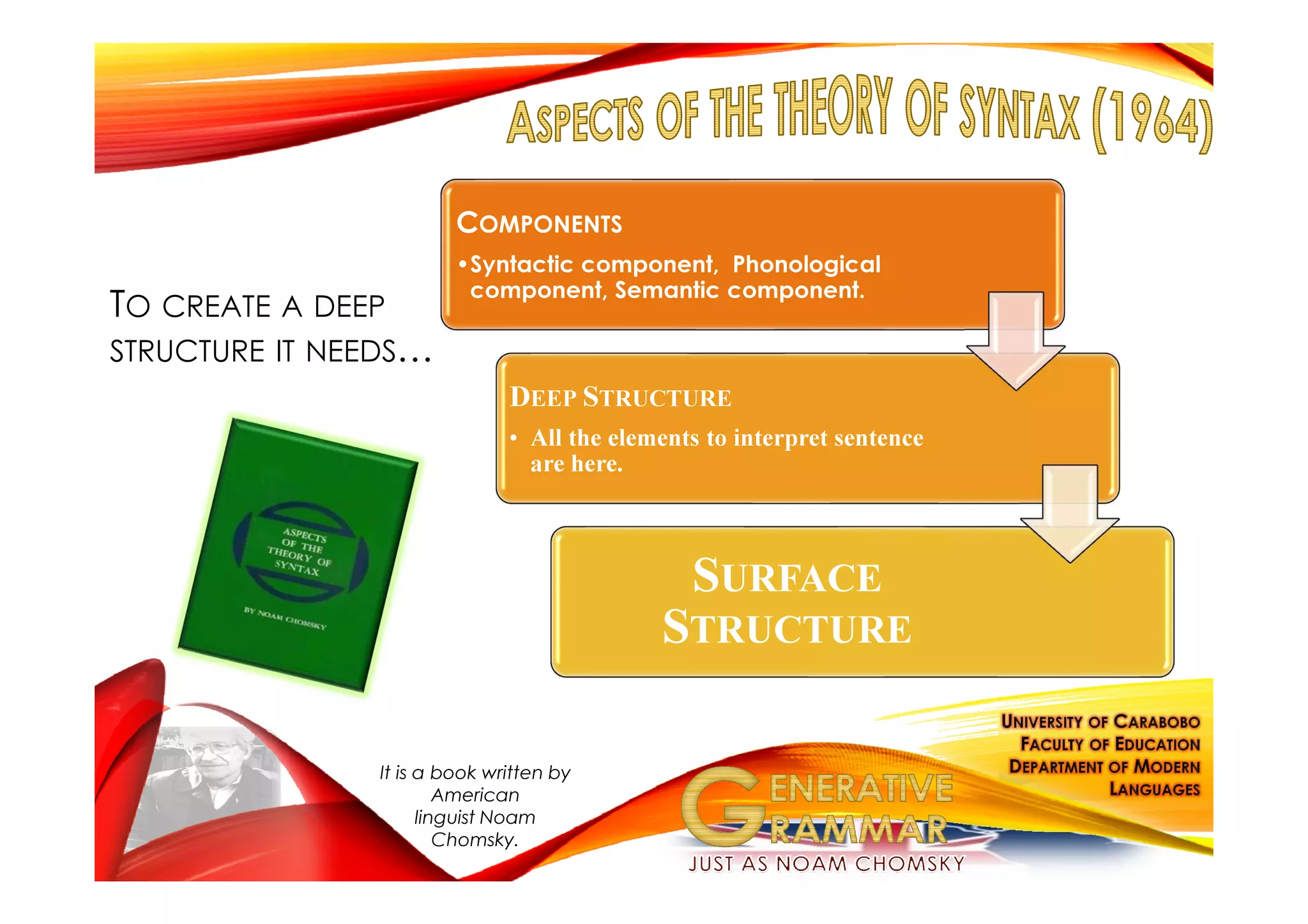
COMPONENTS
•Syntactic component, Phonological
component, Semantic component.
DEEP STRUCTURE
• All the elements to interpret sentence
are here.
SURFACE
STRUCTURE
It is a book written by
American
linguist Noam
Chomsky.
TO CREATE A DEEP
STRUCTURE IT NEEDS…
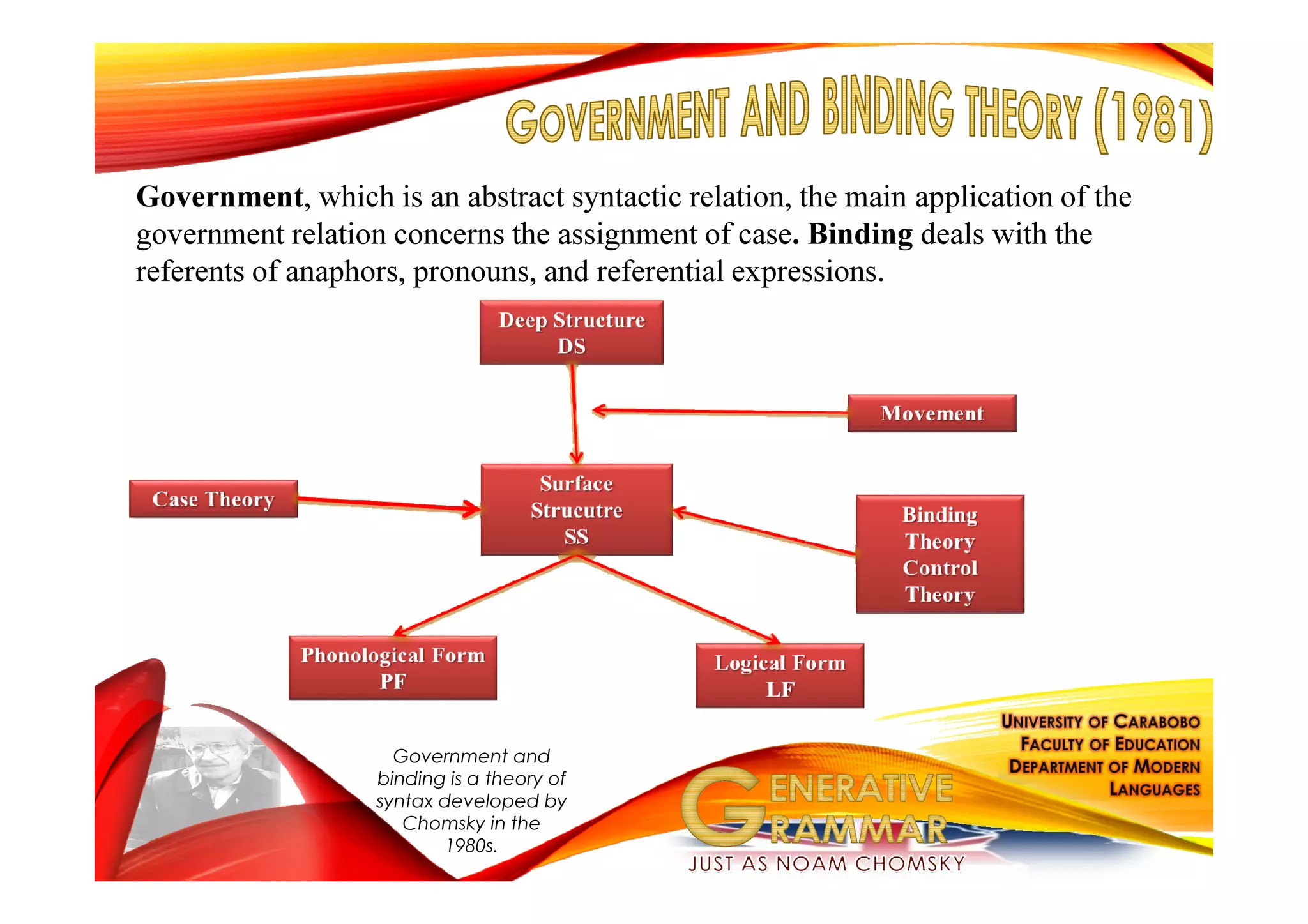
Government and
binding is a theory of
syntax developed by
Chomsky in the
1980s.
Government, which is an abstract syntactic relation, the main application of the
government relation concerns the assignment of case. Binding deals with the
referents of anaphors, pronouns, and referential expressions.
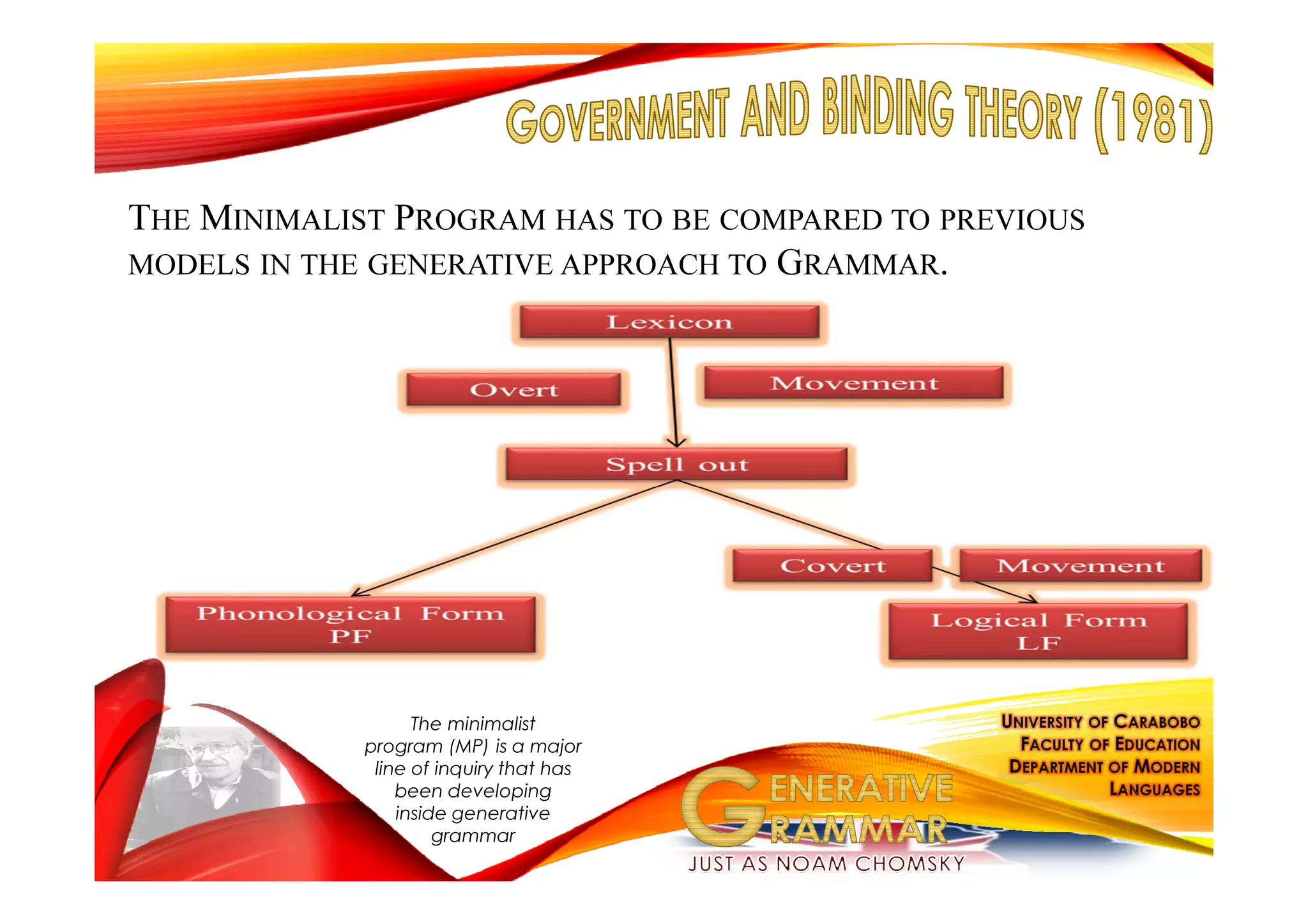
The minimalist
program (MP) is a major
line of inquiry that has
been developing
inside generative
grammar
THE MINIMALIST PROGRAM HAS TO BE COMPARED TO PREVIOUS
MODELS IN THE GENERATIVE APPROACH TO GRAMMAR.
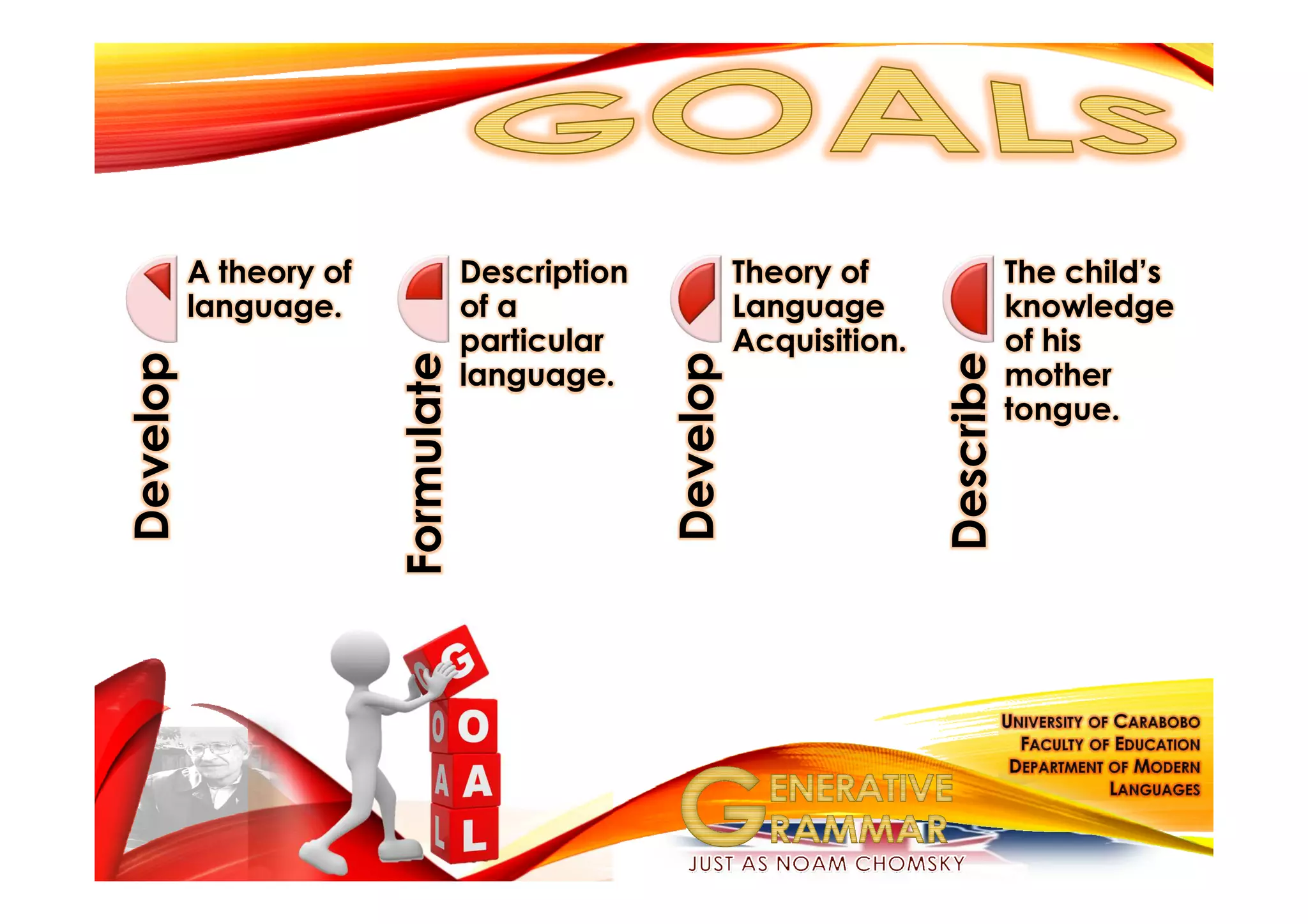
Develop
A theory of
language.
Formulate
Description
of a
particular
language.
Develop
Theory of
Language
Acquisition.
Describe
The child’s
knowledge
of his
mother
tongue.
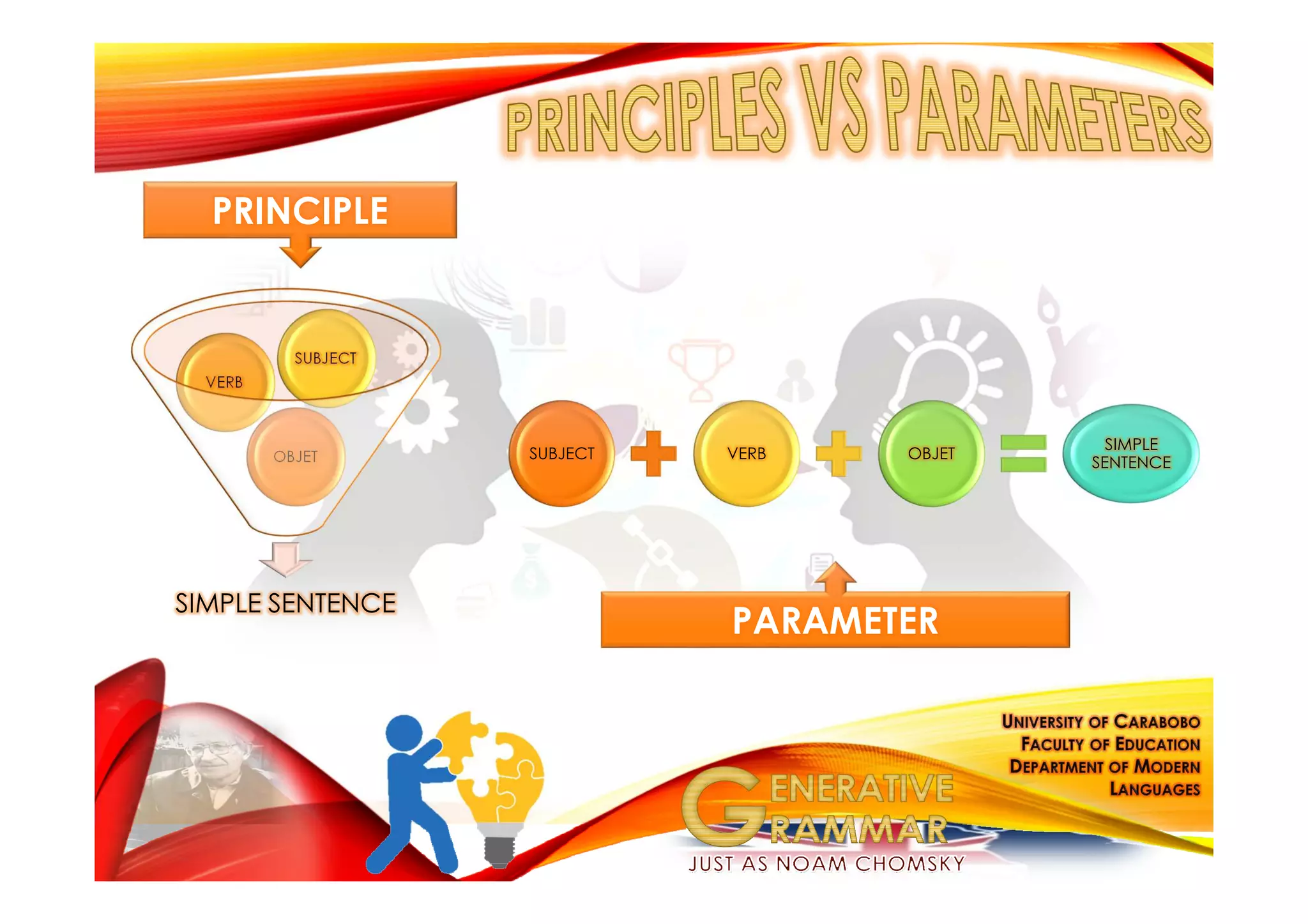
SIMPLE SENTENCE
OBJET
VERB
SUBJECT
PRINCIPLE
SUBJECT VERB OBJET
SIMPLE
SENTENCE
PARAMETER
VS
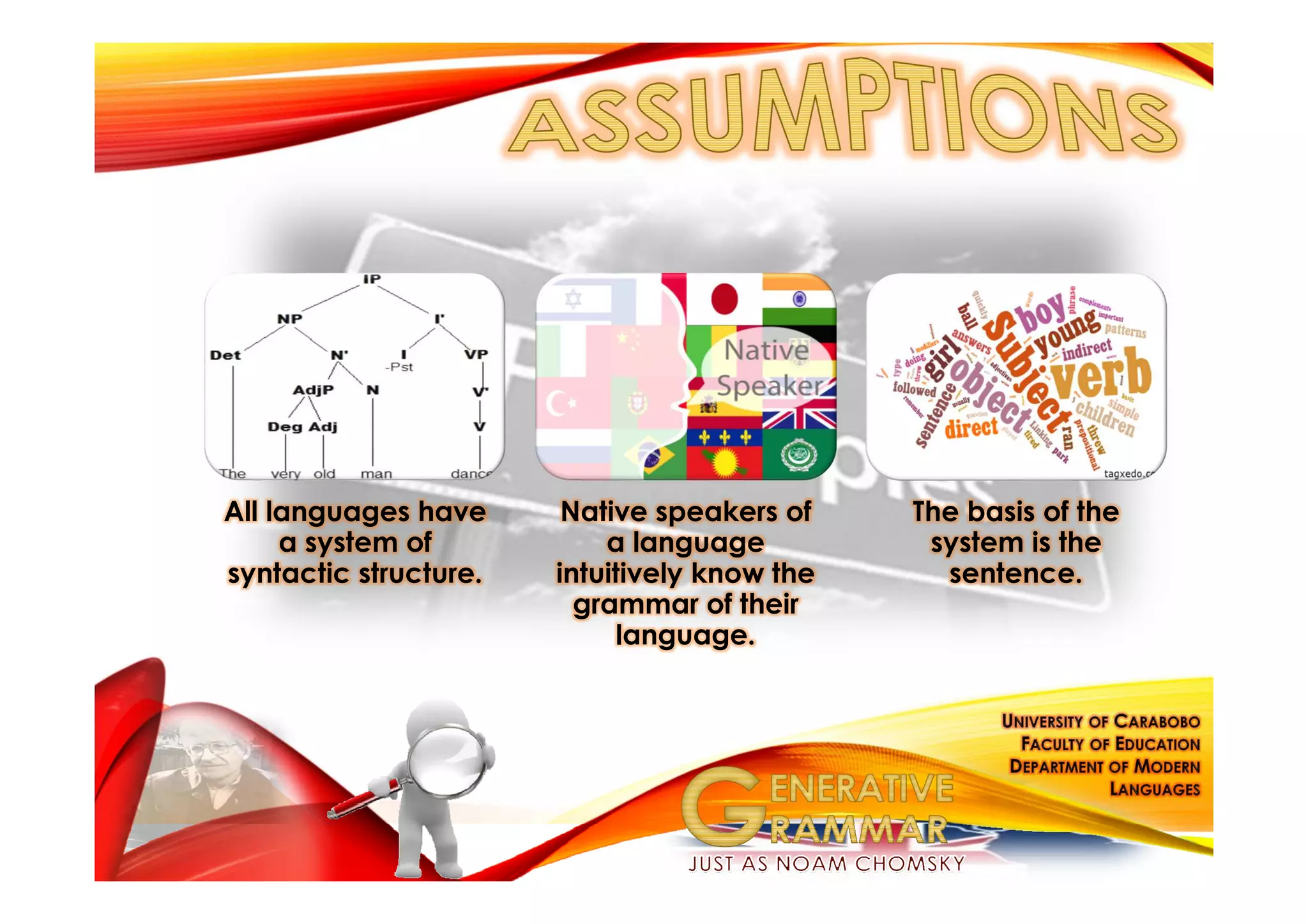
All languages have
a system of
syntactic structure.
Native speakers of
a language
intuitively know the
grammar of their
language.
The basis of the
system is the
sentence.
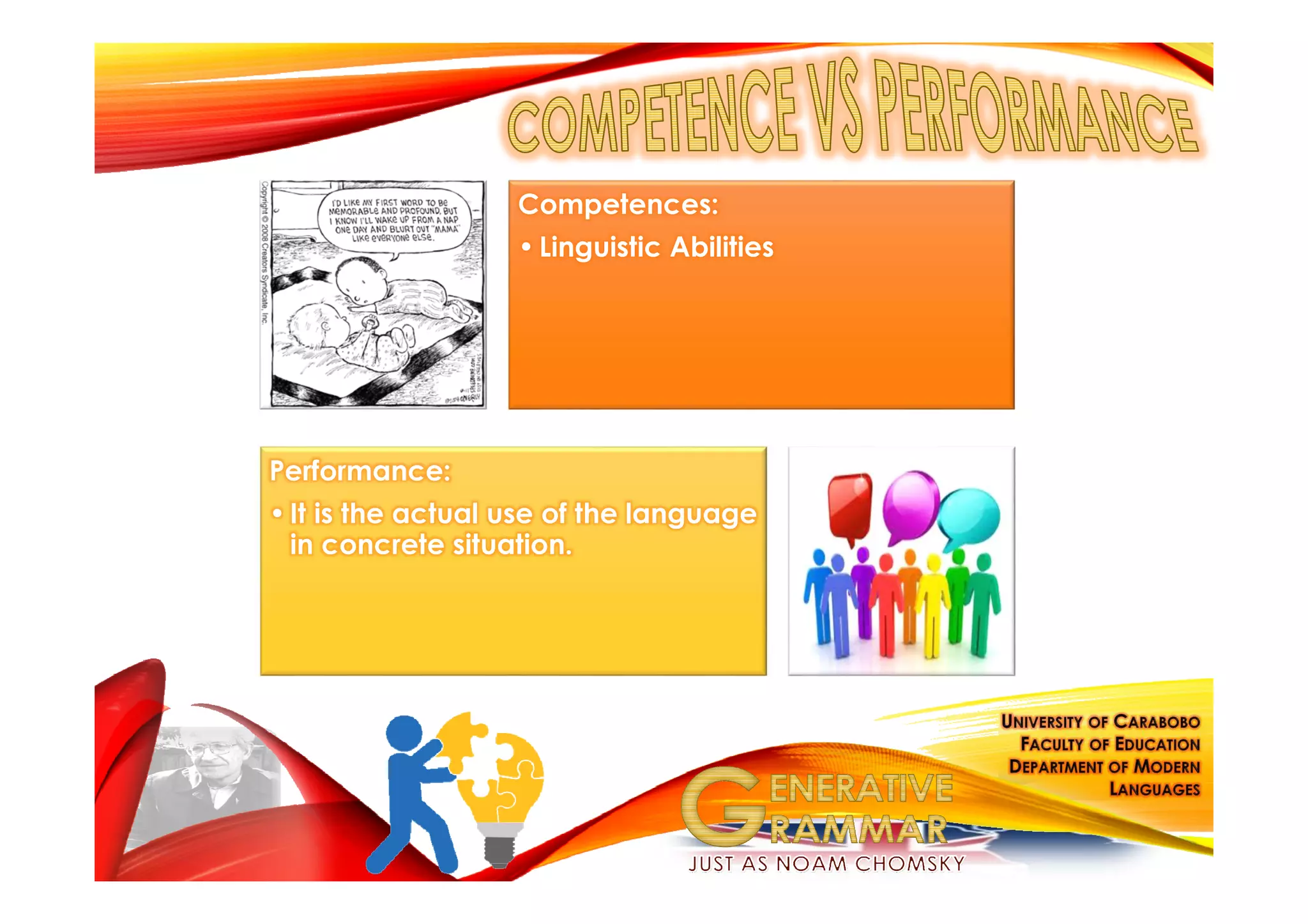
Competences:
• Linguistic Abilities
Performance:
• It is the actual use of the language
in concrete situation.
Competences include:
• Grammatical Competence:
• Knowledge of the grammar of the language.
• Semantic competence.
• Phonological Competence
• Pragmatic Competence:
• Non-linguistic Information.
• Background knowledge.
• Personal Belief in our use and Interpretation of
a sentence
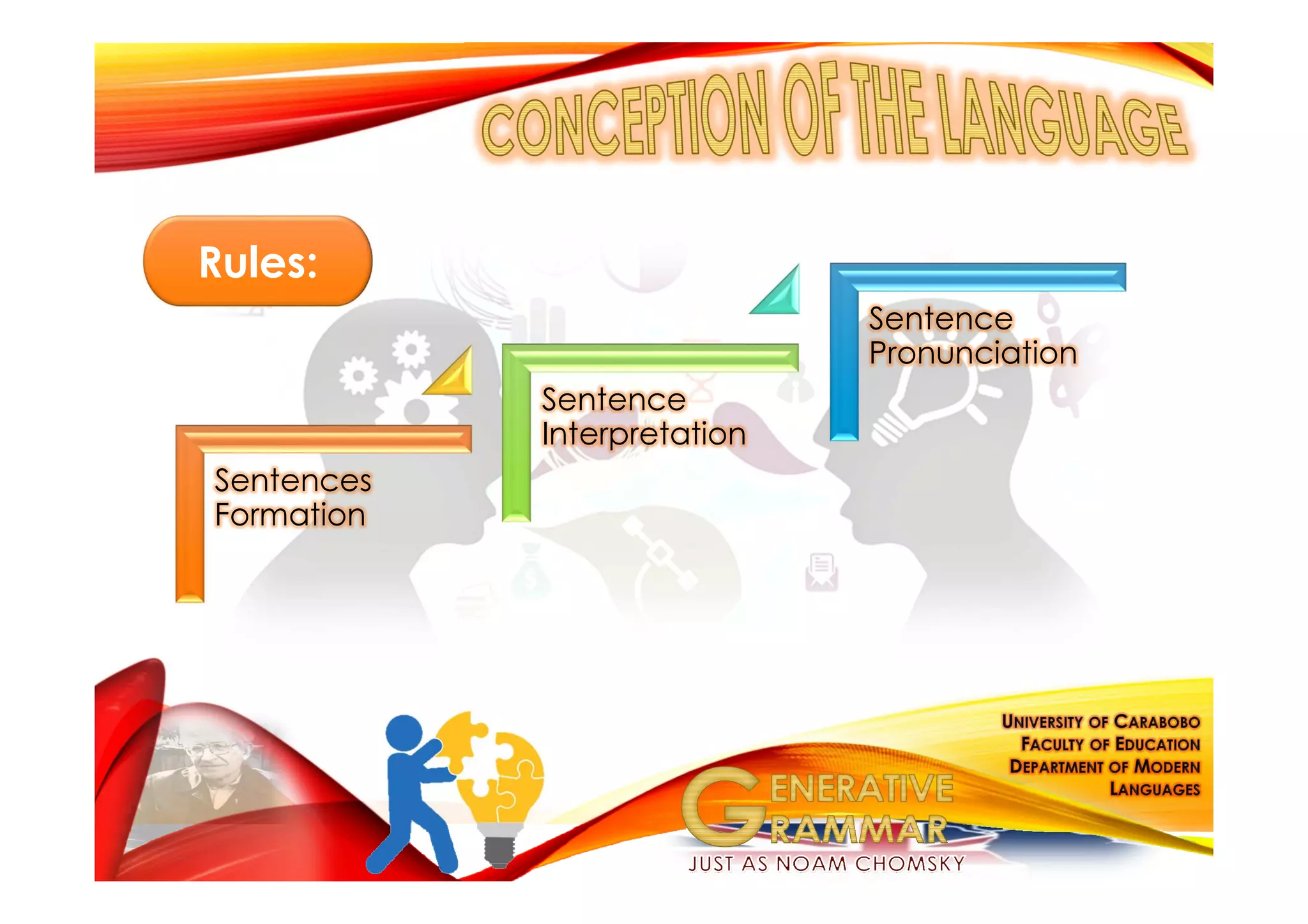
Sentences
Formation
Sentence
Interpretation
Sentence
Pronunciation
Rules:
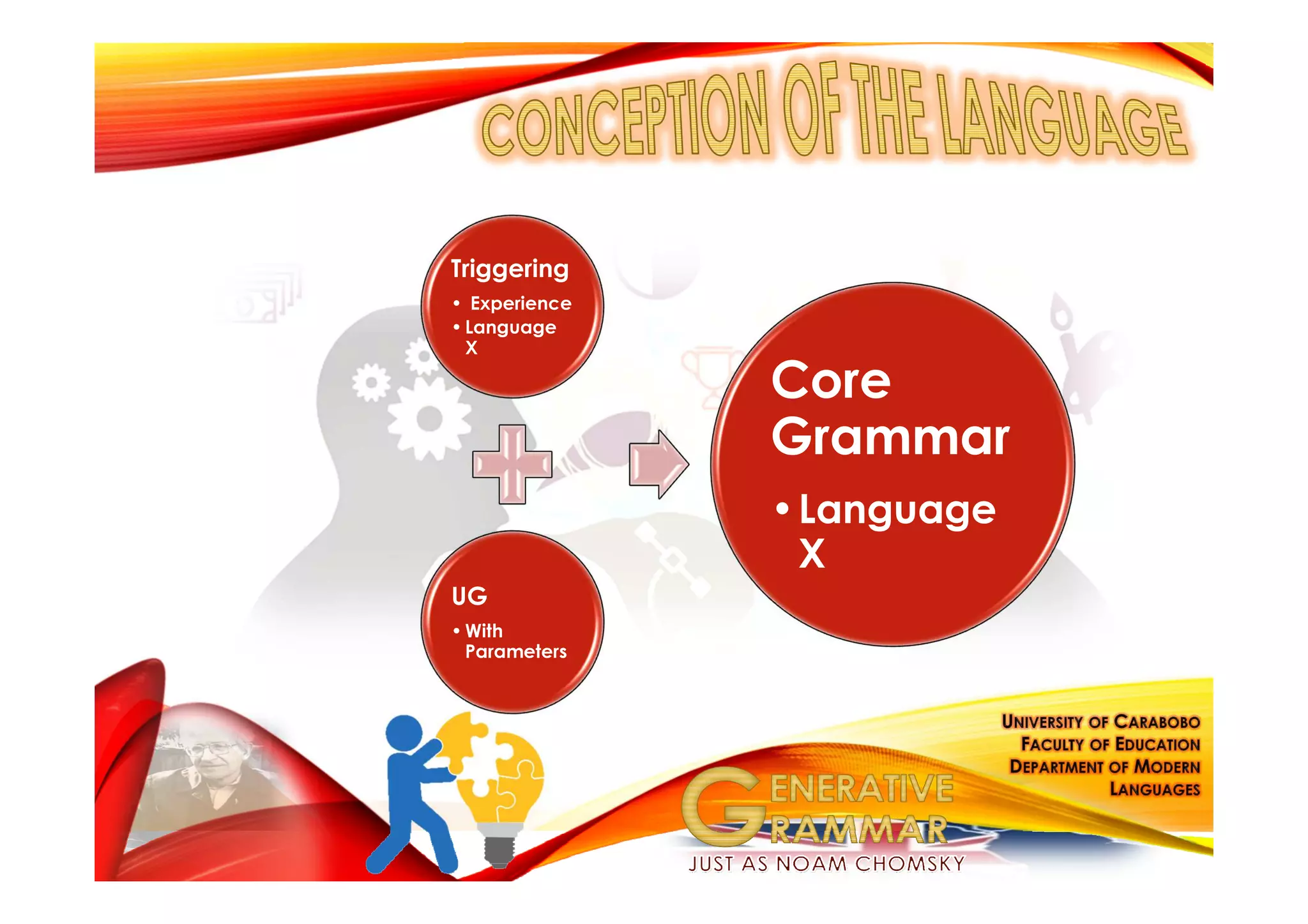
Triggering
• Experience
• Language
X
UG
• With
Parameters
Core
Grammar
•Language
X
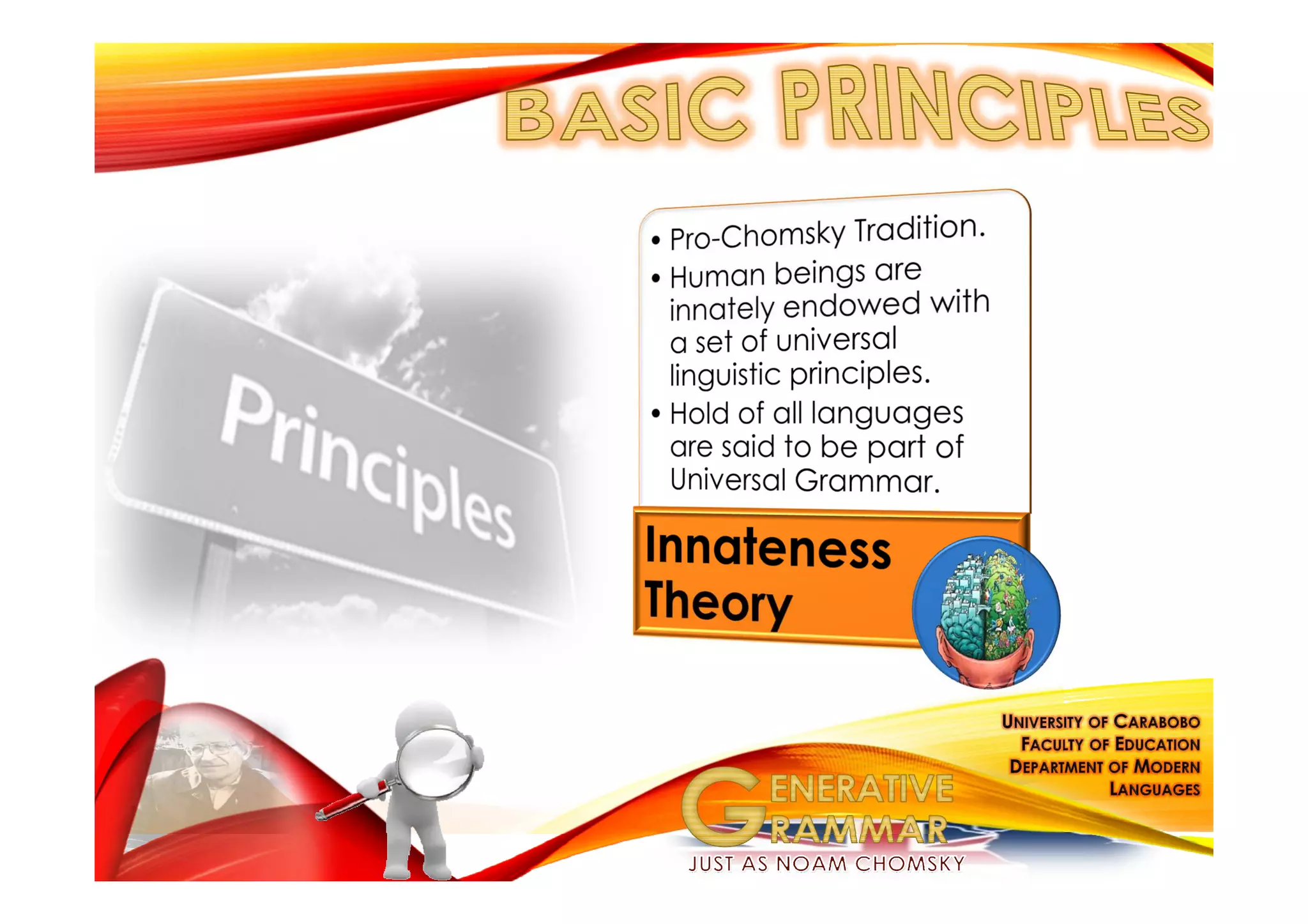
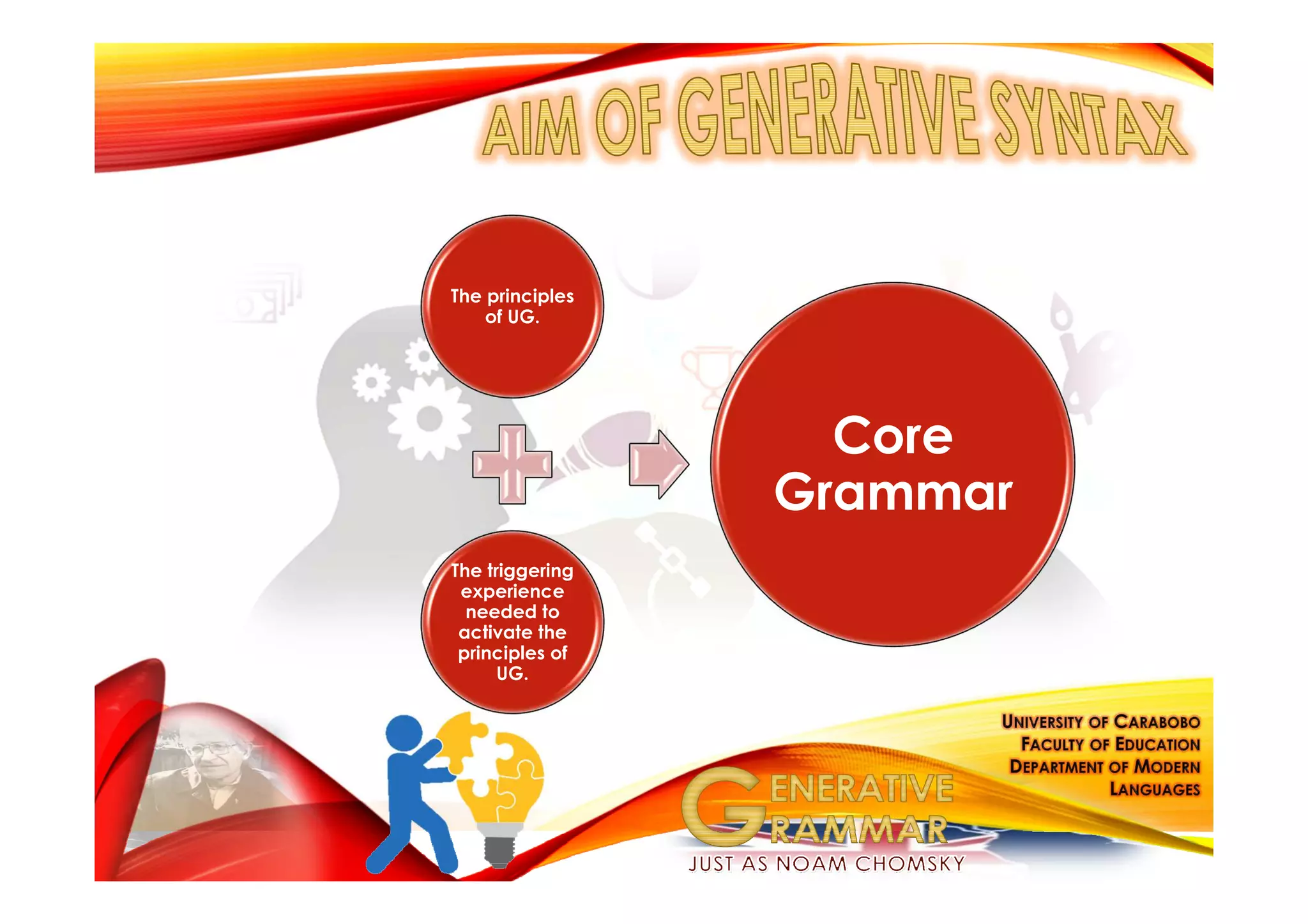
The principles
of UG.
The triggering
experience
needed to
activate the
principles of
UG.
Core
Grammar
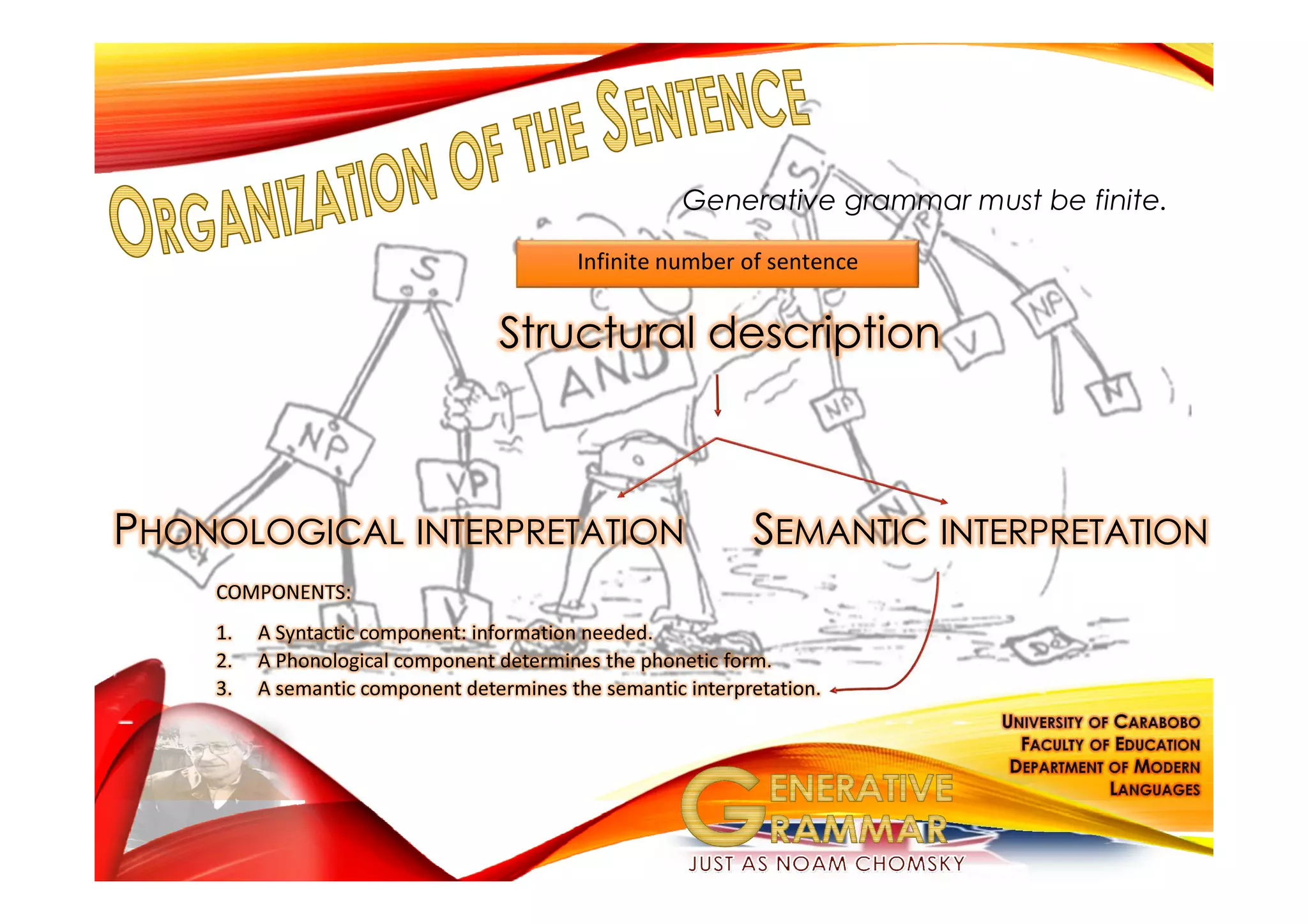
Generative grammar must be finite.
Infinite number of sentence
Structural description
PHONOLOGICAL INTERPRETATION SEMANTIC INTERPRETATION
COMPONENTS:
1. A Syntactic component: information needed.
2. A Phonological component determines the phonetic form.
3. A semantic component determines the semantic interpretation.
Generative grammar must be finite.Generative grammar must be finite.
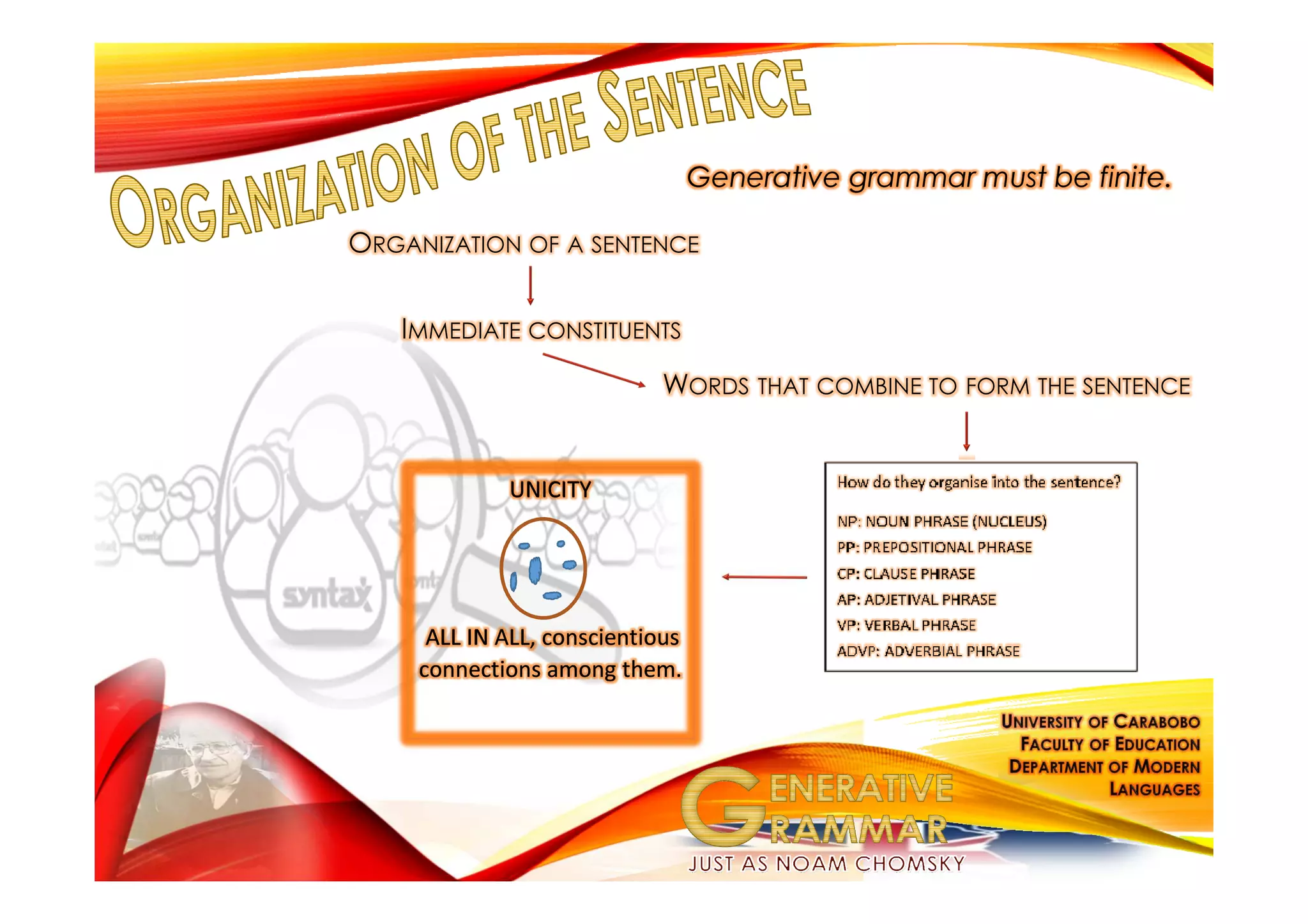
ORGANIZATION OF A SENTENCE
IMMEDIATE CONSTITUENTS
WORDS THAT COMBINE TO FORM THE SENTENCE
UNICITY
ALL IN ALL, conscientious
connections among them.
UNICITY
ALL IN ALL, conscientious
connections among them.
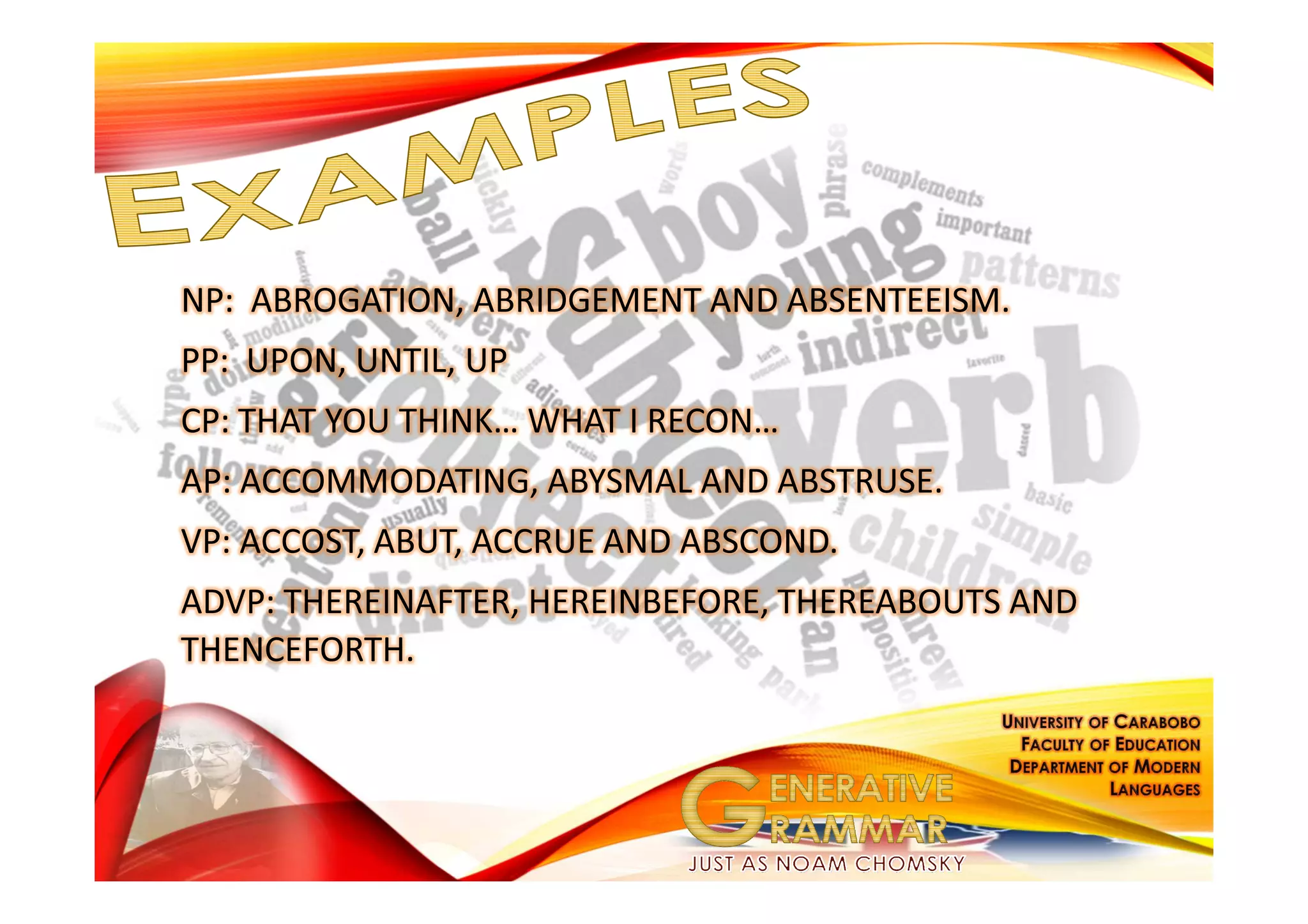
NP: ABROGATION, ABRIDGEMENT AND ABSENTEEISM.
PP: UPON, UNTIL, UP
CP: THAT YOU THINK… WHAT I RECON…
AP: ACCOMMODATING, ABYSMAL AND ABSTRUSE.
VP: ACCOST, ABUT, ACCRUE AND ABSCOND.
ADVP: THEREINAFTER, HEREINBEFORE, THEREABOUTS AND
THENCEFORTH.
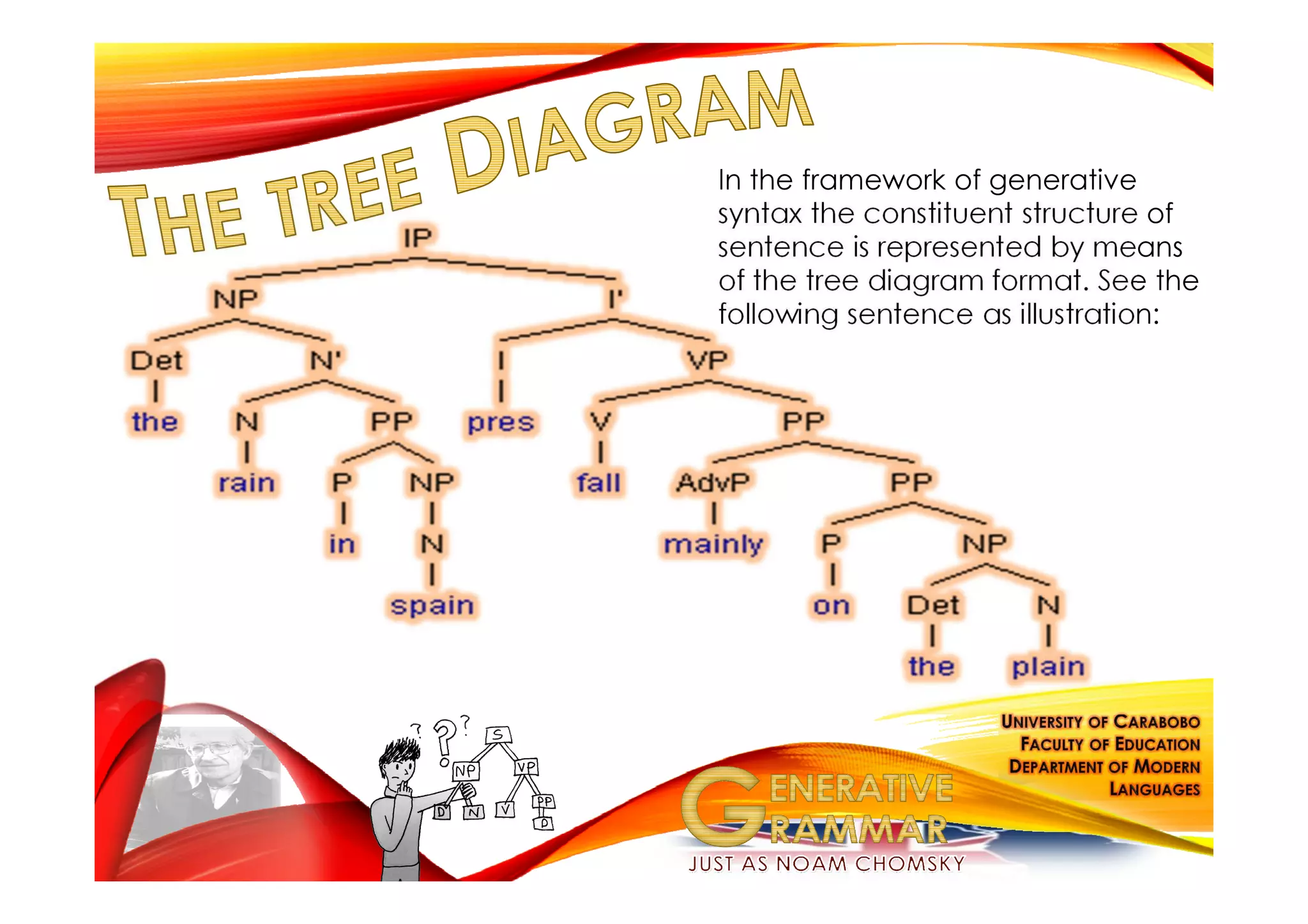
In the framework of generative
syntax the constituent structure of
sentence is represented by means
of the tree diagram format. See the
following sentence as illustration:
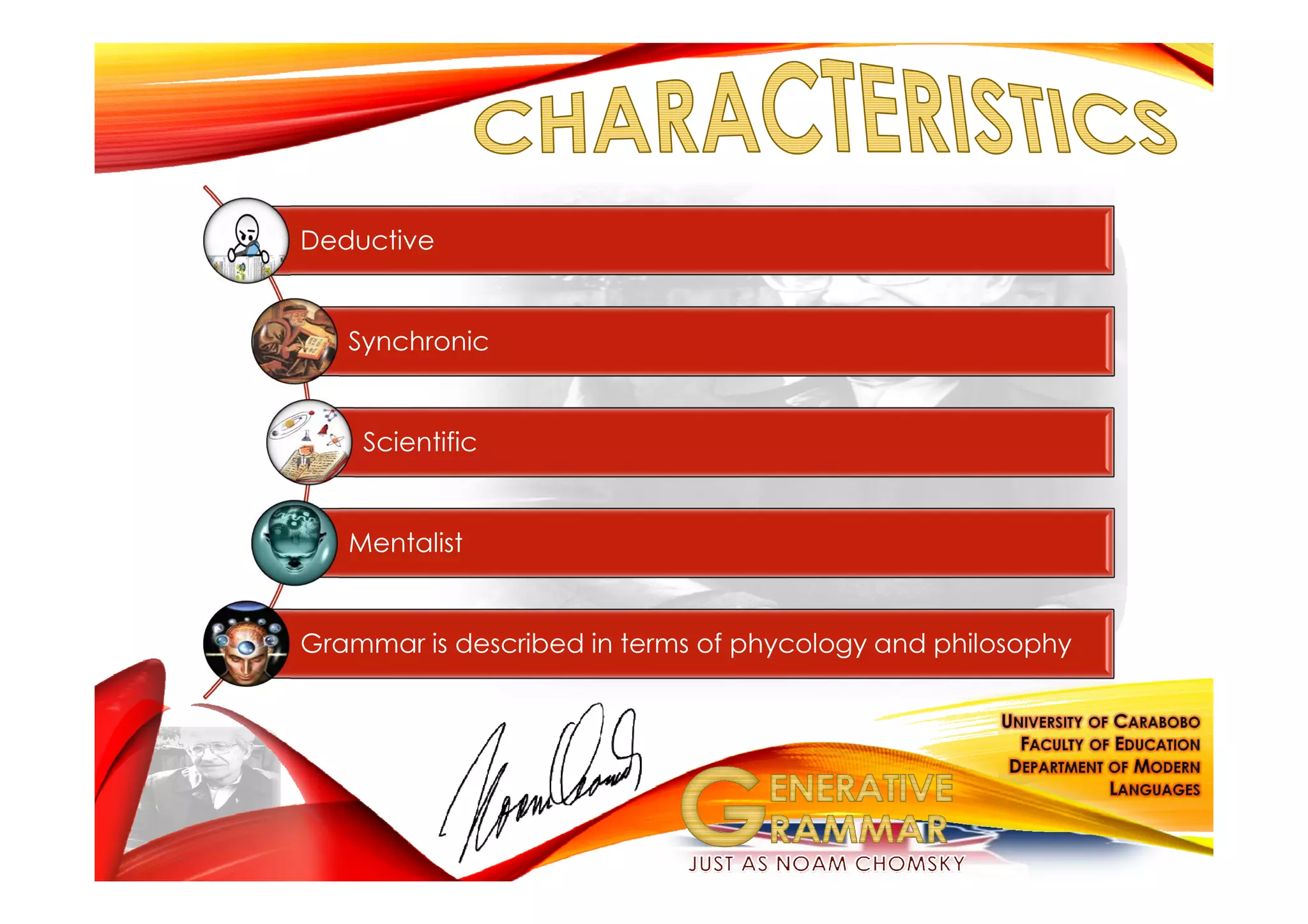
Deductive
Synchronic
Scientific
Mentalist
Grammar is described in terms of phycology and philosophy
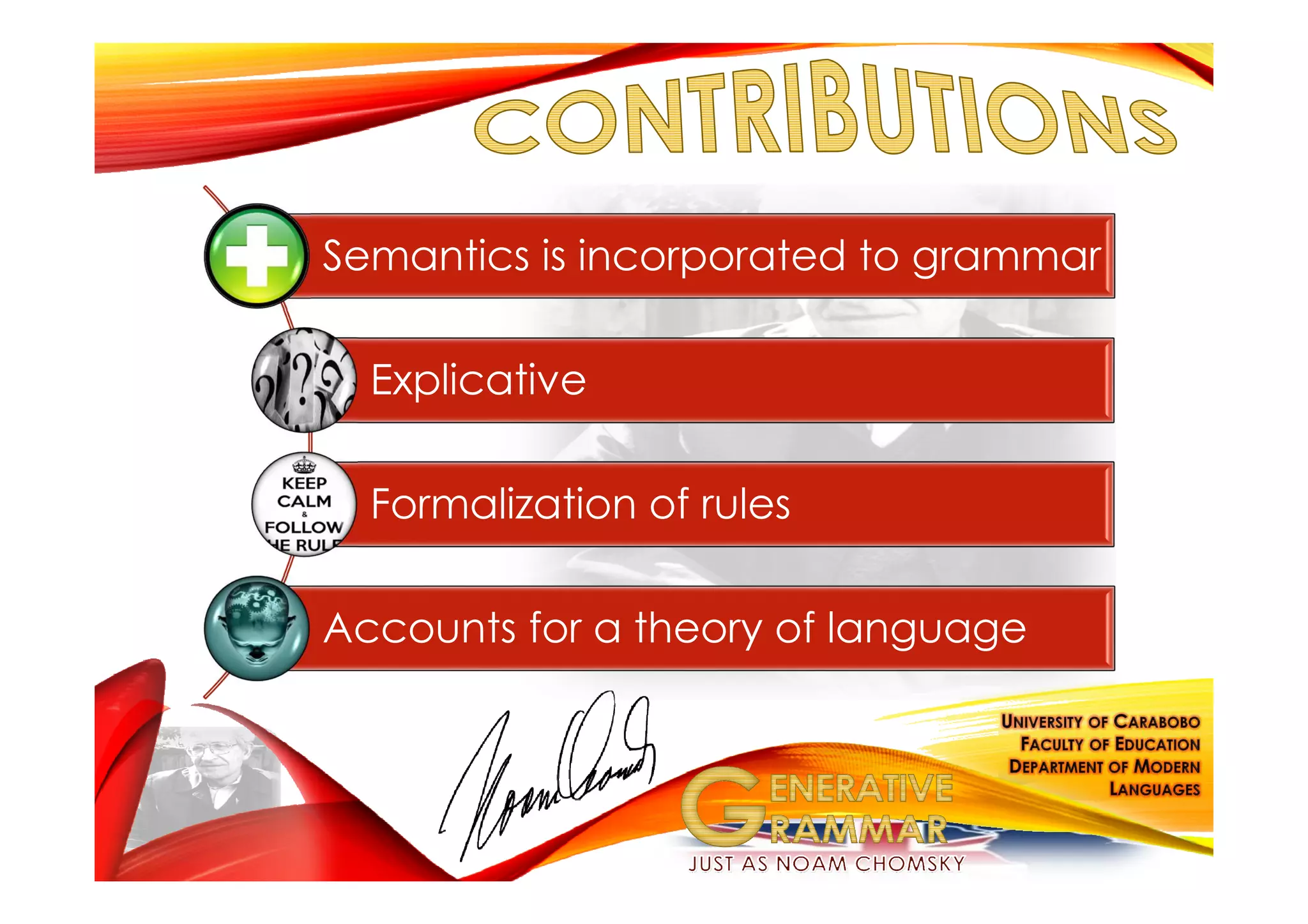
Semantics is incorporated to grammar
Explicative
Formalization of rules
Accounts for a theory of language
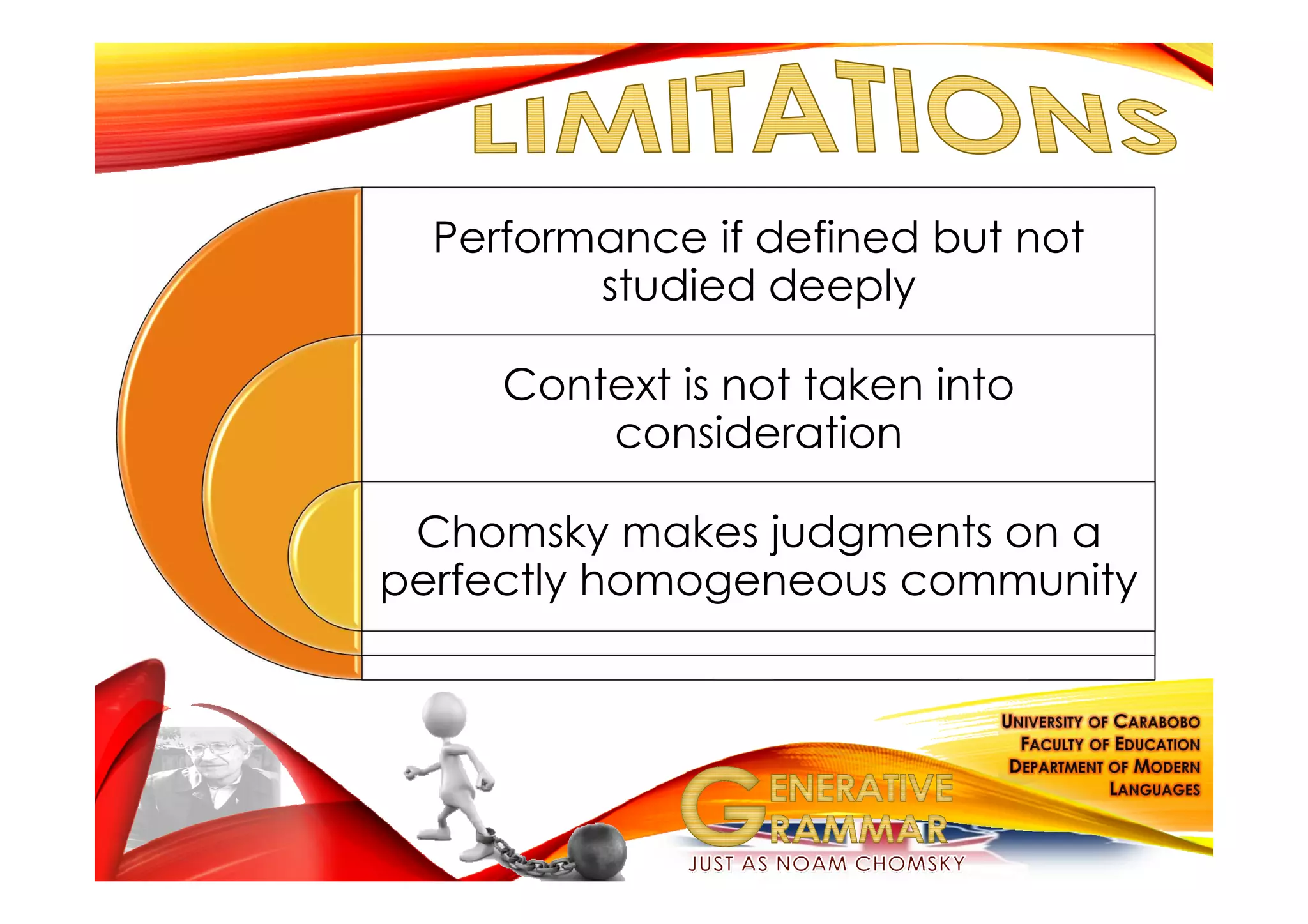
Performance if defined but not
studied deeply
Context is not taken into
consideration
Chomsky makes judgments on a
perfectly homogeneous community
Firmado digitalmente por Orlando
J. Trosell F.
Nombre de reconocimiento (DN):
cn=Orlando J. Trosell F.,
o=TROSELL NETWORKS,
ou=DISEÑO GRAFICO,
email=webmaster@e-orlando.tk,
c=VE
Fecha: 2015.02.14 19:43:27 -04'30'

GRAMATICA GENERATIVA - GENERATIVE GRAMMAR

  • 2.
    DEFINITION Generative grammar refers toa particular approach to the study of syntax. OBJECTIVE A generative grammar attempts to give a set of rules that will correctly predict which combinations of words will form grammatical sentences.
  • 3.
    He was born on December 7,1928 in Philadelphia . He is one of the main representatives because he explains the FOUR MODELS of this theory He is an American linguistic, philosopher and cognitive scientist. He has spent his career at the Massachuse tts Institute of Technology (MI T), where he is Professor , and has authored over 100 books.
  • 4.
    In 1957, NoamChomsky published Syntactic Structures, in which he developed the idea of Kernel sentences that is a basic irreducible set of simple structure produced by the phrase Structure Rules of grammar. The (SS) model contains obligatory and optional transformational rules. Kernel sentence is derived from the string by a series of obligatory transformational rules. According to this model different types of sentences (Negative, interrogative, passive, etc.), simple and complex, were derived from these kernels by successive optional transformational Rules. MORPHOPHONEMICRULES TRANSFORMATIONALRULES PSRULES THE DEEP STRUCTURES OF SENTENCES (NOUNS, VERBS, COMPONENTS) PRODUCE THE SURFACE STRUCTURES OF THE LANGUAGE. CHANGES LEXICAL FORMS WHERE NECESSARY (GO + PAST = WENT).
  • 5.
    COMPONENTS •Syntactic component, Phonological component,Semantic component. DEEP STRUCTURE • All the elements to interpret sentence are here. SURFACE STRUCTURE It is a book written by American linguist Noam Chomsky. TO CREATE A DEEP STRUCTURE IT NEEDS…
  • 6.
    Government and binding isa theory of syntax developed by Chomsky in the 1980s. Government, which is an abstract syntactic relation, the main application of the government relation concerns the assignment of case. Binding deals with the referents of anaphors, pronouns, and referential expressions.
  • 7.
    The minimalist program (MP)is a major line of inquiry that has been developing inside generative grammar THE MINIMALIST PROGRAM HAS TO BE COMPARED TO PREVIOUS MODELS IN THE GENERATIVE APPROACH TO GRAMMAR.
  • 8.
    Develop A theory of language. Formulate Description ofa particular language. Develop Theory of Language Acquisition. Describe The child’s knowledge of his mother tongue.
  • 10.
  • 12.
  • 13.
    All languages have asystem of syntactic structure. Native speakers of a language intuitively know the grammar of their language. The basis of the system is the sentence.
  • 14.
    Competences: • Linguistic Abilities Performance: •It is the actual use of the language in concrete situation.
  • 15.
    Competences include: • GrammaticalCompetence: • Knowledge of the grammar of the language. • Semantic competence. • Phonological Competence • Pragmatic Competence: • Non-linguistic Information. • Background knowledge. • Personal Belief in our use and Interpretation of a sentence
  • 16.
  • 17.
    Triggering • Experience • Language X UG •With Parameters Core Grammar •Language X
  • 18.
    The principles of UG. Thetriggering experience needed to activate the principles of UG. Core Grammar
  • 19.
    Generative grammar mustbe finite. Infinite number of sentence Structural description PHONOLOGICAL INTERPRETATION SEMANTIC INTERPRETATION COMPONENTS: 1. A Syntactic component: information needed. 2. A Phonological component determines the phonetic form. 3. A semantic component determines the semantic interpretation.
  • 20.
    Generative grammar mustbe finite.Generative grammar must be finite. ORGANIZATION OF A SENTENCE IMMEDIATE CONSTITUENTS WORDS THAT COMBINE TO FORM THE SENTENCE UNICITY ALL IN ALL, conscientious connections among them. UNICITY ALL IN ALL, conscientious connections among them.
  • 21.
    NP: ABROGATION, ABRIDGEMENTAND ABSENTEEISM. PP: UPON, UNTIL, UP CP: THAT YOU THINK… WHAT I RECON… AP: ACCOMMODATING, ABYSMAL AND ABSTRUSE. VP: ACCOST, ABUT, ACCRUE AND ABSCOND. ADVP: THEREINAFTER, HEREINBEFORE, THEREABOUTS AND THENCEFORTH.
  • 22.
    In the frameworkof generative syntax the constituent structure of sentence is represented by means of the tree diagram format. See the following sentence as illustration:
  • 23.
  • 24.
    Semantics is incorporatedto grammar Explicative Formalization of rules Accounts for a theory of language
  • 25.
    Performance if definedbut not studied deeply Context is not taken into consideration Chomsky makes judgments on a perfectly homogeneous community
  • 26.
    Firmado digitalmente porOrlando J. Trosell F. Nombre de reconocimiento (DN): cn=Orlando J. Trosell F., o=TROSELL NETWORKS, ou=DISEÑO GRAFICO, email=webmaster@e-orlando.tk, c=VE Fecha: 2015.02.14 19:43:27 -04'30'