Sentence StructureThe sequence and connection of the words, phrases, and clauses that constitute sentences. SYNTAX
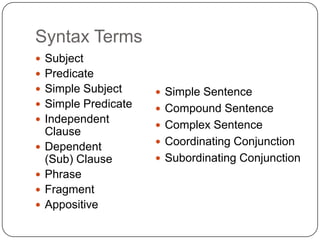
Syntax TermsSubjectPredicateSimple SubjectSimple PredicateIndependent ClauseDependent (Sub) ClausePhraseFragmentAppositive Simple Sentence
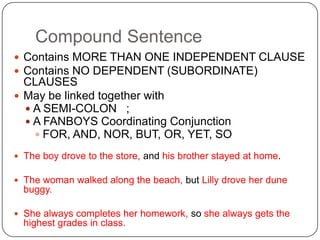
Compound Sentence
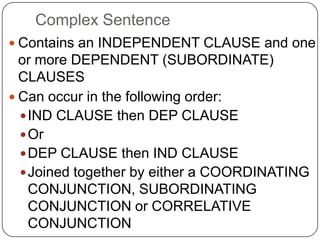
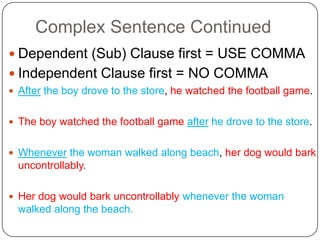
Complex Sentence
Coordinating Conjunction
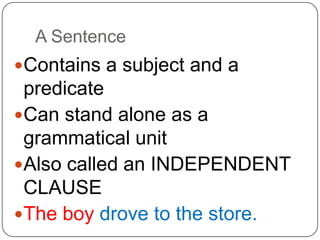
Subordinating ConjunctionA SentenceContains a subject and a predicate Can stand alone as a grammatical unitAlso called an INDEPENDENT CLAUSEThe boy drove to the store.
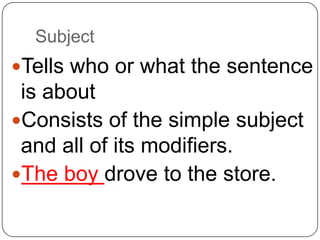
SubjectTells who or what the sentence is aboutConsists of the simple subject and all of its modifiers.The boy drove to the store.
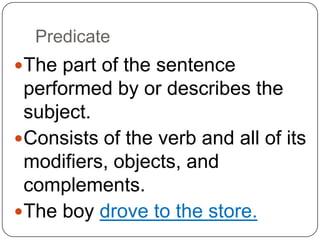
PredicateThe part of the sentence performed by or describes the subject.Consists of the verb and all of its modifiers, objects, and complements. The boy drove to the store.
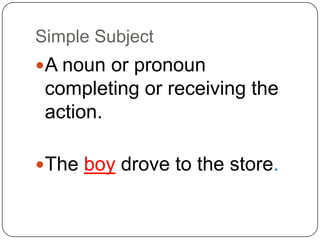
Simple SubjectA noun or pronoun completing or receiving the action.Theboydrove to the store.
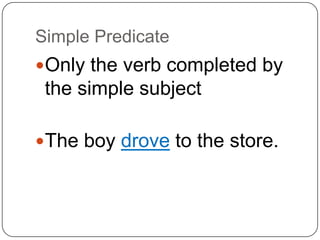
Simple PredicateOnly the verb completed by the simple subject The boy droveto the store.
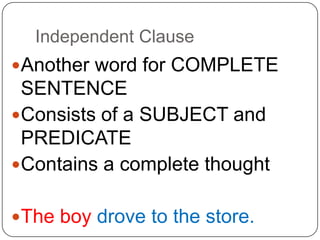
Independent ClauseAnother word for COMPLETE SENTENCEConsists of a SUBJECT and PREDICATE Contains a complete thoughtThe boy drove to the store.
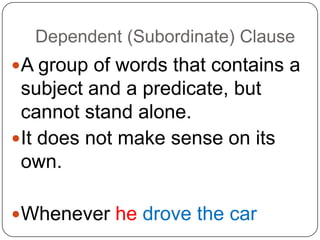
Dependent (Subordinate) ClauseA group of words that contains a subject and a predicate, but cannot stand alone.It does not make sense on its own.Whenever hedrove the car
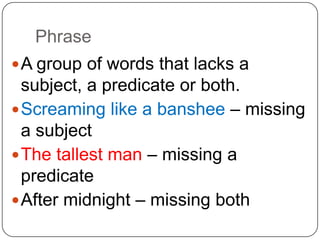
PhraseA group of words that lacks a subject, a predicate or both.Screaming like a banshee – missing a subjectThe tallest man – missing a predicate After midnight – missing both
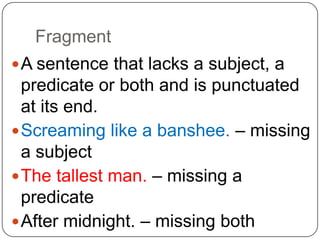
FragmentA sentence that lacks a subject, a predicate or both and is punctuated at its end. Screaming like a banshee. – missing a subjectThe tallest man. – missing a predicate After midnight. – missing both
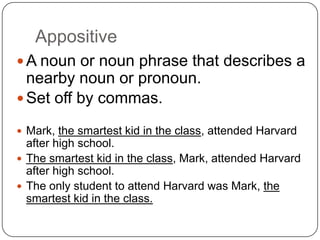
Appositive A noun or noun phrase that describes a nearby noun or pronoun. Set off by commas. Mark, the smartest kid in the class, attended Harvard after high school. The smartest kid in the class, Mark, attended Harvard after high school. The only student to attend Harvard was Mark, the smartest kid in the class.
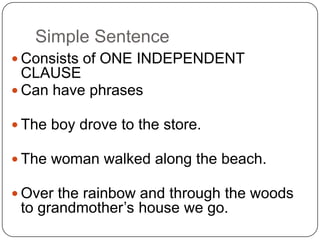
Simple SentenceConsists of ONE INDEPENDENT CLAUSECan have phrases The boy drove to the store. The woman walked along the beach.Over the rainbow and through the woods to grandmother’s house we go.
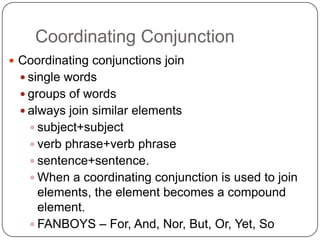
Coordinating ConjunctionCoordinating conjunctions join single wordsgroups of wordsalways join similar elementssubject+subjectverb phrase+verb phrasesentence+sentence. When a coordinating conjunction is used to join elements, the element becomes a compound element.FANBOYS – For, And, Nor, But, Or, Yet, So
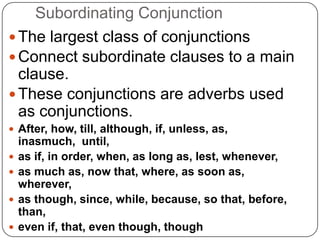
Subordinating Conjunction The largest class of conjunctionsConnect subordinate clauses to a main clause. These conjunctions are adverbs used as conjunctions.After,how, till, although,if, unless, as, inasmuch,  until,as if, in order, when,as long as, lest, whenever,as much as, now that, where,as soon as, wherever,as though, since,while, because, so that,before, than,even if, that, even though, though
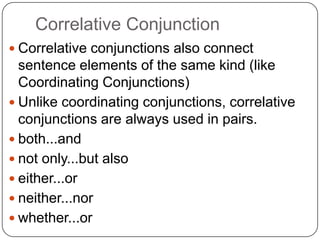
Correlative Conjunction Correlative conjunctions also connect sentence elements of the same kind (like Coordinating Conjunctions)Unlike coordinating conjunctions, correlative conjunctions are always used in pairs.both...and not only...but also either...or neither...nor whether...or

Syntax

  • 1.
    Sentence StructureThe sequenceand connection of the words, phrases, and clauses that constitute sentences. SYNTAX
  • 2.
    Syntax TermsSubjectPredicateSimple SubjectSimplePredicateIndependent ClauseDependent (Sub) ClausePhraseFragmentAppositive Simple Sentence
  • 3.
  • 4.
  • 5.
  • 6.
    Subordinating ConjunctionA SentenceContainsa subject and a predicate Can stand alone as a grammatical unitAlso called an INDEPENDENT CLAUSEThe boy drove to the store.
  • 7.
    SubjectTells who orwhat the sentence is aboutConsists of the simple subject and all of its modifiers.The boy drove to the store.
  • 8.
    PredicateThe part ofthe sentence performed by or describes the subject.Consists of the verb and all of its modifiers, objects, and complements. The boy drove to the store.
  • 9.
    Simple SubjectA nounor pronoun completing or receiving the action.Theboydrove to the store.
  • 10.
    Simple PredicateOnly theverb completed by the simple subject The boy droveto the store.
  • 11.
    Independent ClauseAnother wordfor COMPLETE SENTENCEConsists of a SUBJECT and PREDICATE Contains a complete thoughtThe boy drove to the store.
  • 12.
    Dependent (Subordinate) ClauseAgroup of words that contains a subject and a predicate, but cannot stand alone.It does not make sense on its own.Whenever hedrove the car
  • 13.
    PhraseA group ofwords that lacks a subject, a predicate or both.Screaming like a banshee – missing a subjectThe tallest man – missing a predicate After midnight – missing both
  • 14.
    FragmentA sentence thatlacks a subject, a predicate or both and is punctuated at its end. Screaming like a banshee. – missing a subjectThe tallest man. – missing a predicate After midnight. – missing both
  • 15.
    Appositive A nounor noun phrase that describes a nearby noun or pronoun. Set off by commas. Mark, the smartest kid in the class, attended Harvard after high school. The smartest kid in the class, Mark, attended Harvard after high school. The only student to attend Harvard was Mark, the smartest kid in the class.
  • 16.
    Simple SentenceConsists ofONE INDEPENDENT CLAUSECan have phrases The boy drove to the store. The woman walked along the beach.Over the rainbow and through the woods to grandmother’s house we go.
  • 17.
    Coordinating ConjunctionCoordinating conjunctionsjoin single wordsgroups of wordsalways join similar elementssubject+subjectverb phrase+verb phrasesentence+sentence. When a coordinating conjunction is used to join elements, the element becomes a compound element.FANBOYS – For, And, Nor, But, Or, Yet, So
  • 18.
    Subordinating Conjunction Thelargest class of conjunctionsConnect subordinate clauses to a main clause. These conjunctions are adverbs used as conjunctions.After,how, till, although,if, unless, as, inasmuch,  until,as if, in order, when,as long as, lest, whenever,as much as, now that, where,as soon as, wherever,as though, since,while, because, so that,before, than,even if, that, even though, though
  • 19.
    Correlative Conjunction Correlativeconjunctions also connect sentence elements of the same kind (like Coordinating Conjunctions)Unlike coordinating conjunctions, correlative conjunctions are always used in pairs.both...and not only...but also either...or neither...nor whether...or