NOUNS AND PREPOSITIONS  Changing a Noun Appositives Subject Complements Direct / Indirect Objects Prepositions and Preposition Objects Plural / Singular subjects Noun (subject) Verb Agreement Types of Nouns – Proper / Common / Concrete / Abstract / Count / Non-Count / Collective
WHAT IS A NOUN? A part of speech used to name  People, Places, Things (including ideas)  Every noun has a type Common / Proper / Concrete / Abstract / Count /  Non-Count / Collective  Every noun has a Gender  Masculine / Feminine / Neuter  Every noun has a Number Singular / Plural  Every noun has a Person 1st Person / 2 nd  Person / 3 rd  Person  Every noun has a case Nominative, Objective, Possessive,
NOUN TYPES – PROPER / COMMON  Proper Nouns  name specific People, Places, or Things.  George Washington The Eiffel Tower Sony Playstation Common Nouns  name non-specific People, Places, or Things. president  building video game
NOUN TYPES – CONCRETE / ABSTRACT  Concrete Nouns  are able to be touched, smelt, seen, heard, or felt.  Cotton Gas Clouds Insect Air Abstract Nouns  are ideas, feelings, or attributes – nouns you cannot touch, smell, feel, hear, or see.  Love – Hate – Peace – Honesty – Beauty – Dream – Education – Friendship – Thought – Culture – Evil
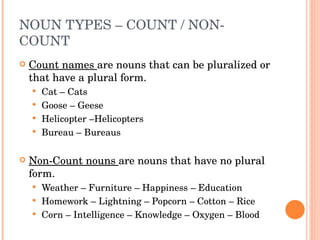
NOUN TYPES – COUNT / NON-COUNT  Count names  are nouns that can be pluralized or that have a plural form.  Cat – Cats Goose – Geese Helicopter –Helicopters Bureau – Bureaus  Non-Count nouns  are nouns that have no plural form.  Weather – Furniture – Happiness – Education  Homework – Lightning – Popcorn – Cotton – Rice  Corn – Intelligence – Knowledge – Oxygen – Blood
NOUN TYPES – COLLECTIVE  Collective Nouns  are nouns that represent groups of people, places, or things.  Flock = many birds Band = many musicians  Audience = many people Quiver  = many arrows  Class = many students Army = many soldiers Gaggle = many geese  Team = many athletes  Department = many people
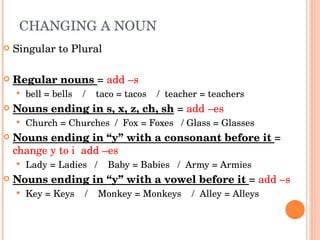
CHANGING A NOUN  Singular to Plural Regular nouns  =  add –s bell = bells  /  taco = tacos  /  teacher = teachers  Nouns ending in s, x, z, ch, sh  =  add –es  Church = Churches  /  Fox = Foxes  / Glass = Glasses Nouns ending in “y” with a consonant before it  =  change y to i  add –es  Lady = Ladies  /  Baby = Babies  /  Army = Armies  Nouns ending in “y” with a vowel before it  =  add –s Key = Keys  /  Monkey = Monkeys  /  Alley = Alleys
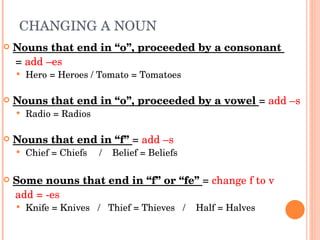
CHANGING A NOUN  Nouns that end in “o”, proceeded by a consonant  =  add –es Hero = Heroes / Tomato = Tomatoes  Nouns that end in “o”, proceeded by a vowel  =  add –s   Radio = Radios  Nouns that end in “f”  =  add –s Chief = Chiefs  /  Belief = Beliefs  Some nouns that end in “f” or “fe”  =  change f to v  add = -es Knife = Knives  /  Thief = Thieves  /  Half = Halves
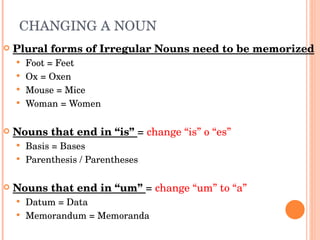
CHANGING A NOUN  Plural forms of Irregular Nouns need to be memorized Foot = Feet Ox = Oxen Mouse = Mice Woman = Women Nouns that end in “is”  =  change “is” o “es”  Basis = Bases  Parenthesis / Parentheses Nouns that end in “um”  =  change “um” to “a” Datum = Data Memorandum = Memoranda
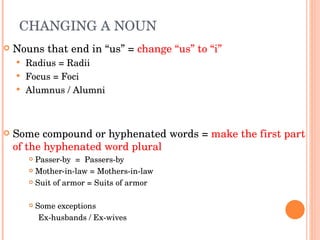
CHANGING A NOUN  Nouns that end in “us” =  change “us” to “i” Radius = Radii Focus = Foci Alumnus / Alumni  Some compound or hyphenated words =  make the first part of the hyphenated word plural  Passer-by  =  Passers-by Mother-in-law = Mothers-in-law Suit of armor = Suits of armor Some exceptions Ex-husbands / Ex-wives
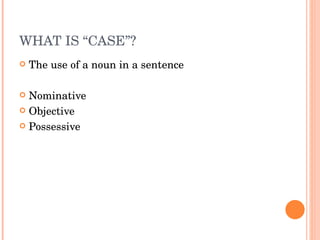
WHAT IS “CASE”?  The use of a noun in a sentence Nominative  Objective Possessive
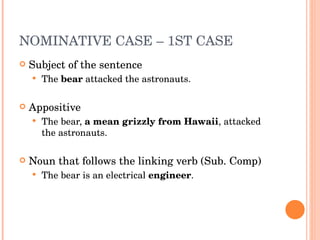
NOMINATIVE CASE – 1ST CASE  Subject of the sentence The  bear  attacked the astronauts. Appositive  The bear,  a mean grizzly from Hawaii , attacked the astronauts.  Noun that follows the linking verb (Sub. Comp) The bear is an electrical  engineer .
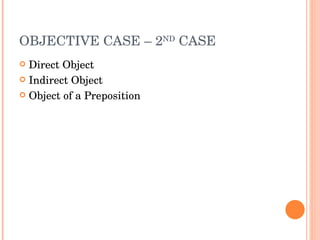
OBJECTIVE CASE – 2 ND  CASE  Direct Object Indirect Object Object of a Preposition
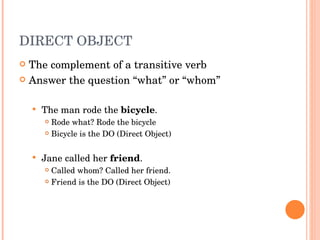
DIRECT OBJECT  The complement of a transitive verb  Answer the question “what” or “whom” The man rode the  bicycle .  Rode what? Rode the bicycle Bicycle is the DO (Direct Object) Jane called her  friend . Called whom? Called her friend.  Friend is the DO (Direct Object)
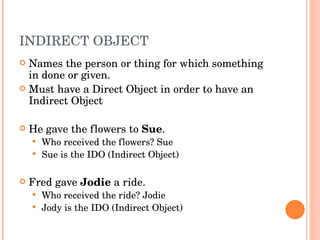
INDIRECT OBJECT  Names the person or thing for which something in done or given.  Must have a Direct Object in order to have an Indirect Object He gave the flowers to  Sue .  Who received the flowers? Sue  Sue is the IDO (Indirect Object)  Fred gave  Jodie  a ride.  Who received the ride? Jodie Jody is the IDO (Indirect Object)
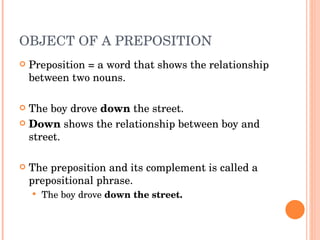
OBJECT OF A PREPOSITION  Preposition = a word that shows the relationship between two nouns.  The boy drove  down  the street.  Down  shows the relationship between boy and street.  The preposition and its complement is called a prepositional phrase.  The boy drove  down the street.
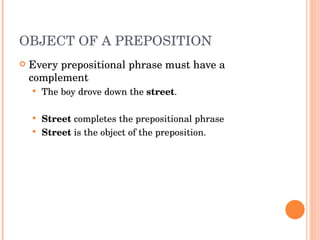
OBJECT OF A PREPOSITION  Every prepositional phrase must have a complement The boy drove down the  street .  Street  completes the prepositional phrase Street  is the object of the preposition.
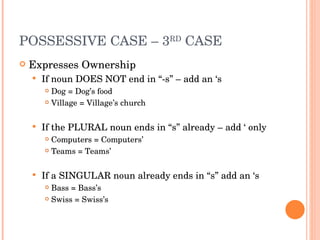
POSSESSIVE CASE – 3 RD  CASE  Expresses Ownership If noun DOES NOT end in “-s” – add an ‘s Dog = Dog’s food Village = Village’s church If the PLURAL noun ends in “s” already – add ‘ only Computers = Computers’ Teams = Teams’ If a SINGULAR noun already ends in “s” add an ‘s Bass = Bass’s Swiss = Swiss’s
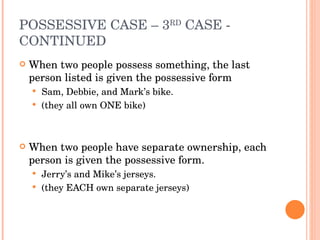
POSSESSIVE CASE – 3 RD  CASE - CONTINUED When two people possess something, the last person listed is given the possessive form Sam, Debbie, and Mark’s bike.  (they all own ONE bike) When two people have separate ownership, each person is given the possessive form. Jerry’s and Mike’s jerseys. (they EACH own separate jerseys)
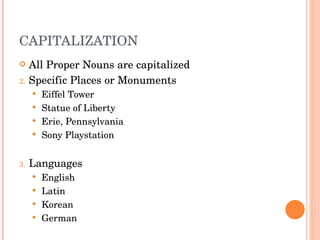
CAPITALIZATION All Proper Nouns are capitalized Specific Places or Monuments Eiffel Tower Statue of Liberty Erie, Pennsylvania Sony Playstation Languages English Latin Korean German
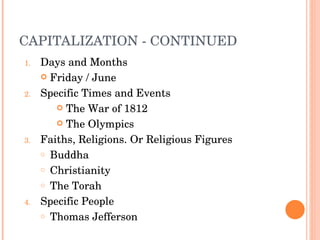
CAPITALIZATION - CONTINUED Days and Months Friday / June Specific Times and Events The War of 1812 The Olympics Faiths, Religions. Or Religious Figures Buddha Christianity The Torah Specific People Thomas Jefferson
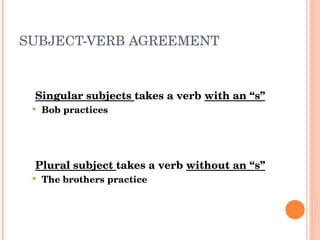
SUBJECT-VERB AGREEMENT Singular subjects  takes a verb  with an “s” Bob practices Plural subject  takes a verb  without an “s” The brothers practice

Parts of Speech - Nouns And Prepositions

  • 1.
    NOUNS AND PREPOSITIONS Changing a Noun Appositives Subject Complements Direct / Indirect Objects Prepositions and Preposition Objects Plural / Singular subjects Noun (subject) Verb Agreement Types of Nouns – Proper / Common / Concrete / Abstract / Count / Non-Count / Collective
  • 2.
    WHAT IS ANOUN? A part of speech used to name People, Places, Things (including ideas) Every noun has a type Common / Proper / Concrete / Abstract / Count / Non-Count / Collective Every noun has a Gender Masculine / Feminine / Neuter Every noun has a Number Singular / Plural Every noun has a Person 1st Person / 2 nd Person / 3 rd Person Every noun has a case Nominative, Objective, Possessive,
  • 3.
    NOUN TYPES –PROPER / COMMON Proper Nouns name specific People, Places, or Things. George Washington The Eiffel Tower Sony Playstation Common Nouns name non-specific People, Places, or Things. president building video game
  • 4.
    NOUN TYPES –CONCRETE / ABSTRACT Concrete Nouns are able to be touched, smelt, seen, heard, or felt. Cotton Gas Clouds Insect Air Abstract Nouns are ideas, feelings, or attributes – nouns you cannot touch, smell, feel, hear, or see. Love – Hate – Peace – Honesty – Beauty – Dream – Education – Friendship – Thought – Culture – Evil
  • 5.
    NOUN TYPES –COUNT / NON-COUNT Count names are nouns that can be pluralized or that have a plural form. Cat – Cats Goose – Geese Helicopter –Helicopters Bureau – Bureaus Non-Count nouns are nouns that have no plural form. Weather – Furniture – Happiness – Education Homework – Lightning – Popcorn – Cotton – Rice Corn – Intelligence – Knowledge – Oxygen – Blood
  • 6.
    NOUN TYPES –COLLECTIVE Collective Nouns are nouns that represent groups of people, places, or things. Flock = many birds Band = many musicians Audience = many people Quiver = many arrows Class = many students Army = many soldiers Gaggle = many geese Team = many athletes Department = many people
  • 7.
    CHANGING A NOUN Singular to Plural Regular nouns = add –s bell = bells / taco = tacos / teacher = teachers Nouns ending in s, x, z, ch, sh = add –es Church = Churches / Fox = Foxes / Glass = Glasses Nouns ending in “y” with a consonant before it = change y to i add –es Lady = Ladies / Baby = Babies / Army = Armies Nouns ending in “y” with a vowel before it = add –s Key = Keys / Monkey = Monkeys / Alley = Alleys
  • 8.
    CHANGING A NOUN Nouns that end in “o”, proceeded by a consonant = add –es Hero = Heroes / Tomato = Tomatoes Nouns that end in “o”, proceeded by a vowel = add –s Radio = Radios Nouns that end in “f” = add –s Chief = Chiefs / Belief = Beliefs Some nouns that end in “f” or “fe” = change f to v add = -es Knife = Knives / Thief = Thieves / Half = Halves
  • 9.
    CHANGING A NOUN Plural forms of Irregular Nouns need to be memorized Foot = Feet Ox = Oxen Mouse = Mice Woman = Women Nouns that end in “is” = change “is” o “es” Basis = Bases Parenthesis / Parentheses Nouns that end in “um” = change “um” to “a” Datum = Data Memorandum = Memoranda
  • 10.
    CHANGING A NOUN Nouns that end in “us” = change “us” to “i” Radius = Radii Focus = Foci Alumnus / Alumni Some compound or hyphenated words = make the first part of the hyphenated word plural Passer-by = Passers-by Mother-in-law = Mothers-in-law Suit of armor = Suits of armor Some exceptions Ex-husbands / Ex-wives
  • 11.
    WHAT IS “CASE”? The use of a noun in a sentence Nominative Objective Possessive
  • 12.
    NOMINATIVE CASE –1ST CASE Subject of the sentence The bear attacked the astronauts. Appositive The bear, a mean grizzly from Hawaii , attacked the astronauts. Noun that follows the linking verb (Sub. Comp) The bear is an electrical engineer .
  • 13.
    OBJECTIVE CASE –2 ND CASE Direct Object Indirect Object Object of a Preposition
  • 14.
    DIRECT OBJECT The complement of a transitive verb Answer the question “what” or “whom” The man rode the bicycle . Rode what? Rode the bicycle Bicycle is the DO (Direct Object) Jane called her friend . Called whom? Called her friend. Friend is the DO (Direct Object)
  • 15.
    INDIRECT OBJECT Names the person or thing for which something in done or given. Must have a Direct Object in order to have an Indirect Object He gave the flowers to Sue . Who received the flowers? Sue Sue is the IDO (Indirect Object) Fred gave Jodie a ride. Who received the ride? Jodie Jody is the IDO (Indirect Object)
  • 16.
    OBJECT OF APREPOSITION Preposition = a word that shows the relationship between two nouns. The boy drove down the street. Down shows the relationship between boy and street. The preposition and its complement is called a prepositional phrase. The boy drove down the street.
  • 17.
    OBJECT OF APREPOSITION Every prepositional phrase must have a complement The boy drove down the street . Street completes the prepositional phrase Street is the object of the preposition.
  • 18.
    POSSESSIVE CASE –3 RD CASE Expresses Ownership If noun DOES NOT end in “-s” – add an ‘s Dog = Dog’s food Village = Village’s church If the PLURAL noun ends in “s” already – add ‘ only Computers = Computers’ Teams = Teams’ If a SINGULAR noun already ends in “s” add an ‘s Bass = Bass’s Swiss = Swiss’s
  • 19.
    POSSESSIVE CASE –3 RD CASE - CONTINUED When two people possess something, the last person listed is given the possessive form Sam, Debbie, and Mark’s bike. (they all own ONE bike) When two people have separate ownership, each person is given the possessive form. Jerry’s and Mike’s jerseys. (they EACH own separate jerseys)
  • 20.
    CAPITALIZATION All ProperNouns are capitalized Specific Places or Monuments Eiffel Tower Statue of Liberty Erie, Pennsylvania Sony Playstation Languages English Latin Korean German
  • 21.
    CAPITALIZATION - CONTINUEDDays and Months Friday / June Specific Times and Events The War of 1812 The Olympics Faiths, Religions. Or Religious Figures Buddha Christianity The Torah Specific People Thomas Jefferson
  • 22.
    SUBJECT-VERB AGREEMENT Singularsubjects takes a verb with an “s” Bob practices Plural subject takes a verb without an “s” The brothers practice