Definitions and Examples of Basic
Sentence Elements
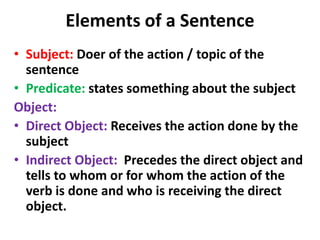
Elements of a Sentence
• Subject: Doer of the action / topic of the
sentence
• Predicate: states something about the subject
Object:
• Direct Object: Receives the action done by the
subject
• Indirect Object: Precedes the direct object and
tells to whom or for whom the action of the
verb is done and who is receiving the direct
object.
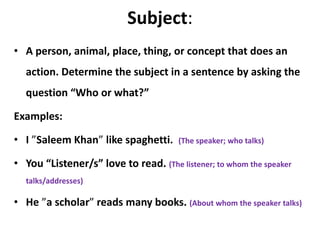
Subject:
• A person, animal, place, thing, or concept that does an
action. Determine the subject in a sentence by asking the
question “Who or what?”
Examples:
• I ”Saleem Khan” like spaghetti. (The speaker; who talks)
• You “Listener/s” love to read. (The listener; to whom the speaker
talks/addresses)
• He ”a scholar” reads many books. (About whom the speaker talks)
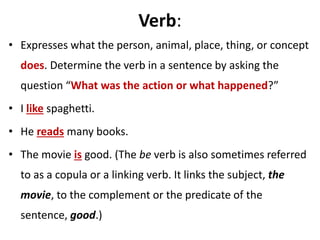
Verb:
• Expresses what the person, animal, place, thing, or concept
does. Determine the verb in a sentence by asking the
question “What was the action or what happened?”
• I like spaghetti.
• He reads many books.
• The movie is good. (The be verb is also sometimes referred
to as a copula or a linking verb. It links the subject, the
movie, to the complement or the predicate of the
sentence, good.)
Object:
• A person, animal, place, thing, or concept that
receives the action. Determine the object in a
sentence by asking the question “The subject
did what?” or “To whom?/For whom?”
Examples:
• I like spaghetti.
• He reads many books.
Objects
• Direct Object: Receives the action done by the subject
• Indirect Object: Precedes the direct object and tells to
whom or for whom the action of the verb is done and
who is receiving the direct object.
Examples:
• He writes a letter. (Direct Object receives the action)
• He writes a letter to me. (Indirect Object-receives the direct
Object)
Independent clause:
• An independent clause can stand alone as a
sentence. It contains a subject and a verb and
is a complete idea.
Examples:
• I like spaghetti.
• He reads many books.
Dependent clause:
• A dependent clause is not a complete
sentence. It must be attached to an
independent clause to become complete.
This is also known as a subordinate clause.
Example:
• Although I like spaghetti,…
• Because he reads many books,…
Sentences Structure
Independent and Dependent Clauses
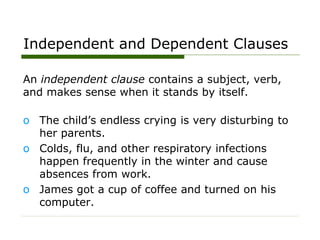
An independent clause contains a subject, verb,
and makes sense when it stands by itself.
o The child’s endless crying is very disturbing to
her parents.
o Colds, flu, and other respiratory infections
happen frequently in the winter and cause
absences from work.
o James got a cup of coffee and turned on his
computer.
Independent and Dependent Clauses
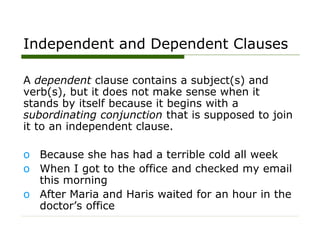
A dependent clause contains a subject(s) and
verb(s), but it does not make sense when it
stands by itself because it begins with a
subordinating conjunction that is supposed to join
it to an independent clause.
o Because she has had a terrible cold all week
o When I got to the office and checked my email
this morning
o After Maria and Haris waited for an hour in the
doctor’s office
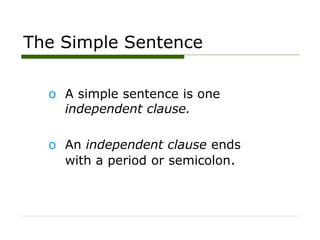
The Simple Sentence
o A simple sentence is one
independent clause.
o An independent clause ends
with a period or semicolon.
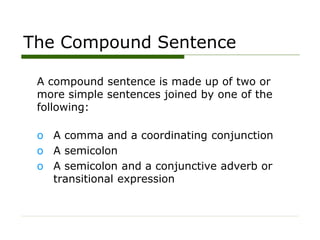
The Compound Sentence
A compound sentence is made up of two or
more simple sentences joined by one of the
following:
o A comma and a coordinating conjunction
o A semicolon
o A semicolon and a conjunctive adverb or
transitional expression
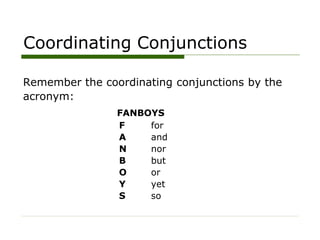
Coordinating Conjunctions
Remember the coordinating conjunctions by the
acronym:
FANBOYS
F for
A and
N nor
B but
O or
Y yet
S so
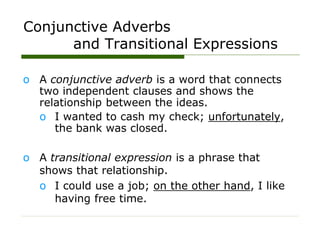
Conjunctive Adverbs
and Transitional Expressions
o A conjunctive adverb is a word that connects
two independent clauses and shows the
relationship between the ideas.
o I wanted to cash my check; unfortunately,
the bank was closed.
o A transitional expression is a phrase that
shows that relationship.
o I could use a job; on the other hand, I like
having free time.
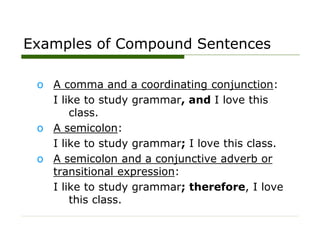
Examples of Compound Sentences
o A comma and a coordinating conjunction:
I like to study grammar, and I love this
class.
o A semicolon:
I like to study grammar; I love this class.
o A semicolon and a conjunctive adverb or
transitional expression:
I like to study grammar; therefore, I love
this class.
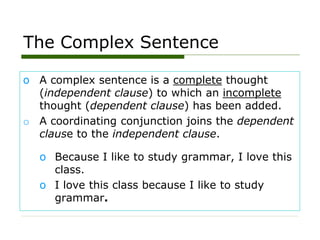
The Complex Sentence
o A complex sentence is a complete thought
(independent clause) to which an incomplete
thought (dependent clause) has been added.
o A coordinating conjunction joins the dependent
clause to the independent clause.
o Because I like to study grammar, I love this
class.
o I love this class because I like to study
grammar.
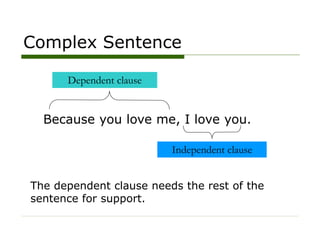
The dependent clause needs the rest of the
sentence for support.
Because you love me, I love you.
Dependent clause
Independent clause
Complex Sentence
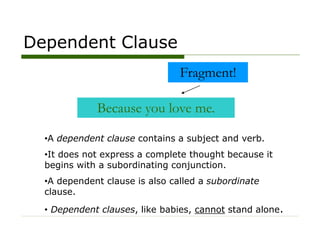
•A dependent clause contains a subject and verb.
•It does not express a complete thought because it
begins with a subordinating conjunction.
•A dependent clause is also called a subordinate
clause.
• Dependent clauses, like babies, cannot stand alone.
Because you love me.
Fragment!
Dependent Clause
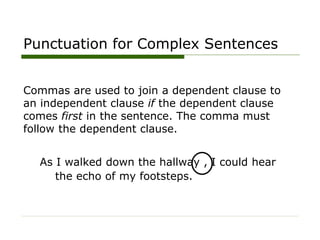
Punctuation for Complex Sentences
Commas are used to join a dependent clause to
an independent clause if the dependent clause
comes first in the sentence. The comma must
follow the dependent clause.
As I walked down the hallway , I could hear
the echo of my footsteps.
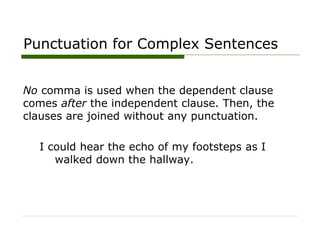
Punctuation for Complex Sentences
No comma is used when the dependent clause
comes after the independent clause. Then, the
clauses are joined without any punctuation.
I could hear the echo of my footsteps as I
walked down the hallway.
Punctuation for Complex Sentences
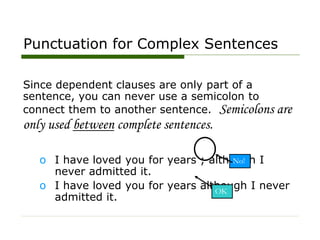
Since dependent clauses are only part of a
sentence, you can never use a semicolon to
connect them to another sentence. Semicolons are
only used between complete sentences.
o I have loved you for years ; although I
never admitted it.
o I have loved you for years although I never
admitted it.
OK
No!
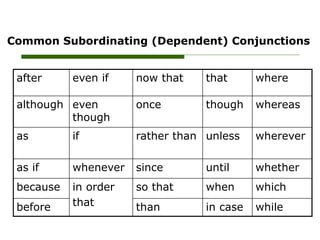
Common Subordinating (Dependent) Conjunctions
after even if now that that where
although even
though
once though whereas
as if rather than unless wherever
as if whenever since until whether
because in order
that
so that when which
before than in case while
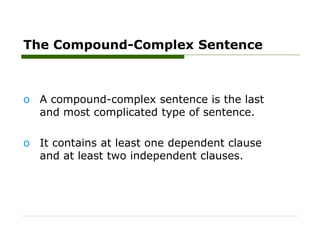
The Compound-Complex Sentence
o A compound-complex sentence is the last
and most complicated type of sentence.
o It contains at least one dependent clause
and at least two independent clauses.
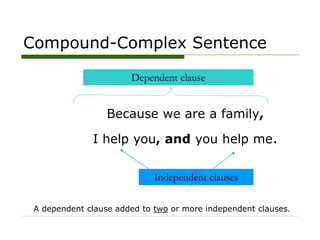
A dependent clause added to two or more independent clauses.
Because we are a family,
I help you, and you help me.
Independent clauses
Dependent clause
Compound-Complex Sentence
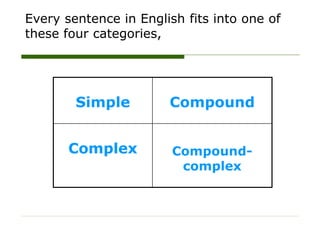
Simple Compound
Complex Compound-
complex
Every sentence in English fits into one of
these four categories,
Sentence Fragments
• A sentence fragment is a string of words that
does not form a complete sentence; there is
a necessary component of a complete
sentence missing. This missing component
may be a subject (usually a noun) or a
predicate (verb or verb phrase) and/or when
the sentence does not express a complete
idea.
Fragment…
• Here is an example of a fragment with a
missing subject.
• Example of a fragment: Shows no
improvement in any of the vital signs.The
sentence above is a fragment since there is no
subject (Who shows no improvement?).
Fragments can be corrected by identifying the
missing element and including it.
Fragment…
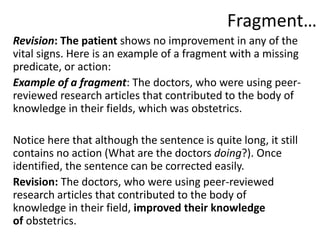
Revision: The patient shows no improvement in any of the
vital signs. Here is an example of a fragment with a missing
predicate, or action:
Example of a fragment: The doctors, who were using peer-
reviewed research articles that contributed to the body of
knowledge in their fields, which was obstetrics.
Notice here that although the sentence is quite long, it still
contains no action (What are the doctors doing?). Once
identified, the sentence can be corrected easily.
Revision: The doctors, who were using peer-reviewed
research articles that contributed to the body of
knowledge in their field, improved their knowledge
of obstetrics.
………………………………………
……………………………………….
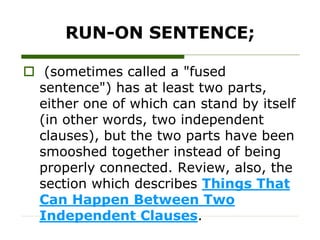
RUN-ON SENTENCE;
 (sometimes called a "fused
sentence") has at least two parts,
either one of which can stand by itself
(in other words, two independent
clauses), but the two parts have been
smooshed together instead of being
properly connected. Review, also, the
section which describes Things That
Can Happen Between Two
Independent Clauses.
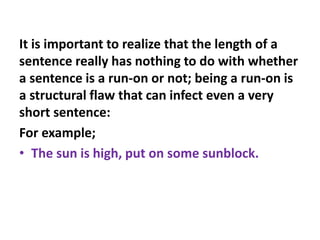
It is important to realize that the length of a
sentence really has nothing to do with whether
a sentence is a run-on or not; being a run-on is
a structural flaw that can infect even a very
short sentence:
For example;
• The sun is high, put on some sunblock.
comma-splice
• When two independent clauses are connected by only a
comma, they constitute a run-on sentence that is called
a comma-splice.
Example; The sun is high, put on some sunblock.
When you use a comma to connect two independent
clauses, it must be accompanied by a little
conjunction (and, but, for, nor, yet, or, so).
• The sun is high, so put on some sunscreen.
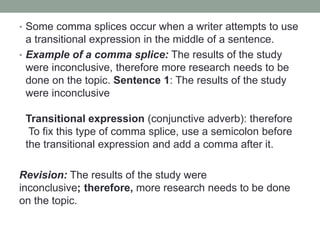
• Some comma splices occur when a writer attempts to use
a transitional expression in the middle of a sentence.
• Example of a comma splice: The results of the study
were inconclusive, therefore more research needs to be
done on the topic. Sentence 1: The results of the study
were inconclusive
Transitional expression (conjunctive adverb): therefore
To fix this type of comma splice, use a semicolon before
the transitional expression and add a comma after it.
Revision: The results of the study were
inconclusive; therefore, more research needs to be done
on the topic.
Run-on sentences happen typically
under the following circumstances*:
1. When an independent clause gives an
order or directive based on what was said in
the prior independent clause:
• This next chapter has a lot of difficult information in it, you
should start studying right away.
(We could put a period where that comma is and start a
new sentence. A semicolon might also work there.)
2. When two independent clauses are connected
by a transitional expression (conjunctive adverb)
such as however, moreover, nevertheless.
• . Mr. Ali has sent his four children to ivy-league colleges,
however, he has sacrificed his health working day and
night in that dusty bakery.
(Again, where that first comma appears, we could have
used either a period — and started a new sentence — or a
semicolon.)
3. When the second of two independent clauses
contains a pronoun that connects it to the first
independent clause.
• This computer doesn't make sense to me, it came
without a manual.(Although these two clauses are
quite brief, and the ideas are closely related, this
is a run-on sentence. We need a period where
that comma now stands.)
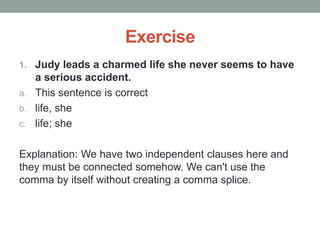
Exercise
1. Judy leads a charmed life she never seems to have
a serious accident.
a. This sentence is correct
b. life, she
c. life; she
Explanation: We have two independent clauses here and
they must be connected somehow. We can't use the
comma by itself without creating a comma splice.
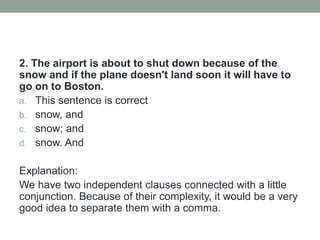
2. The airport is about to shut down because of the
snow and if the plane doesn't land soon it will have to
go on to Boston.
a. This sentence is correct
b. snow, and
c. snow; and
d. snow. And
Explanation:
We have two independent clauses connected with a little
conjunction. Because of their complexity, it would be a very
good idea to separate them with a comma.
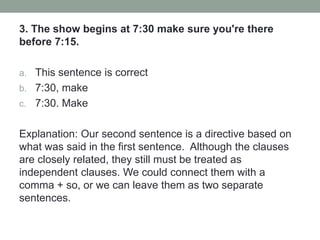
3. The show begins at 7:30 make sure you're there
before 7:15.
a. This sentence is correct
b. 7:30, make
c. 7:30. Make
Explanation: Our second sentence is a directive based on
what was said in the first sentence. Although the clauses
are closely related, they still must be treated as
independent clauses. We could connect them with a
comma + so, or we can leave them as two separate
sentences.
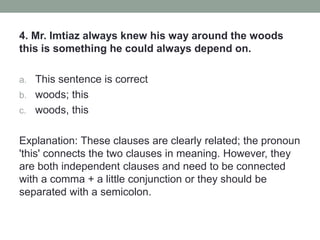
4. Mr. Imtiaz always knew his way around the woods
this is something he could always depend on.
a. This sentence is correct
b. woods; this
c. woods, this
Explanation: These clauses are clearly related; the pronoun
'this' connects the two clauses in meaning. However, they
are both independent clauses and need to be connected
with a comma + a little conjunction or they should be
separated with a semicolon.
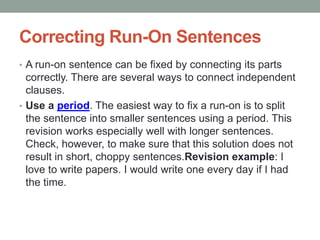
Correcting Run-On Sentences
• A run-on sentence can be fixed by connecting its parts
correctly. There are several ways to connect independent
clauses.
• Use a period. The easiest way to fix a run-on is to split
the sentence into smaller sentences using a period. This
revision works especially well with longer sentences.
Check, however, to make sure that this solution does not
result in short, choppy sentences.Revision example: I
love to write papers. I would write one every day if I had
the time.
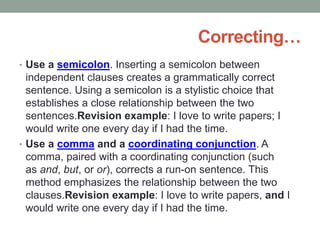
Correcting…
• Use a semicolon. Inserting a semicolon between
independent clauses creates a grammatically correct
sentence. Using a semicolon is a stylistic choice that
establishes a close relationship between the two
sentences.Revision example: I love to write papers; I
would write one every day if I had the time.
• Use a comma and a coordinating conjunction. A
comma, paired with a coordinating conjunction (such
as and, but, or or), corrects a run-on sentence. This
method emphasizes the relationship between the two
clauses.Revision example: I love to write papers, and I
would write one every day if I had the time.
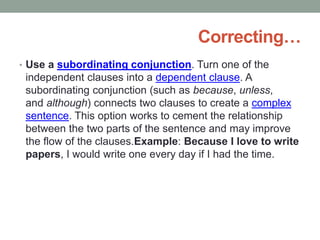
Correcting…
• Use a subordinating conjunction. Turn one of the
independent clauses into a dependent clause. A
subordinating conjunction (such as because, unless,
and although) connects two clauses to create a complex
sentence. This option works to cement the relationship
between the two parts of the sentence and may improve
the flow of the clauses.Example: Because I love to write
papers, I would write one every day if I had the time.
You now know everything you need to know
o to write anything you want to write,
o any way you want to write it,
o and still get the punctuation right each time!
Have
a
Groovy
Day

Best structure.ppt

  • 2.
    Definitions and Examplesof Basic Sentence Elements
  • 3.
    Elements of aSentence • Subject: Doer of the action / topic of the sentence • Predicate: states something about the subject Object: • Direct Object: Receives the action done by the subject • Indirect Object: Precedes the direct object and tells to whom or for whom the action of the verb is done and who is receiving the direct object.
  • 4.
    Subject: • A person,animal, place, thing, or concept that does an action. Determine the subject in a sentence by asking the question “Who or what?” Examples: • I ”Saleem Khan” like spaghetti. (The speaker; who talks) • You “Listener/s” love to read. (The listener; to whom the speaker talks/addresses) • He ”a scholar” reads many books. (About whom the speaker talks)
  • 5.
    Verb: • Expresses whatthe person, animal, place, thing, or concept does. Determine the verb in a sentence by asking the question “What was the action or what happened?” • I like spaghetti. • He reads many books. • The movie is good. (The be verb is also sometimes referred to as a copula or a linking verb. It links the subject, the movie, to the complement or the predicate of the sentence, good.)
  • 6.
    Object: • A person,animal, place, thing, or concept that receives the action. Determine the object in a sentence by asking the question “The subject did what?” or “To whom?/For whom?” Examples: • I like spaghetti. • He reads many books.
  • 7.
    Objects • Direct Object:Receives the action done by the subject • Indirect Object: Precedes the direct object and tells to whom or for whom the action of the verb is done and who is receiving the direct object. Examples: • He writes a letter. (Direct Object receives the action) • He writes a letter to me. (Indirect Object-receives the direct Object)
  • 8.
    Independent clause: • Anindependent clause can stand alone as a sentence. It contains a subject and a verb and is a complete idea. Examples: • I like spaghetti. • He reads many books.
  • 9.
    Dependent clause: • Adependent clause is not a complete sentence. It must be attached to an independent clause to become complete. This is also known as a subordinate clause. Example: • Although I like spaghetti,… • Because he reads many books,…
  • 10.
  • 12.
    Independent and DependentClauses An independent clause contains a subject, verb, and makes sense when it stands by itself. o The child’s endless crying is very disturbing to her parents. o Colds, flu, and other respiratory infections happen frequently in the winter and cause absences from work. o James got a cup of coffee and turned on his computer.
  • 13.
    Independent and DependentClauses A dependent clause contains a subject(s) and verb(s), but it does not make sense when it stands by itself because it begins with a subordinating conjunction that is supposed to join it to an independent clause. o Because she has had a terrible cold all week o When I got to the office and checked my email this morning o After Maria and Haris waited for an hour in the doctor’s office
  • 14.
    The Simple Sentence oA simple sentence is one independent clause. o An independent clause ends with a period or semicolon.
  • 15.
    The Compound Sentence Acompound sentence is made up of two or more simple sentences joined by one of the following: o A comma and a coordinating conjunction o A semicolon o A semicolon and a conjunctive adverb or transitional expression
  • 16.
    Coordinating Conjunctions Remember thecoordinating conjunctions by the acronym: FANBOYS F for A and N nor B but O or Y yet S so
  • 17.
    Conjunctive Adverbs and TransitionalExpressions o A conjunctive adverb is a word that connects two independent clauses and shows the relationship between the ideas. o I wanted to cash my check; unfortunately, the bank was closed. o A transitional expression is a phrase that shows that relationship. o I could use a job; on the other hand, I like having free time.
  • 18.
    Examples of CompoundSentences o A comma and a coordinating conjunction: I like to study grammar, and I love this class. o A semicolon: I like to study grammar; I love this class. o A semicolon and a conjunctive adverb or transitional expression: I like to study grammar; therefore, I love this class.
  • 19.
    The Complex Sentence oA complex sentence is a complete thought (independent clause) to which an incomplete thought (dependent clause) has been added. o A coordinating conjunction joins the dependent clause to the independent clause. o Because I like to study grammar, I love this class. o I love this class because I like to study grammar.
  • 20.
    The dependent clauseneeds the rest of the sentence for support. Because you love me, I love you. Dependent clause Independent clause Complex Sentence
  • 21.
    •A dependent clausecontains a subject and verb. •It does not express a complete thought because it begins with a subordinating conjunction. •A dependent clause is also called a subordinate clause. • Dependent clauses, like babies, cannot stand alone. Because you love me. Fragment! Dependent Clause
  • 22.
    Punctuation for ComplexSentences Commas are used to join a dependent clause to an independent clause if the dependent clause comes first in the sentence. The comma must follow the dependent clause. As I walked down the hallway , I could hear the echo of my footsteps.
  • 23.
    Punctuation for ComplexSentences No comma is used when the dependent clause comes after the independent clause. Then, the clauses are joined without any punctuation. I could hear the echo of my footsteps as I walked down the hallway.
  • 24.
    Punctuation for ComplexSentences Since dependent clauses are only part of a sentence, you can never use a semicolon to connect them to another sentence. Semicolons are only used between complete sentences. o I have loved you for years ; although I never admitted it. o I have loved you for years although I never admitted it. OK No!
  • 25.
    Common Subordinating (Dependent)Conjunctions after even if now that that where although even though once though whereas as if rather than unless wherever as if whenever since until whether because in order that so that when which before than in case while
  • 26.
    The Compound-Complex Sentence oA compound-complex sentence is the last and most complicated type of sentence. o It contains at least one dependent clause and at least two independent clauses.
  • 27.
    A dependent clauseadded to two or more independent clauses. Because we are a family, I help you, and you help me. Independent clauses Dependent clause Compound-Complex Sentence
  • 28.
    Simple Compound Complex Compound- complex Everysentence in English fits into one of these four categories,
  • 30.
    Sentence Fragments • Asentence fragment is a string of words that does not form a complete sentence; there is a necessary component of a complete sentence missing. This missing component may be a subject (usually a noun) or a predicate (verb or verb phrase) and/or when the sentence does not express a complete idea.
  • 31.
    Fragment… • Here isan example of a fragment with a missing subject. • Example of a fragment: Shows no improvement in any of the vital signs.The sentence above is a fragment since there is no subject (Who shows no improvement?). Fragments can be corrected by identifying the missing element and including it.
  • 32.
    Fragment… Revision: The patientshows no improvement in any of the vital signs. Here is an example of a fragment with a missing predicate, or action: Example of a fragment: The doctors, who were using peer- reviewed research articles that contributed to the body of knowledge in their fields, which was obstetrics. Notice here that although the sentence is quite long, it still contains no action (What are the doctors doing?). Once identified, the sentence can be corrected easily. Revision: The doctors, who were using peer-reviewed research articles that contributed to the body of knowledge in their field, improved their knowledge of obstetrics.
  • 33.
  • 34.
    RUN-ON SENTENCE;  (sometimescalled a "fused sentence") has at least two parts, either one of which can stand by itself (in other words, two independent clauses), but the two parts have been smooshed together instead of being properly connected. Review, also, the section which describes Things That Can Happen Between Two Independent Clauses.
  • 35.
    It is importantto realize that the length of a sentence really has nothing to do with whether a sentence is a run-on or not; being a run-on is a structural flaw that can infect even a very short sentence: For example; • The sun is high, put on some sunblock.
  • 36.
    comma-splice • When twoindependent clauses are connected by only a comma, they constitute a run-on sentence that is called a comma-splice. Example; The sun is high, put on some sunblock. When you use a comma to connect two independent clauses, it must be accompanied by a little conjunction (and, but, for, nor, yet, or, so). • The sun is high, so put on some sunscreen.
  • 37.
    • Some commasplices occur when a writer attempts to use a transitional expression in the middle of a sentence. • Example of a comma splice: The results of the study were inconclusive, therefore more research needs to be done on the topic. Sentence 1: The results of the study were inconclusive Transitional expression (conjunctive adverb): therefore To fix this type of comma splice, use a semicolon before the transitional expression and add a comma after it. Revision: The results of the study were inconclusive; therefore, more research needs to be done on the topic.
  • 38.
    Run-on sentences happentypically under the following circumstances*:
  • 39.
    1. When anindependent clause gives an order or directive based on what was said in the prior independent clause: • This next chapter has a lot of difficult information in it, you should start studying right away. (We could put a period where that comma is and start a new sentence. A semicolon might also work there.)
  • 40.
    2. When twoindependent clauses are connected by a transitional expression (conjunctive adverb) such as however, moreover, nevertheless. • . Mr. Ali has sent his four children to ivy-league colleges, however, he has sacrificed his health working day and night in that dusty bakery. (Again, where that first comma appears, we could have used either a period — and started a new sentence — or a semicolon.)
  • 41.
    3. When thesecond of two independent clauses contains a pronoun that connects it to the first independent clause. • This computer doesn't make sense to me, it came without a manual.(Although these two clauses are quite brief, and the ideas are closely related, this is a run-on sentence. We need a period where that comma now stands.)
  • 42.
    Exercise 1. Judy leadsa charmed life she never seems to have a serious accident. a. This sentence is correct b. life, she c. life; she Explanation: We have two independent clauses here and they must be connected somehow. We can't use the comma by itself without creating a comma splice.
  • 43.
    2. The airportis about to shut down because of the snow and if the plane doesn't land soon it will have to go on to Boston. a. This sentence is correct b. snow, and c. snow; and d. snow. And Explanation: We have two independent clauses connected with a little conjunction. Because of their complexity, it would be a very good idea to separate them with a comma.
  • 44.
    3. The showbegins at 7:30 make sure you're there before 7:15. a. This sentence is correct b. 7:30, make c. 7:30. Make Explanation: Our second sentence is a directive based on what was said in the first sentence. Although the clauses are closely related, they still must be treated as independent clauses. We could connect them with a comma + so, or we can leave them as two separate sentences.
  • 45.
    4. Mr. Imtiazalways knew his way around the woods this is something he could always depend on. a. This sentence is correct b. woods; this c. woods, this Explanation: These clauses are clearly related; the pronoun 'this' connects the two clauses in meaning. However, they are both independent clauses and need to be connected with a comma + a little conjunction or they should be separated with a semicolon.
  • 46.
    Correcting Run-On Sentences •A run-on sentence can be fixed by connecting its parts correctly. There are several ways to connect independent clauses. • Use a period. The easiest way to fix a run-on is to split the sentence into smaller sentences using a period. This revision works especially well with longer sentences. Check, however, to make sure that this solution does not result in short, choppy sentences.Revision example: I love to write papers. I would write one every day if I had the time.
  • 47.
    Correcting… • Use asemicolon. Inserting a semicolon between independent clauses creates a grammatically correct sentence. Using a semicolon is a stylistic choice that establishes a close relationship between the two sentences.Revision example: I love to write papers; I would write one every day if I had the time. • Use a comma and a coordinating conjunction. A comma, paired with a coordinating conjunction (such as and, but, or or), corrects a run-on sentence. This method emphasizes the relationship between the two clauses.Revision example: I love to write papers, and I would write one every day if I had the time.
  • 48.
    Correcting… • Use asubordinating conjunction. Turn one of the independent clauses into a dependent clause. A subordinating conjunction (such as because, unless, and although) connects two clauses to create a complex sentence. This option works to cement the relationship between the two parts of the sentence and may improve the flow of the clauses.Example: Because I love to write papers, I would write one every day if I had the time.
  • 49.
    You now knoweverything you need to know o to write anything you want to write, o any way you want to write it, o and still get the punctuation right each time!
  • 51.