SYNTAX
Compiled by: Monita
The Word
Can be grouped together into

• Words
words classes
(parts of speech)
• It has at least two kinds of properties :
▫ Morphological (page 20, 2nd paragraph)
▫ Syntactic (page 20, 3rd paragraph)
Words
Nouns, Adjectives,
Adverbs, Verbs

• Open word classes or
• Major Word Classes or
• Lexical words (karena punya
makna) or
• Content words

Prepositions, conjunctions,
articles, numerals, pronouns,
quantifiers, and interjections

• Closed word classes or
• Minor Word Classes or
• Grammatical words
or
• Functional words
The Word
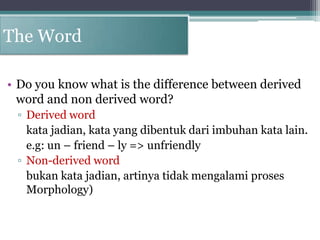
• Do you know what is the difference between derived
word and non derived word?
▫ Derived word
kata jadian, kata yang dibentuk dari imbuhan kata lain.
e.g: un – friend – ly => unfriendly
▫ Non-derived word
bukan kata jadian, artinya tidak mengalami proses
Morphology)
• Derivational affixes are added to the root or
stem in order to produce a new word.
▫ E.g : Book => booklet , book-s , book-ing
Semantic

Syntactic

VERB

Book+ -s “plural”

NOUN

Book+ -s “process”

Morphological

NOUN

Refers to “process”

Books

Refers to “thing”

VERB

NOUN

VERB

The books are hers
She books a seat
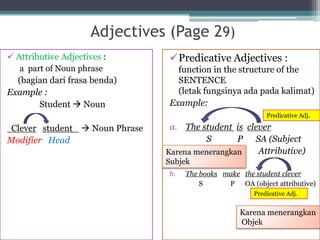
Adjectives (Page 29)
 Attributive Adjectives :
a part of Noun phrase

(bagian dari frasa benda)
Example :
Student  Noun

Predicative Adjectives :
function in the structure of the
SENTENCE
(letak fungsinya ada pada kalimat)
Example:
Predicative Adj.

Clever student  Noun Phrase
Modifier Head

a. The student is clever
S
P SA (Subject
Attributive)
Karena menerangkan
Subjek
b.

The books make the student clever
S
P OA (object attributive)
Predicative Adj.

Karena menerangkan
Objek
exercise
• The international students will be satisfied with the
luxurious treatments that make them honored.
• The door is green
• Students interested in Chomsky’s theory of language
felt ashamed.

English Syntax

  • 1.
  • 2.
    The Word Can begrouped together into • Words words classes (parts of speech) • It has at least two kinds of properties : ▫ Morphological (page 20, 2nd paragraph) ▫ Syntactic (page 20, 3rd paragraph)
  • 3.
    Words Nouns, Adjectives, Adverbs, Verbs •Open word classes or • Major Word Classes or • Lexical words (karena punya makna) or • Content words Prepositions, conjunctions, articles, numerals, pronouns, quantifiers, and interjections • Closed word classes or • Minor Word Classes or • Grammatical words or • Functional words
  • 4.
    The Word • Doyou know what is the difference between derived word and non derived word? ▫ Derived word kata jadian, kata yang dibentuk dari imbuhan kata lain. e.g: un – friend – ly => unfriendly ▫ Non-derived word bukan kata jadian, artinya tidak mengalami proses Morphology)
  • 5.
    • Derivational affixesare added to the root or stem in order to produce a new word. ▫ E.g : Book => booklet , book-s , book-ing Semantic Syntactic VERB Book+ -s “plural” NOUN Book+ -s “process” Morphological NOUN Refers to “process” Books Refers to “thing” VERB NOUN VERB The books are hers She books a seat
  • 6.
    Adjectives (Page 29) Attributive Adjectives : a part of Noun phrase (bagian dari frasa benda) Example : Student  Noun Predicative Adjectives : function in the structure of the SENTENCE (letak fungsinya ada pada kalimat) Example: Predicative Adj. Clever student  Noun Phrase Modifier Head a. The student is clever S P SA (Subject Attributive) Karena menerangkan Subjek b. The books make the student clever S P OA (object attributive) Predicative Adj. Karena menerangkan Objek
  • 7.
    exercise • The internationalstudents will be satisfied with the luxurious treatments that make them honored. • The door is green • Students interested in Chomsky’s theory of language felt ashamed.