ANALEPTICS
PRESENTER – DR SABA RAZZAK
MEDICINAL CHEMISTRY
1
ANALEPTICS
 Analeptics are central nervous system stimulants that include a wide
variety of medications used to treat depression, attention deficit
hyperactivity disorder (ADHD), and respiratory depression.
CNS STIMULANTS
CNS stimulants (CNS stands for central nervous system) are medicines that
stimulate the brain, speeding up both mental and physical processes.
They increase energy, improve attention and alertness, and elevate blood
pressure, heart rate and respiratory rate
2
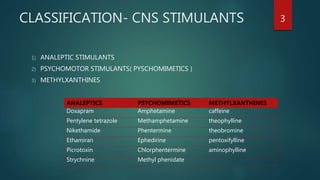
CLASSIFICATION- CNS STIMULANTS
1) ANALEPTIC STIMULANTS
2) PSYCHOMOTOR STIMULANTS( PYSCHOMIMETICS )
3) METHYLXANTHINES
3
ANALEPTICS PSYCHOMIMETICS METHYLXANTHINES
Doxapram Amphetamine caffeine
Pentylene tetrazole Methamphetamine theophylline
Nikethamide Phentermine theobromine
Ethamiran Ephedirine pentoxifylline
Picrotoxin Chlorphentermine aminophylline
Strychnine Methyl phenidate
ANALEPTICS
RESPIRATORY STIMULANTS
4
ANALEPTICS
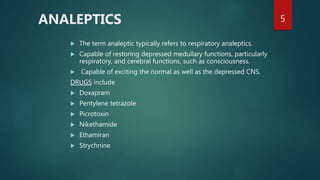
 The term analeptic typically refers to respiratory analeptics.
 Capable of restoring depressed medullary functions, particularly
respiratory, and cerebral functions, such as consciousness.
 Capable of exciting the normal as well as the depressed CNS.
DRUGS include
 Doxapram
 Pentylene tetrazole
 Picrotoxin
 Nikethamide
 Ethamiran
 Strychnine
5
CONTENTS
 INTRODUCTION
 SOURCE
 CLASS
 CHEMISTRY
 SYNTHESIS
 MECHANISM OF ACTION
 INDICATIONS
 CONCLUSION
6
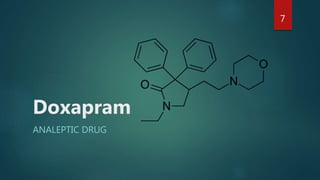
Doxapram
ANALEPTIC DRUG
7
DOXAPRAM- INTRODUCTION
 Doxapram hydrochloride is a respiratory stimulant with a brief duration of
action, found to have a strong, dose dependent respiratory stimulant
action.
 One of the analeptic, Synthesized by Lunsford et al. (1964).
 First marketed in the USA in 1965 by Robins Company.
 SOURCE Syntheic drug
 CLASS Pyrrolidinone
8
Appearance - Doxapram
 White to off white, colorless, crystalline powder, stable in light.
 Soluble in water, Sparingly soluble in alcohol and practically insoluble in
ether.
 Injectable products have a pH from 3.5-5.
Pharmacokinetics
 Onset: 20-40 sec
 Duration: 5-12 min (single IV injection)
 Peak Plasma Time: 1-2 min
 Half-life: 3.4 hr (2.4-4.1 hr)
9
CHEMISTRY-DOXAPRAM 10
CLASS Pyrrolidinone derivative
IUPAC NAME 1-Ethyl-4-(2-morpholinoethyl)-3,3-
diphenylpyrrolidin-2-one
CHEMICAL FORMULA C24H30N2O2
Synthesis- Doxapram
 Doxapram marketed and medically used as racemate, has a stereogenic
centre.
 it possess [+] enantiomer and [-] enantiomer
 [+] enantiomer possess pharmacological activity while [-] enantiomer is
inactive.
 The doxapram can be prepared by multiple crystallization of
dibenzoyltartaric acid salts. But loss of material during crystallization is
unsuitable in industrial scale.
11
Dibenzoyltartaric acid salt
Synthesis- Doxapram
 Three steps
12
N-
allyamide
γ-lactams
Pure
Doxapram
Synthesis- Doxapram 13
N-allyamideγ-lactams
DOXAPRAM
SAR - DOXAPRAM
 A member of the class of pyrrolidin-2-ones that is N-ethylpyrrolidin-2-one
in which both of the hydrogens at the 3 position (adjacent to the carbonyl
group) are substituted by phenyl groups, and one of the hydrogens at the
4 position is substituted by a 2-(morpholin-4-yl)ethyl group.
 Pharmacophore is N-ethylpyrrolidin-2-one.
 Morpholino functional group at position 4 is essential for stimulant activity.
14
Pharmacology- Doxapram
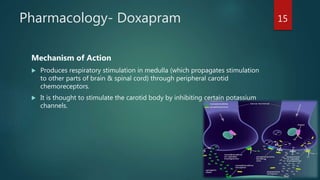
Mechanism of Action
 Produces respiratory stimulation in medulla (which propagates stimulation
to other parts of brain & spinal cord) through peripheral carotid
chemoreceptors.
 It is thought to stimulate the carotid body by inhibiting certain potassium
channels.
15
Indication- Doxapram
For use as a temporary measure in hospitalized patients with acute
respiratory insufficiency superimposed on chronic obstructive pulmonary
disease.
Associated conditions---
 Anesthetic complication pulmonary
 Acute Hypercapnia
 Drug-induced Respiratory depression
 Postoperative respiratory depression
Associated Therapies--
 Post-operative respiratory stimulation
16
Restriction- Doxapram
 Use of doxapram in the medical setting is hampered by side effects, such
as high blood pressure, panic attacks, tachycardia (rapid heart rate),
tremor, convulsions, sweating, vomiting and the sensation of "air hunger."
 Doxapram may not be used in patients with coronary heart disease,
epilepsy and high blood pressure.
17
Pentylene Tetrazol
ANALEPTIC DRUG
18
Pentylene Tetrazol- Introduction
 In 1924, in search of a camphor substitute, Schmidt of Heidelberg
synthesized pentylene tetrazol.
 Marketed in the same year under the trade name Cardiazol as a
cardiotonic.
 2 years later, introduced under the registered trademark of Metrazol.
 SOURCE Syntheic drug
 CLASS Tetrazole
19
Chemistry- Pentylene tetrazol 20
Class Tetrazole derivative
IUPAC name 6,7,8,9-tetrahydro-5H- tetrazoio(l,5-
a)azepine
Chemical formula C6H10N4
Synthesis – Pentylene tetrazol 21
AZEPINE RING
SAR- Pentylene tetrazole
 Unsubstituted tetrazol has no pharmacological action, but alkylation in
position 1 or 5 leads to compounds with convulsant and analeptic
properties, or to depressant action.
 Stimulant effects are obtained with a relatively long chain substitution in
position 1 and a short chain in position 5.
 Reversal of the substituted groups causes a decrease in the stimulant
action or even depressant action.
22
 1,5-cyclohexamethylenetetrazol and 1,5-cycloheptamethylenetetrazol
resemble pentylene tetrazol in their actions,
 whereas 1,5-cyclodecamethylenetetrazol is inactive.
 Compounds with smaller (tetra- or trimethylene) rings have low activity
which is increased by alkylation.
 The introduction of a methyl group into the pentylenetetrazol molecules
in position 8 causes an increase in activity; an isopropyl or tertiary butyl
group in the same position is even more active.
 In general, it appears that a certain number of carbon atoms is essential
for the analeptic activity.
23
Pharmacology – Pentylene tetrazol
 Mechanism of action:
 Pentylene tetrazol acts on the entire CNS, significantly
block GABAA receptor function.
 Convulsant activity can be observed, no matter what route of
administration is used
24
Indications – Pentylene tetrazole
 Pentylene tetrazole has been experimentally used to study seizure
phenomena.
 Found to be effective for depression.
 It has shown its convulsant actions in mice, rats, cats and primates.
25
CONCLUSION
 CNS STIMULANTS are of three types
ANALEPTICS
PYSCHOMIMETICS
METHYLXANTHINES
 The most commonly used ANALEPTICS are Doxapram and pentylene Tetrazole.
 DOXAPRAM belongs to class pyrollidines while PTZ a Tetrazole derivative.
 Doxapram works by stimulating the medulla and PTZ by inhibiting GABA.
 Their primary medical use - As an anesthetic recovery tool.
 To treat – Emergency respiratory depression.
 As a Barbiturate antidote. ( for its poisoning/overdose)
26
27
28

ANALEPTICS - DOXAPRAM

  • 1.
    ANALEPTICS PRESENTER – DRSABA RAZZAK MEDICINAL CHEMISTRY 1
  • 2.
    ANALEPTICS  Analeptics arecentral nervous system stimulants that include a wide variety of medications used to treat depression, attention deficit hyperactivity disorder (ADHD), and respiratory depression. CNS STIMULANTS CNS stimulants (CNS stands for central nervous system) are medicines that stimulate the brain, speeding up both mental and physical processes. They increase energy, improve attention and alertness, and elevate blood pressure, heart rate and respiratory rate 2
  • 3.
    CLASSIFICATION- CNS STIMULANTS 1)ANALEPTIC STIMULANTS 2) PSYCHOMOTOR STIMULANTS( PYSCHOMIMETICS ) 3) METHYLXANTHINES 3 ANALEPTICS PSYCHOMIMETICS METHYLXANTHINES Doxapram Amphetamine caffeine Pentylene tetrazole Methamphetamine theophylline Nikethamide Phentermine theobromine Ethamiran Ephedirine pentoxifylline Picrotoxin Chlorphentermine aminophylline Strychnine Methyl phenidate
  • 4.
  • 5.
    ANALEPTICS  The termanaleptic typically refers to respiratory analeptics.  Capable of restoring depressed medullary functions, particularly respiratory, and cerebral functions, such as consciousness.  Capable of exciting the normal as well as the depressed CNS. DRUGS include  Doxapram  Pentylene tetrazole  Picrotoxin  Nikethamide  Ethamiran  Strychnine 5
  • 6.
    CONTENTS  INTRODUCTION  SOURCE CLASS  CHEMISTRY  SYNTHESIS  MECHANISM OF ACTION  INDICATIONS  CONCLUSION 6
  • 7.
  • 8.
    DOXAPRAM- INTRODUCTION  Doxapramhydrochloride is a respiratory stimulant with a brief duration of action, found to have a strong, dose dependent respiratory stimulant action.  One of the analeptic, Synthesized by Lunsford et al. (1964).  First marketed in the USA in 1965 by Robins Company.  SOURCE Syntheic drug  CLASS Pyrrolidinone 8
  • 9.
    Appearance - Doxapram White to off white, colorless, crystalline powder, stable in light.  Soluble in water, Sparingly soluble in alcohol and practically insoluble in ether.  Injectable products have a pH from 3.5-5. Pharmacokinetics  Onset: 20-40 sec  Duration: 5-12 min (single IV injection)  Peak Plasma Time: 1-2 min  Half-life: 3.4 hr (2.4-4.1 hr) 9
  • 10.
    CHEMISTRY-DOXAPRAM 10 CLASS Pyrrolidinonederivative IUPAC NAME 1-Ethyl-4-(2-morpholinoethyl)-3,3- diphenylpyrrolidin-2-one CHEMICAL FORMULA C24H30N2O2
  • 11.
    Synthesis- Doxapram  Doxaprammarketed and medically used as racemate, has a stereogenic centre.  it possess [+] enantiomer and [-] enantiomer  [+] enantiomer possess pharmacological activity while [-] enantiomer is inactive.  The doxapram can be prepared by multiple crystallization of dibenzoyltartaric acid salts. But loss of material during crystallization is unsuitable in industrial scale. 11 Dibenzoyltartaric acid salt
  • 12.
    Synthesis- Doxapram  Threesteps 12 N- allyamide γ-lactams Pure Doxapram
  • 13.
  • 14.
    SAR - DOXAPRAM A member of the class of pyrrolidin-2-ones that is N-ethylpyrrolidin-2-one in which both of the hydrogens at the 3 position (adjacent to the carbonyl group) are substituted by phenyl groups, and one of the hydrogens at the 4 position is substituted by a 2-(morpholin-4-yl)ethyl group.  Pharmacophore is N-ethylpyrrolidin-2-one.  Morpholino functional group at position 4 is essential for stimulant activity. 14
  • 15.
    Pharmacology- Doxapram Mechanism ofAction  Produces respiratory stimulation in medulla (which propagates stimulation to other parts of brain & spinal cord) through peripheral carotid chemoreceptors.  It is thought to stimulate the carotid body by inhibiting certain potassium channels. 15
  • 16.
    Indication- Doxapram For useas a temporary measure in hospitalized patients with acute respiratory insufficiency superimposed on chronic obstructive pulmonary disease. Associated conditions---  Anesthetic complication pulmonary  Acute Hypercapnia  Drug-induced Respiratory depression  Postoperative respiratory depression Associated Therapies--  Post-operative respiratory stimulation 16
  • 17.
    Restriction- Doxapram  Useof doxapram in the medical setting is hampered by side effects, such as high blood pressure, panic attacks, tachycardia (rapid heart rate), tremor, convulsions, sweating, vomiting and the sensation of "air hunger."  Doxapram may not be used in patients with coronary heart disease, epilepsy and high blood pressure. 17
  • 18.
  • 19.
    Pentylene Tetrazol- Introduction In 1924, in search of a camphor substitute, Schmidt of Heidelberg synthesized pentylene tetrazol.  Marketed in the same year under the trade name Cardiazol as a cardiotonic.  2 years later, introduced under the registered trademark of Metrazol.  SOURCE Syntheic drug  CLASS Tetrazole 19
  • 20.
    Chemistry- Pentylene tetrazol20 Class Tetrazole derivative IUPAC name 6,7,8,9-tetrahydro-5H- tetrazoio(l,5- a)azepine Chemical formula C6H10N4
  • 21.
    Synthesis – Pentylenetetrazol 21 AZEPINE RING
  • 22.
    SAR- Pentylene tetrazole Unsubstituted tetrazol has no pharmacological action, but alkylation in position 1 or 5 leads to compounds with convulsant and analeptic properties, or to depressant action.  Stimulant effects are obtained with a relatively long chain substitution in position 1 and a short chain in position 5.  Reversal of the substituted groups causes a decrease in the stimulant action or even depressant action. 22
  • 23.
     1,5-cyclohexamethylenetetrazol and1,5-cycloheptamethylenetetrazol resemble pentylene tetrazol in their actions,  whereas 1,5-cyclodecamethylenetetrazol is inactive.  Compounds with smaller (tetra- or trimethylene) rings have low activity which is increased by alkylation.  The introduction of a methyl group into the pentylenetetrazol molecules in position 8 causes an increase in activity; an isopropyl or tertiary butyl group in the same position is even more active.  In general, it appears that a certain number of carbon atoms is essential for the analeptic activity. 23
  • 24.
    Pharmacology – Pentylenetetrazol  Mechanism of action:  Pentylene tetrazol acts on the entire CNS, significantly block GABAA receptor function.  Convulsant activity can be observed, no matter what route of administration is used 24
  • 25.
    Indications – Pentylenetetrazole  Pentylene tetrazole has been experimentally used to study seizure phenomena.  Found to be effective for depression.  It has shown its convulsant actions in mice, rats, cats and primates. 25
  • 26.
    CONCLUSION  CNS STIMULANTSare of three types ANALEPTICS PYSCHOMIMETICS METHYLXANTHINES  The most commonly used ANALEPTICS are Doxapram and pentylene Tetrazole.  DOXAPRAM belongs to class pyrollidines while PTZ a Tetrazole derivative.  Doxapram works by stimulating the medulla and PTZ by inhibiting GABA.  Their primary medical use - As an anesthetic recovery tool.  To treat – Emergency respiratory depression.  As a Barbiturate antidote. ( for its poisoning/overdose) 26
  • 27.
  • 28.