SYMPATHECTOMY
Dr. Akshai George Paul
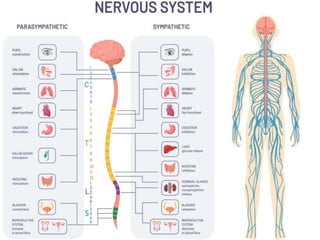
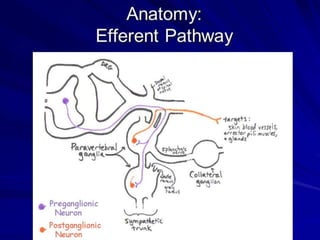
• THE SYMPATHETIC NERVOUS SYSTEM IS FORMED
FROM PREGANGLIONIC FIBERS WHICH EXIT
VENTRAL ROOT OF SPINAL CORD FROM T1-L2.
• IT SYNAPSE WITH POSTGANGLIONIC FIBERS IN
SYMPATHETIC GANGLION NEAR SPINAL CORD, OR
TRAVELS ALONG SYMPATHETIC TRUNK TO
ANOTHER GANGLION OR TRAVELS TO COLLATERAL
GANGLION NEARER THE ORGAN OR GLAND
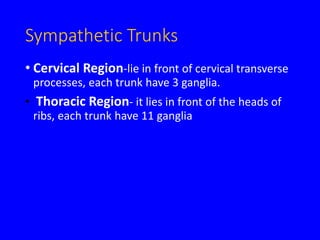
Sympathetic Trunks
• Cervical Region-lie in front of cervical transverse
processes, each trunk have 3 ganglia.
• Thoracic Region- it lies in front of the heads of
ribs, each trunk have 11 ganglia
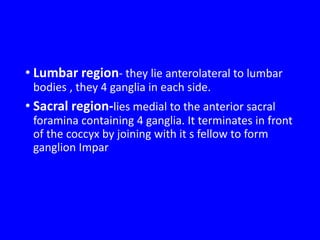
• Lumbar region- they lie anterolateral to lumbar
bodies , they 4 ganglia in each side.
• Sacral region-lies medial to the anterior sacral
foramina containing 4 ganglia. It terminates in front
of the coccyx by joining with it s fellow to form
ganglion Impar
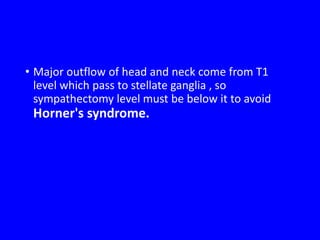
• Major outflow of head and neck come from T1
level which pass to stellate ganglia , so
sympathectomy level must be below it to avoid
Horner's syndrome.
SYMPATHECTOMY
CHEMICAL SYMPATHECTOMY
Under flouroscopic guidance percutaneous approach
to the required segment
Alcohol/phenol is Injected
SURGICAL SYMPATHECTOMY
General Principle-Physiology
• Sympathetic denervation results in increased blood
flow
• Vasodilation of arterioles in cutaneous beds
Indications
1) Primary Hyperhydrosis
Thoracoscopic sympathectomy is effective-mostly T2-
T3 level
2) Raynauds syndrome and Frost bite
3) Burgers Disease
4) Causalgia-pain associated with injury to somatic
nerves
5) POVD
It is to control Rest pain
6) Migraine
7) Thoracic Outlet Syndrome
Thoracic Sympathectomy
• Open
• Thoracoscopic
• Percutaneous RFA
• Robotic Surgery
Complications
• Compensatory Hyperhydrosis
• Gustatory Sweating
• Horners syndrome
• Recurrence
• Intercostal neuralgia
Lumbar Sympathectomy
• Done as Open Or Laparoscopic approch
• sympathetic chain on the left side is easiest to
approach as it lies on loose areolar tissue alongside
the aorta and can be palpated as ganglionated cord
against vertebral bodies
• On the right side it lies behind IVC which retracted
gently , avoid injury of lumbar veins which may
pass in front of sympathetic chain
• Lift the chain forwards with nerve hook,
diathermize and divide
Complications
• Retoperitoneal hematoma
• Post Sympathectomy neuralgia
• Dry orgasm-If both L1 are removed-damages
ejaculatory mechanism
Contraindications
• Intermittent claudication's
• ABPI >0.3
• Diabetics [ autonomic neuropathy]
Summary
• Sympathectomy increases peripheral blood flow by
vasodilation of arterioles in cutaneous vascular
beds
• Some patients may receive sufficient increases to
help heal superficial ischemic ulcers and relieve rest
pain
• Blood flow effects are comparatively small in the
long run
• Protection against an exaggerated vasoconstrictor
response to cold, improvement against sympathetic
pain, and suppression of sweating are long lasting
results
THANK YOU
SYMPATHECTOMY .pptx
SYMPATHECTOMY .pptx
SYMPATHECTOMY .pptx
SYMPATHECTOMY .pptx
SYMPATHECTOMY .pptx
SYMPATHECTOMY .pptx

SYMPATHECTOMY .pptx