Cervical sympathectomy
• Cervical sympathectomy is
somewhat misnomer
• the sympathetic outflow to the upper limb is
from the 2nd to the 5th thoracic ganglia.
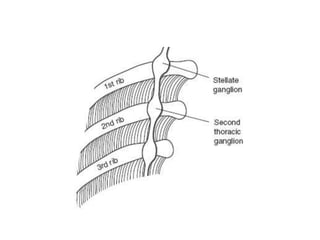
• Stellate ganglion
composite ganglion formed by fusion of the
inferior cervical ganglion and the first thoracic
ganglion
• fact carefully preserved to prevent a Horner’s
syndrome.
Nomenclature
Th2 sympathectomy- resection of the Th2 ganglion,
generally achieved by resecting the sympathetic
chain between the middle of the second
rib (Th2) and the third rib (Th3).
• Th2 sympathicotomy- division of the sympathetic
chain over the middle of the 2nd rib and division of
the sympathetic chain over the middle of the 3rd
rib. This accomplishes isolation of the Th2 ganglion
that is found in between the two cuts.
Indications of cervical sympathectomy
Hyperhidrosis of the hands and or axilla –
commonest indication.
Occasionally facial sweating or blushing,
• Raynaud’s disease – in severe cases.
• Sympathetic maintained causalgia or pain,
• Non reconstructible arterial insufficiencies,
• Facial blushing,
• Axillary sweating,
• Cold sensitivity after cold injury,
• Angina pectoris,
• Long QT syndrome,
• Reflex sympathetic dystrophy (Shoulder-
hand syndrome, Sudeck’s atrophy),
• Splanchnicectomy for pancreatic pain.
Both sides can be done at the same sitting or
sequentally a week or two apart.
Open cervicodorsal sympathectomy
The operation is now obsolete,having been
replaced by endoscopic transthoracic
sympathectomy.
ANTERIOR APPROACH FOR
SYMPATHECTOMY
• A transverse incision above the medial third of
the clavicle is deepened through platysma, the
lateral fibres of sternocleidomastoid are divided,
and the external jugular vein ligated and
divided.
• Scalenus anterior is identified as it crosses the
operative field to its insertion into the first rib.
The phrenic nerve on its anterior surface is
retracted and preserved, and the muscle is
divided to expose the subclavian artery.
The artery can either be depressed downwards,
or gently mobilized and retracted upwards by
means of a tape passed around it.
The supra-pleural membrane is detached from
the inner border of the first rib, and the pleura is
displaced downwards and laterally to expose the
neck of the ribs with the sympathetic chain and
ganglia.
THORACOSCOPIC SYMPATHECTOMY
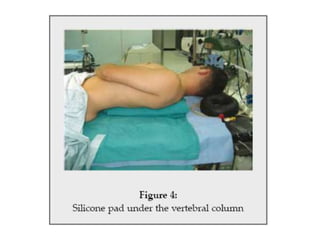
Video assisted thoracoscopic procedure using a
two-port technique.
10 mm for camera
5 mm for instrument
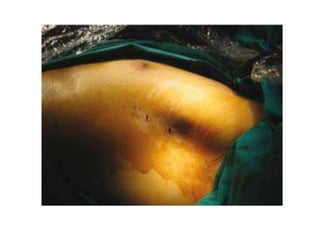
• The first incision is made in the fourth
submammary intercostal space just below the
pectoral muscle as an access route for camera,
and
• a second incision is made at third midaxillary
intercostal space to introduce surgical
instruments.
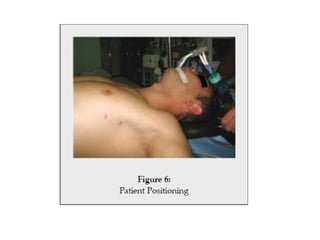
• Prior to the insertion of the camera 8-10
mmHg 2L/min carbon dioxide insufflation is
done.
• Also semi-recumbent position allow gravity to
help pull the upper lobes out of the field of
dissection.
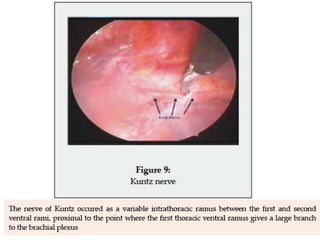
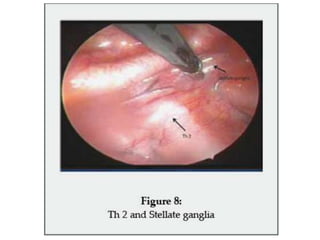
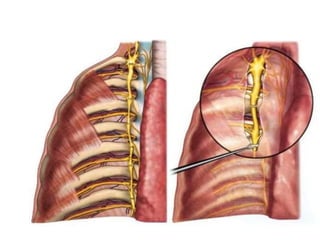
The sympathetic chain, with its ganglia, is
identified as a pale pink structure traversing
the necks of the ribs.
It is found deep to the parietal pleura
divided with the diathermy hook.
On the right, great care must be taken to avoid
injury to the azygos vein.
Levels of sympathectomy
• Hyperhidrosis th2 level;
• Facial sweating or blushing, the th2 level
• Hand sweating, the th2 and th3 levels
• Axillary sweating th3 and th4 level.
• Raynaud syndrome,causalgia th2 to th3 levels
• For pancreatic splanchnicectomy
Th4 to th10 should be divided.
complications
The most common complication is the
compensatory sweating.
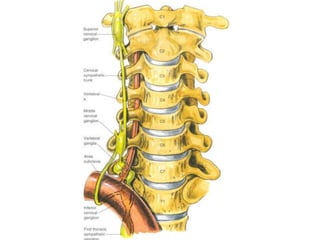
The sympathetic trunk
• extends from the base of the skull to the coccyx in close
relationship to the vertebral column, maintaining a
distance of about 1 inch (2.5 cm) from the midline
throughout its course.
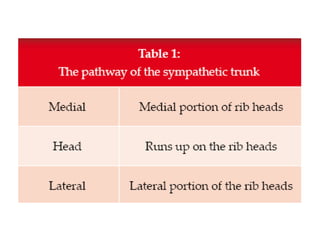
• the chain descends closely behind the posterior wall of
the carotid sheath,
• enters the thorax anterior to the neck of the first rib,
• descends over the heads of the upper ribs and then on
the sides of the bodies of the last three or four thoracic
vertebrae.
• The chain then passes into the abdomen behind
the medial arcuate ligament of the diaphragm
and descends in a groove between psoas major
and the sides of the lumbar vertebral bodies,
overlapped by the abdominal aorta on the left
and the inferior vena cava on the right.
• The chain then passes behind the common iliac
vessels to enter the pelvis anterior to the ala of
the sacrum and then descends medial to the
anterior sacral foramina.
• The sympathetic trunks end below by meeting
each other at the ganglion impar on the anterior
face of the coccyx.
• Developmentally, there was originally one
ganglion for each peripheral nerve, but by
a process of fusion these have been
reduced in man to
• three cervical,
• twelve or less thoracic,
• two to four lumbar and
• four sacral ganglia.
A second 5-mm instrument port is established in the
5th space.
The sympathetic chain, with its ganglia, is
identified as a pale pink structure traversing the
necks of the ribs.
It is found lying deep to the parietal pleura, which
must be incised to isolate the sympathetic chain.
The sympathetic chain is then lifted and divided
with the diathermy hook.
On the right, great care must be taken to avoid
injury to the azygos vein.
Cervical sympathectomy

Cervical sympathectomy

  • 1.
  • 2.
    • Cervical sympathectomyis somewhat misnomer
  • 3.
    • the sympatheticoutflow to the upper limb is from the 2nd to the 5th thoracic ganglia. • Stellate ganglion composite ganglion formed by fusion of the inferior cervical ganglion and the first thoracic ganglion • fact carefully preserved to prevent a Horner’s syndrome.
  • 5.
    Nomenclature Th2 sympathectomy- resectionof the Th2 ganglion, generally achieved by resecting the sympathetic chain between the middle of the second rib (Th2) and the third rib (Th3). • Th2 sympathicotomy- division of the sympathetic chain over the middle of the 2nd rib and division of the sympathetic chain over the middle of the 3rd rib. This accomplishes isolation of the Th2 ganglion that is found in between the two cuts.
  • 6.
    Indications of cervicalsympathectomy Hyperhidrosis of the hands and or axilla – commonest indication. Occasionally facial sweating or blushing, • Raynaud’s disease – in severe cases. • Sympathetic maintained causalgia or pain, • Non reconstructible arterial insufficiencies, • Facial blushing, • Axillary sweating,
  • 7.
    • Cold sensitivityafter cold injury, • Angina pectoris, • Long QT syndrome, • Reflex sympathetic dystrophy (Shoulder- hand syndrome, Sudeck’s atrophy), • Splanchnicectomy for pancreatic pain. Both sides can be done at the same sitting or sequentally a week or two apart.
  • 8.
    Open cervicodorsal sympathectomy Theoperation is now obsolete,having been replaced by endoscopic transthoracic sympathectomy.
  • 9.
    ANTERIOR APPROACH FOR SYMPATHECTOMY •A transverse incision above the medial third of the clavicle is deepened through platysma, the lateral fibres of sternocleidomastoid are divided, and the external jugular vein ligated and divided. • Scalenus anterior is identified as it crosses the operative field to its insertion into the first rib.
  • 10.
    The phrenic nerveon its anterior surface is retracted and preserved, and the muscle is divided to expose the subclavian artery. The artery can either be depressed downwards, or gently mobilized and retracted upwards by means of a tape passed around it. The supra-pleural membrane is detached from the inner border of the first rib, and the pleura is displaced downwards and laterally to expose the neck of the ribs with the sympathetic chain and ganglia.
  • 11.
    THORACOSCOPIC SYMPATHECTOMY Video assistedthoracoscopic procedure using a two-port technique. 10 mm for camera 5 mm for instrument
  • 13.
    • The firstincision is made in the fourth submammary intercostal space just below the pectoral muscle as an access route for camera, and • a second incision is made at third midaxillary intercostal space to introduce surgical instruments.
  • 16.
    • Prior tothe insertion of the camera 8-10 mmHg 2L/min carbon dioxide insufflation is done. • Also semi-recumbent position allow gravity to help pull the upper lobes out of the field of dissection.
  • 18.
    The sympathetic chain,with its ganglia, is identified as a pale pink structure traversing the necks of the ribs. It is found deep to the parietal pleura divided with the diathermy hook. On the right, great care must be taken to avoid injury to the azygos vein.
  • 21.
    Levels of sympathectomy •Hyperhidrosis th2 level; • Facial sweating or blushing, the th2 level • Hand sweating, the th2 and th3 levels • Axillary sweating th3 and th4 level. • Raynaud syndrome,causalgia th2 to th3 levels • For pancreatic splanchnicectomy Th4 to th10 should be divided.
  • 22.
    complications The most commoncomplication is the compensatory sweating.
  • 23.
    The sympathetic trunk •extends from the base of the skull to the coccyx in close relationship to the vertebral column, maintaining a distance of about 1 inch (2.5 cm) from the midline throughout its course. • the chain descends closely behind the posterior wall of the carotid sheath, • enters the thorax anterior to the neck of the first rib, • descends over the heads of the upper ribs and then on the sides of the bodies of the last three or four thoracic vertebrae.
  • 25.
    • The chainthen passes into the abdomen behind the medial arcuate ligament of the diaphragm and descends in a groove between psoas major and the sides of the lumbar vertebral bodies, overlapped by the abdominal aorta on the left and the inferior vena cava on the right. • The chain then passes behind the common iliac vessels to enter the pelvis anterior to the ala of the sacrum and then descends medial to the anterior sacral foramina. • The sympathetic trunks end below by meeting each other at the ganglion impar on the anterior face of the coccyx.
  • 26.
    • Developmentally, therewas originally one ganglion for each peripheral nerve, but by a process of fusion these have been reduced in man to • three cervical, • twelve or less thoracic, • two to four lumbar and • four sacral ganglia.
  • 27.
    A second 5-mminstrument port is established in the 5th space. The sympathetic chain, with its ganglia, is identified as a pale pink structure traversing the necks of the ribs. It is found lying deep to the parietal pleura, which must be incised to isolate the sympathetic chain. The sympathetic chain is then lifted and divided with the diathermy hook. On the right, great care must be taken to avoid injury to the azygos vein.