SWOT ANALYSIS
Strength Weakness Opportunity Threat
Strengths describe the
positive attributes,
tangible and intangible,
internal to your
organization. They are
within your control.
Weaknesses are aspects of
your business that detract
from the value you offer or
place you at a competitive
disadvantage. You need to
enhance these areas in
order to compete with your
best competitor.
Opportunities are
external attractive
factors that represent
reasons your business
is likely to prosper.
Threats include external
factors beyond your control
that could place your
strategy, or the business
itself, at risk. You have no
control over these, but you
may benefit by having
contingency plans to address
them if they should occur.
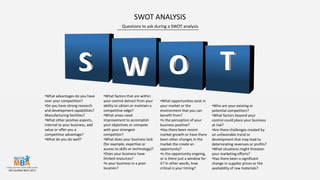
Questions to ask during a SWOT analysis
SWOT ANALYSIS
•What advantages do you have
over your competition?
•Do you have strong research
and development capabilities?
Manufacturing facilities?
•What other positive aspects,
internal to your business, add
value or offer you a
competitive advantage?
•What do you do well?
•What factors that are within
your control detract from your
ability to obtain or maintain a
competitive edge?
•What areas need
improvement to accomplish
your objectives or compete
with your strongest
competitor?
•What does your business lack
(for example, expertise or
access to skills or technology)?
•Does your business have
limited resources?
•Is your business in a poor
location?
•What opportunities exist in
your market or the
environment that you can
benefit from?
•Is the perception of your
business positive?
•Has there been recent
market growth or have there
been other changes in the
market the create an
opportunity?
•Is the opportunity ongoing,
or is there just a window for
it? In other words, how
critical is your timing?
•Who are your existing or
potential competitors?
•What factors beyond your
control could place your business
at risk?
•Are there challenges created by
an unfavorable trend or
development that may lead to
deteriorating revenues or profits?
•What situations might threaten
your marketing efforts?
•Has there been a significant
change in supplier prices or the
availability of raw materials?
SWOT ANALYSIS
Strengths in SWOT analysis
are the attributes within an
organization that are
considered to be necessary
for the ultimate success of a
project. Strengths are
resources and capabilities
that can be used for
competitive advantage.
Weaknesses include factors
such as an abundance of
rivalry between
departments, a weak
internal communication
system, lack of funding and
an inadequate amount of
materials.
Opportunities are
classified as external
elements that might be
helpful in achieving the
goals set for the project.
The possible threats that
are critical to any SWOT
analysis include a negative
public image, no ready-
made market for the final
product and the lack of
vendors who are able to
supply raw materials for
the project.
Strength Weakness Opportunity Threat
s wo t
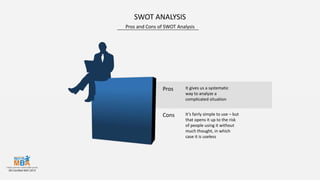
Pros and Cons of SWOT Analysis
SWOT ANALYSIS
It gives us a systematic
way to analyze a
complicated situation
It’s fairly simple to use – but
that opens it up to the risk
of people using it without
much thought, in which
case it is useless
Pros
Cons
Pros and Cons of SWOT Analysis
SWOT ANALYSIS
It prompts us to find ways to build on
our strengths, deal with our weaknesses,
take advantages of opportunities and
prepare for threats
Analysis paralysis is a real risk – don’t get
bogged down with it – the trick is finding
a balance between what you need to
know and what you don’t
Pros
Cons
Pros and Cons of SWOT Analysis
SWOT ANALYSIS
It’s fairly simple to
understand and use
We may have a tendency to overemphasize our strengths.
Critical thinking is therefore crucial, and always remembering
that strengths are not strengths unless they can make a
genuine difference to your business’ competitiveness and are
not something that the other players in the market have –
we need to be stronger than they on those points.
Pros
Cons
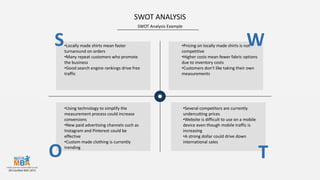
SWOT Analysis Example
SWOT ANALYSIS
S W
O T
•Locally made shirts mean faster
turnaround on orders
•Many repeat customers who promote
the business
•Good search engine rankings drive free
traffic
•Pricing on locally made shirts is not
competitive
•Higher costs mean fewer fabric options
due to inventory costs
•Customers don't like taking their own
measurements
•Using technology to simplify the
measurement process could increase
conversions
•New paid advertising channels such as
Instagram and Pinterest could be
effective
•Custom made clothing is currently
trending
•Several competitors are currently
undercutting prices
•Website is difficult to use on a mobile
device even though mobile traffic is
increasing
•A strong dollar could drive down
international sales
THANK YOU

Swot analysis

  • 1.
    SWOT ANALYSIS Strength WeaknessOpportunity Threat Strengths describe the positive attributes, tangible and intangible, internal to your organization. They are within your control. Weaknesses are aspects of your business that detract from the value you offer or place you at a competitive disadvantage. You need to enhance these areas in order to compete with your best competitor. Opportunities are external attractive factors that represent reasons your business is likely to prosper. Threats include external factors beyond your control that could place your strategy, or the business itself, at risk. You have no control over these, but you may benefit by having contingency plans to address them if they should occur.
  • 2.
    Questions to askduring a SWOT analysis SWOT ANALYSIS •What advantages do you have over your competition? •Do you have strong research and development capabilities? Manufacturing facilities? •What other positive aspects, internal to your business, add value or offer you a competitive advantage? •What do you do well? •What factors that are within your control detract from your ability to obtain or maintain a competitive edge? •What areas need improvement to accomplish your objectives or compete with your strongest competitor? •What does your business lack (for example, expertise or access to skills or technology)? •Does your business have limited resources? •Is your business in a poor location? •What opportunities exist in your market or the environment that you can benefit from? •Is the perception of your business positive? •Has there been recent market growth or have there been other changes in the market the create an opportunity? •Is the opportunity ongoing, or is there just a window for it? In other words, how critical is your timing? •Who are your existing or potential competitors? •What factors beyond your control could place your business at risk? •Are there challenges created by an unfavorable trend or development that may lead to deteriorating revenues or profits? •What situations might threaten your marketing efforts? •Has there been a significant change in supplier prices or the availability of raw materials?
  • 3.
    SWOT ANALYSIS Strengths inSWOT analysis are the attributes within an organization that are considered to be necessary for the ultimate success of a project. Strengths are resources and capabilities that can be used for competitive advantage. Weaknesses include factors such as an abundance of rivalry between departments, a weak internal communication system, lack of funding and an inadequate amount of materials. Opportunities are classified as external elements that might be helpful in achieving the goals set for the project. The possible threats that are critical to any SWOT analysis include a negative public image, no ready- made market for the final product and the lack of vendors who are able to supply raw materials for the project. Strength Weakness Opportunity Threat s wo t
  • 4.
    Pros and Consof SWOT Analysis SWOT ANALYSIS It gives us a systematic way to analyze a complicated situation It’s fairly simple to use – but that opens it up to the risk of people using it without much thought, in which case it is useless Pros Cons
  • 5.
    Pros and Consof SWOT Analysis SWOT ANALYSIS It prompts us to find ways to build on our strengths, deal with our weaknesses, take advantages of opportunities and prepare for threats Analysis paralysis is a real risk – don’t get bogged down with it – the trick is finding a balance between what you need to know and what you don’t Pros Cons
  • 6.
    Pros and Consof SWOT Analysis SWOT ANALYSIS It’s fairly simple to understand and use We may have a tendency to overemphasize our strengths. Critical thinking is therefore crucial, and always remembering that strengths are not strengths unless they can make a genuine difference to your business’ competitiveness and are not something that the other players in the market have – we need to be stronger than they on those points. Pros Cons
  • 7.
    SWOT Analysis Example SWOTANALYSIS S W O T •Locally made shirts mean faster turnaround on orders •Many repeat customers who promote the business •Good search engine rankings drive free traffic •Pricing on locally made shirts is not competitive •Higher costs mean fewer fabric options due to inventory costs •Customers don't like taking their own measurements •Using technology to simplify the measurement process could increase conversions •New paid advertising channels such as Instagram and Pinterest could be effective •Custom made clothing is currently trending •Several competitors are currently undercutting prices •Website is difficult to use on a mobile device even though mobile traffic is increasing •A strong dollar could drive down international sales
  • 8.