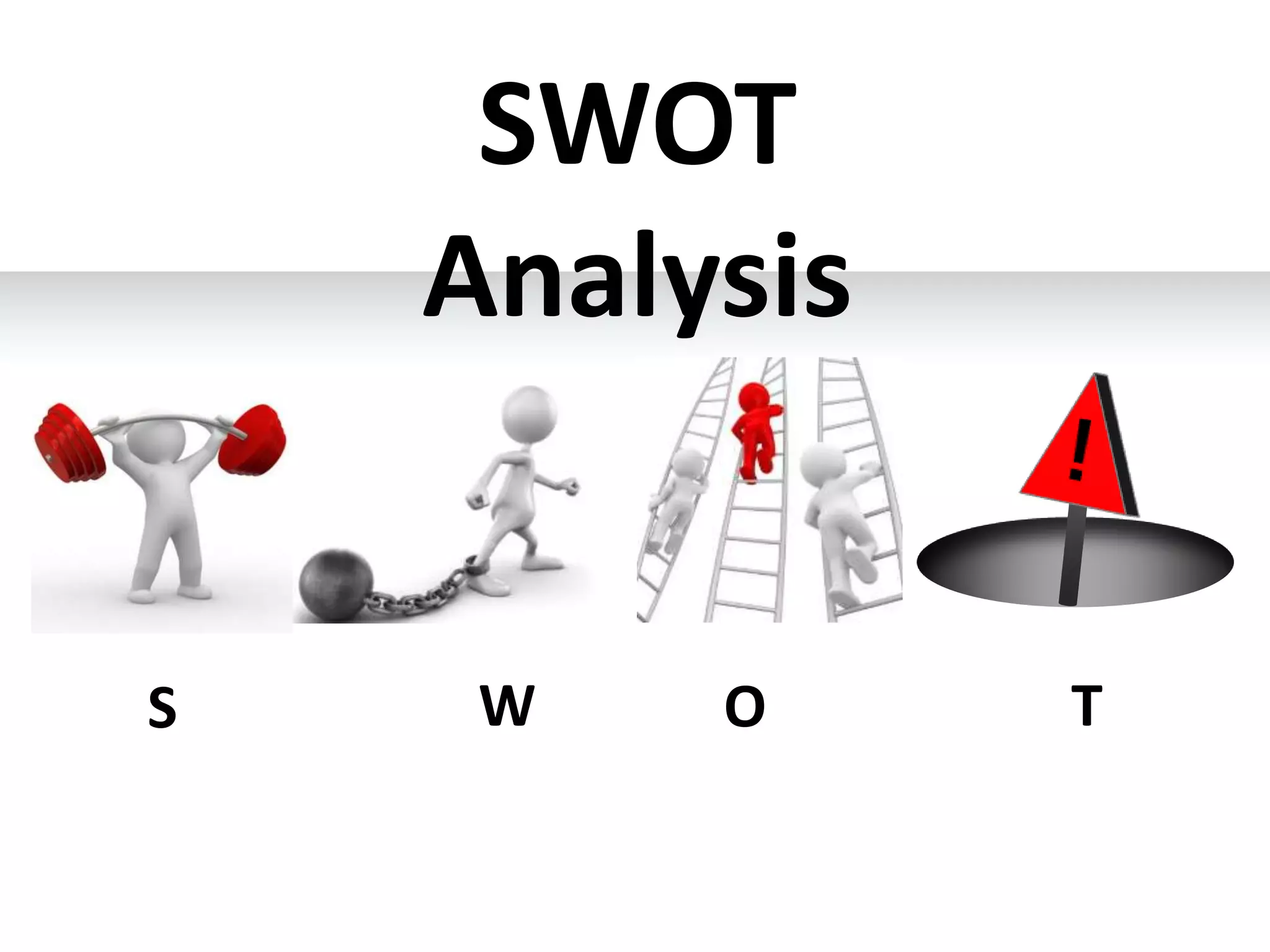
SWOT
Analysis
S W O T
SWOT Analysis
Example text
Go ahead and replace it with your
own text. This is an example text.
Your own footer Your Logo
Aim of SWOT Analysis
Who needs SWOT Analysis?
How to conduct SWOT Analysis?
Learning Objectives
What is SWOT Analysis?
Benefits & Pitfalls of SWOT Analysis
What is SWOT Analysis?
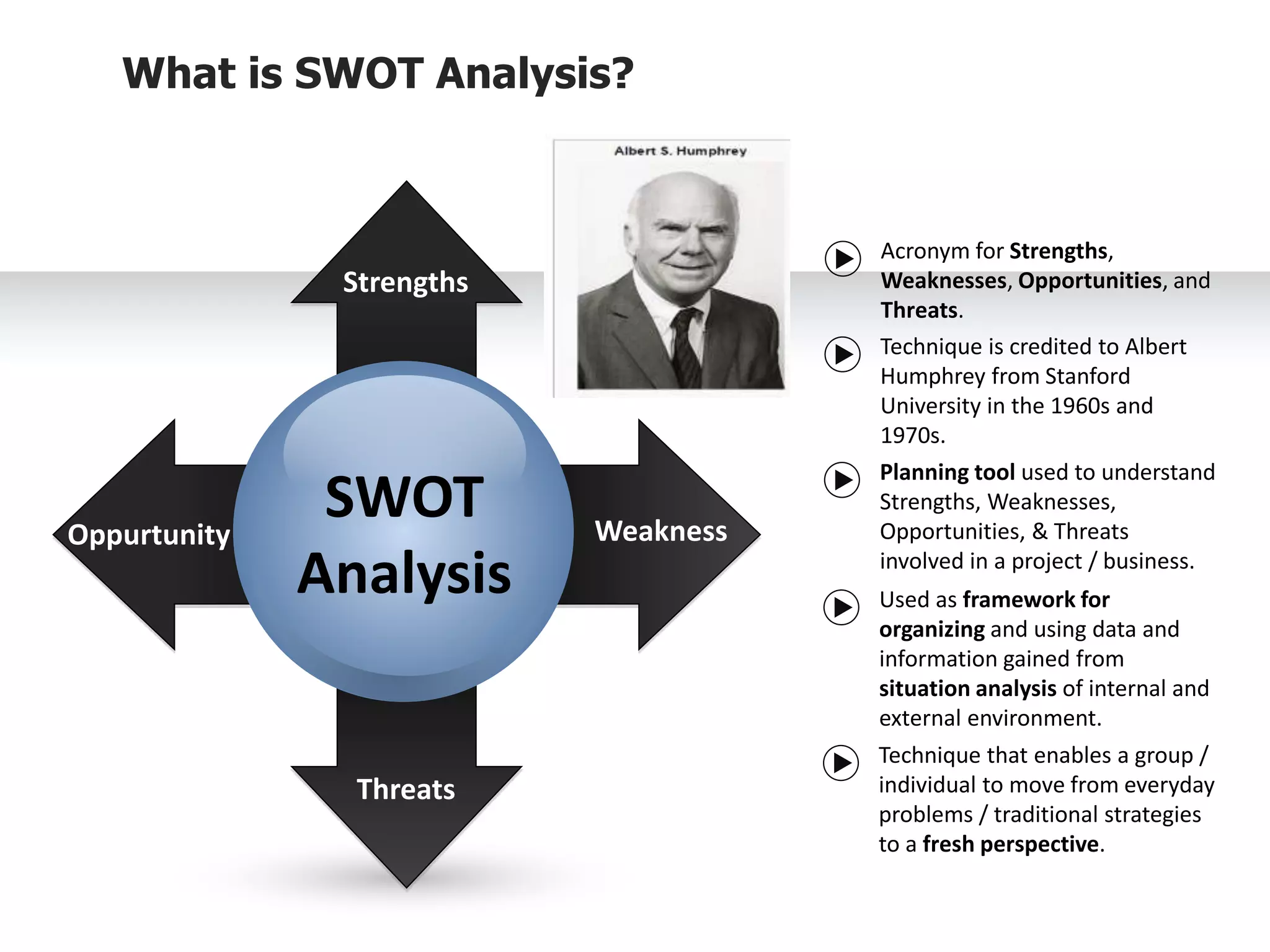
SWOT
Analysis
Oppurtunity
Threats
Strengths
Weakness
Acronym for Strengths,
Weaknesses, Opportunities, and
Threats.
Technique is credited to Albert
Humphrey from Stanford
University in the 1960s and
1970s.
Planning tool used to understand
Strengths, Weaknesses,
Opportunities, & Threats
involved in a project / business.
Used as framework for
organizing and using data and
information gained from
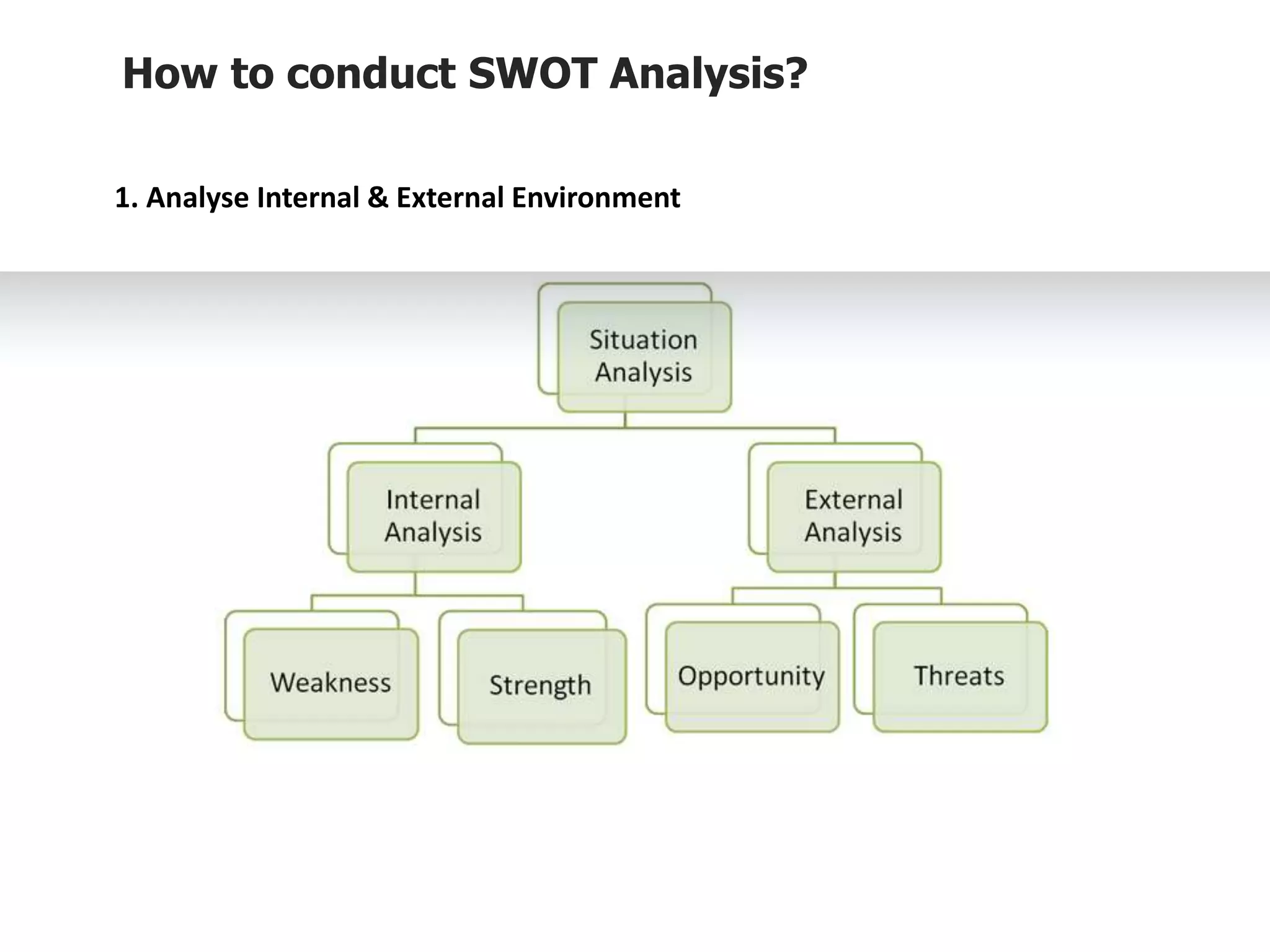
situation analysis of internal and
external environment.
Technique that enables a group /
individual to move from everyday
problems / traditional strategies
to a fresh perspective.
What is SWOT Analysis?
STRENGTHS
Characteristics of the business or a team
that give it an advantage over others in
the industry.
Positive tangible and intangible
attributes, internal to an organization.
Beneficial aspects of the organization
or the capabilities of an organization,
which includes human competencies,
process capabilities, financial
resources, products and services,
customer goodwill and brand loyalty.
Examples - Abundant financial resources,
Well-known brand name, Economies of
scale, Lower costs [raw materials or
processes], Superior management talent,
Better marketing skills, Good distribution
skills, Committed employees.
What is SWOT Analysis?
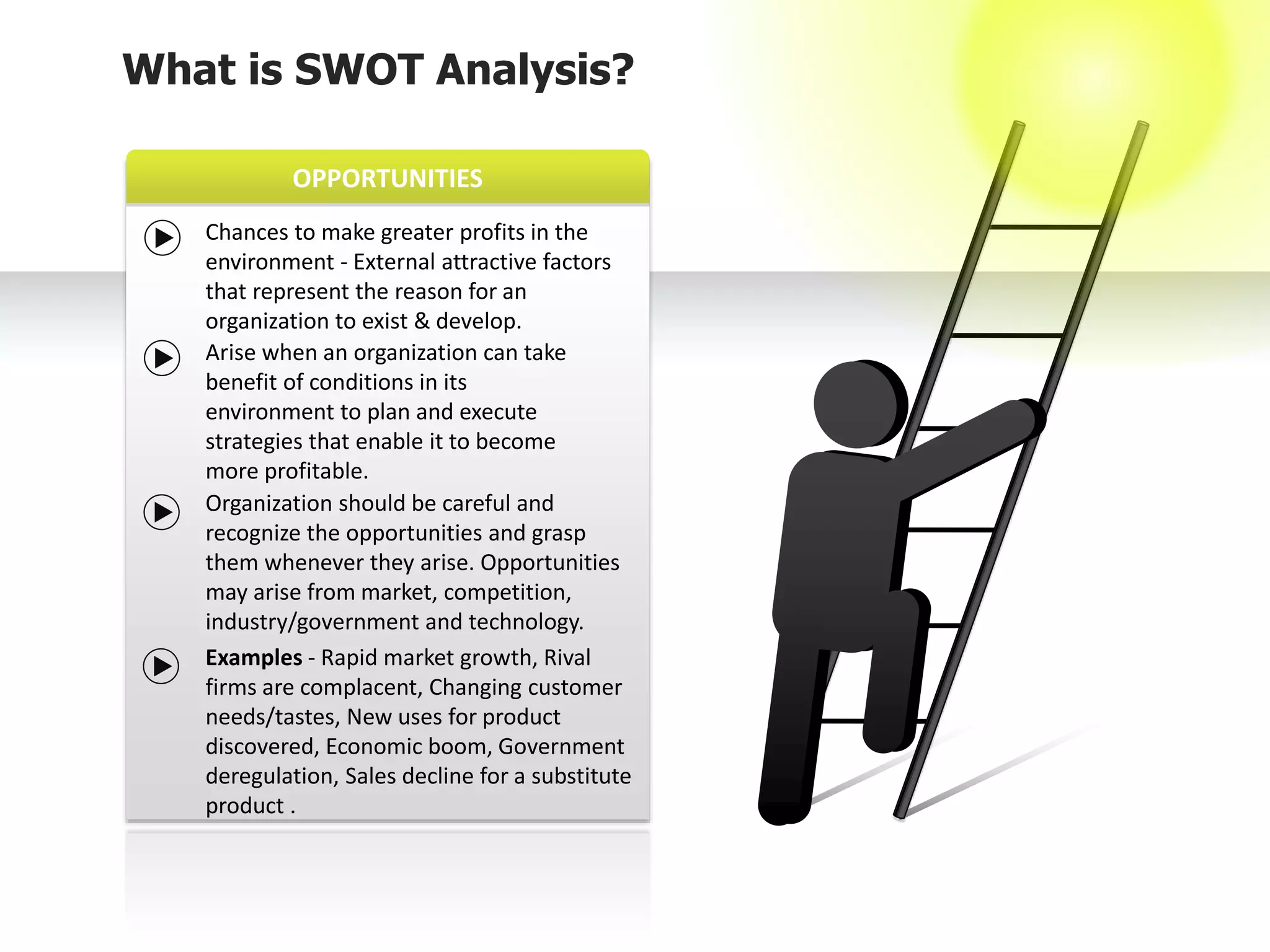
OPPORTUNITIES
What is SWOT Analysis?
Chances to make greater profits in the
environment - External attractive factors
that represent the reason for an
organization to exist & develop.
Arise when an organization can take
benefit of conditions in its
environment to plan and execute
strategies that enable it to become
more profitable.
Organization should be careful and
recognize the opportunities and grasp
them whenever they arise. Opportunities
may arise from market, competition,
industry/government and technology.
Examples - Rapid market growth, Rival
firms are complacent, Changing customer
needs/tastes, New uses for product
discovered, Economic boom, Government
deregulation, Sales decline for a substitute
product .
WEAKNESSES
Characteristics that place the firm at a
disadvantage relative to others.
Detract the organization from its
ability to attain the core goal and
influence its growth.
Weaknesses are the factors which do
not meet the standards we feel they
should meet. However, weaknesses
are controllable. They must be
minimized and eliminated.
Examples - Limited financial resources,,
Very narrow product line, Limited
distribution, Higher costs, Out-of-date
products / technology, Weak market
image, Poor marketing skills, Limited
management skills, Under-trained
employees.
What is SWOT Analysis?
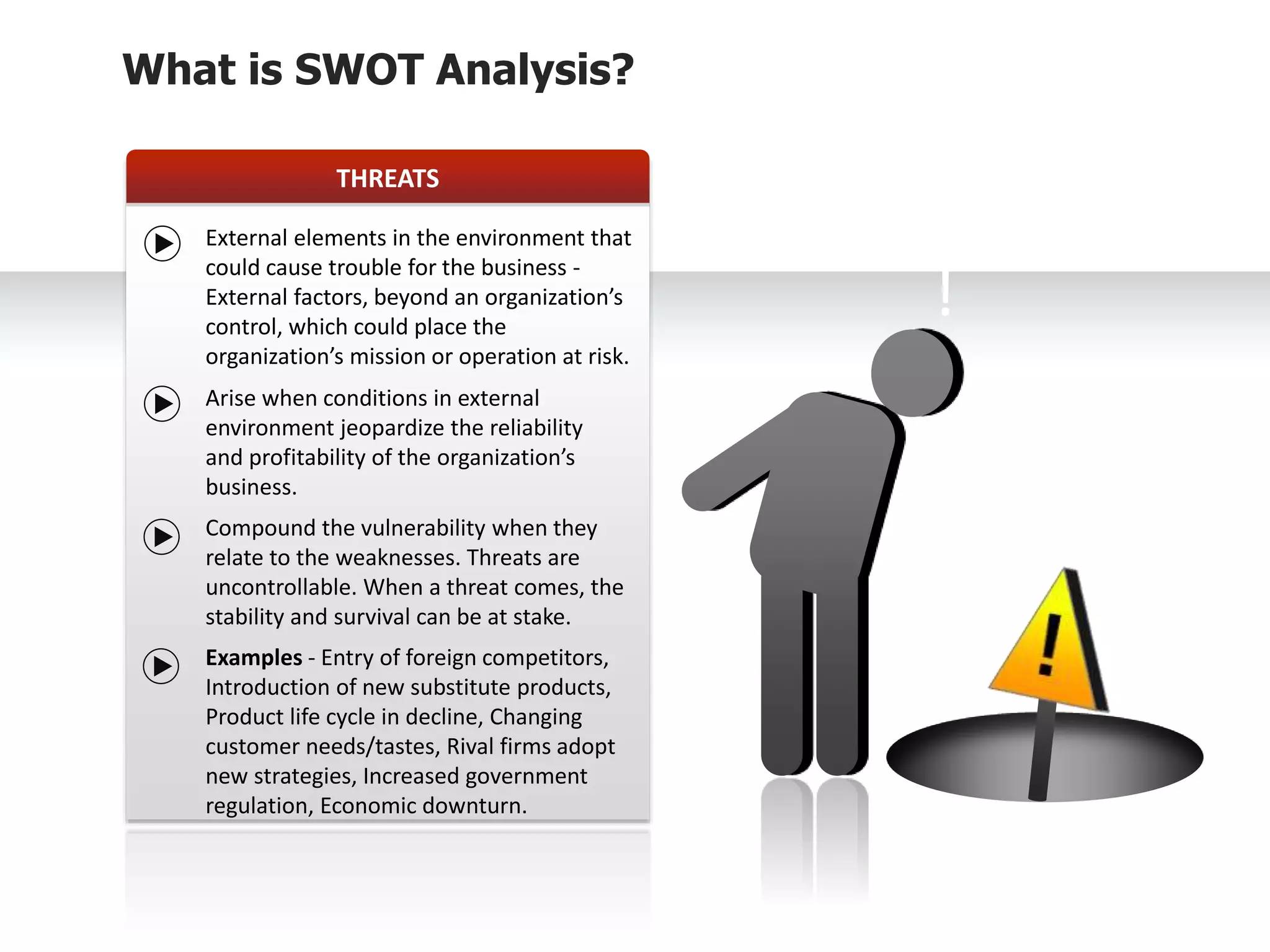
SWOT ANALYSIS - THREAT
!
THREATS
What is SWOT Analysis?
External elements in the environment that
could cause trouble for the business -
External factors, beyond an organization’s
control, which could place the
organization’s mission or operation at risk.
Arise when conditions in external
environment jeopardize the reliability
and profitability of the organization’s
business.
Compound the vulnerability when they
relate to the weaknesses. Threats are
uncontrollable. When a threat comes, the
stability and survival can be at stake.
Examples - Entry of foreign competitors,
Introduction of new substitute products,
Product life cycle in decline, Changing
customer needs/tastes, Rival firms adopt
new strategies, Increased government
regulation, Economic downturn.
SWOT Analysis
Example text
Go ahead and replace it with your
own text. This is an example text.
Your own footer Your Logo
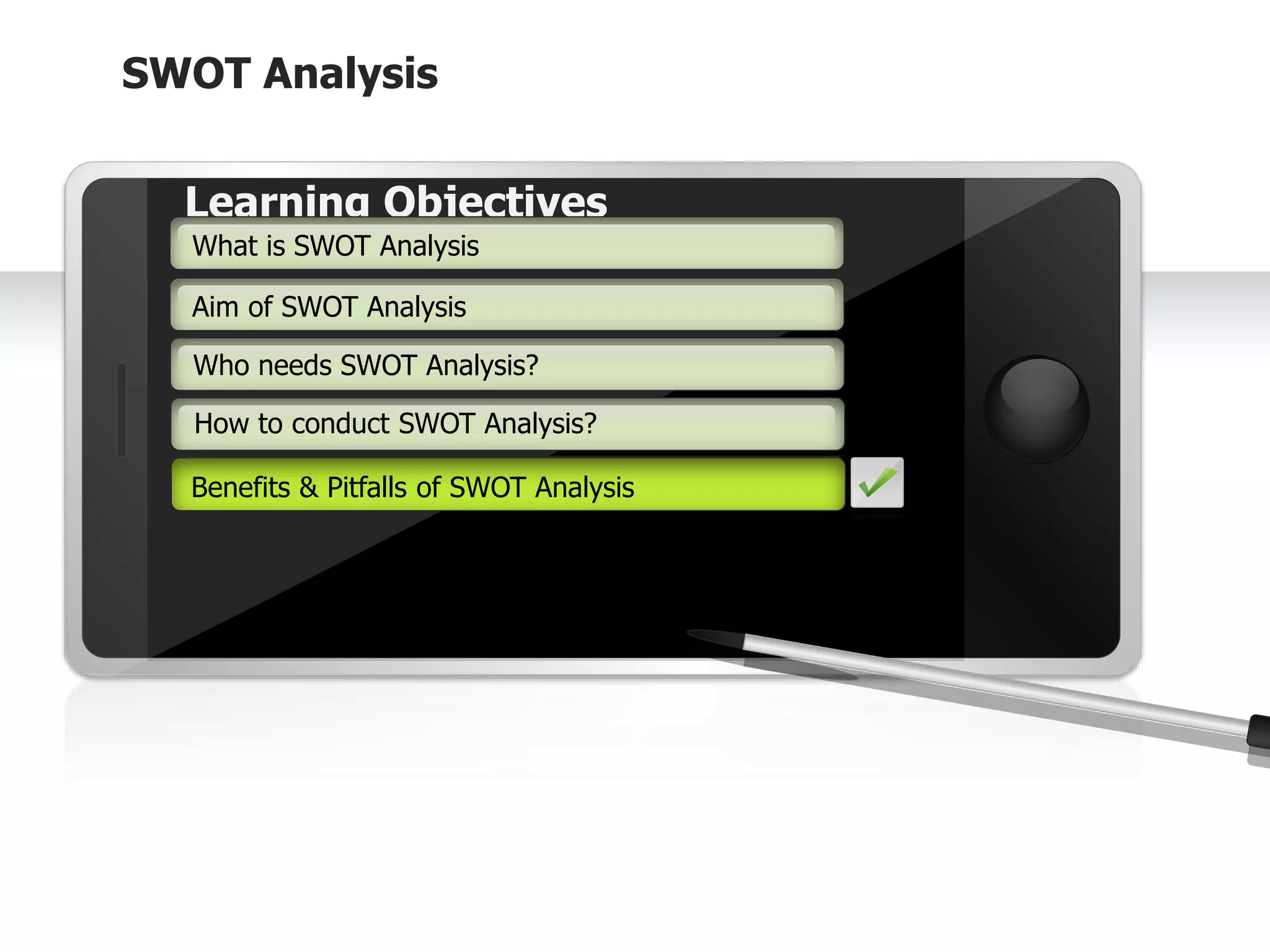
Aim of SWOT Analysis
Who needs SWOT Analysis?
How to conduct SWOT Analysis?
Learning Objectives
What is SWOT Analysis?
Benefits & Pitfalls of SWOT Analysis
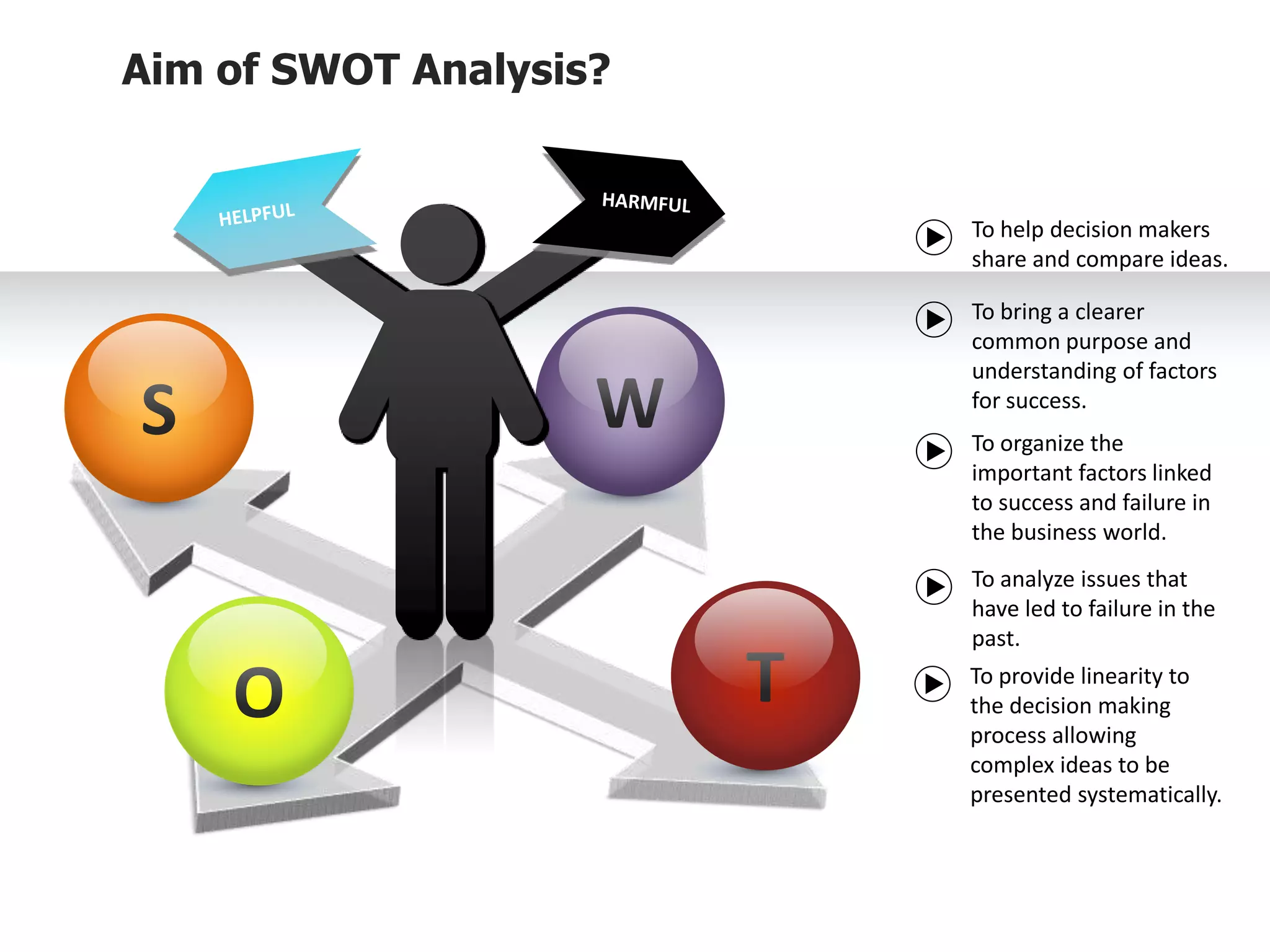
Aim of SWOT Analysis?
S W
T
O
To help decision makers
share and compare ideas.
To bring a clearer
common purpose and
understanding of factors
for success.
To organize the
important factors linked
to success and failure in
the business world.
To analyze issues that
have led to failure in the
past.
Aim of SWOT Analysis?
To provide linearity to
the decision making
process allowing
complex ideas to be
presented systematically.
SWOT Analysis
Example text
Go ahead and replace it with your
own text. This is an example text.
Your own footer Your Logo
Aim of SWOT Analysis
Who needs SWOT Analysis?
How to conduct SWOT Analysis?
Learning Objectives
What is SWOT Analysis?
Benefits & Pitfalls of SWOT Analysis
Who needs SWOT Analysis?
Mr. Sherpinsky's Honors Marketing Class.
2015 All rights reserved.
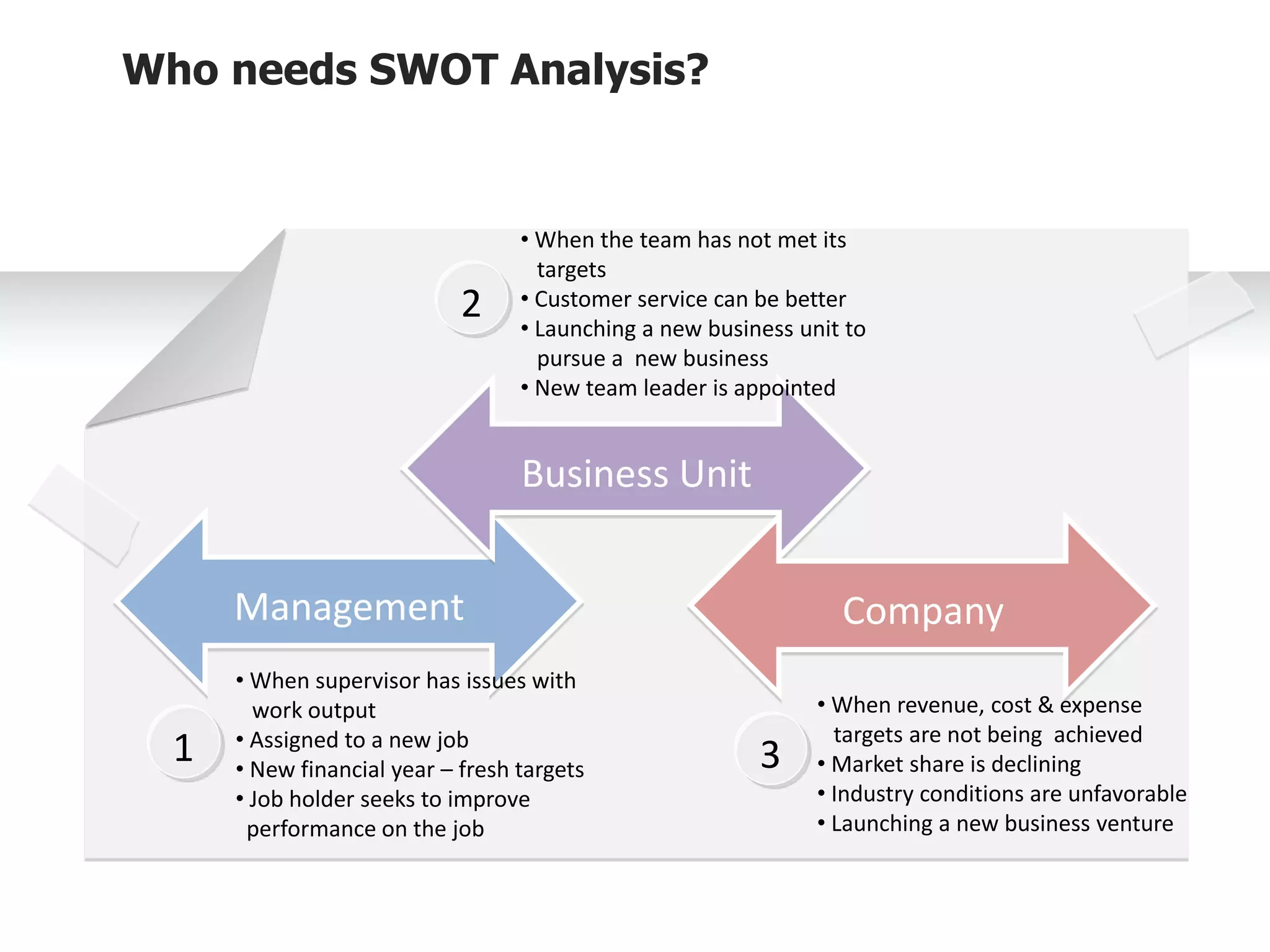
Management
• When supervisor has issues with
work output
• Assigned to a new job
• New financial year – fresh targets
• Job holder seeks to improve
performance on the job
1
Business Unit
2
• When the team has not met its
targets
• Customer service can be better
• Launching a new business unit to
pursue a new business
• New team leader is appointed
Company
• When revenue, cost & expense
targets are not being achieved
• Market share is declining
• Industry conditions are unfavorable
• Launching a new business venture
3
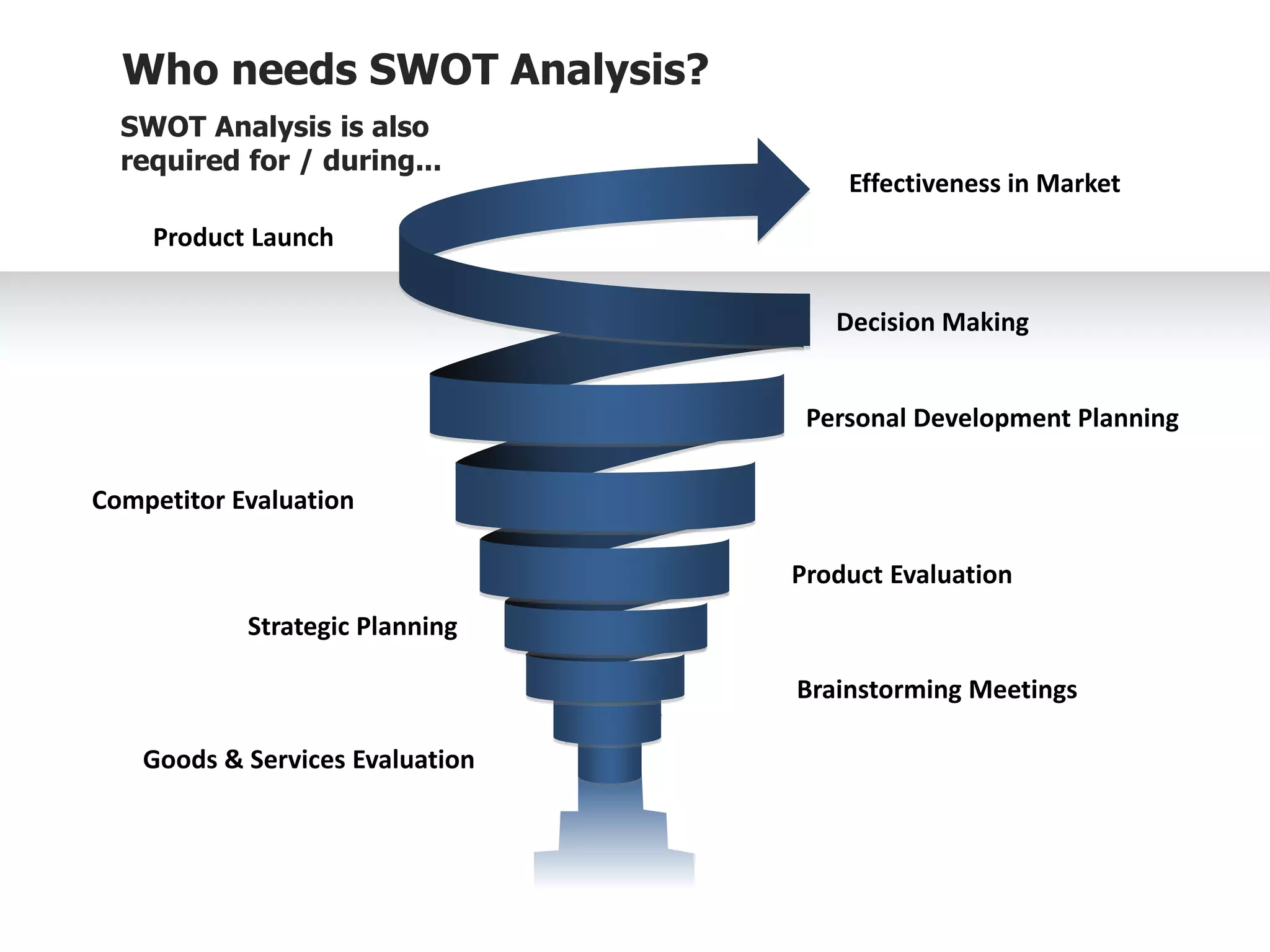
Who needs SWOT Analysis?
Goods & Services Evaluation
Brainstorming Meetings
Strategic Planning
Product Evaluation
Competitor Evaluation
Personal Development Planning
Decision Making
Product Launch
Effectiveness in Market
Who needs SWOT Analysis?
SWOT Analysis is also
required for / during...
SWOT Analysis
Example text
Go ahead and replace it with your
own text. This is an example text.
Your own footer Your Logo
Aim of SWOT Analysis
Who needs SWOT Analysis?
How to conduct SWOT Analysis?
Learning Objectives
What is SWOT Analysis?
Benefits & Pitfalls of SWOT Analysis
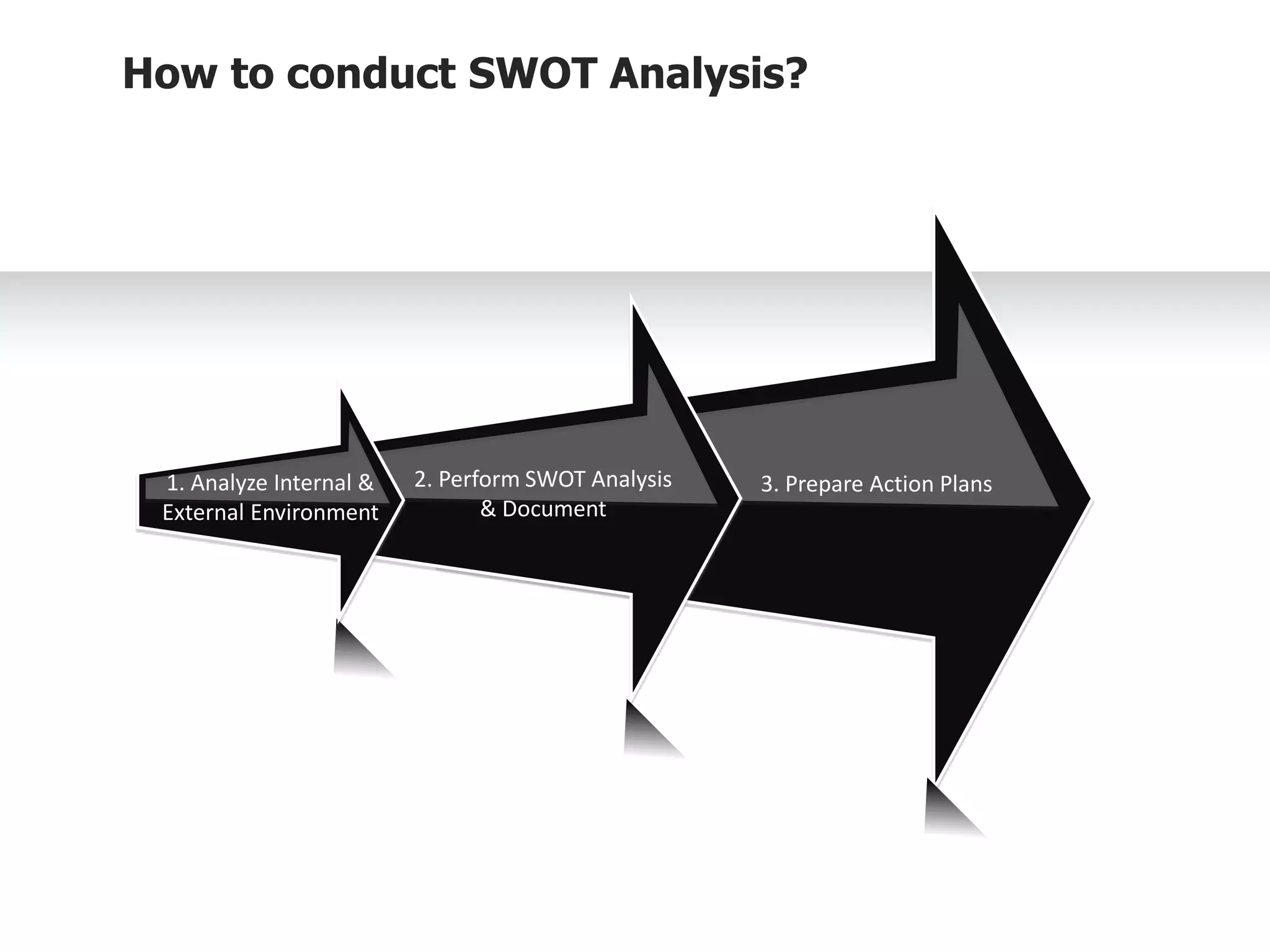
How to conduct SWOT Analysis?
3. Prepare Action Plans
2. Perform SWOT Analysis
& Document
1. Analyze Internal &
External Environment
How to conduct SWOT Analysis?
1. Analyse Internal & External Environment
How to conduct SWOT Analysis?
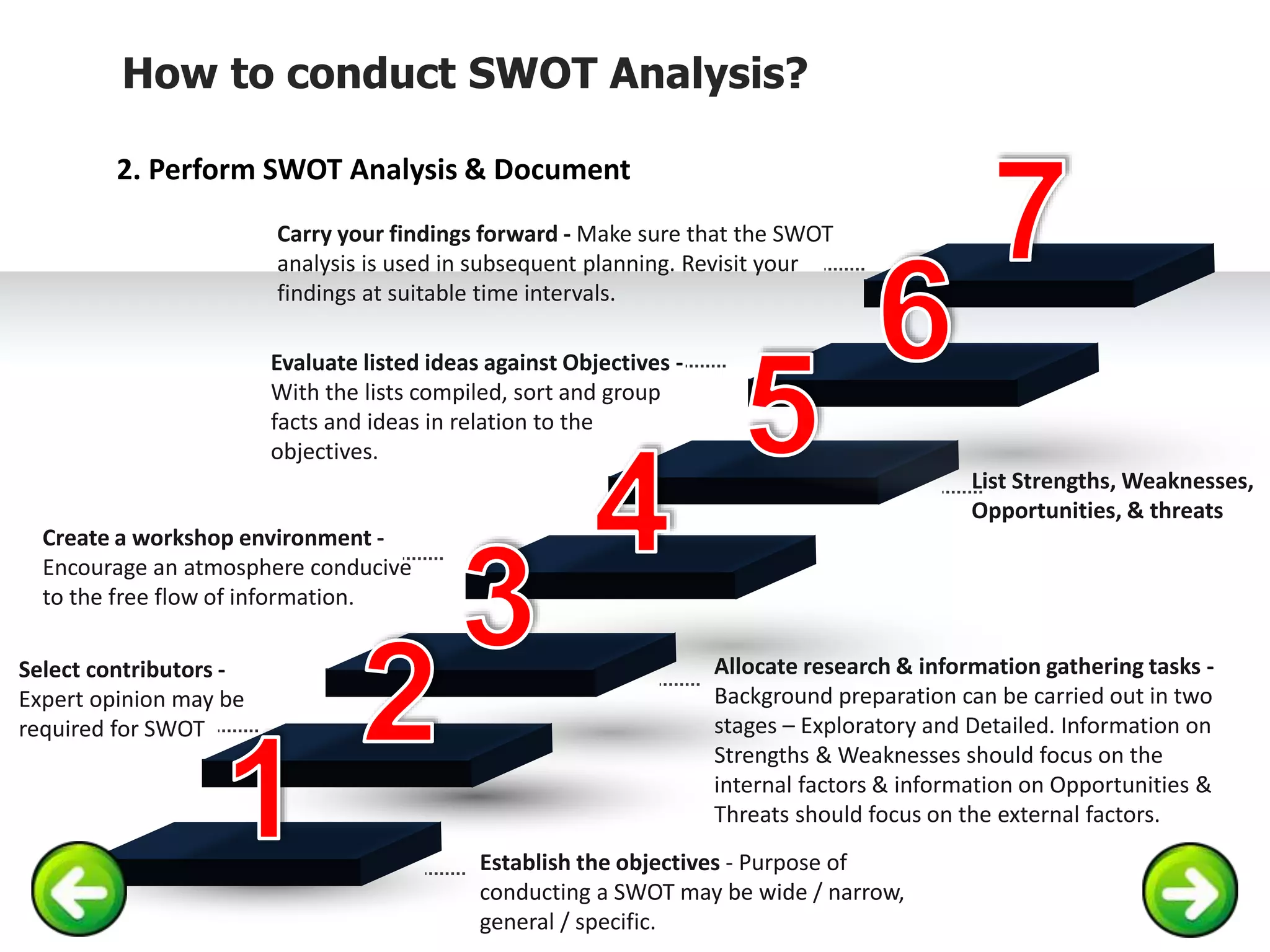
Carry your findings forward - Make sure that the SWOT
analysis is used in subsequent planning. Revisit your
findings at suitable time intervals.
Create a workshop environment -
Encourage an atmosphere conducive
to the free flow of information.
Allocate research & information gathering tasks -
Background preparation can be carried out in two
stages – Exploratory and Detailed. Information on
Strengths & Weaknesses should focus on the
internal factors & information on Opportunities &
Threats should focus on the external factors.
Select contributors -
Expert opinion may be
required for SWOT
Establish the objectives - Purpose of
conducting a SWOT may be wide / narrow,
general / specific.
Evaluate listed ideas against Objectives -
With the lists compiled, sort and group
facts and ideas in relation to the
objectives.
List Strengths, Weaknesses,
Opportunities, & threats
How to conduct SWOT Analysis?
2. Perform SWOT Analysis & Document
How to conduct SWOT Analysis?
3. Prepare Action Plan
Things that MUST be addressed immediately
Once the SWOT analysis has been completed, mark each point with:
Things that can be handled now
Things that should be researched further
Things that should be planned for the future
SWOT Analysis
Example text
Go ahead and replace it with your
own text. This is an example text.
Your own footer Your Logo
Aim of SWOT Analysis
Who needs SWOT Analysis?
How to conduct SWOT Analysis?
Learning Objectives
What is SWOT Analysis
Benefits & Pitfalls of SWOT Analysis
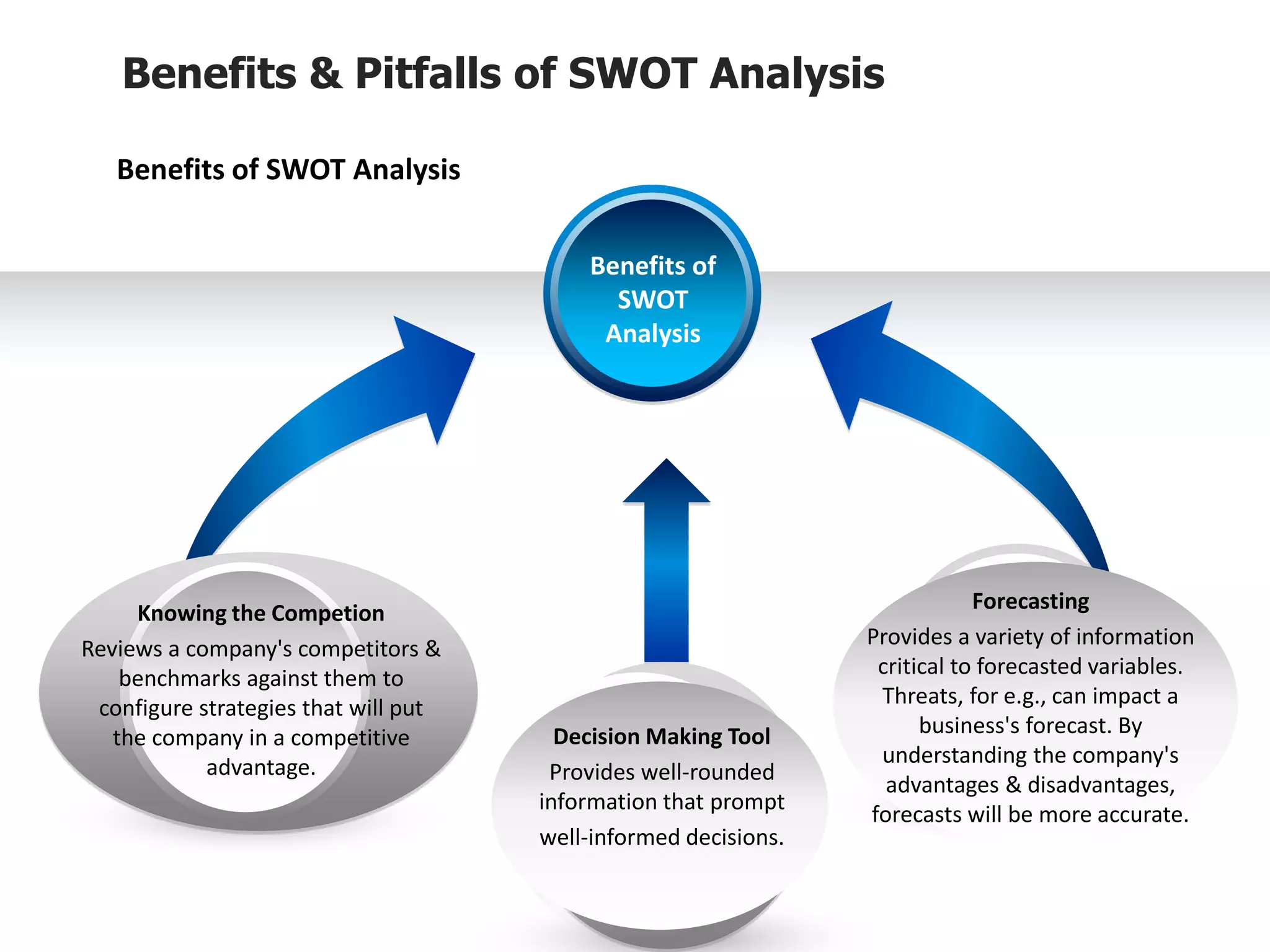
Benefits of SWOT Analysis
Forecasting
Provides a variety of information
critical to forecasted variables.
Threats, for e.g., can impact a
business's forecast. By
understanding the company's
advantages & disadvantages,
forecasts will be more accurate.
Decision Making Tool
Provides well-rounded
information that prompt
well-informed decisions.
Knowing the Competion
Reviews a company's competitors &
benchmarks against them to
configure strategies that will put
the company in a competitive
advantage.
Benefits of
SWOT
Analysis
Benefits & Pitfalls of SWOT Analysis
Pitfalls of SWOT Analysis
Can be very subjective. Two people rarely come up with the same final
version of a SWOT. Use it as a guide and not as a prescription.
May cause organizations to view circumstances as very simple due to
which certain key strategic contact may be overlooked.
Categorizing aspects as strengths, weaknesses, opportunities & threats
might be very subjective as there is great degree of uncertainty in market.
To be effective, SWOT needs to be conducted regularly. The pace of
change makes it difficult to anticipate developments.
The data used in the analysis may be based on assumptions that
subsequently prove to be unfounded [good and bad].
It lacks detailed structure, so key elements may get missed.
WEAKNESSES
• Failing pizza test market thus limiting the
ability to compete with pizza providers.
• High training costs due to high turnover.
• Minimal concentration on organic foods.
• Not much variation in seasonal products .
• Quality concerns due to franchised operations.
• Focus on burgers / fried foods not on healthier
options for their customers.
• Ranks very high on the Fortune Magazine's most
admired list
• Community oriented
• Global operations all over the world
• Cultural diversity in the foods
• Excellent location
• Assembly line operations.
• Use of top quality products
STRENGTHS
INTERNAL
• Marketing strategies that entice people from
small children to adults.
• Lawsuits for offering unhealthy foods.
• Contamination risks that include the threat of
e-coli containments.
• The vast amount of fastfood restaurants that
are open as competition.
• Focus on healthier dieting by consumers.
• Down turn in economy affecting the ability to eat
that much.
THREATS
• Opening more joint ventures.
• Being more responsive to healthier options.
• Advertising wifi services in the branches.
• Expanding on the advertising on being
more socially responsible
• Expansions of business into newly developed
parts of the world.
• Open products up to
allergen free options
such as peanut free.
OPPORTUNITIES
EXTERNAL
Mc Donald’s
SWOT Analysis
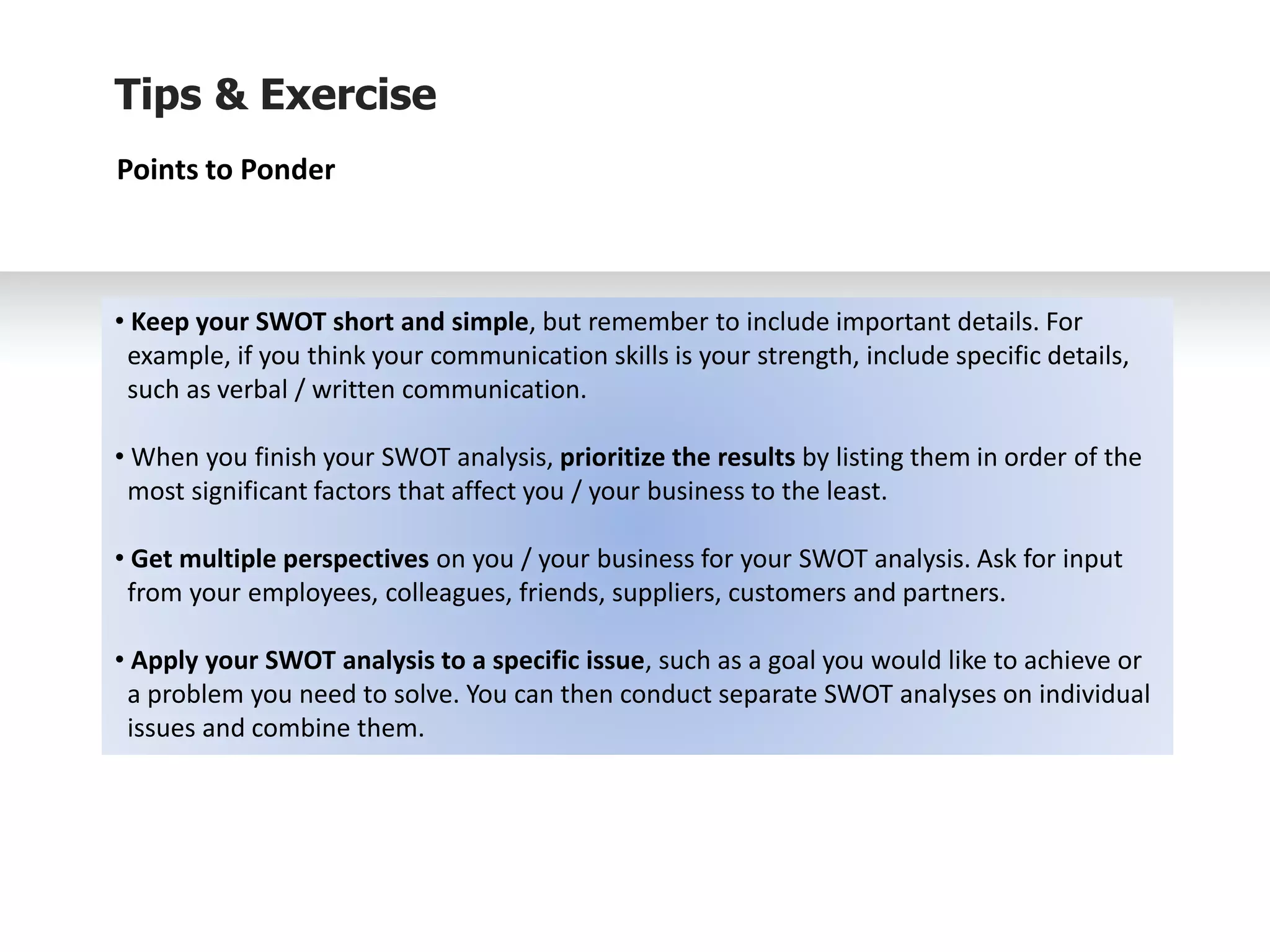
Tips & Exercise
Points to Ponder
• Keep your SWOT short and simple, but remember to include important details. For
example, if you think your communication skills is your strength, include specific details,
such as verbal / written communication.
• When you finish your SWOT analysis, prioritize the results by listing them in order of the
most significant factors that affect you / your business to the least.
• Get multiple perspectives on you / your business for your SWOT analysis. Ask for input
from your employees, colleagues, friends, suppliers, customers and partners.
• Apply your SWOT analysis to a specific issue, such as a goal you would like to achieve or
a problem you need to solve. You can then conduct separate SWOT analyses on individual
issues and combine them.
Do a SWOT analysis for your business
plan!
Example text
Go ahead and replace it with your
own text. This is an example text.
Your own footer Your Logo
Start writing…
Check-up
1. Which SWOT elements are internal factors for a business?
A. Strengths and Weaknesses
B. Opportunities and Threats
C. Strengths and Opportunities
D. Weaknesses and Threats
2. Which statement is false regarding why a SWOT Analysis is
used?
A. To build on the strengths of a business
B. To minimize the weaknesses of a business
C. To reduce opportunities available to a business
D. To counteract threats to a business
3. How often should a SWOT Analysis be performed?
A. Only when specific issues need to be addressed
B. At least once per year
C. Only when the business starts
D. Every 3-5 years
4. Which could be a strength?
A. Weather
B. A new international market
C. A price that is too high
D. The location of a business
Check-up
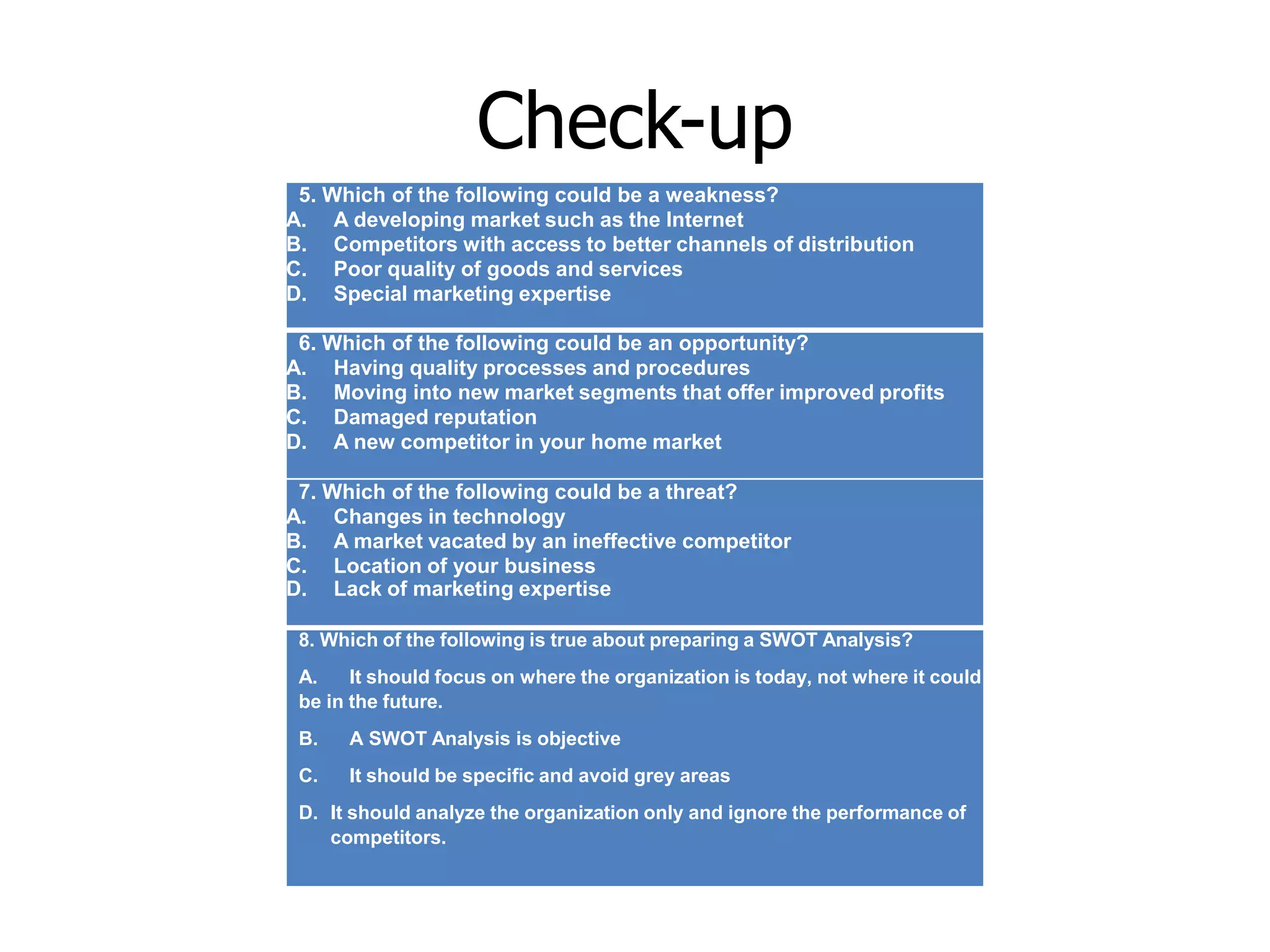
5. Which of the following could be a weakness?
A. A developing market such as the Internet
B. Competitors with access to better channels of distribution
C. Poor quality of goods and services
D. Special marketing expertise
6. Which of the following could be an opportunity?
A. Having quality processes and procedures
B. Moving into new market segments that offer improved profits
C. Damaged reputation
D. A new competitor in your home market
7. Which of the following could be a threat?
A. Changes in technology
B. A market vacated by an ineffective competitor
C. Location of your business
D. Lack of marketing expertise
8. Which of the following is true about preparing a SWOT Analysis?
A. It should focus on where the organization is today, not where it could
be in the future.
B. A SWOT Analysis is objective
C. It should be specific and avoid grey areas
D. It should analyze the organization only and ignore the performance of
competitors.
Check-up
9. Who usually conducts a SWOT Analysis for a business?
A. Financial Institutions/Banks
B. Lawyers
C. Employees
D. Managers
10. Which is a Weakness?
A. Overseas demand for product
B. Falling number of customers within specific age group
C. Making a profit
D. Poor quality good

Swot analysis

  • 1.
  • 2.
    SWOT Analysis Example text Goahead and replace it with your own text. This is an example text. Your own footer Your Logo Aim of SWOT Analysis Who needs SWOT Analysis? How to conduct SWOT Analysis? Learning Objectives What is SWOT Analysis? Benefits & Pitfalls of SWOT Analysis What is SWOT Analysis?
  • 3.
    SWOT Analysis Oppurtunity Threats Strengths Weakness Acronym for Strengths, Weaknesses,Opportunities, and Threats. Technique is credited to Albert Humphrey from Stanford University in the 1960s and 1970s. Planning tool used to understand Strengths, Weaknesses, Opportunities, & Threats involved in a project / business. Used as framework for organizing and using data and information gained from situation analysis of internal and external environment. Technique that enables a group / individual to move from everyday problems / traditional strategies to a fresh perspective. What is SWOT Analysis?
  • 4.
    STRENGTHS Characteristics of thebusiness or a team that give it an advantage over others in the industry. Positive tangible and intangible attributes, internal to an organization. Beneficial aspects of the organization or the capabilities of an organization, which includes human competencies, process capabilities, financial resources, products and services, customer goodwill and brand loyalty. Examples - Abundant financial resources, Well-known brand name, Economies of scale, Lower costs [raw materials or processes], Superior management talent, Better marketing skills, Good distribution skills, Committed employees. What is SWOT Analysis?
  • 5.
    OPPORTUNITIES What is SWOTAnalysis? Chances to make greater profits in the environment - External attractive factors that represent the reason for an organization to exist & develop. Arise when an organization can take benefit of conditions in its environment to plan and execute strategies that enable it to become more profitable. Organization should be careful and recognize the opportunities and grasp them whenever they arise. Opportunities may arise from market, competition, industry/government and technology. Examples - Rapid market growth, Rival firms are complacent, Changing customer needs/tastes, New uses for product discovered, Economic boom, Government deregulation, Sales decline for a substitute product .
  • 6.
    WEAKNESSES Characteristics that placethe firm at a disadvantage relative to others. Detract the organization from its ability to attain the core goal and influence its growth. Weaknesses are the factors which do not meet the standards we feel they should meet. However, weaknesses are controllable. They must be minimized and eliminated. Examples - Limited financial resources,, Very narrow product line, Limited distribution, Higher costs, Out-of-date products / technology, Weak market image, Poor marketing skills, Limited management skills, Under-trained employees. What is SWOT Analysis?
  • 7.
    SWOT ANALYSIS -THREAT ! THREATS What is SWOT Analysis? External elements in the environment that could cause trouble for the business - External factors, beyond an organization’s control, which could place the organization’s mission or operation at risk. Arise when conditions in external environment jeopardize the reliability and profitability of the organization’s business. Compound the vulnerability when they relate to the weaknesses. Threats are uncontrollable. When a threat comes, the stability and survival can be at stake. Examples - Entry of foreign competitors, Introduction of new substitute products, Product life cycle in decline, Changing customer needs/tastes, Rival firms adopt new strategies, Increased government regulation, Economic downturn.
  • 8.
    SWOT Analysis Example text Goahead and replace it with your own text. This is an example text. Your own footer Your Logo Aim of SWOT Analysis Who needs SWOT Analysis? How to conduct SWOT Analysis? Learning Objectives What is SWOT Analysis? Benefits & Pitfalls of SWOT Analysis Aim of SWOT Analysis?
  • 9.
    S W T O To helpdecision makers share and compare ideas. To bring a clearer common purpose and understanding of factors for success. To organize the important factors linked to success and failure in the business world. To analyze issues that have led to failure in the past. Aim of SWOT Analysis? To provide linearity to the decision making process allowing complex ideas to be presented systematically.
  • 10.
    SWOT Analysis Example text Goahead and replace it with your own text. This is an example text. Your own footer Your Logo Aim of SWOT Analysis Who needs SWOT Analysis? How to conduct SWOT Analysis? Learning Objectives What is SWOT Analysis? Benefits & Pitfalls of SWOT Analysis Who needs SWOT Analysis? Mr. Sherpinsky's Honors Marketing Class. 2015 All rights reserved.
  • 11.
    Management • When supervisorhas issues with work output • Assigned to a new job • New financial year – fresh targets • Job holder seeks to improve performance on the job 1 Business Unit 2 • When the team has not met its targets • Customer service can be better • Launching a new business unit to pursue a new business • New team leader is appointed Company • When revenue, cost & expense targets are not being achieved • Market share is declining • Industry conditions are unfavorable • Launching a new business venture 3 Who needs SWOT Analysis?
  • 12.
    Goods & ServicesEvaluation Brainstorming Meetings Strategic Planning Product Evaluation Competitor Evaluation Personal Development Planning Decision Making Product Launch Effectiveness in Market Who needs SWOT Analysis? SWOT Analysis is also required for / during...
  • 13.
    SWOT Analysis Example text Goahead and replace it with your own text. This is an example text. Your own footer Your Logo Aim of SWOT Analysis Who needs SWOT Analysis? How to conduct SWOT Analysis? Learning Objectives What is SWOT Analysis? Benefits & Pitfalls of SWOT Analysis How to conduct SWOT Analysis?
  • 14.
    3. Prepare ActionPlans 2. Perform SWOT Analysis & Document 1. Analyze Internal & External Environment How to conduct SWOT Analysis?
  • 15.
    How to conductSWOT Analysis? 1. Analyse Internal & External Environment
  • 16.
    How to conductSWOT Analysis?
  • 17.
    Carry your findingsforward - Make sure that the SWOT analysis is used in subsequent planning. Revisit your findings at suitable time intervals. Create a workshop environment - Encourage an atmosphere conducive to the free flow of information. Allocate research & information gathering tasks - Background preparation can be carried out in two stages – Exploratory and Detailed. Information on Strengths & Weaknesses should focus on the internal factors & information on Opportunities & Threats should focus on the external factors. Select contributors - Expert opinion may be required for SWOT Establish the objectives - Purpose of conducting a SWOT may be wide / narrow, general / specific. Evaluate listed ideas against Objectives - With the lists compiled, sort and group facts and ideas in relation to the objectives. List Strengths, Weaknesses, Opportunities, & threats How to conduct SWOT Analysis? 2. Perform SWOT Analysis & Document
  • 18.
    How to conductSWOT Analysis? 3. Prepare Action Plan Things that MUST be addressed immediately Once the SWOT analysis has been completed, mark each point with: Things that can be handled now Things that should be researched further Things that should be planned for the future
  • 19.
    SWOT Analysis Example text Goahead and replace it with your own text. This is an example text. Your own footer Your Logo Aim of SWOT Analysis Who needs SWOT Analysis? How to conduct SWOT Analysis? Learning Objectives What is SWOT Analysis Benefits & Pitfalls of SWOT Analysis Benefits & Pitfalls of SWOT Analysis
  • 20.
    Benefits & Pitfallsof SWOT Analysis Benefits of SWOT Analysis Forecasting Provides a variety of information critical to forecasted variables. Threats, for e.g., can impact a business's forecast. By understanding the company's advantages & disadvantages, forecasts will be more accurate. Decision Making Tool Provides well-rounded information that prompt well-informed decisions. Knowing the Competion Reviews a company's competitors & benchmarks against them to configure strategies that will put the company in a competitive advantage. Benefits of SWOT Analysis
  • 21.
    Benefits & Pitfallsof SWOT Analysis Pitfalls of SWOT Analysis Can be very subjective. Two people rarely come up with the same final version of a SWOT. Use it as a guide and not as a prescription. May cause organizations to view circumstances as very simple due to which certain key strategic contact may be overlooked. Categorizing aspects as strengths, weaknesses, opportunities & threats might be very subjective as there is great degree of uncertainty in market. To be effective, SWOT needs to be conducted regularly. The pace of change makes it difficult to anticipate developments. The data used in the analysis may be based on assumptions that subsequently prove to be unfounded [good and bad]. It lacks detailed structure, so key elements may get missed.
  • 22.
    WEAKNESSES • Failing pizzatest market thus limiting the ability to compete with pizza providers. • High training costs due to high turnover. • Minimal concentration on organic foods. • Not much variation in seasonal products . • Quality concerns due to franchised operations. • Focus on burgers / fried foods not on healthier options for their customers. • Ranks very high on the Fortune Magazine's most admired list • Community oriented • Global operations all over the world • Cultural diversity in the foods • Excellent location • Assembly line operations. • Use of top quality products STRENGTHS INTERNAL • Marketing strategies that entice people from small children to adults. • Lawsuits for offering unhealthy foods. • Contamination risks that include the threat of e-coli containments. • The vast amount of fastfood restaurants that are open as competition. • Focus on healthier dieting by consumers. • Down turn in economy affecting the ability to eat that much. THREATS • Opening more joint ventures. • Being more responsive to healthier options. • Advertising wifi services in the branches. • Expanding on the advertising on being more socially responsible • Expansions of business into newly developed parts of the world. • Open products up to allergen free options such as peanut free. OPPORTUNITIES EXTERNAL Mc Donald’s SWOT Analysis
  • 23.
    Tips & Exercise Pointsto Ponder • Keep your SWOT short and simple, but remember to include important details. For example, if you think your communication skills is your strength, include specific details, such as verbal / written communication. • When you finish your SWOT analysis, prioritize the results by listing them in order of the most significant factors that affect you / your business to the least. • Get multiple perspectives on you / your business for your SWOT analysis. Ask for input from your employees, colleagues, friends, suppliers, customers and partners. • Apply your SWOT analysis to a specific issue, such as a goal you would like to achieve or a problem you need to solve. You can then conduct separate SWOT analyses on individual issues and combine them.
  • 24.
    Do a SWOTanalysis for your business plan! Example text Go ahead and replace it with your own text. This is an example text. Your own footer Your Logo Start writing…
  • 25.
    Check-up 1. Which SWOTelements are internal factors for a business? A. Strengths and Weaknesses B. Opportunities and Threats C. Strengths and Opportunities D. Weaknesses and Threats 2. Which statement is false regarding why a SWOT Analysis is used? A. To build on the strengths of a business B. To minimize the weaknesses of a business C. To reduce opportunities available to a business D. To counteract threats to a business 3. How often should a SWOT Analysis be performed? A. Only when specific issues need to be addressed B. At least once per year C. Only when the business starts D. Every 3-5 years 4. Which could be a strength? A. Weather B. A new international market C. A price that is too high D. The location of a business
  • 26.
    Check-up 5. Which ofthe following could be a weakness? A. A developing market such as the Internet B. Competitors with access to better channels of distribution C. Poor quality of goods and services D. Special marketing expertise 6. Which of the following could be an opportunity? A. Having quality processes and procedures B. Moving into new market segments that offer improved profits C. Damaged reputation D. A new competitor in your home market 7. Which of the following could be a threat? A. Changes in technology B. A market vacated by an ineffective competitor C. Location of your business D. Lack of marketing expertise 8. Which of the following is true about preparing a SWOT Analysis? A. It should focus on where the organization is today, not where it could be in the future. B. A SWOT Analysis is objective C. It should be specific and avoid grey areas D. It should analyze the organization only and ignore the performance of competitors.
  • 27.
    Check-up 9. Who usuallyconducts a SWOT Analysis for a business? A. Financial Institutions/Banks B. Lawyers C. Employees D. Managers 10. Which is a Weakness? A. Overseas demand for product B. Falling number of customers within specific age group C. Making a profit D. Poor quality good