A
SUMMER PRACTICAL TRAINING
PRESENTATION
ON
400 KV GRID SUB STATION
HEERAPURA, JAIPUR
RAJASTHAN
Presented By
Sahid Raja Khan (EE VII sem)
Compucom Institute Of Technology & Management, Jaipur
CONTENTS
 Power transformers
 Conductors
 Feeders
 Bus bars
 Insulators
 Circuit breakers
 Relay
 Lightning arresters
 Isolators
 Instrument Transformers
 PLCC (Wave Trap)
 Battery room
 Control room
POWER TRANSFORMERS
 Transformer
A transformer is a static machine used for transforming
power from one circuit to another circuit without
changing frequency.
 Transformers are used to voltage control , at constant
frequency.
CONSTRUCTIONAL FEATURE OF POWER
TRANSFORMER
 Transformer Tank and Cover
 Core
 Winding
 Insulation
 Insulating Oil
 Conservator
 Buchholz Relay
 Elbow relief Device
 Temperature Gauge
 Oil Gauge
 Bushing
 Breather
 Arching Horn
 Tap Changer
Cooling System
Lightning
arrester
Conservator
Insulators
RATINGS & SPECIFICATIONS OF TRANSFORMERS
FOR TRANSFORMER 1,2 AND 3
I.D. NO.: ILT-1, ILT-2 AND ILT-3
MAKE: TELK
RATIO: 400/220/33 KV
CAPACITY: 250 MVA
CURRENT: 361/656 A
FOR TRANSFORMER 4
I.D. NO.: ILT-4
MAKE: TELK
RATIO: 400/220/33 KV
CAPACITY: 315 MVA
CURRENT: 455/828 A
TYPES OF POWER TRANSFORMER
Step up Transformer & Step Down
Transformer
Three Phase Transformer & Single Phase
Transformer
Electric Power Transformer , Distribution
Transformer & Instrument Transformer
Two Winding Transformer & Auto
Transformer
Outdoor transformer & Indoor transformer
CONDUCTORS
Properties of conductor’s material
 High electrical conductivity.
 High tensile strength in order to with stand mechanical stresses.
 Low cost so that it can be used for long distances.
 Low specific gravity so that weight per unit volume is small.
COMMON USED CONDUCTOR MATERIALS
 Copper
 Aluminum
 Steel Cored Aluminum
 Galvanized Steel and
 Cadmium Copper
 A.C.S.R. CONDUCTOR
Aluminum Conductor Steel Reinforced
In order to increase the tensile strength; the aluminum
conductor is reinforced with a core of galvanized steel
wires.
 THE CONDUCTORS USED FOR
400 KV line: - Tarantulla and marculla conductor.
220 KV line: - Zebra conductor is used composite
of aluminum strands and steel wires.
132 KV line: - Panther conductor is used composite
of aluminum strands and steel wires.
INCOMING AND OUTGOING FEEDERS
 400KV INCOMMING FEEDERS
• BASSI-1
• BASSI-2
• MERTA
• HINDAUN
• PHAGI-1
• PHAGI-2
• JAIPUR NORTH
 220KV OUTGOING FEEDERS
• SANGANER
• SEZ
• PHULERA
• KTPS
• NPH
BUS BAR
Bus-bar term is used for a main bar or conductor carrying an electric
current to which many connections can be made.
It is defined as a conductor or group of conductor used for collecting
electrical energy from incoming feeders and distributed them to the
outgoing feeders.
 Types of Different Bus-Bar Arrangement:-
1. Single Bus-Bar Arrangement
2. Single Main Transfer Bus Scheme
3. Double Main Bus-Bar Scheme
4. Double Main Transfer Bus Scheme
5. One And A-Half Breaker Scheme
AT 400KV GSS HEERAPURA
 At 400kV side
Two main bus A and B
Both are Aluminum Hollow Pipes
Diameter- 114.2 mm
Current carrying capacity- 2000 Amp
 At 220kV side
Three main bus D, E and F
Twin Moose Conductor Bus
INSULATORS
 It provides insulations between line conductor and supports and thus prevents
any leakage current from conductor to earth.
It must be used in electrical system
 To prevent unwanted flow of current to the earth from its supporting points.
 Mechanically strong enough
 High insulation resistance
 It should not be porous.
Power insulator
PURPOSE
 To isolate the bus-bar switches and other support
structures
 To prevent leakage current
Material used- Porcelain and Fiberglass
TYPES OF INSULATORS
1. Pin Type
2. Suspension Type
3. Shackle Type
4. Strain Type
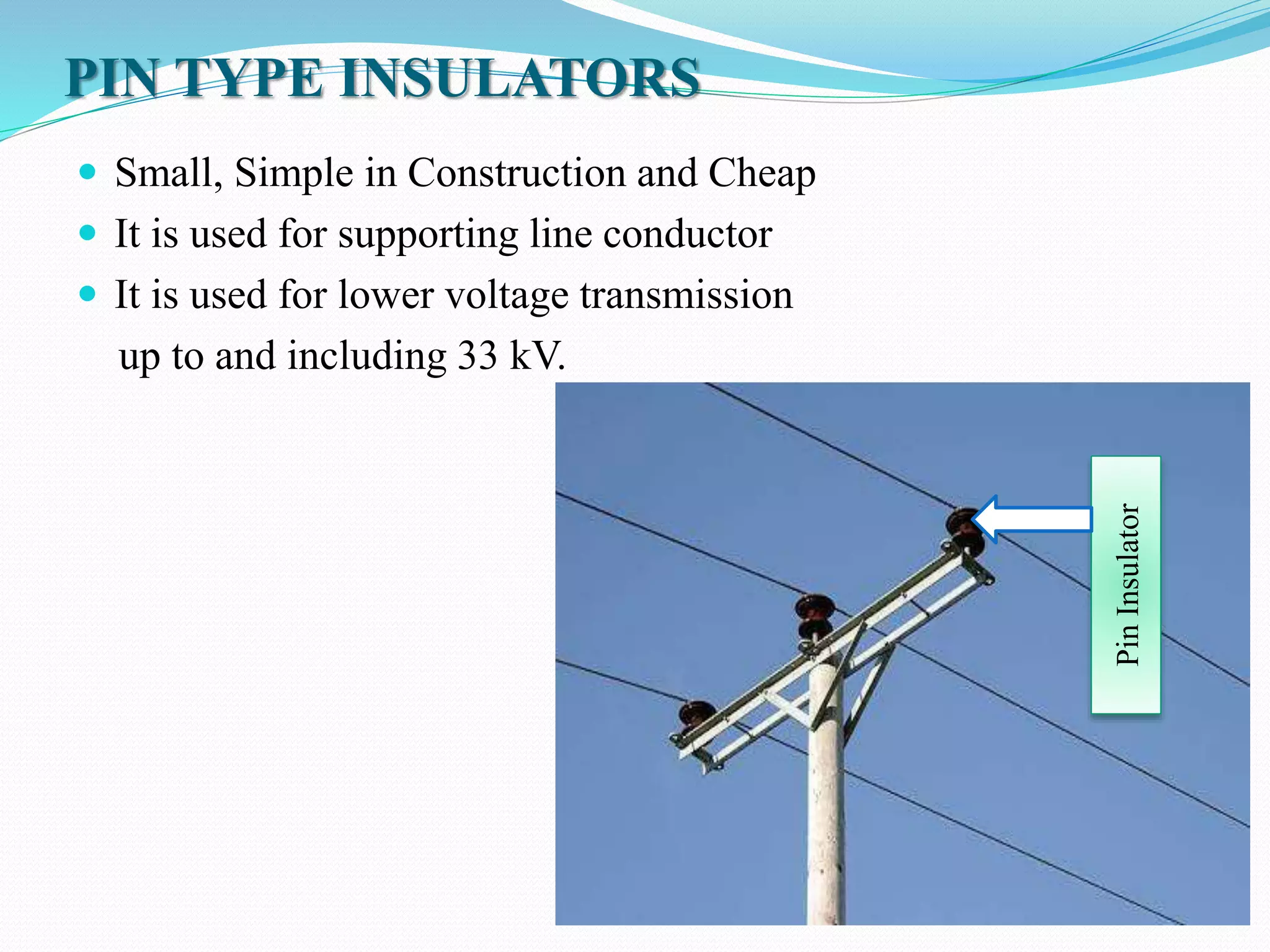
PIN TYPE INSULATORS
 Small, Simple in Construction and Cheap
 It is used for supporting line conductor
 It is used for lower voltage transmission
up to and including 33 kV.
PinInsulator
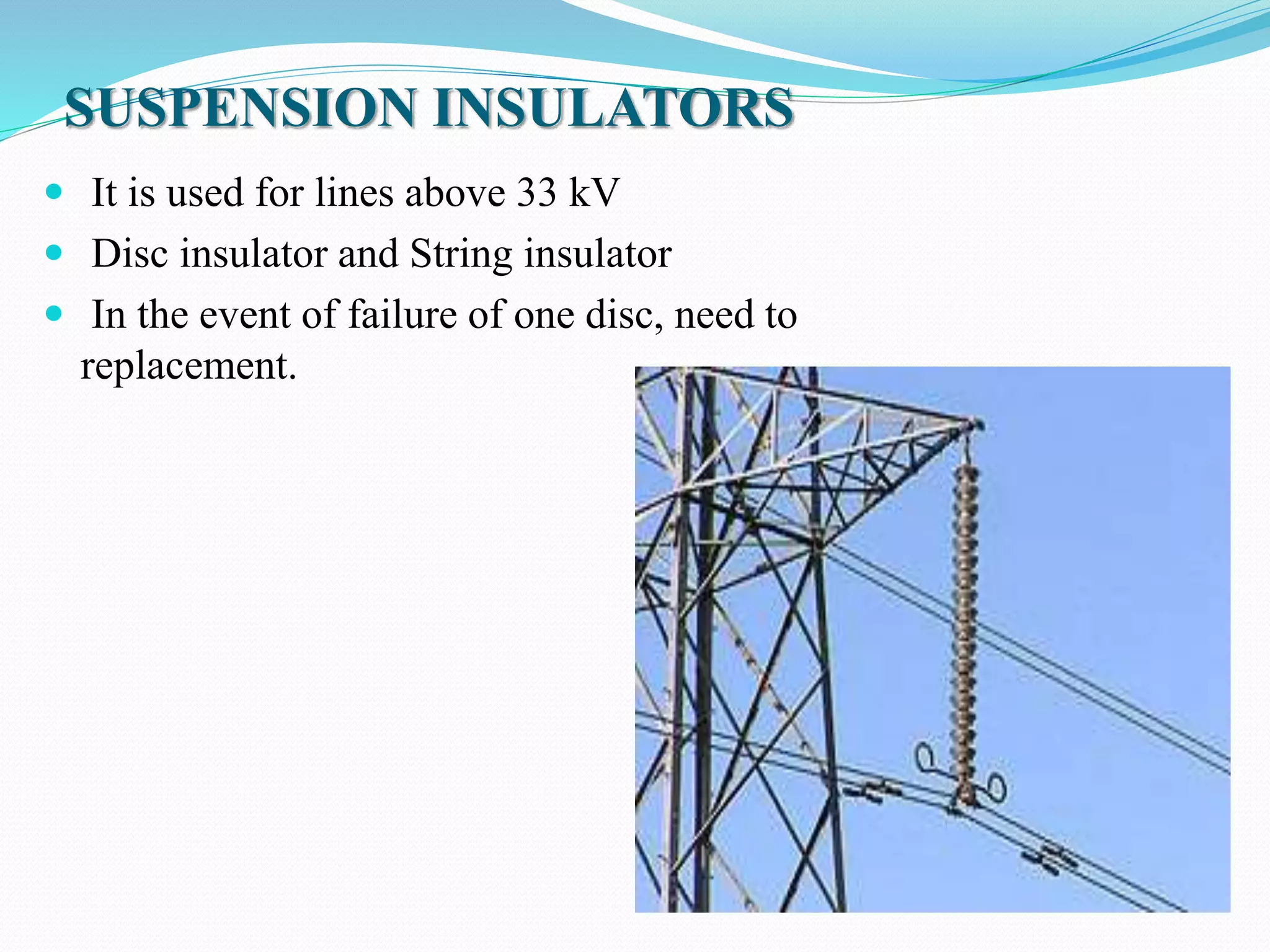
SUSPENSION INSULATORS
 It is used for lines above 33 kV
 Disc insulator and String insulator
 In the event of failure of one disc, need to
replacement.
STRAIN INSULATORS
 Egg Shape
 Also called Strain or Guy insulators
 Insulate the lower part of the guy cable from the pole
CIRCUIT BREAKER
 Electrical circuit breaker is a switching device which can be
operated manually and automatically for
 Controlling and protection of electrical power system with the
help of relay
Main Functions
1. It carries current continuously without heating.
2. Open or close the circuit when required.
3. It protects the circuit in case of any fault.
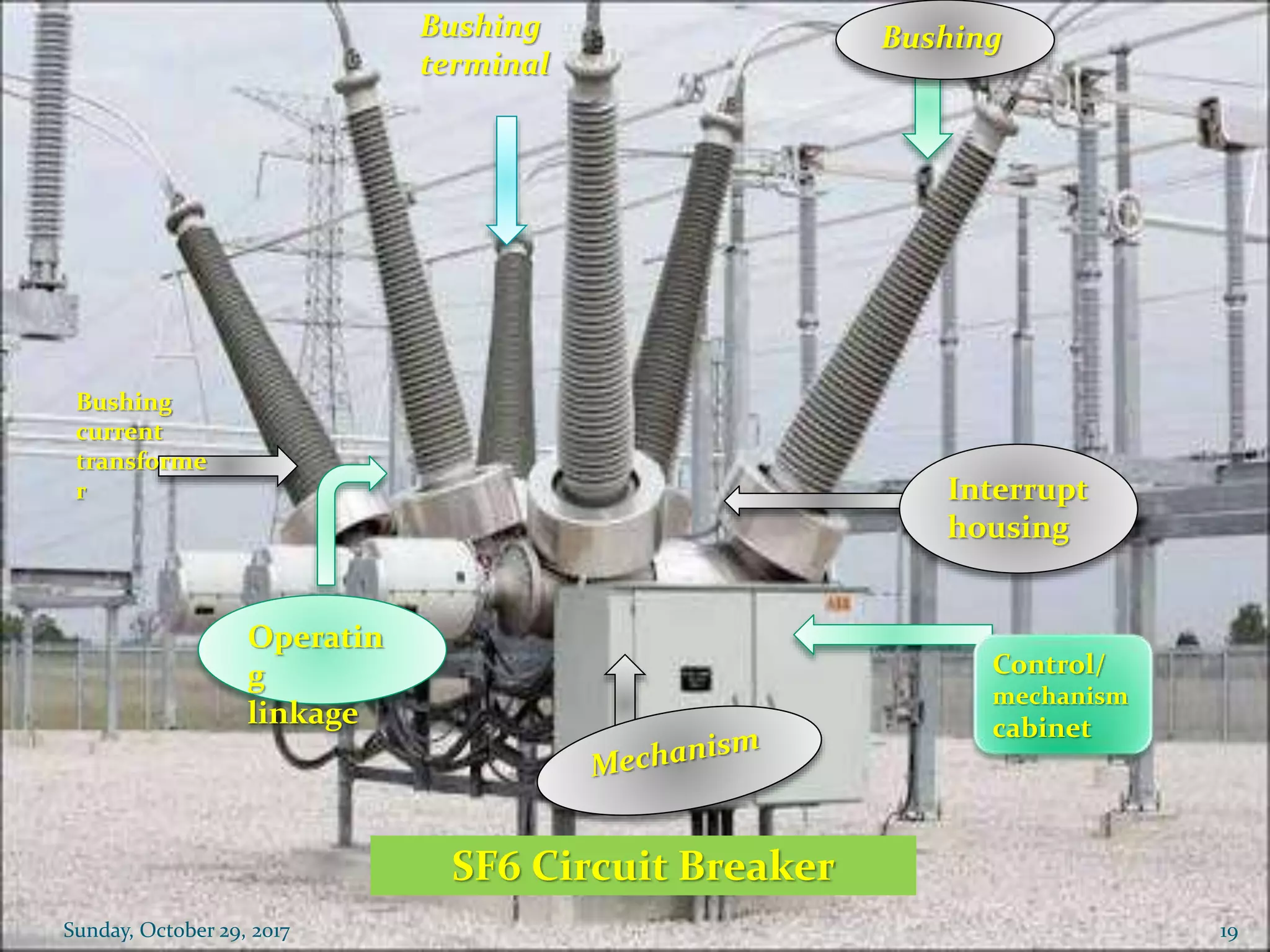
Bushing
terminal
Bushing
Interrupt
housing
Control/
mechanism
cabinet
Bushing
current
transforme
r
Operatin
g
linkage
SF6 Circuit Breaker
Sunday, October 29, 2017 19
TYPES OF CIRCUIT BREAKER
 Low oil Circuit Breaker
 Bulk oil Circuit Breaker
 Air-blast Circuit Breakers
 S.F.6 Circuit Breaker
 Vacuum Circuit Breaker
 Specification of C.B.
No. of C.B. at 220 KV side: 12
No. of C.B. at 400KV side: 18
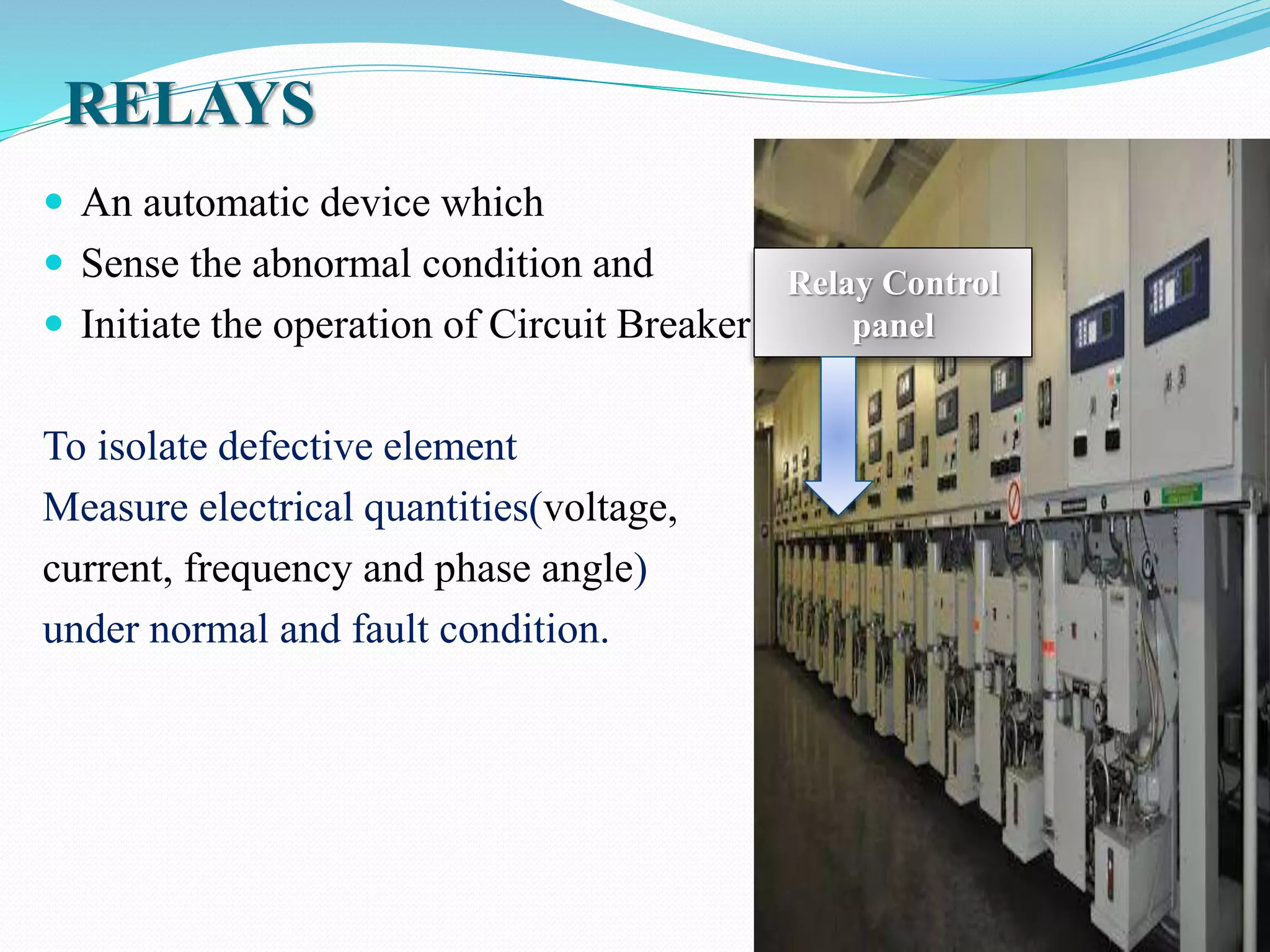
RELAYS
 An automatic device which
 Sense the abnormal condition and
 Initiate the operation of Circuit Breaker
To isolate defective element
Measure electrical quantities(voltage,
current, frequency and phase angle)
under normal and fault condition.
Relay Control
panel
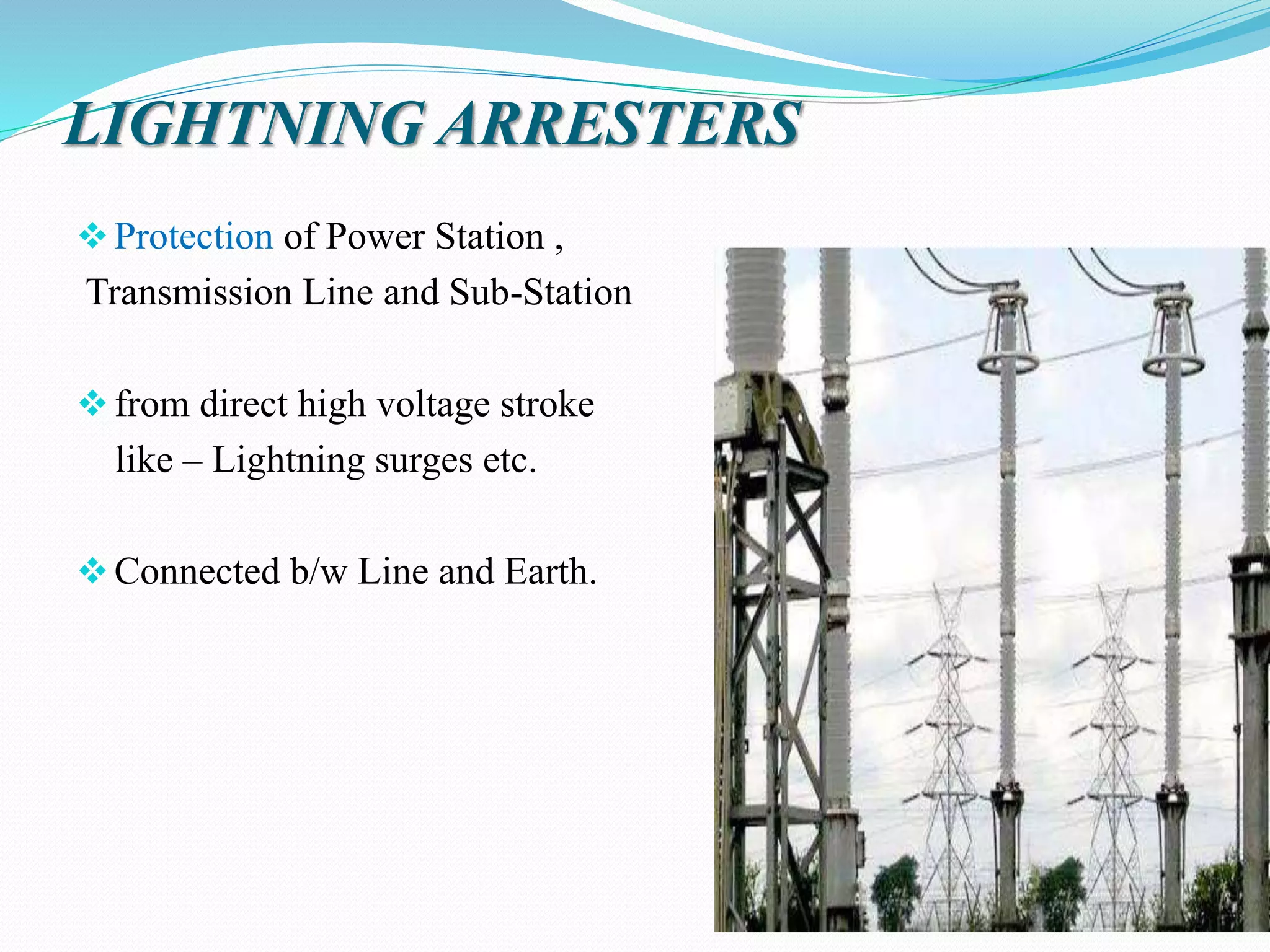
LIGHTNING ARRESTERS
Protection of Power Station ,
Transmission Line and Sub-Station
from direct high voltage stroke
like – Lightning surges etc.
Connected b/w Line and Earth.
TYPES OF LA
 Rod Gap Arrestor
These are usually connected across the bushings of various
equipments.
 Valve Type Arrestor
Such an arrestor consists essentially of a divided spark gap in series
with a resistance element having non-linear characteristics.
 Electrolyte Type Arrestor
a thin film of aluminum hydroxide deposited on the aluminum plate
immersed in electrolyte acts as a high resistance to a low voltage but
a low resistance to a voltage above a critical value.
 Thyrite Type Arrestor
At high voltage it will behave like a conducting material and after
the surge has passed the thyrite again retains its original property.
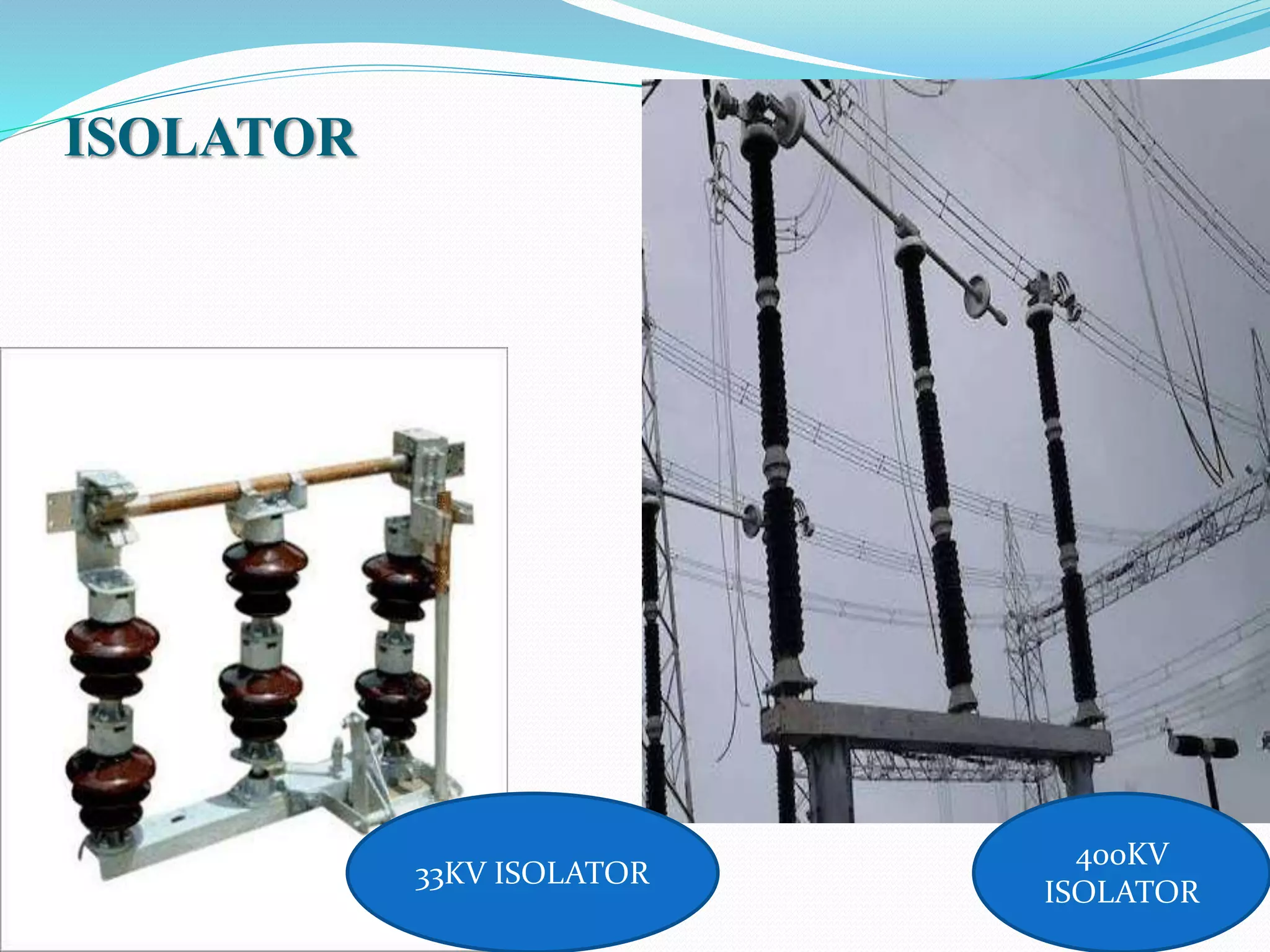
ISOLATORS
Isolator is a mechanical switch which isolates a part of circuit from
system as when required.
 Isolator is a manually operated mechanical switch.
 Isolators are used to open a circuit under no load.
 Isolators specifications at 400KV
No. of Isolators: 6 (Bay No.1 to Bay No.6)
Voltage (KV): 420/142T
Current: 2000A
 Types of Electrical Isolators:-
1. Double Break isolator
2. Single Break isolator
3. Pantograph type isolator
ISOLATOR
33KV ISOLATOR
400KV
ISOLATOR
INSTRUMENT TRANSFORMER
The measuring instruments and protective devices are designed
for low voltage ( generally 110V ) and currents ( about 5
Am . ).
To transfer voltage or current in the power lines to values which
are convenient for the operation of measuring instruments
and relays.
Types :-
 Current Transformer (C.T.)
 Potential Transformer(P.T.)
Capacitor voltage transformer(C.V.T.)
CURRENT TRANSFORMER
 To measure currents in high voltage AC circuit
 Step-down the current
 Step-up transformer
 Primary connected to line and Secondary connected to
Ammeter terminals
 Street lighting circuit
POTENTIAL TRANSFORMER
 To transform high voltage of power line to a lower value
which is in the range of an AC voltmeter
 Primary is connected to the main bus bar
 Secondary- various indicating and metering instrument
 When rated high voltage applicable on PT the voltage of
110V appears at secondary
Classification
 Capacitive Voltage Transformer
 Electro Magnetic type
CAPACITOR VOLTAGE TRANSFORMER
 Capacitors to step down the voltage.
 CVT is more economical than PT
 The carrier current equipment can be connected via the
capacitor of the CVT
 CVT is used for voltage 66KV and more
Application
 Measuring
 Metering
 Protection
 Carrier communication etc.
C.T.
P.T.
Gahantree
Insulators
C.T. & P.T.
ARRANGEMENT
What is the difference between Isolator and
Circuit breaker?
Isolator is an off load device while , circuit breaker is an
on load device.
Isolator is a switch operated manually , which separated
the circuit from the power main and discharge the trapped
charge in the circuit.
Circuit breaker operated automatically , higher triggered
by electromechanical mechanism inside and are a safely
feature for abnormal loads and voltages in the circuit.
WAVE TRAPPER
 Power line communication is the most economical and reliable
method of communication for medium and long distance in
power network.
 Exchange of data and transfer of message between substation.
 A line trap (high frequency stopper) is a maintenance-free
inductor ,
 Mounted in line on high voltage AC transmission power lines
 To prevent the transmission of high frequency(40KHz to
1000KHz) carrier signals of line communication to unwanted
destinations.
 11PLCC system in Raj. In which 5 from Heerapura GSS.
WAVE TRAPS
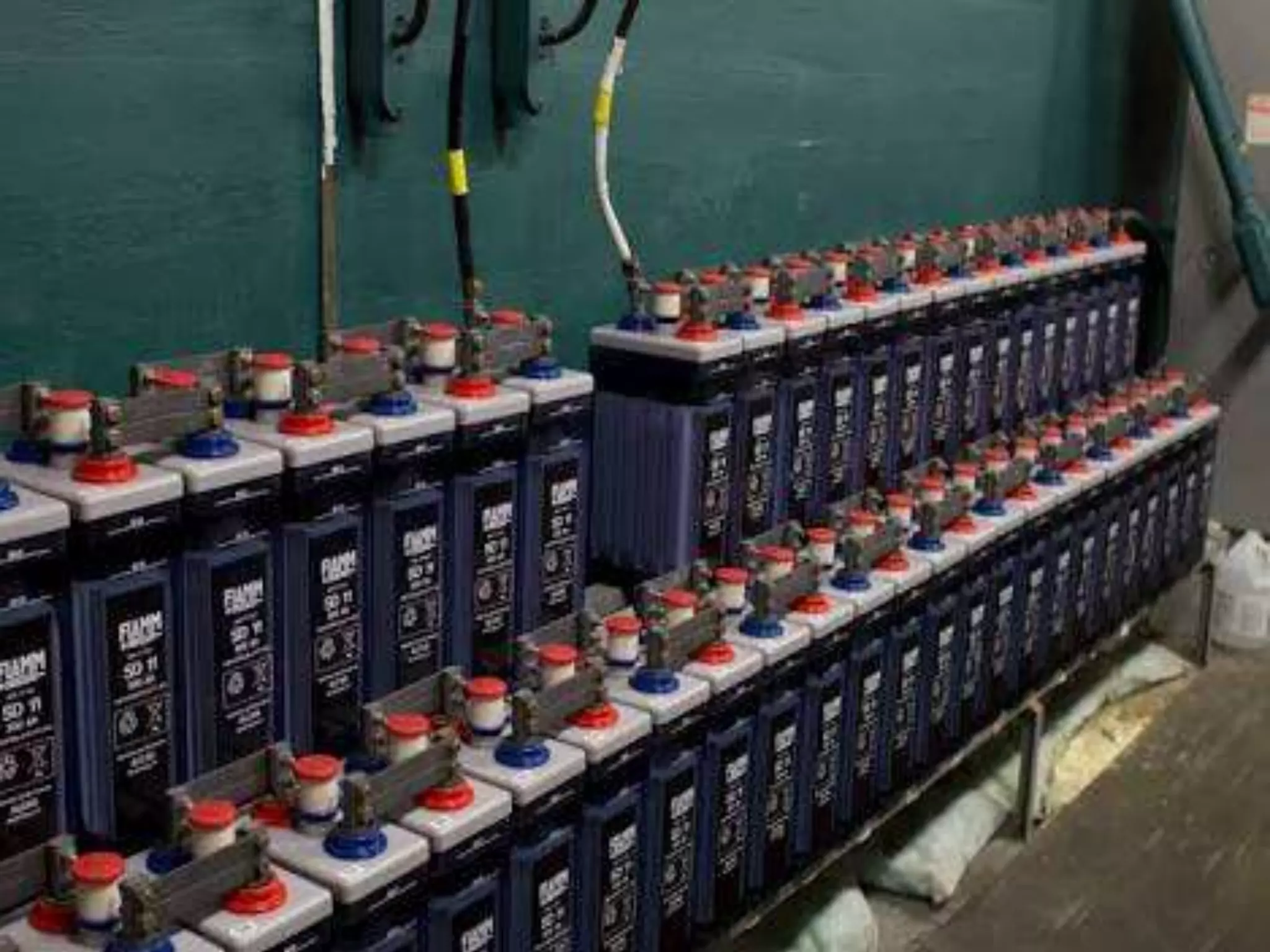
BATTERY ROOM
A battery room is a room in a facility used to house batteries for backup or
uninterruptible power systems.
Battery room which has batteries
 At 132 KV Section
55 batteries of
2 volt each
 At 220KV/400KV Section
110 batteries
Lead Acid Type
DC Power used for functioning of control panels.
In 400 KV 2 dc source (source-1 & source-2) of 220KV
Source-1 is utilized in main-1 protection scheme and
Source-2 is utilized in main-2 protection scheme.
Two rectifier separately charged these batteries.
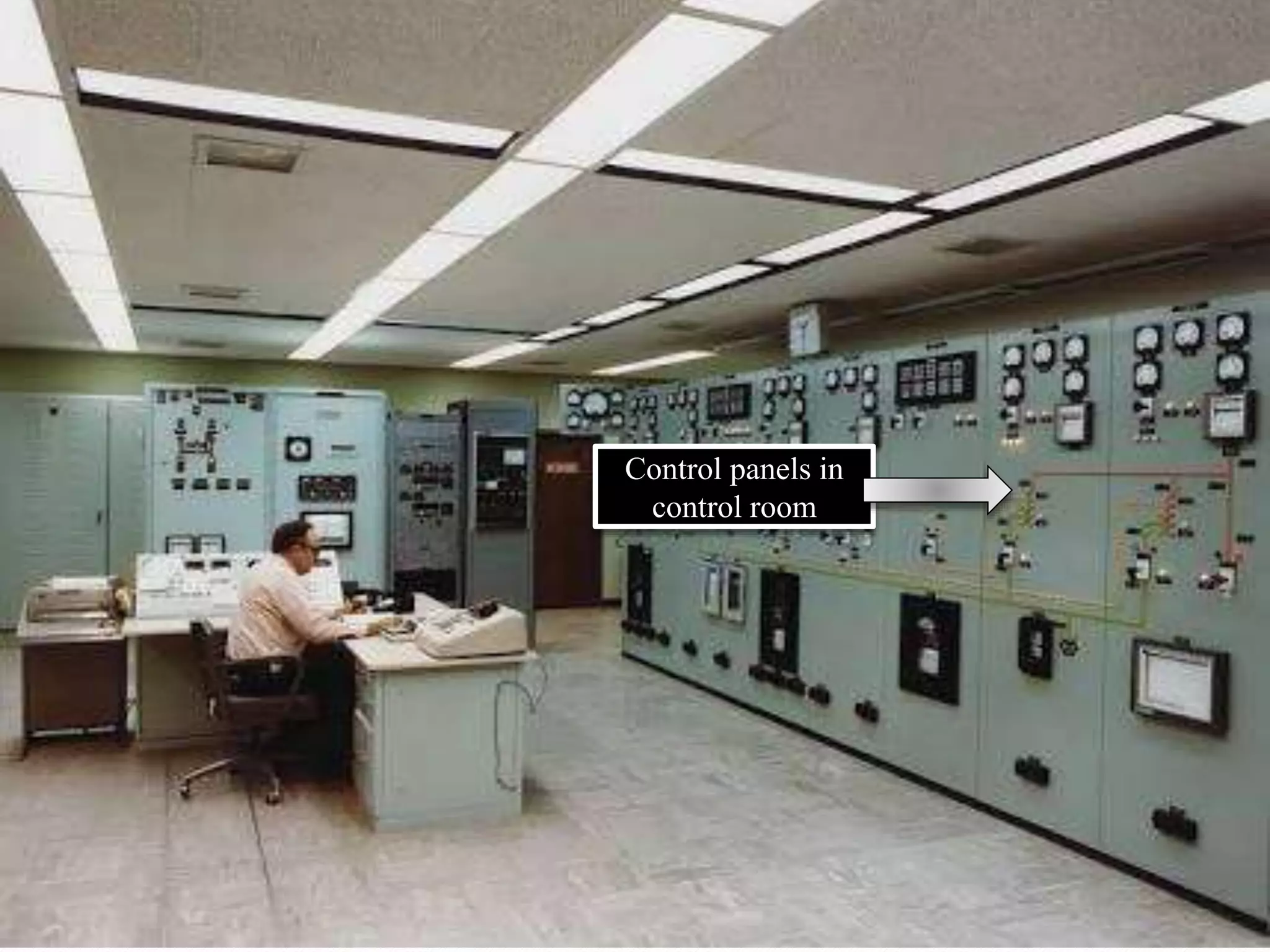
CONTROL ROOM
The control room is generally houses the indoor panels on which are
mounted the protective relays at back with various instruments.
 Control panels contain meters , control switches and recorders
located in the control building or doghouse.
These are used-
 to control the substation equipments,
 to send power from one circuit to another circuit or
 to open or to shut down circuits when needed.
MEASURING INSTRUMENT USED
 Energy Meter
 Watt Meter
 Frequency Meter
 Voltmeter
 KA Meter
Control panels in
control room
CONCLUSION
 During these eight weeks of work these are developed
my team work, analytical thinking and various
important information about electric power system.
 The main objective of this whole training program is
to provide an opportunity to identify, observe and
practice how engineering is applicable in the real
industry.
 In Heerapura G.S.S. every event added a lot to my
practical knowledge during my training session.
400 KV GSS HEERAPURA, JAIPUR

400 KV GSS HEERAPURA, JAIPUR

  • 1.
    A SUMMER PRACTICAL TRAINING PRESENTATION ON 400KV GRID SUB STATION HEERAPURA, JAIPUR RAJASTHAN Presented By Sahid Raja Khan (EE VII sem) Compucom Institute Of Technology & Management, Jaipur
  • 2.
    CONTENTS  Power transformers Conductors  Feeders  Bus bars  Insulators  Circuit breakers  Relay  Lightning arresters  Isolators  Instrument Transformers  PLCC (Wave Trap)  Battery room  Control room
  • 3.
    POWER TRANSFORMERS  Transformer Atransformer is a static machine used for transforming power from one circuit to another circuit without changing frequency.  Transformers are used to voltage control , at constant frequency.
  • 4.
    CONSTRUCTIONAL FEATURE OFPOWER TRANSFORMER  Transformer Tank and Cover  Core  Winding  Insulation  Insulating Oil  Conservator  Buchholz Relay  Elbow relief Device  Temperature Gauge  Oil Gauge  Bushing  Breather  Arching Horn  Tap Changer
  • 5.
  • 6.
    RATINGS & SPECIFICATIONSOF TRANSFORMERS FOR TRANSFORMER 1,2 AND 3 I.D. NO.: ILT-1, ILT-2 AND ILT-3 MAKE: TELK RATIO: 400/220/33 KV CAPACITY: 250 MVA CURRENT: 361/656 A FOR TRANSFORMER 4 I.D. NO.: ILT-4 MAKE: TELK RATIO: 400/220/33 KV CAPACITY: 315 MVA CURRENT: 455/828 A
  • 7.
    TYPES OF POWERTRANSFORMER Step up Transformer & Step Down Transformer Three Phase Transformer & Single Phase Transformer Electric Power Transformer , Distribution Transformer & Instrument Transformer Two Winding Transformer & Auto Transformer Outdoor transformer & Indoor transformer
  • 8.
    CONDUCTORS Properties of conductor’smaterial  High electrical conductivity.  High tensile strength in order to with stand mechanical stresses.  Low cost so that it can be used for long distances.  Low specific gravity so that weight per unit volume is small. COMMON USED CONDUCTOR MATERIALS  Copper  Aluminum  Steel Cored Aluminum  Galvanized Steel and  Cadmium Copper
  • 9.
     A.C.S.R. CONDUCTOR AluminumConductor Steel Reinforced In order to increase the tensile strength; the aluminum conductor is reinforced with a core of galvanized steel wires.  THE CONDUCTORS USED FOR 400 KV line: - Tarantulla and marculla conductor. 220 KV line: - Zebra conductor is used composite of aluminum strands and steel wires. 132 KV line: - Panther conductor is used composite of aluminum strands and steel wires.
  • 10.
    INCOMING AND OUTGOINGFEEDERS  400KV INCOMMING FEEDERS • BASSI-1 • BASSI-2 • MERTA • HINDAUN • PHAGI-1 • PHAGI-2 • JAIPUR NORTH  220KV OUTGOING FEEDERS • SANGANER • SEZ • PHULERA • KTPS • NPH
  • 11.
    BUS BAR Bus-bar termis used for a main bar or conductor carrying an electric current to which many connections can be made. It is defined as a conductor or group of conductor used for collecting electrical energy from incoming feeders and distributed them to the outgoing feeders.  Types of Different Bus-Bar Arrangement:- 1. Single Bus-Bar Arrangement 2. Single Main Transfer Bus Scheme 3. Double Main Bus-Bar Scheme 4. Double Main Transfer Bus Scheme 5. One And A-Half Breaker Scheme
  • 12.
    AT 400KV GSSHEERAPURA  At 400kV side Two main bus A and B Both are Aluminum Hollow Pipes Diameter- 114.2 mm Current carrying capacity- 2000 Amp  At 220kV side Three main bus D, E and F Twin Moose Conductor Bus
  • 13.
    INSULATORS  It providesinsulations between line conductor and supports and thus prevents any leakage current from conductor to earth. It must be used in electrical system  To prevent unwanted flow of current to the earth from its supporting points.  Mechanically strong enough  High insulation resistance  It should not be porous. Power insulator
  • 14.
    PURPOSE  To isolatethe bus-bar switches and other support structures  To prevent leakage current Material used- Porcelain and Fiberglass TYPES OF INSULATORS 1. Pin Type 2. Suspension Type 3. Shackle Type 4. Strain Type
  • 15.
    PIN TYPE INSULATORS Small, Simple in Construction and Cheap  It is used for supporting line conductor  It is used for lower voltage transmission up to and including 33 kV. PinInsulator
  • 16.
    SUSPENSION INSULATORS  Itis used for lines above 33 kV  Disc insulator and String insulator  In the event of failure of one disc, need to replacement.
  • 17.
    STRAIN INSULATORS  EggShape  Also called Strain or Guy insulators  Insulate the lower part of the guy cable from the pole
  • 18.
    CIRCUIT BREAKER  Electricalcircuit breaker is a switching device which can be operated manually and automatically for  Controlling and protection of electrical power system with the help of relay Main Functions 1. It carries current continuously without heating. 2. Open or close the circuit when required. 3. It protects the circuit in case of any fault.
  • 19.
  • 20.
    TYPES OF CIRCUITBREAKER  Low oil Circuit Breaker  Bulk oil Circuit Breaker  Air-blast Circuit Breakers  S.F.6 Circuit Breaker  Vacuum Circuit Breaker  Specification of C.B. No. of C.B. at 220 KV side: 12 No. of C.B. at 400KV side: 18
  • 21.
    RELAYS  An automaticdevice which  Sense the abnormal condition and  Initiate the operation of Circuit Breaker To isolate defective element Measure electrical quantities(voltage, current, frequency and phase angle) under normal and fault condition. Relay Control panel
  • 22.
    LIGHTNING ARRESTERS Protection ofPower Station , Transmission Line and Sub-Station from direct high voltage stroke like – Lightning surges etc. Connected b/w Line and Earth.
  • 23.
    TYPES OF LA Rod Gap Arrestor These are usually connected across the bushings of various equipments.  Valve Type Arrestor Such an arrestor consists essentially of a divided spark gap in series with a resistance element having non-linear characteristics.  Electrolyte Type Arrestor a thin film of aluminum hydroxide deposited on the aluminum plate immersed in electrolyte acts as a high resistance to a low voltage but a low resistance to a voltage above a critical value.  Thyrite Type Arrestor At high voltage it will behave like a conducting material and after the surge has passed the thyrite again retains its original property.
  • 24.
    ISOLATORS Isolator is amechanical switch which isolates a part of circuit from system as when required.  Isolator is a manually operated mechanical switch.  Isolators are used to open a circuit under no load.  Isolators specifications at 400KV No. of Isolators: 6 (Bay No.1 to Bay No.6) Voltage (KV): 420/142T Current: 2000A  Types of Electrical Isolators:- 1. Double Break isolator 2. Single Break isolator 3. Pantograph type isolator
  • 25.
  • 26.
    INSTRUMENT TRANSFORMER The measuringinstruments and protective devices are designed for low voltage ( generally 110V ) and currents ( about 5 Am . ). To transfer voltage or current in the power lines to values which are convenient for the operation of measuring instruments and relays. Types :-  Current Transformer (C.T.)  Potential Transformer(P.T.) Capacitor voltage transformer(C.V.T.)
  • 27.
    CURRENT TRANSFORMER  Tomeasure currents in high voltage AC circuit  Step-down the current  Step-up transformer  Primary connected to line and Secondary connected to Ammeter terminals  Street lighting circuit
  • 28.
    POTENTIAL TRANSFORMER  Totransform high voltage of power line to a lower value which is in the range of an AC voltmeter  Primary is connected to the main bus bar  Secondary- various indicating and metering instrument  When rated high voltage applicable on PT the voltage of 110V appears at secondary Classification  Capacitive Voltage Transformer  Electro Magnetic type
  • 29.
    CAPACITOR VOLTAGE TRANSFORMER Capacitors to step down the voltage.  CVT is more economical than PT  The carrier current equipment can be connected via the capacitor of the CVT  CVT is used for voltage 66KV and more Application  Measuring  Metering  Protection  Carrier communication etc.
  • 30.
  • 31.
    What is thedifference between Isolator and Circuit breaker? Isolator is an off load device while , circuit breaker is an on load device. Isolator is a switch operated manually , which separated the circuit from the power main and discharge the trapped charge in the circuit. Circuit breaker operated automatically , higher triggered by electromechanical mechanism inside and are a safely feature for abnormal loads and voltages in the circuit.
  • 32.
    WAVE TRAPPER  Powerline communication is the most economical and reliable method of communication for medium and long distance in power network.  Exchange of data and transfer of message between substation.  A line trap (high frequency stopper) is a maintenance-free inductor ,  Mounted in line on high voltage AC transmission power lines  To prevent the transmission of high frequency(40KHz to 1000KHz) carrier signals of line communication to unwanted destinations.  11PLCC system in Raj. In which 5 from Heerapura GSS.
  • 33.
  • 34.
    BATTERY ROOM A batteryroom is a room in a facility used to house batteries for backup or uninterruptible power systems. Battery room which has batteries  At 132 KV Section 55 batteries of 2 volt each  At 220KV/400KV Section 110 batteries Lead Acid Type DC Power used for functioning of control panels. In 400 KV 2 dc source (source-1 & source-2) of 220KV Source-1 is utilized in main-1 protection scheme and Source-2 is utilized in main-2 protection scheme. Two rectifier separately charged these batteries.
  • 36.
    CONTROL ROOM The controlroom is generally houses the indoor panels on which are mounted the protective relays at back with various instruments.  Control panels contain meters , control switches and recorders located in the control building or doghouse. These are used-  to control the substation equipments,  to send power from one circuit to another circuit or  to open or to shut down circuits when needed. MEASURING INSTRUMENT USED  Energy Meter  Watt Meter  Frequency Meter  Voltmeter  KA Meter
  • 37.
  • 38.
    CONCLUSION  During theseeight weeks of work these are developed my team work, analytical thinking and various important information about electric power system.  The main objective of this whole training program is to provide an opportunity to identify, observe and practice how engineering is applicable in the real industry.  In Heerapura G.S.S. every event added a lot to my practical knowledge during my training session.