37.12 37.14 37.16 37.18 37.20 37.22
9.549.569.589.609.62
Circle plot of 'z'
X Coord
YCoord
0.00 0.02 0.04 0.06 0.08 0.10
0.000.050.100.15
Variogram with
tolerance limits
distance
semivariance
Infectious bursal disease in Ethiopian village chickens
J. Bettridge1,2, S. Lynch1,2, C. Brena1,2, K. Melese3, T. Dessie2, Z. Gutu1,2, T. Taye2,4, O. Hanotte4,
P. Kaiser5, P. Wigley1 and R. Christley1
1. The Institute of Infection and Global Health, University of Liverpool, UK
2. International Livestock Research Institute, Addis Ababa, Ethiopia
3. Ethiopian Institute for Agriculture Research, Debre Zeit, Ethiopia
4. Centre for Genetics and Genomics, School of Biology, University of Nottingham
5. Infection and Immunity Division, The Roslin Institute and R(D) SVS, University of Edinburgh
Jarso
Horro
Poultry production in Ethiopia and
Infectious bursal disease virus (IBDV)
• The majority of Ethiopian poultry are indigenous birds kept in small backyard flocks, belonging
to rural smallholders, and are particularly important to landless in society, and also to women.
• Disease is reported by smallholders to be a major constraint to production, but most outbreaks
are attributed to Newcastle disease without any investigation of the pathogens responsible.
• IBDV was first reported in Ethiopia in 2002 in a commercial flock, but the very virulent (vvIBDV)
strain type has since been identified in all production systems. This strain is associated with
high mortality in birds between 3 and 6 weeks of age.
• Only birds over 3 weeks and less than around 10 weeks of age will have clinical disease
(diarrhoea, dehydration, echymotic haemorrhages). Adult birds will seroconvert without
showing clinical signs. Chicks under 2 weeks do not normally develop disease, but become
immunosuppressed, as the developing B-cells  are  depleted  by  the  virus,  impairing  the  bird’s  
ability to produce antibodies.
4 Market sheds
(groups of villages dependent
on a single market)
2 Regions (Horro & Jarso)
Both in highland
areas, but with different
social demographics
8 Villages
2 birds of over 6 months of age were randomly
selected from each household flock Total: 1280 birds
Sampling Methods
Modelling risk factors
• Multi-level intercept only models were fitted to assess the variation in antibody levels (as
measured by the S:P ratio) at each level of the dataset, and the amount of variation between
different ELISA plates.
• Intraclass clustering coefficients indicated ~66% of variation was contributed by individual birds,
and ~ 13% by the farm. Market shed and region did not contribute significantly, however, the
ELISA plate was an important source of variation. Household and plate were therefore fitted in
the final multilevel mixed model as random effects, and village and season were included as
fixed effects.
• Other household and bird level variables were screened for inclusion in the final model, and
retained where there was evidence that they significantly (p<0.05) improved model fit (Table 1.)
• Due to the non-normality of the residuals, bootstrap estimates of the standard errors (SE) were
estimated.  The  simulated  SE’s  were  lower  for  the  effects  of  Salmonella  titre  and  outbreak  
history and only slightly increased for the village effect without altering the significance,
providing evidence that our estimates are generally robust, despite non-normality. However,
the bootstrapped model suggested that Season B was not significantly different to the other
seasons (p=0.09).
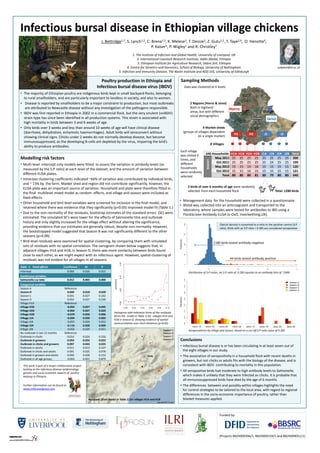
• Bird-level residuals were examined for spatial clustering, by comparing them with simulated
sets of residuals with no spatial correlation. The variogram shown below suggests that, in
adjacent villages H1A and H1B, in Season D, there was more similarity between birds found
close to each other, as we might expect with an infectious agent. However, spatial clustering of
residuals was not evident for all villages in all seasons.
Conclusions
• Infectious bursal disease is or has been circulating in at least seven out of
the eight villages in our study.
• The association of seropositivity in a household flock with recent deaths in
growers, but not chicks or adults fits with the biology of the disease, and is
consistent with IBDV contributing to mortality in this population.
• All seropositive birds had moderate to high antibody levels to Salmonella,
which makes it unlikely that they were infected as chicks. It is probable that
all immunosuppressed birds have died by the age of 6 months.
• The differences between and possibly within villages highlights the need
for control strategies to be tailored to the local area, with regard to regional
differences in the socio-economic importance of poultry, rather than
blanket measures applied.
640 Households H1A H1B H2A H2B J1A J1B J2A J2B Total
Season
May 2011 25 25 25 25 25 25 25 25 200
Oct 2011 25 25 25 25 25 24 25 25 199
May 2012 15 15 14 16 15 15 15 15 120
Oct 2012 15 15 16 15 15 15 15 15 121
Total 80 80 80 81 80 79 80 80 640
Data was clustered at 4 levels
Each village
was visited 4
times, and
different
households
were randomly
selected
44 birds tested antibody positive
1180 birds tested antibody negative
• Management data for the household were collected in a questionnaire
• Blood was collected into an anticoagulant and transported to the
laboratory, where samples were tested for antibodies to IBD using a
FlockScreen Antibody ELISA (x-OvO, Inverkeithing,UK).
Optical density is converted to a ratio to the positive control (S:P
ratio). Birds with an S:P ratio > 0.285 are considered seropositive
Variogram with tolerance limits of the residuals
(from the model in Table 1) for villages H1A and
H1B in Season D, showing evidence of spatial
autocorrelation over short distances (p=0.02)
Table 1: Fixed effects Coefficient SE P
Intercept 0.060 0.026 0.022
Continuous variables
Salmonella s:p ratio 0.012 0.003 0.000
Categorical variables
Season A Reference
Season B 0.040 0.018 0.028
Season C 0.031 0.027 0.242
Season D 0.033 0.027 0.230
Village H1A Reference
Village H1B -0.054 0.027 0.045
Village H2A -0.064 0.027 0.020
Village H2B -0.070 0.026 0.006
Village J1A -0.094 0.030 0.002
Village J1B -0.055 0.029 0.052
Village J2A -0.116 0.028 0.000
Village J2B -0.056 0.029 0.051
No outbreak in last 12 months Reference
Outbreak in chicks 0.014 0.024 0.556
Outbreak in growers 0.059 0.026 0.022
Outbreak in chicks and growers 0.097 0.043 0.025
Outbreak in adults 0.011 0.012 0.337
Outbreak in chicks and adults 0.001 0.025 0.978
Outbreak in growers and adults 0.040 0.028 0.152
Outbreak in all age groups -0.003 0.021 0.879
H1 H2 J1 J2
Seroprevalence by village and season, based on a cut-off S:P ratio value of 0.285
Distribution of S:P ratios. An S:P ratio of 0.285 equates to an antibody titre of ~2400
Residuals (from model in Table 1) for villages H1A and H1B
H1A
H1B
This work is part of a larger collaborative project
looking at the infectious disease epidemiology,
genetic and socio-economic aspects of poultry
keeping in Ethiopia.
Further information can be found at
www.ch4d.wordpress.com
Funded by:
(Projects BB/H009396/1, BB/H009159/1 and BB/H009051/1)
judybett@liv.ac.uk

Infectious bursal disease in Ethiopian village chickens

  • 1.
    37.12 37.14 37.1637.18 37.20 37.22 9.549.569.589.609.62 Circle plot of 'z' X Coord YCoord 0.00 0.02 0.04 0.06 0.08 0.10 0.000.050.100.15 Variogram with tolerance limits distance semivariance Infectious bursal disease in Ethiopian village chickens J. Bettridge1,2, S. Lynch1,2, C. Brena1,2, K. Melese3, T. Dessie2, Z. Gutu1,2, T. Taye2,4, O. Hanotte4, P. Kaiser5, P. Wigley1 and R. Christley1 1. The Institute of Infection and Global Health, University of Liverpool, UK 2. International Livestock Research Institute, Addis Ababa, Ethiopia 3. Ethiopian Institute for Agriculture Research, Debre Zeit, Ethiopia 4. Centre for Genetics and Genomics, School of Biology, University of Nottingham 5. Infection and Immunity Division, The Roslin Institute and R(D) SVS, University of Edinburgh Jarso Horro Poultry production in Ethiopia and Infectious bursal disease virus (IBDV) • The majority of Ethiopian poultry are indigenous birds kept in small backyard flocks, belonging to rural smallholders, and are particularly important to landless in society, and also to women. • Disease is reported by smallholders to be a major constraint to production, but most outbreaks are attributed to Newcastle disease without any investigation of the pathogens responsible. • IBDV was first reported in Ethiopia in 2002 in a commercial flock, but the very virulent (vvIBDV) strain type has since been identified in all production systems. This strain is associated with high mortality in birds between 3 and 6 weeks of age. • Only birds over 3 weeks and less than around 10 weeks of age will have clinical disease (diarrhoea, dehydration, echymotic haemorrhages). Adult birds will seroconvert without showing clinical signs. Chicks under 2 weeks do not normally develop disease, but become immunosuppressed, as the developing B-cells  are  depleted  by  the  virus,  impairing  the  bird’s   ability to produce antibodies. 4 Market sheds (groups of villages dependent on a single market) 2 Regions (Horro & Jarso) Both in highland areas, but with different social demographics 8 Villages 2 birds of over 6 months of age were randomly selected from each household flock Total: 1280 birds Sampling Methods Modelling risk factors • Multi-level intercept only models were fitted to assess the variation in antibody levels (as measured by the S:P ratio) at each level of the dataset, and the amount of variation between different ELISA plates. • Intraclass clustering coefficients indicated ~66% of variation was contributed by individual birds, and ~ 13% by the farm. Market shed and region did not contribute significantly, however, the ELISA plate was an important source of variation. Household and plate were therefore fitted in the final multilevel mixed model as random effects, and village and season were included as fixed effects. • Other household and bird level variables were screened for inclusion in the final model, and retained where there was evidence that they significantly (p<0.05) improved model fit (Table 1.) • Due to the non-normality of the residuals, bootstrap estimates of the standard errors (SE) were estimated.  The  simulated  SE’s  were  lower  for  the  effects  of  Salmonella  titre  and  outbreak   history and only slightly increased for the village effect without altering the significance, providing evidence that our estimates are generally robust, despite non-normality. However, the bootstrapped model suggested that Season B was not significantly different to the other seasons (p=0.09). • Bird-level residuals were examined for spatial clustering, by comparing them with simulated sets of residuals with no spatial correlation. The variogram shown below suggests that, in adjacent villages H1A and H1B, in Season D, there was more similarity between birds found close to each other, as we might expect with an infectious agent. However, spatial clustering of residuals was not evident for all villages in all seasons. Conclusions • Infectious bursal disease is or has been circulating in at least seven out of the eight villages in our study. • The association of seropositivity in a household flock with recent deaths in growers, but not chicks or adults fits with the biology of the disease, and is consistent with IBDV contributing to mortality in this population. • All seropositive birds had moderate to high antibody levels to Salmonella, which makes it unlikely that they were infected as chicks. It is probable that all immunosuppressed birds have died by the age of 6 months. • The differences between and possibly within villages highlights the need for control strategies to be tailored to the local area, with regard to regional differences in the socio-economic importance of poultry, rather than blanket measures applied. 640 Households H1A H1B H2A H2B J1A J1B J2A J2B Total Season May 2011 25 25 25 25 25 25 25 25 200 Oct 2011 25 25 25 25 25 24 25 25 199 May 2012 15 15 14 16 15 15 15 15 120 Oct 2012 15 15 16 15 15 15 15 15 121 Total 80 80 80 81 80 79 80 80 640 Data was clustered at 4 levels Each village was visited 4 times, and different households were randomly selected 44 birds tested antibody positive 1180 birds tested antibody negative • Management data for the household were collected in a questionnaire • Blood was collected into an anticoagulant and transported to the laboratory, where samples were tested for antibodies to IBD using a FlockScreen Antibody ELISA (x-OvO, Inverkeithing,UK). Optical density is converted to a ratio to the positive control (S:P ratio). Birds with an S:P ratio > 0.285 are considered seropositive Variogram with tolerance limits of the residuals (from the model in Table 1) for villages H1A and H1B in Season D, showing evidence of spatial autocorrelation over short distances (p=0.02) Table 1: Fixed effects Coefficient SE P Intercept 0.060 0.026 0.022 Continuous variables Salmonella s:p ratio 0.012 0.003 0.000 Categorical variables Season A Reference Season B 0.040 0.018 0.028 Season C 0.031 0.027 0.242 Season D 0.033 0.027 0.230 Village H1A Reference Village H1B -0.054 0.027 0.045 Village H2A -0.064 0.027 0.020 Village H2B -0.070 0.026 0.006 Village J1A -0.094 0.030 0.002 Village J1B -0.055 0.029 0.052 Village J2A -0.116 0.028 0.000 Village J2B -0.056 0.029 0.051 No outbreak in last 12 months Reference Outbreak in chicks 0.014 0.024 0.556 Outbreak in growers 0.059 0.026 0.022 Outbreak in chicks and growers 0.097 0.043 0.025 Outbreak in adults 0.011 0.012 0.337 Outbreak in chicks and adults 0.001 0.025 0.978 Outbreak in growers and adults 0.040 0.028 0.152 Outbreak in all age groups -0.003 0.021 0.879 H1 H2 J1 J2 Seroprevalence by village and season, based on a cut-off S:P ratio value of 0.285 Distribution of S:P ratios. An S:P ratio of 0.285 equates to an antibody titre of ~2400 Residuals (from model in Table 1) for villages H1A and H1B H1A H1B This work is part of a larger collaborative project looking at the infectious disease epidemiology, genetic and socio-economic aspects of poultry keeping in Ethiopia. Further information can be found at www.ch4d.wordpress.com Funded by: (Projects BB/H009396/1, BB/H009159/1 and BB/H009051/1) judybett@liv.ac.uk