SUTURING BASICS
When is skin closure needed? An open cut of the skin through the dermis (remember: Epidermis Dermis
Subcutaneous tissue Muscle)
What are the steps in wound closure? 1. Hemostasis 2. Local anesthesia 3. Cleanse 4. Sterile field 5.
Choose closure technique 6. Cover
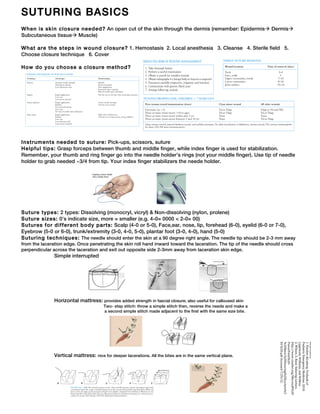
How do you choose a closure method?


Instruments needed to suture: Pick-ups, scissors, suture
Helpful tips: Grasp forceps between thumb and middle finger, while index finger is used for stabilization.
Remember, your thumb and ring finger go into the needle holder’s rings (not your middle finger). Use tip of needle
holder to grab needed ~3/4 from tip. Your index finger stabilizers the neede holder.


Suture types: 2 types: Dissolving (monocryl, vicryl) & Non-dissolving (nylon, prolene)
Suture sizes: 0’s indicate size, more = smaller (e.g. 4-0= 0000 < 2-0= 00)
Sutures for different body parts: Scalp (4-0 or 5-0), Face,ear, nose, lip, forehead (6-0), eyelid (6-0 or 7-0),
Eyebrow (5-0 or 6-0), trunk/extremity (3-0, 4-0, 5-0), plantar foot (3-0, 4-0), hand (5-0)
Suturing techniques: The needle should enter the skin at a 90 degree right angle. The needle tip should be 2-3 mm away
from the laceration edge. Once penetrating the skin roll hand inward toward the laceration. The tip of the needle should cross
perpendicular across the laceration and exit out opposite side 2-3mm away from laceration skin edge.

Simple interrupted


Horizontal mattress: provides added strength in fascial closure; also useful for calloused skin
Two- step stitch: throw a simple stitch then, reverse the neede and make a
a second simple stitch made adjacent to the first with the same size bite.


Vertical mattress: nice for deeper lacerations. All the bites are in the same vertical plane.


References:	
  	
  
1.	
  Fleisher	
  &Ludwig.	
  Texbook	
  of	
  
Pediatric	
  Emergency	
  Medicine.	
  2010.	
  
Lippincott,	
  Williams,	
  and	
  Wilkins	
  
2.	
  W ilson,	
  S.	
  Basic	
  Suturing	
  Lecture.	
  
http://www.coadwi.org/Microsoft%20
PowerPoint%20-­‐
%20Basic%20Suturing%20Lecture%5
B1%5D.pdf	
  Accessed	
  7/29/12.	


Suturing basics

  • 1.
    SUTURING BASICS When isskin closure needed? An open cut of the skin through the dermis (remember: Epidermis Dermis Subcutaneous tissue Muscle) What are the steps in wound closure? 1. Hemostasis 2. Local anesthesia 3. Cleanse 4. Sterile field 5. Choose closure technique 6. Cover How do you choose a closure method?         Instruments needed to suture: Pick-ups, scissors, suture Helpful tips: Grasp forceps between thumb and middle finger, while index finger is used for stabilization. Remember, your thumb and ring finger go into the needle holder’s rings (not your middle finger). Use tip of needle holder to grab needed ~3/4 from tip. Your index finger stabilizers the neede holder.       Suture types: 2 types: Dissolving (monocryl, vicryl) & Non-dissolving (nylon, prolene) Suture sizes: 0’s indicate size, more = smaller (e.g. 4-0= 0000 < 2-0= 00) Sutures for different body parts: Scalp (4-0 or 5-0), Face,ear, nose, lip, forehead (6-0), eyelid (6-0 or 7-0), Eyebrow (5-0 or 6-0), trunk/extremity (3-0, 4-0, 5-0), plantar foot (3-0, 4-0), hand (5-0) Suturing techniques: The needle should enter the skin at a 90 degree right angle. The needle tip should be 2-3 mm away from the laceration edge. Once penetrating the skin roll hand inward toward the laceration. The tip of the needle should cross perpendicular across the laceration and exit out opposite side 2-3mm away from laceration skin edge. Simple interrupted     Horizontal mattress: provides added strength in fascial closure; also useful for calloused skin Two- step stitch: throw a simple stitch then, reverse the neede and make a a second simple stitch made adjacent to the first with the same size bite.   Vertical mattress: nice for deeper lacerations. All the bites are in the same vertical plane.     References:     1.  Fleisher  &Ludwig.  Texbook  of   Pediatric  Emergency  Medicine.  2010.   Lippincott,  Williams,  and  Wilkins   2.  W ilson,  S.  Basic  Suturing  Lecture.   http://www.coadwi.org/Microsoft%20 PowerPoint%20-­‐ %20Basic%20Suturing%20Lecture%5 B1%5D.pdf  Accessed  7/29/12.