འབྲུག་རྒྱལ་འཛིན་གཙུག་ལག་སློབ་སྡེ།
རང་འབྱུང་འཐློན་བསྡེད་མཐློ་རིམ་སློབ་ྲྭ།
སྤུ་ན་ཁ་རློང་ཁག།
ལློད་སྦུད་ས།
དློག་ཏྲར་་་འཇིགས་འབྡེལ་རློ་རྡེ།
རང་འབྱུང་འཐློན་བསྡེད་མཐློ་རིམ་སློབ་ྲྭ། སྤུ་ན་ཁ་རློང་ཁག།
ལློད་སྦུད་ས།
Suture Patterns & Techniques
S U T U R E P A T T E R N A N D T E C H N I Q U E S
1
LEARNING OBJECTIVES
 Classify suture patterns based on their effect on tissue
apposition
 Describe the steps involved in the accurate placement
of basic suture patterns
 Discuss the advantages and disadvantages of various
suture patterns
 Visually identify suture patterns
 Know when to apply the patterns in Surgery
After the completion of the lesson, each student should be able
to;
S U T U R E P A T T E R N A N D T E C H N I Q U E S
2
Basic Terminology in Suturing a wound
 Appositional: Like Layers are apposed
 Inverting: Outer Layer Apposed
 Everting: Inner Layer Apposed
 Throw : Individual phase of knot
 Bite: Span of tissue suture encompasses on either side of
incision
Horizontal _____ are parallel to the incision
Vertical ______ are perpendicular to the incision
S U T U R E P A T T E R N A N D T E C H N I Q U E S
3
4
S U T U R E P A T T E R N A N D T E C H N I Q U E S
Basic Principle of Suturing
 Approximated well with least trauma
 Tissues should be handled gently
 Stitches should be placed a little away from the
edges of incision without including large tissue mass
 Tight placed sutures are prone to high tension and
ischemia
 Obliteration of dead spaces should be ensured
 Knots should be simple, secured and placed on one
side of the incision line to avoid interference in
healing
Classification of Suture Patterns
1.Appositional Suture Patterns: Bring tissues into
close approximation.
2.Inverting Suture Patterns: Turn tissue edges towards
the patient, away from the surgeon, or toward the center
of a hollow organ
3.Everting Suture Patterns: Turn tissues edges outward
away from the patient and toward the surgeon.
S U T U R E P A T T E R N A N D T E C H N I Q U E S
5
Apposing two layers of the Skin
Inverting Suture Pattern Eversion suture Pattern
S U T U R E P A T T E R N A N D T E C H N I Q U E S
6
B. Continuous Suture Patterns
1. Simple continuous
2. Ford interlocking
3. Lambert
4. Connell and Cushing
5. Intradermal pattern
A. Interrupted Suture Patterns
1. Simple Interrupted
2. Horizontal mattress
3. Cruciate
4. Vertical mattress
5. Near and far patterns
Common Suture Patterns Used in Veterinary
Surgery
S U T U R E P A T T E R N A N D T E C H N I Q U E S
7
1. Interrupted Suture Patterns
A. Simple Interrupted Pattern.
 Most basic
 Most often used
 Insert needle on one side of wound, cross wound, and through tissue on
opposite side
Advantages
Easy to execute
Rapid
Disruption of one suture does not result in
suture line failure
Disadvantages
Excessive tension yields inversion or
eversion
Costly in terms of time and suture (foreign)
material
S U T U R E P A T T E R N A N D T E C H N I Q U E S
8
Cross Mattress Suture Pattern/Cruciate
Pattern
S U T U R E P A T T E R N A N D T E C H N I Q U E S
9
Advantages
Covers a greater distance per suture than SI, thus saves time
Stronger closure than SI
Resists tension and tissue eversion
10
S U T U R E P A T T E R N A N D T E C H N I Q U E S
Simple Continuous Pattern
Similar to Simple Interrupted except the Individual knots are not
applied. Bites are taken from right angle to the Incision line.
Advantages
Conservation of suture compared to SI
Good apposition and a watertight seal
Good for layers under little tension
Disadvantages
If one suture line
breaks, all sutures
will be broken off.
11
S U T U R E P A T T E R N A N D T E C H N I Q U E S
Horizontal Mattress Pattern
Advantage.
1. It can be placed in the areas
where much tension is placed
on the skin.
Disadvantage.
1. It interferes with blood
supply to the skin and interferes
with healing.
12
S U T U R E P A T T E R N A N D T E C H N I Q U E S
Vertical Mattress Suture Pattern
Near- Near, Far
Far=Perpendicular to the Incision
Line
Advantage.
 Doesn't Interfere with blood supply of the skin like HM
Disadvantage.
 Consumes more suture materials and consumes more
time.
13
S U T U R E P A T T E R N A N D T E C H N I Q U E S
Continuous Suture Pattern
1.Simple Continuous Pattern
 Similar to Simple Interrupted except this is continuous. No
knots are applied between until incision line is sutured.
Advantage:
 Simple and fast with less
requirement of suture material
Disadvantage
 If one stitch is untied, rest
stitches can be lost.
14
S U T U R E P A T T E R N A N D T E C H N I Q U E S
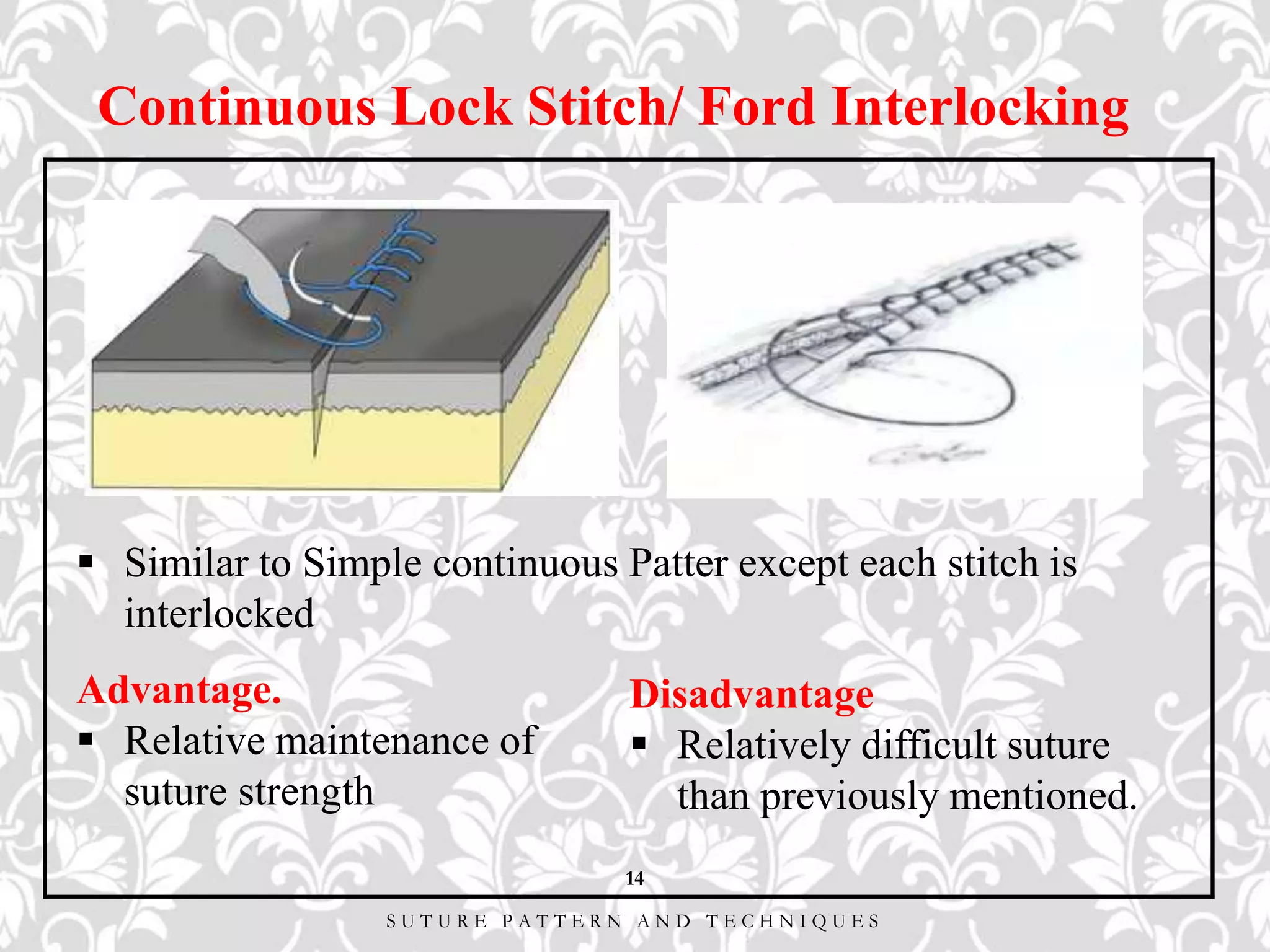
Continuous Lock Stitch/ Ford Interlocking
 Similar to Simple continuous Patter except each stitch is
interlocked
Advantage.
 Relative maintenance of
suture strength
Disadvantage
 Relatively difficult suture
than previously mentioned.
15
S U T U R E P A T T E R N A N D T E C H N I Q U E S
Lambert Suture Pattern /Inverting Suture
Patterns
Primarily indicated to close hollow viscera with large
lumen size such as Rumen, Uterus etc..
 Penetrate the serosa, mucularis and submucosa but not the
mucosa of the hollow organ
F-n-f-n
16
S U T U R E P A T T E R N A N D T E C H N I Q U E S
Lambert Suture Continued……..
Advantage
 Simplest pattern for internal hollow organs.
 Relatively rapidly performed, and does not involve mucosa
therefore low risk of contamination.
Disadvantage.
 Produces slight stenosis of the organ.
17
S U T U R E P A T T E R N A N D T E C H N I Q U E S
Connell And Cushing Suture Pattern
 Both pattern are almost same except the Connell pattern
penetrates the Lumen of the hollow organ with each bite while
Cushing only penetrates serosa, mucularis, and submucosa
 Bites are placed parallel to
the incision edge
https://www.youtube.com/watch?time_continue
=3&v=mK1I-EWTZIo
https://www.youtube.com/watch?time_continue=22&v=EJS4kEf
BBQA
18
S U T U R E P A T T E R N A N D T E C H N I Q U E S
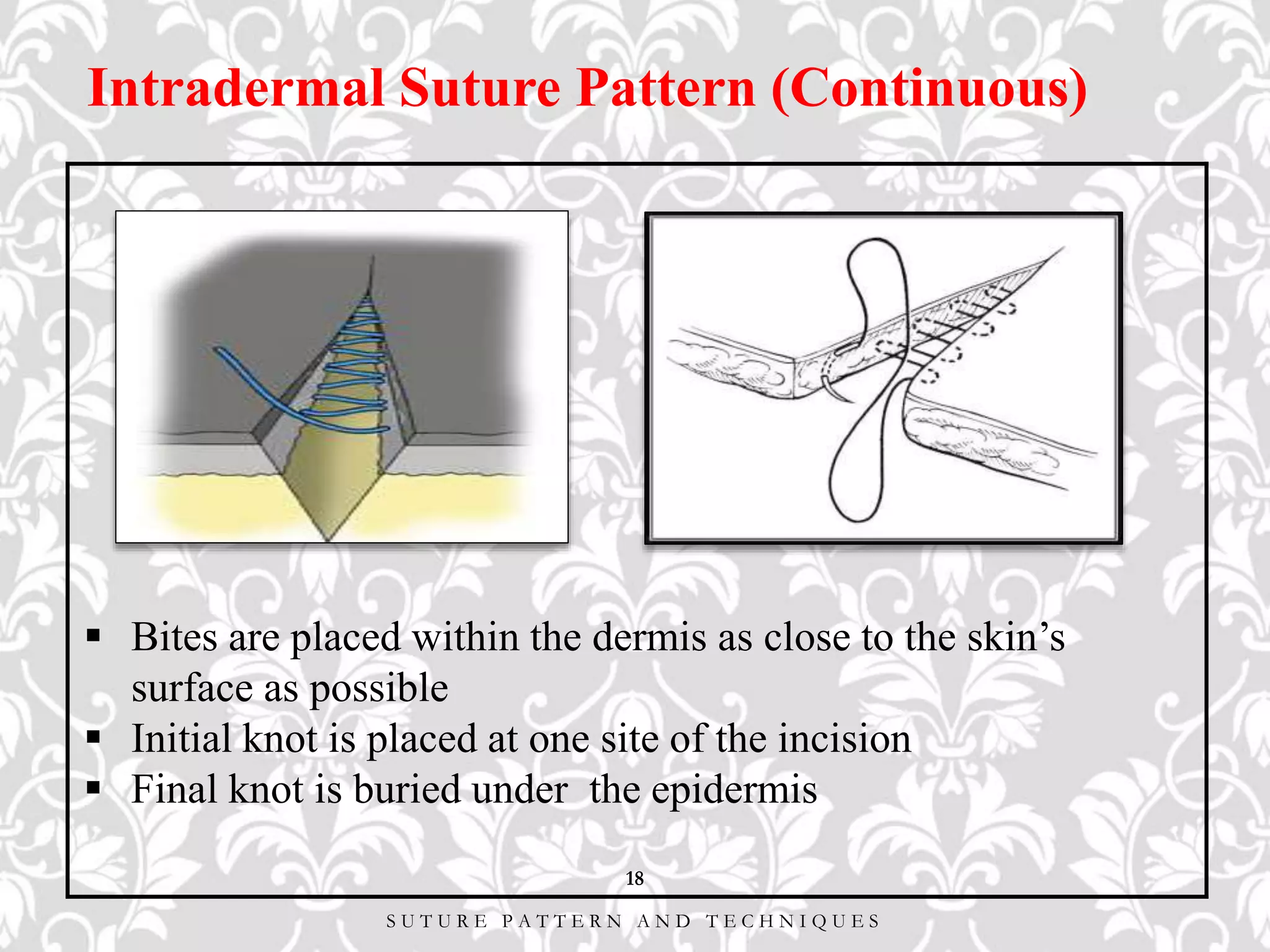
Intradermal Suture Pattern (Continuous)
 Bites are placed within the dermis as close to the skin’s
surface as possible
 Initial knot is placed at one site of the incision
 Final knot is buried under the epidermis
19
S U T U R E P A T T E R N A N D T E C H N I Q U E S
SURGICSL KNOTS
20
S U T U R E P A T T E R N A N D T E C H N I Q U E S
Background
 A secure knot is created only when one loop or throw
is placed over another.
 The first throw can be made in various ways
depending on the circumstances, and in every case
determines the tension and position of the knot.
 The second throw is there only to prevent slippage
and is therefore placed firmly against the first.
 Every suture material acts as a foreign body in tissue.
Buried knots are therefore kept as small as possible
and the ends cut short.
 However, suture swelling must be borne in mind
when using catgut.
21
S U T U R E P A T T E R N A N D T E C H N I Q U E S
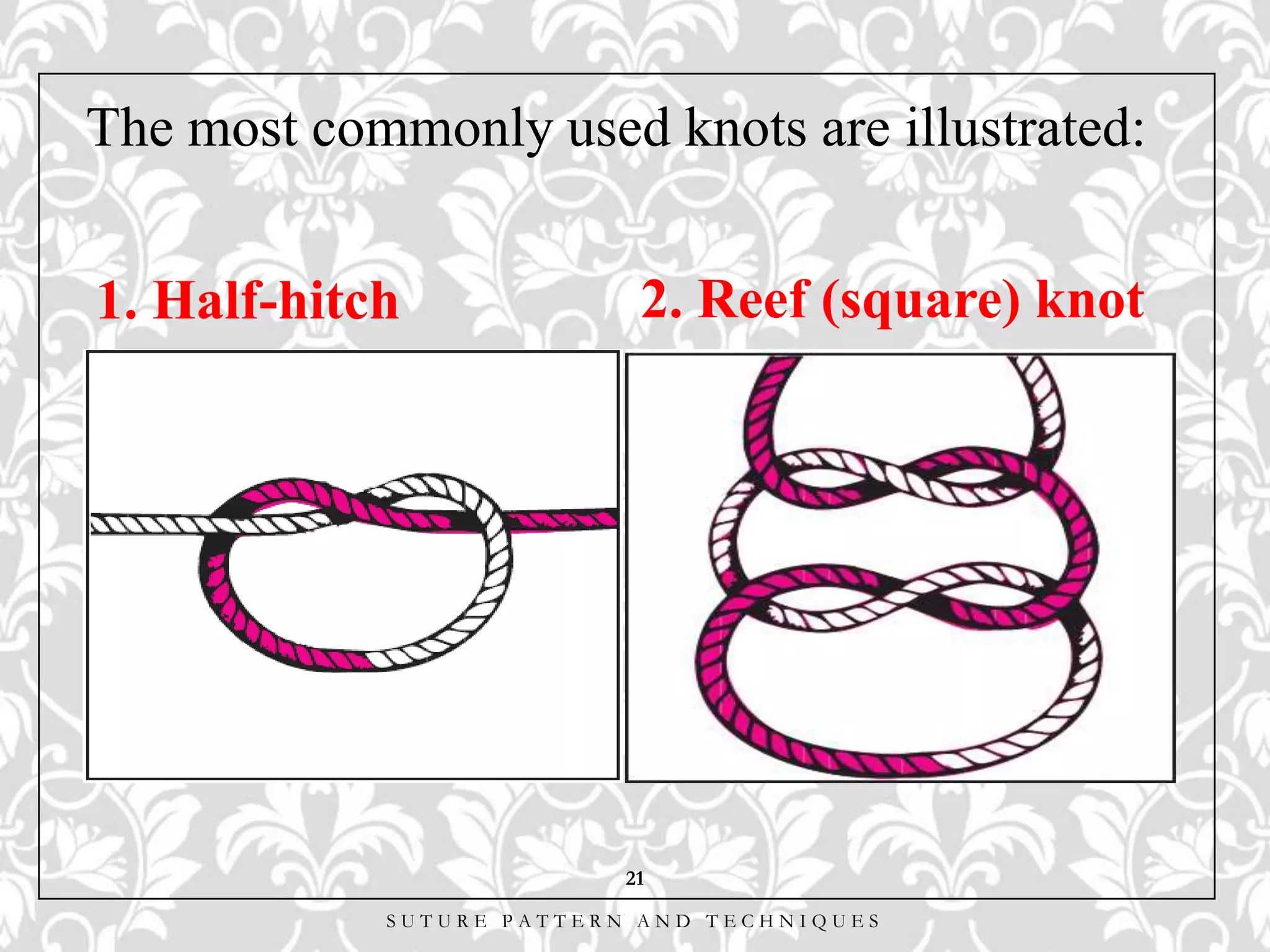
The most commonly used knots are illustrated:
1. Half-hitch 2. Reef (square) knot
22
S U T U R E P A T T E R N A N D T E C H N I Q U E S
3. Granny Knot 4. Surgical knot
23
S U T U R E P A T T E R N A N D T E C H N I Q U E S
Trashi Delek

Suture paterns & knots

  • 1.
  • 2.
    LEARNING OBJECTIVES  Classifysuture patterns based on their effect on tissue apposition  Describe the steps involved in the accurate placement of basic suture patterns  Discuss the advantages and disadvantages of various suture patterns  Visually identify suture patterns  Know when to apply the patterns in Surgery After the completion of the lesson, each student should be able to; S U T U R E P A T T E R N A N D T E C H N I Q U E S 2
  • 3.
    Basic Terminology inSuturing a wound  Appositional: Like Layers are apposed  Inverting: Outer Layer Apposed  Everting: Inner Layer Apposed  Throw : Individual phase of knot  Bite: Span of tissue suture encompasses on either side of incision Horizontal _____ are parallel to the incision Vertical ______ are perpendicular to the incision S U T U R E P A T T E R N A N D T E C H N I Q U E S 3
  • 4.
    4 S U TU R E P A T T E R N A N D T E C H N I Q U E S Basic Principle of Suturing  Approximated well with least trauma  Tissues should be handled gently  Stitches should be placed a little away from the edges of incision without including large tissue mass  Tight placed sutures are prone to high tension and ischemia  Obliteration of dead spaces should be ensured  Knots should be simple, secured and placed on one side of the incision line to avoid interference in healing
  • 5.
    Classification of SuturePatterns 1.Appositional Suture Patterns: Bring tissues into close approximation. 2.Inverting Suture Patterns: Turn tissue edges towards the patient, away from the surgeon, or toward the center of a hollow organ 3.Everting Suture Patterns: Turn tissues edges outward away from the patient and toward the surgeon. S U T U R E P A T T E R N A N D T E C H N I Q U E S 5
  • 6.
    Apposing two layersof the Skin Inverting Suture Pattern Eversion suture Pattern S U T U R E P A T T E R N A N D T E C H N I Q U E S 6
  • 7.
    B. Continuous SuturePatterns 1. Simple continuous 2. Ford interlocking 3. Lambert 4. Connell and Cushing 5. Intradermal pattern A. Interrupted Suture Patterns 1. Simple Interrupted 2. Horizontal mattress 3. Cruciate 4. Vertical mattress 5. Near and far patterns Common Suture Patterns Used in Veterinary Surgery S U T U R E P A T T E R N A N D T E C H N I Q U E S 7
  • 8.
    1. Interrupted SuturePatterns A. Simple Interrupted Pattern.  Most basic  Most often used  Insert needle on one side of wound, cross wound, and through tissue on opposite side Advantages Easy to execute Rapid Disruption of one suture does not result in suture line failure Disadvantages Excessive tension yields inversion or eversion Costly in terms of time and suture (foreign) material S U T U R E P A T T E R N A N D T E C H N I Q U E S 8
  • 9.
    Cross Mattress SuturePattern/Cruciate Pattern S U T U R E P A T T E R N A N D T E C H N I Q U E S 9 Advantages Covers a greater distance per suture than SI, thus saves time Stronger closure than SI Resists tension and tissue eversion
  • 10.
    10 S U TU R E P A T T E R N A N D T E C H N I Q U E S Simple Continuous Pattern Similar to Simple Interrupted except the Individual knots are not applied. Bites are taken from right angle to the Incision line. Advantages Conservation of suture compared to SI Good apposition and a watertight seal Good for layers under little tension Disadvantages If one suture line breaks, all sutures will be broken off.
  • 11.
    11 S U TU R E P A T T E R N A N D T E C H N I Q U E S Horizontal Mattress Pattern Advantage. 1. It can be placed in the areas where much tension is placed on the skin. Disadvantage. 1. It interferes with blood supply to the skin and interferes with healing.
  • 12.
    12 S U TU R E P A T T E R N A N D T E C H N I Q U E S Vertical Mattress Suture Pattern Near- Near, Far Far=Perpendicular to the Incision Line Advantage.  Doesn't Interfere with blood supply of the skin like HM Disadvantage.  Consumes more suture materials and consumes more time.
  • 13.
    13 S U TU R E P A T T E R N A N D T E C H N I Q U E S Continuous Suture Pattern 1.Simple Continuous Pattern  Similar to Simple Interrupted except this is continuous. No knots are applied between until incision line is sutured. Advantage:  Simple and fast with less requirement of suture material Disadvantage  If one stitch is untied, rest stitches can be lost.
  • 14.
    14 S U TU R E P A T T E R N A N D T E C H N I Q U E S Continuous Lock Stitch/ Ford Interlocking  Similar to Simple continuous Patter except each stitch is interlocked Advantage.  Relative maintenance of suture strength Disadvantage  Relatively difficult suture than previously mentioned.
  • 15.
    15 S U TU R E P A T T E R N A N D T E C H N I Q U E S Lambert Suture Pattern /Inverting Suture Patterns Primarily indicated to close hollow viscera with large lumen size such as Rumen, Uterus etc..  Penetrate the serosa, mucularis and submucosa but not the mucosa of the hollow organ F-n-f-n
  • 16.
    16 S U TU R E P A T T E R N A N D T E C H N I Q U E S Lambert Suture Continued…….. Advantage  Simplest pattern for internal hollow organs.  Relatively rapidly performed, and does not involve mucosa therefore low risk of contamination. Disadvantage.  Produces slight stenosis of the organ.
  • 17.
    17 S U TU R E P A T T E R N A N D T E C H N I Q U E S Connell And Cushing Suture Pattern  Both pattern are almost same except the Connell pattern penetrates the Lumen of the hollow organ with each bite while Cushing only penetrates serosa, mucularis, and submucosa  Bites are placed parallel to the incision edge https://www.youtube.com/watch?time_continue =3&v=mK1I-EWTZIo https://www.youtube.com/watch?time_continue=22&v=EJS4kEf BBQA
  • 18.
    18 S U TU R E P A T T E R N A N D T E C H N I Q U E S Intradermal Suture Pattern (Continuous)  Bites are placed within the dermis as close to the skin’s surface as possible  Initial knot is placed at one site of the incision  Final knot is buried under the epidermis
  • 19.
    19 S U TU R E P A T T E R N A N D T E C H N I Q U E S SURGICSL KNOTS
  • 20.
    20 S U TU R E P A T T E R N A N D T E C H N I Q U E S Background  A secure knot is created only when one loop or throw is placed over another.  The first throw can be made in various ways depending on the circumstances, and in every case determines the tension and position of the knot.  The second throw is there only to prevent slippage and is therefore placed firmly against the first.  Every suture material acts as a foreign body in tissue. Buried knots are therefore kept as small as possible and the ends cut short.  However, suture swelling must be borne in mind when using catgut.
  • 21.
    21 S U TU R E P A T T E R N A N D T E C H N I Q U E S The most commonly used knots are illustrated: 1. Half-hitch 2. Reef (square) knot
  • 22.
    22 S U TU R E P A T T E R N A N D T E C H N I Q U E S 3. Granny Knot 4. Surgical knot
  • 23.
    23 S U TU R E P A T T E R N A N D T E C H N I Q U E S Trashi Delek