Presentedto :
Dr. Ashwani Arya
[Instructor]
College of Veterinary & Animal Sciences
SVP University of Agriculture & Technology,
Meerut - 250110
Presentedby :
Surya Kant Agarwal
[V-3098/14]
Topic
Basic suture patterns
10/14/2017 1
Introduction
o Suture material is an artificial fiber used to keep wound
together until they hold sufficiently well by themselves by
natural fiber (collagen) which is synthesized and woven
into a stronger scar
o A large number of suture patterns are available for use
under different circumstances
o The experienced surgeon will only utilize a minimum of
these patterns and will be familiar with their advantages
and disadvantages
o Choice should be based on the basic concept of providing
the wound with maximum security with minimal alteration
to healing
10/14/2017 2
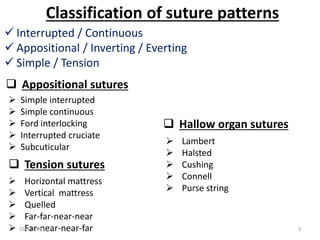
Classification of suture patterns
 Interrupted / Continuous
 Appositional / Inverting / Everting
 Simple / Tension
 Appositional sutures
 Simple interrupted
 Simple continuous
 Ford interlocking
 Interrupted cruciate
 Subcuticular
 Tension sutures
 Horizontal mattress
 Vertical mattress
 Quelled
 Far-far-near-near
 Far-near-near-far
 Hallow organ sutures
 Lambert
 Halsted
 Cushing
 Connell
 Purse string
10/14/2017 3
Appositional sutures
10/14/2017 4
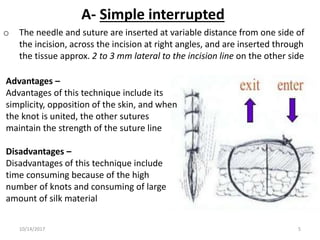
A- Simple interrupted
o The needle and suture are inserted at variable distance from one side of
the incision, across the incision at right angles, and are inserted through
the tissue approx. 2 to 3 mm lateral to the incision line on the other side
Advantages –
Advantages of this technique include its
simplicity, opposition of the skin, and when
the knot is united, the other sutures
maintain the strength of the suture line
Disadvantages –
Disadvantages of this technique include
time consuming because of the high
number of knots and consuming of large
amount of silk material
10/14/2017 5
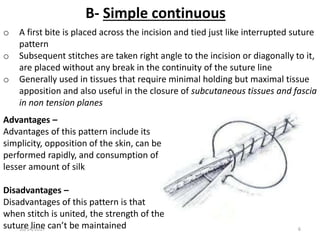
B- Simple continuous
o A first bite is placed across the incision and tied just like interrupted suture
pattern
o Subsequent stitches are taken right angle to the incision or diagonally to it,
are placed without any break in the continuity of the suture line
o Generally used in tissues that require minimal holding but maximal tissue
apposition and also useful in the closure of subcutaneous tissues and fascia
in non tension planes
Advantages –
Advantages of this pattern include its
simplicity, opposition of the skin, can be
performed rapidly, and consumption of
lesser amount of silk
Disadvantages –
Disadvantages of this pattern is that
when stitch is united, the strength of the
suture line can’t be maintained10/14/2017 6
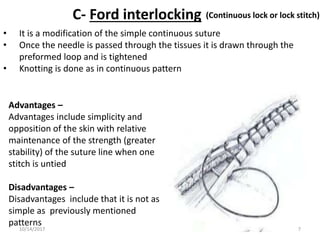
C- Ford interlocking
• It is a modification of the simple continuous suture
• Once the needle is passed through the tissues it is drawn through the
preformed loop and is tightened
• Knotting is done as in continuous pattern
(Continuous lock or lock stitch)
Advantages –
Advantages include simplicity and
opposition of the skin with relative
maintenance of the strength (greater
stability) of the suture line when one
stitch is untied
Disadvantages –
Disadvantages include that it is not as
simple as previously mentioned
patterns
10/14/2017 7
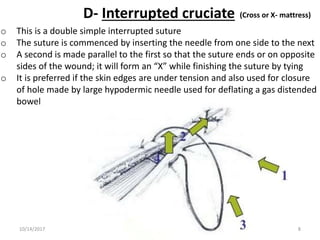
D- Interrupted cruciate (Cross or X- mattress)
o This is a double simple interrupted suture
o The suture is commenced by inserting the needle from one side to the next
o A second is made parallel to the first so that the suture ends or on opposite
sides of the wound; it will form an “X” while finishing the suture by tying
o It is preferred if the skin edges are under tension and also used for closure
of hole made by large hypodermic needle used for deflating a gas distended
bowel
10/14/2017 8
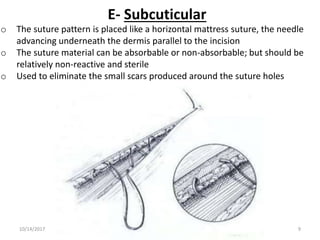
E- Subcuticular
o The suture pattern is placed like a horizontal mattress suture, the needle
advancing underneath the dermis parallel to the incision
o The suture material can be absorbable or non-absorbable; but should be
relatively non-reactive and sterile
o Used to eliminate the small scars produced around the suture holes
10/14/2017 9
Tension sutures
10/14/2017 10
A- Horizontal mattress
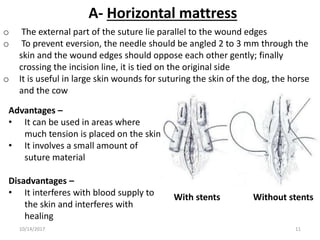
o The external part of the suture lie parallel to the wound edges
o To prevent eversion, the needle should be angled 2 to 3 mm through the
skin and the wound edges should oppose each other gently; finally
crossing the incision line, it is tied on the original side
o It is useful in large skin wounds for suturing the skin of the dog, the horse
and the cow
Advantages –
• It can be used in areas where
much tension is placed on the skin
• It involves a small amount of
suture material
Disadvantages –
• It interferes with blood supply to
the skin and interferes with
healing
With stents Without stents
10/14/2017 11
B- Vertical mattress
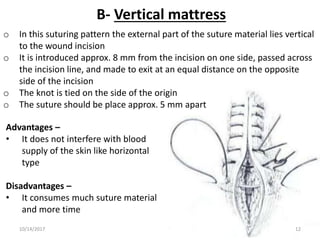
o In this suturing pattern the external part of the suture material lies vertical
to the wound incision
o It is introduced approx. 8 mm from the incision on one side, passed across
the incision line, and made to exit at an equal distance on the opposite
side of the incision
o The knot is tied on the side of the origin
o The suture should be place approx. 5 mm apart
Advantages –
• It does not interfere with blood
supply of the skin like horizontal
type
Disadvantages –
• It consumes much suture material
and more time
10/14/2017 12
C- Quilled sutures
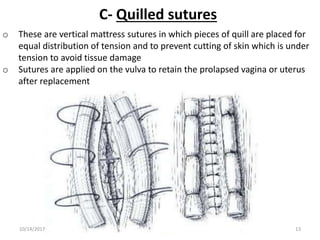
o These are vertical mattress sutures in which pieces of quill are placed for
equal distribution of tension and to prevent cutting of skin which is under
tension to avoid tissue damage
o Sutures are applied on the vulva to retain the prolapsed vagina or uterus
after replacement
10/14/2017 13
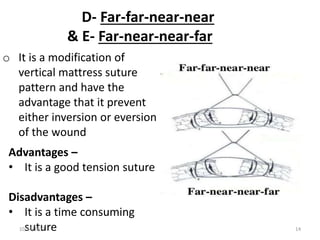
D- Far-far-near-near
& E- Far-near-near-far
Advantages –
• It is a good tension suture
Disadvantages –
• It is a time consuming
suture
o It is a modification of
vertical mattress suture
pattern and have the
advantage that it prevent
either inversion or eversion
of the wound
10/14/2017 14
Suture patterns used for Hallow organs
10/14/2017 15
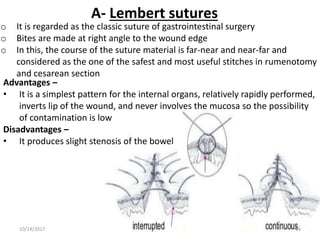
A- Lembert sutures
o It is regarded as the classic suture of gastrointestinal surgery
o Bites are made at right angle to the wound edge
o In this, the course of the suture material is far-near and near-far and
considered as the one of the safest and most useful stitches in rumenotomy
and cesarean section
Advantages –
• It is a simplest pattern for the internal organs, relatively rapidly performed,
inverts lip of the wound, and never involves the mucosa so the possibility
of contamination is low
Disadvantages –
• It produces slight stenosis of the bowel
10/14/2017 16
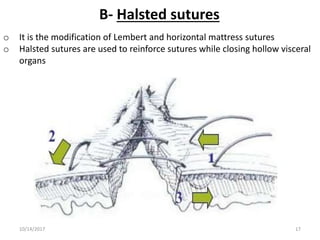
B- Halsted sutures
o It is the modification of Lembert and horizontal mattress sutures
o Halsted sutures are used to reinforce sutures while closing hollow visceral
organs
10/14/2017 17
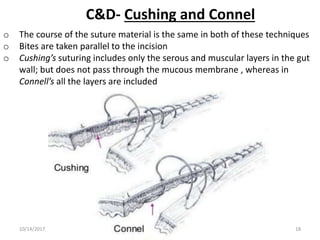
C&D- Cushing and Connel
o The course of the suture material is the same in both of these techniques
o Bites are taken parallel to the incision
o Cushing’s suturing includes only the serous and muscular layers in the gut
wall; but does not pass through the mucous membrane , whereas in
Connell’s all the layers are included
10/14/2017 18
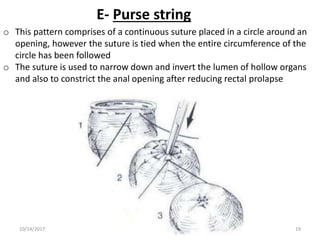
E- Purse string
o This pattern comprises of a continuous suture placed in a circle around an
opening, however the suture is tied when the entire circumference of the
circle has been followed
o The suture is used to narrow down and invert the lumen of hollow organs
and also to constrict the anal opening after reducing rectal prolapse
10/14/2017 19
10/14/2017 20

Surya kant agarwal

  • 1.
    Presentedto : Dr. AshwaniArya [Instructor] College of Veterinary & Animal Sciences SVP University of Agriculture & Technology, Meerut - 250110 Presentedby : Surya Kant Agarwal [V-3098/14] Topic Basic suture patterns 10/14/2017 1
  • 2.
    Introduction o Suture materialis an artificial fiber used to keep wound together until they hold sufficiently well by themselves by natural fiber (collagen) which is synthesized and woven into a stronger scar o A large number of suture patterns are available for use under different circumstances o The experienced surgeon will only utilize a minimum of these patterns and will be familiar with their advantages and disadvantages o Choice should be based on the basic concept of providing the wound with maximum security with minimal alteration to healing 10/14/2017 2
  • 3.
    Classification of suturepatterns  Interrupted / Continuous  Appositional / Inverting / Everting  Simple / Tension  Appositional sutures  Simple interrupted  Simple continuous  Ford interlocking  Interrupted cruciate  Subcuticular  Tension sutures  Horizontal mattress  Vertical mattress  Quelled  Far-far-near-near  Far-near-near-far  Hallow organ sutures  Lambert  Halsted  Cushing  Connell  Purse string 10/14/2017 3
  • 4.
  • 5.
    A- Simple interrupted oThe needle and suture are inserted at variable distance from one side of the incision, across the incision at right angles, and are inserted through the tissue approx. 2 to 3 mm lateral to the incision line on the other side Advantages – Advantages of this technique include its simplicity, opposition of the skin, and when the knot is united, the other sutures maintain the strength of the suture line Disadvantages – Disadvantages of this technique include time consuming because of the high number of knots and consuming of large amount of silk material 10/14/2017 5
  • 6.
    B- Simple continuous oA first bite is placed across the incision and tied just like interrupted suture pattern o Subsequent stitches are taken right angle to the incision or diagonally to it, are placed without any break in the continuity of the suture line o Generally used in tissues that require minimal holding but maximal tissue apposition and also useful in the closure of subcutaneous tissues and fascia in non tension planes Advantages – Advantages of this pattern include its simplicity, opposition of the skin, can be performed rapidly, and consumption of lesser amount of silk Disadvantages – Disadvantages of this pattern is that when stitch is united, the strength of the suture line can’t be maintained10/14/2017 6
  • 7.
    C- Ford interlocking •It is a modification of the simple continuous suture • Once the needle is passed through the tissues it is drawn through the preformed loop and is tightened • Knotting is done as in continuous pattern (Continuous lock or lock stitch) Advantages – Advantages include simplicity and opposition of the skin with relative maintenance of the strength (greater stability) of the suture line when one stitch is untied Disadvantages – Disadvantages include that it is not as simple as previously mentioned patterns 10/14/2017 7
  • 8.
    D- Interrupted cruciate(Cross or X- mattress) o This is a double simple interrupted suture o The suture is commenced by inserting the needle from one side to the next o A second is made parallel to the first so that the suture ends or on opposite sides of the wound; it will form an “X” while finishing the suture by tying o It is preferred if the skin edges are under tension and also used for closure of hole made by large hypodermic needle used for deflating a gas distended bowel 10/14/2017 8
  • 9.
    E- Subcuticular o Thesuture pattern is placed like a horizontal mattress suture, the needle advancing underneath the dermis parallel to the incision o The suture material can be absorbable or non-absorbable; but should be relatively non-reactive and sterile o Used to eliminate the small scars produced around the suture holes 10/14/2017 9
  • 10.
  • 11.
    A- Horizontal mattress oThe external part of the suture lie parallel to the wound edges o To prevent eversion, the needle should be angled 2 to 3 mm through the skin and the wound edges should oppose each other gently; finally crossing the incision line, it is tied on the original side o It is useful in large skin wounds for suturing the skin of the dog, the horse and the cow Advantages – • It can be used in areas where much tension is placed on the skin • It involves a small amount of suture material Disadvantages – • It interferes with blood supply to the skin and interferes with healing With stents Without stents 10/14/2017 11
  • 12.
    B- Vertical mattress oIn this suturing pattern the external part of the suture material lies vertical to the wound incision o It is introduced approx. 8 mm from the incision on one side, passed across the incision line, and made to exit at an equal distance on the opposite side of the incision o The knot is tied on the side of the origin o The suture should be place approx. 5 mm apart Advantages – • It does not interfere with blood supply of the skin like horizontal type Disadvantages – • It consumes much suture material and more time 10/14/2017 12
  • 13.
    C- Quilled sutures oThese are vertical mattress sutures in which pieces of quill are placed for equal distribution of tension and to prevent cutting of skin which is under tension to avoid tissue damage o Sutures are applied on the vulva to retain the prolapsed vagina or uterus after replacement 10/14/2017 13
  • 14.
    D- Far-far-near-near & E-Far-near-near-far Advantages – • It is a good tension suture Disadvantages – • It is a time consuming suture o It is a modification of vertical mattress suture pattern and have the advantage that it prevent either inversion or eversion of the wound 10/14/2017 14
  • 15.
    Suture patterns usedfor Hallow organs 10/14/2017 15
  • 16.
    A- Lembert sutures oIt is regarded as the classic suture of gastrointestinal surgery o Bites are made at right angle to the wound edge o In this, the course of the suture material is far-near and near-far and considered as the one of the safest and most useful stitches in rumenotomy and cesarean section Advantages – • It is a simplest pattern for the internal organs, relatively rapidly performed, inverts lip of the wound, and never involves the mucosa so the possibility of contamination is low Disadvantages – • It produces slight stenosis of the bowel 10/14/2017 16
  • 17.
    B- Halsted sutures oIt is the modification of Lembert and horizontal mattress sutures o Halsted sutures are used to reinforce sutures while closing hollow visceral organs 10/14/2017 17
  • 18.
    C&D- Cushing andConnel o The course of the suture material is the same in both of these techniques o Bites are taken parallel to the incision o Cushing’s suturing includes only the serous and muscular layers in the gut wall; but does not pass through the mucous membrane , whereas in Connell’s all the layers are included 10/14/2017 18
  • 19.
    E- Purse string oThis pattern comprises of a continuous suture placed in a circle around an opening, however the suture is tied when the entire circumference of the circle has been followed o The suture is used to narrow down and invert the lumen of hollow organs and also to constrict the anal opening after reducing rectal prolapse 10/14/2017 19
  • 20.