Solid Waste Management
Master Plan for Mumbai, India
Vision 2023
BY
PRATIMA PANDEY
&
ARINDAM CHAKRABORTY

JANUARY 11, 2014

Towards completion of
‘Online Course On Solid Waste Management’
UNESCO-IHE Institute for Water Education
Contents of the Presentation
About Mumbai
Current Waste Management Scenario

Proposed Master Plan - Vision 2023
Proposed Master Plan - Decoded

Sustainability Assessment
Highlights and Conclusion
About Mumbai
Current Waste Management Scenario

Proposed Master Plan - Vision 2023
Proposed Master Plan - Decoded

Sustainability Assessment
Highlights and Conclusion
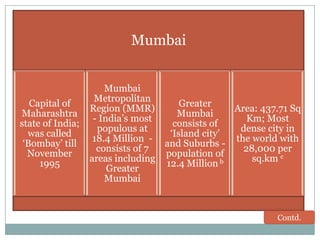
Mumbai

Capital of
Maharashtra
state of India;
was called
„Bombay‟ till
November
1995

Mumbai
Metropolitan
Greater
Region (MMR)
Area: 437.71 Sq
Mumbai
- India‟s most
Km; Most
consists of
populous at
dense city in
„Island city‟
18.4 Million the world with
and Suburbs consists of 7
28,000 per
population of
areas including
sq.km c
b
12.4 Million
Greater
Mumbai

Contd.
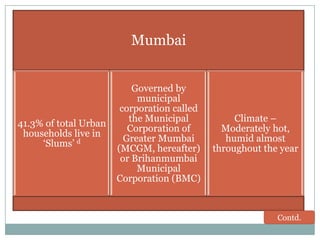
Mumbai

41.3% of total Urban
households live in
„Slums‟ d

Governed by
municipal
corporation called
the Municipal
Corporation of
Greater Mumbai
(MCGM, hereafter)
or Brihanmumbai
Municipal
Corporation (BMC)

Climate –
Moderately hot,
humid almost
throughout the year

Contd.
About Mumbai
Current Waste Management Scenario

Proposed Master Plan - Vision 2023
Proposed Master Plan - Decoded

Sustainability Assessment
Highlights and Conclusion
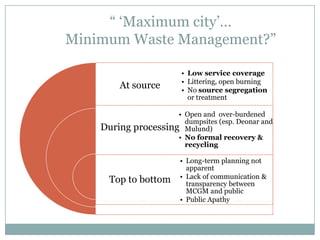
“ „Maximum city‟…
Minimum Waste Management?”
At source

During

• Low service coverage
• Littering, open burning
• No source segregation
or treatment

• Open and over-burdened
dumpsites (esp. Deonar and
processing Mulund)
• No formal recovery &
recycling

Top to bottom

• Long-term planning not
apparent
• Lack of communication &
transparency between
MCGM and public
• Public Apathy
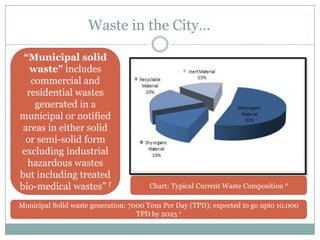
Waste in the City…
“Municipal solid
waste" includes
commercial and
residential wastes
generated in a
municipal or notified
areas in either solid
or semi-solid form
excluding industrial
hazardous wastes
but including treated
bio-medical wastes” f

Chart: Typical Current Waste Composition e

Municipal Solid waste generation: 7000 Tons Per Day (TPD); expected to go upto 10,000
TPD by 2025 c
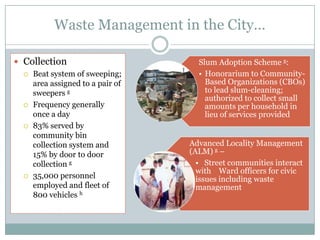
Waste Management in the City…
 Collection
 Beat system of sweeping;
area assigned to a pair of
sweepers g
 Frequency generally
once a day
 83% served by
community bin
collection system and
15% by door to door
collection g
 35,000 personnel
employed and fleet of
800 vehicles h

g

Slum Adoption Scheme g:
• Honorarium to CommunityBased Organizations (CBOs)
to lead slum-cleaning;
authorized to collect small
amounts per household in
lieu of services provided
Advanced Locality Management
(ALM) g –
• Street communities interact
with Ward officers for civic
issues including waste
management
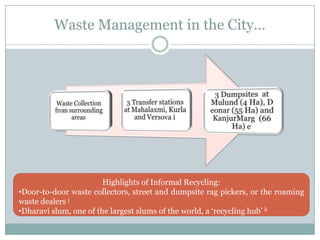
Waste Management in the City…

Highlights of Informal Recycling:
•Door-to-door waste collectors, street and dumpsite rag pickers, or the roaming
waste dealers j
•Dharavi slum, one of the largest slums of the world, a „recycling hub‟ k
About Mumbai
Current Waste Management Scenario

Proposed Master Plan - Vision 2023
Proposed Master Plan - Decoded

Sustainability Assessment
Highlights and Conclusion
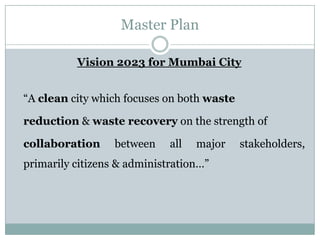
Master Plan
Vision 2023 for Mumbai City
“A clean city which focuses on both waste
reduction & waste recovery on the strength of

collaboration

between

all

major

primarily citizens & administration…”

stakeholders,
Master Plan

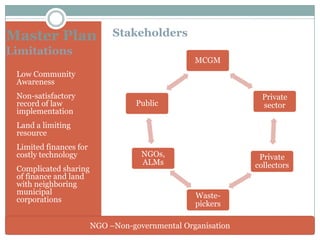
Stakeholders

Limitations

MCGM

Low Community
Awareness
Non-satisfactory
record of law
implementation

Private
sector

Public

Land a limiting
resource
Limited finances for
costly technology
Complicated sharing
of finance and land
with neighboring
municipal
corporations

NGOs,
ALMs

Private
collectors

Wastepickers
NGO –Non-governmental Organisation
About Mumbai
Current Waste Management Scenario

Proposed Master Plan - Vision 2023
Proposed Master Plan - Decoded

Sustainability Assessment
Highlights and Conclusion
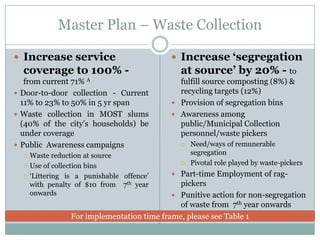
Master Plan – Waste Collection
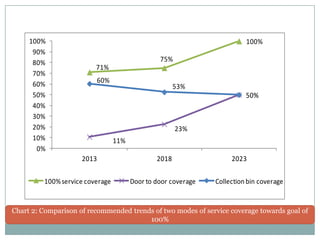
 Increase service

coverage to 100% from current 71% A
 Door-to-door collection - Current
11% to 23% to 50% in 5 yr span
 Waste collection in MOST slums
(40% of the city‟s households) be
under coverage
 Public Awareness campaigns
Waste reduction at source
 Use of collection bins
 „Littering is a punishable offence‟
with penalty of $10 from 7th year
onwards

 Increase ‘segregation

at source’ by 20% - to
fulfill source composting (8%) &
recycling targets (12%)
 Provision of segregation bins
 Awareness among
public/Municipal Collection
personnel/waste pickers






Need/ways of remunerable
segregation
Pivotal role played by waste-pickers

 Part-time Employment of rag-

pickers
 Punitive action for non-segregation
of waste from 7th year onwards
For implementation time frame, please see Table 1
100%
90%
80%
70%
60%
50%
40%
30%
20%
10%
0%

100%
75%
71%
60%

53%
50%

23%
11%
2013

100% service coverage

2018
Door to door coverage

2023
Collection bin coverage

Chart 2: Comparison of recommended trends of two modes of service coverage towards goal of
100%
Master Plan – Waste Transportation,
Processing and Disposal
 Waste Transportation
 Design transport routes keeping

public convenience in view
 Arrange modernized, parallel set of
vehicles in 5 yr span




Smooth transfer of waste from bins to
trucks
Manual waste handling to be phased
out

 Waste Processing &

Disposal
Sanitary changes to existing
Landfill and urgent diversion of
waste reaching and sitting in the
landfill
Sanitary provisions in KanjurMarg (KM)

landfill (60 Hectare area)
Phase-out other two dumpsites in
scientific way (see Timeframe Table)
Mechanical Biological Treatment (MBT)
Plant in 6 Hectare of KM

For implementation time frame, please see Table 1
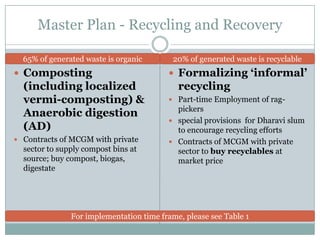
Master Plan - Recycling and Recovery
65% of generated waste is organic

 Composting

(including localized
vermi-composting) &
Anaerobic digestion
(AD)
 Contracts of MCGM with private

sector to supply compost bins at
source; buy compost, biogas,
digestate

20% of generated waste is recyclable

 Formalizing ‘informal’

recycling
 Part-time Employment of rag-

pickers
 special provisions for Dharavi slum
to encourage recycling efforts
 Contracts of MCGM with private
sector to buy recyclables at
market price

For implementation time frame, please see Table 1
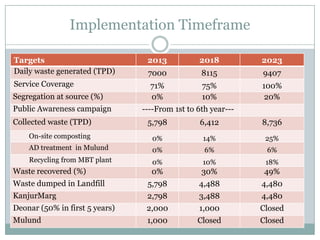
Implementation Timeframe
Targets
Daily waste generated (TPD)
Service Coverage

Segregation at source (%)
Public Awareness campaign
Collected waste (TPD)

2013

2018

2023

7000

8115

9407

71%
0%

75%
10%

100%
20%

----From 1st to 6th year--5,798

6,412

8,736

On-site composting

0%

14%

25%

AD treatment in Mulund

0%

6%

6%

Recycling from MBT plant

0%

10%

18%

0%

30%

49%

Waste dumped in Landfill

5,798

4,488

4,480

KanjurMarg

2,798

3,488

4,480

Deonar (50% in first 5 years)

2,000

1,000

Closed

Mulund

1,000

Closed

Closed

Waste recovered (%)
About Mumbai
Current Waste Management Scenario

Proposed Master Plan - Vision 2023
Proposed Master Plan - Decoded

Sustainability Assessment
Highlights and Conclusion
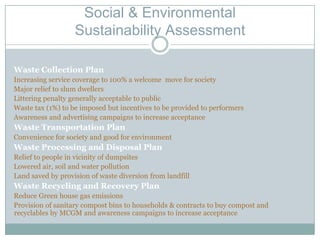
Social & Environmental
Sustainability Assessment
Waste Collection Plan
Increasing service coverage to 100% a welcome move for society
Major relief to slum dwellers
Littering penalty generally acceptable to public
Waste tax (1%) to be imposed but incentives to be provided to performers
Awareness and advertising campaigns to increase acceptance

Waste Transportation Plan
Convenience for society and good for environment

Waste Processing and Disposal Plan
Relief to people in vicinity of dumpsites
Lowered air, soil and water pollution
Land saved by provision of waste diversion from landfill

Waste Recycling and Recovery Plan
Reduce Green house gas emissions
Provision of sanitary compost bins to households & contracts to buy compost and
recyclables by MCGM and awareness campaigns to increase acceptance
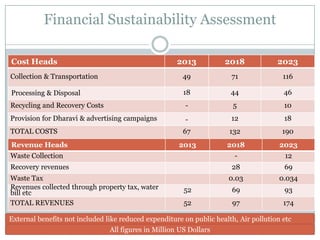
Financial Sustainability Assessment
Cost Heads

2013

2018

2023

Collection & Transportation

49

71

116

Processing & Disposal

18

44

46

Recycling and Recovery Costs

-

5

10

Provision for Dharavi & advertising campaigns

-

12

18

67

132

190

2013

2018

2023

-

12

28

69

0.03

0.034

52

69

93

52

97

174

TOTAL COSTS
Revenue Heads
Waste Collection

Recovery revenues
Waste Tax
Revenues collected through property tax, water
bill etc
TOTAL REVENUES

External benefits not included like reduced expenditure on public health, Air pollution etc
All figures in Million US Dollars
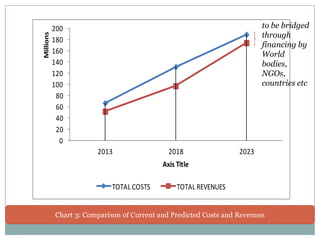
Millions

to be bridged
through
financing by
World
bodies,
NGOs,
countries etc

200
180
160
140
120
100
80
60
40
20
0
2013

2018

2023

Axis Title
TOTAL COSTS

TOTAL REVENUES

Chart 3: Comparison of Current and Predicted Costs and Revenues
About Mumbai
Current Waste Management Scenario

Proposed Master Plan - Vision 2023
Proposed Master Plan - Decoded

Sustainability Assessment
Highlights and Conclusion
What the Plan stands for?

 Waste to be treated as resource
 Public awareness and participation in a big way
 Collaborative functioning of MCGM
 Emphasis on implementation of MSW rules, through

„carrot and stick‟ policy for the stakeholders
References (in order of appearance)
Mumbai First (2012a) Workshop on Metropolitan Governance and Planning. Retrieved December
12, 2013, from
http://www.mumbaifirst.org/metropolitan/presentation/Transport_Plan_for_MMR_and_Resourse
_Generation_Plan_under_Mumbai_Transformation.pdf



a



b



c



d



e



f

Census India (2011a) Mumbai (Greater Mumbai) City Census 2011 data. Retrieved December 12,
2013, from http://www.census2011.co.in/census/city/365-mumbai.html
MCGM. (2013a). Municipal Corporation of Greater Mumbai. Retrieved December 12, 2013, from
http://www.mcgm.gov.in/irj/portal/anonymous?NavigationTarget=navurl://c4b79f15e55f98176905a
7c2c7d910ee
Chandramouli, C. (2011). Housing Stocks, Amenities and Assets in Slums - Census 2011. Retrieved
December 12, 2013, from censusindia.gov.in/2011-Documents/On_Slums-2011Final.ppt
Mumbai First. (2012b). Solid Waste Management. Retrieved December 12, 2013, from Mumbai
First: http://www.mumbaifirst.org/metropolitan/presentation/MCGM.pdf
” Ministry of Envrionment and Forests India. (2000). MSW Rules 2000. Retrieved December 12,
2013, from envis.mse.ac.in/lawspdf/SOLID%20WASTE.pdf
References
G MCGM. (n.d.(a)). Solid Waste Management. Retrieved December 12, 2013, from
http://www.mcgm.gov.in/irj/go/km/docs/documents/MCGM%20Department%20List/City%20Engi
neer/Deputy%20City%20Engineer%20(Planning%20and%20Design)/City%20Development%20Plan
/Solid%20Waste%20Management.pdf



g



h



i



j



k CNN.



71% service coverage - Combining two sources of information, one indicating a non-collection of 15%
of waste (Ghanekar, 2013); and another arguing that most slums (comprising 40% of city‟s
households (Chandramouli, 2011)) do not come in the formal waste collection system of Municipal
body, we get a figure of 71% service coverage (85%*60%+50%*40%); i.e., 85% of the non-slums and
half of slums.

BCPT. (n.d.). Solid Waste Management in Mumbai. Retrieved December 12, 2013, from
http://www.bcpt.org.in/webadmin/publications/pubimages/solidwaste.pdf
MCGM. (2013b). Functional Elements of SWM in Mumbai. Retrieved December 12, 2013, from
MCGM: http://www.mcgm.gov.in/irj/portal/anonymous/qlcleanover
Mahadevia, D., Pharate, B., & Mistry, A. (2005). New Practices of Waste Management - Case of
Mumbai. Retrieved November 28, 2013, from
http://spcept.ac.in/pdf/New%20Practices%20of%20Waste%20Management%20%20Case%20of%20Mumbai.pdf
(2012). The slums of Mumbai: A model of urban sustainability? Retrieved November 21, 2013,
from CNN:
http://edition.cnn.com/interactive/2012/02/world/interactive.mumbai.slums.sustainability/
Thank You for your attention!

Master plan for Solid Waste Management in Mumbai, India

  • 1.
    Solid Waste Management MasterPlan for Mumbai, India Vision 2023 BY PRATIMA PANDEY & ARINDAM CHAKRABORTY JANUARY 11, 2014 Towards completion of ‘Online Course On Solid Waste Management’ UNESCO-IHE Institute for Water Education
  • 2.
    Contents of thePresentation About Mumbai Current Waste Management Scenario Proposed Master Plan - Vision 2023 Proposed Master Plan - Decoded Sustainability Assessment Highlights and Conclusion
  • 3.
    About Mumbai Current WasteManagement Scenario Proposed Master Plan - Vision 2023 Proposed Master Plan - Decoded Sustainability Assessment Highlights and Conclusion
  • 4.
    Mumbai Capital of Maharashtra state ofIndia; was called „Bombay‟ till November 1995 Mumbai Metropolitan Greater Region (MMR) Area: 437.71 Sq Mumbai - India‟s most Km; Most consists of populous at dense city in „Island city‟ 18.4 Million the world with and Suburbs consists of 7 28,000 per population of areas including sq.km c b 12.4 Million Greater Mumbai Contd.
  • 5.
    Mumbai 41.3% of totalUrban households live in „Slums‟ d Governed by municipal corporation called the Municipal Corporation of Greater Mumbai (MCGM, hereafter) or Brihanmumbai Municipal Corporation (BMC) Climate – Moderately hot, humid almost throughout the year Contd.
  • 6.
    About Mumbai Current WasteManagement Scenario Proposed Master Plan - Vision 2023 Proposed Master Plan - Decoded Sustainability Assessment Highlights and Conclusion
  • 7.
    “ „Maximum city‟… MinimumWaste Management?” At source During • Low service coverage • Littering, open burning • No source segregation or treatment • Open and over-burdened dumpsites (esp. Deonar and processing Mulund) • No formal recovery & recycling Top to bottom • Long-term planning not apparent • Lack of communication & transparency between MCGM and public • Public Apathy
  • 8.
    Waste in theCity… “Municipal solid waste" includes commercial and residential wastes generated in a municipal or notified areas in either solid or semi-solid form excluding industrial hazardous wastes but including treated bio-medical wastes” f Chart: Typical Current Waste Composition e Municipal Solid waste generation: 7000 Tons Per Day (TPD); expected to go upto 10,000 TPD by 2025 c
  • 9.
    Waste Management inthe City…  Collection  Beat system of sweeping; area assigned to a pair of sweepers g  Frequency generally once a day  83% served by community bin collection system and 15% by door to door collection g  35,000 personnel employed and fleet of 800 vehicles h g Slum Adoption Scheme g: • Honorarium to CommunityBased Organizations (CBOs) to lead slum-cleaning; authorized to collect small amounts per household in lieu of services provided Advanced Locality Management (ALM) g – • Street communities interact with Ward officers for civic issues including waste management
  • 10.
    Waste Management inthe City… Highlights of Informal Recycling: •Door-to-door waste collectors, street and dumpsite rag pickers, or the roaming waste dealers j •Dharavi slum, one of the largest slums of the world, a „recycling hub‟ k
  • 11.
    About Mumbai Current WasteManagement Scenario Proposed Master Plan - Vision 2023 Proposed Master Plan - Decoded Sustainability Assessment Highlights and Conclusion
  • 12.
    Master Plan Vision 2023for Mumbai City “A clean city which focuses on both waste reduction & waste recovery on the strength of collaboration between all major primarily citizens & administration…” stakeholders,
  • 13.
    Master Plan Stakeholders Limitations MCGM Low Community Awareness Non-satisfactory recordof law implementation Private sector Public Land a limiting resource Limited finances for costly technology Complicated sharing of finance and land with neighboring municipal corporations NGOs, ALMs Private collectors Wastepickers NGO –Non-governmental Organisation
  • 14.
    About Mumbai Current WasteManagement Scenario Proposed Master Plan - Vision 2023 Proposed Master Plan - Decoded Sustainability Assessment Highlights and Conclusion
  • 15.
    Master Plan –Waste Collection  Increase service coverage to 100% from current 71% A  Door-to-door collection - Current 11% to 23% to 50% in 5 yr span  Waste collection in MOST slums (40% of the city‟s households) be under coverage  Public Awareness campaigns Waste reduction at source  Use of collection bins  „Littering is a punishable offence‟ with penalty of $10 from 7th year onwards  Increase ‘segregation at source’ by 20% - to fulfill source composting (8%) & recycling targets (12%)  Provision of segregation bins  Awareness among public/Municipal Collection personnel/waste pickers    Need/ways of remunerable segregation Pivotal role played by waste-pickers  Part-time Employment of rag- pickers  Punitive action for non-segregation of waste from 7th year onwards For implementation time frame, please see Table 1
  • 16.
    100% 90% 80% 70% 60% 50% 40% 30% 20% 10% 0% 100% 75% 71% 60% 53% 50% 23% 11% 2013 100% service coverage 2018 Doorto door coverage 2023 Collection bin coverage Chart 2: Comparison of recommended trends of two modes of service coverage towards goal of 100%
  • 17.
    Master Plan –Waste Transportation, Processing and Disposal  Waste Transportation  Design transport routes keeping public convenience in view  Arrange modernized, parallel set of vehicles in 5 yr span   Smooth transfer of waste from bins to trucks Manual waste handling to be phased out  Waste Processing & Disposal Sanitary changes to existing Landfill and urgent diversion of waste reaching and sitting in the landfill Sanitary provisions in KanjurMarg (KM) landfill (60 Hectare area) Phase-out other two dumpsites in scientific way (see Timeframe Table) Mechanical Biological Treatment (MBT) Plant in 6 Hectare of KM For implementation time frame, please see Table 1
  • 18.
    Master Plan -Recycling and Recovery 65% of generated waste is organic  Composting (including localized vermi-composting) & Anaerobic digestion (AD)  Contracts of MCGM with private sector to supply compost bins at source; buy compost, biogas, digestate 20% of generated waste is recyclable  Formalizing ‘informal’ recycling  Part-time Employment of rag- pickers  special provisions for Dharavi slum to encourage recycling efforts  Contracts of MCGM with private sector to buy recyclables at market price For implementation time frame, please see Table 1
  • 19.
    Implementation Timeframe Targets Daily wastegenerated (TPD) Service Coverage Segregation at source (%) Public Awareness campaign Collected waste (TPD) 2013 2018 2023 7000 8115 9407 71% 0% 75% 10% 100% 20% ----From 1st to 6th year--5,798 6,412 8,736 On-site composting 0% 14% 25% AD treatment in Mulund 0% 6% 6% Recycling from MBT plant 0% 10% 18% 0% 30% 49% Waste dumped in Landfill 5,798 4,488 4,480 KanjurMarg 2,798 3,488 4,480 Deonar (50% in first 5 years) 2,000 1,000 Closed Mulund 1,000 Closed Closed Waste recovered (%)
  • 20.
    About Mumbai Current WasteManagement Scenario Proposed Master Plan - Vision 2023 Proposed Master Plan - Decoded Sustainability Assessment Highlights and Conclusion
  • 21.
    Social & Environmental SustainabilityAssessment Waste Collection Plan Increasing service coverage to 100% a welcome move for society Major relief to slum dwellers Littering penalty generally acceptable to public Waste tax (1%) to be imposed but incentives to be provided to performers Awareness and advertising campaigns to increase acceptance Waste Transportation Plan Convenience for society and good for environment Waste Processing and Disposal Plan Relief to people in vicinity of dumpsites Lowered air, soil and water pollution Land saved by provision of waste diversion from landfill Waste Recycling and Recovery Plan Reduce Green house gas emissions Provision of sanitary compost bins to households & contracts to buy compost and recyclables by MCGM and awareness campaigns to increase acceptance
  • 22.
    Financial Sustainability Assessment CostHeads 2013 2018 2023 Collection & Transportation 49 71 116 Processing & Disposal 18 44 46 Recycling and Recovery Costs - 5 10 Provision for Dharavi & advertising campaigns - 12 18 67 132 190 2013 2018 2023 - 12 28 69 0.03 0.034 52 69 93 52 97 174 TOTAL COSTS Revenue Heads Waste Collection Recovery revenues Waste Tax Revenues collected through property tax, water bill etc TOTAL REVENUES External benefits not included like reduced expenditure on public health, Air pollution etc All figures in Million US Dollars
  • 23.
    Millions to be bridged through financingby World bodies, NGOs, countries etc 200 180 160 140 120 100 80 60 40 20 0 2013 2018 2023 Axis Title TOTAL COSTS TOTAL REVENUES Chart 3: Comparison of Current and Predicted Costs and Revenues
  • 24.
    About Mumbai Current WasteManagement Scenario Proposed Master Plan - Vision 2023 Proposed Master Plan - Decoded Sustainability Assessment Highlights and Conclusion
  • 25.
    What the Planstands for?  Waste to be treated as resource  Public awareness and participation in a big way  Collaborative functioning of MCGM  Emphasis on implementation of MSW rules, through „carrot and stick‟ policy for the stakeholders
  • 26.
    References (in orderof appearance) Mumbai First (2012a) Workshop on Metropolitan Governance and Planning. Retrieved December 12, 2013, from http://www.mumbaifirst.org/metropolitan/presentation/Transport_Plan_for_MMR_and_Resourse _Generation_Plan_under_Mumbai_Transformation.pdf  a  b  c  d  e  f Census India (2011a) Mumbai (Greater Mumbai) City Census 2011 data. Retrieved December 12, 2013, from http://www.census2011.co.in/census/city/365-mumbai.html MCGM. (2013a). Municipal Corporation of Greater Mumbai. Retrieved December 12, 2013, from http://www.mcgm.gov.in/irj/portal/anonymous?NavigationTarget=navurl://c4b79f15e55f98176905a 7c2c7d910ee Chandramouli, C. (2011). Housing Stocks, Amenities and Assets in Slums - Census 2011. Retrieved December 12, 2013, from censusindia.gov.in/2011-Documents/On_Slums-2011Final.ppt Mumbai First. (2012b). Solid Waste Management. Retrieved December 12, 2013, from Mumbai First: http://www.mumbaifirst.org/metropolitan/presentation/MCGM.pdf ” Ministry of Envrionment and Forests India. (2000). MSW Rules 2000. Retrieved December 12, 2013, from envis.mse.ac.in/lawspdf/SOLID%20WASTE.pdf
  • 27.
    References G MCGM. (n.d.(a)).Solid Waste Management. Retrieved December 12, 2013, from http://www.mcgm.gov.in/irj/go/km/docs/documents/MCGM%20Department%20List/City%20Engi neer/Deputy%20City%20Engineer%20(Planning%20and%20Design)/City%20Development%20Plan /Solid%20Waste%20Management.pdf  g  h  i  j  k CNN.  71% service coverage - Combining two sources of information, one indicating a non-collection of 15% of waste (Ghanekar, 2013); and another arguing that most slums (comprising 40% of city‟s households (Chandramouli, 2011)) do not come in the formal waste collection system of Municipal body, we get a figure of 71% service coverage (85%*60%+50%*40%); i.e., 85% of the non-slums and half of slums. BCPT. (n.d.). Solid Waste Management in Mumbai. Retrieved December 12, 2013, from http://www.bcpt.org.in/webadmin/publications/pubimages/solidwaste.pdf MCGM. (2013b). Functional Elements of SWM in Mumbai. Retrieved December 12, 2013, from MCGM: http://www.mcgm.gov.in/irj/portal/anonymous/qlcleanover Mahadevia, D., Pharate, B., & Mistry, A. (2005). New Practices of Waste Management - Case of Mumbai. Retrieved November 28, 2013, from http://spcept.ac.in/pdf/New%20Practices%20of%20Waste%20Management%20%20Case%20of%20Mumbai.pdf (2012). The slums of Mumbai: A model of urban sustainability? Retrieved November 21, 2013, from CNN: http://edition.cnn.com/interactive/2012/02/world/interactive.mumbai.slums.sustainability/
  • 28.
    Thank You foryour attention!