DECISION‐MAKING
TOOL

•  Iden3fy
or
Recognize
a
Sustainability
issue
or

   Concern


•  Iden3fy
or
Consult
Stakeholders
Affected
by

   this
Issue


•  Research
on
the
+
and
–
impacts
to

   environment,
economy
and
health
and
well‐
   being
of
the
people

DECISION‐MAKING
TOOL

•  Propose
Crea3ve
Op3ons
or
Solu3ons


•  Assess
each
Op3on
or
Solu3on
in
terms
of
+
or

   –
impact


•  Propose
one
Solu3on
by
Consensus

DECISION‐MAKING
TOOL

•  Develop
an
Ac3on
Plan
and
Contact
Stakeholders

   for
Input


•  Implement
Ac3on
Plan


•  Monitor
and
Evaluate
Ac3on
Plan


•  Communicate
Results
to
the
Community


•  Consult
and
Reassess

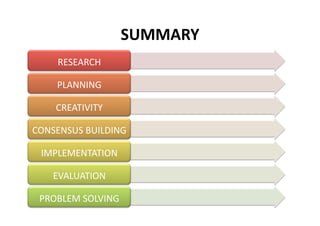
SUMMARY

     RESEARCH


    PLANNING


    CREATIVITY


CONSENSUS
BUILDING


 IMPLEMENTATION


    EVALUATION


 PROBLEM
SOLVING

AGENDA
21

WHAT
IS
AGENDA
21?

•  It
recognizes
that
sustainable
development
is

   primarily
the
responsibility
of
governments,
and

   this
will
require
na3onal
strategies,
plans
and

   policies


•  The
efforts
of
na3ons
need
to
be
linked
by

   interna5onal
coopera5on
through
such

   organiza3ons
as
the
United
Na3ons


•  The
broadest
public
par5cipa5on,
and
the
ac3ve

   involvement
of
the
non‐governmental

   organiza3ons
and
other
groups
should
also
be

   encouraged

HITCHES
OF
AGENDA
21

•  The
objec3ves
of
agenda
21
require
substan5al

   assistance
for
developing
countries


•  They
need
this
addi5onal
support
to
cover
the

   incremental
costs
of
ac3ons
to
deal
with
global

   environmental
problems,
and
to
accelerate

   sustainable
development


•  Money
is
also
needed
to
allow
interna3onal

   bodies
to
implement
the
recommenda3ons
of

   Agenda
21

PHILIPPINE
AGENDA
21

•  the
na3on's
blueprint
for
sustainable
development


•  describes
a
path
for
individuals,
families,
households
and

   communi3es


•  an
ac3on
plan
for
each
ecosystem
(coastal/marine,
freshwater,

   upland,
lowland,
and
urban)
and
across
ecosystems
in
considera3on

   of
the
interac3on
of
the
various
lifescapes
and
landscapes
found

   therein.


•  grounded
on
respect
and
ac5ve
advocacy
for
the
empowerment
of

   the
various
social
groupings
of
society
to
manage
the
economy,

   cri3cal
resources,
society
and
culture,
poli3cs
and
governance
and

   in
the
arena
of
foreign
rela3ons

PHILIPPINE
AGENDA
21

•  advocates
a
fundamental
shi_
in
development

   thinking
and
approach


•  departs
from
tradi3onal
conceptual

   frameworks
that
emphasize
sector‐based
and

   macro
concerns

PHILIPPINE
AGENDA
21

•  Promotes
harmony
and
achieves
sustainability
by
emphasizing:


•  A
scale
of
interven/on
that
is
primarily
area‐based

    –  The
na3onal
and
global
policy
environment
builds
upon
and
supports
area‐
       based
ini3a3ves


•  Integrated
island
development
approaches
where
applicable

    –  This
recognizes
the
archipelagic
character
of
the
Philippines
which
includes

       many
small
island
provinces

    –  


•  People
and
integrity
of
nature
at
the
center
of
development
ini/a/ves

    –  This
implies
the
strengthening
of
roles,
rela3onships,
and
interac3ons

       between
and
among
stakeholders
in
government,
civil
society,
labor
and

       business


    –  Basic
sectors
have
an
important
role
to
play
in
achieving
equity
and
managing

       the
ecosystems
that
sustain
life.


•  PA
21
envisions
a
beaer
quality
of
life
for
all

   Filipinos


•  through
the
development
of
a
just,
moral
and

   crea3ve,
spiritual,
economically
vibrant,
caring,

   diverse
yet
cohesive
society


•  characterized
by
appropriate
produc3vity,

   par3cipatory
and
democra3c
processes,
and

   living
in
harmony


•  within
the
limits
of
the
carrying
capacity
of

   nature
and
the
integrity
of
crea3on

•  PA
21
was
adopted
on
26
September
1996,

   with
the
issuance
of
Memorandum
Order
No.

   399
by
then
President
Fidel
V.
Ramos


•  Philippine
Council
for
Sustainable

   Development
(PCSD)


•  The
ac3on
agenda
is
based
on
the
impera3ves

   of
the
current
na3onal
situa3on
and
emerging

   landscape
for
sustainable
development

•  PA
21
is
a
dynamic
document


•  will
con3nue
to
evolve


  – as
new
challenges
and
opportuni3es
emerge

  – as
the
level
of
consensus
con3nue
to
deepen
in

    the
Philippine
society

  – 
as
the
Filipinos
aaempt
to
solidify
the
framework


  – as
the
government
con3nue
to
refine
the

    processes

  – as
the
Filipinos
strive
to
widen
and
enrich
their

    understanding
of
each
other
to
pave
the
way
for

    new
modes
of
collabora3on

INITIATIVES
OF
THE
PCSD


  “The
Philippine
Council
for

  Sustainable
Development”

REGULAR
ACTIVITIES

ISSUES
AND
CONCERNS
ADDRESSED

•  Biodiversity
Policy


•  sustainable
agriculture


•  biotechnology
and
property
rights


•  community‐based
management
among

   others

PCSD
PROVIDED
THE

Lead
Roles
to
NGOs/Pos
in

   the
Implementa3on
of
NGO/PO‐ini3ated

          Projects
in
the
Philippines


 NGOs
and
Pos
contracted
for
the

  implementa3on
of
programs
and
projects
on

  environment
and
sustainable
development


 Consor3um
of
local
organiza3ons
formed
to

  implement
government
programs
on

  integrated
protected
areas

Ra3fica3on
of
the
Basel

          Conven3on

•  The
country
supported
the
ra3fica3on
of
the

   Basel
Conven3on


•  About
hazardous
wastes
and
transboundary

   movement


•  Nuclear
and
chemical
wastes

THEIR
OTHER
JOBS…

Hos3ng
of
the
Interna3onal
Experts

Group
Mee3ng
on
Opera3onalizing

   the
Economics
of
Sustainable

    Development
last
July
1994

   This
gathering
provided
outputs
which

  became
the
focus
of
the
work
of
the
UN

         Commission
on
Sustainable

                Development

Integra3ng
sustainable
development

     concerns
in
local
development
plans

  Issuance
of
a
memo
circular
by
the
DILG

   designa3ng
a
focal
person
in
the
local

   government
unit


  Shall
be
responsible
for
ensuring
that

   sustainable
development
concepts
are

   considered
in
local
planning


                   Marilen
Manalo
Parungao
   26

Issuance
of
Execu3ve

             Order
no.
247

•  Prescribing
guidelines
and
Establishing
a

   Regulatory
Framework
for
the
Prospec3ng
of

   Biological
and
Gene3c
resources

  –    Products
and
Deriva3ves

  –    For
Scien3fic
and
Commercial
Purposes
and
Other

       Purposes


                      Marilen
Manalo
Parungao
      27

BUDGET

•  Budgetary
alloca3ons
for
environmental

   management
from
DENR
budget


• But,
budget
generally
decreasing


                  Marilen
Manalo
Parungao
   28

MANAGEMENT
SYSTEMS
AND

       EFFORTS

Environmental
Impact

     Assessment
and
Management

•  EIA
requirement
–
main
means
of
government
for

   ensuring
that
environmental
dimensions
are

   incorporated
into
the
planning
of
development

   projects
and
programs


•  Some
perceive
it
as
a
hindrance
to
development,

   yet
u3lized
and
accepted
nowadays


•  Mul3‐par3te
monitoring


•  Environmental
Compliance
Cer3ficates

                     Marilen
Manalo
Parungao
     31

POLLUTION
CONTROL

•  Toxic
Chemicals
and
Hazardous
Wastes

   Management


•  Pollu3on
Control
Law
(PD
984)


•  Industrial
Environmental
Management
Project


•  Solid
Waste
Management

NATURAL
RESOURCES

  MANAGEMENT

Forest
Protec3on
and

     Management


       Marilen
Manalo
Parungao
   34

Biodiversity
Conserva3on


         Marilen
Manalo
Parungao
   35

Biodiversity
Conserva3on

•  Pawikan
Conserva3on
Project


•  Calauit
Game
Reserve
Project


•  Tamaraw
Conserva3on
Project


•  Philippine
Eagle
Conserva3on
Project

                Marilen
Manalo
Parungao
   36

Biodiversity
Conserva3on

•  Philippine
Flying
Lemur
Program


•  Philippine
Tarsier
Conserva3on
Program


•  Bird
Banding


                   Marilen
Manalo
Parungao
   37

Environmental
Educa3on


        Marilen
Manalo
Parungao
   38

A
NEWBIE…THE
MILLENIUM

DEVELOPMENT
GOALS
OR
MGD

MTPDP2004-2010
A.
Thrust
No.1
‐
Sustainable
and
more
producAve

      uAlizaAon
of
natural
resources
to
promote
investments

      and
entrepreneurship


1.
Across
Ecosystem


 a.
Maximize
physical
planning
as
a
development
tool
for
greater

  and
sustained
job
crea3on


 b.
Create
a
climate
conducive
for
investments
and
produc3on


2.
Forest
Ecosystem


 a.
Open
up
more
forestlands
that
are
denuded
or
no
longer

  suitable
for
protec3on
forest
for
development


 b.
Promote
investments
in
permanent
produc3on
forest
areas

3.
Biodiversity


       Ini3ate
the
development
and
sustainable

u3liza3on
of
biodiversity
resources
(e.g.,
promote
the

establishment
of
15
wildlife
farms
and
zoos)


4.
Coastal
and
Marine
Ecosystem


       Clearly
delineate
areas
for
protec3on,
explora3on

and
u3liza3on
through
the
survey
and
mapping
of
mari3me

zones
star3ng
in
2005
with
par3cular
emphasis
on
expedi3ng

the
delinea3on
of
municipal
waters
in
coastal
areas
with

offshore
islands.

B.
Thrust
No.
2
‐
Promote
responsible
mining
that

   adheres
to
the
principles
of
sustainable
development:

   economic
growth,
environmental
protecAon
and
social

   equity
to
reduce
poverty
and
benefit
local
and

   indigenous
communiAes


1. Launch
a
major
program
to
revive


the
mining
industry

2.
Pursue
and
assist
in
the
development
of
18‐23
large

scale
mining
projects
that
will
bring
an
es3mated
U.S
$4.0‐6.0

billion
in
investments,
U.S
$5.0‐7.0
billion
in
foreign
exchange,
PhP

5.0‐
7.0
billion
in
excise
taxes
alone,
and
about
210,000
in
direct

and
indirect
employment


3.
Resolve
the
issues
involving
mining
accidents
in

abandoned
and
idle
mine
areas.


4.
Develop
incen5ve
schemes
to
aJract
interna5onal

and
local
investors
in
Mt.
Diwalwal

C.
Thrust
No.
3
‐
Focus
and
strengthen
the
protecAon
of

   vulnerable
and
ecologically
fragile
areas,
especially

   watersheds
and
areas
where
biodiversity
is
highly

   threatened


1.  orest
Ecosystem


  F

 
    Rehabilitate
and
strengthen
protec3on
of
cri3cal
watersheds


2.
Coastal
and
Marine
Ecosystem


 Expand
coverage
and
strengthen
protec3on
of
coastal
and

  marine
ecosystem


3.
Biodiversity
Resources

a. 
Delineate
6.336
million
hectares
na3onwide
for
protec3on

b.
Develop
Protected
Areas
into
viable
management
areas

D.
Thrust
No.
4
‐
Create
healthier
environment
for
the

   populaAon

1. Air


       Improve
air
quality
in
major
urban
centers
and
reduce
air

     pollu3on
(total
suspended
par3culates
or
TSP)
in
Metro
Manila
by

     90
percent
to
bring
air
quality
within
acceptable


standard.


2.
Water
Resources

a. 
General
Strategy:
Adopt
the
Integrated
Water
Resources

   Management
Approach

b.
Specific
Strategies


 •
Potable
water
for
the
en3re
country
by
2010


 •
Ensure
clean
water
resources
for
the
en3re
country
through

   full
implementa3on
of
the
Ecological
Solid
Waste
Management

   Act
and
the
Clean
Water
Act

3.
Waste


       a.
Improve
management
of
solid
waste
especially

in
Metro
Manila
by
fully
implemen3ng
the

Ecological
Solid
Waste
Management
Act
(RA
9003)


       b.
Clean
and
rehabilitate
esteros,
especially
in
eight

major
esteros
in
Metro
Manila
and
32

priori3zed
esteros
in
other
urban
centers
that
contributes

significantly
to
flooding,
on
a
sustained
basis


       c.
Establish
management
system
and
facili3es
for

toxic
and
hazardous
wastes


       d.
Total
phase‐out
of
ozone
deple3ng
substances

(ODS)
consump3on
na3onwide

E.
Thrust
No.
5
‐
MiAgate
the
occurrence
of
natural

disasters
to
prevent
the
loss
of
lives

and
properAes


1.
Nonstructural
measures

a.
Complete
the
geo‐hazard
mapping
of
the
remaining
13
regions;

b.
Conduct
soil
stability
measures
(e.g.,
reforesta3on
and
plan3ng
in

river
banks)
for

landslide‐vulnerable
areas;
and

c.
Ensure
integra3on
of
disaster
preparedness
and
management

strategy
in
the
development

planning
process
at
all
levels
of
governance.

2.
Structural
Measures


       a.
Keep
at
the
op3mum
the
conveyance

capaci3es
of
exis3ng
river
channel
floodways,

drainage
canals,
esteros
through
riverbank
protec3on,

dredging/desil3ng,
observance
of

river
easements,
reloca3on
of
informal
sealers,
proper

disposal
of
garbage,
and
efficient

maintenance
in
coordina3on
with
LGUs;


       b.
Provide
adequate
flood
control
and
drainage

facili3es
in
all
flood/sediment
disaster
prone

areas
to
mi3gate
flooding
as
well
as
rehabilitate
and
improve

exis3ng
facili3es.
The

priority
flood
management
projects
are
as
follows:

FOR
NEXT
MEETING’S
ACTIVITY

•  FOCUS
GROUP
DISCUSSION


•  TOPIC:
Sustainable
Development
Project
for

   Waste
Management
in
CAS


•  Discuss
Using
the
Decision
Making
Tool
via
a

   Formal
ReporAng/FGD
(with
Facilitator)


Sustainable Development