Overview of environmental laws implemented by EMB-DENR
1.
OVERVIEW OF
ENVIRONMENTAL LAWS
BEINGIMPLEMENTED BY
EMB-DENR
Republic of the Philippines
Department of Environment and Natural Resources
ENVIRONMENTAL MANAGEMENT BUREAU RXI
“Environmental law –or
“environmental and natural
resources law” – is a collective term
describing the network of treaties,
statutes, regulations, and common
and customary laws addressing the
effects of human activity on the
natural environment.”
-Wikipedia
6.
Environmental Issues andConcerns
• Extractive industries – logging, mining
• Loss of biodiversity
• Loss of Soil Fertility because of Agricultural
Practices
• Conversion of Prime Agricultural Land
• Over-expansion of Subdivisions (Sprawl)
• Trade in endangered species
• Invasive species
• Man-made Disasters – poor siting, poor construction,
pollution, oil spills
• Solid waste
• Climate Change
7.
Environmental Issues andConcerns are:
– Multidisciplinary in nature
• Often the environmental concerns are difficult to
segregate from the main functions of a particular
agency
• Practices in other countries shows it is most
efficient to integrate environmental concerns to the
main functions of the agencies
– Its enforcement and implementation cuts across various
departments, commissions and organs of government
countries shows it is most efficient to integrate environmental
concerns to the main functions of the agencies – Its enforcement
Environmental Law encompassesall the
protections for our environment that
emanates from the
Constitution
Laws and Local Ordinances
Regulations Promulgated by Regulatory
Agencies or Implementing Rules and
Regulations (IRR)
Court Decision interpreting Laws &
Regulations
10.
The Philippine Constitutiondeclares that it is the
duty of the State to protect and advance the right
of the people to a balanced and healthful
ecology. This duty had earlier been codified in
the Philippine Environmental Policy, which is the
national blueprint for environmental protection.
The Philippine Environment Code, in turn,
contains general principles dealing with the
major environmental and natural resource
concerns of the Philippines.
Framework of Envi Laws in the Philippines
11.
LOI 422- InteragencyCommittee on
Environment - issued June 6, 1976
Created to prevent the deterioration of
environmental quality due to destruction of our
natural resources
LOI 422 enumerated the different agencies in
charge of environmental protection for strong
integration of environmental concerns in the 19
agencies identified as agencies “concerned with
environment”
Department of Natural Resources was directed to
initiate the creation of the interagency committee
12.
Presidential Decree No.1151
Philippine Environmental Policy (Enacted in 1977)
national blueprint for environmental protection
declares the Policy (a) to create, develop, maintain,
and improve conditions under which man and
nature can thrive in productive and enjoyable
harmony with each other, (b) to fullfill the social,
economic and other requirements of present and
future generations of Filipinos, and (c) to insure the
attainment of an environmental quality that is
conducive to a life of dignity and well-being.
requires EIA for proposed projects/undertakings that
may significantly affect the quality of environment
13.
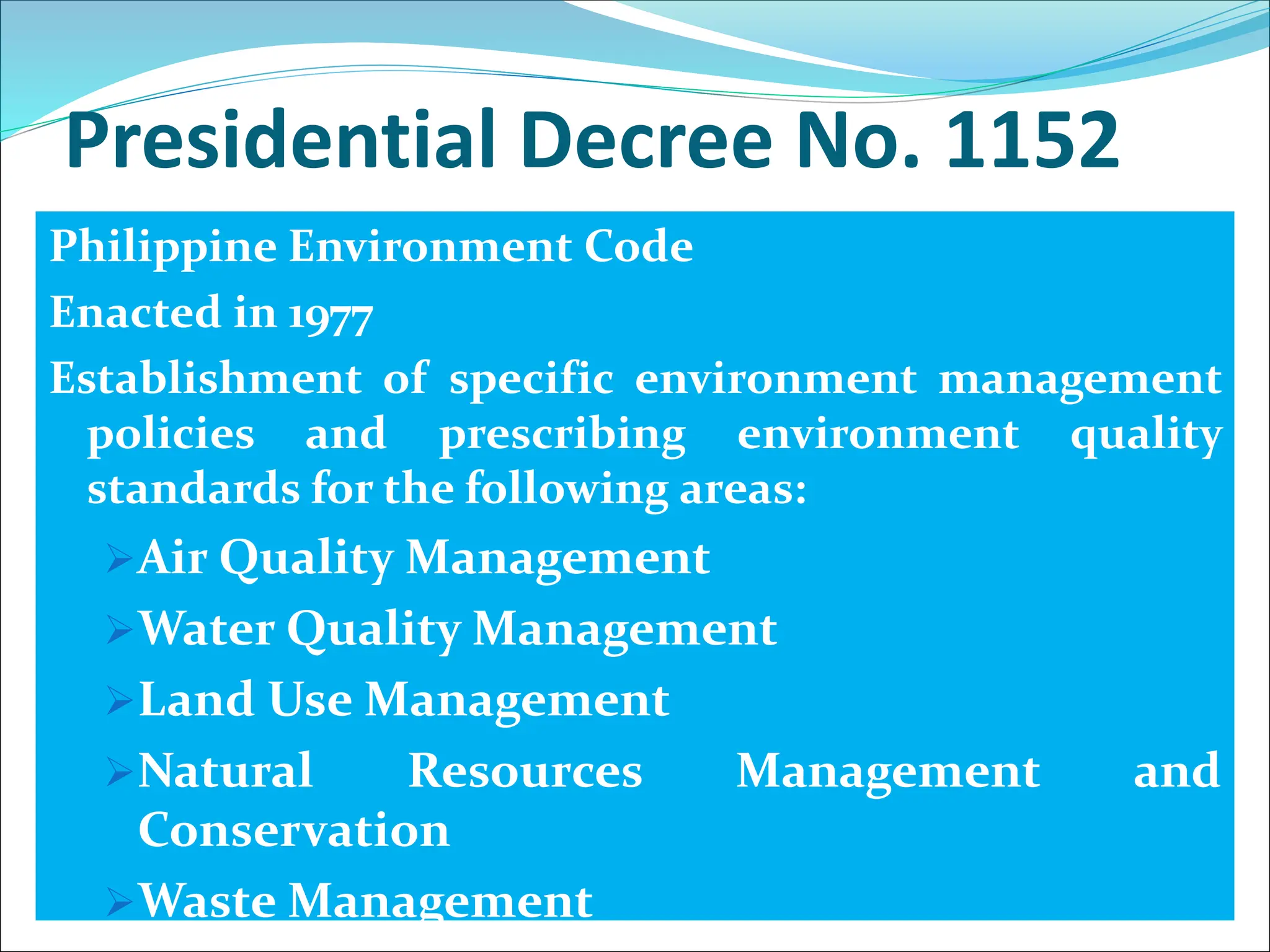
Presidential Decree No.1152
Philippine Environment Code
Enacted in 1977
Establishment of specific environment management
policies and prescribing environment quality
standards for the following areas:
Air Quality Management
Water Quality Management
Land Use Management
Natural Resources Management and
Conservation
Waste Management
14.
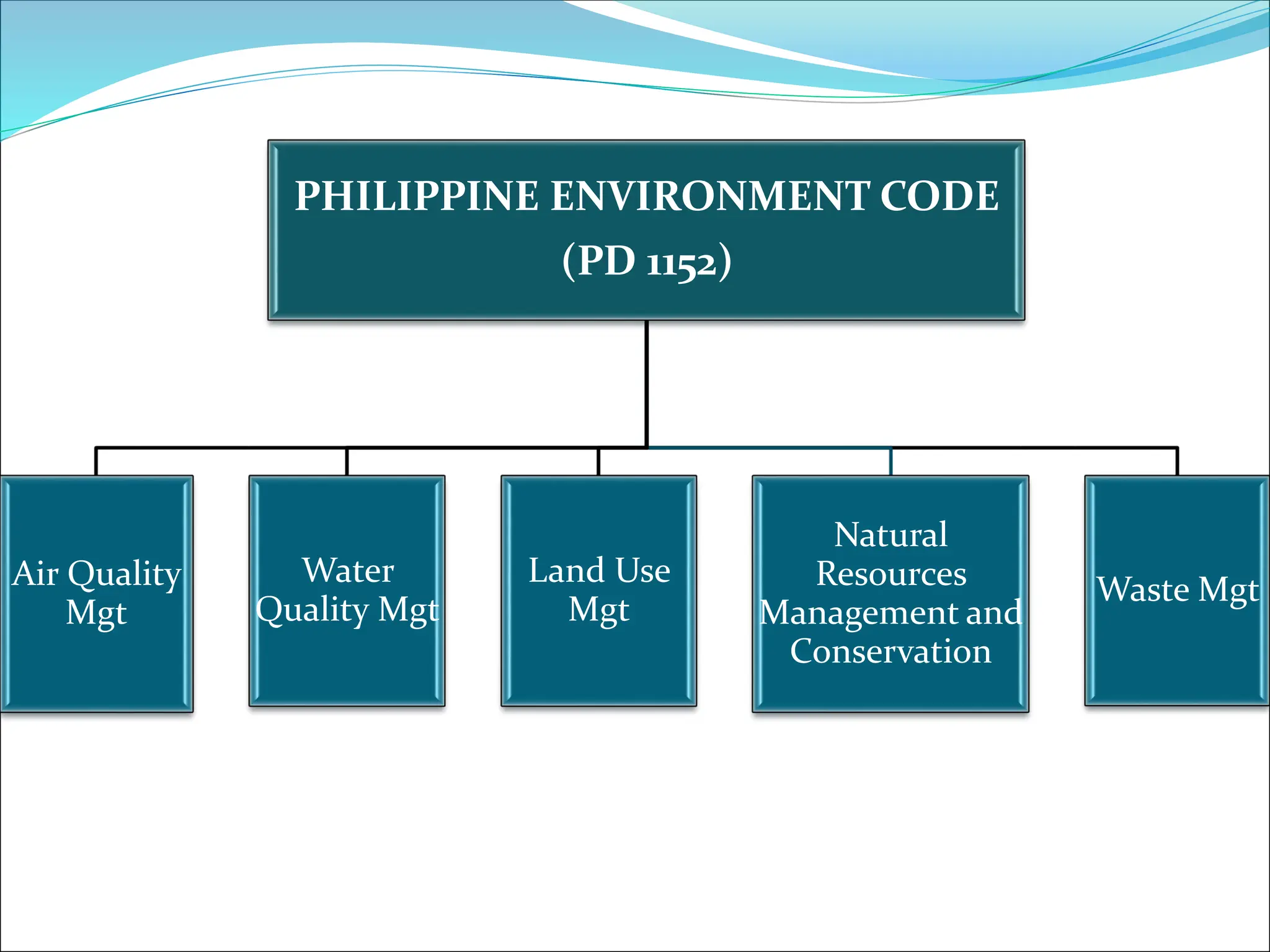
PHILIPPINE ENVIRONMENT CODE
(PD1152)
Air Quality
Mgt
Water
Quality Mgt
Land Use
Mgt
Natural
Resources
Management and
Conservation
Waste Mgt
15.
These two documents(PD 1151 & PD 1152)
are very broad and general, and contain
few substantive provisions. Taken
together, the Policy and the Code can
best be described as forming the very
basic framework laws on the
environment in the Philippines.
16.
Due to thegenerality of the Policy
and the Code, various other laws
have been enacted to address
specific environmental concerns,
like Presidential Decree No. 1586 of
1978, which established the
environmental impact statement
(EIS) system, and others.
17.
1987 Philippine Constitution
ArticleII – Declaration of Principles and
State Policies
Section 2. The Philippines renounces war
as an instrument of national policy,
adopts a generally accepted principles of
international law as part of the law of the
land and adheres to the policy of peace,
equality, justice, freedom, cooperation
and amity with all nations.
18.
1987 Philippine Constitution
Section2, Article XII
Sec. 2. All lands of the public domain,
waters, minerals, coal, petroleum, and
other mineral oils, all forces of potential
energy, fisheries, forests or timber, wildlife,
flora and fauna, and other natural
resources are owned by the State. With the
exception of agricultural lands, all other
natural resources shall not be alienated.
19.
Agenda 21
• Globalaction plan related to Sustainable
Development
• outcome of the UN Conference on Environment and
Development in 1992 at Brazil
• addresses the global community critical issues:
continuing damage to ecosystems, the worsening of
poverty, hunger and ill health, increasing world
population and illiteracy.
• composed of 40 chapters that identify each
challenge and propose simple realistic solutions
towards sustainable development which is: meeting
the needs of the present without compromising the
ability of future generations to meet their own needs.
21.
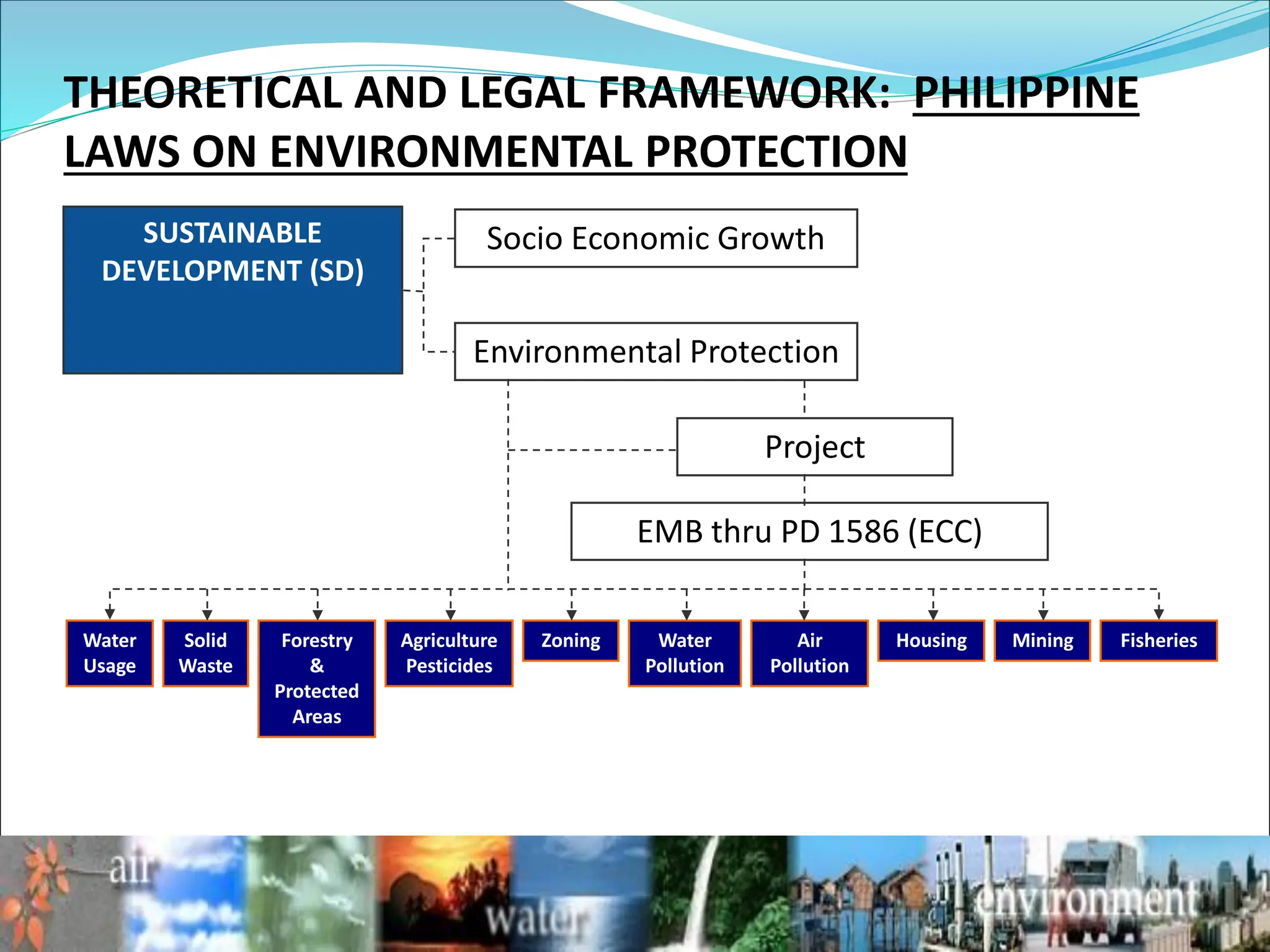
THEORETICAL AND LEGALFRAMEWORK: PHILIPPINE
LAWS ON ENVIRONMENTAL PROTECTION
SUSTAINABLE
DEVELOPMENT (SD)
Socio Economic Growth
Environmental Protection
Project
EMB thru PD 1586 (ECC)
Water
Usage
Solid
Waste
Forestry
&
Protected
Areas
Agriculture
Pesticides
Zoning Water
Pollution
Air
Pollution
Housing Mining Fisheries
22.
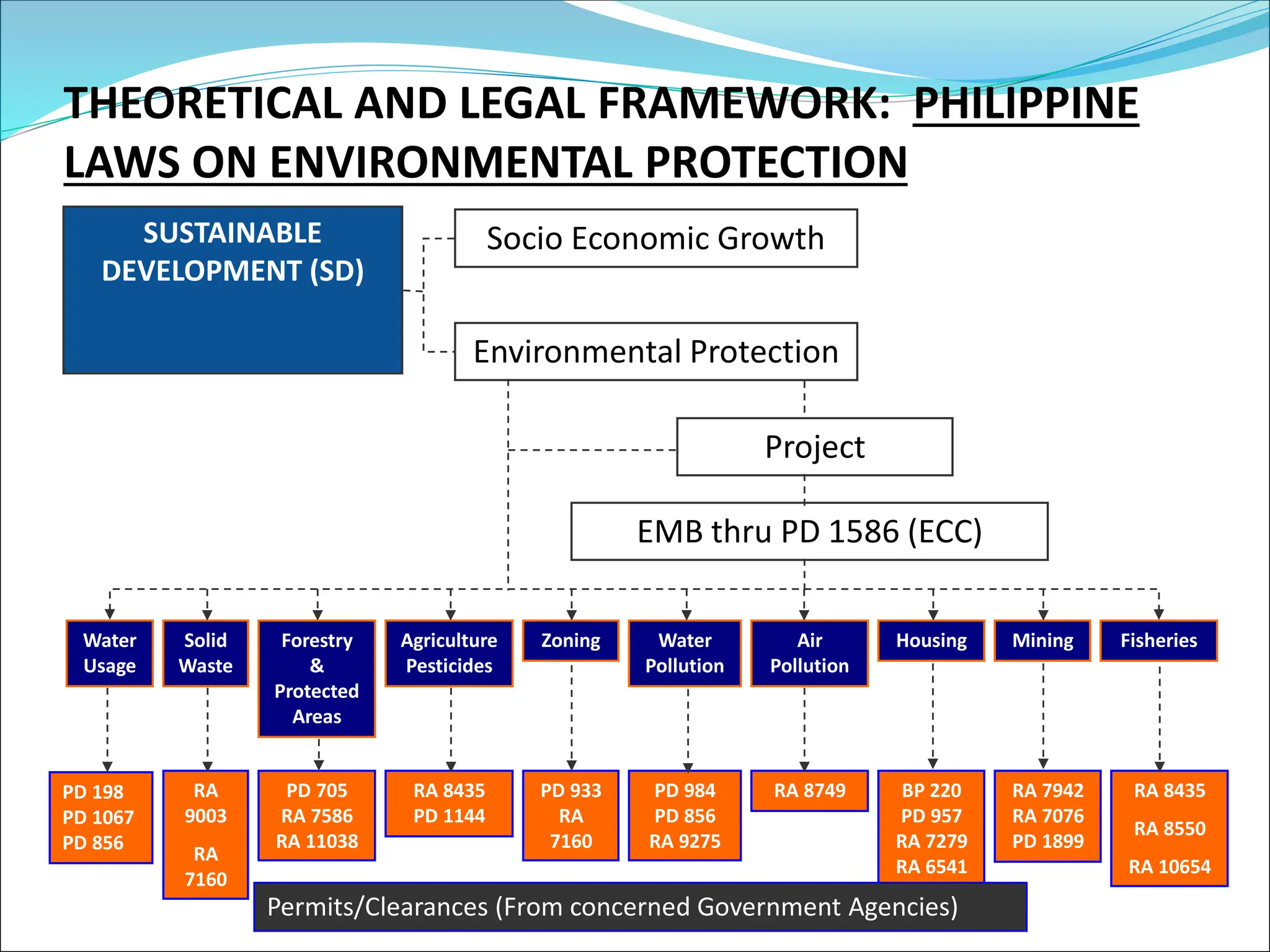
THEORETICAL AND LEGALFRAMEWORK: PHILIPPINE
LAWS ON ENVIRONMENTAL PROTECTION
SUSTAINABLE
DEVELOPMENT (SD)
Socio Economic Growth
Environmental Protection
Project
EMB thru PD 1586 (ECC)
Water
Usage
Solid
Waste
Forestry
&
Protected
Areas
Agriculture
Pesticides
Zoning Water
Pollution
Air
Pollution
Housing Mining Fisheries
PD 198
PD 1067
PD 856
RA
9003
RA
7160
PD 705
RA 7586
RA 11038
RA 8435
PD 1144
PD 933
RA
7160
PD 984
PD 856
RA 9275
RA 8749 BP 220
PD 957
RA 7279
RA 6541
RA 7942
RA 7076
PD 1899
RA 8435
RA 8550
RA 10654
Permits/Clearances (From concerned Government Agencies)
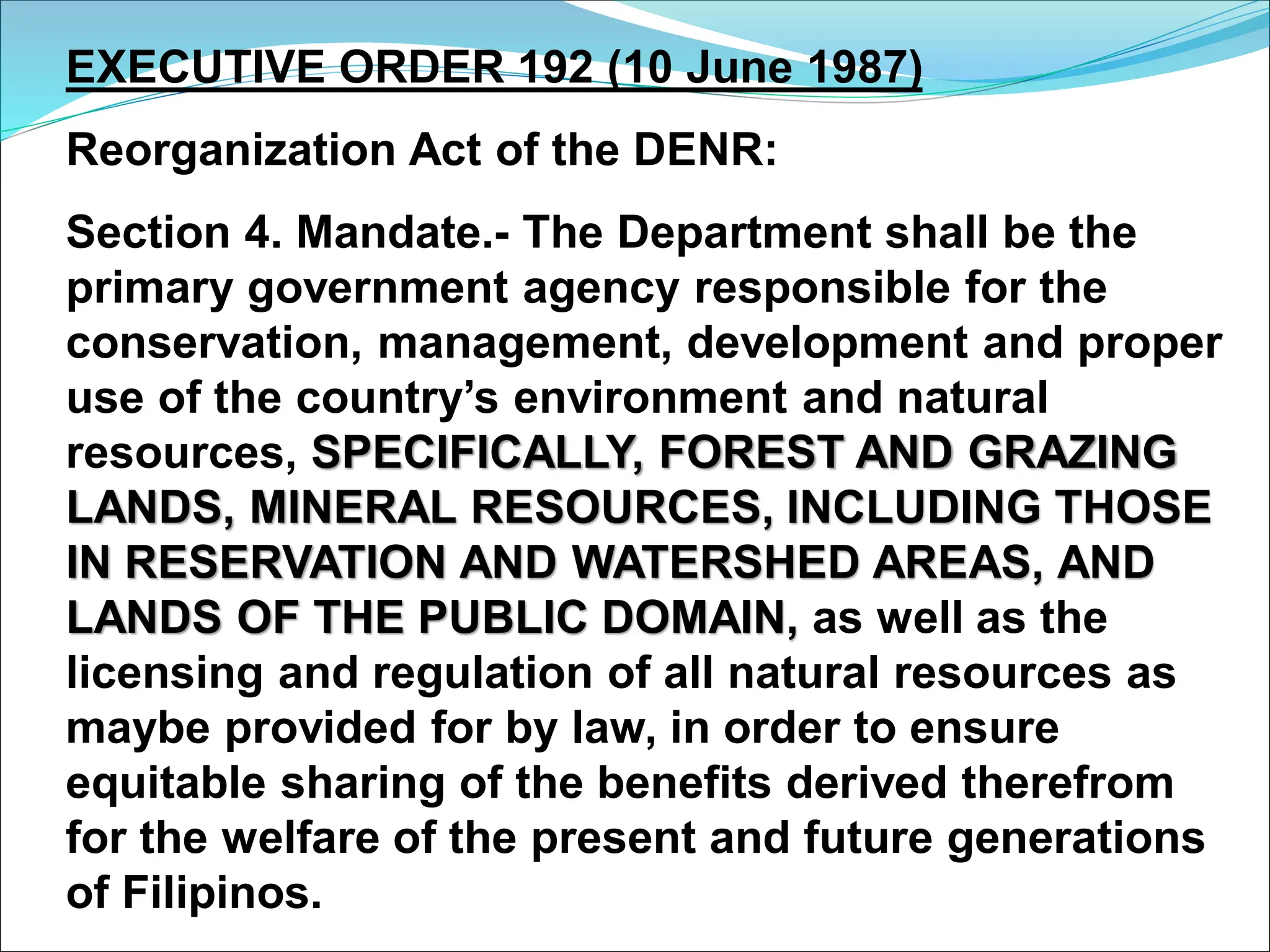
EXECUTIVE ORDER 192(10 June 1987)
Reorganization Act of the DENR:
Section 4. Mandate.- The Department shall be the
primary government agency responsible for the
conservation, management, development and proper
use of the country’s environment and natural
resources, SPECIFICALLY, FOREST AND GRAZING
LANDS, MINERAL RESOURCES, INCLUDING THOSE
IN RESERVATION AND WATERSHED AREAS, AND
LANDS OF THE PUBLIC DOMAIN, as well as the
licensing and regulation of all natural resources as
maybe provided for by law, in order to ensure
equitable sharing of the benefits derived therefrom
for the welfare of the present and future generations
of Filipinos.
Environmental Management Bureau
(EMB)is tasked to spearhead the
government’s efforts in environmental
protection and management. The EMB
was created as a staff bureau of the
DENR and later became a line bureau
as per Republic Act 8749, otherwise
known as the “Philippine Clean Air Act
of 1999”.
28.
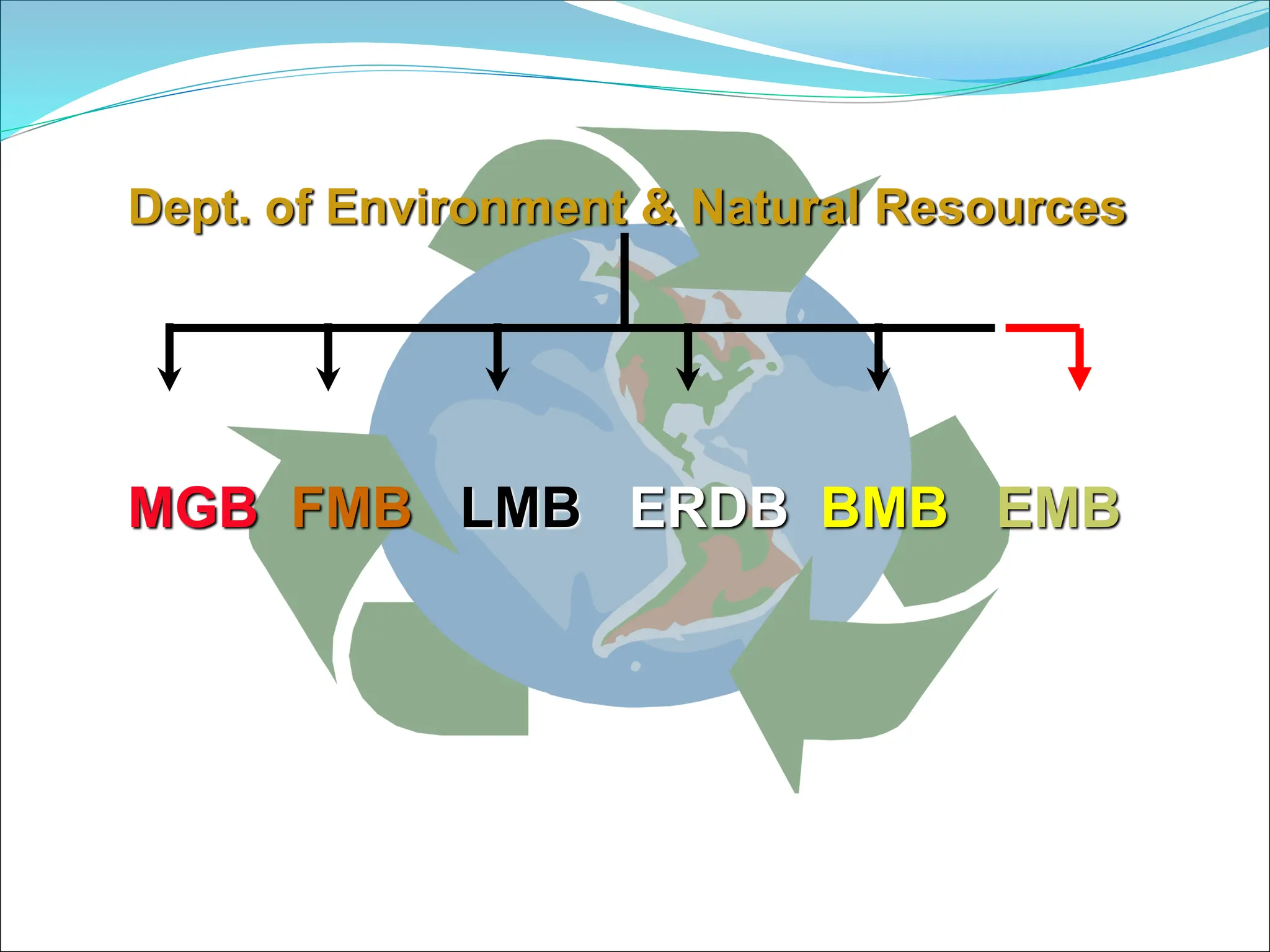
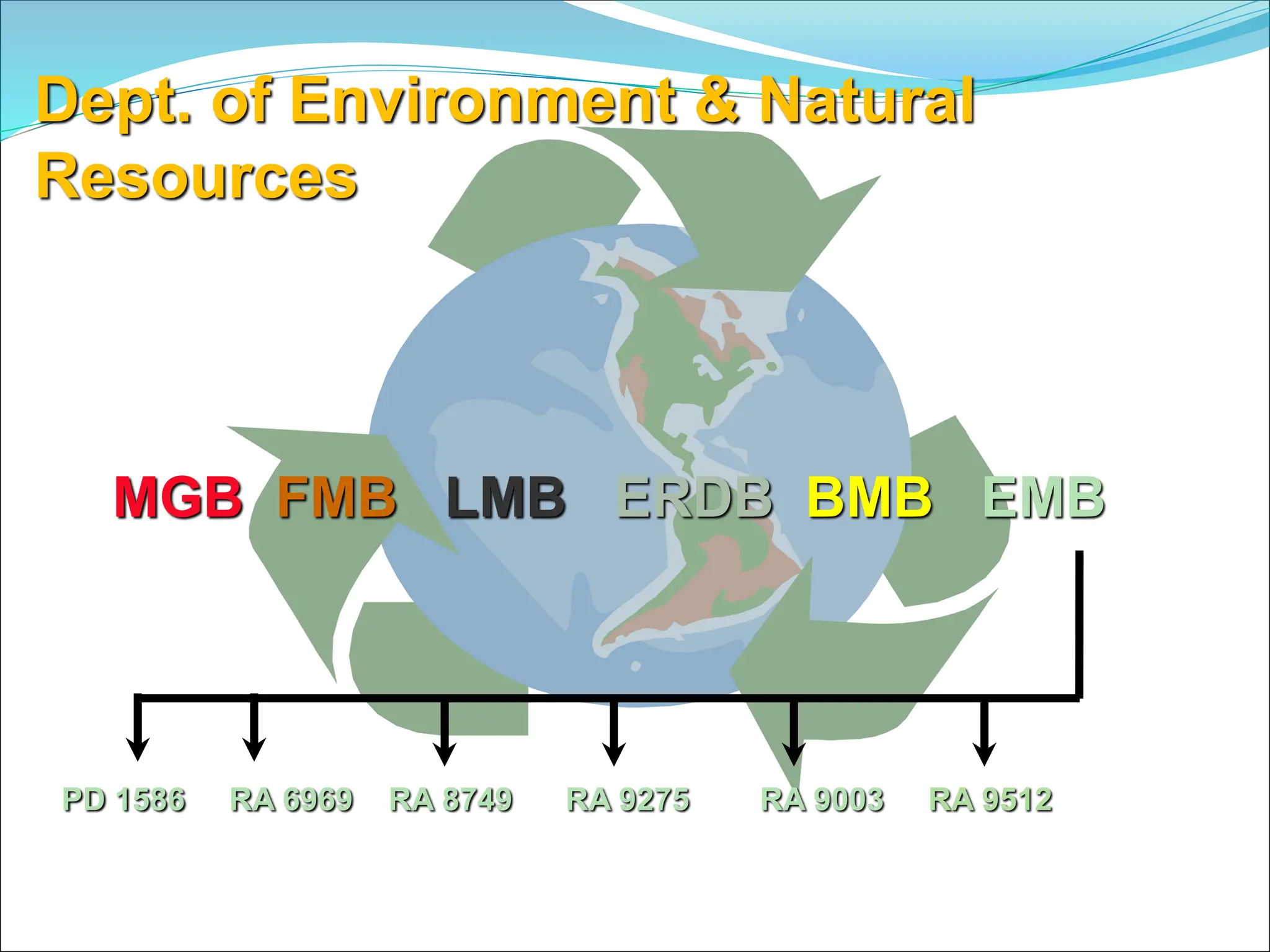
Dept. of Environment& Natural
Resources
MGB FMB LMB ERDB BMB EMB
PD 1586 RA 6969 RA 8749 RA 9275 RA 9003 RA 9512
29.
Main Tasks ofEMB Regional Office
Philippine Environmental Impact Statement
(EIS) system Policy (Presidential Decree
1586);
Philippine Clean Air Act (Republic Act 8749);
Philippine Clean Water Act (Republic Act
9275);
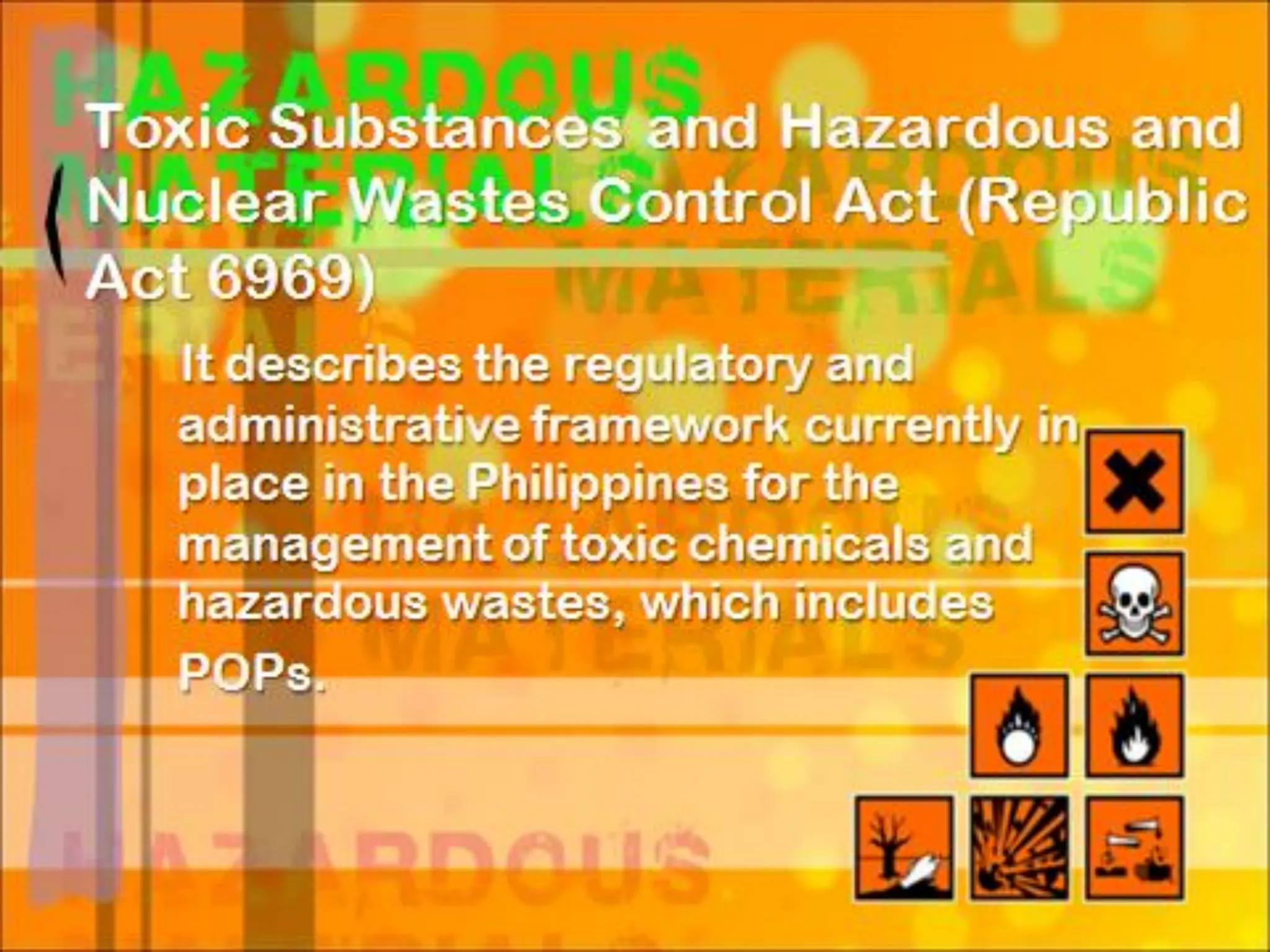
Toxic Substances and Hazardous and Nuclear
Wastes Control Act (Republic Act 6969); and
Philippine Ecological Solid Waste
Management Act of 2000 (Republic Act 9003)
Republic Act No. 9512 – Environmental
Awareness Education Act
30.
PD 1586 orPhilippine Environmental
Impact Statement (EIS)
The system provides the legal and procedural
framework for conducting Environmental
Impact Assessments (EIAs) for projects likely
to have significant environmental impact. The
EIS system requires completion of an EIA and
preparation of an EIS report for any
environmentally critical project (ECP) or any
project located in an environmentally critical
area (ECA).
32.
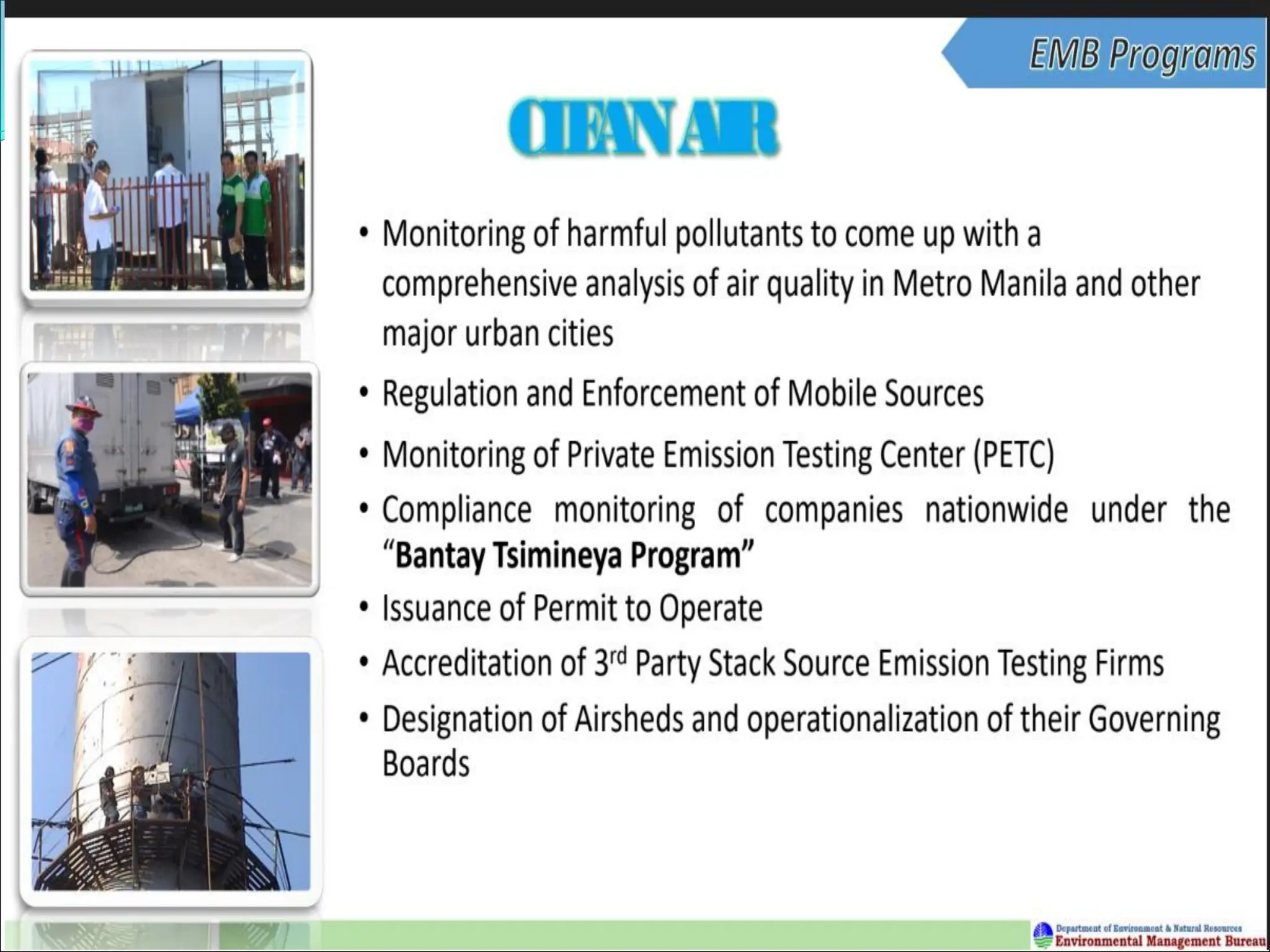
The Act outlinesthe government’s measures to
reduce air pollution and incorporate
environmental protection into its development
plans. It relies heavily on the polluter pays
principle and other market-based instruments
to promote self-regulation among the
population. It sets emission standards for all
motor vehicles and issues pollutant limitations
for industry.
PHILIPPINE CLEAN AIR ACT (RA
8749)
34.
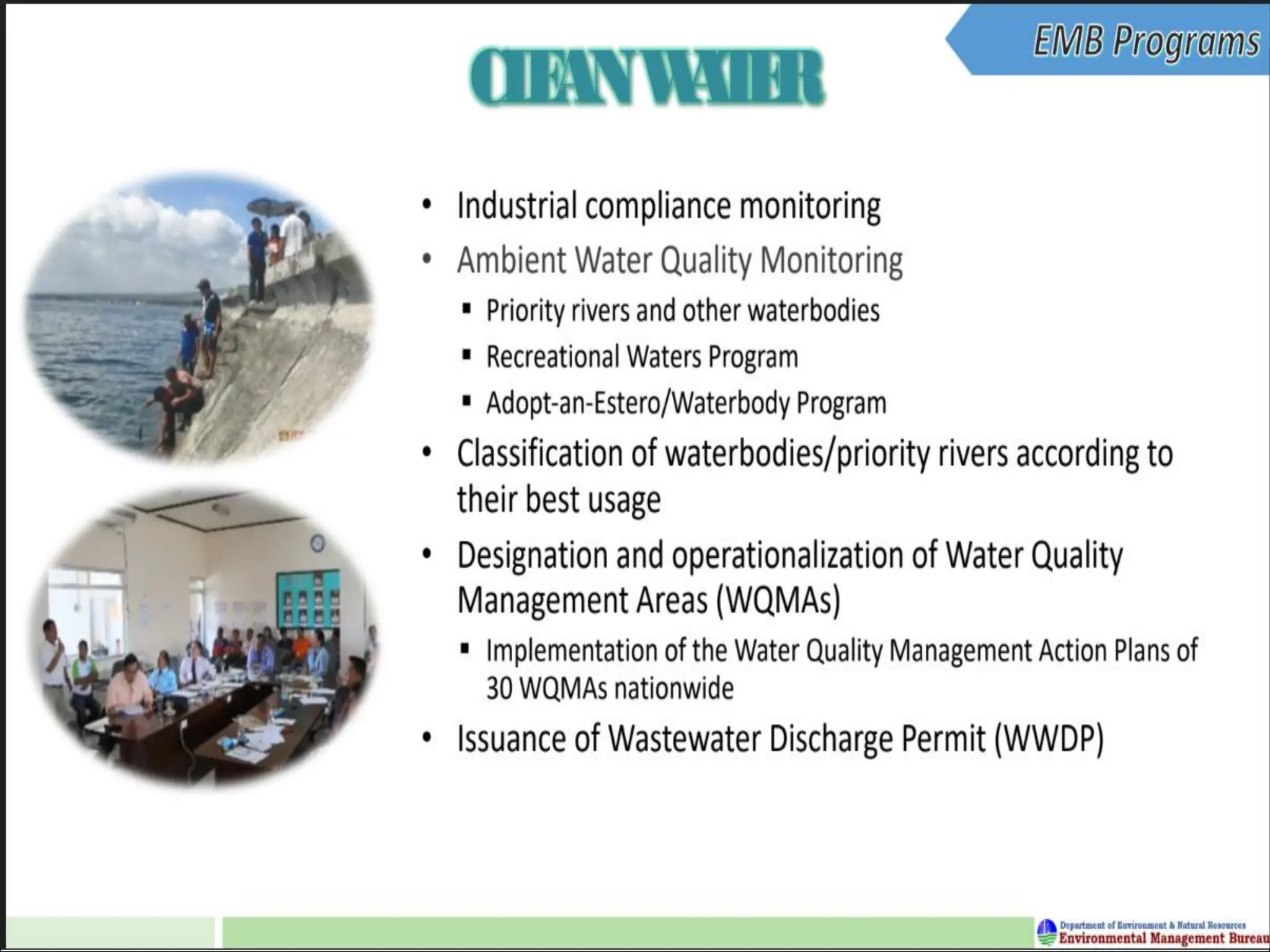
Philippine Clean WaterAct (Republic
Act 9275)
The Philippine Clean Water Act of 2004
(Republic Act No. 9275) aims to protect the
country’s water bodies from pollution from land-
based sources (industries and commercial
establishments, agriculture and
community/household activities). It provides for
a comprehensive and integrated strategy to
prevent and minimize pollution through a multi-
sectoral and participatory approach involving all
the stakeholders.
38.
Philippine Ecological SolidWaste
Management Act of 2000 (Republic
Act 9003)
The Act provides the legal framework for the
country’s systematic, comprehensive and
ecological solid waste management
program that shall ensure protection of
public health and the environment. It
underscores, among other things, the need
to create the necessary institutional
mechanisms and incentives, as well as
imposes penalties for acts in violation of any
of its provisions.
40.
Republic Act No.9512 (Environmental
Awareness Education Act)
It is an Act to promote environmental
awareness through Environmental
Education (EE) and covers the integration
of EE in the school curricula at all levels,
whether public or private, including in
barangay daycare, preschool, non-formal,
technical vocational, professional level,
indigenous learning and out-of-school
youth courses or programs.
41.
• Conduct ofspecial events for the national
environmental celebrations (Zero Waste
Month/World Water Day/Philippine Water Week,
Earth Day/Earth Month, World Environment
Day/Environment Month, National Clean Up Month,
International Day for the Preservation of the Ozone
Layer, World Environmental Health Day,
International Lead Poisoning Prevention Week,
Clean Air Month, Climate Change Consciousness
Week, Environmental Awareness Month)
• Production and dissemination of localized IEC
Materials
• School caravan
• Convening of Regional Inter-Agency Committee on
Environmental Education