ENVIRONMENT ETHICS &
ENVIRONMENTAL LAWS
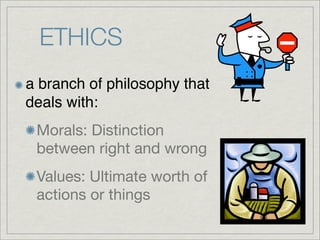
ETHICS
a branch of philosophy that
deals with:
 Morals: Distinction
 between right and wrong
 Values: Ultimate worth of
 actions or things
ENVIRONMENTAL
ETHICS
considers extending the traditional boundaries of ethics
from solely including humans to including the non-human
world

  deals with the moral relationships between
  humans and the surrounding world

exerts influence on a large range of disciplines including
law, sociology, theology, economics, ecology and
geography
ETHICAL DECISIONS
CONCERNING THE
ENVIRONMENT
Should we continue to clear cut forests for the sake of
human consumption?

Should we continue to propagate?

Should we continue to make gasoline powered vehicles?

What environmental obligations do we need to keep for
future generations?

Is it right for humans to knowingly cause the extinction of
a species for the convenience of humanity?
TO UNDERSTAND...WE
MUST BE GUIDED BY
PRINCIPLES!
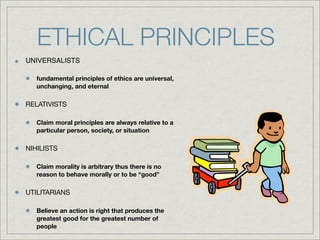
ETHICAL PRINCIPLES
UNIVERSALISTS

   fundamental principles of ethics are universal,
   unchanging, and eternal

RELATIVISTS

   Claim moral principles are always relative to a
   particular person, society, or situation

NIHILISTS

   Claim morality is arbitrary thus there is no
   reason to behave morally or to be “good”

UTILITARIANS

   Believe an action is right that produces the
   greatest good for the greatest number of
   people
RIGHTS AND
  OBLIGATIONS
Moral Agents - Beings capable of acting morally or
immorally, and who can accept responsibility for their acts.

  Humans

Moral Subjects - Beings who are not moral agents, but who
have moral interests and can be treated rightly or wrongly.

  Children, people who are mentally retarded or ill

Moral Extensionism - Widening definition of who is
considered ethically significant.

  Animal Rights
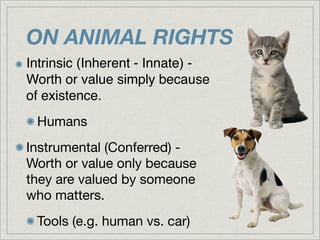
ON ANIMAL RIGHTS
Intrinsic (Inherent - Innate) -
Worth or value simply because
of existence.
 Humans
Instrumental (Conferred) -
Worth or value only because
they are valued by someone
who matters.
 Tools (e.g. human vs. car)
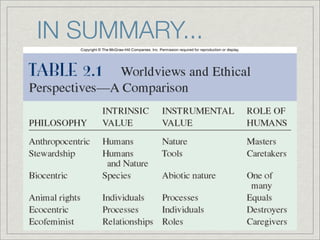
IN SUMMARY...
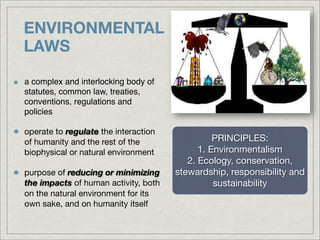
ENVIRONMENTAL
LAWS

a complex and interlocking body of
statutes, common law, treaties,
conventions, regulations and
policies

operate to regulate the interaction
of humanity and the rest of the                 PRINCIPLES:
biophysical or natural environment          1. Environmentalism
                                         2. Ecology, conservation,
purpose of reducing or minimizing     stewardship, responsibility and
the impacts of human activity, both             sustainability
on the natural environment for its
own sake, and on humanity itself
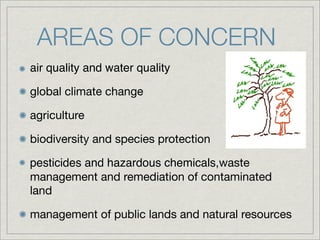
AREAS OF CONCERN
air quality and water quality

global climate change

agriculture

biodiversity and species protection

pesticides and hazardous chemicals,waste
management and remediation of contaminated
land

management of public lands and natural resources
THE TREATIES...
Basel Convention on the Control of
Transboundary Movements of Hazardous
    Wastes and their Disposal (1992)

aims to protect human health
and the environment against
the adverse effects of
hazardous wastes:

  generation and
  management

  transboundary movements

  disposal
CONVENTION ON INTERNATIONAL
   TRADE IN ENDANGERED SPECIES
              (CITES)

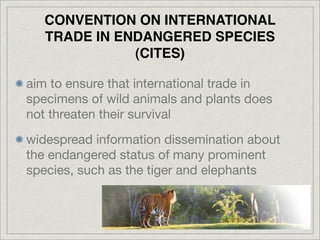
aim to ensure that international trade in
specimens of wild animals and plants does
not threaten their survival
widespread information dissemination about
the endangered status of many prominent
species, such as the tiger and elephants
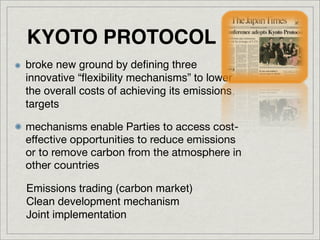
KYOTO PROTOCOL
broke new ground by defining three
innovative “flexibility mechanisms” to lower
the overall costs of achieving its emissions
targets

mechanisms enable Parties to access cost-
effective opportunities to reduce emissions
or to remove carbon from the atmosphere in
other countries

Emissions trading (carbon market)
Clean development mechanism
Joint implementation
United Nations Framework Convention
     on Climate Change (UNFCCC)
consider what can be done to reduce   key points (objectives)
global warming and to cope with
whatever temperature increases are       to keep the maximum
inevitable                               temperature rise to below 2
                                         degrees Celsius
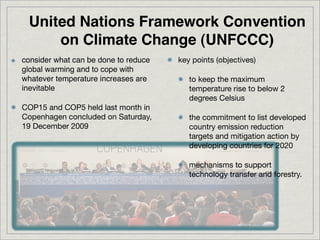
COP15 and COP5 held last month in
Copenhagen concluded on Saturday,        the commitment to list developed
19 December 2009                         country emission reduction
                                         targets and mitigation action by
                                         developing countries for 2020

                                         mechanisms to support
                                         technology transfer and forestry.
THE PHILIPPINE
CONSTITUTION PROTECTS
THE ENVIRONMENT...
CHAIN SAW ACT (2002) or RA 9175


AN ACT REGULATING THE OWNERSHIP, POSSESSION, SALE, IMPORTATION AND USE OF CHAIN SAWS,
  PENALIZING VIOLATIONS THEREOF AND FOR OTHER PURPOSES

PERSONS AUTHORIZED TO POSSES OR USE CHAIN SAW:
   HAS A SUBSISTING TIMBER LICENSE AGREEMENT, PRODUCTION SHARING AGREEMENT, OR SIMILAR AGREEMENTS,
      OR A PRIVATE LAND TIMBER PERMIT;
   IS AN ORCHARD AND FRUIT TREE FARMER;
   IS AN INDUSTRIAL TREE FARMER;
   IS A LICENSED WOOD PROCESSOR AND THE CHAIN SAW SHALL BE USED FOR THE CUTTING OF TIMBER THAT HAS
      BEEN LEGALLY SOLD TO SAID APPLICANT
   SHALL USE THE CHAIN SAW FOR A LEGAL PURPOSE.
ECOLOGICAL SOLID WASTE
MANAGEMENT ACT OF 2000 or RA 9003


SEGREGATION AND COLLECTION OF SOLID WASTE SHALL
 BE CONDUCTED AT THE BARANGAY LEVEL SPECIFICALLY
 FOR BIODEGRADABLE, COMPOSTABLE AND REUSABLE
 WASTES:
  PROVIDED, THAT THE COLLECTION OF NON-RECYCLABLE
   MATERIALS AND SPECIAL WASTES SHALL BE THE
   RESPONSIBILITY OF THE MUNICIPALITY OR CITY
   (SECTION 10)
PHILIPPINE CLEAN AIR ACT OF 1999
or RA 8749


THE STATE SHALL PROMOTE AND PROTECT THE GLOBAL ENVIRONMENT
  TO ATTAIN SUSTAINABLE DEVELOPMENT WHILE  RECOGNIZING THE
  PRIMARY RESPONSIBILITY OF LOCAL GOVERNMENT UNITS TO DEAL
  WITH ENVIRONMENTAL PROBLEMS.

THE STATE RECOGNIZES THAT THE RESPONSIBILITY OF CLEANING THE
  HABITAT AND ENVIRONMENT IS PRIMARILY AREA-BASED.

THE STATE ALSO RECOGNIZES THE PRINCIPLE THAT “POLLUTERS MUST
  PAY”.
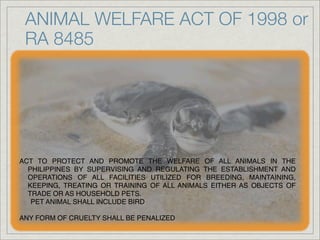
ANIMAL WELFARE ACT OF 1998 or
 RA 8485


ACT TO PROTECT AND PROMOTE THE WELFARE OF ALL ANIMALS IN THE
  PHILIPPINES BY SUPERVISING AND REGULATING THE ESTABLISHMENT AND
  OPERATIONS OF ALL FACILITIES UTILIZED FOR BREEDING, MAINTAINING,
  KEEPING, TREATING OR TRAINING OF ALL ANIMALS EITHER AS OBJECTS OF
  TRADE OR AS HOUSEHOLD PETS.
   PET ANIMAL SHALL INCLUDE BIRD

ANY FORM OF CRUELTY SHALL BE PENALIZED
PHILIPPINE MINING ACT OF 1995
or RA 7942

        WITHIN THE TERRITORY AND EXCLUSIVE ECONOMIC
         ZONE OF THE REPUBLIC OF THE PHILIPPINES ARE
         OWNED BY THE STATE.

        IT SHALL BE THE RESPONSIBILITY OF THE STATE TO
           PROMOTE THEIR RATIONAL EXPLORATION,
           DEVELOPMENT, UTILIZATION AND CONSERVATION
           THROUGH THE COMBINED EFFORTS OF
           GOVERNMENT AND THE PRIVATE SECTOR IN
           ORDER TO ENHANCE NATIONAL GROWTH IN A
           WAY THAT EFFECTIVELY SAFEGUARDS THE
           ENVIRONMENT AND PROTECT THE RIGHTS OF
           AFFECTED COMMUNITIES
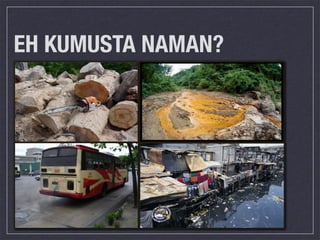
EH KUMUSTA NAMAN?
FOR YOUR ACTIVITY...PAGE 73
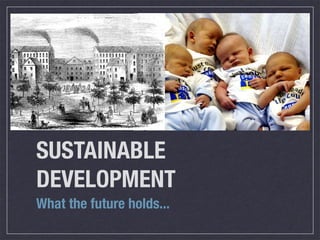
SUSTAINABLE
DEVELOPMENT
What the future holds...
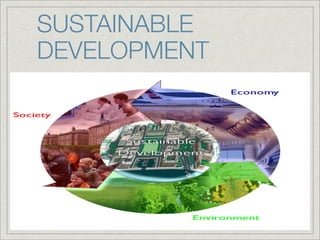
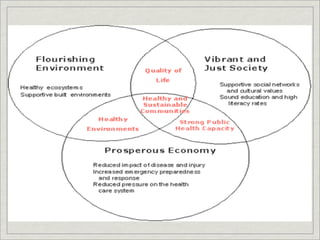
SUSTAINABLE
DEVELOPMENT
TO INCREASING THE QUALITY
OF LIFE OF EVERY FILIPINO
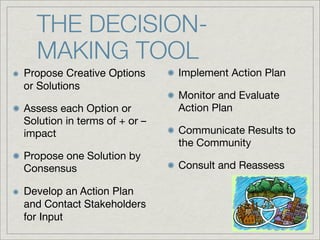
THE DECISION-
  MAKING TOOL
Propose Creative Options      Implement Action Plan
or Solutions
                              Monitor and Evaluate
Assess each Option or         Action Plan
Solution in terms of + or –
impact                        Communicate Results to
                              the Community
Propose one Solution by
Consensus                     Consult and Reassess

Develop an Action Plan
and Contact Stakeholders
for Input
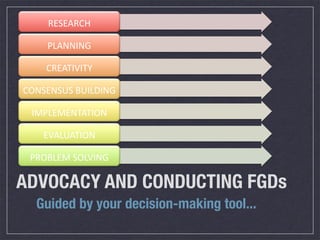
!"#"$!%&'

    ()$**+*,'

    %!"$-+.+-/'

%0*#"*#1#'21+)3+*,'

 +4()"4"*-$-+0*'

    ".$)1$-+0*'

 (!02)"4'#0).+*,'

ADVOCACY AND CONDUCTING FGDs
  Guided by your decision-making tool...
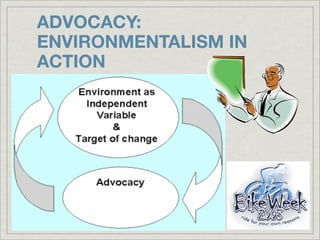
ADVOCACY:
ENVIRONMENTALISM IN
ACTION
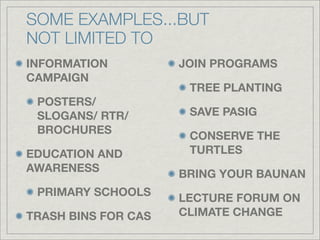
SOME EXAMPLES...BUT
NOT LIMITED TO
INFORMATION          JOIN PROGRAMS
CAMPAIGN
                      TREE PLANTING
 POSTERS/
 SLOGANS/ RTR/        SAVE PASIG
 BROCHURES
                      CONSERVE THE
EDUCATION AND         TURTLES
AWARENESS
                     BRING YOUR BAUNAN
 PRIMARY SCHOOLS
                     LECTURE FORUM ON
TRASH BINS FOR CAS   CLIMATE CHANGE
TO ARRIVE AT YOUR
  CLASS ADVOCACY...
FGD-based on sustainable development
decision wheel

Choose panelists/resource persons and
Moderator

ISSUE to FOCUS: one environmental
problem that can be addressed by a
student advocacy

END GOAL: a class advocacy plan/project!

Lectures 11 to 14 ns 5 2010

  • 1.
  • 2.
    ETHICS a branch ofphilosophy that deals with: Morals: Distinction between right and wrong Values: Ultimate worth of actions or things
  • 3.
    ENVIRONMENTAL ETHICS considers extending thetraditional boundaries of ethics from solely including humans to including the non-human world deals with the moral relationships between humans and the surrounding world exerts influence on a large range of disciplines including law, sociology, theology, economics, ecology and geography
  • 4.
    ETHICAL DECISIONS CONCERNING THE ENVIRONMENT Shouldwe continue to clear cut forests for the sake of human consumption? Should we continue to propagate? Should we continue to make gasoline powered vehicles? What environmental obligations do we need to keep for future generations? Is it right for humans to knowingly cause the extinction of a species for the convenience of humanity?
  • 5.
    TO UNDERSTAND...WE MUST BEGUIDED BY PRINCIPLES!
  • 6.
    ETHICAL PRINCIPLES UNIVERSALISTS fundamental principles of ethics are universal, unchanging, and eternal RELATIVISTS Claim moral principles are always relative to a particular person, society, or situation NIHILISTS Claim morality is arbitrary thus there is no reason to behave morally or to be “good” UTILITARIANS Believe an action is right that produces the greatest good for the greatest number of people
  • 7.
    RIGHTS AND OBLIGATIONS Moral Agents - Beings capable of acting morally or immorally, and who can accept responsibility for their acts. Humans Moral Subjects - Beings who are not moral agents, but who have moral interests and can be treated rightly or wrongly. Children, people who are mentally retarded or ill Moral Extensionism - Widening definition of who is considered ethically significant. Animal Rights
  • 8.
    ON ANIMAL RIGHTS Intrinsic(Inherent - Innate) - Worth or value simply because of existence. Humans Instrumental (Conferred) - Worth or value only because they are valued by someone who matters. Tools (e.g. human vs. car)
  • 9.
  • 10.
    ENVIRONMENTAL LAWS a complex andinterlocking body of statutes, common law, treaties, conventions, regulations and policies operate to regulate the interaction of humanity and the rest of the PRINCIPLES: biophysical or natural environment 1. Environmentalism 2. Ecology, conservation, purpose of reducing or minimizing stewardship, responsibility and the impacts of human activity, both sustainability on the natural environment for its own sake, and on humanity itself
  • 11.
    AREAS OF CONCERN airquality and water quality global climate change agriculture biodiversity and species protection pesticides and hazardous chemicals,waste management and remediation of contaminated land management of public lands and natural resources
  • 12.
  • 13.
    Basel Convention onthe Control of Transboundary Movements of Hazardous Wastes and their Disposal (1992) aims to protect human health and the environment against the adverse effects of hazardous wastes: generation and management transboundary movements disposal
  • 14.
    CONVENTION ON INTERNATIONAL TRADE IN ENDANGERED SPECIES (CITES) aim to ensure that international trade in specimens of wild animals and plants does not threaten their survival widespread information dissemination about the endangered status of many prominent species, such as the tiger and elephants
  • 15.
    KYOTO PROTOCOL broke newground by defining three innovative “flexibility mechanisms” to lower the overall costs of achieving its emissions targets mechanisms enable Parties to access cost- effective opportunities to reduce emissions or to remove carbon from the atmosphere in other countries Emissions trading (carbon market) Clean development mechanism Joint implementation
  • 16.
    United Nations FrameworkConvention on Climate Change (UNFCCC) consider what can be done to reduce key points (objectives) global warming and to cope with whatever temperature increases are to keep the maximum inevitable temperature rise to below 2 degrees Celsius COP15 and COP5 held last month in Copenhagen concluded on Saturday, the commitment to list developed 19 December 2009 country emission reduction targets and mitigation action by developing countries for 2020 mechanisms to support technology transfer and forestry.
  • 17.
  • 18.
    CHAIN SAW ACT(2002) or RA 9175 AN ACT REGULATING THE OWNERSHIP, POSSESSION, SALE, IMPORTATION AND USE OF CHAIN SAWS, PENALIZING VIOLATIONS THEREOF AND FOR OTHER PURPOSES PERSONS AUTHORIZED TO POSSES OR USE CHAIN SAW: HAS A SUBSISTING TIMBER LICENSE AGREEMENT, PRODUCTION SHARING AGREEMENT, OR SIMILAR AGREEMENTS, OR A PRIVATE LAND TIMBER PERMIT; IS AN ORCHARD AND FRUIT TREE FARMER; IS AN INDUSTRIAL TREE FARMER; IS A LICENSED WOOD PROCESSOR AND THE CHAIN SAW SHALL BE USED FOR THE CUTTING OF TIMBER THAT HAS BEEN LEGALLY SOLD TO SAID APPLICANT SHALL USE THE CHAIN SAW FOR A LEGAL PURPOSE.
  • 19.
    ECOLOGICAL SOLID WASTE MANAGEMENTACT OF 2000 or RA 9003 SEGREGATION AND COLLECTION OF SOLID WASTE SHALL BE CONDUCTED AT THE BARANGAY LEVEL SPECIFICALLY FOR BIODEGRADABLE, COMPOSTABLE AND REUSABLE WASTES: PROVIDED, THAT THE COLLECTION OF NON-RECYCLABLE MATERIALS AND SPECIAL WASTES SHALL BE THE RESPONSIBILITY OF THE MUNICIPALITY OR CITY (SECTION 10)
  • 20.
    PHILIPPINE CLEAN AIRACT OF 1999 or RA 8749 THE STATE SHALL PROMOTE AND PROTECT THE GLOBAL ENVIRONMENT TO ATTAIN SUSTAINABLE DEVELOPMENT WHILE  RECOGNIZING THE PRIMARY RESPONSIBILITY OF LOCAL GOVERNMENT UNITS TO DEAL WITH ENVIRONMENTAL PROBLEMS. THE STATE RECOGNIZES THAT THE RESPONSIBILITY OF CLEANING THE HABITAT AND ENVIRONMENT IS PRIMARILY AREA-BASED. THE STATE ALSO RECOGNIZES THE PRINCIPLE THAT “POLLUTERS MUST PAY”.
  • 21.
    ANIMAL WELFARE ACTOF 1998 or RA 8485 ACT TO PROTECT AND PROMOTE THE WELFARE OF ALL ANIMALS IN THE PHILIPPINES BY SUPERVISING AND REGULATING THE ESTABLISHMENT AND OPERATIONS OF ALL FACILITIES UTILIZED FOR BREEDING, MAINTAINING, KEEPING, TREATING OR TRAINING OF ALL ANIMALS EITHER AS OBJECTS OF TRADE OR AS HOUSEHOLD PETS. PET ANIMAL SHALL INCLUDE BIRD ANY FORM OF CRUELTY SHALL BE PENALIZED
  • 22.
    PHILIPPINE MINING ACTOF 1995 or RA 7942 WITHIN THE TERRITORY AND EXCLUSIVE ECONOMIC ZONE OF THE REPUBLIC OF THE PHILIPPINES ARE OWNED BY THE STATE. IT SHALL BE THE RESPONSIBILITY OF THE STATE TO PROMOTE THEIR RATIONAL EXPLORATION, DEVELOPMENT, UTILIZATION AND CONSERVATION THROUGH THE COMBINED EFFORTS OF GOVERNMENT AND THE PRIVATE SECTOR IN ORDER TO ENHANCE NATIONAL GROWTH IN A WAY THAT EFFECTIVELY SAFEGUARDS THE ENVIRONMENT AND PROTECT THE RIGHTS OF AFFECTED COMMUNITIES
  • 23.
  • 24.
  • 25.
  • 26.
  • 27.
    TO INCREASING THEQUALITY OF LIFE OF EVERY FILIPINO
  • 29.
    THE DECISION- MAKING TOOL Propose Creative Options Implement Action Plan or Solutions Monitor and Evaluate Assess each Option or Action Plan Solution in terms of + or – impact Communicate Results to the Community Propose one Solution by Consensus Consult and Reassess Develop an Action Plan and Contact Stakeholders for Input
  • 30.
    !"#"$!%&' ()$**+*,' %!"$-+.+-/' %0*#"*#1#'21+)3+*,' +4()"4"*-$-+0*' ".$)1$-+0*' (!02)"4'#0).+*,' ADVOCACY AND CONDUCTING FGDs Guided by your decision-making tool...
  • 31.
  • 32.
    SOME EXAMPLES...BUT NOT LIMITEDTO INFORMATION JOIN PROGRAMS CAMPAIGN TREE PLANTING POSTERS/ SLOGANS/ RTR/ SAVE PASIG BROCHURES CONSERVE THE EDUCATION AND TURTLES AWARENESS BRING YOUR BAUNAN PRIMARY SCHOOLS LECTURE FORUM ON TRASH BINS FOR CAS CLIMATE CHANGE
  • 33.
    TO ARRIVE ATYOUR CLASS ADVOCACY... FGD-based on sustainable development decision wheel Choose panelists/resource persons and Moderator ISSUE to FOCUS: one environmental problem that can be addressed by a student advocacy END GOAL: a class advocacy plan/project!