 Suspension is the term given to the
system of springs, shock absorbers and
linkages that connects a vehicle to its
wheels
 Serve a dual purpose – contributing to
the car's handling and braking.
 Protects the vehicle itself and any cargo
or luggage from damage and wear
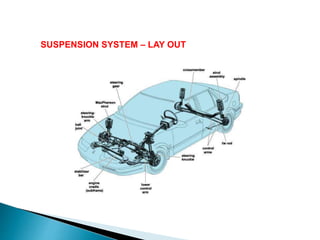
SUSPENSION SYSTEM – LAY OUT
 Conventional suspension system
 Independent suspension system
 Air suspension system
 Hydro elastic suspension system
 Two wheels are mounted on either side of the
rigid axle
 When one wheel encounters the bump, both
the wheel do not execute parallel up and
down motion
 So it gives rise to gyroscopic effect and wheel
wobble
 Rear driving wheels mounted on live axle
suspended by laminated leaf springs and
shock absorbers
 Both the front and the rear wheel are utilized
 Design incorporated in the front wheels
 One wheel goes down ,the other wheel does
not have much effect
 Basic classification of the design
1. MacPherson Strut
2. Double Wishbone
3. Multi link
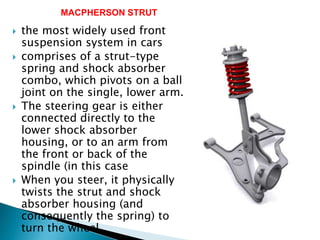
 the most widely used front
suspension system in cars
 comprises of a strut-type
spring and shock absorber
combo, which pivots on a ball
joint on the single, lower arm.
 The steering gear is either
connected directly to the
lower shock absorber
housing, or to an arm from
the front or back of the
spindle (in this case
 When you steer, it physically
twists the strut and shock
absorber housing (and
consequently the spring) to
turn the wheel
MACPHERSON STRUT
Type of double-A or double wishbone suspension
Wheel spindles are supported by an upper and lower
'A' shaped arm.
The lower arm carries most of the load.
If you look head-on at this type of system,
parallelogram system that allows the spindles to travel
vertically up and down.
This side-to-side motion is known as scrub
 Type of double-A arm suspension although the lower
arm in these systems can sometimes be replaced with
a single solid arm (as in my picture).
 The spring/shock combo is moved from between the
arms to above the upper arm.
 This transfers the load-bearing capability of the
suspension almost entirely to the upper arm and the
spring mounts.
 The lower arm in this instance becomes a control
arm.
 It's currently being used in the
Audi A8 and A4 amongst other
cars.
 The basic principle of it is the
same, but instead of solid upper
and lower wishbones, each 'arm' of
the wishbone is a separate item.
 These are joined at the top and
bottom of the spindle thus forming
the wishbone shape.
 The super-weird thing about this
is that as the spindle turns for
steering, it alters the geometry of
the suspension by torquing all four
suspension arms.
 Spring is separate from the schock
absorber.
 Bigger deflection of front wheels, no reaction on steering
 Greater distance for resisting rolling action
 Front axle (small-stub), improves road holding tendency of
tyres.
 Minimum vibrations
DISADVANTAGES
 Better shock absorber required.
 Expensive
 Tyre wear increases due to transmission of torque.
 Lesser unsprung weight – improves ride ,
reduces tyre wear.
 Increased passenger space
 Rear wheels remain stable ..
DISADVANTAGES
 Increased cost
 Complicated design
 Steering action is not proper
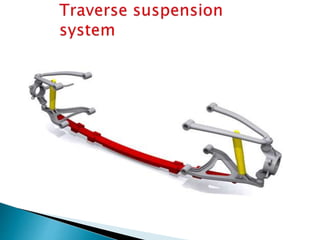
 Normally find on the rear suspension
 Combines independent double wishbone
suspension with a leaf spring.
 It involves one leaf spring mounted
across the vehicle, connected at each end
to the lower wishbone.
 The centre of the spring is connected to
the front subframe in the middle of the
car.
 There are still two shock absorbers,
mounted one to each side on the lower
wishbones.
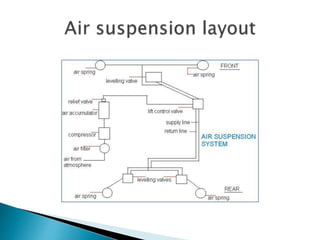
 Comprises of compressor , suppling air to air
tank
 Pressure maintained – 5.6 to 7 kg/sq.m
 Air bags – on each wheel
 As load applied , air bags compressed
actuating the levelling valve .
 Air from the tank fills the compressrd air bag
& hence raise the level of the frame.
 Air from air bag gets released as load on
chassis decreases .
 These maintain a constant frequency of vibration
whether the vehicle is laden or unladen.
 Constant frame height is maintained.
 It helps to reduce the load while the vehicle in
motion i.e. the dynamic loading as the spring
rate variation between laden and unladen weight
is much less.
 It gives smooth and comfort ride of the vehicle.
 The stiffness of the system increases with the
increase of the deflection.
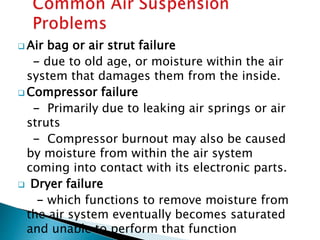
 Air bag or air strut failure
- due to old age, or moisture within the air
system that damages them from the inside.
 Compressor failure
- Primarily due to leaking air springs or air
struts
- Compressor burnout may also be caused
by moisture from within the air system
coming into contact with its electronic parts.
 Dryer failure
- which functions to remove moisture from
the air system eventually becomes saturated
and unable to perform that function
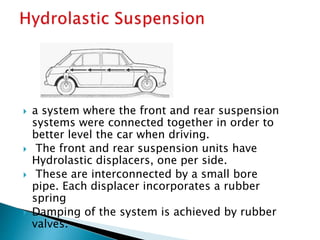
 a system where the front and rear suspension
systems were connected together in order to
better level the car when driving.
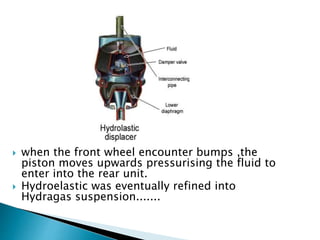
 The front and rear suspension units have
Hydrolastic displacers, one per side.
 These are interconnected by a small bore
pipe. Each displacer incorporates a rubber
spring
 Damping of the system is achieved by rubber
valves.
 when the front wheel encounter bumps ,the
piston moves upwards pressurising the fluid to
enter into the rear unit.
 Hydroelastic was eventually refined into
Hydragas suspension.......
 Known as hydro-pneumatic suspension.
 The difference is in the displacer unit itself.
 In the older systems, fluid was used in the
displacer units with a rubber spring cushion
built-in.
 With Hydragas, the rubber spring is removed
completely.
 The fluid still exists but above the fluid there
is now a separating membrane or diaphragm,
and above that is a cylinder or sphere which
is charged with nitrogen gas.
 The nitrogen section is what has become the
spring and damping unit whilst the fluid is
still free to run from the front to the rear
units and back.
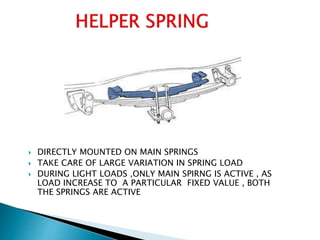
 DIRECTLY MOUNTED ON MAIN SPRINGS
 TAKE CARE OF LARGE VARIATION IN SPRING LOAD
 DURING LIGHT LOADS ,ONLY MAIN SPIRNG IS ACTIVE , AS
LOAD INCREASE TO A PARTICULAR FIXED VALUE , BOTH
THE SPRINGS ARE ACTIVE
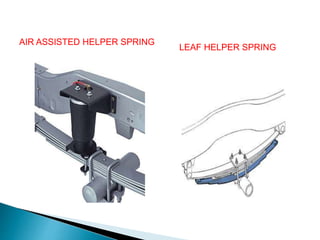
AIR ASSISTED HELPER SPRING
LEAF HELPER SPRING
suspension-system-in-automobiles.ppt

suspension-system-in-automobiles.ppt

  • 2.
     Suspension isthe term given to the system of springs, shock absorbers and linkages that connects a vehicle to its wheels  Serve a dual purpose – contributing to the car's handling and braking.  Protects the vehicle itself and any cargo or luggage from damage and wear
  • 3.
  • 4.
     Conventional suspensionsystem  Independent suspension system  Air suspension system  Hydro elastic suspension system
  • 5.
     Two wheelsare mounted on either side of the rigid axle  When one wheel encounters the bump, both the wheel do not execute parallel up and down motion  So it gives rise to gyroscopic effect and wheel wobble  Rear driving wheels mounted on live axle suspended by laminated leaf springs and shock absorbers
  • 7.
     Both thefront and the rear wheel are utilized  Design incorporated in the front wheels  One wheel goes down ,the other wheel does not have much effect  Basic classification of the design 1. MacPherson Strut 2. Double Wishbone 3. Multi link
  • 8.
     the mostwidely used front suspension system in cars  comprises of a strut-type spring and shock absorber combo, which pivots on a ball joint on the single, lower arm.  The steering gear is either connected directly to the lower shock absorber housing, or to an arm from the front or back of the spindle (in this case  When you steer, it physically twists the strut and shock absorber housing (and consequently the spring) to turn the wheel MACPHERSON STRUT
  • 9.
    Type of double-Aor double wishbone suspension Wheel spindles are supported by an upper and lower 'A' shaped arm. The lower arm carries most of the load. If you look head-on at this type of system, parallelogram system that allows the spindles to travel vertically up and down. This side-to-side motion is known as scrub
  • 10.
     Type ofdouble-A arm suspension although the lower arm in these systems can sometimes be replaced with a single solid arm (as in my picture).  The spring/shock combo is moved from between the arms to above the upper arm.  This transfers the load-bearing capability of the suspension almost entirely to the upper arm and the spring mounts.  The lower arm in this instance becomes a control arm.
  • 11.
     It's currentlybeing used in the Audi A8 and A4 amongst other cars.  The basic principle of it is the same, but instead of solid upper and lower wishbones, each 'arm' of the wishbone is a separate item.  These are joined at the top and bottom of the spindle thus forming the wishbone shape.  The super-weird thing about this is that as the spindle turns for steering, it alters the geometry of the suspension by torquing all four suspension arms.  Spring is separate from the schock absorber.
  • 12.
     Bigger deflectionof front wheels, no reaction on steering  Greater distance for resisting rolling action  Front axle (small-stub), improves road holding tendency of tyres.  Minimum vibrations DISADVANTAGES  Better shock absorber required.  Expensive  Tyre wear increases due to transmission of torque.
  • 13.
     Lesser unsprungweight – improves ride , reduces tyre wear.  Increased passenger space  Rear wheels remain stable .. DISADVANTAGES  Increased cost  Complicated design  Steering action is not proper
  • 15.
     Normally findon the rear suspension  Combines independent double wishbone suspension with a leaf spring.  It involves one leaf spring mounted across the vehicle, connected at each end to the lower wishbone.  The centre of the spring is connected to the front subframe in the middle of the car.  There are still two shock absorbers, mounted one to each side on the lower wishbones.
  • 16.
     Comprises ofcompressor , suppling air to air tank  Pressure maintained – 5.6 to 7 kg/sq.m  Air bags – on each wheel  As load applied , air bags compressed actuating the levelling valve .  Air from the tank fills the compressrd air bag & hence raise the level of the frame.  Air from air bag gets released as load on chassis decreases .
  • 18.
     These maintaina constant frequency of vibration whether the vehicle is laden or unladen.  Constant frame height is maintained.  It helps to reduce the load while the vehicle in motion i.e. the dynamic loading as the spring rate variation between laden and unladen weight is much less.  It gives smooth and comfort ride of the vehicle.  The stiffness of the system increases with the increase of the deflection.
  • 19.
     Air bagor air strut failure - due to old age, or moisture within the air system that damages them from the inside.  Compressor failure - Primarily due to leaking air springs or air struts - Compressor burnout may also be caused by moisture from within the air system coming into contact with its electronic parts.  Dryer failure - which functions to remove moisture from the air system eventually becomes saturated and unable to perform that function
  • 20.
     a systemwhere the front and rear suspension systems were connected together in order to better level the car when driving.  The front and rear suspension units have Hydrolastic displacers, one per side.  These are interconnected by a small bore pipe. Each displacer incorporates a rubber spring  Damping of the system is achieved by rubber valves.
  • 21.
     when thefront wheel encounter bumps ,the piston moves upwards pressurising the fluid to enter into the rear unit.  Hydroelastic was eventually refined into Hydragas suspension.......
  • 22.
     Known ashydro-pneumatic suspension.  The difference is in the displacer unit itself.  In the older systems, fluid was used in the displacer units with a rubber spring cushion built-in.  With Hydragas, the rubber spring is removed completely.  The fluid still exists but above the fluid there is now a separating membrane or diaphragm, and above that is a cylinder or sphere which is charged with nitrogen gas.  The nitrogen section is what has become the spring and damping unit whilst the fluid is still free to run from the front to the rear units and back.
  • 24.
     DIRECTLY MOUNTEDON MAIN SPRINGS  TAKE CARE OF LARGE VARIATION IN SPRING LOAD  DURING LIGHT LOADS ,ONLY MAIN SPIRNG IS ACTIVE , AS LOAD INCREASE TO A PARTICULAR FIXED VALUE , BOTH THE SPRINGS ARE ACTIVE
  • 25.
    AIR ASSISTED HELPERSPRING LEAF HELPER SPRING