SURVEYING 
INNOVATIONS IN 
QUARRYING 
White Paper
CONTENTS 
1. INTRODUCTION 4 
2. SURVEYING TECHNOLOGIES 5 
2.1 Aerial Photography and 
Photogrammetry 7 
2.2 Aerial LiDAR 8 
2.3 Total Stations and GPS 10 
2.4 Laser Scanning 11 
2.5 Unmanned Aerial Systems 12 
2.6 Echo Sounders 14 
2.7 Smartphone Apps 15 
3. APPLICATIONS 17 
3.1 Volumes 18 
3.2 Mapping 19 
3.3 Planning 21 
3.4 Setting Out 22 
3.5 Cadastral Surveys 23 
3.6 Blasting Surveys 25 
3.7 Plant Surveys 26 
3.8 Monitoring Surveys 27 
4. STOCKPILE VOLUME CALCULATION 
RESEARCH 29 
4.1 Accuracy 30 
4.2 Time Spent on Your Site 33 
4.3 Number of Sites per Day 35 
4.4 Cost Comparison 37 
5. CONCLUSION 39
4 
1. INTRODUCTION 
Surveying has always been an essential component of successful quarrying in 
areas such as planning and monitoring. 
In the past two main surveying approaches for quarry applications were used: 
ground surveys or aerial surveys using fixed wing aircraft. Today, there are many 
more options available along with a broader range of applications. 
This paper will discuss three different aspects of surveying technology, namely 
the types of surveying technologies available for use in a quarry environment, the 
types of applications the surveying technologies are used for and comparative 
performance of different surveying technologies in measuring stockpile volumes.
5 
2. SURVEYING TECHNOLOGIES 
Presently there are many different types of technology that can provide survey 
solutions for quarry requirements including: 
1. Aerial Photography and Photogrammetry 
2. Aerial LiDAR 
3. Total Stations and GPS 
4. Laser Scanning 
5. Unmanned Aerial Systems (drones) 
6. Echo Sounders 
7. Smartphone Apps
SURVEYING HAS ALWAYS BEEN AN ESSENTIAL 
COMPONENT OF SUCCESSFUL QUARRYING
2.1 Aerial Photography 
and Photogrammetry 
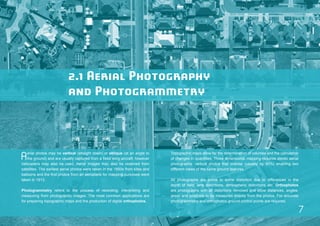
Aerial photos may be vertical (straight down) or oblique (at an angle to 
the ground) and are usually captured from a fixed wing aircraft; however 
helicopters may also be used. Aerial images may also be obtained from 
satellites. The earliest aerial photos were taken in the 1850s from kites and 
balloons and the first photos from an aeroplane for mapping purposes were 
taken in 1913. 
Photogrammetry refers to the process of recording, interpreting and 
measuring from photographic images. The most common applications are 
for preparing topographic maps and the production of digital orthophotos. 
Topographic maps allow for the determination of volumes and the calculation 
of changes in quantities. Three dimensional mapping requires stereo aerial 
photographs: vertical photos that overlap (usually by 60%) enabling two 
different views of the same ground features. 
All photographs are prone to some distortion due to differences in the 
depth of field, lens distortions, atmospheric distortions etc. Orthophotos 
are photographs with all distortions removed and allow distances, angles, 
areas and positions to be measured directly from the photos. For accurate 
photogrammetry and orthophotos ground control points are required. 
7
8 
2.2 Aerial LiDAR 
LiDAR stands for Light Detection and Ranging. Essentially the LIDAR scanner 
is mounted on an aircraft and it shoots out laser beams towards the Earth and 
times how long it takes for the beam to return to the sensor. The information 
collected is the distance of each point measured to the sensor together with the 
intensity of the return signal. 
By combining this information with the position and orientation of the scanner an 
accurate and detailed model of the earth’s surface may be obtained. 
LiDAR can penetrate vegetation and so can measure the elevation of the Earth’s 
surface under trees. The varying intensities of the return signal may also be used 
to determine clearances of power lines above vegetation and canopy heights. 
Some forms of LiDAR may also be used to measure the earth’s surface under 
shallow water.
LIDAR CAN MEASURE THE ELEVATION OF 
THE EARTH’S SURFACE UNDER TREES
10 
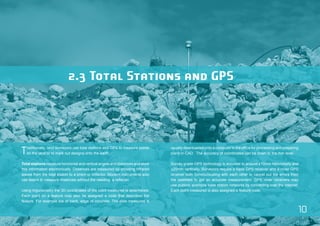
2.3 Total Stations and GPS 
Traditionally, land surveyors use total stations and GPS to measure points 
on the land or to mark out designs onto the earth. 
Total stations measure horizontal and vertical angles and distances and store 
this information electronically. Distances are measured by shooting infrared 
waves from the total station to a prism or reflector. Modern instruments also 
use lasers to measure distances without the needing a reflector. 
Using trigonometry the 3D coordinates of the point measured is determined. 
Each point on a feature may also be assigned a code that describes the 
feature. For example toe of bank, edge of concrete. The data measured is 
usually downloaded onto a computer in the office for processing and preparing 
plans in CAD. The accuracy of coordinates can be down to the mm level. 
Survey grade GPS technology is accurate to around ±10mm horizontally and 
±20mm vertically. Surveyors require a base GPS receiver and a rover GPS 
receiver both communicating with each other to cancel out the errors from 
the satellites to get an accurate measurement. GPS rover receivers may 
use publicly available base station networks by connecting over the internet. 
Each point measured is also assigned a feature code.
11 
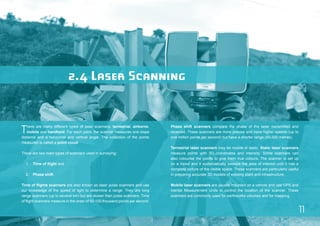
2.4 Laser Scanning 
There are many different types of laser scanners: terrestrial, airborne, 
mobile and handheld. For each point, the scanner measures one slope 
distance and a horizontal and vertical angle. The collection of the points 
measured is called a point cloud. 
There are two main types of scanners used in surveying: 
1. Time of flight and 
2. Phase shift. 
Time of flights scanners are also known as laser pulse scanners and use 
our knowledge of the speed of light to determine a range. They are long 
range scanners (up to several km) but are slower than pulse scanners. Time 
of flight scanners measure in the order of 50-100 thousand points per second. 
Phase shift scanners compare the phase of the laser transmitted and 
received. These scanners are more precise and have higher speeds (up to 
one million points per second) but have a shorter range (50-300 metres). 
Terrestrial laser scanners may be mobile or static. Static laser scanners 
measure points with 3D coordinates and intensity. Some scanners can 
also colourise the points to give them true colours. The scanner is set up 
on a tripod and it systematically sweeps the area of interest until it has a 
complete picture of the visible space. These scanners are particularly useful 
in preparing accurate 3D models of existing plant and infrastructure. 
Mobile laser scanners are usually mounted on a vehicle and use GPS and 
Inertial Measurement Units to control the location of the scanner. These 
scanners are commonly used for earthworks volumes and for mapping.
12 
2.5 Unmanned Aerial Systems 
Unmanned Aerial Systems (UAS) are Unmanned Aerial Vehicles (UAV’s) 
with sensors (drones). 
The sensors the drones carry may include cameras, GPS, LiDAR and 
others. There are a number of regulatory requirements from the Civil 
Aviation Safety Authority (CASA) to fly a drone for commercial purposes. 
Drone Operators need a UAV Operators Certificate, Operations Manual, 
Flight Manual and Maintenance Manual. 
CASA must give a specific Area Approval for the following: 
• to fly above 120 meters (400 feet) 
• inside controlled airspace 
• within 4.8 km (3 miles) of an aerodrome 
• over populated areas. 
An area is a populated area if in the event of a fault in the UAV there would 
be an unreasonable risk to the life, safety or property of somebody who is in 
the area but is not connected with the operation. 
Common uses for drones include preparing orthophotos and calculating 
approximate volumes.
THERE ARE A NUMBER OF REGULATORY 
REQUIREMENTS TO FLY A DRONE
14 
2.6 Echo Sounders 
Echo sounders are a type of sonar device. They transmit sound pulses into the 
water and time the interval between transmission and receipt of the sound from 
which the distance is determined. 
Bathymetric surveys determine the depth of dams, lakes, rivers and ocean floors. 
Duel frequency echo sounders may also be used to determine the thickness of 
sediment on dam or lake floors.
15 
2.7 Smartphone Apps 
Smartphone apps may use overlapping imagery combined with known 
dimensions of objects to determine approximate volumes or approximate 
dimensions of features.
SMARTPHONE APPS DETERMINE 
APPROXIMATE VOLUMES
17 
3. APPLICATIONS 
Surveys are required for many applications on a quarry site. These 
applications include: 
1. Volumes 
2. Mapping 
3. Planning 
4. Setting Out 
5. Cadastral Surveys 
6. Blasting Surveys 
7. Plant Surveys 
8. Monitoring Surveys
18 
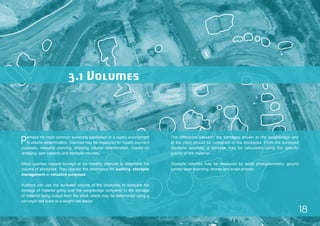
Perhaps the most common surveying application in a quarry environment 
is volume determination. Volumes may be measured for royalty payment 
purposes, resource planning, stripping volume determination, checks on 
dredging, dam capacity and stockpile volumes. 
Many quarries request surveys at six monthly intervals to determine the 
volume of stockpiles. They request this information for auditing, stockpile 
management or valuation purposes. 
Auditors can use the surveyed volume of the stockpiles to compare the 
tonnage of material going over the weighbridge compared to the tonnage 
of material being output from the plant, which may be determined using a 
conveyor belt scale or a weight belt feeder. 
The difference between the tonnages shown at the weighbridge and 
at the plant should be contained in the stockpiles. From the surveyed 
stockpile volumes, a tonnage may be calculated using the specific 
gravity of the material. 
Stockpile volumes may be measured by aerial photogrammetry, ground 
survey, laser scanning, drones and smart phones. 
3.1 Volumes
Mapping of a site refers to measuring features on the Earth’s surface in 3D 
19 
such as tops and toes of batters, changes in ground profile, spot heights, 
benches and drainage patterns. Once these ground features are measured then a 
3D model of the Earth’s surface can be prepared allowing for volume determination, 
engineering design, pit design, haul road design, haul road grade checking and 
drainage design. 
Other features typically measured in mapping a quarry include man made 
features such as buildings, fixed plant, fences, roads, tracks, overhead power 
lines and vegetation. 
Mapping of whole quarry sites is usually performed by aerial surveying but smaller 
areas may be mapped using ground survey or drones. 
3.2 Mapping
MAPPING OF WHOLE QUARRY SITES IS 
USUALLY PERFORMED BY AERIAL SURVEYING
21 
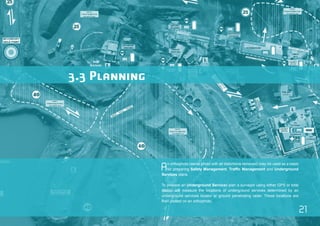
An orthophoto (aerial photo with all distortions removed) may be used as a basis 
for preparing Safety Management, Traffic Management and Underground 
Services plans. 
To prepare an Underground Services plan a surveyor using either GPS or total 
station will measure the locations of underground services determined by an 
underground services locator or ground penetrating radar. These locations are 
then plotted on an orthophoto. 
3.3 Planning
22 
3.4 Setting Out 
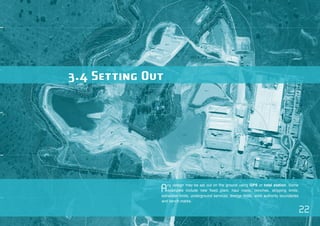
Any design may be set out on the ground using GPS or total station. Some 
examples include new fixed plant, haul roads, benches, stripping limits, 
extraction limits, underground services, dredge limits, work authority boundaries 
and bench marks.
23 
3.5 Cadastral Surveys 
Cadastral surveys are surveys that relate to land title boundaries. The title 
boundaries may need to be defined and marked on the ground for fencing, 
royalty volume calculations or placing structures near the boundaries. Easements 
may also need to be marked on the ground to ensure quarrying does not encroach. 
Subdivisions of land and the creation and removal of easements are also examples 
of cadastral surveys. These surveys are undertaken using GPS or total stations 
and must be performed by a registered or licensed surveyor. Sometimes Work 
Authority boundaries are related to the title boundaries.
CADASTRAL SURVEYS RELATE TO 
LAND TITLE BOUNDARIES
25 
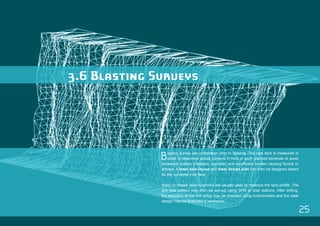
3.6 Blasting Surveys 
Blasting survey are undertaken prior to blasting. The rock face is measured in 
detail to determine actual burdens in front of each planned borehole to avoid 
excessive burden (vibration, oversize) and insufficient burden causing flyrock or 
airblast. A blast hole layout and blast design plan can then be designed based 
on the surveyed rock face. 
Static or mobile laser scanners are usually used to measure the face profile. The 
drill hole pattern may then be set-out using GPS or total stations. After drilling, 
the accuracy of the drill holes may be checked using inclinometers and the blast 
design may be amended if necessary.
26 
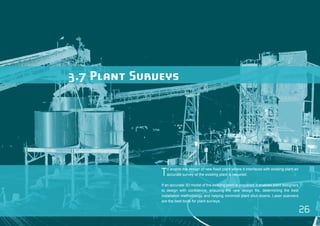
3.7 Plant Surveys 
To enable the design of new fixed plant where it interfaces with existing plant an 
accurate survey of the existing plant is required. 
If an accurate 3D model of the existing plant is prepared, it enables plant designers 
to design with confidence, ensuring the new design fits, determining the best 
installation methodology and helping minimize plant shut-downs. Laser scanners 
are the best tools for plant surveys.
27 
3.8 Monitoring Surveys 
Monitoring surveys are undertaken to measure the movement of objects over 
time. Typical examples are dam walls and rock faces. 
Targets are usually installed in locations where movement is expected. These 
targets are measured weekly, monthly or yearly depending on the risk. Total 
stations and GPS are usually the best tools for this.
TOTAL STATIONS AND GPS ARE USUALLY 
THE BEST TOOLS FOR MONITORING SURVEYS
29 
4. STOCKPILE VOLUME 
CALCULATION RESEARCH 
On 19 June 2014 we measured stockpile volumes at a site in Brooklyn 
in Melbourne’s western suburbs. The purpose of this research was to 
compare different methods of determining the volume of stockpiles. We used: 
• Aerial photogrammetry 
• GPS land survey 
• Laser scanning 
• Drone with a camera 
We compared: 
1. Accuracy 
2. Time spent on site 
3. Number of possible different sites to survey per day 
4. Cost 
The site chosen for the research was a small quarry and materials recycling 
facility. The size of the site was 220 metres by 500 metres. Stockpile sizes 
ranged from 35m³ to 29,000m³.
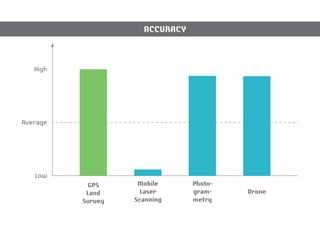
Conventionally it is assumed by industry that a GPS ground survey is the 
30 
most accurate. 
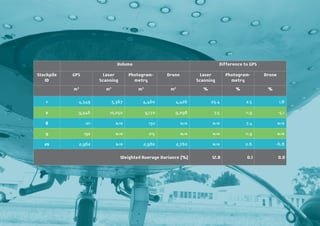
On this site difference in total volumes between GPS and both the UAV and 
photogrammetry was much less than 1%. For common stockpiles with a total 
volume of 17,000m³ the differences were less than 15m³. 
For both photogrammetry and the drone, individual larger stockpiles averaged 
accuracies of 2%. 
Laser scanning had poor accuracy for this site. Either a mobile or static scanner can 
only measure what is in the line of site so dips, holes or valleys are not measured. 
For the common stockpiles measured the scanner gave a 12% greater volume 
than the other three methods. 
4.1 Accuracy
High 
Average 
Low 
GPS 
Land 
Survey 
Mobile 
Laser 
Scanning 
Photo-gram-metry 
Drone 
ACCURACY
Volume Difference to GPS 
Stockpile 
ID 
GPS Laser 
Scanning 
Photogram-metry 
Drone Laser 
Scanning 
Photogram-metry 
Drone 
m3 m3 m3 m3 % % % 
1 4,349 5,367 4,460 4,426 23.4 2.5 1.8 
2 9,346 10,050 9,172 9,298 7.5 -1.9 -5.1 
8 121 n/a 130 n/a n/a 7.4 n/a 
9 192 n/a 215 n/a n/a 11.9 n/a 
25 2,962 n/a 2,980 2,760 n/a 0.6 -6.8 
Weighted Average Variance (%) 12.8 0.1 0.0
4.2 Time Spent on Your Site 
The time spent on site is important for safety reasons. Obviously the less time 
33 
surveyors are on site the better from both a safety point of view and to minimise 
interruptions to your normal operations. GPS, laser scanning and drone surveys 
require site inductions. 
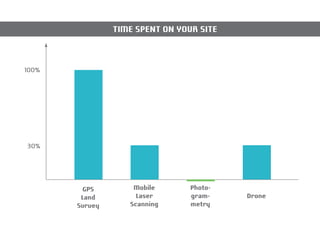
To survey the stockpiles on the Brooklyn site the GPS survey would require 
three teams working all day. 
Mobile laser scanners drive all around site interacting with mobile plant and 
other vehicles. 
Drone survey also requires a lot of time on site: the operator needs to see the 
drone at all times. At the Brooklyn site the drone survey took about two hours 
plus two hours of surveying a dense ground control points grid. Drones require 
more ground control points than photogrammetry. 
For this survey, photogrammetry required zero time on this site. The photo 
control points were placed five years previously external to site.
100% 
30% 
GPS 
Land 
Survey 
Mobile 
Laser 
Scanning 
Photo-gram-metry 
Drone 
TIME SPENT ON YOUR SITE
35 
4.3 Number of Sites per Day 
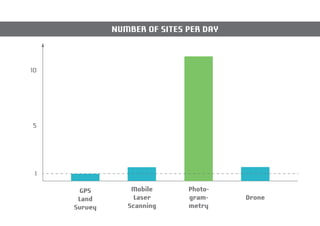
GPS, laser scanning and drone surveys require site inductions and travel time 
between sites and time spent on site carrying out the survey. This limits the 
amount of sites that can be surveyed in one day. 
Photogrammetry allows for surveying up to 12 sites per day, drone and mobile 
laser scanning surveys could complete two sites per day, however GPS surveys 
require multiple teams just to complete one site in a day. 
The amount of time spent measuring stockpiles is also important because on 
some sites stockpile volumes can change rapidly. Photogrammetric surveys 
allow a snapshot to be taken of stockpiles and all volumes calculated for the 
same instant in time.
10 
5 
1 
Drone 
GPS 
Land 
Survey 
NUMBER OF SITES PER DAY 
Mobile 
Laser 
Scanning 
Photo-gram-metry
37 
4.4 Cost Comparison 
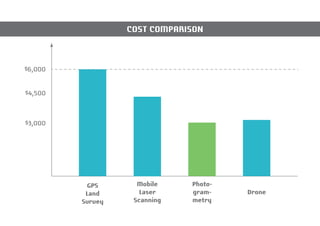
We estimated the cost for measuring all 26 stockpiles at the Brooklyn site and 
for calculating volumes. 
The GPS land survey estimate was based on extrapolating the five 
stockpiles measured. 
Mobile laser scanning cost were estimated based on the equipment hire rates. 
Photogrammetry costs were based on our current rates. 
Drone costs include actual costs of flying plus extrapolation of the three stockpile 
volumes calculated.
$6,000 
$4,500 
GPS 
Land 
Survey 
Mobile 
Laser 
Scanning 
Photo-gram-metry 
Drone 
$3,000 
COST COMPARISON
39 
5. CONCLUSION 
This paper has discussed some of the surveying technologies available on a 
quarry site and some of the different applications of surveying technologies for a 
quarry business. 
The paper also examined research undertaken by Landair Surveys on different 
methods to determine stockpile volumes. The research proved that drone surveys 
and photogrammetric surveys are just as accurate as GPS surveys. The research 
further showed that photogrammetry was the safest and most cost effective way to 
determine the volumes of stockpiles. 
Technology can be fast, accurate and bright and shiny, but it is important to know 
what to do with the data produced, the limitations of the data and the most efficient 
way of satisfying requirements.
1300 130 158 
info@landair.com.au 
www.landair.com.au

Surveying Innovations in Quarrying

  • 1.
    SURVEYING INNOVATIONS IN QUARRYING White Paper
  • 3.
    CONTENTS 1. INTRODUCTION4 2. SURVEYING TECHNOLOGIES 5 2.1 Aerial Photography and Photogrammetry 7 2.2 Aerial LiDAR 8 2.3 Total Stations and GPS 10 2.4 Laser Scanning 11 2.5 Unmanned Aerial Systems 12 2.6 Echo Sounders 14 2.7 Smartphone Apps 15 3. APPLICATIONS 17 3.1 Volumes 18 3.2 Mapping 19 3.3 Planning 21 3.4 Setting Out 22 3.5 Cadastral Surveys 23 3.6 Blasting Surveys 25 3.7 Plant Surveys 26 3.8 Monitoring Surveys 27 4. STOCKPILE VOLUME CALCULATION RESEARCH 29 4.1 Accuracy 30 4.2 Time Spent on Your Site 33 4.3 Number of Sites per Day 35 4.4 Cost Comparison 37 5. CONCLUSION 39
  • 4.
    4 1. INTRODUCTION Surveying has always been an essential component of successful quarrying in areas such as planning and monitoring. In the past two main surveying approaches for quarry applications were used: ground surveys or aerial surveys using fixed wing aircraft. Today, there are many more options available along with a broader range of applications. This paper will discuss three different aspects of surveying technology, namely the types of surveying technologies available for use in a quarry environment, the types of applications the surveying technologies are used for and comparative performance of different surveying technologies in measuring stockpile volumes.
  • 5.
    5 2. SURVEYINGTECHNOLOGIES Presently there are many different types of technology that can provide survey solutions for quarry requirements including: 1. Aerial Photography and Photogrammetry 2. Aerial LiDAR 3. Total Stations and GPS 4. Laser Scanning 5. Unmanned Aerial Systems (drones) 6. Echo Sounders 7. Smartphone Apps
  • 6.
    SURVEYING HAS ALWAYSBEEN AN ESSENTIAL COMPONENT OF SUCCESSFUL QUARRYING
  • 7.
    2.1 Aerial Photography and Photogrammetry Aerial photos may be vertical (straight down) or oblique (at an angle to the ground) and are usually captured from a fixed wing aircraft; however helicopters may also be used. Aerial images may also be obtained from satellites. The earliest aerial photos were taken in the 1850s from kites and balloons and the first photos from an aeroplane for mapping purposes were taken in 1913. Photogrammetry refers to the process of recording, interpreting and measuring from photographic images. The most common applications are for preparing topographic maps and the production of digital orthophotos. Topographic maps allow for the determination of volumes and the calculation of changes in quantities. Three dimensional mapping requires stereo aerial photographs: vertical photos that overlap (usually by 60%) enabling two different views of the same ground features. All photographs are prone to some distortion due to differences in the depth of field, lens distortions, atmospheric distortions etc. Orthophotos are photographs with all distortions removed and allow distances, angles, areas and positions to be measured directly from the photos. For accurate photogrammetry and orthophotos ground control points are required. 7
  • 8.
    8 2.2 AerialLiDAR LiDAR stands for Light Detection and Ranging. Essentially the LIDAR scanner is mounted on an aircraft and it shoots out laser beams towards the Earth and times how long it takes for the beam to return to the sensor. The information collected is the distance of each point measured to the sensor together with the intensity of the return signal. By combining this information with the position and orientation of the scanner an accurate and detailed model of the earth’s surface may be obtained. LiDAR can penetrate vegetation and so can measure the elevation of the Earth’s surface under trees. The varying intensities of the return signal may also be used to determine clearances of power lines above vegetation and canopy heights. Some forms of LiDAR may also be used to measure the earth’s surface under shallow water.
  • 9.
    LIDAR CAN MEASURETHE ELEVATION OF THE EARTH’S SURFACE UNDER TREES
  • 10.
    10 2.3 TotalStations and GPS Traditionally, land surveyors use total stations and GPS to measure points on the land or to mark out designs onto the earth. Total stations measure horizontal and vertical angles and distances and store this information electronically. Distances are measured by shooting infrared waves from the total station to a prism or reflector. Modern instruments also use lasers to measure distances without the needing a reflector. Using trigonometry the 3D coordinates of the point measured is determined. Each point on a feature may also be assigned a code that describes the feature. For example toe of bank, edge of concrete. The data measured is usually downloaded onto a computer in the office for processing and preparing plans in CAD. The accuracy of coordinates can be down to the mm level. Survey grade GPS technology is accurate to around ±10mm horizontally and ±20mm vertically. Surveyors require a base GPS receiver and a rover GPS receiver both communicating with each other to cancel out the errors from the satellites to get an accurate measurement. GPS rover receivers may use publicly available base station networks by connecting over the internet. Each point measured is also assigned a feature code.
  • 11.
    11 2.4 LaserScanning There are many different types of laser scanners: terrestrial, airborne, mobile and handheld. For each point, the scanner measures one slope distance and a horizontal and vertical angle. The collection of the points measured is called a point cloud. There are two main types of scanners used in surveying: 1. Time of flight and 2. Phase shift. Time of flights scanners are also known as laser pulse scanners and use our knowledge of the speed of light to determine a range. They are long range scanners (up to several km) but are slower than pulse scanners. Time of flight scanners measure in the order of 50-100 thousand points per second. Phase shift scanners compare the phase of the laser transmitted and received. These scanners are more precise and have higher speeds (up to one million points per second) but have a shorter range (50-300 metres). Terrestrial laser scanners may be mobile or static. Static laser scanners measure points with 3D coordinates and intensity. Some scanners can also colourise the points to give them true colours. The scanner is set up on a tripod and it systematically sweeps the area of interest until it has a complete picture of the visible space. These scanners are particularly useful in preparing accurate 3D models of existing plant and infrastructure. Mobile laser scanners are usually mounted on a vehicle and use GPS and Inertial Measurement Units to control the location of the scanner. These scanners are commonly used for earthworks volumes and for mapping.
  • 12.
    12 2.5 UnmannedAerial Systems Unmanned Aerial Systems (UAS) are Unmanned Aerial Vehicles (UAV’s) with sensors (drones). The sensors the drones carry may include cameras, GPS, LiDAR and others. There are a number of regulatory requirements from the Civil Aviation Safety Authority (CASA) to fly a drone for commercial purposes. Drone Operators need a UAV Operators Certificate, Operations Manual, Flight Manual and Maintenance Manual. CASA must give a specific Area Approval for the following: • to fly above 120 meters (400 feet) • inside controlled airspace • within 4.8 km (3 miles) of an aerodrome • over populated areas. An area is a populated area if in the event of a fault in the UAV there would be an unreasonable risk to the life, safety or property of somebody who is in the area but is not connected with the operation. Common uses for drones include preparing orthophotos and calculating approximate volumes.

  • 13.
    THERE ARE ANUMBER OF REGULATORY REQUIREMENTS TO FLY A DRONE
  • 14.
    14 2.6 EchoSounders Echo sounders are a type of sonar device. They transmit sound pulses into the water and time the interval between transmission and receipt of the sound from which the distance is determined. Bathymetric surveys determine the depth of dams, lakes, rivers and ocean floors. Duel frequency echo sounders may also be used to determine the thickness of sediment on dam or lake floors.
  • 15.
    15 2.7 SmartphoneApps Smartphone apps may use overlapping imagery combined with known dimensions of objects to determine approximate volumes or approximate dimensions of features.
  • 16.
    SMARTPHONE APPS DETERMINE APPROXIMATE VOLUMES
  • 17.
    17 3. APPLICATIONS Surveys are required for many applications on a quarry site. These applications include: 1. Volumes 2. Mapping 3. Planning 4. Setting Out 5. Cadastral Surveys 6. Blasting Surveys 7. Plant Surveys 8. Monitoring Surveys
  • 18.
    18 Perhaps themost common surveying application in a quarry environment is volume determination. Volumes may be measured for royalty payment purposes, resource planning, stripping volume determination, checks on dredging, dam capacity and stockpile volumes. Many quarries request surveys at six monthly intervals to determine the volume of stockpiles. They request this information for auditing, stockpile management or valuation purposes. Auditors can use the surveyed volume of the stockpiles to compare the tonnage of material going over the weighbridge compared to the tonnage of material being output from the plant, which may be determined using a conveyor belt scale or a weight belt feeder. The difference between the tonnages shown at the weighbridge and at the plant should be contained in the stockpiles. From the surveyed stockpile volumes, a tonnage may be calculated using the specific gravity of the material. Stockpile volumes may be measured by aerial photogrammetry, ground survey, laser scanning, drones and smart phones. 3.1 Volumes
  • 19.
    Mapping of asite refers to measuring features on the Earth’s surface in 3D 19 such as tops and toes of batters, changes in ground profile, spot heights, benches and drainage patterns. Once these ground features are measured then a 3D model of the Earth’s surface can be prepared allowing for volume determination, engineering design, pit design, haul road design, haul road grade checking and drainage design. Other features typically measured in mapping a quarry include man made features such as buildings, fixed plant, fences, roads, tracks, overhead power lines and vegetation. Mapping of whole quarry sites is usually performed by aerial surveying but smaller areas may be mapped using ground survey or drones. 3.2 Mapping
  • 20.
    MAPPING OF WHOLEQUARRY SITES IS USUALLY PERFORMED BY AERIAL SURVEYING
  • 21.
    21 An orthophoto(aerial photo with all distortions removed) may be used as a basis for preparing Safety Management, Traffic Management and Underground Services plans. To prepare an Underground Services plan a surveyor using either GPS or total station will measure the locations of underground services determined by an underground services locator or ground penetrating radar. These locations are then plotted on an orthophoto. 3.3 Planning
  • 22.
    22 3.4 SettingOut Any design may be set out on the ground using GPS or total station. Some examples include new fixed plant, haul roads, benches, stripping limits, extraction limits, underground services, dredge limits, work authority boundaries and bench marks.
  • 23.
    23 3.5 CadastralSurveys Cadastral surveys are surveys that relate to land title boundaries. The title boundaries may need to be defined and marked on the ground for fencing, royalty volume calculations or placing structures near the boundaries. Easements may also need to be marked on the ground to ensure quarrying does not encroach. Subdivisions of land and the creation and removal of easements are also examples of cadastral surveys. These surveys are undertaken using GPS or total stations and must be performed by a registered or licensed surveyor. Sometimes Work Authority boundaries are related to the title boundaries.
  • 24.
    CADASTRAL SURVEYS RELATETO LAND TITLE BOUNDARIES
  • 25.
    25 3.6 BlastingSurveys Blasting survey are undertaken prior to blasting. The rock face is measured in detail to determine actual burdens in front of each planned borehole to avoid excessive burden (vibration, oversize) and insufficient burden causing flyrock or airblast. A blast hole layout and blast design plan can then be designed based on the surveyed rock face. Static or mobile laser scanners are usually used to measure the face profile. The drill hole pattern may then be set-out using GPS or total stations. After drilling, the accuracy of the drill holes may be checked using inclinometers and the blast design may be amended if necessary.
  • 26.
    26 3.7 PlantSurveys To enable the design of new fixed plant where it interfaces with existing plant an accurate survey of the existing plant is required. If an accurate 3D model of the existing plant is prepared, it enables plant designers to design with confidence, ensuring the new design fits, determining the best installation methodology and helping minimize plant shut-downs. Laser scanners are the best tools for plant surveys.
  • 27.
    27 3.8 MonitoringSurveys Monitoring surveys are undertaken to measure the movement of objects over time. Typical examples are dam walls and rock faces. Targets are usually installed in locations where movement is expected. These targets are measured weekly, monthly or yearly depending on the risk. Total stations and GPS are usually the best tools for this.
  • 28.
    TOTAL STATIONS ANDGPS ARE USUALLY THE BEST TOOLS FOR MONITORING SURVEYS
  • 29.
    29 4. STOCKPILEVOLUME CALCULATION RESEARCH On 19 June 2014 we measured stockpile volumes at a site in Brooklyn in Melbourne’s western suburbs. The purpose of this research was to compare different methods of determining the volume of stockpiles. We used: • Aerial photogrammetry • GPS land survey • Laser scanning • Drone with a camera We compared: 1. Accuracy 2. Time spent on site 3. Number of possible different sites to survey per day 4. Cost The site chosen for the research was a small quarry and materials recycling facility. The size of the site was 220 metres by 500 metres. Stockpile sizes ranged from 35m³ to 29,000m³.
  • 30.
    Conventionally it isassumed by industry that a GPS ground survey is the 30 most accurate. On this site difference in total volumes between GPS and both the UAV and photogrammetry was much less than 1%. For common stockpiles with a total volume of 17,000m³ the differences were less than 15m³. For both photogrammetry and the drone, individual larger stockpiles averaged accuracies of 2%. Laser scanning had poor accuracy for this site. Either a mobile or static scanner can only measure what is in the line of site so dips, holes or valleys are not measured. For the common stockpiles measured the scanner gave a 12% greater volume than the other three methods. 4.1 Accuracy
  • 31.
    High Average Low GPS Land Survey Mobile Laser Scanning Photo-gram-metry Drone ACCURACY
  • 32.
    Volume Difference toGPS Stockpile ID GPS Laser Scanning Photogram-metry Drone Laser Scanning Photogram-metry Drone m3 m3 m3 m3 % % % 1 4,349 5,367 4,460 4,426 23.4 2.5 1.8 2 9,346 10,050 9,172 9,298 7.5 -1.9 -5.1 8 121 n/a 130 n/a n/a 7.4 n/a 9 192 n/a 215 n/a n/a 11.9 n/a 25 2,962 n/a 2,980 2,760 n/a 0.6 -6.8 Weighted Average Variance (%) 12.8 0.1 0.0
  • 33.
    4.2 Time Spenton Your Site The time spent on site is important for safety reasons. Obviously the less time 33 surveyors are on site the better from both a safety point of view and to minimise interruptions to your normal operations. GPS, laser scanning and drone surveys require site inductions. To survey the stockpiles on the Brooklyn site the GPS survey would require three teams working all day. Mobile laser scanners drive all around site interacting with mobile plant and other vehicles. Drone survey also requires a lot of time on site: the operator needs to see the drone at all times. At the Brooklyn site the drone survey took about two hours plus two hours of surveying a dense ground control points grid. Drones require more ground control points than photogrammetry. For this survey, photogrammetry required zero time on this site. The photo control points were placed five years previously external to site.
  • 34.
    100% 30% GPS Land Survey Mobile Laser Scanning Photo-gram-metry Drone TIME SPENT ON YOUR SITE
  • 35.
    35 4.3 Numberof Sites per Day GPS, laser scanning and drone surveys require site inductions and travel time between sites and time spent on site carrying out the survey. This limits the amount of sites that can be surveyed in one day. Photogrammetry allows for surveying up to 12 sites per day, drone and mobile laser scanning surveys could complete two sites per day, however GPS surveys require multiple teams just to complete one site in a day. The amount of time spent measuring stockpiles is also important because on some sites stockpile volumes can change rapidly. Photogrammetric surveys allow a snapshot to be taken of stockpiles and all volumes calculated for the same instant in time.
  • 36.
    10 5 1 Drone GPS Land Survey NUMBER OF SITES PER DAY Mobile Laser Scanning Photo-gram-metry
  • 37.
    37 4.4 CostComparison We estimated the cost for measuring all 26 stockpiles at the Brooklyn site and for calculating volumes. The GPS land survey estimate was based on extrapolating the five stockpiles measured. Mobile laser scanning cost were estimated based on the equipment hire rates. Photogrammetry costs were based on our current rates. Drone costs include actual costs of flying plus extrapolation of the three stockpile volumes calculated.
  • 38.
    $6,000 $4,500 GPS Land Survey Mobile Laser Scanning Photo-gram-metry Drone $3,000 COST COMPARISON
  • 39.
    39 5. CONCLUSION This paper has discussed some of the surveying technologies available on a quarry site and some of the different applications of surveying technologies for a quarry business. The paper also examined research undertaken by Landair Surveys on different methods to determine stockpile volumes. The research proved that drone surveys and photogrammetric surveys are just as accurate as GPS surveys. The research further showed that photogrammetry was the safest and most cost effective way to determine the volumes of stockpiles. Technology can be fast, accurate and bright and shiny, but it is important to know what to do with the data produced, the limitations of the data and the most efficient way of satisfying requirements.
  • 40.
    1300 130 158 info@landair.com.au www.landair.com.au