RAKAN KONGSI
  INFORMASI
1. What is a CCTV System?
A Closed Circuit Television (or CCTV) system is used for
visual (and frequently audio) monitoring and recording
events in a defined area

Generally categorised for the following requirements:

Deter criminal activity
Assist in the detection of crime
To instil confidence in staff/visitors/customers that they
 are in a safe and secure area
Provide management intelligence for health & safety or
 commercial use
2. CCTV Principles
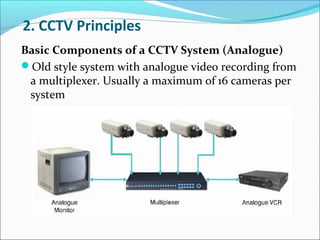
Basic Components of a CCTV System (Analogue)
Old style system with analogue video recording from
 a multiplexer. Usually a maximum of 16 cameras per
 system
2. CCTV Principles
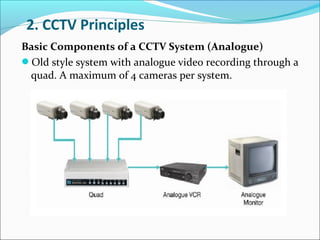
Basic Components of a CCTV System (Analogue)
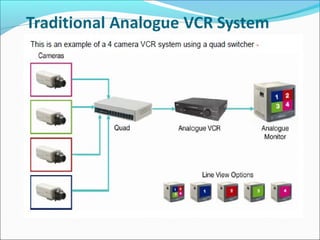
Old style system with analogue video recording through a
 quad. A maximum of 4 cameras per system.
CCTV Principles
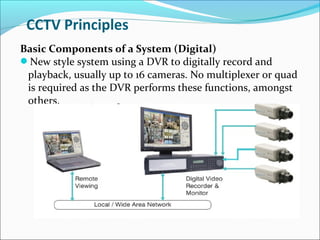
Basic Components of a System (Digital)
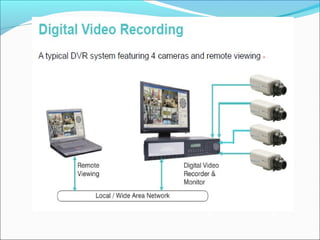
New style system using a DVR to digitally record and
 playback, usually up to 16 cameras. No multiplexer or quad
 is required as the DVR performs these functions, amongst
 others.
2. CCTV Principles
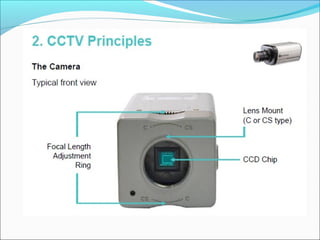
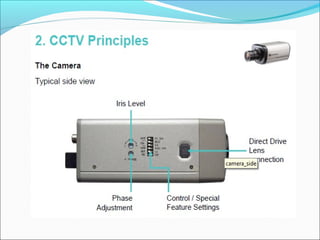
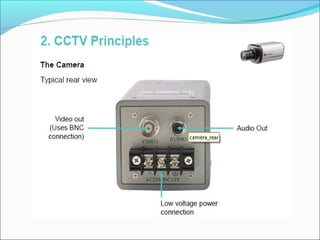
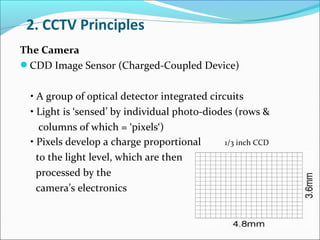
The Camera
CDD Image Sensor (Charged-Coupled Device)


 • A group of optical detector integrated circuits
 • Light is ‘sensed’ by individual photo-diodes (rows &
    columns of which = ‘pixels‘)
 • Pixels develop a charge proportional       1/3 inch CCD
   to the light level, which are then
   processed by the
   camera’s electronics
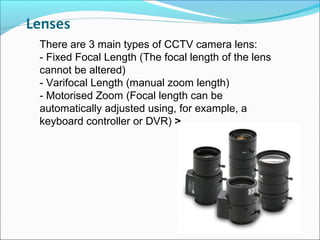
There are 3 main types of CCTV camera lens:
- Fixed Focal Length (The focal length of the lens
cannot be altered)
- Varifocal Length (manual zoom length)
- Motorised Zoom (Focal length can be
automatically adjusted using, for example, a
keyboard controller or DVR) >
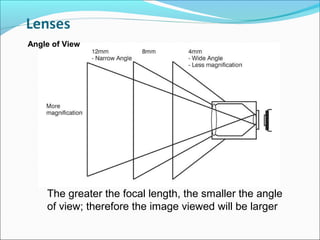
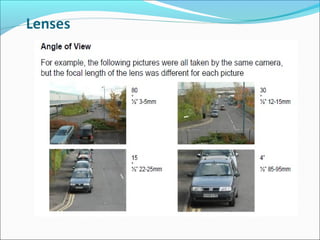
Angle of View


    The greater the focal length, the smaller the angle
    of view; therefore the image viewed will be larger
Iris Control Methods
Auto Iris
 Features integral circuitry which will vary the size of
 lens aperture according to changes in light
Direct Drive
  Lens control circuitry is within the camera, rather
 than the lens (Direct Drive specific lenses and
 cameras required)
Fixed/Manual Iris
  No electronic control over the iris
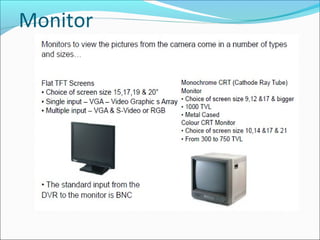
Monitor
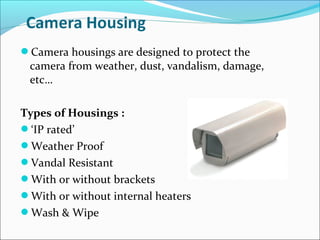
Camera housings are designed to protect the
 camera from weather, dust, vandalism, damage,
 etc…

Types of Housings :
‘IP rated’
Weather Proof
Vandal Resistant
With or without brackets
With or without internal heaters
Wash & Wipe
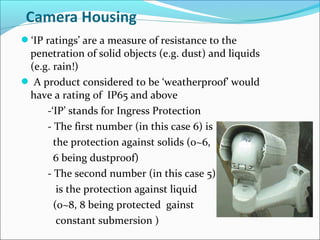
‘IP ratings’ are a measure of resistance to the
 penetration of solid objects (e.g. dust) and liquids
 (e.g. rain!)
 A product considered to be ‘weatherproof’ would
 have a rating of IP65 and above
     -‘IP’ stands for Ingress Protection
     - The first number (in this case 6) is
       the protection against solids (0~6,
       6 being dustproof)
     - The second number (in this case 5)
        is the protection against liquid
       (0~8, 8 being protected gainst
        constant submersion )
Cameras and housings with heaters will require
 power, mains or low voltage depending upon
 the product you have chosen.
Where low voltage PSUs are required there are
 various choices.
24v AV 500MA up to 4A
 12v DC 750MA up to 4A
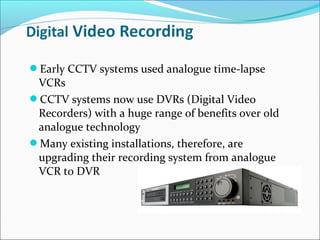
Early CCTV systems used analogue time-lapse
 VCRs
CCTV systems now use DVRs (Digital Video
 Recorders) with a huge range of benefits over old
 analogue technology
Many existing installations, therefore, are
 upgrading their recording system from analogue
 VCR to DVR
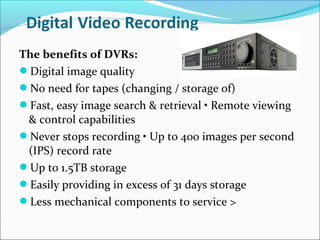
The benefits of DVRs:
Digital image quality
No need for tapes (changing / storage of)
Fast, easy image search & retrieval • Remote viewing
 & control capabilities
Never stops recording • Up to 400 images per second
 (IPS) record rate
Up to 1.5TB storage
Easily providing in excess of 31 days storage
Less mechanical components to service >
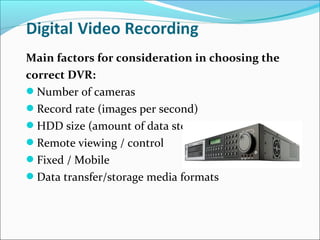
Main factors for consideration in choosing the
correct DVR:
Number of cameras
Record rate (images per second)
HDD size (amount of data storage)
Remote viewing / control
Fixed / Mobile
Data transfer/storage media formats
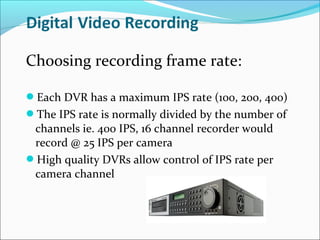
Choosing recording frame rate:

Each DVR has a maximum IPS rate (100, 200, 400)
The IPS rate is normally divided by the number of
 channels ie. 400 IPS, 16 channel recorder would
 record @ 25 IPS per camera
High quality DVRs allow control of IPS rate per
 camera channel
How long does the customer require to retain the
images/video on the DVR?
Record duration is the
  ‘data lifetime’ of the recorded
   images / video on the DVR
Data lifetime will be determined by customer’s
  specific requirements and rules of the Data Protection
  Act
Longer data lifetimes require larger HDD space
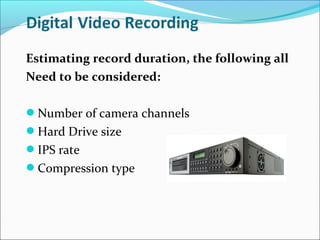
Estimating record duration, the following all
Need to be considered:

Number of camera channels
Hard Drive size
IPS rate
Compression type
Multiplex (Simultaneous functionality) :
Simplex: The ability to record or playback but not at the
 same time. For live view it is only possible to see a single
 camera on the monitor, multiple camera view is possible
 during playback.
Duplex: The ability to record and playback
 simultaneously. Multiple live screen is possible. However,
 the monitor will only display live images or recorded
 images.
Triplex: The ability to record and playback
 simultaneously. Multiple live screen is possible and unlike
 Duplex operation the monitor will display both live
 images and recorded images simultaneously.
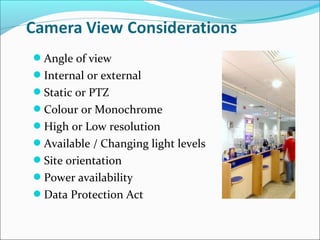
Angle of view
Internal or external
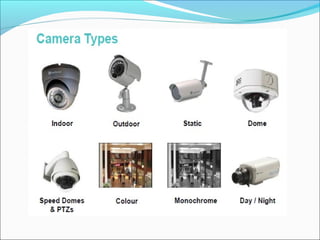
Static or PTZ
Colour or Monochrome
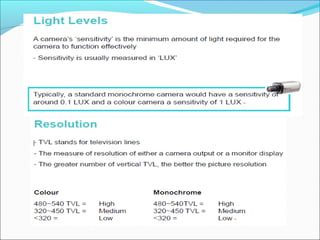
High or Low resolution
Available / Changing light levels
Site orientation
Power availability
Data Protection Act
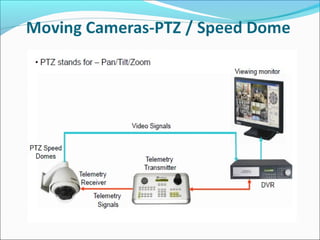
Alarm Inputs send telemetry signals via the DVR
 to automatically control / preset camera position,
 record rate, image resolution, etc…

Alarm Inputs triggered via:


 • External detection devices
 • Panic Button
 • Access Control Equipment
Lamps are usually Tungsten
Heat generated by the bulb’s wasted energy
 Aluminium-plated reflector
 Short life
 High power consumption / High cost of
 ownership
Range = various angles – Wide / Medium /
 Narrow
Use solid state technology
Long life
Better performance & efficiency
Gold-plated reflector
Low power consumption
Need IR sensitive cameras
Range = 10° ~ 60° / 20m ~ 175m >
SEKIAN TERIMA KASIH

PRINSIPLES OF CCTV

  • 1.
    RAKAN KONGSI INFORMASI
  • 3.
    1. What isa CCTV System? A Closed Circuit Television (or CCTV) system is used for visual (and frequently audio) monitoring and recording events in a defined area Generally categorised for the following requirements: Deter criminal activity Assist in the detection of crime To instil confidence in staff/visitors/customers that they are in a safe and secure area Provide management intelligence for health & safety or commercial use
  • 4.
    2. CCTV Principles BasicComponents of a CCTV System (Analogue) Old style system with analogue video recording from a multiplexer. Usually a maximum of 16 cameras per system
  • 5.
    2. CCTV Principles BasicComponents of a CCTV System (Analogue) Old style system with analogue video recording through a quad. A maximum of 4 cameras per system.
  • 6.
    CCTV Principles Basic Componentsof a System (Digital) New style system using a DVR to digitally record and playback, usually up to 16 cameras. No multiplexer or quad is required as the DVR performs these functions, amongst others.
  • 10.
    2. CCTV Principles TheCamera CDD Image Sensor (Charged-Coupled Device) • A group of optical detector integrated circuits • Light is ‘sensed’ by individual photo-diodes (rows & columns of which = ‘pixels‘) • Pixels develop a charge proportional 1/3 inch CCD to the light level, which are then processed by the camera’s electronics
  • 14.
    There are 3main types of CCTV camera lens: - Fixed Focal Length (The focal length of the lens cannot be altered) - Varifocal Length (manual zoom length) - Motorised Zoom (Focal length can be automatically adjusted using, for example, a keyboard controller or DVR) >
  • 15.
    Angle of View The greater the focal length, the smaller the angle of view; therefore the image viewed will be larger
  • 17.
    Iris Control Methods AutoIris Features integral circuitry which will vary the size of lens aperture according to changes in light Direct Drive Lens control circuitry is within the camera, rather than the lens (Direct Drive specific lenses and cameras required) Fixed/Manual Iris No electronic control over the iris
  • 18.
  • 19.
    Camera housings aredesigned to protect the camera from weather, dust, vandalism, damage, etc… Types of Housings : ‘IP rated’ Weather Proof Vandal Resistant With or without brackets With or without internal heaters Wash & Wipe
  • 20.
    ‘IP ratings’ area measure of resistance to the penetration of solid objects (e.g. dust) and liquids (e.g. rain!)  A product considered to be ‘weatherproof’ would have a rating of IP65 and above -‘IP’ stands for Ingress Protection - The first number (in this case 6) is the protection against solids (0~6, 6 being dustproof) - The second number (in this case 5) is the protection against liquid (0~8, 8 being protected gainst constant submersion )
  • 21.
    Cameras and housingswith heaters will require power, mains or low voltage depending upon the product you have chosen. Where low voltage PSUs are required there are various choices. 24v AV 500MA up to 4A 12v DC 750MA up to 4A
  • 22.
    Early CCTV systemsused analogue time-lapse VCRs CCTV systems now use DVRs (Digital Video Recorders) with a huge range of benefits over old analogue technology Many existing installations, therefore, are upgrading their recording system from analogue VCR to DVR
  • 24.
    The benefits ofDVRs: Digital image quality No need for tapes (changing / storage of) Fast, easy image search & retrieval • Remote viewing & control capabilities Never stops recording • Up to 400 images per second (IPS) record rate Up to 1.5TB storage Easily providing in excess of 31 days storage Less mechanical components to service >
  • 26.
    Main factors forconsideration in choosing the correct DVR: Number of cameras Record rate (images per second) HDD size (amount of data storage) Remote viewing / control Fixed / Mobile Data transfer/storage media formats
  • 27.
    Choosing recording framerate: Each DVR has a maximum IPS rate (100, 200, 400) The IPS rate is normally divided by the number of channels ie. 400 IPS, 16 channel recorder would record @ 25 IPS per camera High quality DVRs allow control of IPS rate per camera channel
  • 28.
    How long doesthe customer require to retain the images/video on the DVR? Record duration is the ‘data lifetime’ of the recorded images / video on the DVR Data lifetime will be determined by customer’s specific requirements and rules of the Data Protection Act Longer data lifetimes require larger HDD space
  • 29.
    Estimating record duration,the following all Need to be considered: Number of camera channels Hard Drive size IPS rate Compression type
  • 30.
    Multiplex (Simultaneous functionality): Simplex: The ability to record or playback but not at the same time. For live view it is only possible to see a single camera on the monitor, multiple camera view is possible during playback. Duplex: The ability to record and playback simultaneously. Multiple live screen is possible. However, the monitor will only display live images or recorded images. Triplex: The ability to record and playback simultaneously. Multiple live screen is possible and unlike Duplex operation the monitor will display both live images and recorded images simultaneously.
  • 31.
    Angle of view Internalor external Static or PTZ Colour or Monochrome High or Low resolution Available / Changing light levels Site orientation Power availability Data Protection Act
  • 33.
    Alarm Inputs sendtelemetry signals via the DVR to automatically control / preset camera position, record rate, image resolution, etc… Alarm Inputs triggered via: • External detection devices • Panic Button • Access Control Equipment
  • 34.
    Lamps are usuallyTungsten Heat generated by the bulb’s wasted energy  Aluminium-plated reflector  Short life  High power consumption / High cost of ownership Range = various angles – Wide / Medium / Narrow
  • 35.
    Use solid statetechnology Long life Better performance & efficiency Gold-plated reflector Low power consumption Need IR sensitive cameras Range = 10° ~ 60° / 20m ~ 175m >
  • 37.