Learning in Safe Schools,
creating classrooms where all
  students belong, 2nd ed – 	
  
   Brownlie	
  and	
  King,	
  2011	
  
     Pembroke	
  Publishers	
  
             Coquitlam	
  	
  
           April	
  17th,	
  2012	
  
The Context:
 4 big ideas
Schools as communities where
 everyone ‘owns’ all students	


             Chap.	
  1-­‐4	
  
Goal:	


to	
  support	
  students	
  in	
  working	
  
  effecDvely	
  in	
  the	
  classroom	
  
  environment	
  
Rationale:	


By	
  sharing	
  our	
  collecDve	
  
 knowledge	
  about	
  our	
  classes	
  of	
  
 students	
  and	
  developing	
  a	
  plan	
  of	
  
 acDon	
  based	
  on	
  this,	
  we	
  can	
  
 beHer	
  meet	
  the	
  needs	
  of	
  all	
  
 students.	
  
A Key Belief

IntervenDon	
  is	
  focused	
  on	
  classroom	
  support.	
  	
  
  Classroom-­‐based	
  intervenDon	
  does	
  NOT	
  mean	
  
  that	
  all	
  specialists	
  have	
  to	
  be	
  in	
  the	
  classroom	
  
  all	
  the	
  Dme.	
  	
  Instead,	
  the	
  RESULTS	
  of	
  their	
  
  work	
  have	
  to	
  show	
  up	
  in	
  the	
  classroom.	
  
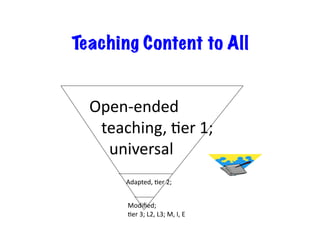
Teaching Content to All


  Open-­‐ended	


  teaching,	
  Der	
  1;	


  universal	
  
             	
  Adapted,	
  Der	
  2;	


              Modified;	
  	
  
              Der	
  3;	
  L2,	
  L3;	
  M,	
  I,	
  E	
  
Shifting or reaffirming
resource/support models


         Chap.	
  9	
  
A Non-categorical Resource Model
•    Co-­‐teach	
  
•    Work	
  with	
  small	
  groups/individuals	
  
•    Consult	
  
•    Peer/parent	
  tutors	
  
•    EducaDonal	
  assistant	
  programming	
  
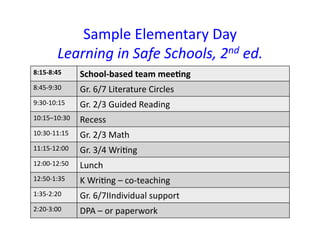
Sample	
  Elementary	
  Day	
  
             Learning	
  in	
  Safe	
  Schools,	
  2nd	
  ed.	
  
8:15-­‐8:45	
           School-­‐based	
  team	
  mee4ng	
  
8:45-­‐9:30	
           Gr.	
  6/7	
  Literature	
  Circles	
  
9:30-­‐10:15	
          Gr.	
  2/3	
  Guided	
  Reading	
  
10:15–10:30	
           Recess	
  
10:30-­‐11:15	
         Gr.	
  2/3	
  Math	
  
11:15-­‐12:00	
         Gr.	
  3/4	
  WriDng	
  
12:00-­‐12:50	
  	
     Lunch	
  
12:50-­‐1:35	
          K	
  WriDng	
  –	
  co-­‐teaching	
  
1:35-­‐2:20	
           Gr.	
  6/7IIndividual	
  support	
  
2:20-­‐3:00	
           DPA	
  –	
  or	
  paperwork	
  
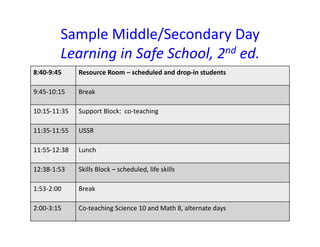
Sample	
  Middle/Secondary	
  Day	
  
             Learning	
  in	
  Safe	
  School,	
  2nd	
  ed.	
  
8:40-­‐9:45	
       Resource	
  Room	
  –	
  scheduled	
  and	
  drop-­‐in	
  students	
  

9:45-­‐10:15	
      Break	
  

10:15-­‐11:35	
     Support	
  Block:	
  	
  co-­‐teaching	
  

11:35-­‐11:55	
     USSR	
  

11:55-­‐12:38	
     Lunch	
  

12:38-­‐1:53	
      Skills	
  Block	
  –	
  scheduled,	
  life	
  skills	
  

1:53-­‐2:00	
       Break	
  

2:00-­‐3:15	
       Co-­‐teaching	
  Science	
  10	
  and	
  Math	
  8,	
  alternate	
  days	
  
Class Reviews


   Chap.	
  10	
  
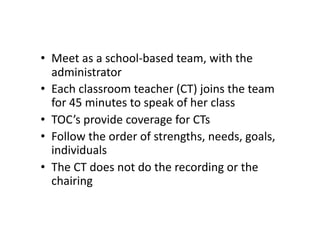
•  Meet	
  as	
  a	
  school-­‐based	
  team,	
  with	
  the	
  
   administrator	
  
•  Each	
  classroom	
  teacher	
  (CT)	
  joins	
  the	
  team	
  
   for	
  45	
  minutes	
  to	
  speak	
  of	
  her	
  class	
  
•  TOC’s	
  provide	
  coverage	
  for	
  CTs	
  
•  Follow	
  the	
  order	
  of	
  strengths,	
  needs,	
  goals,	
  
   individuals	
  
•  The	
  CT	
  does	
  not	
  do	
  the	
  recording	
  or	
  the	
  
   chairing	
  
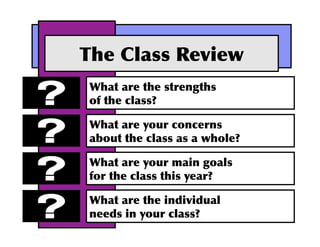
The	
 Class	
 Review	
  
 What	
 are	
 the	
 strengths	
 	
 
 of	
 the	
 class?	
 

 What	
 are	
 your	
 concerns	
 	
 
 about	
 the	
 class	
 as	
 a	
 whole?	
 

 What	
 are	
 your	
 main	
 goals	
 	
 
 for	
 the	
 class	
 this	
 year?	
 

 What	
 are	
 the	
 individual	
 	
 
 needs	
 in	
 your	
 class?
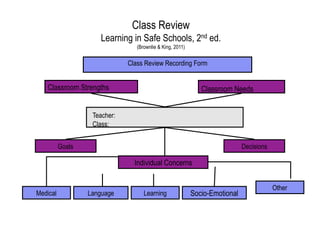
Class Review
                      Learning in Safe Schools, 2nd ed.
                                                       	
  
                                 (Brownlie & King, 2011)

                              Class Review Recording Form


   Classroom Strengths                                           Classroom Needs


                   Teacher:
                   Class:


          Goals                                                                 Decisions

                                Individual Concerns


                                                                                            Other
Medical           Language          Learning                  Socio-Emotional
Performance Based Assessments


•  It’s	
  All	
  about	
  Thinking	
  –	
  CollaboraDng	
  to	
  
   Support	
  All	
  Learners	
  (English,	
  SS,	
  HumaniDes	
  
   OR	
  Math,	
  Science)	
  
•  Student	
  Diversity	
  
School-wide performance based
     reading assessment
•  Standard	
  Reading	
  Assessment	
  (see	
  Student	
  
   Diversity	
  or	
  It’s	
  All	
  about	
  Thinking)	
  
•  DART	
  
•  RAD	
  
•  QCA	
  
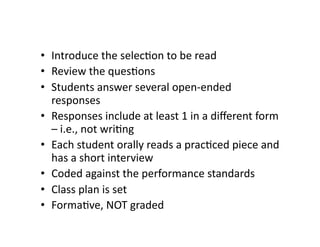
•  Introduce	
  the	
  selecDon	
  to	
  be	
  read	
  
•  Review	
  the	
  quesDons	
  
•  Students	
  answer	
  several	
  open-­‐ended	
  
   responses	
  
•  Responses	
  include	
  at	
  least	
  1	
  in	
  a	
  different	
  form	
  
   –	
  i.e.,	
  not	
  wriDng	
  
•  Each	
  student	
  orally	
  reads	
  a	
  pracDced	
  piece	
  and	
  
   has	
  a	
  short	
  interview	
  
•  Coded	
  against	
  the	
  performance	
  standards	
  
•  Class	
  plan	
  is	
  set	
  
•  FormaDve,	
  NOT	
  graded	
  

Learning in safe schools

  • 1.
    Learning in SafeSchools, creating classrooms where all students belong, 2nd ed –   Brownlie  and  King,  2011   Pembroke  Publishers   Coquitlam     April  17th,  2012  
  • 2.
    The Context: 4big ideas
  • 3.
    Schools as communitieswhere everyone ‘owns’ all students   Chap.  1-­‐4  
  • 4.
    Goal:   to  support  students  in  working   effecDvely  in  the  classroom   environment  
  • 5.
    Rationale:   By  sharing  our  collecDve   knowledge  about  our  classes  of   students  and  developing  a  plan  of   acDon  based  on  this,  we  can   beHer  meet  the  needs  of  all   students.  
  • 6.
    A Key Belief IntervenDon  is  focused  on  classroom  support.     Classroom-­‐based  intervenDon  does  NOT  mean   that  all  specialists  have  to  be  in  the  classroom   all  the  Dme.    Instead,  the  RESULTS  of  their   work  have  to  show  up  in  the  classroom.  
  • 7.
    Teaching Content toAll Open-­‐ended          teaching,  Der  1;              universal    Adapted,  Der  2;   Modified;     Der  3;  L2,  L3;  M,  I,  E  
  • 8.
  • 9.
    A Non-categorical ResourceModel •  Co-­‐teach   •  Work  with  small  groups/individuals   •  Consult   •  Peer/parent  tutors   •  EducaDonal  assistant  programming  
  • 10.
    Sample  Elementary  Day   Learning  in  Safe  Schools,  2nd  ed.   8:15-­‐8:45   School-­‐based  team  mee4ng   8:45-­‐9:30   Gr.  6/7  Literature  Circles   9:30-­‐10:15   Gr.  2/3  Guided  Reading   10:15–10:30   Recess   10:30-­‐11:15   Gr.  2/3  Math   11:15-­‐12:00   Gr.  3/4  WriDng   12:00-­‐12:50     Lunch   12:50-­‐1:35   K  WriDng  –  co-­‐teaching   1:35-­‐2:20   Gr.  6/7IIndividual  support   2:20-­‐3:00   DPA  –  or  paperwork  
  • 11.
    Sample  Middle/Secondary  Day   Learning  in  Safe  School,  2nd  ed.   8:40-­‐9:45   Resource  Room  –  scheduled  and  drop-­‐in  students   9:45-­‐10:15   Break   10:15-­‐11:35   Support  Block:    co-­‐teaching   11:35-­‐11:55   USSR   11:55-­‐12:38   Lunch   12:38-­‐1:53   Skills  Block  –  scheduled,  life  skills   1:53-­‐2:00   Break   2:00-­‐3:15   Co-­‐teaching  Science  10  and  Math  8,  alternate  days  
  • 12.
    Class Reviews Chap.  10  
  • 13.
    •  Meet  as  a  school-­‐based  team,  with  the   administrator   •  Each  classroom  teacher  (CT)  joins  the  team   for  45  minutes  to  speak  of  her  class   •  TOC’s  provide  coverage  for  CTs   •  Follow  the  order  of  strengths,  needs,  goals,   individuals   •  The  CT  does  not  do  the  recording  or  the   chairing  
  • 14.
    The Class Review   What are the strengths of the class? What are your concerns about the class as a whole? What are your main goals for the class this year? What are the individual needs in your class?
  • 15.
    Class Review Learning in Safe Schools, 2nd ed.   (Brownlie & King, 2011) Class Review Recording Form Classroom Strengths Classroom Needs Teacher: Class: Goals Decisions Individual Concerns Other Medical Language Learning Socio-Emotional
  • 16.
    Performance Based Assessments • It’s  All  about  Thinking  –  CollaboraDng  to   Support  All  Learners  (English,  SS,  HumaniDes   OR  Math,  Science)   •  Student  Diversity  
  • 17.
    School-wide performance based reading assessment •  Standard  Reading  Assessment  (see  Student   Diversity  or  It’s  All  about  Thinking)   •  DART   •  RAD   •  QCA  
  • 19.
    •  Introduce  the  selecDon  to  be  read   •  Review  the  quesDons   •  Students  answer  several  open-­‐ended   responses   •  Responses  include  at  least  1  in  a  different  form   –  i.e.,  not  wriDng   •  Each  student  orally  reads  a  pracDced  piece  and   has  a  short  interview   •  Coded  against  the  performance  standards   •  Class  plan  is  set   •  FormaDve,  NOT  graded