8P20 Week 9
Writing Assessment
Oral Communication Part 1
A note on last week
• Balancing the heavy with some good 
• Circles of Life response & Inherent goodness
https://www.huffingtonpost.ca/2018/11/03/rings
-of-peace-toronto-synagogue-
muslims_a_23579698/
• Current Events Daily Presentations (reading,
writing, oral communication and media literacy
all in one 5 minute start to your day!)
A note on last week
• Children as Change Makers:
– Current events can significantly change the climate in the classroom
and sometimes you need to abandon your plans to address them.
– Students are affected by what they see and hear on the news and
often feel powerless to affect real and meaningful change.
– Many may be fearful and struggling with anxiety which negatively
impacts their ability to learn.
– As educators, we need to provide students with a safe space for
sharing their fears and explicitly teach some practical strategies for
coping productively with their anxieties, so that we’re able to reach –
and teach – them more effectively.
– Empowering students with support and the means to make a
difference can be life-altering and will help to ensure that all of our
students grow up to be caring, concerned, and ACTIVE global citizens.
A note on last week
• Children as Change Makers:
– Reflect back on last week: What happens when we
put our fears on paper?
– Our classrooms are microcosms of society.
– Empathy and relationships are the basis for positive change.
– Feelings can be the catalyst for ACTION – Craig Kielburger (you never
know who will be the next world changer – we must cultivate them all)
– CBT: Thoughts, feelings, and actions are all intricately connected; if you
change one, the others change automatically.
– If students are feeling insecure or vulnerable in their worlds, one way to
shift those thoughts and feelings is to empower them to take action.
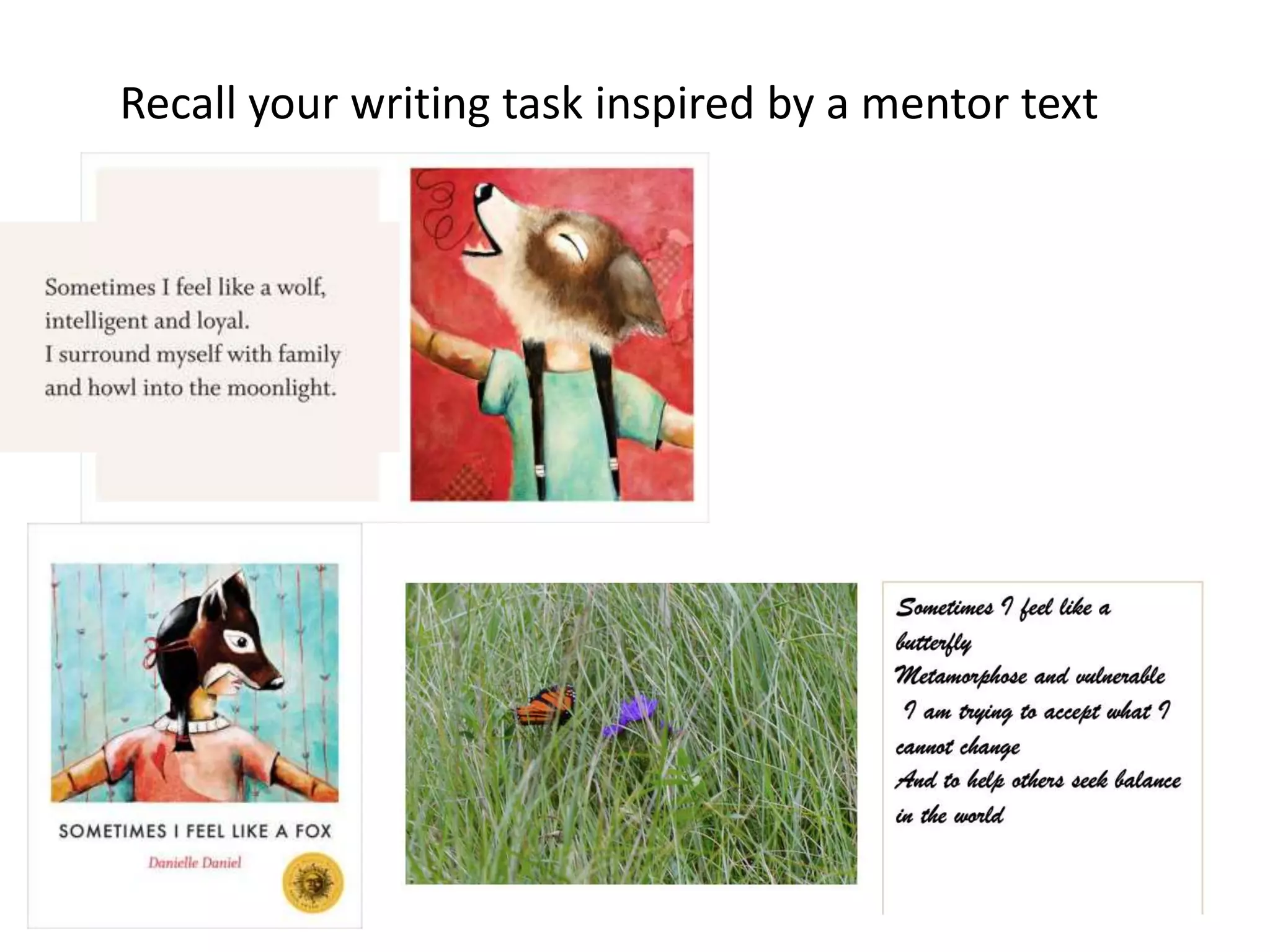
Recall your writing task inspired by a mentor text
Co-created rubrics
• What:
– A rubric created with students (shared writing task)
• Why:
– To give students ownership over their learning,
– To ensure they understand how to succeed,
– To ensure student friendly language is used
• How:
– Have a plan in your mind, list the curriculum expectations in student
friendly language, and organize their thoughts in categories,
– Ask them about what is important to include, probe them for deeper
examples of what they mean, prompt them to explain reasons for
their choices.
– Write down all student ideas, then create the official document on
your own using “their ideas”.
A Note on Feedback
Feedback needs to be:
• specific and detailed
– Excellent job! Vs. “Your vocabulary is really expanding allowing
you to really paint a picture in the mind of your reader!”
• positive (ie. What a student can do not can’t do)
– Your vocabulary is not descriptive enough vs “Using a
thesaurus will help you find even more descriptive words”
• understood by the student
– Abysmal diction vs “Some of your words aren’t saying what
you mean to say”
• applied to student learning
– Great job vs “Excellent word choices, especially when you
used the word grumbly tummy to describe your hunger!”
Our writing rubric for our poems
• Your task: Look at the poems provided. How should they be assessed?
• Expectations:
– 1.2 – developing ideas
– 2.3 – vivid, figurative, innovative word choice (metaphorical language)
– 3.6 – proofread for spelling, punctuation, grammar
Suggestions CRITERIA Yes, And!
Content (ideas):
-animal + 2 adjectives + 2 action phrases
-animal is from totem website
-animal + adjective link to your feelings about current events
Form (poem, metaphors):
-starts with “sometimes I feel like a…”
-appropriate word choice (lyrical and on topic)
Conventions and publishing (spelling, layout, images):
-text in 4 lines like the book
-appropriate image + visual creativity + readable font
Correct spelling, grammar, and punctuation
- 2.1 – writing form (poem)
- 3.7 - publishing (layout, images)
Once we have created our rubric, swap poems with another table group
and offer feedback on the printed copy provided.
Our writing rubric for our poems
• Your task: Look at the poems provided. How should they be assessed?
• Expectations:
– 1.2 – developing ideas
– 2.3 – vivid, figurative, innovative word choice (metaphorical language)
– 3.6 – proofread for spelling, punctuation, grammarSuggestions CRITERIA Yes, And!
Content (ideas):
-animal + characteristics + actions
-actions and descriptors match the animal
Form (poem, metaphors):
-Start with “Sometimes I feel like a…”
-Includes 2 adjectives, followed by two actions
-2 sentences, 2nd sentence with a conjuction
-metaphorical or figurative language used
Conventions and publishing (spelling, layout, images):
-includes appropriate image(s), visually appealing, font
-Sentence layout matches poem (4 lines)
-free of spelling, punctuation, and grammar errors
- 2.1 – writing form (poem)
- 3.7 - publishing (layout, images)
Once we have created our rubric, swap poems with another table group
and offer feedback on the printed copy provided.
A Sample GRR Lesson Sequence
Part 3: consolidation
sharing our work
• Thinking About Assessment:
– How would it have been helpful to co-create our rubric before you
started your writing task?
– Why is it important to share our assessment tools with students?
• Thinking About Lesson Planning:
– How did I hook you?
– What writing actions did you take?
– Why is consolidation an important stage?
– How did I weave current events into the lesson?
A quick note on assessment
• What are assessment tools?
• What are the different styles of rubrics?
ASSESSMENT TOOLS
• Checklists
• Rubrics
• Checkbrick
• Anecdotal notes
• Scales and scores
Assessment tools are
what teachers (and
students) use to
evaluate strengths and
weaknesses, and
make judgments/give
a grade.
Assessment strategies are the tasks students
complete. These are evaluated using a tool.
 Test/Quiz – marked with a score /10
 Project – marked with a checklist
 Essay/Narrative – marked with a rubric
 Presentation – marked with anecdotal notes
A closer look at rubrics
• A RUBRIC IS AN EVALUATIVE TOOL FOR
TEACHERS AND LEARNERS THAT...
– Establishes goals and expectations for learning
– Establishes standards
– Provides guidelines for teaching and learning
– Provides measures for proficiency and
accountability
A closer look at rubrics
RUBRICS CONTAIN CRITERIA AND QUALIFIERS
• CRITERIA: the components being assessed
– Need to reflect curriculum expectations
– Need to separate ideas (content) and skills (spelling etc).
– Need to be observable traits
• QUALIFIERS: the degree of competency demonstrated
by the work
– Need to be based on the language in the curriculum
documents (see achievement chart)
– Need to be objective as much as possible
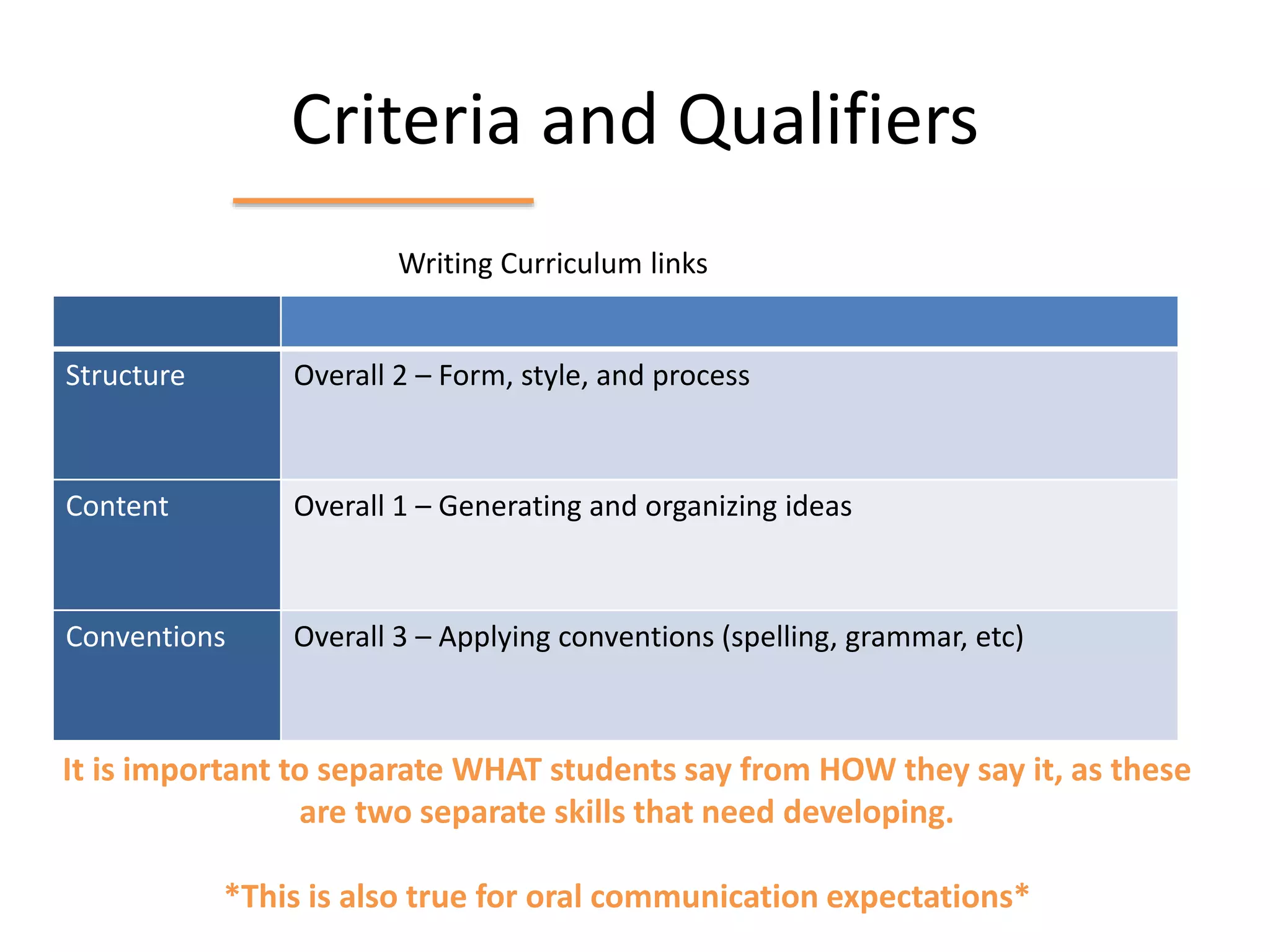
Criteria and Qualifiers
Structure Overall 2 – Form, style, and process
Content Overall 1 – Generating and organizing ideas
Conventions Overall 3 – Applying conventions (spelling, grammar, etc)
Writing Curriculum links
It is important to separate WHAT students say from HOW they say it, as these
are two separate skills that need developing.
*This is also true for oral communication expectations*
Criteria and Qualifiers
Level 4 Level 3 Level 2 Level 1
Structure Strong topic sentence,
3-5 detail sentences,
strong concluding
sentence
Appropriate topic
sentence, 3-4 detail
sentences, appropriate
concluding sentence
Somewhat appropriate
topic sentence, 2-3
detail sentences,
Somewhat appropriate
concluding sentence
Missing components of
a paragraph
Content Topic sentence is clear
and directive; all details
are convincing;
conclusion is clear and
compelling; Ideas are all
on one topic and are in
a logical and well-
thought order.
Topic sentence is clear;
most details are
convincing; conclusion
is clear; Ideas are all on
one topic and are in a
reasonable order.
Topic sentence and
conclusion are
somewhat clear; details
are somewhat
convincing; Ideas are
mostly one on one topic
but stray a bit; order is
somewhat logical.
Topic is unclear; details
are not convincing or
are missing; ideas could
be in a more logical
order to strengthen
clarity of argument.
Conventions No errors in grammar,
spelling, punctuation, or
word choices.
Mostly free of errors in
grammar, spelling,
punctuation, or word
choices.
Many errors in
grammar, spelling,
punctuation, or word
choices.
Writing has too many
errors that inhibit
reader understanding.
PERSUASIVE PARAGRAPH RUBRIC
This has all the information students need, but it looks wordy and overwhelming to many
Criteria and Qualifiers
Level 4 Level 3 Level 2 Level 1
Structure
-topic sentence
-body details
-concluding
sentence
All components
included with high
degree of thought
and creativity
All components
included
Components are
somewhat present
Missing components
Content
-clear topic
-convincing details
related to topic
-logical order
-persuasive word
choices
High degree of
clarity and
persuasiveness;
excellent
organization and
word choices
Considerable clarity
and persuasion
Somewhat clear and
persuasive
Limited clarity and
persusaion
Conventions
-spelling
-grammar
-punctuation
Free from all errors Mostly free from
errors
A few errors Many errors
PERSUASIVE PARAGRAPH RUBRIC
This format is cleaner, and serves as more of a checklist with degrees of quality of completion
3 types of rubrics:
Holistic, analytic, & single-point
A holistic rubric is the most general kind. It lists three to five levels of performance, along with a
broad description of the characteristics that define each level.
Advantages:
-easy for teacher
-faster to grade
-gives one grade to piece
as a whole
Disadvantages:
-doesn't’t provide
targeted feedback for
students
Ideal use:
-standardized tests or
quick tasks that do not
need (or have time for)
feedback
3 types of rubrics:
Holistic, analytic, & single-point
An analytic rubric breaks down the characteristics of an assignment into parts, allowing the
scorer to itemize and define exactly what aspects are strong, and which ones need
improvement. Advantages:
-gives students a clearer
picture of why they received
the score they got
-easier for teachers to justify
grades
Disadvantages:
-time consuming and
challenging to create (so many
qualifiers and descriptors for
each level)
-longer, which means students
are less likely to read them
3 types of rubrics:
Holistic, analytic, & single-point
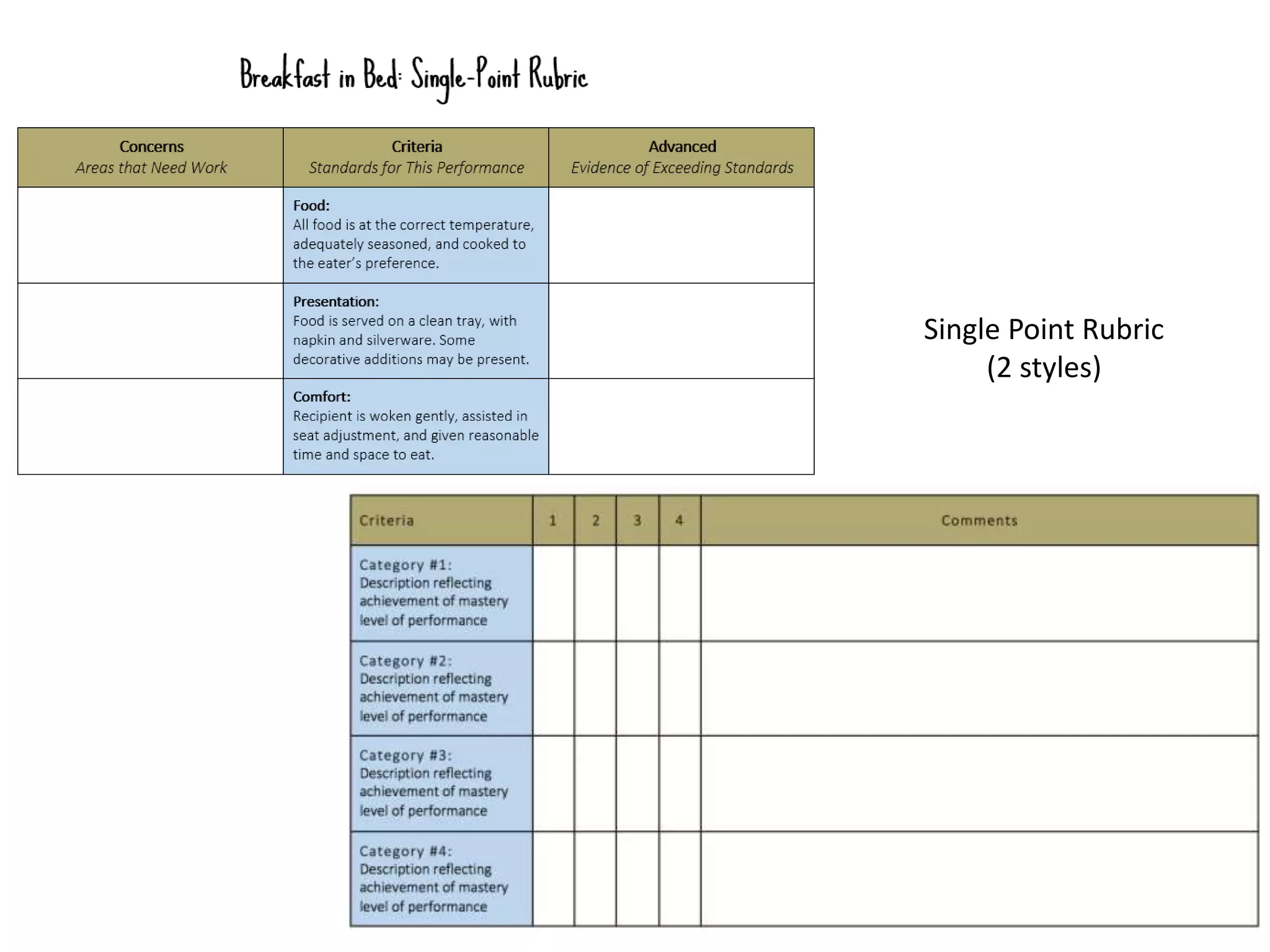
A single-point rubric is a lot like an analytic rubric, because it breaks down the components
of an assignment into different criteria. What makes it different is that it only describes the
criteria for proficiency; it does not attempt to list all the ways a student could fall short, nor
does it specify how a student could exceed expectations.
Advantages:
-contains less language, so its likely
to be read
-less time to create, while still rich
in detail of expectations
-areas of concern and excellence
are open ended (sometimes a
rubric can be constricting – here,
you don’t have to predict every
way students will deviate from a 3)
Disadvantages:
-requires more writing for the
teacher than simply highlighting a
column
Single Point Rubric
(2 styles)
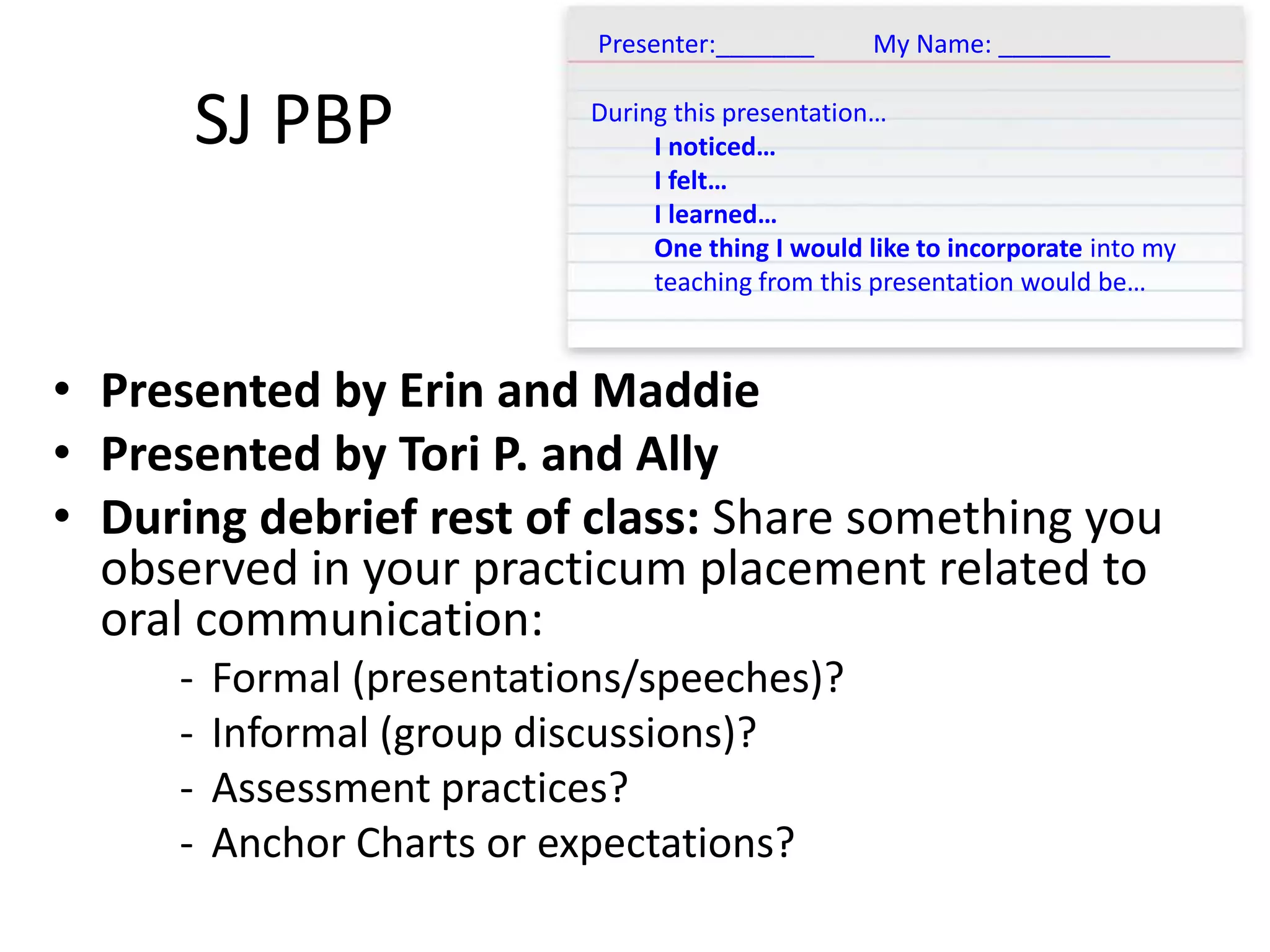
SJ PBP
• Presented by Erin and Maddie
• Presented by Tori P. and Ally
• During debrief rest of class: Share something you
observed in your practicum placement related to
oral communication:
- Formal (presentations/speeches)?
- Informal (group discussions)?
- Assessment practices?
- Anchor Charts or expectations?
Presenter:_______ My Name: ________
During this presentation…
I noticed…
I felt…
I learned…
One thing I would like to incorporate into my
teaching from this presentation would be…
Never underestimate
the effectiveness of sound
ORAL COMMUNICATION
• Speaking Skills
• Listening Skills
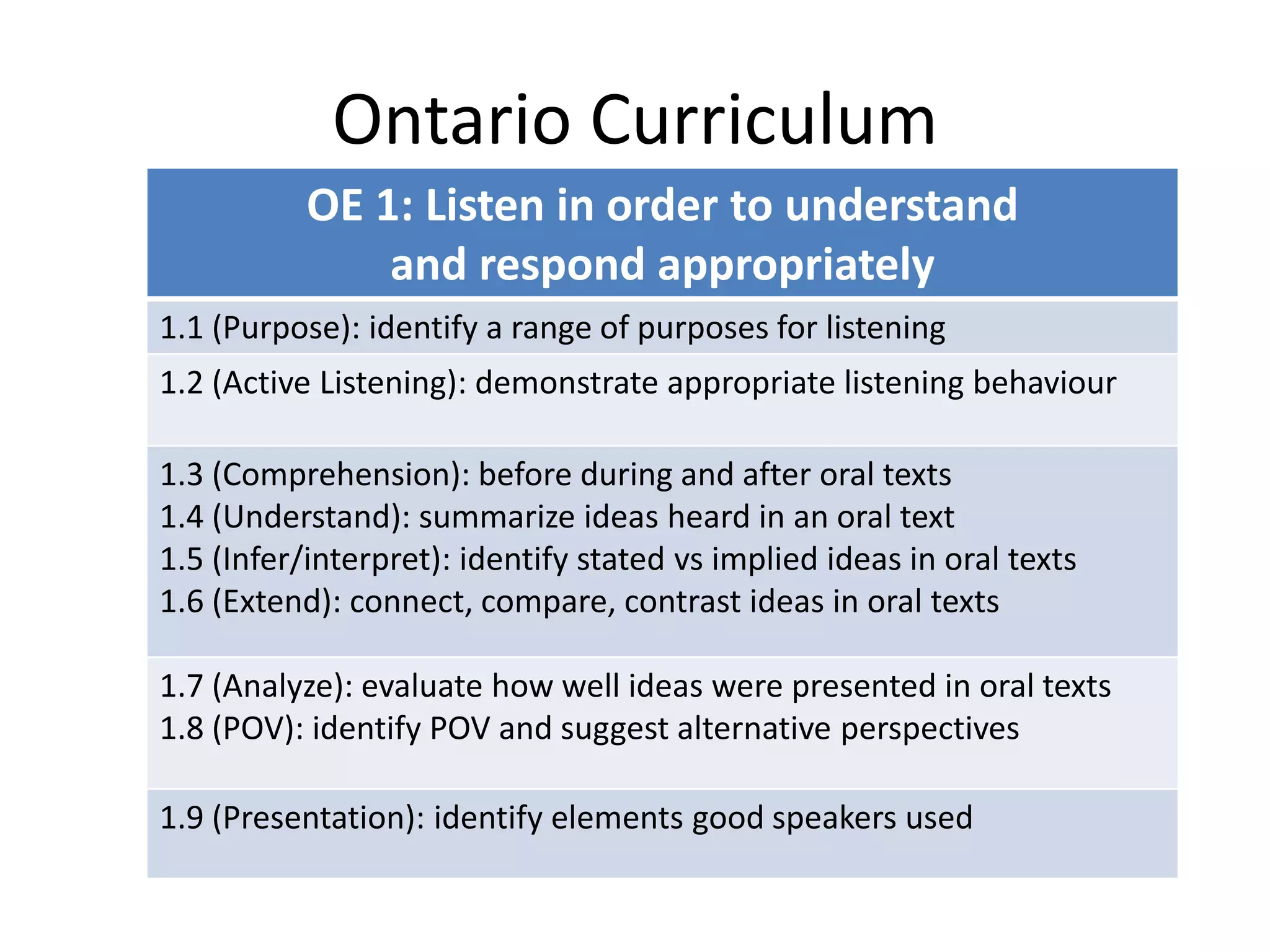
Ontario Curriculum
OE 1: Listen in order to understand
and respond appropriately
1.1 (Purpose): identify a range of purposes for listening
1.2 (Active Listening): demonstrate appropriate listening behaviour
1.3 (Comprehension): before during and after oral texts
1.4 (Understand): summarize ideas heard in an oral text
1.5 (Infer/interpret): identify stated vs implied ideas in oral texts
1.6 (Extend): connect, compare, contrast ideas in oral texts
1.7 (Analyze): evaluate how well ideas were presented in oral texts
1.8 (POV): identify POV and suggest alternative perspectives
1.9 (Presentation): identify elements good speakers used
1.2 Active Listening
• Think back to the video about Listening by
Julian Treasure:
• Complete the chart on your table group:
Active Listening:
Looks like… Sounds like…Feels like…
• Have someone at your table read aloud the article “Real
Listening as Real Teaching” by Carol Ann Tomlinson (Ed.
Leadership, Nov. 2014, pp. 90-91).
• Discuss the boy’s comment about his teacher at the end of
the article. What connections can you make to this comment?
• When your group has finished discussing, go back to your
Active Listening chart and reflect on whether you were active
listeners.
Teachers as listeners
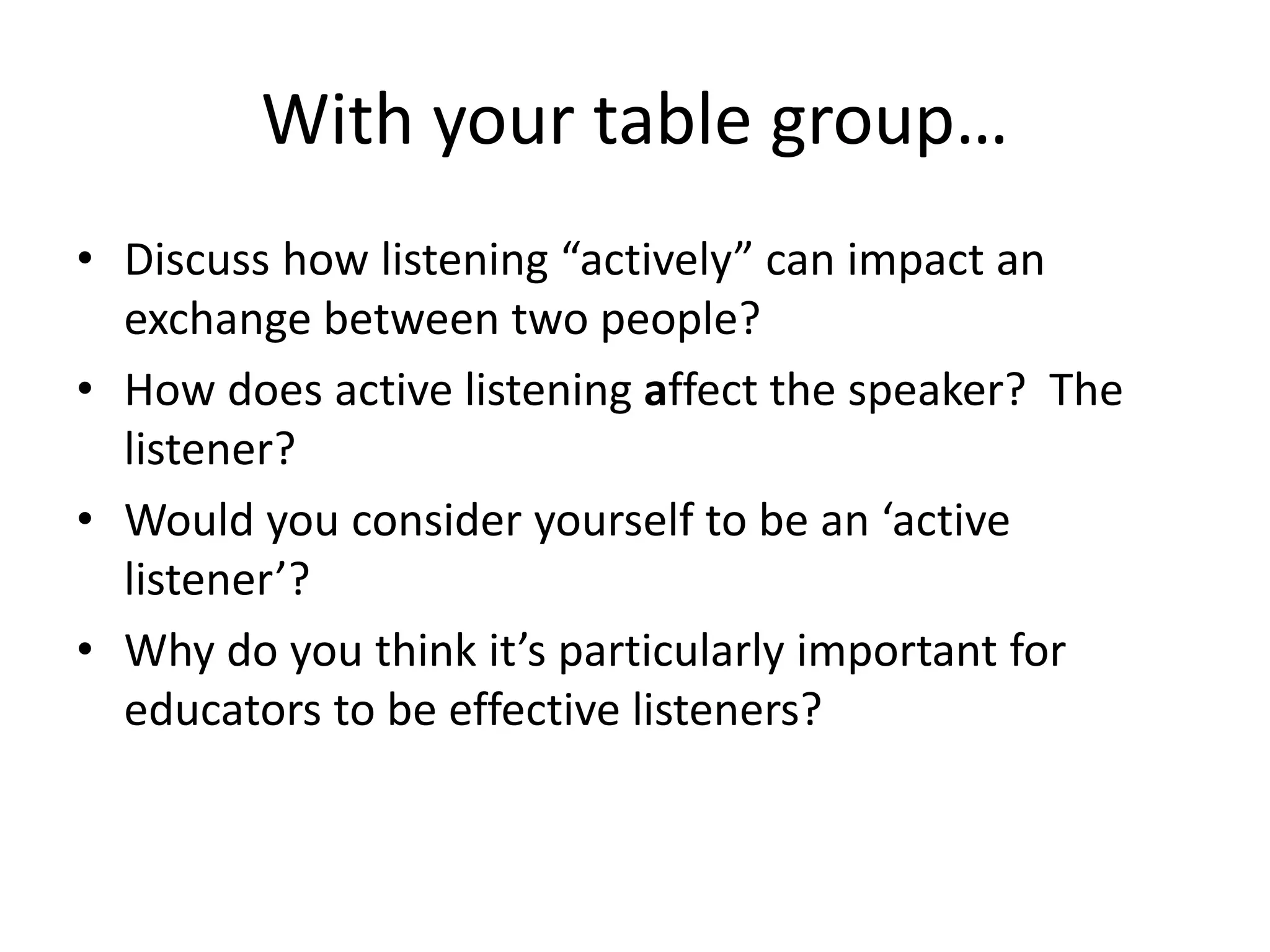
With your table group…
• Discuss how listening “actively” can impact an
exchange between two people?
• How does active listening affect the speaker? The
listener?
• Would you consider yourself to be an ‘active
listener’?
• Why do you think it’s particularly important for
educators to be effective listeners?
Oral Communication Strand Overall Expectation #1:
Listen in order to understand and respond appropriately in a variety
of situations for a variety of purposes
1. Read through the specific oral communication expectations for a grade of
your choice
1. Watch a podcast of your choice through any of the links on our course site
1. Identify a specific expectation that could be addressed through your
podcast (an idea for teachers to use, or an idea for students to respond
with after watching the podcast – whichever context seem appropriate)
2. Write directions for students to follow once they have listened to the
podcast in a listening center
1. As a group, type your instructions on our Google doc to share with your
peers.
Curriculum and Podcasts
PLC
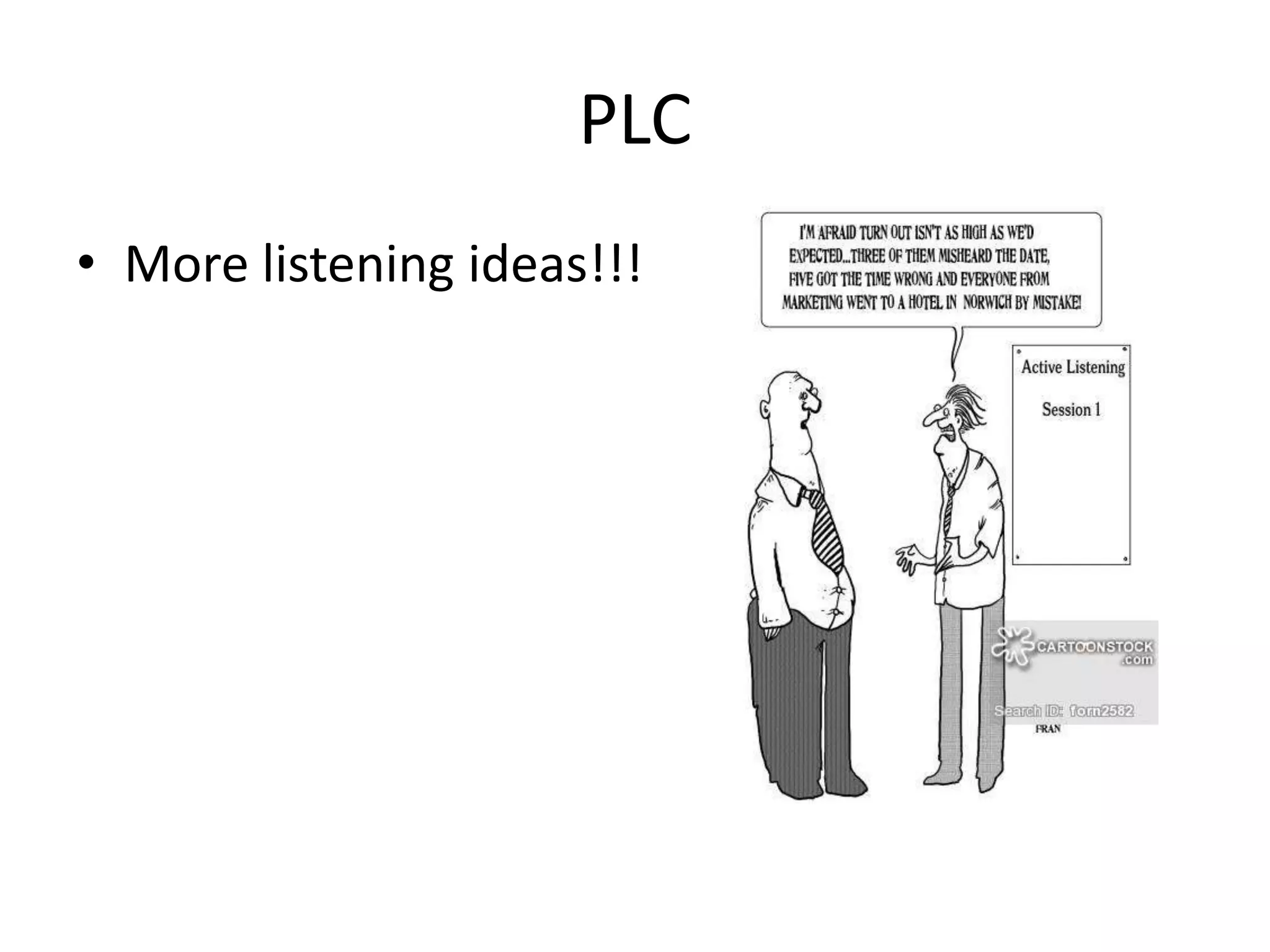
• More listening ideas!!!
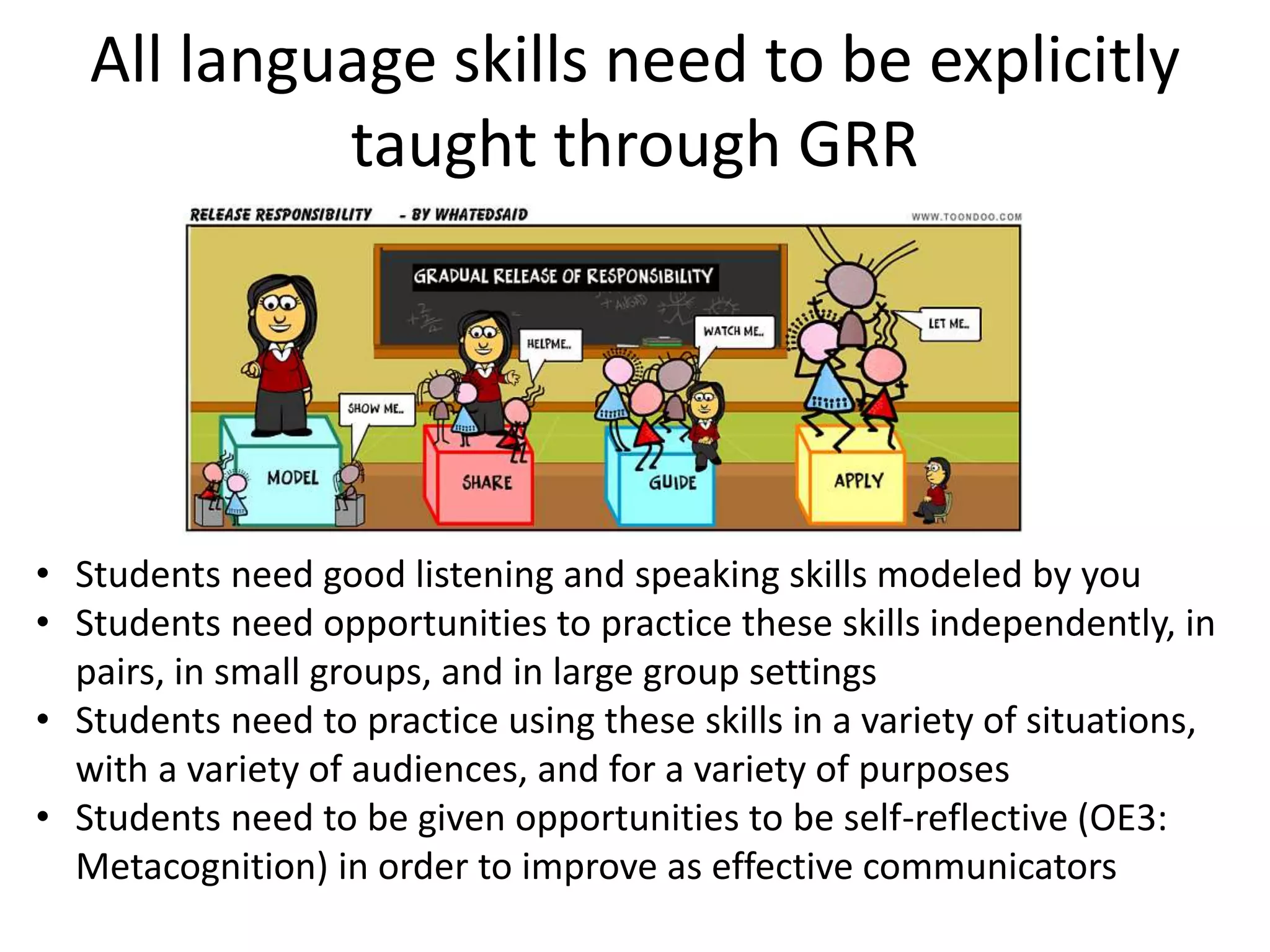
All language skills need to be explicitly
taught through GRR
• Students need good listening and speaking skills modeled by you
• Students need opportunities to practice these skills independently, in
pairs, in small groups, and in large group settings
• Students need to practice using these skills in a variety of situations,
with a variety of audiences, and for a variety of purposes
• Students need to be given opportunities to be self-reflective (OE3:
Metacognition) in order to improve as effective communicators
Homework
• 3R Forum Post on Professional Reading:
Teaching Indigenous Histories Through an Authentic
Voice http://etfovoice.ca/feature/teaching-
indigenous-histories-through-authentic-voice
Note: This is a 3 pager – you need to click on page 2 & 3 when you finish
the first webpage view.
Next week presentations 8:00 class Sydney
11:00 class Tia and Ruth

Bc week 9

  • 1.
    8P20 Week 9 WritingAssessment Oral Communication Part 1
  • 2.
    A note onlast week • Balancing the heavy with some good  • Circles of Life response & Inherent goodness https://www.huffingtonpost.ca/2018/11/03/rings -of-peace-toronto-synagogue- muslims_a_23579698/ • Current Events Daily Presentations (reading, writing, oral communication and media literacy all in one 5 minute start to your day!)
  • 3.
    A note onlast week • Children as Change Makers: – Current events can significantly change the climate in the classroom and sometimes you need to abandon your plans to address them. – Students are affected by what they see and hear on the news and often feel powerless to affect real and meaningful change. – Many may be fearful and struggling with anxiety which negatively impacts their ability to learn. – As educators, we need to provide students with a safe space for sharing their fears and explicitly teach some practical strategies for coping productively with their anxieties, so that we’re able to reach – and teach – them more effectively. – Empowering students with support and the means to make a difference can be life-altering and will help to ensure that all of our students grow up to be caring, concerned, and ACTIVE global citizens.
  • 4.
    A note onlast week • Children as Change Makers: – Reflect back on last week: What happens when we put our fears on paper? – Our classrooms are microcosms of society. – Empathy and relationships are the basis for positive change. – Feelings can be the catalyst for ACTION – Craig Kielburger (you never know who will be the next world changer – we must cultivate them all) – CBT: Thoughts, feelings, and actions are all intricately connected; if you change one, the others change automatically. – If students are feeling insecure or vulnerable in their worlds, one way to shift those thoughts and feelings is to empower them to take action.
  • 5.
    Recall your writingtask inspired by a mentor text
  • 6.
    Co-created rubrics • What: –A rubric created with students (shared writing task) • Why: – To give students ownership over their learning, – To ensure they understand how to succeed, – To ensure student friendly language is used • How: – Have a plan in your mind, list the curriculum expectations in student friendly language, and organize their thoughts in categories, – Ask them about what is important to include, probe them for deeper examples of what they mean, prompt them to explain reasons for their choices. – Write down all student ideas, then create the official document on your own using “their ideas”.
  • 8.
    A Note onFeedback Feedback needs to be: • specific and detailed – Excellent job! Vs. “Your vocabulary is really expanding allowing you to really paint a picture in the mind of your reader!” • positive (ie. What a student can do not can’t do) – Your vocabulary is not descriptive enough vs “Using a thesaurus will help you find even more descriptive words” • understood by the student – Abysmal diction vs “Some of your words aren’t saying what you mean to say” • applied to student learning – Great job vs “Excellent word choices, especially when you used the word grumbly tummy to describe your hunger!”
  • 9.
    Our writing rubricfor our poems • Your task: Look at the poems provided. How should they be assessed? • Expectations: – 1.2 – developing ideas – 2.3 – vivid, figurative, innovative word choice (metaphorical language) – 3.6 – proofread for spelling, punctuation, grammar Suggestions CRITERIA Yes, And! Content (ideas): -animal + 2 adjectives + 2 action phrases -animal is from totem website -animal + adjective link to your feelings about current events Form (poem, metaphors): -starts with “sometimes I feel like a…” -appropriate word choice (lyrical and on topic) Conventions and publishing (spelling, layout, images): -text in 4 lines like the book -appropriate image + visual creativity + readable font Correct spelling, grammar, and punctuation - 2.1 – writing form (poem) - 3.7 - publishing (layout, images) Once we have created our rubric, swap poems with another table group and offer feedback on the printed copy provided.
  • 10.
    Our writing rubricfor our poems • Your task: Look at the poems provided. How should they be assessed? • Expectations: – 1.2 – developing ideas – 2.3 – vivid, figurative, innovative word choice (metaphorical language) – 3.6 – proofread for spelling, punctuation, grammarSuggestions CRITERIA Yes, And! Content (ideas): -animal + characteristics + actions -actions and descriptors match the animal Form (poem, metaphors): -Start with “Sometimes I feel like a…” -Includes 2 adjectives, followed by two actions -2 sentences, 2nd sentence with a conjuction -metaphorical or figurative language used Conventions and publishing (spelling, layout, images): -includes appropriate image(s), visually appealing, font -Sentence layout matches poem (4 lines) -free of spelling, punctuation, and grammar errors - 2.1 – writing form (poem) - 3.7 - publishing (layout, images) Once we have created our rubric, swap poems with another table group and offer feedback on the printed copy provided.
  • 12.
    A Sample GRRLesson Sequence Part 3: consolidation sharing our work • Thinking About Assessment: – How would it have been helpful to co-create our rubric before you started your writing task? – Why is it important to share our assessment tools with students? • Thinking About Lesson Planning: – How did I hook you? – What writing actions did you take? – Why is consolidation an important stage? – How did I weave current events into the lesson?
  • 13.
    A quick noteon assessment • What are assessment tools? • What are the different styles of rubrics?
  • 14.
    ASSESSMENT TOOLS • Checklists •Rubrics • Checkbrick • Anecdotal notes • Scales and scores Assessment tools are what teachers (and students) use to evaluate strengths and weaknesses, and make judgments/give a grade. Assessment strategies are the tasks students complete. These are evaluated using a tool.  Test/Quiz – marked with a score /10  Project – marked with a checklist  Essay/Narrative – marked with a rubric  Presentation – marked with anecdotal notes
  • 15.
    A closer lookat rubrics • A RUBRIC IS AN EVALUATIVE TOOL FOR TEACHERS AND LEARNERS THAT... – Establishes goals and expectations for learning – Establishes standards – Provides guidelines for teaching and learning – Provides measures for proficiency and accountability
  • 16.
    A closer lookat rubrics RUBRICS CONTAIN CRITERIA AND QUALIFIERS • CRITERIA: the components being assessed – Need to reflect curriculum expectations – Need to separate ideas (content) and skills (spelling etc). – Need to be observable traits • QUALIFIERS: the degree of competency demonstrated by the work – Need to be based on the language in the curriculum documents (see achievement chart) – Need to be objective as much as possible
  • 17.
    Criteria and Qualifiers StructureOverall 2 – Form, style, and process Content Overall 1 – Generating and organizing ideas Conventions Overall 3 – Applying conventions (spelling, grammar, etc) Writing Curriculum links It is important to separate WHAT students say from HOW they say it, as these are two separate skills that need developing. *This is also true for oral communication expectations*
  • 18.
    Criteria and Qualifiers Level4 Level 3 Level 2 Level 1 Structure Strong topic sentence, 3-5 detail sentences, strong concluding sentence Appropriate topic sentence, 3-4 detail sentences, appropriate concluding sentence Somewhat appropriate topic sentence, 2-3 detail sentences, Somewhat appropriate concluding sentence Missing components of a paragraph Content Topic sentence is clear and directive; all details are convincing; conclusion is clear and compelling; Ideas are all on one topic and are in a logical and well- thought order. Topic sentence is clear; most details are convincing; conclusion is clear; Ideas are all on one topic and are in a reasonable order. Topic sentence and conclusion are somewhat clear; details are somewhat convincing; Ideas are mostly one on one topic but stray a bit; order is somewhat logical. Topic is unclear; details are not convincing or are missing; ideas could be in a more logical order to strengthen clarity of argument. Conventions No errors in grammar, spelling, punctuation, or word choices. Mostly free of errors in grammar, spelling, punctuation, or word choices. Many errors in grammar, spelling, punctuation, or word choices. Writing has too many errors that inhibit reader understanding. PERSUASIVE PARAGRAPH RUBRIC This has all the information students need, but it looks wordy and overwhelming to many
  • 19.
    Criteria and Qualifiers Level4 Level 3 Level 2 Level 1 Structure -topic sentence -body details -concluding sentence All components included with high degree of thought and creativity All components included Components are somewhat present Missing components Content -clear topic -convincing details related to topic -logical order -persuasive word choices High degree of clarity and persuasiveness; excellent organization and word choices Considerable clarity and persuasion Somewhat clear and persuasive Limited clarity and persusaion Conventions -spelling -grammar -punctuation Free from all errors Mostly free from errors A few errors Many errors PERSUASIVE PARAGRAPH RUBRIC This format is cleaner, and serves as more of a checklist with degrees of quality of completion
  • 20.
    3 types ofrubrics: Holistic, analytic, & single-point A holistic rubric is the most general kind. It lists three to five levels of performance, along with a broad description of the characteristics that define each level. Advantages: -easy for teacher -faster to grade -gives one grade to piece as a whole Disadvantages: -doesn't’t provide targeted feedback for students Ideal use: -standardized tests or quick tasks that do not need (or have time for) feedback
  • 21.
    3 types ofrubrics: Holistic, analytic, & single-point An analytic rubric breaks down the characteristics of an assignment into parts, allowing the scorer to itemize and define exactly what aspects are strong, and which ones need improvement. Advantages: -gives students a clearer picture of why they received the score they got -easier for teachers to justify grades Disadvantages: -time consuming and challenging to create (so many qualifiers and descriptors for each level) -longer, which means students are less likely to read them
  • 22.
    3 types ofrubrics: Holistic, analytic, & single-point A single-point rubric is a lot like an analytic rubric, because it breaks down the components of an assignment into different criteria. What makes it different is that it only describes the criteria for proficiency; it does not attempt to list all the ways a student could fall short, nor does it specify how a student could exceed expectations. Advantages: -contains less language, so its likely to be read -less time to create, while still rich in detail of expectations -areas of concern and excellence are open ended (sometimes a rubric can be constricting – here, you don’t have to predict every way students will deviate from a 3) Disadvantages: -requires more writing for the teacher than simply highlighting a column
  • 23.
  • 24.
    SJ PBP • Presentedby Erin and Maddie • Presented by Tori P. and Ally • During debrief rest of class: Share something you observed in your practicum placement related to oral communication: - Formal (presentations/speeches)? - Informal (group discussions)? - Assessment practices? - Anchor Charts or expectations? Presenter:_______ My Name: ________ During this presentation… I noticed… I felt… I learned… One thing I would like to incorporate into my teaching from this presentation would be…
  • 25.
  • 26.
    ORAL COMMUNICATION • SpeakingSkills • Listening Skills
  • 27.
    Ontario Curriculum OE 1:Listen in order to understand and respond appropriately 1.1 (Purpose): identify a range of purposes for listening 1.2 (Active Listening): demonstrate appropriate listening behaviour 1.3 (Comprehension): before during and after oral texts 1.4 (Understand): summarize ideas heard in an oral text 1.5 (Infer/interpret): identify stated vs implied ideas in oral texts 1.6 (Extend): connect, compare, contrast ideas in oral texts 1.7 (Analyze): evaluate how well ideas were presented in oral texts 1.8 (POV): identify POV and suggest alternative perspectives 1.9 (Presentation): identify elements good speakers used
  • 28.
    1.2 Active Listening •Think back to the video about Listening by Julian Treasure: • Complete the chart on your table group: Active Listening: Looks like… Sounds like…Feels like…
  • 29.
    • Have someoneat your table read aloud the article “Real Listening as Real Teaching” by Carol Ann Tomlinson (Ed. Leadership, Nov. 2014, pp. 90-91). • Discuss the boy’s comment about his teacher at the end of the article. What connections can you make to this comment? • When your group has finished discussing, go back to your Active Listening chart and reflect on whether you were active listeners. Teachers as listeners
  • 30.
    With your tablegroup… • Discuss how listening “actively” can impact an exchange between two people? • How does active listening affect the speaker? The listener? • Would you consider yourself to be an ‘active listener’? • Why do you think it’s particularly important for educators to be effective listeners?
  • 31.
    Oral Communication StrandOverall Expectation #1: Listen in order to understand and respond appropriately in a variety of situations for a variety of purposes 1. Read through the specific oral communication expectations for a grade of your choice 1. Watch a podcast of your choice through any of the links on our course site 1. Identify a specific expectation that could be addressed through your podcast (an idea for teachers to use, or an idea for students to respond with after watching the podcast – whichever context seem appropriate) 2. Write directions for students to follow once they have listened to the podcast in a listening center 1. As a group, type your instructions on our Google doc to share with your peers. Curriculum and Podcasts
  • 32.
  • 33.
    All language skillsneed to be explicitly taught through GRR • Students need good listening and speaking skills modeled by you • Students need opportunities to practice these skills independently, in pairs, in small groups, and in large group settings • Students need to practice using these skills in a variety of situations, with a variety of audiences, and for a variety of purposes • Students need to be given opportunities to be self-reflective (OE3: Metacognition) in order to improve as effective communicators
  • 34.
    Homework • 3R ForumPost on Professional Reading: Teaching Indigenous Histories Through an Authentic Voice http://etfovoice.ca/feature/teaching- indigenous-histories-through-authentic-voice Note: This is a 3 pager – you need to click on page 2 & 3 when you finish the first webpage view. Next week presentations 8:00 class Sydney 11:00 class Tia and Ruth