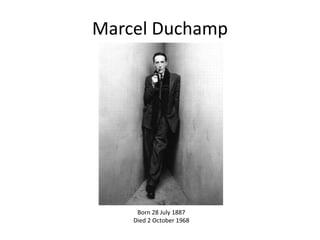
Marcel Duchamp

Born 28 July 1887
Died 2 October 1968
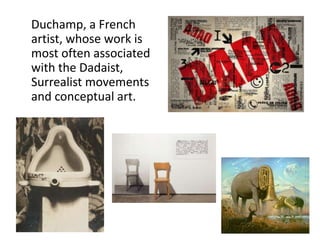
Duchamp, a French
artist, whose work is
most often associated
with the Dadaist,
Surrealist movements
and conceptual art.
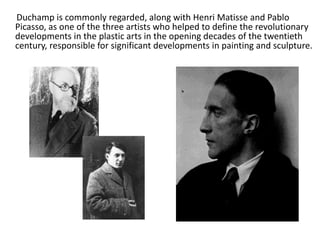
Duchamp is commonly regarded, along with Henri Matisse and Pablo
Picasso, as one of the three artists who helped to define the revolutionary
developments in the plastic arts in the opening decades of the twentieth
century, responsible for significant developments in painting and sculpture.
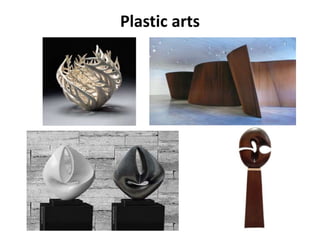
Plastic arts
• Plastic arts are art forms which involve physical
manipulation of a plastic medium by molding or
modeling such as sculpture or ceramics. The term
has also been applied more broadly to all the visual
(non-literary, non-musical) arts.
• Materials for use in the plastic arts, in the narrower
definition, include those that can be carved or
shaped, such as stone or wood, concrete, or metal.
"Plastics" meaning certain synthetic organic resins
have been used ever since they were invented, but
the term "plastic arts" long preceded them.
Plastic arts
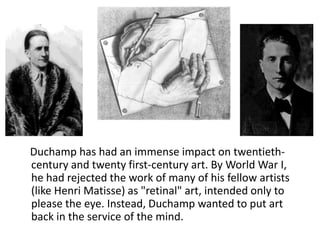
Duchamp has had an immense impact on twentiethcentury and twenty first-century art. By World War I,
he had rejected the work of many of his fellow artists
(like Henri Matisse) as "retinal" art, intended only to
please the eye. Instead, Duchamp wanted to put art
back in the service of the mind.
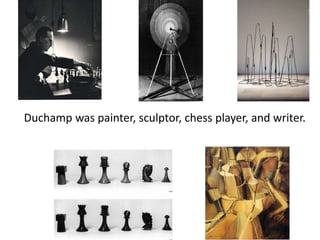
Duchamp was painter, sculptor, chess player, and writer.
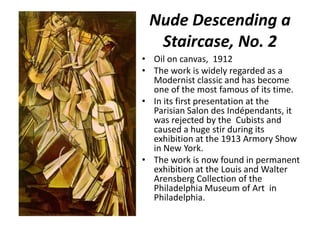
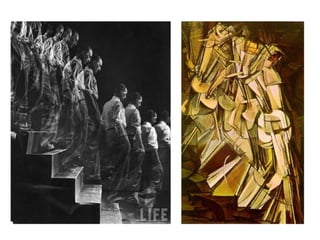
Nude Descending a
Staircase, No. 2
• Oil on canvas, 1912
• The work is widely regarded as a
Modernist classic and has become
one of the most famous of its time.
• In its first presentation at the
Parisian Salon des Indépendants, it
was rejected by the Cubists and
caused a huge stir during its
exhibition at the 1913 Armory Show
in New York.
• The work is now found in permanent
exhibition at the Louis and Walter
Arensberg Collection of the
Philadelphia Museum of Art in
Philadelphia.
Changing The Definition of Art
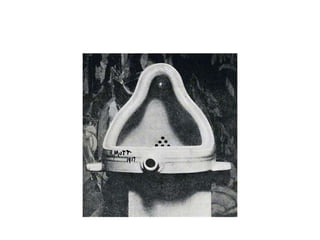
• Fountain 1917, replica 1964
•

Submitted for the exhibition of the Society of
Independent Artists in 1917, Fountain was
rejected by the committee, even though the
rules stated that all works would be accepted
from artists who paid the fee.

•

Fountain was displayed and photographed at
Alfred Stieglitz’s studio, and the photo published
in The Blind Man, but the original has been lost.

•

The work is regarded by some art historians and
theorists of the avant-garde, such as Peter
Bürger, as a major landmark in 20th century art.

•

Replicas commissioned by Duchamp in the 1960s
are now on display in a number of different
museums.
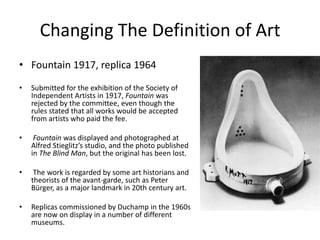
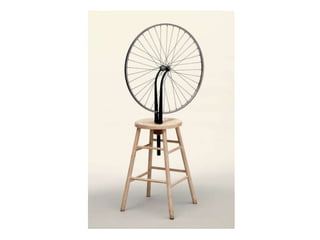
Readymades
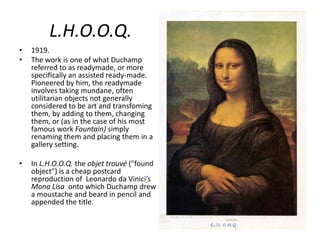
L.H.O.O.Q.
•
•

1919.
The work is one of what Duchamp
referred to as readymade, or more
specifically an assisted ready-made.
Pioneered by him, the readymade
involves taking mundane, often
utilitarian objects not generally
considered to be art and transfoming
them, by adding to them, changing
them, or (as in the case of his most
famous work Fountain) simply
renaming them and placing them in a
gallery setting.

•

In L.H.O.O.Q. the objet trouvé ("found
object") is a cheap postcard
reproduction of Leonardo da Vinici’s
Mona Lisa onto which Duchamp drew
a moustache and beard in pencil and
appended the title.
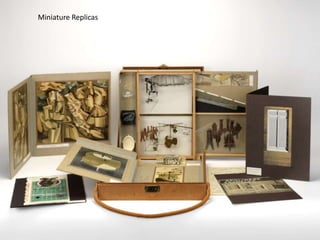
Miniature Replicas
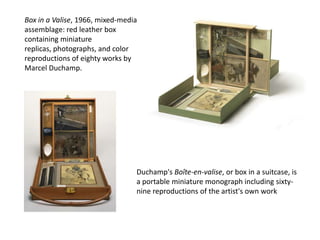
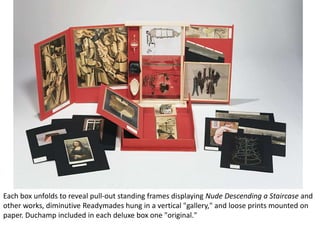
Box in a Valise, 1966, mixed-media
assemblage: red leather box
containing miniature
replicas, photographs, and color
reproductions of eighty works by
Marcel Duchamp.

Duchamp's Boîte-en-valise, or box in a suitcase, is
a portable miniature monograph including sixtynine reproductions of the artist's own work
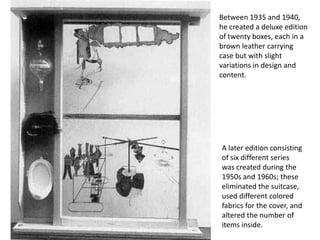
Between 1935 and 1940,
he created a deluxe edition
of twenty boxes, each in a
brown leather carrying
case but with slight
variations in design and
content.

A later edition consisting
of six different series
was created during the
1950s and 1960s; these
eliminated the suitcase,
used different colored
fabrics for the cover, and
altered the number of
items inside.
Each box unfolds to reveal pull-out standing frames displaying Nude Descending a Staircase and
other works, diminutive Readymades hung in a vertical "gallery," and loose prints mounted on
paper. Duchamp included in each deluxe box one "original."
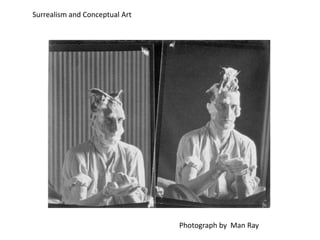
Surrealism and Conceptual Art

Photograph by Man Ray
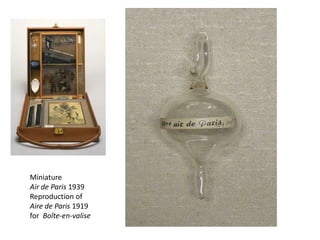
Miniature
Air de Paris 1939
Reproduction of
Aire de Paris 1919
for Boîte-en-valise
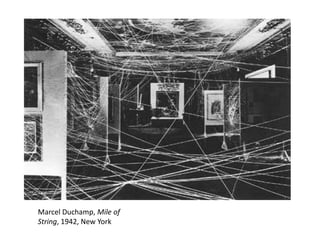
Marcel Duchamp, Mile of
String, 1942, New York
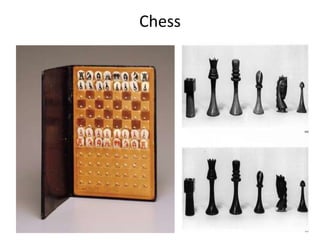
Chess
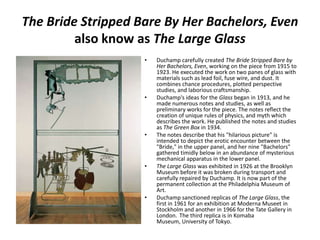
The Bride Stripped Bare By Her Bachelors, Even
also know as The Large Glass
•

•

•

•

•

Duchamp carefully created The Bride Stripped Bare by
Her Bachelors, Even, working on the piece from 1915 to
1923. He executed the work on two panes of glass with
materials such as lead foil, fuse wire, and dust. It
combines chance procedures, plotted perspective
studies, and laborious craftsmanship.
Duchamp's ideas for the Glass began in 1913, and he
made numerous notes and studies, as well as
preliminary works for the piece. The notes reflect the
creation of unique rules of physics, and myth which
describes the work. He published the notes and studies
as The Green Box in 1934.
The notes describe that his "hilarious picture" is
intended to depict the erotic encounter between the
"Bride," in the upper panel, and her nine "Bachelors"
gathered timidly below in an abundance of mysterious
mechanical apparatus in the lower panel.
The Large Glass was exhibited in 1926 at the Brooklyn
Museum before it was broken during transport and
carefully repaired by Duchamp. It is now part of the
permanent collection at the Philadelphia Museum of
Art.
Duchamp sanctioned replicas of The Large Glass, the
first in 1961 for an exhibition at Moderna Museet in
Stockholm and another in 1966 for the Tate Gallery in
London. The third replica is in Komaba
Museum, University of Tokyo.
Marcel Duchamp

Marcel Duchamp

  • 1.
    Marcel Duchamp Born 28July 1887 Died 2 October 1968
  • 2.
    Duchamp, a French artist,whose work is most often associated with the Dadaist, Surrealist movements and conceptual art.
  • 3.
    Duchamp is commonlyregarded, along with Henri Matisse and Pablo Picasso, as one of the three artists who helped to define the revolutionary developments in the plastic arts in the opening decades of the twentieth century, responsible for significant developments in painting and sculpture.
  • 4.
    Plastic arts • Plasticarts are art forms which involve physical manipulation of a plastic medium by molding or modeling such as sculpture or ceramics. The term has also been applied more broadly to all the visual (non-literary, non-musical) arts. • Materials for use in the plastic arts, in the narrower definition, include those that can be carved or shaped, such as stone or wood, concrete, or metal. "Plastics" meaning certain synthetic organic resins have been used ever since they were invented, but the term "plastic arts" long preceded them.
  • 5.
  • 6.
    Duchamp has hadan immense impact on twentiethcentury and twenty first-century art. By World War I, he had rejected the work of many of his fellow artists (like Henri Matisse) as "retinal" art, intended only to please the eye. Instead, Duchamp wanted to put art back in the service of the mind.
  • 7.
    Duchamp was painter,sculptor, chess player, and writer.
  • 8.
    Nude Descending a Staircase,No. 2 • Oil on canvas, 1912 • The work is widely regarded as a Modernist classic and has become one of the most famous of its time. • In its first presentation at the Parisian Salon des Indépendants, it was rejected by the Cubists and caused a huge stir during its exhibition at the 1913 Armory Show in New York. • The work is now found in permanent exhibition at the Louis and Walter Arensberg Collection of the Philadelphia Museum of Art in Philadelphia.
  • 10.
    Changing The Definitionof Art • Fountain 1917, replica 1964 • Submitted for the exhibition of the Society of Independent Artists in 1917, Fountain was rejected by the committee, even though the rules stated that all works would be accepted from artists who paid the fee. • Fountain was displayed and photographed at Alfred Stieglitz’s studio, and the photo published in The Blind Man, but the original has been lost. • The work is regarded by some art historians and theorists of the avant-garde, such as Peter Bürger, as a major landmark in 20th century art. • Replicas commissioned by Duchamp in the 1960s are now on display in a number of different museums.
  • 11.
  • 13.
    L.H.O.O.Q. • • 1919. The work isone of what Duchamp referred to as readymade, or more specifically an assisted ready-made. Pioneered by him, the readymade involves taking mundane, often utilitarian objects not generally considered to be art and transfoming them, by adding to them, changing them, or (as in the case of his most famous work Fountain) simply renaming them and placing them in a gallery setting. • In L.H.O.O.Q. the objet trouvé ("found object") is a cheap postcard reproduction of Leonardo da Vinici’s Mona Lisa onto which Duchamp drew a moustache and beard in pencil and appended the title.
  • 18.
  • 19.
    Box in aValise, 1966, mixed-media assemblage: red leather box containing miniature replicas, photographs, and color reproductions of eighty works by Marcel Duchamp. Duchamp's Boîte-en-valise, or box in a suitcase, is a portable miniature monograph including sixtynine reproductions of the artist's own work
  • 20.
    Between 1935 and1940, he created a deluxe edition of twenty boxes, each in a brown leather carrying case but with slight variations in design and content. A later edition consisting of six different series was created during the 1950s and 1960s; these eliminated the suitcase, used different colored fabrics for the cover, and altered the number of items inside.
  • 21.
    Each box unfoldsto reveal pull-out standing frames displaying Nude Descending a Staircase and other works, diminutive Readymades hung in a vertical "gallery," and loose prints mounted on paper. Duchamp included in each deluxe box one "original."
  • 22.
    Surrealism and ConceptualArt Photograph by Man Ray
  • 23.
    Miniature Air de Paris1939 Reproduction of Aire de Paris 1919 for Boîte-en-valise
  • 24.
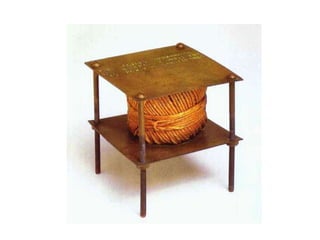
    Marcel Duchamp, Mileof String, 1942, New York
  • 25.
  • 26.
    The Bride StrippedBare By Her Bachelors, Even also know as The Large Glass • • • • • Duchamp carefully created The Bride Stripped Bare by Her Bachelors, Even, working on the piece from 1915 to 1923. He executed the work on two panes of glass with materials such as lead foil, fuse wire, and dust. It combines chance procedures, plotted perspective studies, and laborious craftsmanship. Duchamp's ideas for the Glass began in 1913, and he made numerous notes and studies, as well as preliminary works for the piece. The notes reflect the creation of unique rules of physics, and myth which describes the work. He published the notes and studies as The Green Box in 1934. The notes describe that his "hilarious picture" is intended to depict the erotic encounter between the "Bride," in the upper panel, and her nine "Bachelors" gathered timidly below in an abundance of mysterious mechanical apparatus in the lower panel. The Large Glass was exhibited in 1926 at the Brooklyn Museum before it was broken during transport and carefully repaired by Duchamp. It is now part of the permanent collection at the Philadelphia Museum of Art. Duchamp sanctioned replicas of The Large Glass, the first in 1961 for an exhibition at Moderna Museet in Stockholm and another in 1966 for the Tate Gallery in London. The third replica is in Komaba Museum, University of Tokyo.