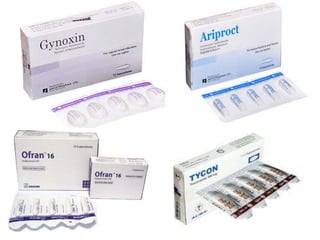
Definition of Suppository
Solid or semi-solid dosage form
Intended for insertion into body
orifices ( Rectum, Vagina, Urethra )
They melt, soften or dissolve in the
body orifices and exert local or
systemic effect.
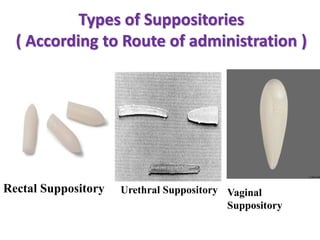
Types of Suppositories
( According to Route of administration )
Rectal Suppository Urethral Suppository Vaginal
Suppository
Advantages of Suppositories
Advantages
Avoid first-
pass
metabolism
Disadvantages of Suppositories
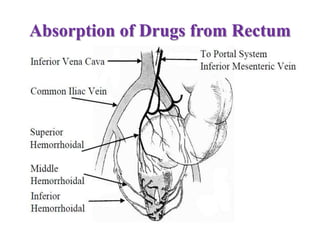
Absorption of Drugs from Rectum
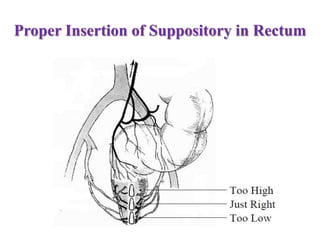
Proper Insertion of Suppository in Rectum
IDEAL SUPPOSITORY BASE
• Melts at body temperature or dissolves in body
fluids.
• Non-toxic and non-irritant.
• Compatible with any medicament.
• Releases any medicament readily.
• Easily moulded and removed from the mould.
• Stable to heating above the melting point.
• Easy to handle.
• Stable on storage.
7
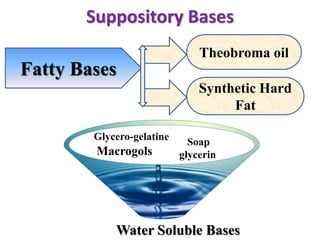
Suppository Bases
• Fatty Bases
Fatty Bases
Theobroma oil
Synthetic Hard
Fat
Water Soluble Bases
Glycero-gelatine
Macrogols
Soap
glycerin
Special Characteristics of Different Bases
Cocoa butter remains solid at room temperature but melts in the body.
Synthetic hard fat has good water absorbing capacity due to presence of w/o
emulsifying agent .
Glycero-gelatin produce laxative effect.
Polyethylene glycols are present in different physical state.
(solid, semisolid, liquid )
Preparation of Suppository
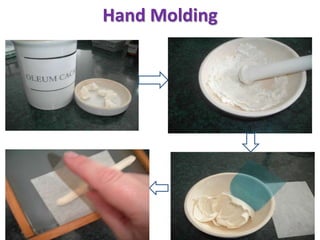
 Hand Molding
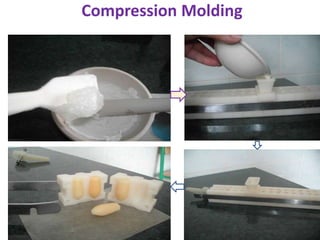
 Compression Molding
 Pour Molding
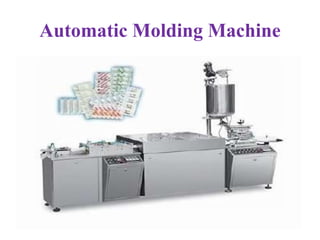
 Automatic Molding
Hand Molding
Compression Molding
Automatic Molding Machine
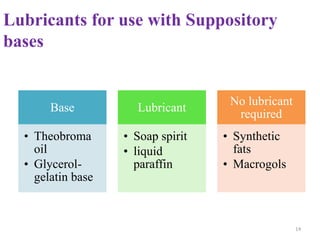
Base
• Theobroma
oil
• Glycerol-
gelatin base
Lubricant
• Soap spirit
• liquid
paraffin
No lubricant
required
• Synthetic
fats
• Macrogols
14
Lubricants for use with Suppository
bases
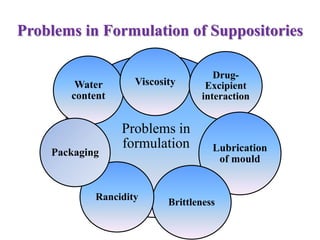
Problems in Formulation of Suppositories
Problems in
formulation
Water
content
Viscosity
Drug-
Excipient
interaction
Lubrication
of mould
Brittleness
Rancidity
Packaging
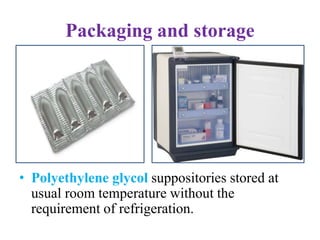
Packaging and storage
• Polyethylene glycol suppositories stored at
usual room temperature without the
requirement of refrigeration.
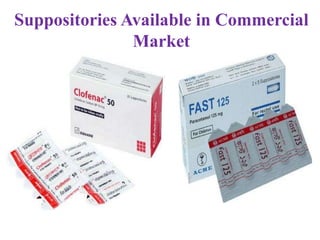
Suppositories Available in Commercial
Market
Antibiotic

Suppository