CLASSICAL DOSAGE 
FORMS 
by: Amna Saeed Pharm.D (2009- 
2014) 
Institute of pharmaceutical Sciences 
Lahore College For Women 
University
DOSAGE FORMS 
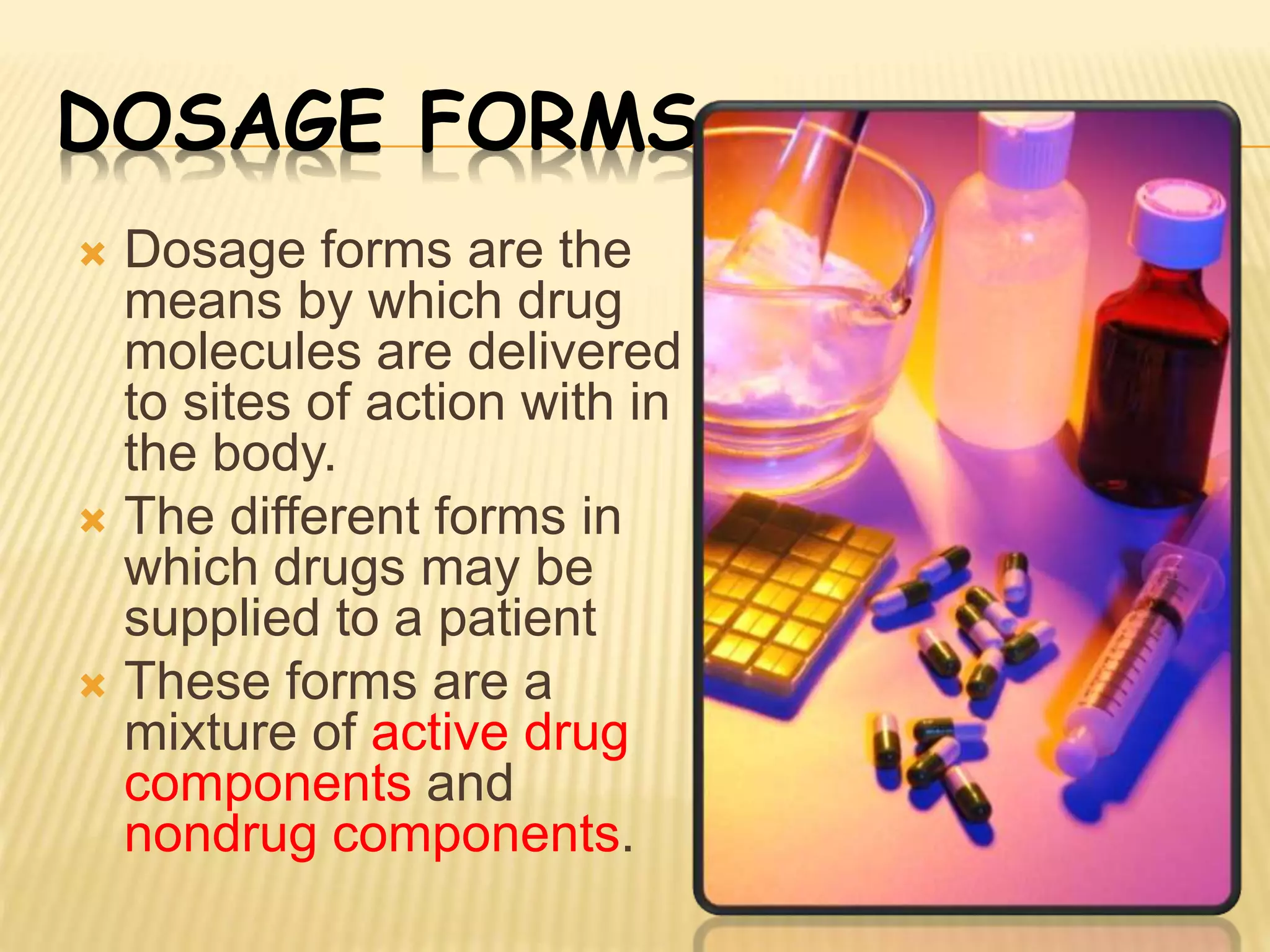
 Dosage forms are the 
means by which drug 
molecules are delivered 
to sites of action with in 
the body. 
 The different forms in 
which drugs may be 
supplied to a patient 
 These forms are a 
mixture of active drug 
components and 
nondrug components.
CLASSIFICATION OF DOSAGE FORMS 
 They are classified 
according to Physical 
form: 
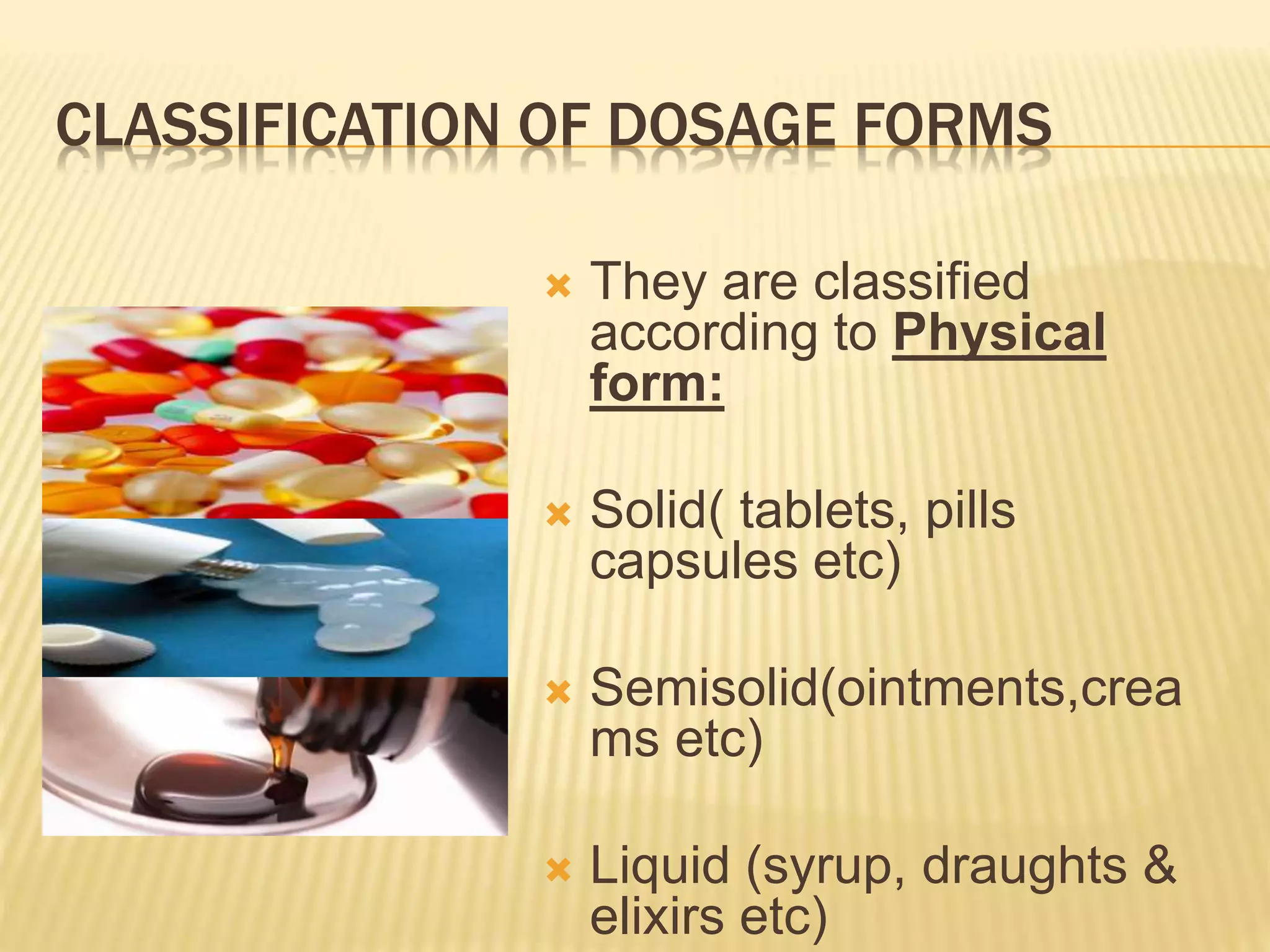
 Solid( tablets, pills 
capsules etc) 
 Semisolid(ointments,crea 
ms etc) 
 Liquid (syrup, draughts & 
elixirs etc)
CLASSICAL DOSAGE FORMS 
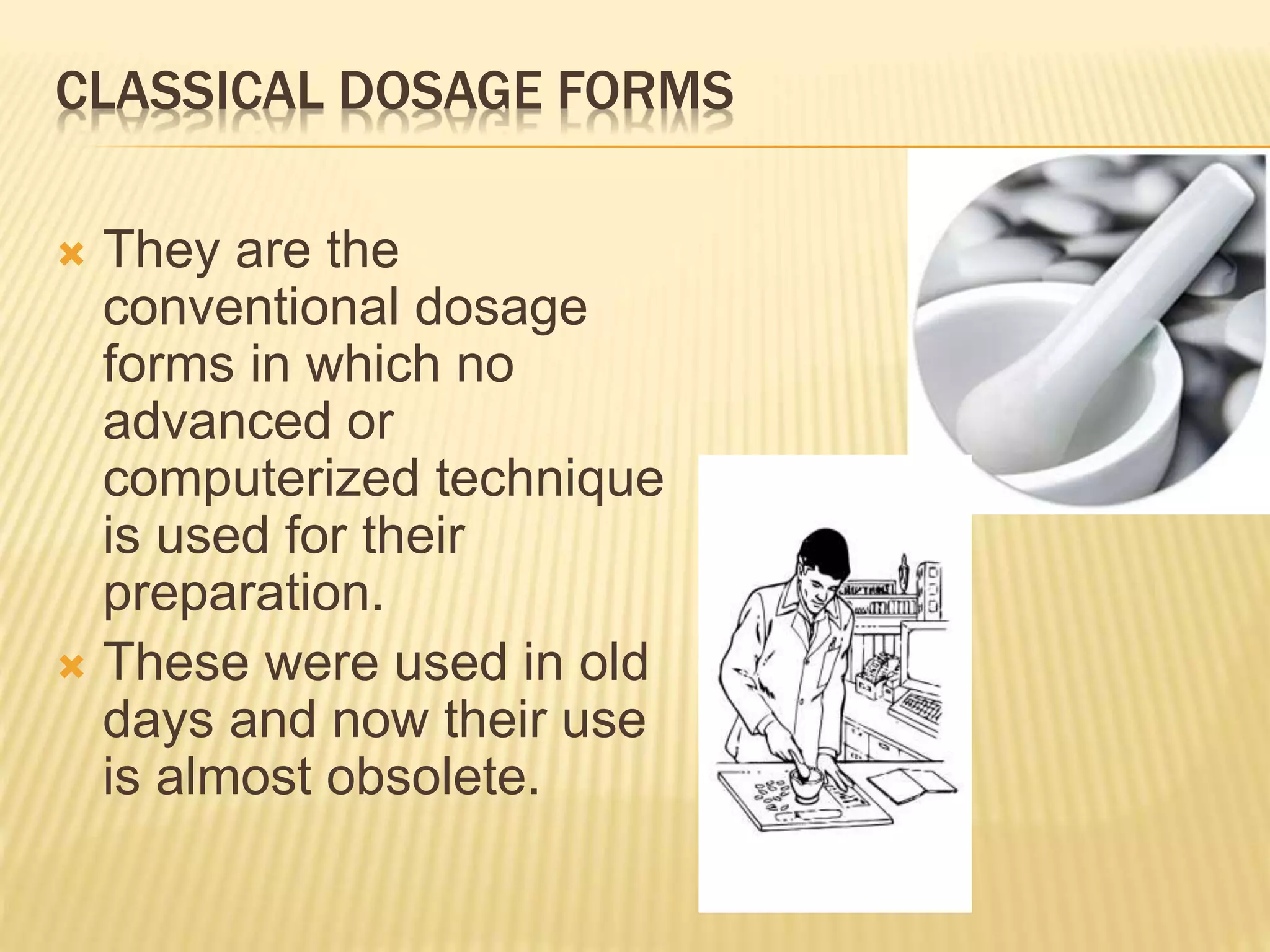
 They are the 
conventional dosage 
forms in which no 
advanced or 
computerized technique 
is used for their 
preparation. 
 These were used in old 
days and now their use 
is almost obsolete.
CLASSICAL DOSAGE FORMS 
 LOZENGES 
 PILLS 
 CACHETS 
 VITRELLAE 
 DRAUGHTS 
 SUPPOSITORIES 
 PESSARIES
LOZENGES 
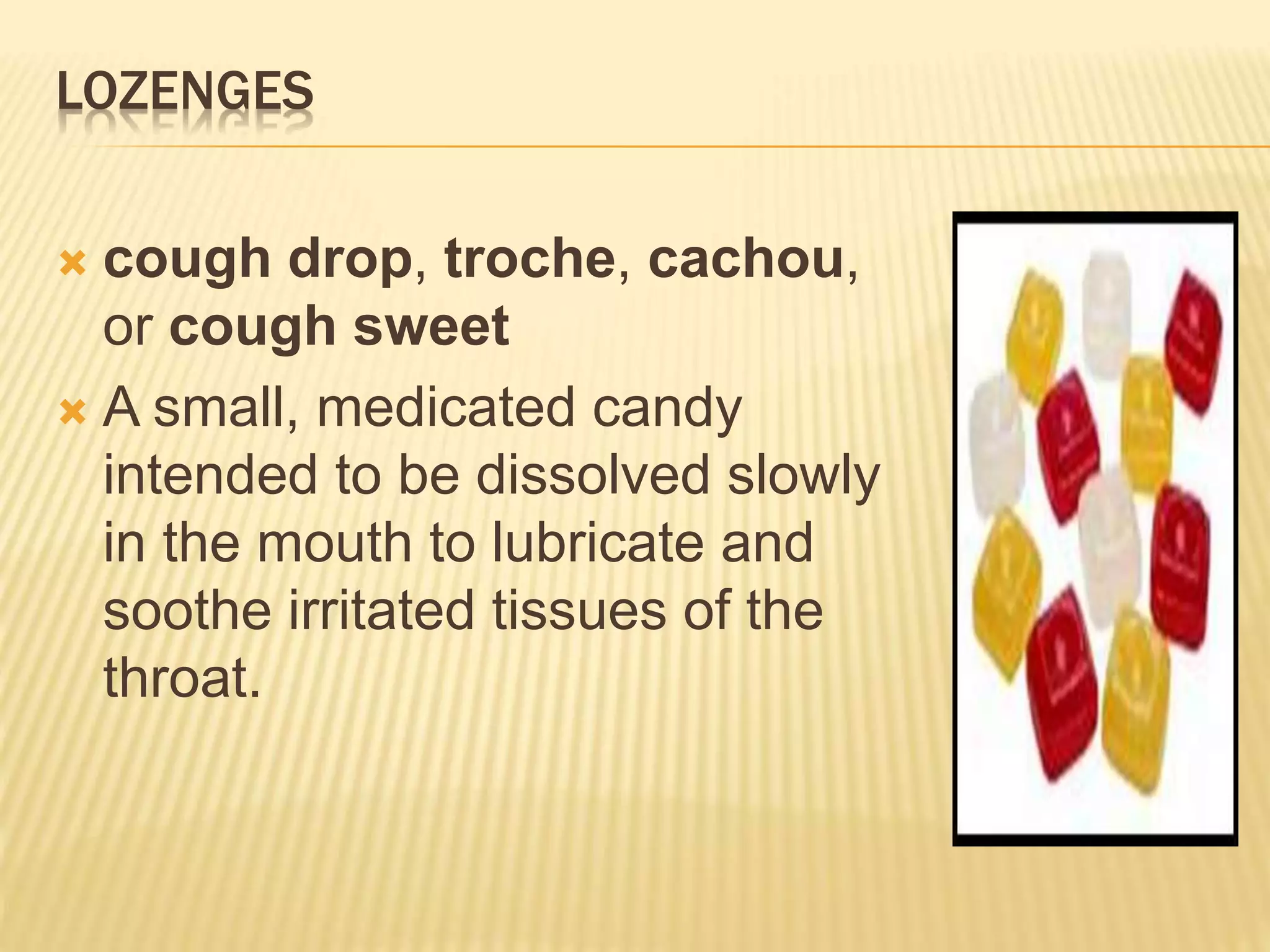
 cough drop, troche, cachou, 
or cough sweet 
 A small, medicated candy 
intended to be dissolved slowly 
in the mouth to lubricate and 
soothe irritated tissues of the 
throat.
TYPES OF LOZENGES 
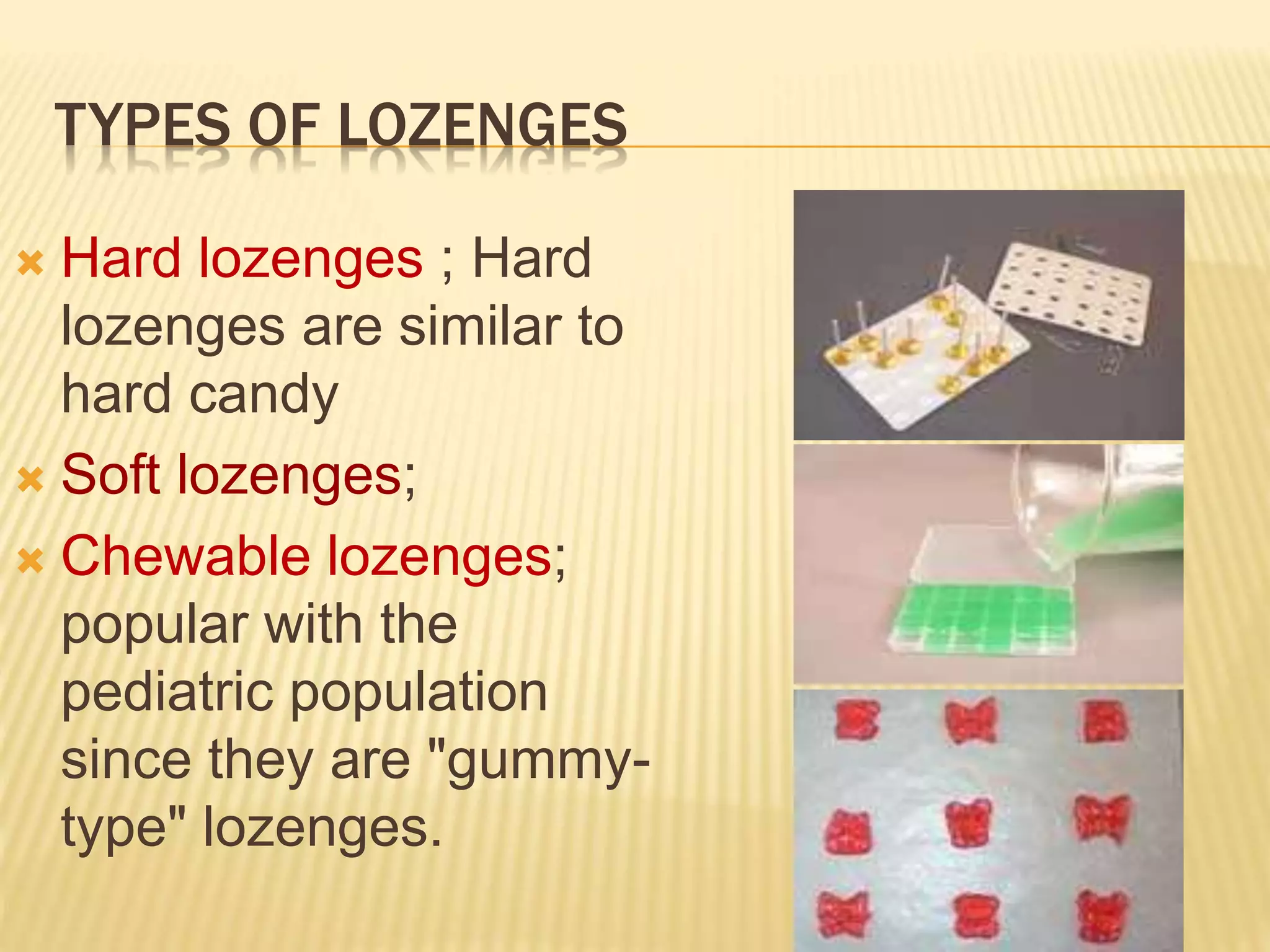
 Hard lozenges ; Hard 
lozenges are similar to 
hard candy 
 Soft lozenges; 
 Chewable lozenges; 
popular with the 
pediatric population 
since they are "gummy-type" 
lozenges.
PREPARATION 
Compounded lozenges can be prepared by 
molding mixtures of ingredients containing: 
 sugars to form a hard lozenge 
 polyethylene glycol (PEG) to form a soft 
lozenge 
 gelatin to form a chewable lozenge
LOZENGES 
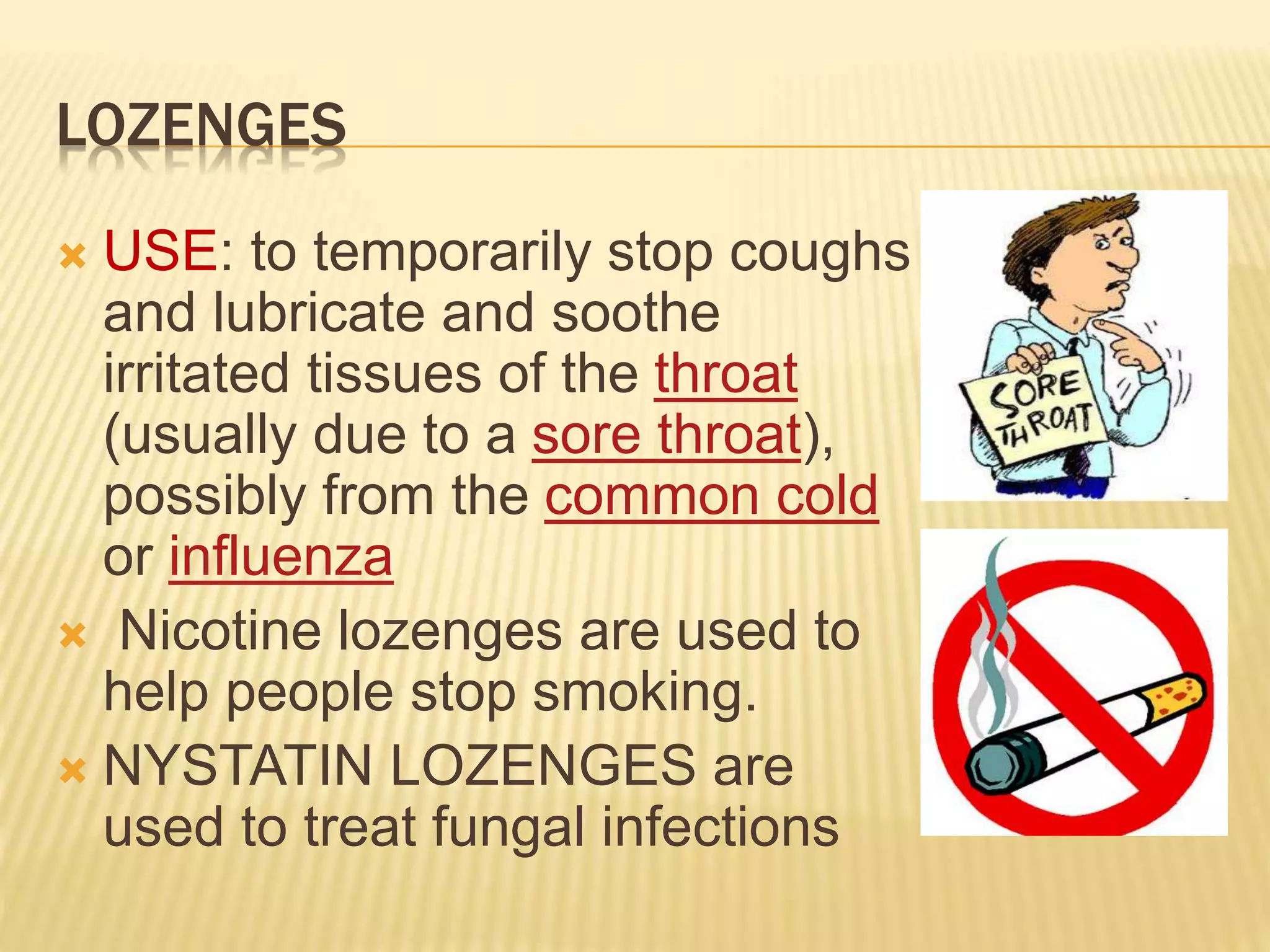
 USE: to temporarily stop coughs 
and lubricate and soothe 
irritated tissues of the throat 
(usually due to a sore throat), 
possibly from the common cold 
or influenza 
 Nicotine lozenges are used to 
help people stop smoking. 
 NYSTATIN LOZENGES are 
used to treat fungal infections
LOZENGES 
 ADVANTAGES: 
 being easy to administer to pediatric and 
geriatric patients. 
 keeping the drug in contact with the oral 
cavity for an extended period of time. 
 DISADVANTAGE: 
 One disadvantage of using a "gummy-type" 
lozenge with children is they may perceive it 
as candy and not a serious dosage form.
LOZENGES 
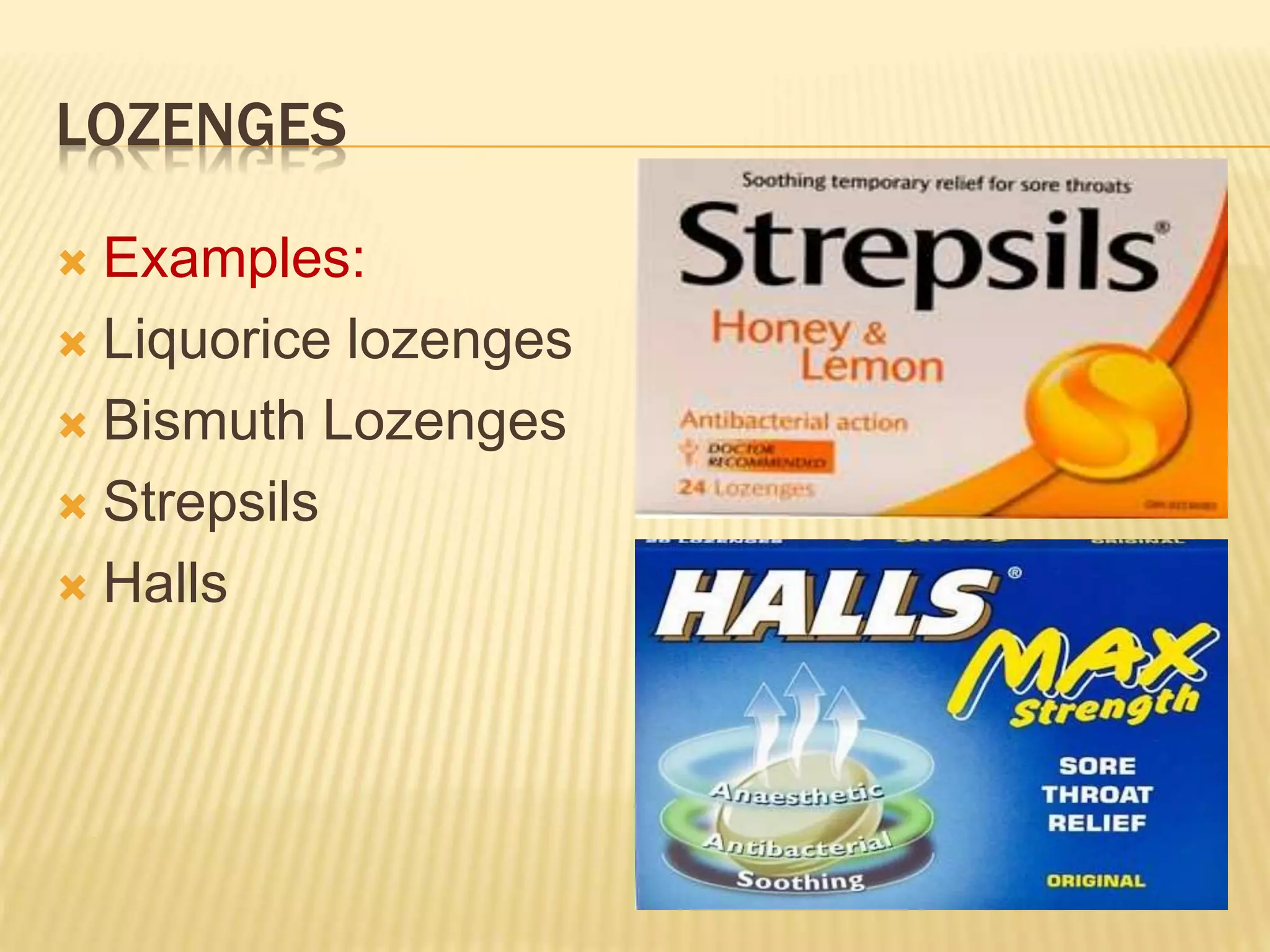
 Examples: 
 Liquorice lozenges 
 Bismuth Lozenges 
 Strepsils 
 Halls
PILLS 
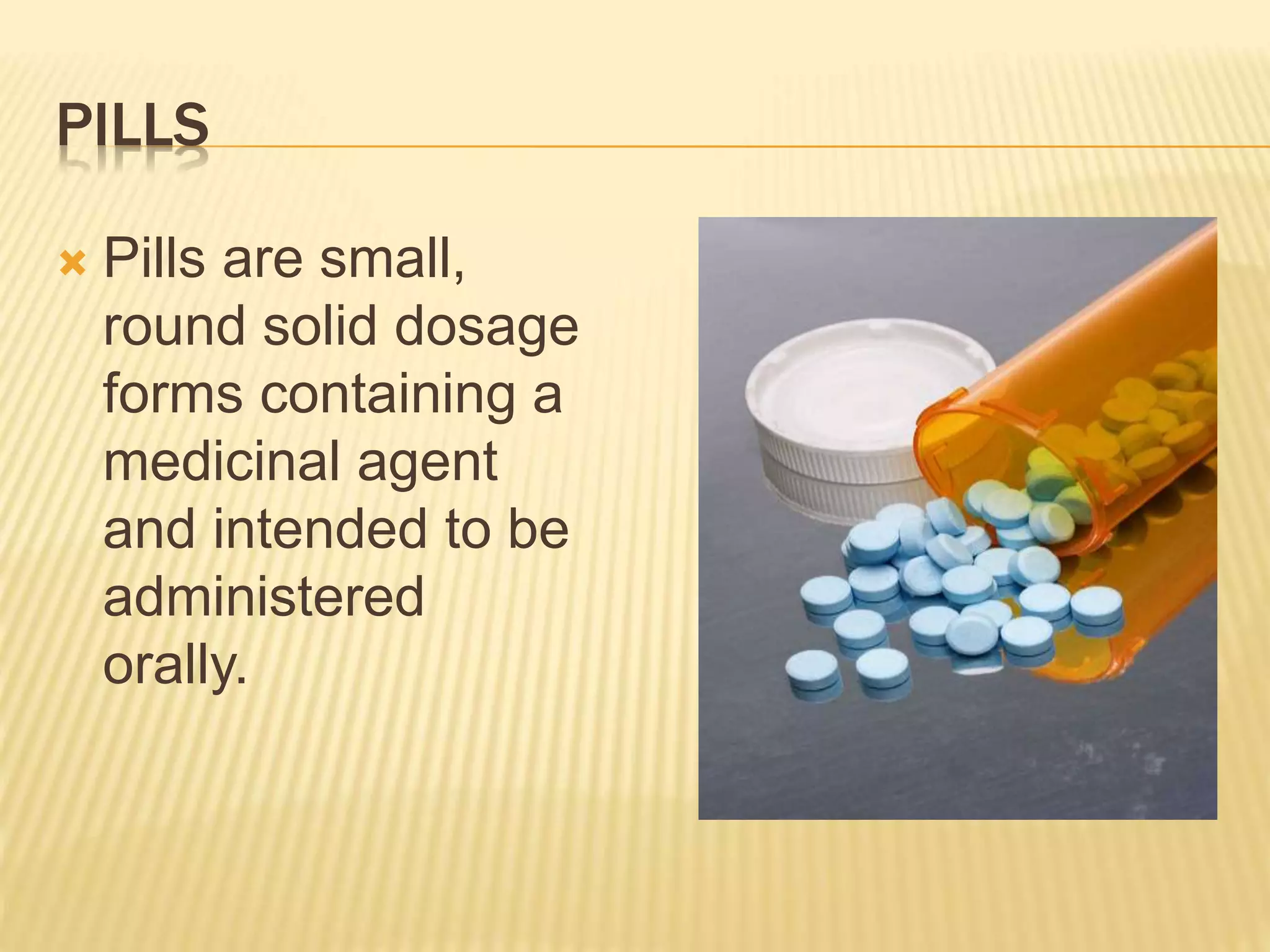
 Pills are small, 
round solid dosage 
forms containing a 
medicinal agent 
and intended to be 
administered 
orally.
PREPARATION 
 Pills were made by mixing the active 
ingredients with an excipient such as glucose 
syrup in a mortar and pestle to form a paste, 
then rolling the mass into a long cylindrical 
shape (called a "pipe"), and dividing it into 
equal portions, which were then rolled into 
balls, and often coated with sugar to make 
them more palatable
PILLS 
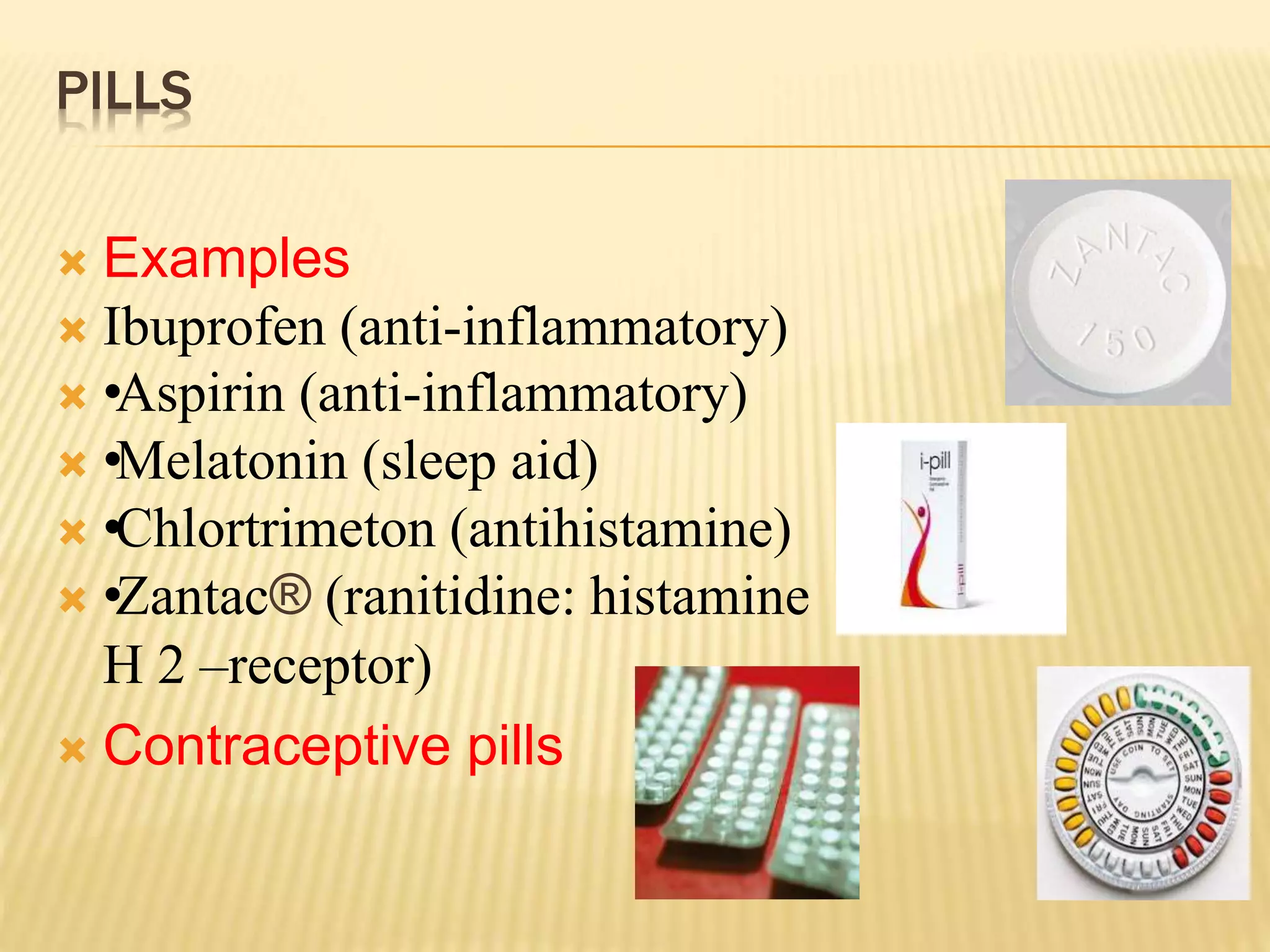
 Examples 
 Ibuprofen (anti-inflammatory) 
• Aspirin (anti-inflammatory) 
• Melatonin (sleep aid) 
• Chlortrimeton (antihistamine) 
• Zantac® (ranitidine: histamine 
H 2 –receptor) 
 Contraceptive pills
CATCHETS 
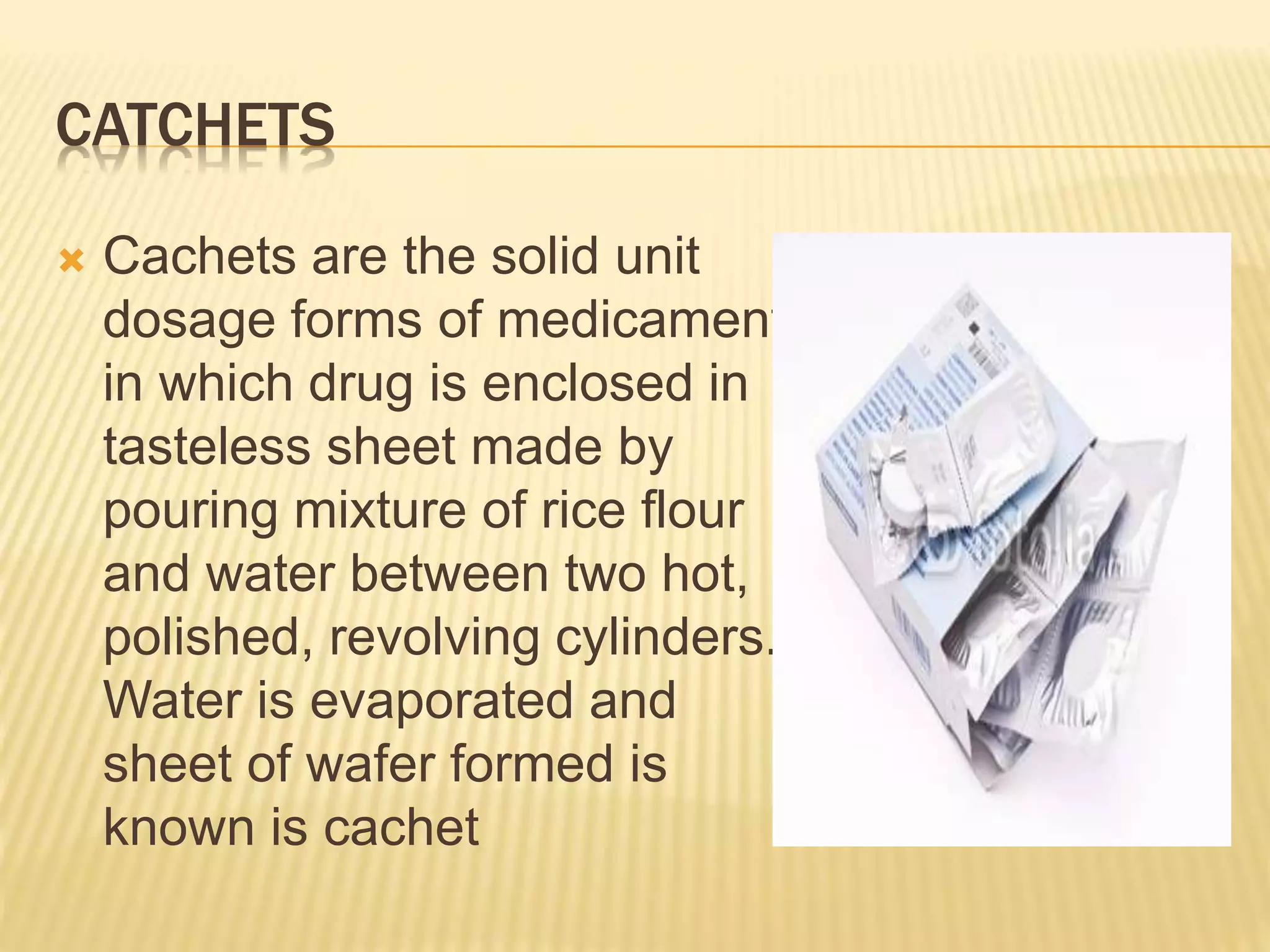
 Cachets are the solid unit 
dosage forms of medicament 
in which drug is enclosed in 
tasteless sheet made by 
pouring mixture of rice flour 
and water between two hot, 
polished, revolving cylinders. 
Water is evaporated and 
sheet of wafer formed is 
known is cachet
TYPES 
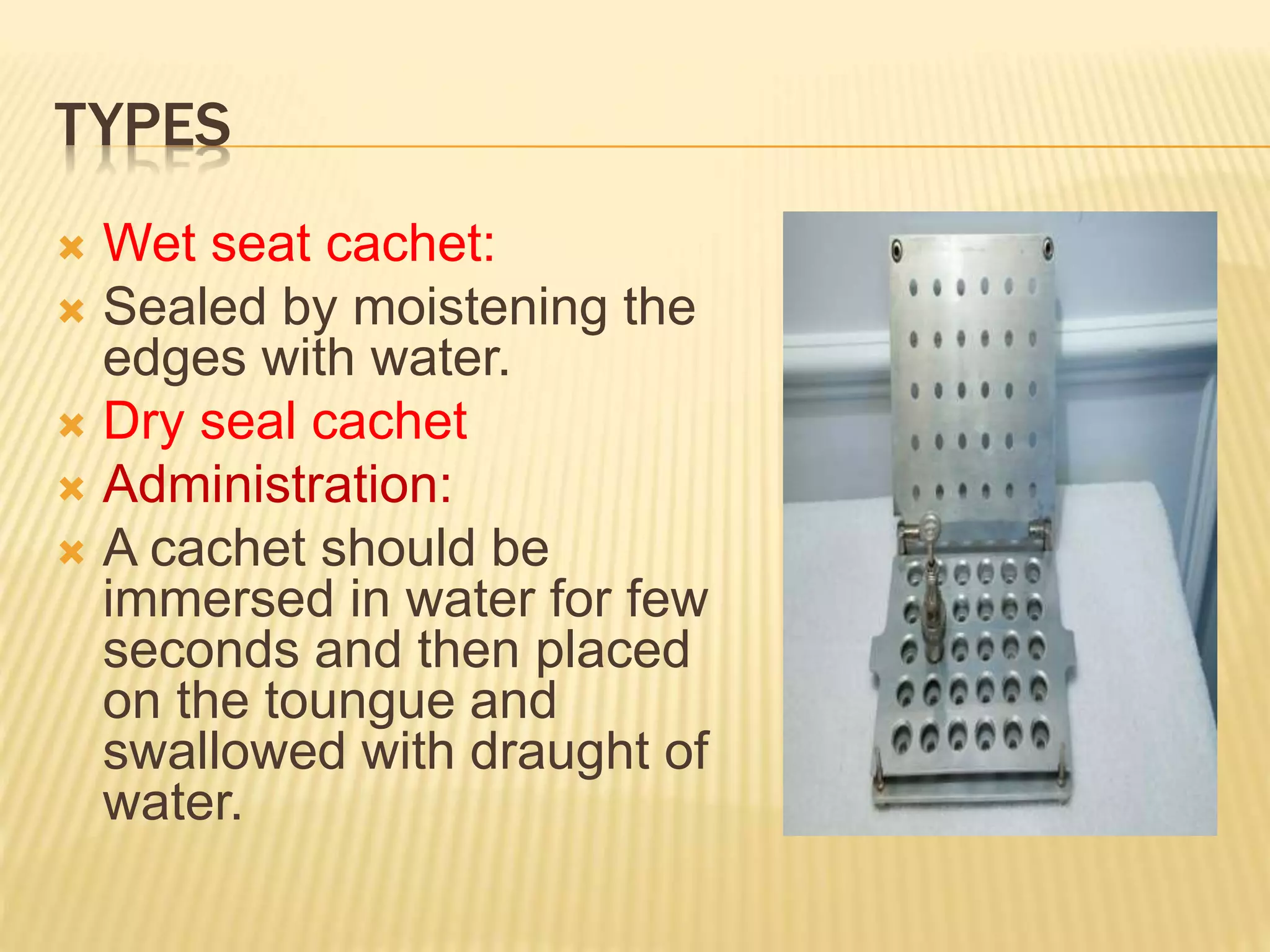
 Wet seat cachet: 
 Sealed by moistening the 
edges with water. 
 Dry seal cachet 
 Administration: 
 A cachet should be 
immersed in water for few 
seconds and then placed 
on the toungue and 
swallowed with draught of 
water.
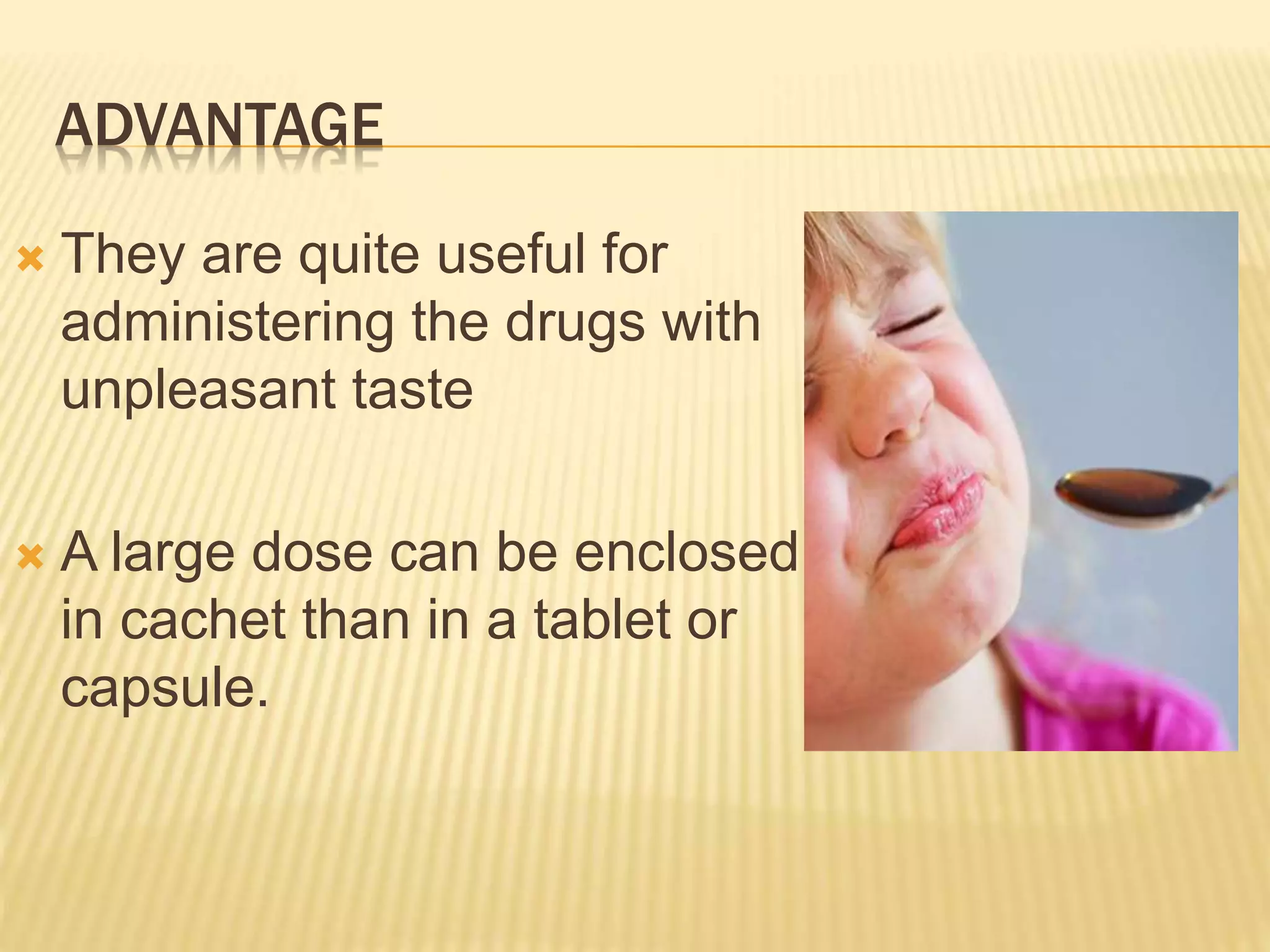
ADVANTAGE 
 They are quite useful for 
administering the drugs with 
unpleasant taste 
 A large dose can be enclosed 
in cachet than in a tablet or 
capsule.
CACHETS 
 Examples: 
 Sodium amino salicylate cachet. 
 Isoniazid cachet.
VITRELLAE 
 Vitrallae are thin walled 
glass capsules 
containing a volatile 
ingredient and 
protected by absorbent 
cotton wool and an 
outer silk bag.
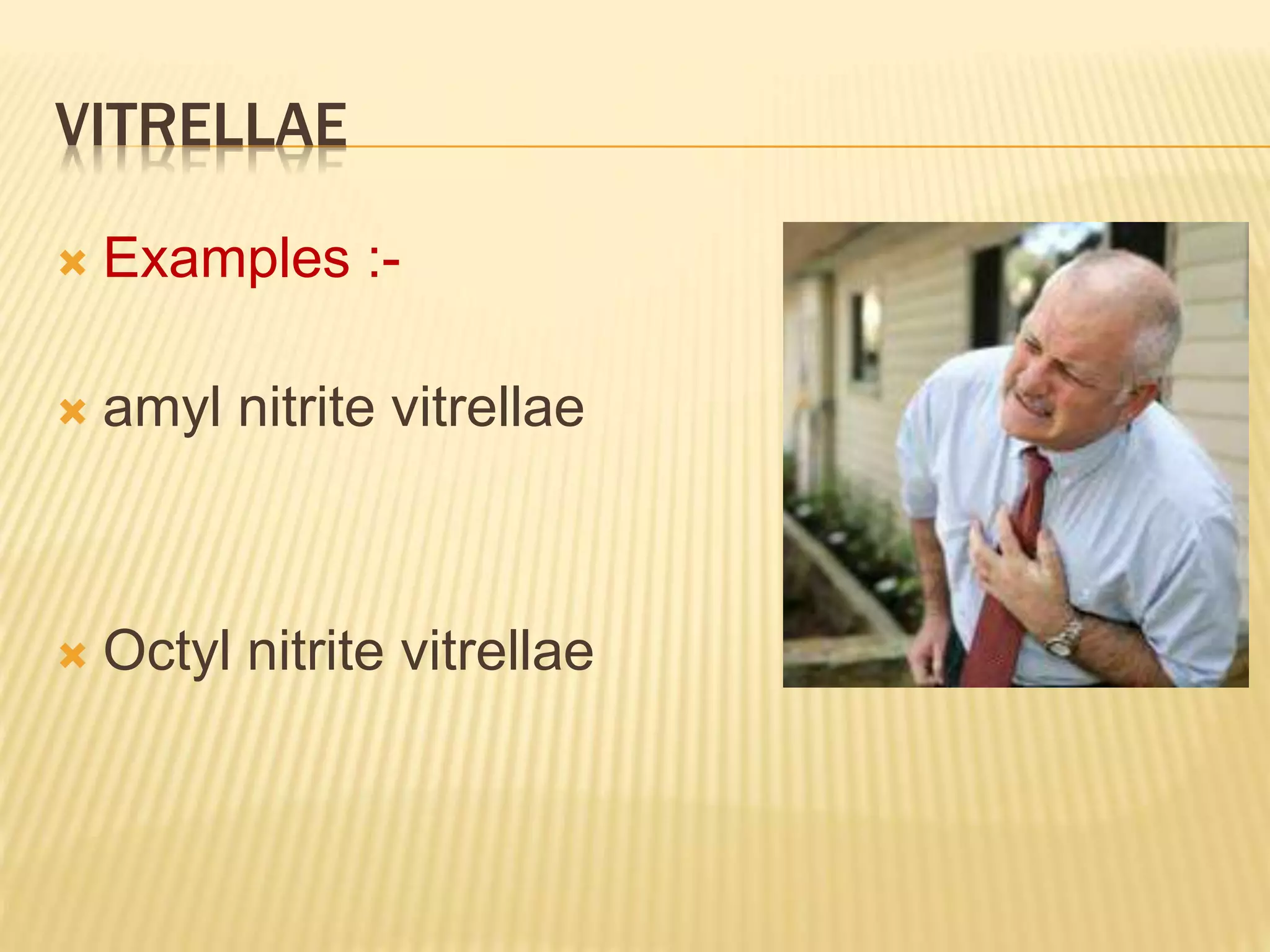
VITRELLAE 
 Examples :- 
 amyl nitrite vitrellae 
 Octyl nitrite vitrellae
DRAUGHTS / HAUSTUS 
 Liquid oral preparations 
packed as a single 
dose in separate 
containers and in large 
volumes are known as 
draught.
DRAUGHTS 
 A draught is an older term used to describe a 
liquid preparation formulated as a single 
dose, in a volume which is larger than 
generally utilised intraditional mixture 
formulations 
 Each draught was usually supplied in a 50mL 
unit dose container
DRAUGHTS 
 Examples: 
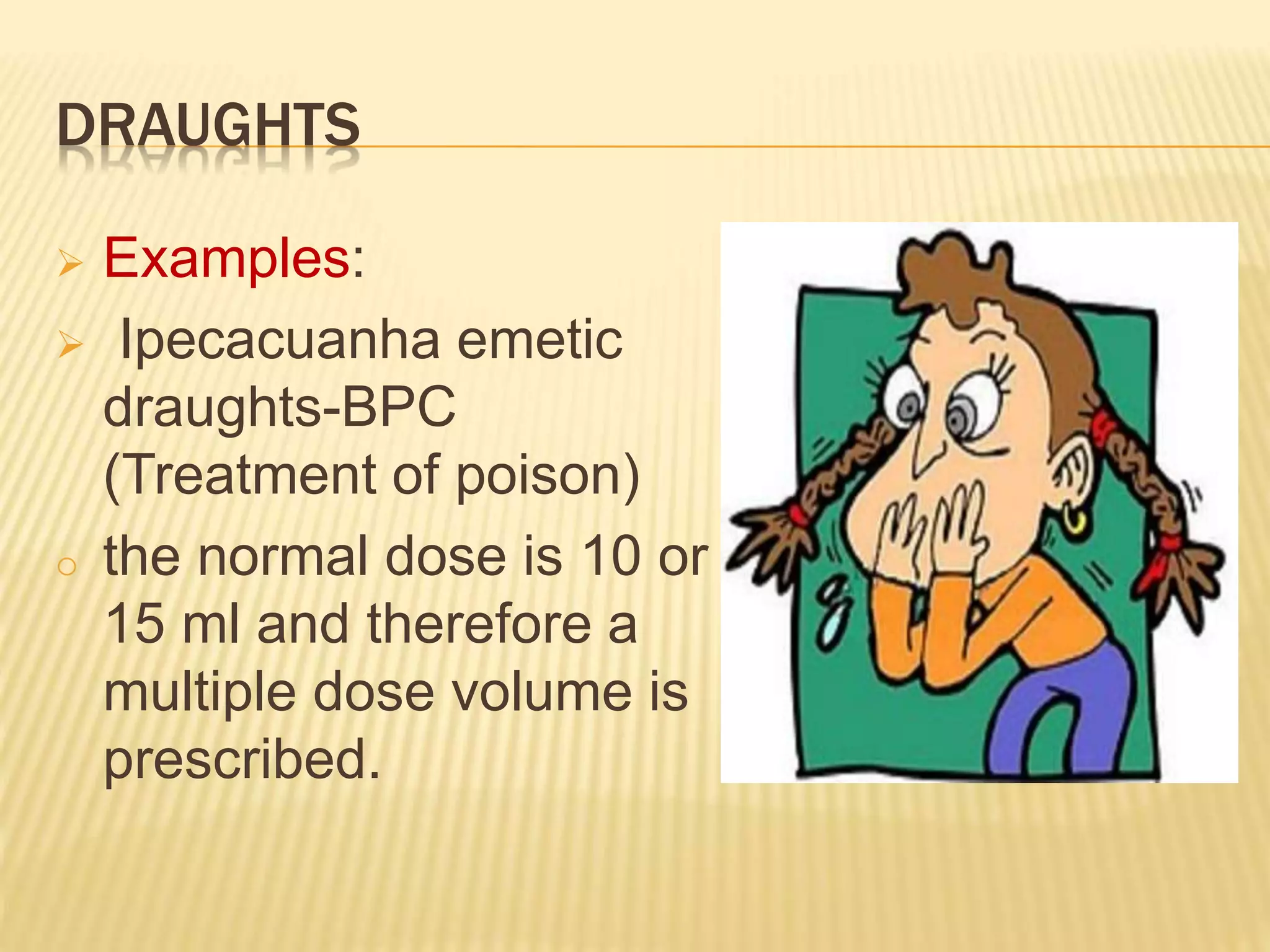
 Ipecacuanha emetic 
draughts-BPC 
(Treatment of poison) 
o the normal dose is 10 or 
15 ml and therefore a 
multiple dose volume is 
prescribed.
DRAUGHTS 
 Malefern draught-Emulsion 
 Paraldehyde draughts- Oxidized to acetic 
acid and cause death. 
 PRECAUTION: Do not use, if the solution is 
discolored
SUPPOSITORIES 
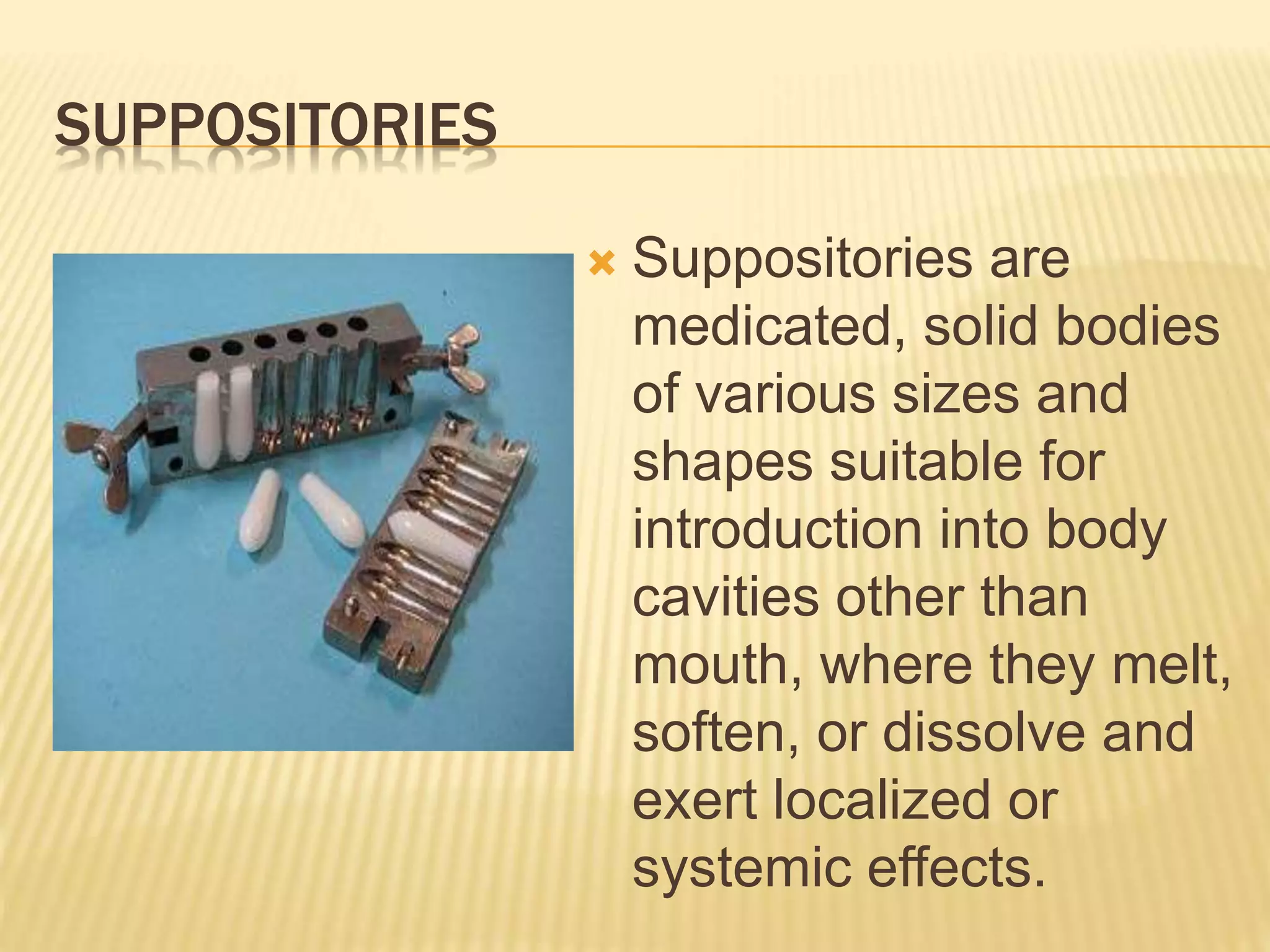
 Suppositories are 
medicated, solid bodies 

of various sizes and 
shapes suitable for 
introduction into body 
cavities other than 
mouth, where they melt, 
soften, or dissolve and 
exert localized or 
systemic effects.
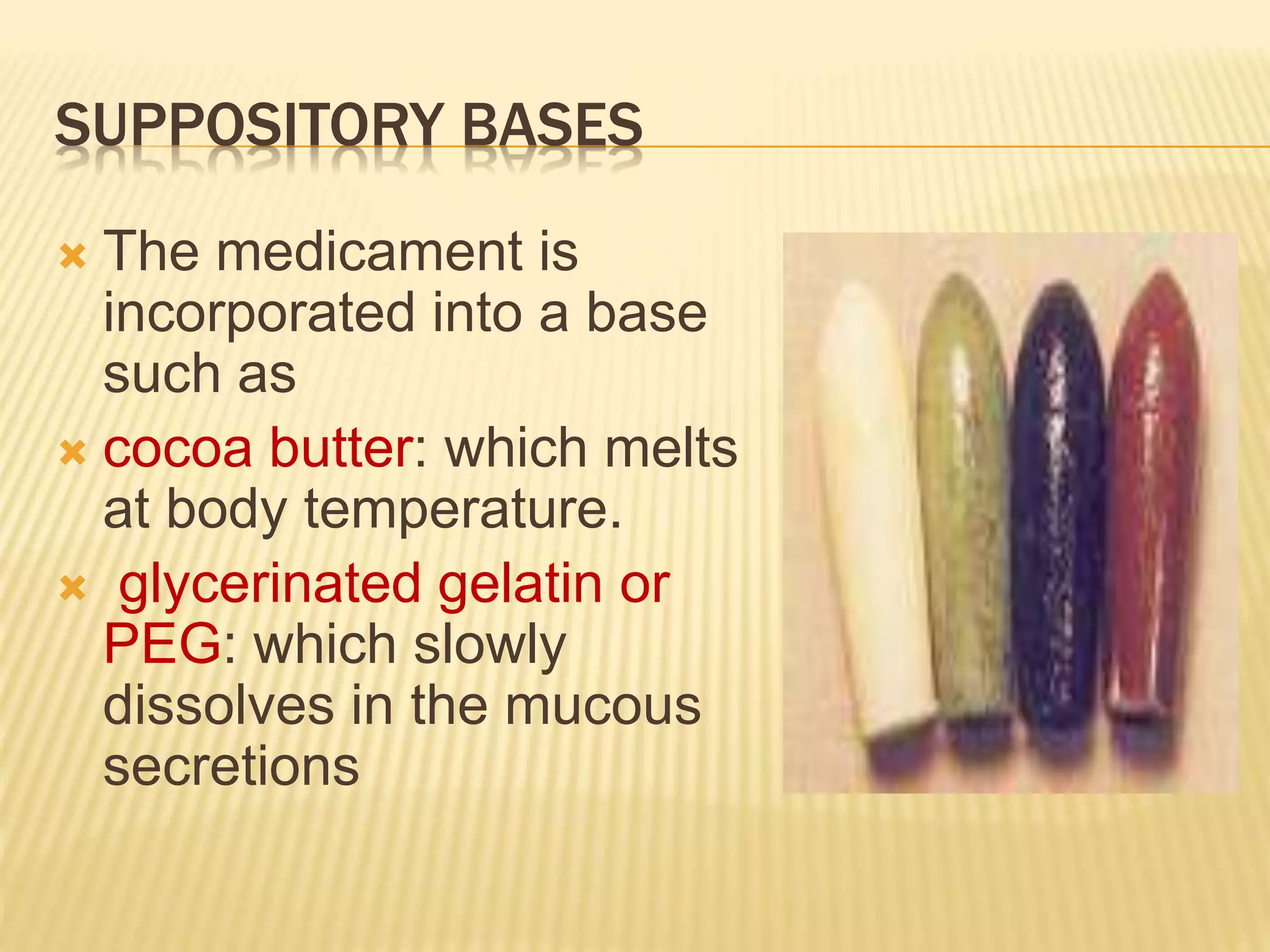
SUPPOSITORY BASES 
 The medicament is 
incorporated into a base 
such as 
 cocoa butter: which melts 
at body temperature. 
 glycerinated gelatin or 
PEG: which slowly 
dissolves in the mucous 
secretions
TYPES OF SUPPOSITORIES 
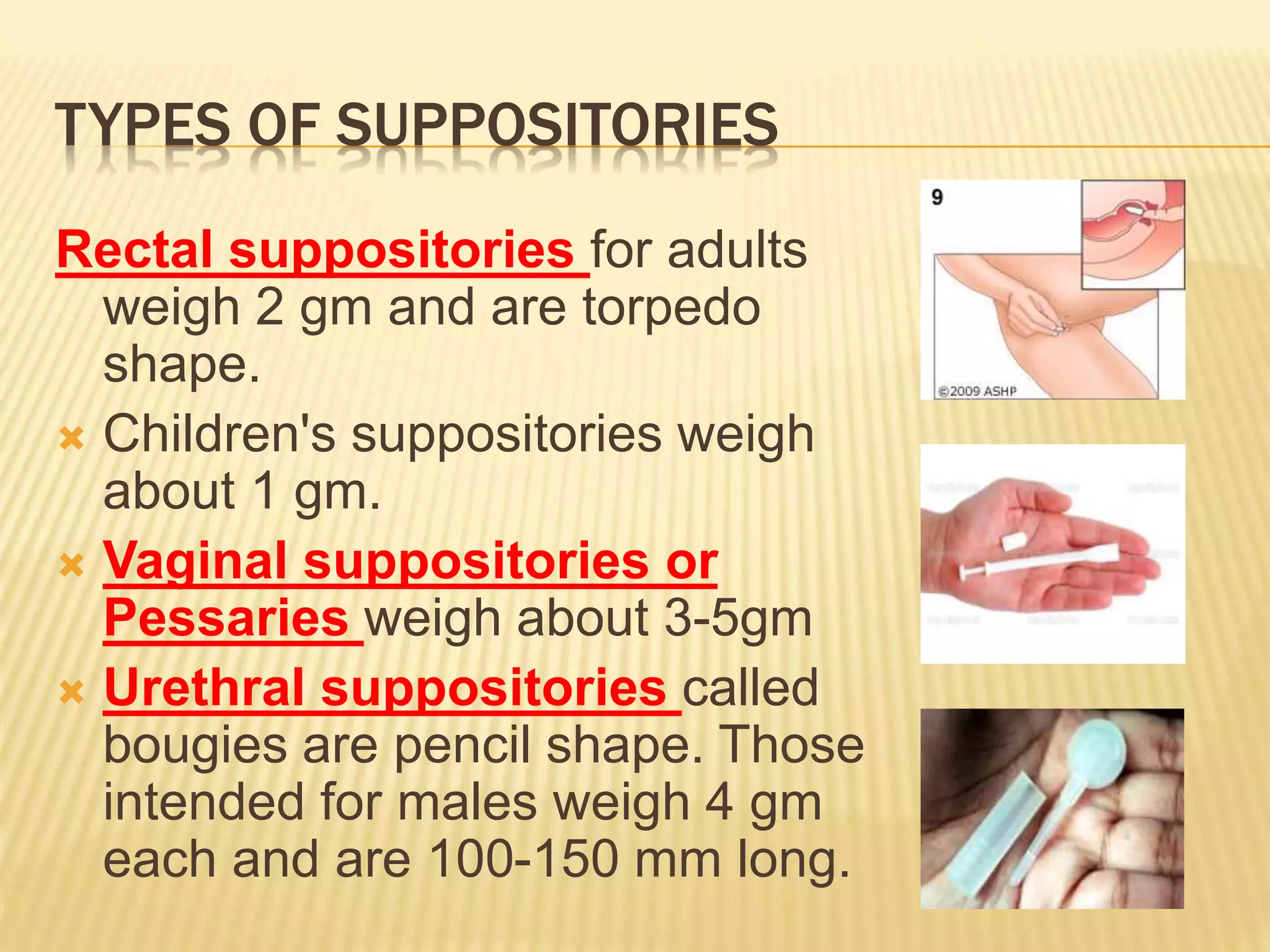
Rectal suppositories for adults 
weigh 2 gm and are torpedo 
shape. 
 Children's suppositories weigh 
about 1 gm. 
 Vaginal suppositories or 
Pessaries weigh about 3-5gm 
 Urethral suppositories called 
bougies are pencil shape. Those 
intended for males weigh 4 gm 
each and are 100-150 mm long.
TYPES OF SUPPOSITORIES 
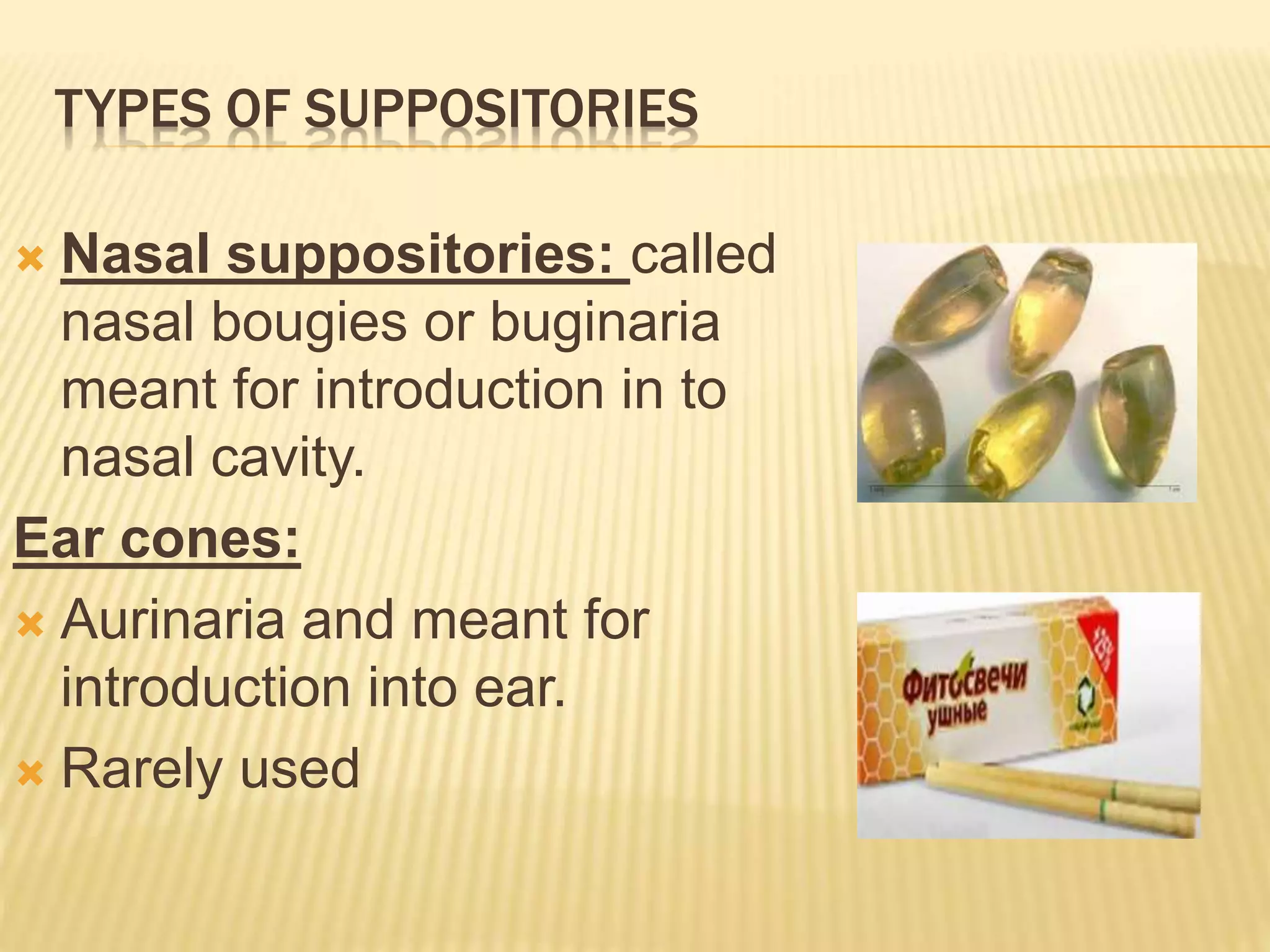
 Nasal suppositories: called 
nasal bougies or buginaria 
meant for introduction in to 
nasal cavity. 
Ear cones: 
 Aurinaria and meant for 
introduction into ear. 
 Rarely used
SUPPOSITORIES 
ADVANTAGES: 
_ Can exert local effect on rectal mucosa. 
_ Used to promote evacuation of bowel. 
_ Avoid any gastrointestinal irritation. 
_ Can be used in unconscious patients. 
_ Can be used for systemic absorption of drugs 
and avoid first-pass metabolism. 
− People suffering from severe nausea or 
vomiting.
SUPPOSITORIES 
 DISADVANTAGES : 
− The problem of patient acceptability. 
− Suppositories are not suitable for patients 
suffering from diarrhea. 
 Incomplete absorption may be obtained 
because suppository usually promotes 
evacuation of the bowel.
SUPPOSITORIES 
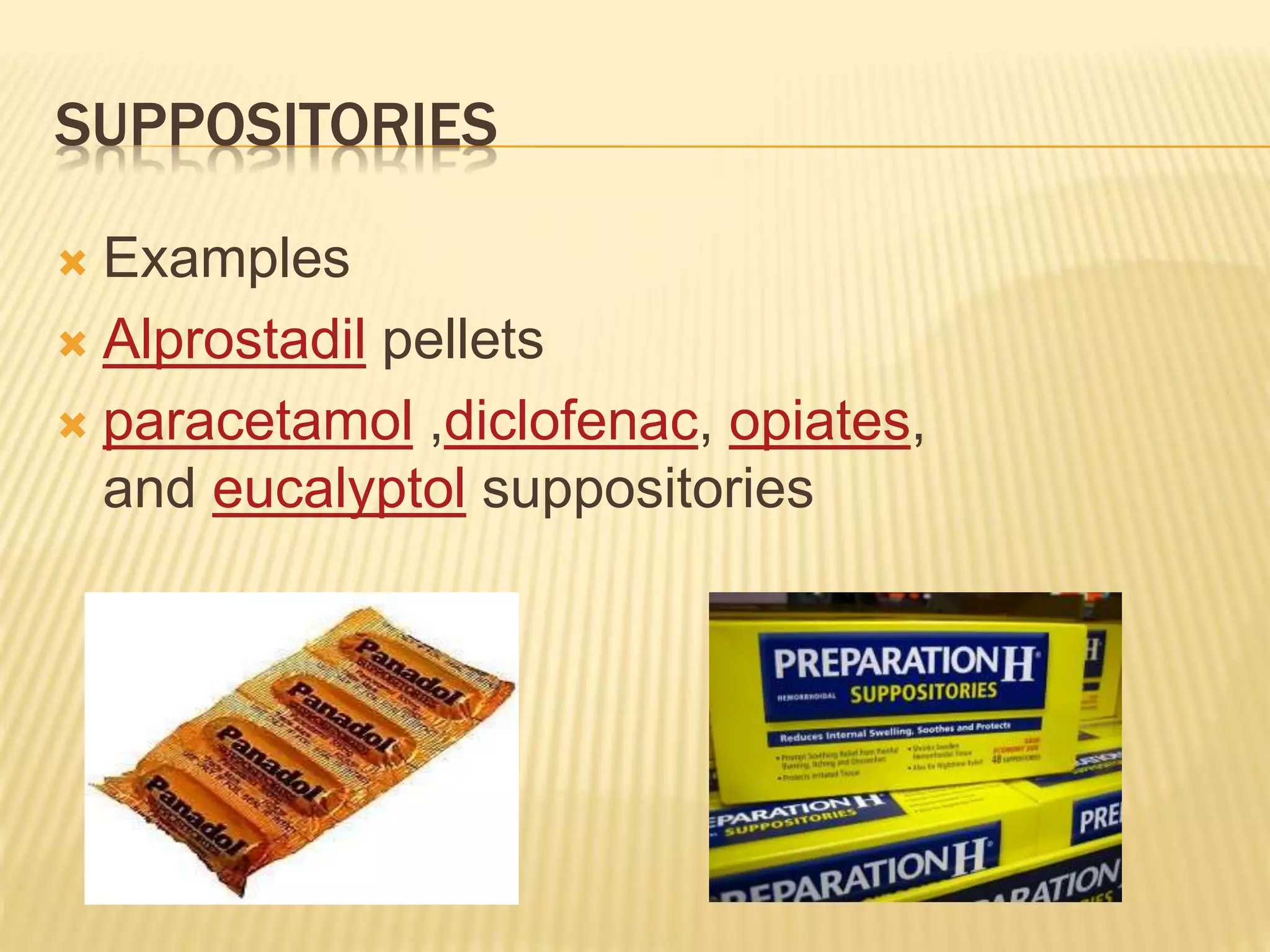
 Examples 
 Alprostadil pellets 
 paracetamol ,diclofenac, opiates, 
and eucalyptol suppositories
PESSARIES 
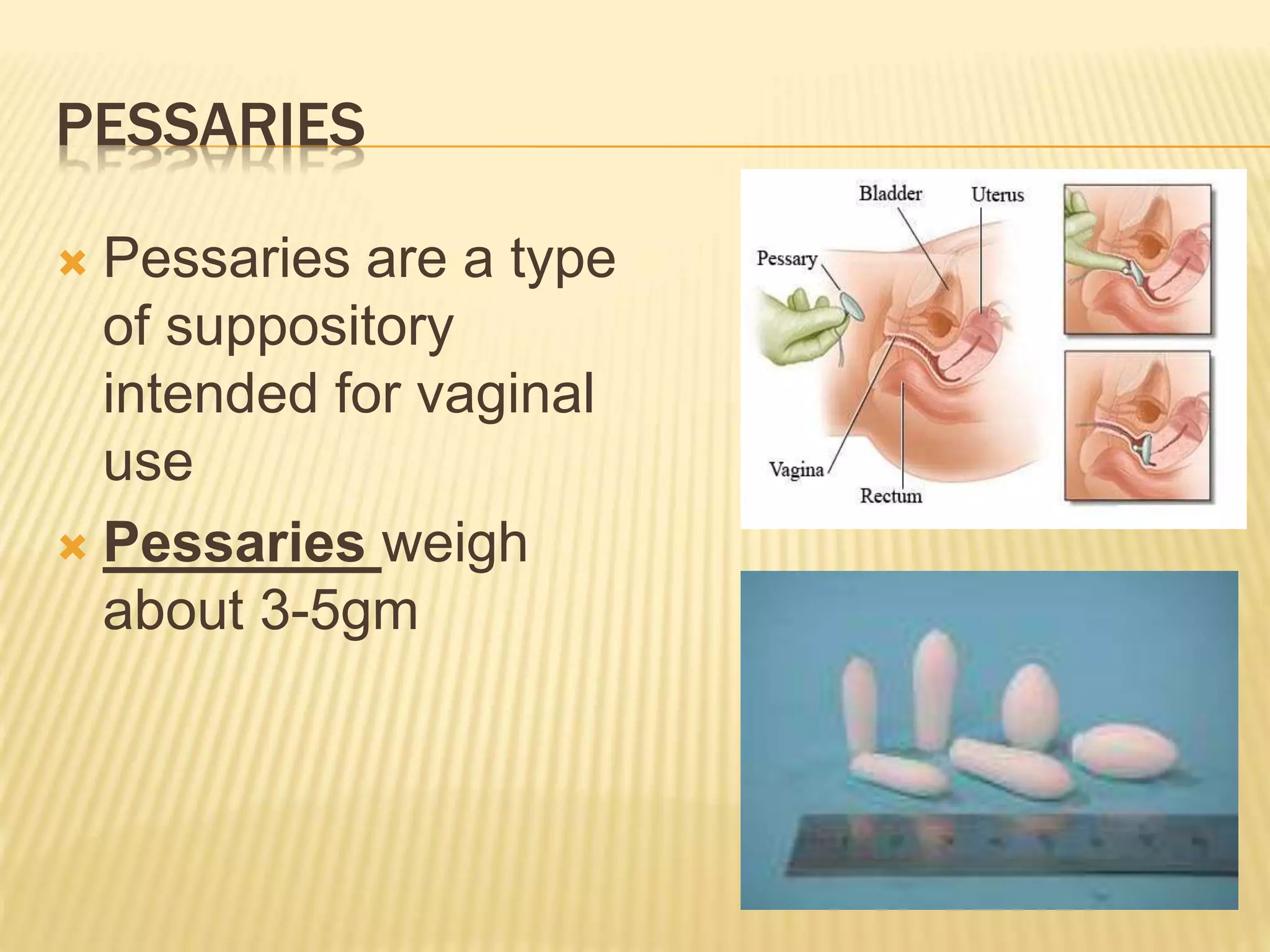
 Pessaries are a type 
of suppository 
intended for vaginal 
use 
 Pessaries weigh 
about 3-5gm
PREPARATION 
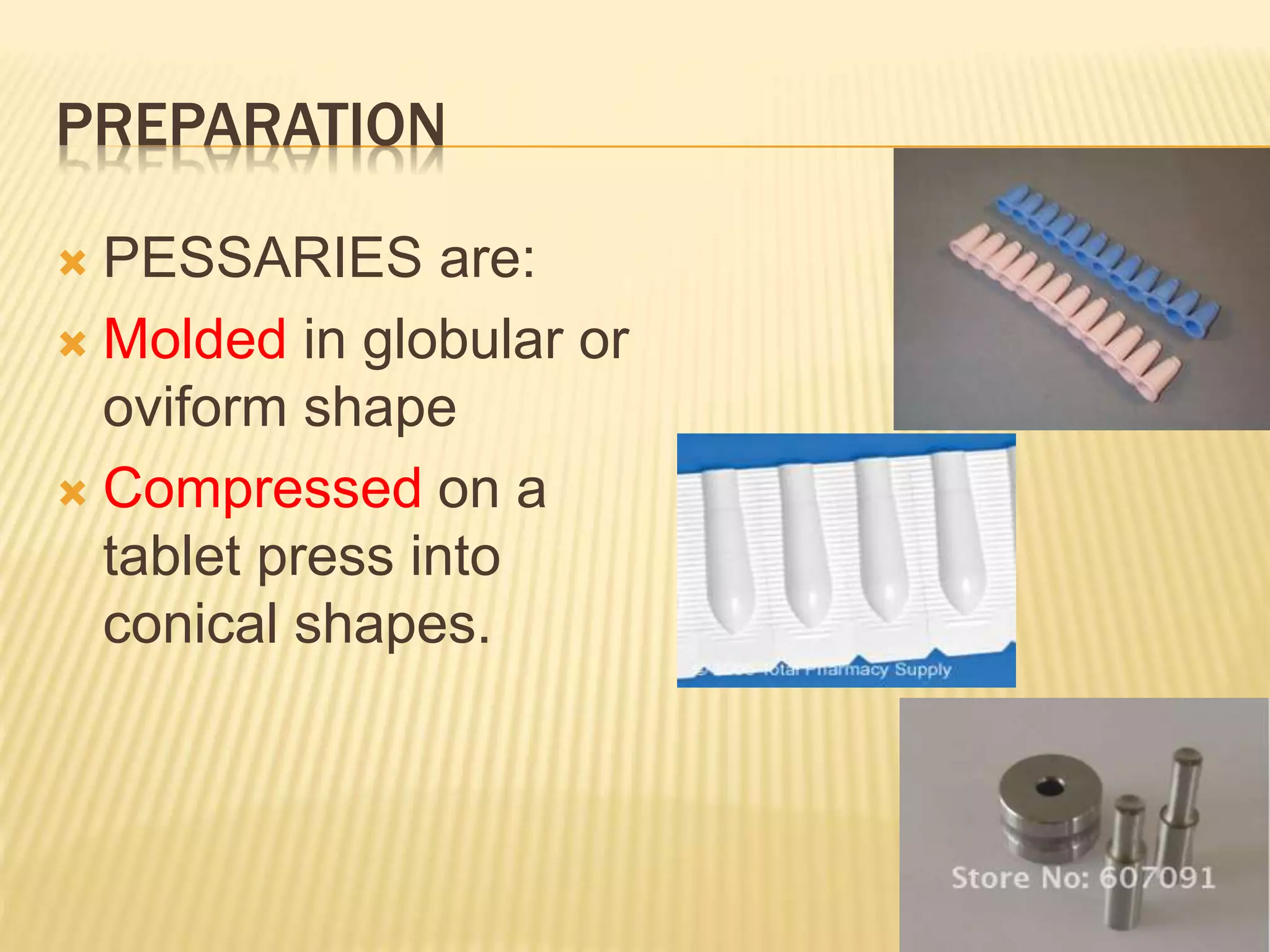
 PESSARIES are: 
 Molded in globular or 
oviform shape 
 Compressed on a 
tablet press into 
conical shapes.
USES 
Common ingredients for inclusion in pessaries 
for local action include: 
 antiseptics 
 contraceptive agents 
 local anaesthetics 
 various therapeutic agents to treat 
infections.
PESSARIES 
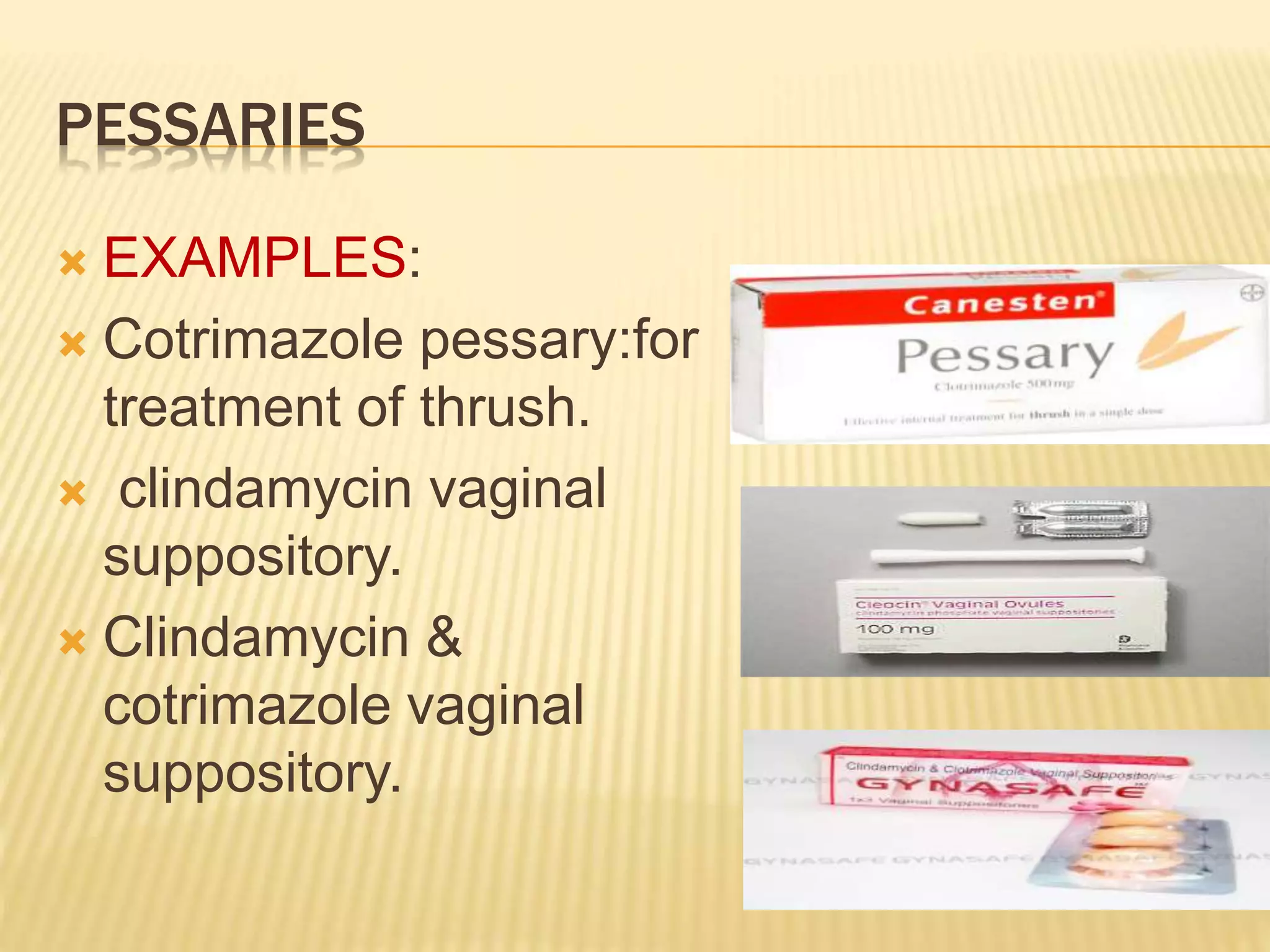
 EXAMPLES: 
 Cotrimazole pessary:for 
treatment of thrush. 
 clindamycin vaginal 
suppository. 
 Clindamycin & 
cotrimazole vaginal 
suppository.
REFEREENCES 
 BOOKS: 
 REMINGTONSCIENCE AND PRACTICE OF 
PHARMACY 
 ANSEL’S PHARMACEUTICAL DOSAGE FORMS AND 
DRUG DELIVERY SYSTEM. 
 INTRODUCTION TO PHARMACEUTICS-I BY ASHOK 
K.GUPTA 
 COOPER AND GUNN’S DISPENSING FOR 
PHARMACEUTICAL STUDENTS 
 NET: 
 http://en.wikipedia.org/wiki/Pessary 
 http://en.wikipedia.org/wiki/Pill_(pharmacy) 
 http://en.wikipedia.org/wiki/Suppository 
 http://pharmlabs.unc.edu/labs/suppository/routes.htm
Classical dosage forms-by Amna Saeed

Classical dosage forms-by Amna Saeed

  • 2.
    CLASSICAL DOSAGE FORMS by: Amna Saeed Pharm.D (2009- 2014) Institute of pharmaceutical Sciences Lahore College For Women University
  • 3.
    DOSAGE FORMS Dosage forms are the means by which drug molecules are delivered to sites of action with in the body.  The different forms in which drugs may be supplied to a patient  These forms are a mixture of active drug components and nondrug components.
  • 4.
    CLASSIFICATION OF DOSAGEFORMS  They are classified according to Physical form:  Solid( tablets, pills capsules etc)  Semisolid(ointments,crea ms etc)  Liquid (syrup, draughts & elixirs etc)
  • 5.
    CLASSICAL DOSAGE FORMS  They are the conventional dosage forms in which no advanced or computerized technique is used for their preparation.  These were used in old days and now their use is almost obsolete.
  • 6.
    CLASSICAL DOSAGE FORMS  LOZENGES  PILLS  CACHETS  VITRELLAE  DRAUGHTS  SUPPOSITORIES  PESSARIES
  • 7.
    LOZENGES  coughdrop, troche, cachou, or cough sweet  A small, medicated candy intended to be dissolved slowly in the mouth to lubricate and soothe irritated tissues of the throat.
  • 8.
    TYPES OF LOZENGES  Hard lozenges ; Hard lozenges are similar to hard candy  Soft lozenges;  Chewable lozenges; popular with the pediatric population since they are "gummy-type" lozenges.
  • 9.
    PREPARATION Compounded lozengescan be prepared by molding mixtures of ingredients containing:  sugars to form a hard lozenge  polyethylene glycol (PEG) to form a soft lozenge  gelatin to form a chewable lozenge
  • 10.
    LOZENGES  USE:to temporarily stop coughs and lubricate and soothe irritated tissues of the throat (usually due to a sore throat), possibly from the common cold or influenza  Nicotine lozenges are used to help people stop smoking.  NYSTATIN LOZENGES are used to treat fungal infections
  • 11.
    LOZENGES  ADVANTAGES:  being easy to administer to pediatric and geriatric patients.  keeping the drug in contact with the oral cavity for an extended period of time.  DISADVANTAGE:  One disadvantage of using a "gummy-type" lozenge with children is they may perceive it as candy and not a serious dosage form.
  • 12.
    LOZENGES  Examples:  Liquorice lozenges  Bismuth Lozenges  Strepsils  Halls
  • 13.
    PILLS  Pillsare small, round solid dosage forms containing a medicinal agent and intended to be administered orally.
  • 14.
    PREPARATION  Pillswere made by mixing the active ingredients with an excipient such as glucose syrup in a mortar and pestle to form a paste, then rolling the mass into a long cylindrical shape (called a "pipe"), and dividing it into equal portions, which were then rolled into balls, and often coated with sugar to make them more palatable
  • 15.
    PILLS  Examples  Ibuprofen (anti-inflammatory) • Aspirin (anti-inflammatory) • Melatonin (sleep aid) • Chlortrimeton (antihistamine) • Zantac® (ranitidine: histamine H 2 –receptor)  Contraceptive pills
  • 16.
    CATCHETS  Cachetsare the solid unit dosage forms of medicament in which drug is enclosed in tasteless sheet made by pouring mixture of rice flour and water between two hot, polished, revolving cylinders. Water is evaporated and sheet of wafer formed is known is cachet
  • 17.
    TYPES  Wetseat cachet:  Sealed by moistening the edges with water.  Dry seal cachet  Administration:  A cachet should be immersed in water for few seconds and then placed on the toungue and swallowed with draught of water.
  • 18.
    ADVANTAGE  Theyare quite useful for administering the drugs with unpleasant taste  A large dose can be enclosed in cachet than in a tablet or capsule.
  • 19.
    CACHETS  Examples:  Sodium amino salicylate cachet.  Isoniazid cachet.
  • 20.
    VITRELLAE  Vitrallaeare thin walled glass capsules containing a volatile ingredient and protected by absorbent cotton wool and an outer silk bag.
  • 21.
    VITRELLAE  Examples:-  amyl nitrite vitrellae  Octyl nitrite vitrellae
  • 22.
    DRAUGHTS / HAUSTUS  Liquid oral preparations packed as a single dose in separate containers and in large volumes are known as draught.
  • 23.
    DRAUGHTS  Adraught is an older term used to describe a liquid preparation formulated as a single dose, in a volume which is larger than generally utilised intraditional mixture formulations  Each draught was usually supplied in a 50mL unit dose container
  • 24.
    DRAUGHTS  Examples:  Ipecacuanha emetic draughts-BPC (Treatment of poison) o the normal dose is 10 or 15 ml and therefore a multiple dose volume is prescribed.
  • 25.
    DRAUGHTS  Maleferndraught-Emulsion  Paraldehyde draughts- Oxidized to acetic acid and cause death.  PRECAUTION: Do not use, if the solution is discolored
  • 26.
    SUPPOSITORIES  Suppositoriesare medicated, solid bodies of various sizes and shapes suitable for introduction into body cavities other than mouth, where they melt, soften, or dissolve and exert localized or systemic effects.
  • 27.
    SUPPOSITORY BASES The medicament is incorporated into a base such as  cocoa butter: which melts at body temperature.  glycerinated gelatin or PEG: which slowly dissolves in the mucous secretions
  • 28.
    TYPES OF SUPPOSITORIES Rectal suppositories for adults weigh 2 gm and are torpedo shape.  Children's suppositories weigh about 1 gm.  Vaginal suppositories or Pessaries weigh about 3-5gm  Urethral suppositories called bougies are pencil shape. Those intended for males weigh 4 gm each and are 100-150 mm long.
  • 29.
    TYPES OF SUPPOSITORIES  Nasal suppositories: called nasal bougies or buginaria meant for introduction in to nasal cavity. Ear cones:  Aurinaria and meant for introduction into ear.  Rarely used
  • 30.
    SUPPOSITORIES ADVANTAGES: _Can exert local effect on rectal mucosa. _ Used to promote evacuation of bowel. _ Avoid any gastrointestinal irritation. _ Can be used in unconscious patients. _ Can be used for systemic absorption of drugs and avoid first-pass metabolism. − People suffering from severe nausea or vomiting.
  • 31.
    SUPPOSITORIES  DISADVANTAGES: − The problem of patient acceptability. − Suppositories are not suitable for patients suffering from diarrhea.  Incomplete absorption may be obtained because suppository usually promotes evacuation of the bowel.
  • 32.
    SUPPOSITORIES  Examples  Alprostadil pellets  paracetamol ,diclofenac, opiates, and eucalyptol suppositories
  • 33.
    PESSARIES  Pessariesare a type of suppository intended for vaginal use  Pessaries weigh about 3-5gm
  • 34.
    PREPARATION  PESSARIESare:  Molded in globular or oviform shape  Compressed on a tablet press into conical shapes.
  • 35.
    USES Common ingredientsfor inclusion in pessaries for local action include:  antiseptics  contraceptive agents  local anaesthetics  various therapeutic agents to treat infections.
  • 36.
    PESSARIES  EXAMPLES:  Cotrimazole pessary:for treatment of thrush.  clindamycin vaginal suppository.  Clindamycin & cotrimazole vaginal suppository.
  • 37.
    REFEREENCES  BOOKS:  REMINGTONSCIENCE AND PRACTICE OF PHARMACY  ANSEL’S PHARMACEUTICAL DOSAGE FORMS AND DRUG DELIVERY SYSTEM.  INTRODUCTION TO PHARMACEUTICS-I BY ASHOK K.GUPTA  COOPER AND GUNN’S DISPENSING FOR PHARMACEUTICAL STUDENTS  NET:  http://en.wikipedia.org/wiki/Pessary  http://en.wikipedia.org/wiki/Pill_(pharmacy)  http://en.wikipedia.org/wiki/Suppository  http://pharmlabs.unc.edu/labs/suppository/routes.htm