Prepared by: Ms. Argade V. P.
M. Pharm (QAT)
Lecturer PRES’s Institute of Pharmacy Loni
• Suppositories are solid or semisolid dosage forms of medicaments meant
for insertion in to body cavities other than mouth (oral cavity).
They may be inserted in to body cavity such as Rectum, Vagina, urethra,
Nose & Ear.
It is comes under semi solid preparation because it is prepared by
melting all ingredients (bases and other additives along with active
ingredient).
All types of suppositories are melt at normal body temperature after
introducing in body cavity and produce their effect.
• It is the alternated dosage form for drugs which have less bioavailability
when it is taken orally.
• Drugs having bad odour and taste can be used in suppository form.
• It is suitable for unconscious patients which can not taken drugs orally.
• It is suitable for drugs which produce irritating effect in GIT.
• It is suitable for infants and old people who find difficulty in swallowing of
drugs.
• It is suitable for the drugs which are destroyed by portal circulation.
• The manufacturing process is more difficult as compare other
formulation.
The drugs which cause irritation to mucous membrane can not be
administrated by this form.
The most important problem is storage condition because it stored at
low temp. (10-20 0c ).
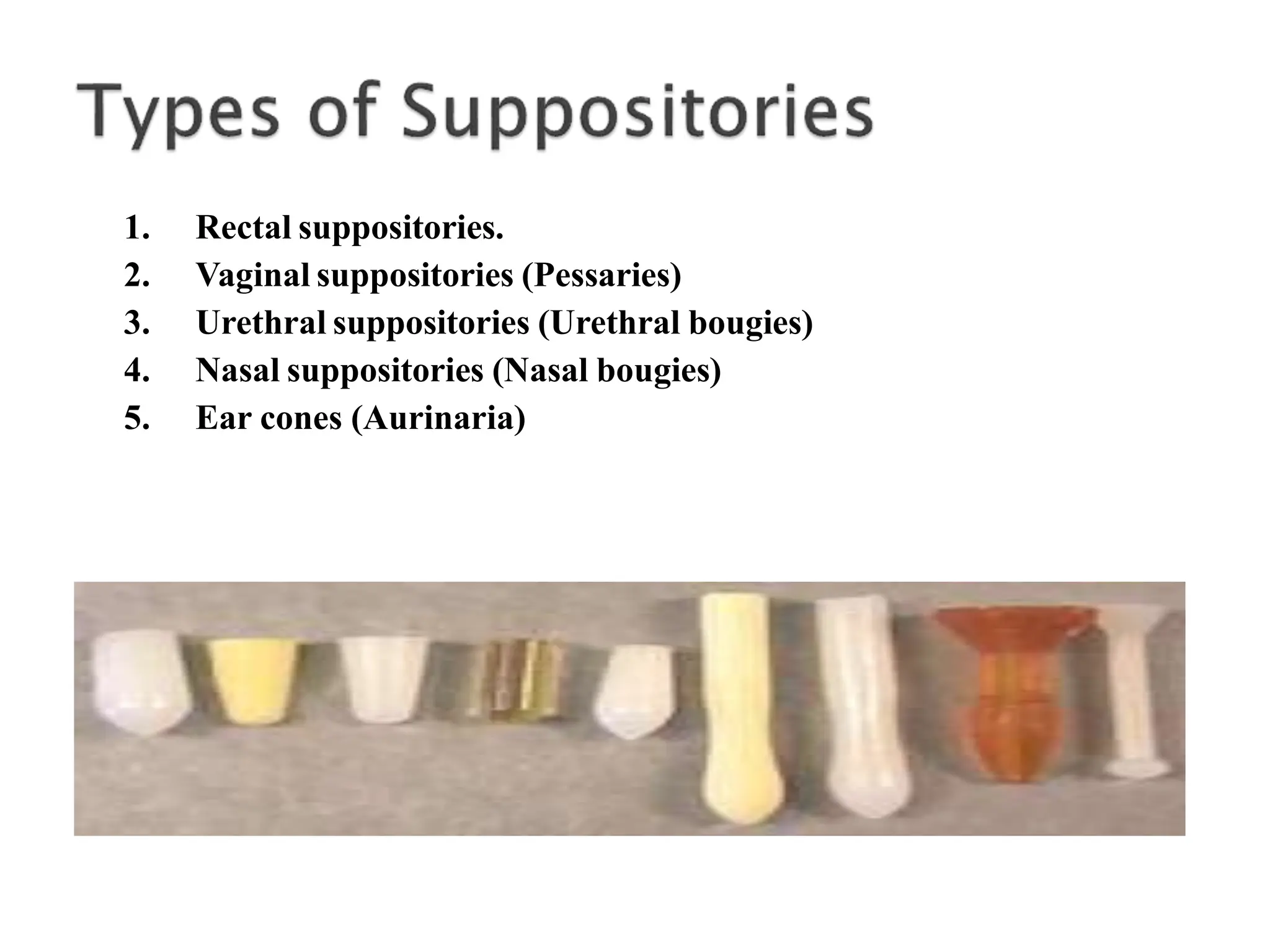
1. Rectal suppositories.
2. Vaginal suppositories (Pessaries)
3. Urethral suppositories (Urethral bougies)
4. Nasal suppositories (Nasal bougies)
5. Ear cones (Aurinaria)
Rectal Suppository Urethral Suppository
Vaginal Suppository
 Tablet Suppositories
 Layered Suppositories
 Coated Suppositories
 Capsule Suppositories
 Disposable mould Suppositories
New Trends of suppositories
 This type of tablets prepared by compression like tablets.
Such type of suppositories used for rectal & vaginal purposes.
Pessaries tablet suppositories are present in almond like shape.
They are coated with thin layers of coating materials such as cetyl alcohol
or polyethylene glycol for protecting & easy insertion in to body cavity &
to make attractive.
.
 In that type of suppositories contains different drugs in different layers to
avoid incompatibility between them.
Drugs having different melting points can be incorporated in to the layered
suppositories.
These can be prepared by partially filling the mould with one type of drugs,
when it gets solidify then the other drugs are added one after other as a
separate layer of drug.
 They are coated with thin layers of coating materials such as cetyl alcohol
or polyethylene glycol for protecting & easy insertion in to body cavity &
to make attractive.
Soft gelatin capsules of different shapes & size are used.
The liquids, semisolids or solids drugs can be filled in to soft gelatin
capsules.
Disposable Mould Suppository
 Disposable Mould are made up of plastic material or tin foil .
 The suppository material is poured in to the disposable mould &
cooled.
 The excess of mass is trimmed off with the help of sharp knife or
blade & mould are sealed.
 These are then packed in to cartons. When suppository are melts
during storage, it will remain in mould itself & can be reconverted
in to suppository after cooling.
 Suppository bases plays important role in maintaining their shape, solidity
& also play important role when inserted into the body cavity.
There are large number of bases used but theobroma oil, glycerogelatin
base & polyethylene glycol fulfill the above mentioned requirements.
 It must retain the shape and size while handling.
 It should melt at body temperature.
 It should be non-toxic & non-irritant.
 It should not interfere in release or absorption of drug.
 It should not adhere to the mould.
 It should be compatible with variety of drugs.
 It should be physically stable on storage.
 It should not be soften or harden on storage.
 It should be good in appearance.
1. Fatty Bases or Oleaginous bases
2. Water Soluble & Water miscible bases
3. Emulsifying/Synthetic bases
Classification of Suppository bases
Examples
1.Cocoa butter or Theobroma Oil
2. Emulsified cocoa butter / Theobroma Oil
3. Hydrogenated oils.
Fatty Bases or Oleaginous bases
Cocoa butter is fat obtained from the roasted seed of Theobroma cocoa.
At room temperature it is a yellowish, white solid having a faint, agreeable
chocolate like odour.It is having a butter like consistency .It melts at 30 -
350C.
It has most stable base for rectal suppository but not for pessaries, nasal,
urethral suppositories.
Advantages
Readily liquefy on heating and solidify on cooling.
Disadvantages
◦ It shows the phenomenon of polymorphism that is
when theobroma oil is melted & cooled, it gets
solidify in to different crystalline forms depending
upon melting point & rate of cooling.
◦ Rancidity.
◦ Stick to mould.
◦ Leakage from body cavity.
◦ Costly.
◦ Immiscibility with body fluids
 Emulsified theobroma oil may be used as a base when large quantities of
aqueous solutions are to be incorporated.
5% glyceryl monostearate, 10% lanette wax, 2-3% cetyl alcohol & 4%
bees wax is recommended for emulsified theobroma oil.
Emulsified Theobroma Oil
These are prepared by hydrogenation of vegetable oil.
Hydrogenated oils are used as a substitute of theobroma oil because it has
following advantage
Advantages
 They are resistant to oxidation.
 Lubrication of the mould is not required.
 Their emulsifying & water absorbing capacity are good.
 They produces colourless, odourless, elegant suppository.
Disadvantages
 On rapid cooling they become brittle.
 When melted they are more fluid than theobroma oil
1. Glycero-gelatin base.
2. Soap-glycerin base.
3. Polyethylene glycol.
Water Soluble & Water miscible bases
It is a mixture of glycerin and water which is made
stiff by the addition of gelatin.
Properties:
It is colourless, transparent, translucent in nature.
It is soft to touch.
It melts at 30 - 350C.
Used for vaginal suppositories.
 Advantages:
◦ It melt at body temperature.
◦ It mix with body fluid.
◦ Not rancid.
◦ It can be used to prepare suppositories using boric acid,
chloral hydrate bromides, iodides, iodoform opium etc.
 Disadvantages:
◦ Difficult to prepare and handle.
◦ Chance of bacterial growth.
◦ Hygroscopic in nature. (become hard on drying and soft in
cont with moisture)
◦ Incompatible with tannic acid, ferric chloride etc.
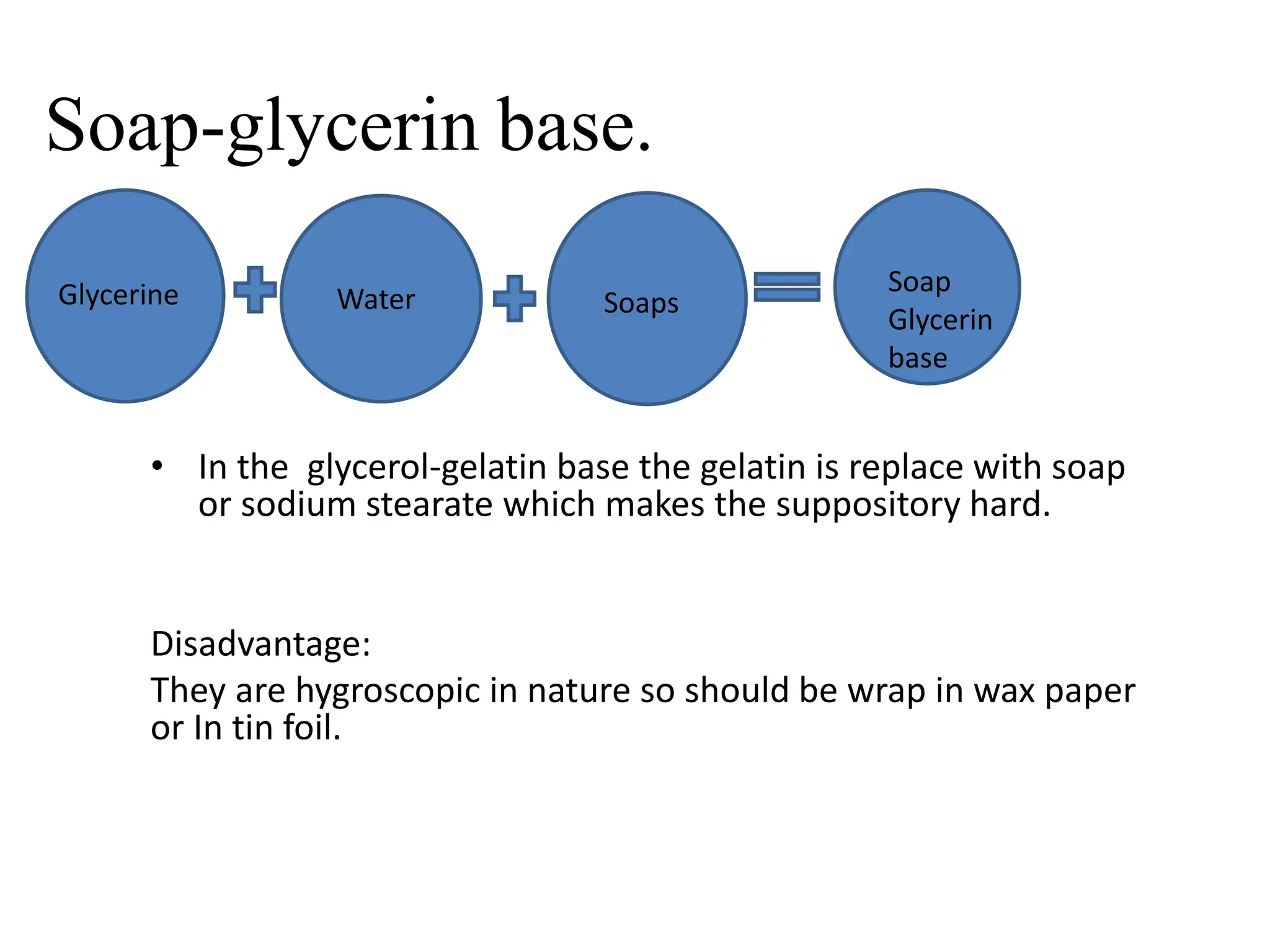
Soap-glycerin base.
• In the glycerol-gelatin base the gelatin is replace with soap
or sodium stearate which makes the suppository hard.
Disadvantage:
They are hygroscopic in nature so should be wrap in wax paper
or In tin foil.
Glycerine Soap
Glycerin
base
Water Soaps
 These are commonly known as carbowaxes & Polyglycols.
These are available in solid, liquid or semi-solid state depending on
molecular weight.
Those polymers having the molecular weight betw. 200 to 1000 are liquids
& those having M.W higher than 1000 are wax like solids.
They are chemically stable & physiologically inert substances & do not
allow the bacterial or mold growth.
Advantages
 They are chemically stable.
Inert, Non-irritant.
Do not allow bacterial growth.
Provide prolonged action.
Do not stick to mould.
Suppositories are clean and smooth in appearance.
Examples
 Witepsol
Massaestarinum
Massuppol.
 They consist of triglycerides of saturated vegetable fatty acid with varying
percentage of partial esters.
A small amount of beeswax is added for use in hot climate.
It should not be cooled rapidly as it become brittle and fracture.
Lubrication is required.
 It is a mixture of mono, di and triglycerides of saturated fatty acids.
It is a white, brittle, almost odourless and tasteless solid.
It has a m.p. 33.5 to 35.50C.
They are available in various grades but grade B is commonly used in
dispensing.
 They solidify rapidly.
They are non-irritant.
The lubrication of mould is not required.
Overheating does not affect the physical properties of the base.
They can absorb large amount of water or aqueous liquids.
The white, odourless, clean and attractive suppositories are produced.
They are less liable to get rancid.
Disadvantages of Emulsifying bases
• Theyshould not be cooled rapidly in a refrigerator
because they become brittle.
• They are not very viscous on melting, so the medicaments incorporated
with the base settle down rapidly.
 Hand rolling.
Hot process or Fusion method.
Cold compression.
 It is the oldest and simplest method of preparation of
suppository.
 In this the suppository base along with drug is rolled & then the
desired shape is given with hand.
Hot Process / Fusion Method
Suppository mould
• Suppository moulds used in preparation of suppositories are
available in different shapes & sizes.
• They are made up from aluminium , brass, stainless steel, plastics
material having 6 to 12 cavities.Molds in different capacities
like1,2,4,8gm are available.
• It is consists of two or more plates which are joined with a screw,
we can open it longitudinally by removing screw.
• The mould is open at the time of cleaning, Lubrication & removal
of suppository.
• Moulds is clean by removing the plates, & immerse in hot water
containing detergent, after drying lubricate the mould.
Plastic Mould
• The surface of cavities should be plane or
even, it should not have any scratches
otherwise suppository of uneven surface
may be form.
Lubrication of Mould
• Cocoa butter and glycero-gelatine bases are required lubrication of
molds.
• This is prevent sticking of bases to the wall of molds cavity.
• It is also useful in easy removal of suppositories from the molds.
• The lubricants are form a film between the wall of mold cavity and
base of suppositories so it prevent adhering of bases to the molds.
• The lubricants should be apply with the brush. Cotton wool should
not be used because it leaves fibers.
EXAMPLES LUBRICANTS USE
(1) For Cocoa Butter Bases: Alcohol(90%)- 50ml
Glycerol - 10ml
Soft Soap - 10 Gm
(2) For Glyceri-gelatin Base: Liquid Paraffin
(3) For Emulsifying Bases: No lubricants
Calibration of Mould
• Calibration of mould is necessary because the size of the
suppository from a particular mould remins same but there
weight will varies due to density difference between bases and
medicament used, So the mould should be calibrated for
individual medicaments & bases.
• This is done by preparing a suppositories from base material
alone. The suppository's combined and average weight is
recorded which will indicate the true capacity of the mould.
• Example: Density of cocoabutter is 1 & Density of
glycerogelatin is 1.15 , suppository prepared by using same
mould will not be same because the size of the suppository
from a particular mould remins same but there weight will
varies due to density difference between bases and medicament
used.
Displacement Value
It is defined as the weight of medicament that displace by one part of the base.
Ex. Displacement value of ZnO in relation to cocoa butter is 5 means, 5g of
ZnO is displaced 1g of cocoa butter.
Displacement value is necessary because the size of the suppository
from a particular mould remins same but there weight will varies due to
density difference between bases and medicament used, thus to prepare the
suppository of uniform & accurate weight allowance must be made for the
change in density of mass due to added medicaments.
Ex;
Boric Acid 1.5
Caster oil 1
Zinc Oxide 5
Iodoform 4
Method of Preparation using fusion method
1. Clean & lubricate the mould.
2. Do the calculations for two extra suppositories for unavoidable wastage.
3. Heat the china dish over waterbath, to this add required quantity of cocoa
butter or other bases & melt it. Remove the china dish over waterbath.
4. Weight quantity of medicament is incorporated in to a melted base, mix it
thoroughly with spatula until product become homogenous.
5. Warm the china dish on waterbath for few seconds, so that product become
pourable.
6. Pour the melted mass in to the cavities of suppository moulds, keep over
the ice for solidification.
7. Remove the excess of mass with the help of sharp knife or blade.
8. Open the mould & remove the suppository.
9. Wrap the suppository in the wax paper.
 Small scale molds are capable of producing 6 or 12
suppositories in a single operation.
 Industrial moldsproduce hundreds of suppositories from a
single molding.
• This method is used when drug is heat sensitive & insoluble in solvent.
• The suppository mass is prepared by mixing the powder medicament with
suppository base.
• This mass is then transfer in to the hopper of the machine, pressure is applied by
pushing a piston so that suppository mass goes in to the mould.
• When mould is filled a stop plate is remove & additional pressure is applied to
eject the suppositories.
• The ejected suppositories are then cut at its base, packed in wax peper & then
submitted.
Cold Compression Method
• Suppositories are usually packed in partitioned cardboard boxes & do not
allow them to come in contact with each other.
• Suppositories are usually packed in tin, aluminum, plastic or wax paper .
• Both cocoa butter and glycerinated gelatin suppositories stored preferably
in a refrigerator.
• Suppositories are required to be store in cool place so that they can retain
their shape at room temperature.
Common Suppository
Medications
• They are meant for introduction in vagina.
• They are larger than rectal suppository & weight varies from 4 to 8 gm.
• Pessaries may be conical, wedge or rod shaped.
• Pessaries are also available as tablets & capsules forms are known as
Vaginal tablets & capsules respectively.
• These are store in cool & dry place.
Pessaries
References:
1. Pharmaceutics II
By R. M. Mehata,
Vallabh Prakashan,
Third edition, 2010
2. Pharmaceutics-2 (Dispensing Pharmacy)
By Dr. G.K.Jani,
B.S.shah Prakashan,
10th edition, 2011-2012.
3. Introduction to Pharmaceutics-II
By A.K.Gupta & S.S. Bajaj,
CBS Publishers & Distributors,
4th edition,2000.
4. MSBTE board Annual question paper,
https://msbte.org.in
THANK
YOU

7. suppositories.pptx Pharmaceutics II ER 1991

  • 1.
    Prepared by: Ms.Argade V. P. M. Pharm (QAT) Lecturer PRES’s Institute of Pharmacy Loni
  • 2.
    • Suppositories aresolid or semisolid dosage forms of medicaments meant for insertion in to body cavities other than mouth (oral cavity). They may be inserted in to body cavity such as Rectum, Vagina, urethra, Nose & Ear. It is comes under semi solid preparation because it is prepared by melting all ingredients (bases and other additives along with active ingredient). All types of suppositories are melt at normal body temperature after introducing in body cavity and produce their effect.
  • 3.
    • It isthe alternated dosage form for drugs which have less bioavailability when it is taken orally. • Drugs having bad odour and taste can be used in suppository form. • It is suitable for unconscious patients which can not taken drugs orally. • It is suitable for drugs which produce irritating effect in GIT. • It is suitable for infants and old people who find difficulty in swallowing of drugs. • It is suitable for the drugs which are destroyed by portal circulation.
  • 4.
    • The manufacturingprocess is more difficult as compare other formulation. The drugs which cause irritation to mucous membrane can not be administrated by this form. The most important problem is storage condition because it stored at low temp. (10-20 0c ).
  • 5.
    1. Rectal suppositories. 2.Vaginal suppositories (Pessaries) 3. Urethral suppositories (Urethral bougies) 4. Nasal suppositories (Nasal bougies) 5. Ear cones (Aurinaria)
  • 6.
    Rectal Suppository UrethralSuppository Vaginal Suppository
  • 7.
     Tablet Suppositories Layered Suppositories  Coated Suppositories  Capsule Suppositories  Disposable mould Suppositories New Trends of suppositories
  • 8.
     This typeof tablets prepared by compression like tablets. Such type of suppositories used for rectal & vaginal purposes. Pessaries tablet suppositories are present in almond like shape. They are coated with thin layers of coating materials such as cetyl alcohol or polyethylene glycol for protecting & easy insertion in to body cavity & to make attractive. .
  • 9.
     In thattype of suppositories contains different drugs in different layers to avoid incompatibility between them. Drugs having different melting points can be incorporated in to the layered suppositories. These can be prepared by partially filling the mould with one type of drugs, when it gets solidify then the other drugs are added one after other as a separate layer of drug.
  • 10.
     They arecoated with thin layers of coating materials such as cetyl alcohol or polyethylene glycol for protecting & easy insertion in to body cavity & to make attractive.
  • 11.
    Soft gelatin capsulesof different shapes & size are used. The liquids, semisolids or solids drugs can be filled in to soft gelatin capsules.
  • 12.
    Disposable Mould Suppository Disposable Mould are made up of plastic material or tin foil .  The suppository material is poured in to the disposable mould & cooled.  The excess of mass is trimmed off with the help of sharp knife or blade & mould are sealed.  These are then packed in to cartons. When suppository are melts during storage, it will remain in mould itself & can be reconverted in to suppository after cooling.
  • 13.
     Suppository basesplays important role in maintaining their shape, solidity & also play important role when inserted into the body cavity. There are large number of bases used but theobroma oil, glycerogelatin base & polyethylene glycol fulfill the above mentioned requirements.
  • 14.
     It mustretain the shape and size while handling.  It should melt at body temperature.  It should be non-toxic & non-irritant.  It should not interfere in release or absorption of drug.  It should not adhere to the mould.  It should be compatible with variety of drugs.  It should be physically stable on storage.  It should not be soften or harden on storage.  It should be good in appearance.
  • 15.
    1. Fatty Basesor Oleaginous bases 2. Water Soluble & Water miscible bases 3. Emulsifying/Synthetic bases Classification of Suppository bases
  • 16.
    Examples 1.Cocoa butter orTheobroma Oil 2. Emulsified cocoa butter / Theobroma Oil 3. Hydrogenated oils. Fatty Bases or Oleaginous bases
  • 17.
    Cocoa butter isfat obtained from the roasted seed of Theobroma cocoa. At room temperature it is a yellowish, white solid having a faint, agreeable chocolate like odour.It is having a butter like consistency .It melts at 30 - 350C. It has most stable base for rectal suppository but not for pessaries, nasal, urethral suppositories.
  • 18.
    Advantages Readily liquefy onheating and solidify on cooling. Disadvantages ◦ It shows the phenomenon of polymorphism that is when theobroma oil is melted & cooled, it gets solidify in to different crystalline forms depending upon melting point & rate of cooling. ◦ Rancidity. ◦ Stick to mould. ◦ Leakage from body cavity. ◦ Costly. ◦ Immiscibility with body fluids
  • 19.
     Emulsified theobromaoil may be used as a base when large quantities of aqueous solutions are to be incorporated. 5% glyceryl monostearate, 10% lanette wax, 2-3% cetyl alcohol & 4% bees wax is recommended for emulsified theobroma oil. Emulsified Theobroma Oil
  • 20.
    These are preparedby hydrogenation of vegetable oil. Hydrogenated oils are used as a substitute of theobroma oil because it has following advantage Advantages  They are resistant to oxidation.  Lubrication of the mould is not required.  Their emulsifying & water absorbing capacity are good.  They produces colourless, odourless, elegant suppository. Disadvantages  On rapid cooling they become brittle.  When melted they are more fluid than theobroma oil
  • 21.
    1. Glycero-gelatin base. 2.Soap-glycerin base. 3. Polyethylene glycol. Water Soluble & Water miscible bases
  • 22.
    It is amixture of glycerin and water which is made stiff by the addition of gelatin. Properties: It is colourless, transparent, translucent in nature. It is soft to touch. It melts at 30 - 350C. Used for vaginal suppositories.
  • 23.
     Advantages: ◦ Itmelt at body temperature. ◦ It mix with body fluid. ◦ Not rancid. ◦ It can be used to prepare suppositories using boric acid, chloral hydrate bromides, iodides, iodoform opium etc.  Disadvantages: ◦ Difficult to prepare and handle. ◦ Chance of bacterial growth. ◦ Hygroscopic in nature. (become hard on drying and soft in cont with moisture) ◦ Incompatible with tannic acid, ferric chloride etc.
  • 24.
    Soap-glycerin base. • Inthe glycerol-gelatin base the gelatin is replace with soap or sodium stearate which makes the suppository hard. Disadvantage: They are hygroscopic in nature so should be wrap in wax paper or In tin foil. Glycerine Soap Glycerin base Water Soaps
  • 25.
     These arecommonly known as carbowaxes & Polyglycols. These are available in solid, liquid or semi-solid state depending on molecular weight. Those polymers having the molecular weight betw. 200 to 1000 are liquids & those having M.W higher than 1000 are wax like solids. They are chemically stable & physiologically inert substances & do not allow the bacterial or mold growth. Advantages  They are chemically stable. Inert, Non-irritant. Do not allow bacterial growth. Provide prolonged action. Do not stick to mould. Suppositories are clean and smooth in appearance.
  • 26.
  • 27.
     They consistof triglycerides of saturated vegetable fatty acid with varying percentage of partial esters. A small amount of beeswax is added for use in hot climate. It should not be cooled rapidly as it become brittle and fracture. Lubrication is required.
  • 28.
     It isa mixture of mono, di and triglycerides of saturated fatty acids. It is a white, brittle, almost odourless and tasteless solid. It has a m.p. 33.5 to 35.50C. They are available in various grades but grade B is commonly used in dispensing.
  • 29.
     They solidifyrapidly. They are non-irritant. The lubrication of mould is not required. Overheating does not affect the physical properties of the base. They can absorb large amount of water or aqueous liquids. The white, odourless, clean and attractive suppositories are produced. They are less liable to get rancid. Disadvantages of Emulsifying bases • Theyshould not be cooled rapidly in a refrigerator because they become brittle. • They are not very viscous on melting, so the medicaments incorporated with the base settle down rapidly.
  • 30.
     Hand rolling. Hotprocess or Fusion method. Cold compression.
  • 31.
     It isthe oldest and simplest method of preparation of suppository.  In this the suppository base along with drug is rolled & then the desired shape is given with hand.
  • 32.
    Hot Process /Fusion Method Suppository mould • Suppository moulds used in preparation of suppositories are available in different shapes & sizes. • They are made up from aluminium , brass, stainless steel, plastics material having 6 to 12 cavities.Molds in different capacities like1,2,4,8gm are available. • It is consists of two or more plates which are joined with a screw, we can open it longitudinally by removing screw. • The mould is open at the time of cleaning, Lubrication & removal of suppository. • Moulds is clean by removing the plates, & immerse in hot water containing detergent, after drying lubricate the mould.
  • 33.
    Plastic Mould • Thesurface of cavities should be plane or even, it should not have any scratches otherwise suppository of uneven surface may be form.
  • 34.
    Lubrication of Mould •Cocoa butter and glycero-gelatine bases are required lubrication of molds. • This is prevent sticking of bases to the wall of molds cavity. • It is also useful in easy removal of suppositories from the molds. • The lubricants are form a film between the wall of mold cavity and base of suppositories so it prevent adhering of bases to the molds. • The lubricants should be apply with the brush. Cotton wool should not be used because it leaves fibers.
  • 35.
    EXAMPLES LUBRICANTS USE (1)For Cocoa Butter Bases: Alcohol(90%)- 50ml Glycerol - 10ml Soft Soap - 10 Gm (2) For Glyceri-gelatin Base: Liquid Paraffin (3) For Emulsifying Bases: No lubricants
  • 36.
    Calibration of Mould •Calibration of mould is necessary because the size of the suppository from a particular mould remins same but there weight will varies due to density difference between bases and medicament used, So the mould should be calibrated for individual medicaments & bases. • This is done by preparing a suppositories from base material alone. The suppository's combined and average weight is recorded which will indicate the true capacity of the mould. • Example: Density of cocoabutter is 1 & Density of glycerogelatin is 1.15 , suppository prepared by using same mould will not be same because the size of the suppository from a particular mould remins same but there weight will varies due to density difference between bases and medicament used.
  • 37.
    Displacement Value It isdefined as the weight of medicament that displace by one part of the base. Ex. Displacement value of ZnO in relation to cocoa butter is 5 means, 5g of ZnO is displaced 1g of cocoa butter. Displacement value is necessary because the size of the suppository from a particular mould remins same but there weight will varies due to density difference between bases and medicament used, thus to prepare the suppository of uniform & accurate weight allowance must be made for the change in density of mass due to added medicaments. Ex; Boric Acid 1.5 Caster oil 1 Zinc Oxide 5 Iodoform 4
  • 38.
    Method of Preparationusing fusion method 1. Clean & lubricate the mould. 2. Do the calculations for two extra suppositories for unavoidable wastage. 3. Heat the china dish over waterbath, to this add required quantity of cocoa butter or other bases & melt it. Remove the china dish over waterbath. 4. Weight quantity of medicament is incorporated in to a melted base, mix it thoroughly with spatula until product become homogenous. 5. Warm the china dish on waterbath for few seconds, so that product become pourable. 6. Pour the melted mass in to the cavities of suppository moulds, keep over the ice for solidification. 7. Remove the excess of mass with the help of sharp knife or blade. 8. Open the mould & remove the suppository. 9. Wrap the suppository in the wax paper.
  • 39.
     Small scalemolds are capable of producing 6 or 12 suppositories in a single operation.  Industrial moldsproduce hundreds of suppositories from a single molding.
  • 41.
    • This methodis used when drug is heat sensitive & insoluble in solvent. • The suppository mass is prepared by mixing the powder medicament with suppository base. • This mass is then transfer in to the hopper of the machine, pressure is applied by pushing a piston so that suppository mass goes in to the mould. • When mould is filled a stop plate is remove & additional pressure is applied to eject the suppositories. • The ejected suppositories are then cut at its base, packed in wax peper & then submitted. Cold Compression Method
  • 43.
    • Suppositories areusually packed in partitioned cardboard boxes & do not allow them to come in contact with each other. • Suppositories are usually packed in tin, aluminum, plastic or wax paper . • Both cocoa butter and glycerinated gelatin suppositories stored preferably in a refrigerator. • Suppositories are required to be store in cool place so that they can retain their shape at room temperature.
  • 44.
  • 49.
    • They aremeant for introduction in vagina. • They are larger than rectal suppository & weight varies from 4 to 8 gm. • Pessaries may be conical, wedge or rod shaped. • Pessaries are also available as tablets & capsules forms are known as Vaginal tablets & capsules respectively. • These are store in cool & dry place. Pessaries
  • 50.
    References: 1. Pharmaceutics II ByR. M. Mehata, Vallabh Prakashan, Third edition, 2010 2. Pharmaceutics-2 (Dispensing Pharmacy) By Dr. G.K.Jani, B.S.shah Prakashan, 10th edition, 2011-2012. 3. Introduction to Pharmaceutics-II By A.K.Gupta & S.S. Bajaj, CBS Publishers & Distributors, 4th edition,2000. 4. MSBTE board Annual question paper, https://msbte.org.in
  • 51.