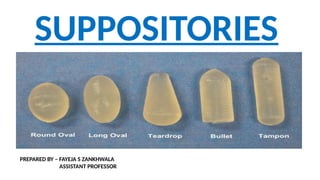
SUPPOSITORIES
PREPARED BY – FAYEJA S ZANKHWALA
ASSISTANT PROFESSOR
• Suppositories are single solid dosage forms intended for
insertion into body orifices/cavities (nasal, vagina, rectal, ear,
nose) where they melt, soften, or dissolve and exert localized or
systemic effects.
• It must dissolve in the body cavity fluid to release of drug
• The suppository can be used for both Local & systemic action
even can be use in unconscious patient.
• The suppositories are available in different weight, size & shapes.
• They contain one or more active substances dispersed or
dissolved in a suitable basis which may be soluble or
dispersible in water or may melt at body temperature.
• Excipients used such as diluents, adsorbents,
surface-active agents, lubricants, antimicrobial
preservatives and coloring matter
4
ADVANTAGES
• EASILY ADMINSTERED to children, old persons, to
unconscious or sometimes to mentally unstable persons who
cannot swallow the drug.
• Convenient mode of administration for drugs which irritate the
GIT, causing vomiting and destroyed in acidic pH of stomach and
enzymes of GIT.
• FASTER ONSET OF ACTION as compared to oral
administration because absorption of drug through rectal mucosa
directly reaches blood
5
DISADVANTAGES
• They are not acceptable by the patients.
• The manufacturing process is difficult.
• The drugs which cause irritation to the mucous membrane
cannot be administered as suppositories.
• Most of the suppositories should be stored at low
temperature10-20°c in a refrigerator , other wise the base gets
liquified.
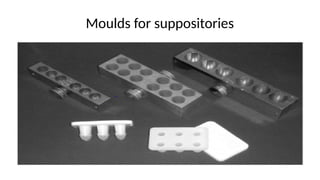
Moulds for suppositories
Classification Of Suppositories
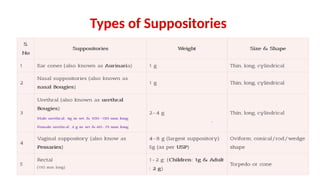
• Rectal suppositories
• Vaginal suppositories ( PESSARIES )
• Urethral suppositories ( BOUGIES )
• Nasal suppositories
• Ear suppositories
8
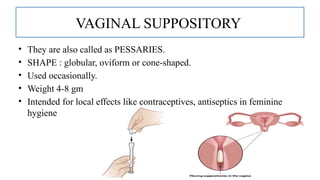
VAGINAL SUPPOSITORY
• They are also called as PESSARIES.
• SHAPE : globular, oviform or cone-shaped.
• Used occasionally.
• Weight 4-8 gm
• Intended for local effects like contraceptives, antiseptics in feminine
hygiene
9
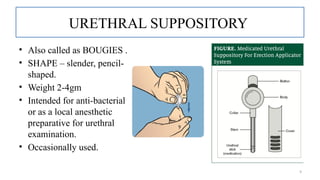
URETHRAL SUPPOSITORY
• Also called as BOUGIES .
• SHAPE – slender, pencil-
shaped.
• Weight 2-4gm
• Intended for anti-bacterial
or as a local anesthetic
preparative for urethral
examination.
• Occasionally used.
10
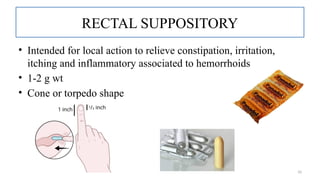
RECTAL SUPPOSITORY
• Intended for local action to relieve constipation, irritation,
itching and inflammatory associated to hemorrhoids
• 1-2 g wt
• Cone or torpedo shape
• Introduced into nasal cavity also known as nasal bougies.
• Similar to urethral suppository.
• Thin , cylindrical shape
• Always Prepared with glycero – gelatin base.
• 9-10cm long and wt 1 g.
NASAL SUPPOSITORY
• Used for internal ear and also called aurinaria.
• Long , thin, and cylindrical shape.
• Weight about 1 gm
• Rarely used.
• Usually prepared with theobroma oil.
EAR CONES
13
Classification Of Suppositories Via Position Of
Action
LOCAL EFFECT :
• In case of pain, itching and hemorrhoid.
• Locally active drugs include astringents, antiseptics, local
anesthetics, vasoconstrictors, anti-inflammatory,
soothing and protective agents and some laxatives.
SYSTEMIC EFFECT :
• Anti-asthmatics, anti rheumatics, anti-pyretic and analgesics
Types of Suppositories
15
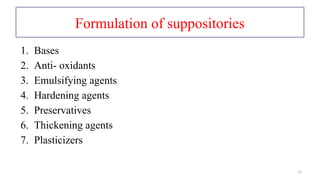
Formulation of suppositories
1. Bases
2. Anti- oxidants
3. Emulsifying agents
4. Hardening agents
5. Preservatives
6. Thickening agents
7. Plasticizers
16
IDEAL PROPERTIES OF SUPPOSITORY BASES
• It should melt at body temperature or dissolve or disperse in
body fluids.
• It should be good appearance
• It should release any medicament easily.
• It should keep its shape when being handled.
• It should be non-toxic and non-irritant to the mucous membrane.
• It should be stable on storage and also stable if heated above its
M.P.
17
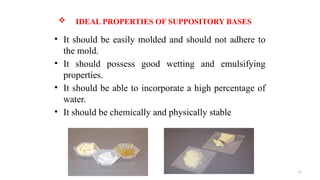
 IDEAL PROPERTIES OF SUPPOSITORY BASES
• It should be easily molded and should not adhere to
the mold.
• It should possess good wetting and emulsifying
properties.
• It should be able to incorporate a high percentage of
water.
• It should be chemically and physically stable
IDEAL PROPERTIES OF SUPPOSITORY BASES
If the base is fatty, it has the following additional requirements:
• Acid value is below 0.2.
• Saponification value ranges from 200 to 245.
• Iodine value is less than 7.
• The interval between melting point and solidification point is
small.
SUPPOSITORY BASES
• Classification of suppository bases
1. Fatty bases – they melt at body temperature.
2. Water-soluble or water miscible base – they dissolve or
disperse in rectal secretions.
3. Emulsifying bases – they emulsifies small amount of
aqueous solution of drug.
1 FATTY BASES
Example: Theobroma oil (Cocoa butter), Synthetic fats.
• Theobroma oil (Cocoa butter)
• It is a yellowish-white solid having chocolate flavor.
• It is a mixture of glyceryl esters of stearic, palmitic, oleic and other fatty acids
• Advantages:
• melting point 30-36
• solid at normal room temperatures but melts in the body
• Ready liquefaction on warming and rapid setting on cooling.
• Miscibility with many ingredients
• Disadvantages
• Relatively costly
• Immiscible with body fluid
• Leakage from body cavities
• Poor water absorbing capacity
• Adherence to mould
2. WATER SOLUBLE AND WATER MISCIBLE BASES
1- Glycero-Gelatin base
• This is a mixture of glycerol and water made into a stiff jelly by
adding gelatin.
• The base being hydrophilic in nature, slowly dissolves in the aqueous
secretions and provide a slow continuous release of medicament.
• Glycerogelatin base is well suited for suppositories containing
belladonna extract, boric acid, chloral hydrate, bromides, iodides,
iodoform, opium, etc.
• Depending upon the compatibility of the drugs used a suitable
type of gelatin is selected for the purpose.
• Two types of gelatin used as suppository base:
• (i) Type-A or Pharmagel-A which is made by acid hydrolysis
• Acidic drugs having isoelectric point between 7 to 9
• (ii) Type-B or Pharmagel-B which is prepared by alkaline
hydrolysis
• Alkaline drugs having isoelectric point between 4.7 to 5
• Disadvantages:
• Glycerol has laxative action.
• Their solution time depends on the content and quality of the
gelatin used.
• Gelatin is incompatible with drugs those precipitate with the
protein e.g. tannic acid, ferric chloride, gallic acid, etc.
• They are more difficult to prepare and handle.
• 3. EMULSIFYING BASES
• These are synthetic bases and a number of proprietary bases of very good quality are
available, few of which are described below:
• Witepso
• They consist of triglycerides of saturated vegetable acids (chain length C12 to C18) with
varying proportions of partial esters.
• Massa Esterium
• This is another range of bases, consisting of a mixture of di-, tri- and mono- glycerides of
saturated fatty acids with chain lengths of C11 to C17.
• Massuppol
• It consists of glyceryl esters mainly of lauric acid, to which a small amount of glyceryl
monostearate has been added to improve its water absorbing capacity.
26
Other excipients
Anti-oxidants
• They protect the drug and the base from getting degraded due to oxidation.
• Examples :
i. Ethyl or propyl gallate
ii. Ascorbic acid and its esters
iii. Hydroquinone
iv. Tocopherols
Emulsifying agents
 They increase the water-absorbing capacity of fatty bases. This makes it possible to include
aqueous solutions in the formulation.
 Examples : polysorbates (tween 61)
 Wool alcohol ,wool fat
Hardening agents:
• These are included in those formulations where the melting point
of the base is decreased by the drug.
• These agents bring the melting point to normal.
 Examples : macrogols with high molecular weight.
Preservatives :
They should be included in suppositories which contain water soluble
bases to prevent microbial growth.
 Examples :methyl paraben , propyl paraben
Thickening Agents:
• They increase the viscosity of molten base and prevent sedimentation of suspended insoluble
solids.
 Examples: Aluminium monostearate , collodial silica, magnesium stearate.
Plasticizer
• They impart plasticity to the fatty base and makes it less brittle.
• Examples :
i. Castor oil
ii. Glycerine or propylene glycol
iii. Glycol
iv. Tween 80
v. Tween 85
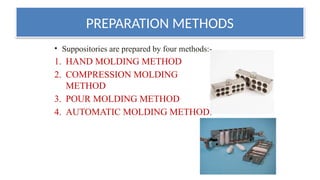
PREPARATION METHODS
• Suppositories are prepared by four methods:-
1. HAND MOLDING METHOD
2. COMPRESSION MOLDING
METHOD
3. POUR MOLDING METHOD
4. AUTOMATIC MOLDING METHOD.
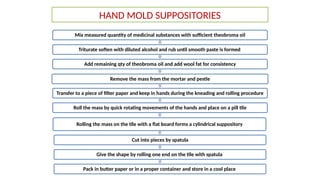
HAND MOLD SUPPOSITORIES
Mix measured quantity of medicinal substances with sufficient theobroma oil
Triturate soften with diluted alcohol and rub until smooth paste is formed
Add remaining qty of theobroma oil and add wool fat for consistency
Remove the mass from the mortar and pestle
Transfer to a piece of filter paper and keep in hands during the kneading and rolling procedure
Roll the mass by quick rotating movements of the hands and place on a pill tile
Rolling the mass on the tile with a flat board forms a cylindrical suppository
Cut into pieces by spatula
Give the shape by rolling one end on the tile with spatula
Pack in butter paper or in a proper container and store in a cool place
 Advantages:-
 Suitable for thermo labile ingredients.
 Economical for the manufacture of small number of suppositories.
 Disadvantages:-
 No uniformity in shape & size of suppository.
HAND MOLD SUPPOSITORIES
COMPRESSION MOLD SUPPOSITORIES [ COLD COMPRESSION]
Mix theobroma oil and drug
Mixture is forced into a mold under pressure , using a wheel
operated press
Mold is removed , opened , replaced
On large scale , cold compression machines are hydraulically
operated by water – jacketed cooling and screw fed
Advantages:-
Suitable for thermo labile drugs.
No possibility of settling of the insoluble solids in base.
Disadvantages:-
Rate of production is low so not suitable for large scale.
Air get entrapped in the mass which leads to oxidation of ingredients.
COMPRESSION MOLD SUPPOSITORIES [ COLD COMPRESSION]
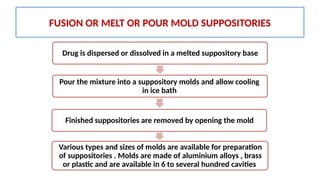
FUSION OR MELT OR POUR MOLD SUPPOSITORIES
Drug is dispersed or dissolved in a melted suppository base
Pour the mixture into a suppository molds and allow cooling
in ice bath
Finished suppositories are removed by opening the mold
Various types and sizes of molds are available for preparation
of suppositories . Molds are made of aluminium alloys , brass
or plastic and are available in 6 to several hundred cavities
 Incorporation of drug:
 Solid:-drug and additive powder mixed on warm tile
 Semisolid:-triturate the ingredients on warm tile with water. this decrease the viscosity
and give homogenous liquid.
 Liquid:-
 Volatile liquid:-they can be added to the molten base directly.
 Nonvolatile liquid:- same as semisolid.
FUSION OR MELT OR POUR MOLD SUPPOSITORIES
• All filling , ejection and mold cleaning operations are fully
automatic
• Output – 3500 to 6000 suppositories per hour
• Suppository mold is lubricated with brushing or spraying and
then filled to a slight excess
• Excess material is removed after the mass gets solidified and
collected for re – use
AUTOMATIC MOLD MACHINE
PACK AND LABEL
Packing of suppositories:-
It can be foiled in aluminum ,plastic, paper, tin strip.
Modern packing machine: nearly 8000 suppositories can be wrapped per hour.
In packing molding : In this ,the suppository mass is directly move into the series of
molds which are made up of plastic. After cooling , excess mass is trimmed of . By
this technique 12,000 to 15,000 suppositories can be produce per hour.
Disposable molds:- They are suitable for tropical climate. They are made up of plastic
or aluminum .
Labeling:-
“store in a cool place.”
“Not to be taken orally.”
EVALUATION OF SUPPOSITORIES
Appearance
Uniformity of weight
Disintegration
Test for uniformity of drug content
Breaking test
Softening time
Test of melting rang
 Test for Dissolution rate
APPEARANCE
• Odor
• Color
• Surface condition
• Shape
• They may contain several layers
• Instabilities are identified based on changes in surface
texture ,color,odor
WEIGHT VARIATION
• Weigh individually 20 suppositories
• Weigh 20 at a time
• Calculate average weight
• Limit: not more than 2 suppository differ from the average
weight by more than 5% and no suppository differs from
average weight by more than 10%
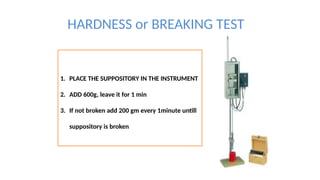
HARDNESS or BREAKING TEST
1. PLACE THE SUPPOSITORY IN THE INSTRUMENT
2. ADD 600g, leave it for 1 min
3. If not broken add 200 gm every 1minute untill
suppository is broken

SUPPOSITORIES , VAGINAL, RECTAL, NASAL, EAR,

  • 1.
    SUPPOSITORIES PREPARED BY –FAYEJA S ZANKHWALA ASSISTANT PROFESSOR
  • 2.
    • Suppositories aresingle solid dosage forms intended for insertion into body orifices/cavities (nasal, vagina, rectal, ear, nose) where they melt, soften, or dissolve and exert localized or systemic effects. • It must dissolve in the body cavity fluid to release of drug • The suppository can be used for both Local & systemic action even can be use in unconscious patient. • The suppositories are available in different weight, size & shapes.
  • 3.
    • They containone or more active substances dispersed or dissolved in a suitable basis which may be soluble or dispersible in water or may melt at body temperature. • Excipients used such as diluents, adsorbents, surface-active agents, lubricants, antimicrobial preservatives and coloring matter
  • 4.
    4 ADVANTAGES • EASILY ADMINSTEREDto children, old persons, to unconscious or sometimes to mentally unstable persons who cannot swallow the drug. • Convenient mode of administration for drugs which irritate the GIT, causing vomiting and destroyed in acidic pH of stomach and enzymes of GIT. • FASTER ONSET OF ACTION as compared to oral administration because absorption of drug through rectal mucosa directly reaches blood
  • 5.
    5 DISADVANTAGES • They arenot acceptable by the patients. • The manufacturing process is difficult. • The drugs which cause irritation to the mucous membrane cannot be administered as suppositories. • Most of the suppositories should be stored at low temperature10-20°c in a refrigerator , other wise the base gets liquified.
  • 6.
  • 7.
    Classification Of Suppositories •Rectal suppositories • Vaginal suppositories ( PESSARIES ) • Urethral suppositories ( BOUGIES ) • Nasal suppositories • Ear suppositories
  • 8.
    8 VAGINAL SUPPOSITORY • Theyare also called as PESSARIES. • SHAPE : globular, oviform or cone-shaped. • Used occasionally. • Weight 4-8 gm • Intended for local effects like contraceptives, antiseptics in feminine hygiene
  • 9.
    9 URETHRAL SUPPOSITORY • Alsocalled as BOUGIES . • SHAPE – slender, pencil- shaped. • Weight 2-4gm • Intended for anti-bacterial or as a local anesthetic preparative for urethral examination. • Occasionally used.
  • 10.
    10 RECTAL SUPPOSITORY • Intendedfor local action to relieve constipation, irritation, itching and inflammatory associated to hemorrhoids • 1-2 g wt • Cone or torpedo shape
  • 11.
    • Introduced intonasal cavity also known as nasal bougies. • Similar to urethral suppository. • Thin , cylindrical shape • Always Prepared with glycero – gelatin base. • 9-10cm long and wt 1 g. NASAL SUPPOSITORY
  • 12.
    • Used forinternal ear and also called aurinaria. • Long , thin, and cylindrical shape. • Weight about 1 gm • Rarely used. • Usually prepared with theobroma oil. EAR CONES
  • 13.
    13 Classification Of SuppositoriesVia Position Of Action LOCAL EFFECT : • In case of pain, itching and hemorrhoid. • Locally active drugs include astringents, antiseptics, local anesthetics, vasoconstrictors, anti-inflammatory, soothing and protective agents and some laxatives. SYSTEMIC EFFECT : • Anti-asthmatics, anti rheumatics, anti-pyretic and analgesics
  • 14.
  • 15.
    15 Formulation of suppositories 1.Bases 2. Anti- oxidants 3. Emulsifying agents 4. Hardening agents 5. Preservatives 6. Thickening agents 7. Plasticizers
  • 16.
    16 IDEAL PROPERTIES OFSUPPOSITORY BASES • It should melt at body temperature or dissolve or disperse in body fluids. • It should be good appearance • It should release any medicament easily. • It should keep its shape when being handled. • It should be non-toxic and non-irritant to the mucous membrane. • It should be stable on storage and also stable if heated above its M.P.
  • 17.
    17  IDEAL PROPERTIESOF SUPPOSITORY BASES • It should be easily molded and should not adhere to the mold. • It should possess good wetting and emulsifying properties. • It should be able to incorporate a high percentage of water. • It should be chemically and physically stable
  • 18.
    IDEAL PROPERTIES OFSUPPOSITORY BASES If the base is fatty, it has the following additional requirements: • Acid value is below 0.2. • Saponification value ranges from 200 to 245. • Iodine value is less than 7. • The interval between melting point and solidification point is small.
  • 19.
    SUPPOSITORY BASES • Classificationof suppository bases 1. Fatty bases – they melt at body temperature. 2. Water-soluble or water miscible base – they dissolve or disperse in rectal secretions. 3. Emulsifying bases – they emulsifies small amount of aqueous solution of drug.
  • 20.
    1 FATTY BASES Example:Theobroma oil (Cocoa butter), Synthetic fats. • Theobroma oil (Cocoa butter) • It is a yellowish-white solid having chocolate flavor. • It is a mixture of glyceryl esters of stearic, palmitic, oleic and other fatty acids • Advantages: • melting point 30-36 • solid at normal room temperatures but melts in the body • Ready liquefaction on warming and rapid setting on cooling. • Miscibility with many ingredients
  • 21.
    • Disadvantages • Relativelycostly • Immiscible with body fluid • Leakage from body cavities • Poor water absorbing capacity • Adherence to mould
  • 22.
    2. WATER SOLUBLEAND WATER MISCIBLE BASES 1- Glycero-Gelatin base • This is a mixture of glycerol and water made into a stiff jelly by adding gelatin. • The base being hydrophilic in nature, slowly dissolves in the aqueous secretions and provide a slow continuous release of medicament. • Glycerogelatin base is well suited for suppositories containing belladonna extract, boric acid, chloral hydrate, bromides, iodides, iodoform, opium, etc.
  • 23.
    • Depending uponthe compatibility of the drugs used a suitable type of gelatin is selected for the purpose. • Two types of gelatin used as suppository base: • (i) Type-A or Pharmagel-A which is made by acid hydrolysis • Acidic drugs having isoelectric point between 7 to 9 • (ii) Type-B or Pharmagel-B which is prepared by alkaline hydrolysis • Alkaline drugs having isoelectric point between 4.7 to 5
  • 24.
    • Disadvantages: • Glycerolhas laxative action. • Their solution time depends on the content and quality of the gelatin used. • Gelatin is incompatible with drugs those precipitate with the protein e.g. tannic acid, ferric chloride, gallic acid, etc. • They are more difficult to prepare and handle.
  • 25.
    • 3. EMULSIFYINGBASES • These are synthetic bases and a number of proprietary bases of very good quality are available, few of which are described below: • Witepso • They consist of triglycerides of saturated vegetable acids (chain length C12 to C18) with varying proportions of partial esters. • Massa Esterium • This is another range of bases, consisting of a mixture of di-, tri- and mono- glycerides of saturated fatty acids with chain lengths of C11 to C17. • Massuppol • It consists of glyceryl esters mainly of lauric acid, to which a small amount of glyceryl monostearate has been added to improve its water absorbing capacity.
  • 26.
    26 Other excipients Anti-oxidants • Theyprotect the drug and the base from getting degraded due to oxidation. • Examples : i. Ethyl or propyl gallate ii. Ascorbic acid and its esters iii. Hydroquinone iv. Tocopherols Emulsifying agents  They increase the water-absorbing capacity of fatty bases. This makes it possible to include aqueous solutions in the formulation.  Examples : polysorbates (tween 61)  Wool alcohol ,wool fat
  • 27.
    Hardening agents: • Theseare included in those formulations where the melting point of the base is decreased by the drug. • These agents bring the melting point to normal.  Examples : macrogols with high molecular weight. Preservatives : They should be included in suppositories which contain water soluble bases to prevent microbial growth.  Examples :methyl paraben , propyl paraben
  • 28.
    Thickening Agents: • Theyincrease the viscosity of molten base and prevent sedimentation of suspended insoluble solids.  Examples: Aluminium monostearate , collodial silica, magnesium stearate. Plasticizer • They impart plasticity to the fatty base and makes it less brittle. • Examples : i. Castor oil ii. Glycerine or propylene glycol iii. Glycol iv. Tween 80 v. Tween 85
  • 29.
    PREPARATION METHODS • Suppositoriesare prepared by four methods:- 1. HAND MOLDING METHOD 2. COMPRESSION MOLDING METHOD 3. POUR MOLDING METHOD 4. AUTOMATIC MOLDING METHOD.
  • 30.
    HAND MOLD SUPPOSITORIES Mixmeasured quantity of medicinal substances with sufficient theobroma oil Triturate soften with diluted alcohol and rub until smooth paste is formed Add remaining qty of theobroma oil and add wool fat for consistency Remove the mass from the mortar and pestle Transfer to a piece of filter paper and keep in hands during the kneading and rolling procedure Roll the mass by quick rotating movements of the hands and place on a pill tile Rolling the mass on the tile with a flat board forms a cylindrical suppository Cut into pieces by spatula Give the shape by rolling one end on the tile with spatula Pack in butter paper or in a proper container and store in a cool place
  • 31.
     Advantages:-  Suitablefor thermo labile ingredients.  Economical for the manufacture of small number of suppositories.  Disadvantages:-  No uniformity in shape & size of suppository. HAND MOLD SUPPOSITORIES
  • 32.
    COMPRESSION MOLD SUPPOSITORIES[ COLD COMPRESSION] Mix theobroma oil and drug Mixture is forced into a mold under pressure , using a wheel operated press Mold is removed , opened , replaced On large scale , cold compression machines are hydraulically operated by water – jacketed cooling and screw fed
  • 33.
    Advantages:- Suitable for thermolabile drugs. No possibility of settling of the insoluble solids in base. Disadvantages:- Rate of production is low so not suitable for large scale. Air get entrapped in the mass which leads to oxidation of ingredients. COMPRESSION MOLD SUPPOSITORIES [ COLD COMPRESSION]
  • 34.
    FUSION OR MELTOR POUR MOLD SUPPOSITORIES Drug is dispersed or dissolved in a melted suppository base Pour the mixture into a suppository molds and allow cooling in ice bath Finished suppositories are removed by opening the mold Various types and sizes of molds are available for preparation of suppositories . Molds are made of aluminium alloys , brass or plastic and are available in 6 to several hundred cavities
  • 35.
     Incorporation ofdrug:  Solid:-drug and additive powder mixed on warm tile  Semisolid:-triturate the ingredients on warm tile with water. this decrease the viscosity and give homogenous liquid.  Liquid:-  Volatile liquid:-they can be added to the molten base directly.  Nonvolatile liquid:- same as semisolid. FUSION OR MELT OR POUR MOLD SUPPOSITORIES
  • 36.
    • All filling, ejection and mold cleaning operations are fully automatic • Output – 3500 to 6000 suppositories per hour • Suppository mold is lubricated with brushing or spraying and then filled to a slight excess • Excess material is removed after the mass gets solidified and collected for re – use AUTOMATIC MOLD MACHINE
  • 37.
    PACK AND LABEL Packingof suppositories:- It can be foiled in aluminum ,plastic, paper, tin strip. Modern packing machine: nearly 8000 suppositories can be wrapped per hour. In packing molding : In this ,the suppository mass is directly move into the series of molds which are made up of plastic. After cooling , excess mass is trimmed of . By this technique 12,000 to 15,000 suppositories can be produce per hour. Disposable molds:- They are suitable for tropical climate. They are made up of plastic or aluminum . Labeling:- “store in a cool place.” “Not to be taken orally.”
  • 38.
    EVALUATION OF SUPPOSITORIES Appearance Uniformityof weight Disintegration Test for uniformity of drug content Breaking test Softening time Test of melting rang  Test for Dissolution rate
  • 39.
    APPEARANCE • Odor • Color •Surface condition • Shape • They may contain several layers • Instabilities are identified based on changes in surface texture ,color,odor
  • 40.
    WEIGHT VARIATION • Weighindividually 20 suppositories • Weigh 20 at a time • Calculate average weight • Limit: not more than 2 suppository differ from the average weight by more than 5% and no suppository differs from average weight by more than 10%
  • 41.
    HARDNESS or BREAKINGTEST 1. PLACE THE SUPPOSITORY IN THE INSTRUMENT 2. ADD 600g, leave it for 1 min 3. If not broken add 200 gm every 1minute untill suppository is broken