SUSPENSIONS
By
ARUNKUMAR B. WALIKAR
M.PHARM
DEPARTMENT OF PHARMACEUTICS
B.L.D.E.A’s
S S M COLLEGE OF PHARMACY, VIJAYPUR
DEFINITION
Suspensions are the biphasic liquid
dosage form of medicament in which
the finely divided solid particles
ranging from 0.5 to 5µ are dispersed
in a liquid or semisolid vehicle.
The solid particles act as dispersed
phase whereas liquid/ semisolid
vehicle acts as the continuous
phase .
Taken orally or by parentral route or
External application.
QUALITIES OF A GOOD
SUSPENSION
Should settle slowly and should
readily re-dispersed on gentle
shaking
Should be chemically intert
Suspended particles should not form
a cake
Should free from large particles
CLASSIFICATION OF
SUSPENSIONS
Oral suspensions
Parenteral suspensions
Opthalmic suspensions
Suspension for external use
ORALSUSPENSIONS
These are to be the consumed by the
patient by oral route
Contains flavouring agents and sweetening
agents
Eg: chloramphenicol palmitate
Advantages : easy to swallow and reduces
excess acidity in the GIT
Disadvantages : accuracy of dosage is less
reliable as compared to solution
PARENTERAL SUSPENSIONS
These are administrated by parentral
route . These suspensions are
required to fulfil the following qualities
Should not be any crystal growth in
the suspension during the storage
Suspensions should be sterilised
The concentration of solid particles
should be between o.5to 30%
OPHTHALMIC SUSPENSIONS
These are commonly used for eye –
drops these suspensions must fulfil
the following conditions:
Should be sterilised
Should be isotonic
Should have desired viscosity
SUSPENSIONS FOR EXTERNAL
USE
Meant for external use eg: lotions,
inhalations ,eardrops etc
Lotions are easier to apply and less
messy than many other semisolid
external preparations
Lotions are meant for application on
broken or inflamed skin should be
free from harmful micro organisms.
FLOCULATED SUSPENSIONS
Rate of sediment is high
Sediment is rapidly formed
Supernatent liquid is clear
Suspension is not in pleasing in appearance
Particles form loose aggregates, and form a
network like structure.
Sediment is easy to redisperse.
Sediment is loosely packed and doesnot form a
hard cake.
The floccules stick to the sides of the bottle.
DEFLOCULATED SUSPENSIONS
Rate of sediment is slow.
Sediment is difficult to redisperse.
Supernatent liquid is not clear.
Suspension is pleasing in appearance.
Individual particles exists as separate entry.
Sediment is slowly formed.
Sediment is closely packed and a hard cake is
formed.
The floccules do not stick to the sides of the bottle.
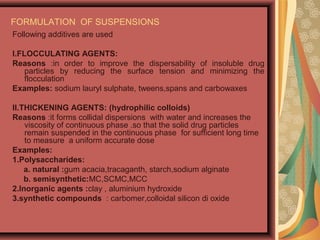
FORMULATION OF SUSPENSIONS
Following additives are used
I.FLOCCULATING AGENTS:
Reasons :in order to improve the dispersability of insoluble drug
particles by reducing the surface tension and minimizing the
flocculation
Examples: sodium lauryl sulphate, tweens,spans and carbowaxes
II.THICKENING AGENTS: (hydrophilic colloids)
Reasons :it forms collidal dispersions with water and increases the
viscosity of continuous phase .so that the solid drug particles
remain suspended in the continuous phase for sufficient long time
to measure a uniform accurate dose
Examples:
1.Polysaccharides:
a. natural :gum acacia,tracaganth, starch,sodium alginate
b. semisynthetic:MC,SCMC,MCC
2.Inorganic agents :clay , aluminium hydroxide
3.synthetic compounds : carbomer,colloidal silicon di oxide
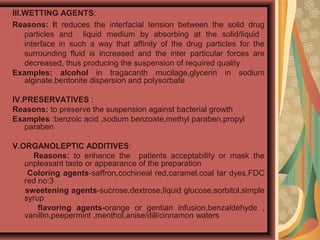
III.WETTING AGENTS:
Reasons: It reduces the interfacial tension between the solid drug
particles and liquid medium by absorbing at the solid/liquid
interface in such a way that affinity of the drug particles for the
surrounding fluid is increased and the inter particular forces are
decreased, thus producing the suspension of required quality
Examples: alcohol in tragacanth mucilage,glycerin in sodium
alginate,bentonite dispersion and polysorbate
IV.PRESERVATIVES :
Reasons: to preserve the suspension against bacterial growth
Examples :benzoic acid ,sodium benzoate,methyl paraben,propyl
paraben
V.ORGANOLEPTIC ADDITIVES:
Reasons: to enhance the patients acceptability or mask the
unpleasant taste or appearance of the preparation
Coloring agents-saffron,cochineal red,caramel,coal tar dyes,FDC
red no:3
sweetening agents-sucrose,dextrose,liquid glucose,sorbitol,simple
syrup
flavoring agents-orange or gentian infusion,benzaldehyde ,
vanillin,peepermint ,menthol,anise/dill/cinnamon waters
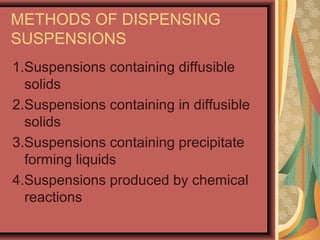
METHODS OF DISPENSING
SUSPENSIONS
1.Suspensions containing diffusible
solids
2.Suspensions containing in diffusible
solids
3.Suspensions containing precipitate
forming liquids
4.Suspensions produced by chemical
reactions
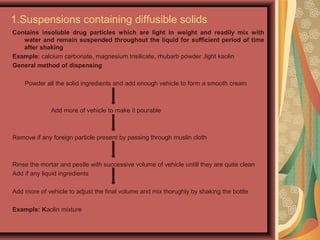
1.Suspensions containing diffusible solids
Contains insoluble drug particles which are light in weight and readily mix with
water and remain suspended throughout the liquid for sufficient period of time
after shaking
Example: calcium carbonate, magnesium trisilicate, rhubarb powder ,light kaolin
General method of dispensing
Powder all the solid ingredients and add enough vehicle to form a smooth cream
Add more of vehicle to make it pourable
Remove if any foreign particle present by passing through muslin cloth
Rinse the mortar and pestle with successive volume of vehicle untill they are quite clean
Add if any liquid ingredients
Add more of vehicle to adjust the final volume and mix thorughly by shaking the bottle
Example: Kaolin mixture
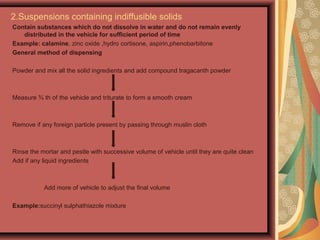
2.Suspensions containing indiffusible solids
Contain substances which do not dissolve in water and do not remain evenly
distributed in the vehicle for sufficient period of time
Example: calamine, zinc oxide ,hydro cortisone, aspirin,phenobarbitone
General method of dispensing
Powder and mix all the solid ingredients and add compound tragacanth powder
Measure ¾ th of the vehicle and triturate to form a smooth cream
Remove if any foreign particle present by passing through muslin cloth
Rinse the mortar and pestle with successive volume of vehicle until they are quite clean
Add if any liquid ingredients
Add more of vehicle to adjust the final volume
Example:succinyl sulphathiazole mixture
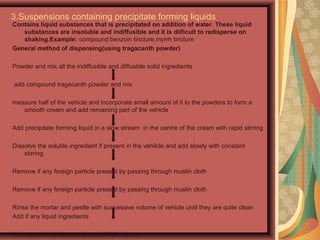
3.Suspensions containing precipitate forming liquids
Contains liquid substances that is precipitated on addition of water. These liquid
substances are insoluble and indiffusible and it is diificult to redisperse on
shaking.Example: compound benzoin tincture,myrrh tincture
General method of dispensing(using tragacanth powder)
Powder and mix all the indiffusible and diffusible solid ingredients
add compound tragacanth powder and mix
measure half of the vehicle and incorporate small amount of it to the powders to form a
smooth cream and add remaining part of the vehicle
Add precipitate forming liquid in a slow stream in the centre of the cream with rapid stirring
Dissolve the soluble ingredient if present in the vehilcle and add slowly with constant
stirring
Remove if any foreign particle present by passing through muslin cloth
Rinse the mortar and pestle with successive volume of vehicle until they are quite clean
Add if any liquid ingredients
Add more of vehicle to adjust the final volume
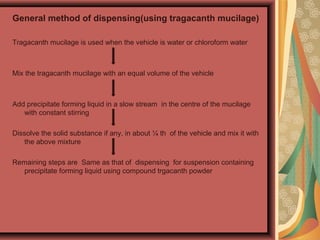
General method of dispensing(using tragacanth mucilage)
Tragacanth mucilage is used when the vehicle is water or chloroform water
Mix the tragacanth mucilage with an equal volume of the vehicle
Add precipitate forming liquid in a slow stream in the centre of the mucilage
with constant stirring
Dissolve the solid substance if any, in about ¼ th of the vehicle and mix it with
the above mixture
Remaining steps are Same as that of dispensing for suspension containing
precipitate forming liquid using compound trgacanth powder
4.Suspensions produced by chemical reactions
Some of the suspensions are prepared by the
chemical reactions between the ingredients used
in the formulations.
In this reactants are highly diluted and mixed
together to form very finely divided precipitates
that can be easily distributed throughout the liquid
by shaking.
The precipitate so formed are diffusible in nature.
Hence there is no need of adding any suspending
agent
Example:sulphurated potash and zinc sulphate
mixture
STABILITY OF SUSPENSIONS
The most stable pharmaceutical
suspensions are flocculated i.ethe
suspended particles are bonded together
physically to form a loose, semi rigid
structure .
The non flocculated suspensions can be
made stable by decreasing the particle
size of the suspended material or by
increasing the density and viscosity of the
vehicle
EVALUATION OF THE STABILTY
OF SUSPENSIONS
1.Sedimentation method
It is the most important parameter in the evaluation of the
stability
It is determined by keeping a measured volume of the
suspension in a graduated cylinder in an un disturbed
position for a definite period of time and noted the ultimate
height of the sediment(Hu) and initial height of the total
suspension
the evalution of redisperbility can also be determined by
shaking the suspension and again find out the sedimentation
volume
RHEOLOGICAL METHOD
The viscosity of the suspension is
studied at different time intervals by
using a good quality of viscometer it
gives useful information about the
stability of suspensions
ELECTROKINETIC METHOD
The determination of surface electric
charge or zeta potential of suspension is
helpful to find out the stabilty of suspension
Certain zeta potentials produce more
stable suspensions becaushe particles
mee of controlled flocculation
Zeta potential can be calculated from
migration velocities of the particles
measured by electrophoretic method
MICROMERITIC METHOD
This can be depends upon the particle size
of the dispersed phase
Any change in particle size with reference
to time will provide useful information
regarding the stability of a suspension
A change in particle size distribution and
crystal habit may be studied by microscopy
and coulter counter method
MARKETED BIPHASIC LIQUID
DOSAGE FORMS
Septran suspension
Ciplin suspension
mebex suspension
Campicilin suspension
Dependal-m suspension
Enterocin suspension
STORAGE CONDITIONS
Should be stored in cool place but
should not be kept in a fridge it leads
to aggregation of the suspended
particles
LABELLING
Must be labelled as a
shake well
before use
CONTAINERS
Should be packed in containers which
are having adeqate air space above
the liquid to permit adequate shaking
Oral suspensions should be packed
in wide mouth bottels to permit
prompt removal of the suspension

Suspension by A B Walikar

  • 1.
    SUSPENSIONS By ARUNKUMAR B. WALIKAR M.PHARM DEPARTMENTOF PHARMACEUTICS B.L.D.E.A’s S S M COLLEGE OF PHARMACY, VIJAYPUR
  • 2.
    DEFINITION Suspensions are thebiphasic liquid dosage form of medicament in which the finely divided solid particles ranging from 0.5 to 5µ are dispersed in a liquid or semisolid vehicle. The solid particles act as dispersed phase whereas liquid/ semisolid vehicle acts as the continuous phase . Taken orally or by parentral route or External application.
  • 3.
    QUALITIES OF AGOOD SUSPENSION Should settle slowly and should readily re-dispersed on gentle shaking Should be chemically intert Suspended particles should not form a cake Should free from large particles
  • 4.
    CLASSIFICATION OF SUSPENSIONS Oral suspensions Parenteralsuspensions Opthalmic suspensions Suspension for external use
  • 5.
    ORALSUSPENSIONS These are tobe the consumed by the patient by oral route Contains flavouring agents and sweetening agents Eg: chloramphenicol palmitate Advantages : easy to swallow and reduces excess acidity in the GIT Disadvantages : accuracy of dosage is less reliable as compared to solution
  • 6.
    PARENTERAL SUSPENSIONS These areadministrated by parentral route . These suspensions are required to fulfil the following qualities Should not be any crystal growth in the suspension during the storage Suspensions should be sterilised The concentration of solid particles should be between o.5to 30%
  • 7.
    OPHTHALMIC SUSPENSIONS These arecommonly used for eye – drops these suspensions must fulfil the following conditions: Should be sterilised Should be isotonic Should have desired viscosity
  • 8.
    SUSPENSIONS FOR EXTERNAL USE Meantfor external use eg: lotions, inhalations ,eardrops etc Lotions are easier to apply and less messy than many other semisolid external preparations Lotions are meant for application on broken or inflamed skin should be free from harmful micro organisms.
  • 9.
    FLOCULATED SUSPENSIONS Rate ofsediment is high Sediment is rapidly formed Supernatent liquid is clear Suspension is not in pleasing in appearance Particles form loose aggregates, and form a network like structure. Sediment is easy to redisperse. Sediment is loosely packed and doesnot form a hard cake. The floccules stick to the sides of the bottle.
  • 10.
    DEFLOCULATED SUSPENSIONS Rate ofsediment is slow. Sediment is difficult to redisperse. Supernatent liquid is not clear. Suspension is pleasing in appearance. Individual particles exists as separate entry. Sediment is slowly formed. Sediment is closely packed and a hard cake is formed. The floccules do not stick to the sides of the bottle.
  • 11.
    FORMULATION OF SUSPENSIONS Followingadditives are used I.FLOCCULATING AGENTS: Reasons :in order to improve the dispersability of insoluble drug particles by reducing the surface tension and minimizing the flocculation Examples: sodium lauryl sulphate, tweens,spans and carbowaxes II.THICKENING AGENTS: (hydrophilic colloids) Reasons :it forms collidal dispersions with water and increases the viscosity of continuous phase .so that the solid drug particles remain suspended in the continuous phase for sufficient long time to measure a uniform accurate dose Examples: 1.Polysaccharides: a. natural :gum acacia,tracaganth, starch,sodium alginate b. semisynthetic:MC,SCMC,MCC 2.Inorganic agents :clay , aluminium hydroxide 3.synthetic compounds : carbomer,colloidal silicon di oxide
  • 12.
    III.WETTING AGENTS: Reasons: Itreduces the interfacial tension between the solid drug particles and liquid medium by absorbing at the solid/liquid interface in such a way that affinity of the drug particles for the surrounding fluid is increased and the inter particular forces are decreased, thus producing the suspension of required quality Examples: alcohol in tragacanth mucilage,glycerin in sodium alginate,bentonite dispersion and polysorbate IV.PRESERVATIVES : Reasons: to preserve the suspension against bacterial growth Examples :benzoic acid ,sodium benzoate,methyl paraben,propyl paraben V.ORGANOLEPTIC ADDITIVES: Reasons: to enhance the patients acceptability or mask the unpleasant taste or appearance of the preparation Coloring agents-saffron,cochineal red,caramel,coal tar dyes,FDC red no:3 sweetening agents-sucrose,dextrose,liquid glucose,sorbitol,simple syrup flavoring agents-orange or gentian infusion,benzaldehyde , vanillin,peepermint ,menthol,anise/dill/cinnamon waters
  • 13.
    METHODS OF DISPENSING SUSPENSIONS 1.Suspensionscontaining diffusible solids 2.Suspensions containing in diffusible solids 3.Suspensions containing precipitate forming liquids 4.Suspensions produced by chemical reactions
  • 14.
    1.Suspensions containing diffusiblesolids Contains insoluble drug particles which are light in weight and readily mix with water and remain suspended throughout the liquid for sufficient period of time after shaking Example: calcium carbonate, magnesium trisilicate, rhubarb powder ,light kaolin General method of dispensing Powder all the solid ingredients and add enough vehicle to form a smooth cream Add more of vehicle to make it pourable Remove if any foreign particle present by passing through muslin cloth Rinse the mortar and pestle with successive volume of vehicle untill they are quite clean Add if any liquid ingredients Add more of vehicle to adjust the final volume and mix thorughly by shaking the bottle Example: Kaolin mixture
  • 15.
    2.Suspensions containing indiffusiblesolids Contain substances which do not dissolve in water and do not remain evenly distributed in the vehicle for sufficient period of time Example: calamine, zinc oxide ,hydro cortisone, aspirin,phenobarbitone General method of dispensing Powder and mix all the solid ingredients and add compound tragacanth powder Measure ¾ th of the vehicle and triturate to form a smooth cream Remove if any foreign particle present by passing through muslin cloth Rinse the mortar and pestle with successive volume of vehicle until they are quite clean Add if any liquid ingredients Add more of vehicle to adjust the final volume Example:succinyl sulphathiazole mixture
  • 16.
    3.Suspensions containing precipitateforming liquids Contains liquid substances that is precipitated on addition of water. These liquid substances are insoluble and indiffusible and it is diificult to redisperse on shaking.Example: compound benzoin tincture,myrrh tincture General method of dispensing(using tragacanth powder) Powder and mix all the indiffusible and diffusible solid ingredients add compound tragacanth powder and mix measure half of the vehicle and incorporate small amount of it to the powders to form a smooth cream and add remaining part of the vehicle Add precipitate forming liquid in a slow stream in the centre of the cream with rapid stirring Dissolve the soluble ingredient if present in the vehilcle and add slowly with constant stirring Remove if any foreign particle present by passing through muslin cloth Remove if any foreign particle present by passing through muslin cloth Rinse the mortar and pestle with successive volume of vehicle until they are quite clean Add if any liquid ingredients Add more of vehicle to adjust the final volume
  • 17.
    General method ofdispensing(using tragacanth mucilage) Tragacanth mucilage is used when the vehicle is water or chloroform water Mix the tragacanth mucilage with an equal volume of the vehicle Add precipitate forming liquid in a slow stream in the centre of the mucilage with constant stirring Dissolve the solid substance if any, in about ¼ th of the vehicle and mix it with the above mixture Remaining steps are Same as that of dispensing for suspension containing precipitate forming liquid using compound trgacanth powder
  • 18.
    4.Suspensions produced bychemical reactions Some of the suspensions are prepared by the chemical reactions between the ingredients used in the formulations. In this reactants are highly diluted and mixed together to form very finely divided precipitates that can be easily distributed throughout the liquid by shaking. The precipitate so formed are diffusible in nature. Hence there is no need of adding any suspending agent Example:sulphurated potash and zinc sulphate mixture
  • 19.
    STABILITY OF SUSPENSIONS Themost stable pharmaceutical suspensions are flocculated i.ethe suspended particles are bonded together physically to form a loose, semi rigid structure . The non flocculated suspensions can be made stable by decreasing the particle size of the suspended material or by increasing the density and viscosity of the vehicle
  • 20.
    EVALUATION OF THESTABILTY OF SUSPENSIONS 1.Sedimentation method It is the most important parameter in the evaluation of the stability It is determined by keeping a measured volume of the suspension in a graduated cylinder in an un disturbed position for a definite period of time and noted the ultimate height of the sediment(Hu) and initial height of the total suspension the evalution of redisperbility can also be determined by shaking the suspension and again find out the sedimentation volume
  • 21.
    RHEOLOGICAL METHOD The viscosityof the suspension is studied at different time intervals by using a good quality of viscometer it gives useful information about the stability of suspensions
  • 22.
    ELECTROKINETIC METHOD The determinationof surface electric charge or zeta potential of suspension is helpful to find out the stabilty of suspension Certain zeta potentials produce more stable suspensions becaushe particles mee of controlled flocculation Zeta potential can be calculated from migration velocities of the particles measured by electrophoretic method
  • 23.
    MICROMERITIC METHOD This canbe depends upon the particle size of the dispersed phase Any change in particle size with reference to time will provide useful information regarding the stability of a suspension A change in particle size distribution and crystal habit may be studied by microscopy and coulter counter method
  • 24.
    MARKETED BIPHASIC LIQUID DOSAGEFORMS Septran suspension Ciplin suspension mebex suspension Campicilin suspension Dependal-m suspension Enterocin suspension
  • 25.
    STORAGE CONDITIONS Should bestored in cool place but should not be kept in a fridge it leads to aggregation of the suspended particles
  • 26.
    LABELLING Must be labelledas a shake well before use
  • 27.
    CONTAINERS Should be packedin containers which are having adeqate air space above the liquid to permit adequate shaking Oral suspensions should be packed in wide mouth bottels to permit prompt removal of the suspension