Suppositories
Presented by
Adilla Vaishnavi
23T21T0002
Pharm.D 1st Year
Under the Guidence of
M. Swetha
Assistant Professor, Department of
Pharmaceutics
CMR College of PHARMACY
CONTENTS
 Introduction
 Advantages & Disadvantages
 Classification
 Suppository bases
 Preparation Methods
INTRODUCTION
 Suppositories are semisolid dosage forms of
medicament for insertion into body orifices other
than mouth
 They are inserted into rectum, vagina, ear, urethral,
nasal cavity.
 Suppositories are in different shapes, sizes and
weights.
Advantages
• Melts at body temperature.
• Both localized and systemic action.
• Easy to use for pediatric and geriatric patients.
• Administered to unconscious patient.
• Suppositories are unit dosage form of drugs
• The drugs in suppositories are slowly absorbed giving
sustained action.
Disadvantages
• Irritant drug cant be administered.
• Embarrassment to patients.
• Need to store at low temp.
• Cannot be prepared easily
• Cost-expensive.
• Fluid content of the rectum is much less than that of the small
intestine; this may effect dissolution rate, etc.
• Some drug may be degraded by the microbial flora present
in the rectum.
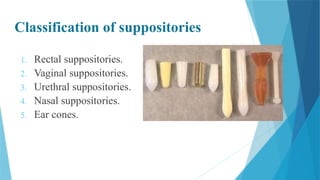
Classification of suppositories
1. Rectal suppositories.
2. Vaginal suppositories.
3. Urethral suppositories.
4. Nasal suppositories.
5. Ear cones.
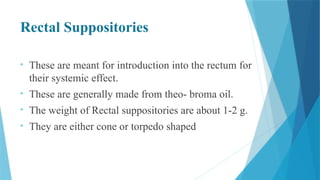
Rectal Suppositories
• These are meant for introduction into the rectum for
their systemic effect.
• These are generally made from theo- broma oil.
• The weight of Rectal suppositories are about 1-2 g.
• They are either cone or torpedo shaped
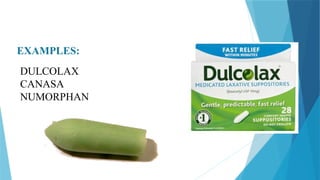
EXAMPLES:
DULCOLAX
CANASA
NUMORPHAN
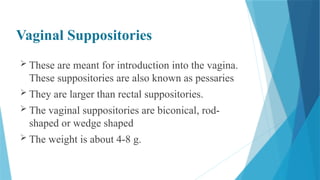
Vaginal Suppositories
 These are meant for introduction into the vagina.
These suppositories are also known as pessaries
 They are larger than rectal suppositories.
 The vaginal suppositories are biconical, rod-
shaped or wedge shaped
 The weight is about 4-8 g.
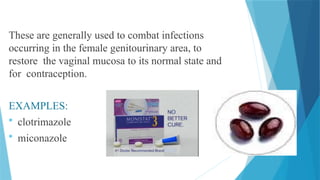
These are generally used to combat infections
occurring in the female genitourinary area, to
restore the vaginal mucosa to its normal state and
for contraception.
EXAMPLES:
 clotrimazole
 miconazole
Urethral Suppositories
 These are meant for introduction into the urethra.
 These are also known as urethral bougies.
 These are thin, long and cylindrical forms rounded
at one end to facilitate insertion.
 The weight varies from 2 to 4 g.
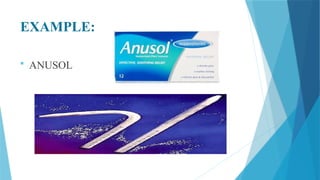
EXAMPLE:
 ANUSOL
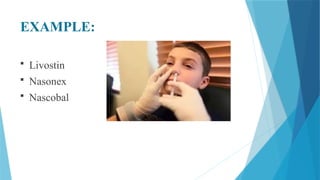
Nasal Suppositories
 These are meant for introduction into the nasal cavity
 These are also known as nasal bougies.
 These are thin and cylindrical in shape
 These are always prepared with glycero-gelatin base.
 Nasal suppositories are about9-10 cm long and
weigh about 1.0 g.
EXAMPLE:
 Livostin
 Nasonex
 Nascobal
Ear Cones
 These are meant for introduction into the ear
 These are also known as aurinaria.
 These suppositories are thin, long and cylindrical
in shape and weigh about 1 gram.
 Ear cones are usually prepared
with theobroma oil.
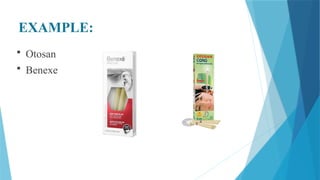
EXAMPLE:
 Otosan
 Benexe
New Trends of Suppositories
1. Tablet Suppositories
2. Layered Suppositories
3. Capsule Suppositories
4. Coated Suppositories
5. Disposable mould
SUPPOSITORY BASES
The various types of suppositories bases are used
to prepare suppositories, so that they can retain its
shape, and firmness during storage
and administration.
Ideal properties:
 It must retain the shape and size on storage.
 It should melt at body temperature after
insertion.
 It should be non-irritant.
 It should shrink sufficiently to remove from
mould.
 It should not interfere in release or absorption of
drug.
 It should permit incorporation of drug.
 It should be compatible with variety of drugs.
 It should not be soften or harden on storage.
Types of bases
1. Oleaginous/ Fatty bases
1. Cocoa butter (Theobroma oil)
2. Emulsified Theobroma oil.
3. Hydrogenated oils.
2. Hydrophilic bases (Water soluble and miscible)
1. Glycero-gelatin base.
2. Soap-glycerin base.
3. Polyethylene glycol.
3. Emulsifying/Synthetic bases
1. Witepsol
2. Massa estarinum
3. Massuppol.
1.Fatty bases
i) Theobroma oil:
 It is yellowish white solid obtained from crushed and roasted
seeds of Theobormococoa.
 It is also known as cocoa butter.
 It has butter like consistency having melting point of 30°C-
35°C.
 It is a mixture of glyceryl esters of stearic, oleic, palmitic and
other fatty acids.
ii) Emulsified Theobroma oil:
 This may be used as a base when quantities of
aqueous solutions are to be incorporated.
 The use of 5% glyceryl monsterate, 10% lenette
wax, 2-3% cetyl alcohol, 4% beeswax and 12%
spermaceti is recommended to prepare
emulsified theobroma oil suppositories.
(iii) Hydrogenated oils:
These can be obtained by hydrogenation of
various vegetable oil, such as arachis oil,
cottonseed oil, coconut oil, palm oil, etc.
It is used as a substitute for theobroma oil because
it has a number of advantages over theobroma oil
2. Water soluble and miscible bases:
(i) Glycero-gelatin base:
It is a mixture of glycerin and water which is made stiff by the
addition of gelatin. The base may be used for preparing all type of
suppositories but it is particularly used for making pessaries.
(ii) Soap-glycerin suppositories:
In glycero-gelatin base, the gelatin is replaced with either curd soap
or sodium sterate which makes the base sufficiently hard to prepare
good quality of suppositories.
(iii) Polyethylene glycols:
PEG polymers are commonly known as carbowaxes or polyglycols
or macrogols.
3. Emulsifying bases
(i)Witepsol:
They consist of triglycerides of saturated vegetable fatty acid
with varying percentage of partial esters.
(ii) Massa estarinum:
It is a mixture of mono, di- and triglycerides of saturated fatty
acids. This is also known as adeps solidus.
(iii) Massuppol:
It consists of glyceryl esters mainly of lauric acid to which
small amount of glyceryl monsterate has been added to
improve its water absorbing capacity.
PREPARATION OF SUPPOSITORIES
Suppositories are prepared by the following methods:
1. Hand Rolling method
2. Hot process or Fusion method.
3. Cold compression method
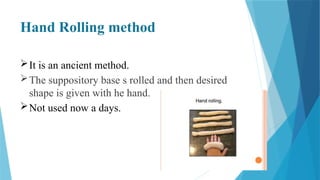
Hand Rolling method
It is an ancient method.
The suppository base s rolled and then desired
shape is given with he hand.
Not used now a days.
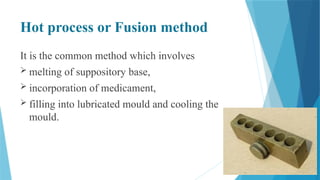
Hot process or Fusion method
It is the common method which involves
 melting of suppository base,
 incorporation of medicament,
 filling into lubricated mould and cooling the
mould.
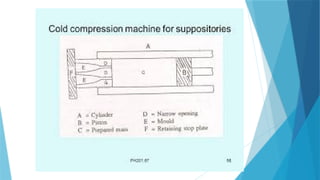
Cold compression method
 This method is useful for thermolabile and insoluble
drugs as it does not involves heating and stirring of the
base.
 The method is not suitable for suppositories in which
glycero gelatin base or any other base which involves
melting.
 Use of Hand or power operated compression machines.
THANK YOU

Suppositors used in pharmacy

  • 1.
    Suppositories Presented by Adilla Vaishnavi 23T21T0002 Pharm.D1st Year Under the Guidence of M. Swetha Assistant Professor, Department of Pharmaceutics CMR College of PHARMACY
  • 2.
    CONTENTS  Introduction  Advantages& Disadvantages  Classification  Suppository bases  Preparation Methods
  • 3.
    INTRODUCTION  Suppositories aresemisolid dosage forms of medicament for insertion into body orifices other than mouth  They are inserted into rectum, vagina, ear, urethral, nasal cavity.  Suppositories are in different shapes, sizes and weights.
  • 4.
    Advantages • Melts atbody temperature. • Both localized and systemic action. • Easy to use for pediatric and geriatric patients. • Administered to unconscious patient. • Suppositories are unit dosage form of drugs • The drugs in suppositories are slowly absorbed giving sustained action.
  • 5.
    Disadvantages • Irritant drugcant be administered. • Embarrassment to patients. • Need to store at low temp. • Cannot be prepared easily • Cost-expensive. • Fluid content of the rectum is much less than that of the small intestine; this may effect dissolution rate, etc. • Some drug may be degraded by the microbial flora present in the rectum.
  • 6.
    Classification of suppositories 1.Rectal suppositories. 2. Vaginal suppositories. 3. Urethral suppositories. 4. Nasal suppositories. 5. Ear cones.
  • 7.
    Rectal Suppositories • Theseare meant for introduction into the rectum for their systemic effect. • These are generally made from theo- broma oil. • The weight of Rectal suppositories are about 1-2 g. • They are either cone or torpedo shaped
  • 8.
  • 9.
    Vaginal Suppositories  Theseare meant for introduction into the vagina. These suppositories are also known as pessaries  They are larger than rectal suppositories.  The vaginal suppositories are biconical, rod- shaped or wedge shaped  The weight is about 4-8 g.
  • 10.
    These are generallyused to combat infections occurring in the female genitourinary area, to restore the vaginal mucosa to its normal state and for contraception. EXAMPLES:  clotrimazole  miconazole
  • 11.
    Urethral Suppositories  Theseare meant for introduction into the urethra.  These are also known as urethral bougies.  These are thin, long and cylindrical forms rounded at one end to facilitate insertion.  The weight varies from 2 to 4 g.
  • 12.
  • 13.
    Nasal Suppositories  Theseare meant for introduction into the nasal cavity  These are also known as nasal bougies.  These are thin and cylindrical in shape  These are always prepared with glycero-gelatin base.  Nasal suppositories are about9-10 cm long and weigh about 1.0 g.
  • 14.
  • 15.
    Ear Cones  Theseare meant for introduction into the ear  These are also known as aurinaria.  These suppositories are thin, long and cylindrical in shape and weigh about 1 gram.  Ear cones are usually prepared with theobroma oil.
  • 16.
  • 17.
    New Trends ofSuppositories 1. Tablet Suppositories 2. Layered Suppositories 3. Capsule Suppositories 4. Coated Suppositories 5. Disposable mould
  • 18.
    SUPPOSITORY BASES The varioustypes of suppositories bases are used to prepare suppositories, so that they can retain its shape, and firmness during storage and administration.
  • 19.
    Ideal properties:  Itmust retain the shape and size on storage.  It should melt at body temperature after insertion.  It should be non-irritant.  It should shrink sufficiently to remove from mould.  It should not interfere in release or absorption of drug.  It should permit incorporation of drug.  It should be compatible with variety of drugs.  It should not be soften or harden on storage.
  • 20.
    Types of bases 1.Oleaginous/ Fatty bases 1. Cocoa butter (Theobroma oil) 2. Emulsified Theobroma oil. 3. Hydrogenated oils. 2. Hydrophilic bases (Water soluble and miscible) 1. Glycero-gelatin base. 2. Soap-glycerin base. 3. Polyethylene glycol. 3. Emulsifying/Synthetic bases 1. Witepsol 2. Massa estarinum 3. Massuppol.
  • 21.
    1.Fatty bases i) Theobromaoil:  It is yellowish white solid obtained from crushed and roasted seeds of Theobormococoa.  It is also known as cocoa butter.  It has butter like consistency having melting point of 30°C- 35°C.  It is a mixture of glyceryl esters of stearic, oleic, palmitic and other fatty acids.
  • 22.
    ii) Emulsified Theobromaoil:  This may be used as a base when quantities of aqueous solutions are to be incorporated.  The use of 5% glyceryl monsterate, 10% lenette wax, 2-3% cetyl alcohol, 4% beeswax and 12% spermaceti is recommended to prepare emulsified theobroma oil suppositories.
  • 23.
    (iii) Hydrogenated oils: Thesecan be obtained by hydrogenation of various vegetable oil, such as arachis oil, cottonseed oil, coconut oil, palm oil, etc. It is used as a substitute for theobroma oil because it has a number of advantages over theobroma oil
  • 24.
    2. Water solubleand miscible bases: (i) Glycero-gelatin base: It is a mixture of glycerin and water which is made stiff by the addition of gelatin. The base may be used for preparing all type of suppositories but it is particularly used for making pessaries. (ii) Soap-glycerin suppositories: In glycero-gelatin base, the gelatin is replaced with either curd soap or sodium sterate which makes the base sufficiently hard to prepare good quality of suppositories. (iii) Polyethylene glycols: PEG polymers are commonly known as carbowaxes or polyglycols or macrogols.
  • 25.
    3. Emulsifying bases (i)Witepsol: Theyconsist of triglycerides of saturated vegetable fatty acid with varying percentage of partial esters. (ii) Massa estarinum: It is a mixture of mono, di- and triglycerides of saturated fatty acids. This is also known as adeps solidus. (iii) Massuppol: It consists of glyceryl esters mainly of lauric acid to which small amount of glyceryl monsterate has been added to improve its water absorbing capacity.
  • 26.
    PREPARATION OF SUPPOSITORIES Suppositoriesare prepared by the following methods: 1. Hand Rolling method 2. Hot process or Fusion method. 3. Cold compression method
  • 27.
    Hand Rolling method Itis an ancient method. The suppository base s rolled and then desired shape is given with he hand. Not used now a days.
  • 28.
    Hot process orFusion method It is the common method which involves  melting of suppository base,  incorporation of medicament,  filling into lubricated mould and cooling the mould.
  • 29.
    Cold compression method This method is useful for thermolabile and insoluble drugs as it does not involves heating and stirring of the base.  The method is not suitable for suppositories in which glycero gelatin base or any other base which involves melting.  Use of Hand or power operated compression machines.
  • 31.