- C H AR L E S J AM E S
SUPPORTIVE PERIODONTAL
TREATMENT
INTRODUCTION.
• Preservation of periodontal health equally important as
elimination of periodontal disease.
• Third World Workshop of the American Academy of
Periodontology 1989 had renamed the maintenance
phase as “SUPPORTIVE PERIODONTAL THERAPY”.
• Maintenance phase should be a step in total patient
care.
RATIONALE FOR SPT.
• Incomplete sub-gingival plaque removal
• Transfer of periodontal bacteria within family members.
• Remaining pockets provide space for reinfection by
pathogens.
• Microscopic nature of dento-gingival unit healing.
Goals of SPT.
• To prevent or minimize the recurrence and
progression of periodontal disease in patients
who have been previously treated.
• To prevent tooth loss by monitoring the
dentition.
• To locate and treat other diseases of the oral
cavity in a timely manner.
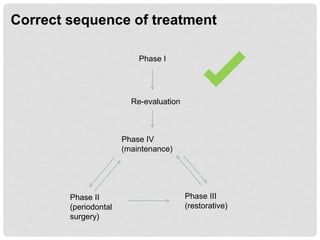
Phase I
Re-evaluation
Phase IV
(maintenance)
Phase II
(periodontal
surgery)
Phase III
(restorative)
Correct sequence of treatment
Objectives.
• Bone support
• Stable CAL
• Proper home care and oral
hygiene
• Patient education
• Maintenance of proper oral
function.
• Assessment of patients
general health.
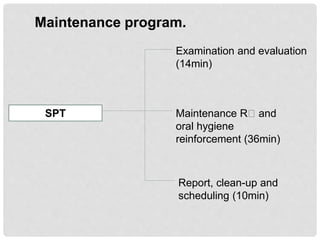
Maintenance program.
SPT
Examination and evaluation
(14min)
Maintenance Rꭖ and
oral hygiene
reinforcement (36min)
Report, clean-up and
scheduling (10min)
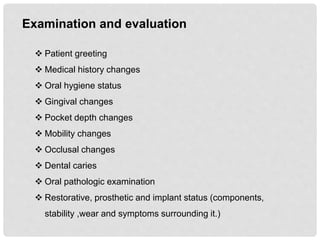
Examination and evaluation
 Patient greeting
 Medical history changes
 Oral hygiene status
 Gingival changes
 Pocket depth changes
 Mobility changes
 Occlusal changes
 Dental caries
 Oral pathologic examination
 Restorative, prosthetic and implant status (components,
stability ,wear and symptoms surrounding it.)
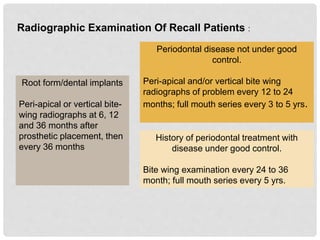
Radiographic Examination Of Recall Patients :
Root form/dental implants
Peri-apical or vertical bite-
wing radiographs at 6, 12
and 36 months after
prosthetic placement, then
every 36 months
Periodontal disease not under good
control.
Peri-apical and/or vertical bite wing
radiographs of problem every 12 to 24
months; full mouth series every 3 to 5 yrs.
History of periodontal treatment with
disease under good control.
Bite wing examination every 24 to 36
month; full mouth series every 5 yrs.
SPT clinical examination
Stable periodontal status (
no microbial testing
required)
Periodic SPT
Progressive and Aggressive
Periodontitis
SPT and Anti microbial
therapy
Clinical microbiological re-
evaluation
Refractory
Periodontitis
Selection of
alternative
clinical treatment
or antimicrobial
regimen
Microbial Testing
Maintenance Treatment And Oral
Hygiene Reinforcement
• Oral hygiene reinforcement.
• Scaling .
• Polishing.
• Chemical irrigation or site specific
antimicrobial placement.
Report ,Clean up and scheduling
• Write report in chart
• Discuss report with patient
• clean and disinfect operatory
• schedule next recall visit
• Schedule further periodontal treatment
• Schedule or refer for restorative or prosthetic
treatment .
Frequency of SPT
• Patients with gingivitis but no previous
attachment loss- SPT twice a year.
• Patients with previous history of
periodontitis- twice within 6 months.
• Active clinical therapy – four times a year.
Compliance affecting SPT
Patients who comply to suggested recall visits are periodontally
healthy and keep their teeth longer.
Improving compliance-
• Counselling them about their condition ,
treatment and importance of compliance.
• Simplify instructions to patients.
• Teach them self performed plaque control.
• Accommodate patients needs also.
• Positive reinforcement.
CONCLUSION.
 Effectiveness of “Supportive Periodontal
Treatment” depends mostly on the patients
compliance to the treatment and his knowledge
on the severity of the disease.
 Healing of periodontium is a complex process
and takes time and proper management.
 More than the actual surgical or restorative
treatment , the maintenance determines the
prognosis of the disease.
Supportive Periodontal Therapy

Supportive Periodontal Therapy

  • 1.
    - C HAR L E S J AM E S SUPPORTIVE PERIODONTAL TREATMENT
  • 2.
    INTRODUCTION. • Preservation ofperiodontal health equally important as elimination of periodontal disease. • Third World Workshop of the American Academy of Periodontology 1989 had renamed the maintenance phase as “SUPPORTIVE PERIODONTAL THERAPY”. • Maintenance phase should be a step in total patient care.
  • 3.
    RATIONALE FOR SPT. •Incomplete sub-gingival plaque removal • Transfer of periodontal bacteria within family members. • Remaining pockets provide space for reinfection by pathogens. • Microscopic nature of dento-gingival unit healing.
  • 4.
    Goals of SPT. •To prevent or minimize the recurrence and progression of periodontal disease in patients who have been previously treated. • To prevent tooth loss by monitoring the dentition. • To locate and treat other diseases of the oral cavity in a timely manner.
  • 5.
    Phase I Re-evaluation Phase IV (maintenance) PhaseII (periodontal surgery) Phase III (restorative) Correct sequence of treatment
  • 6.
    Objectives. • Bone support •Stable CAL • Proper home care and oral hygiene • Patient education • Maintenance of proper oral function. • Assessment of patients general health.
  • 7.
    Maintenance program. SPT Examination andevaluation (14min) Maintenance Rꭖ and oral hygiene reinforcement (36min) Report, clean-up and scheduling (10min)
  • 8.
    Examination and evaluation Patient greeting  Medical history changes  Oral hygiene status  Gingival changes  Pocket depth changes  Mobility changes  Occlusal changes  Dental caries  Oral pathologic examination  Restorative, prosthetic and implant status (components, stability ,wear and symptoms surrounding it.)
  • 9.
    Radiographic Examination OfRecall Patients : Root form/dental implants Peri-apical or vertical bite- wing radiographs at 6, 12 and 36 months after prosthetic placement, then every 36 months Periodontal disease not under good control. Peri-apical and/or vertical bite wing radiographs of problem every 12 to 24 months; full mouth series every 3 to 5 yrs. History of periodontal treatment with disease under good control. Bite wing examination every 24 to 36 month; full mouth series every 5 yrs.
  • 10.
    SPT clinical examination Stableperiodontal status ( no microbial testing required) Periodic SPT Progressive and Aggressive Periodontitis SPT and Anti microbial therapy Clinical microbiological re- evaluation Refractory Periodontitis Selection of alternative clinical treatment or antimicrobial regimen Microbial Testing
  • 11.
    Maintenance Treatment AndOral Hygiene Reinforcement • Oral hygiene reinforcement. • Scaling . • Polishing. • Chemical irrigation or site specific antimicrobial placement.
  • 12.
    Report ,Clean upand scheduling • Write report in chart • Discuss report with patient • clean and disinfect operatory • schedule next recall visit • Schedule further periodontal treatment • Schedule or refer for restorative or prosthetic treatment .
  • 13.
    Frequency of SPT •Patients with gingivitis but no previous attachment loss- SPT twice a year. • Patients with previous history of periodontitis- twice within 6 months. • Active clinical therapy – four times a year.
  • 14.
    Compliance affecting SPT Patientswho comply to suggested recall visits are periodontally healthy and keep their teeth longer. Improving compliance- • Counselling them about their condition , treatment and importance of compliance. • Simplify instructions to patients. • Teach them self performed plaque control. • Accommodate patients needs also. • Positive reinforcement.
  • 15.
    CONCLUSION.  Effectiveness of“Supportive Periodontal Treatment” depends mostly on the patients compliance to the treatment and his knowledge on the severity of the disease.  Healing of periodontium is a complex process and takes time and proper management.  More than the actual surgical or restorative treatment , the maintenance determines the prognosis of the disease.