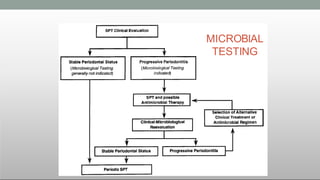
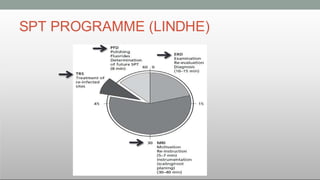
SPT should be based on profile of risk assessment
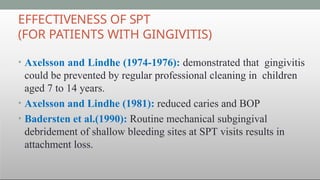
No scientific evidence for subgingival debridement of sites with BOP without concomitant increase in pocket depth. (it should better be avoided)
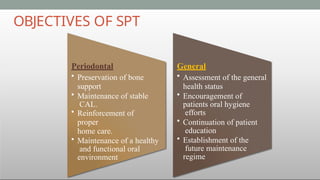
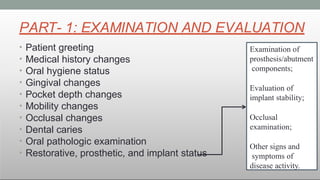
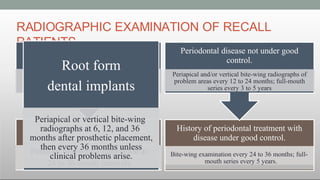
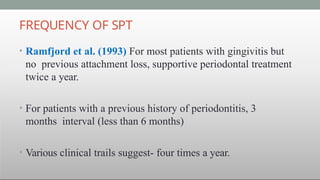
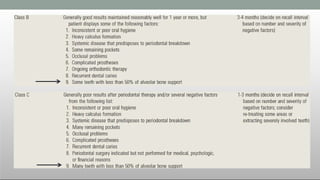
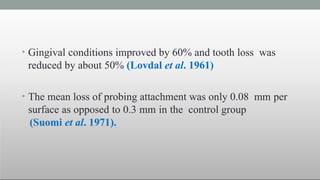
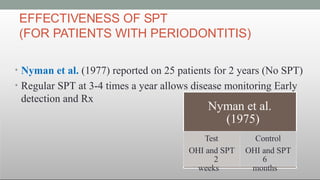
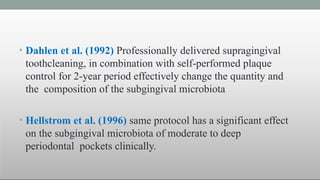
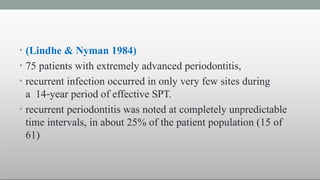
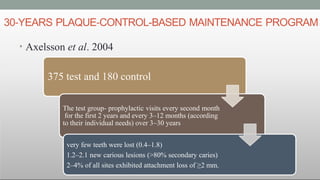
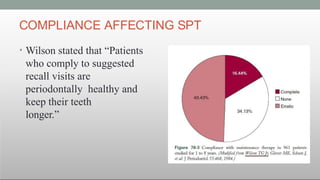
SPT minimizes the risk of periodontal disease progression and tooth mortality
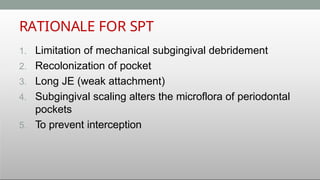
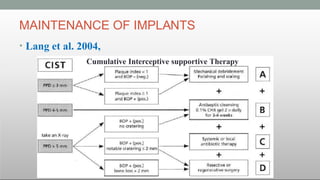
In absence of long-term evaluation of SPT for dental implants, same principles of SPT that is used for periodontitis is also apropriate Limitation of mechanical subgingival debridement
Recolonization of pocket
Long JE (weak attachment)
Subgingival scaling alters the microflora of periodontal
pockets
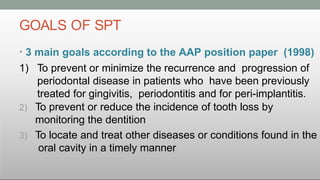
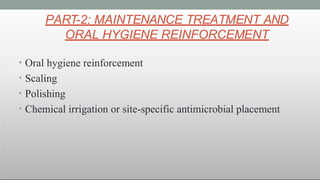
To prevent interception3 main goals according to the AAP position paper (1998)
To prevent or minimize the recurrence and progression of periodontal disease in patients who have been previously treated for gingivitis, periodontitis and for peri-implantitis.
To prevent or reduce the incidence of tooth loss by monitoring the dentition
To locate and treat other diseases or conditions found in the oral cavity in a timely manner
Autogenous Bone Grafts
Historically, extraoral sites for bone harvesting have been from the
iliac crest, but this approach is seldom performed due to medical and
legal concerns. Intraoral autograft donor sites can be eective, espe
cially when donor sites adjacent to the defects are available. Due to
the morbidity of the secondary harvest site and the limited material
that can be harvested, the autograft is not popular. The consequence
is that the allograft is the clinical graft material of choice. Despite
the popularity of using allograft, the material functions primarily as
a scaolding or osteoconductive agent with a minimal amount of
osteogenic content. Historical development of the use of autografts
from intraoral sites suggests that we should consider using an auto
graft when possible. (See online material, Autologous bone graft of
historical interest.)
Bone Allografts
Obtaining donor material for autograft purposes necessitates inÀict
ing surgical trauma on another part of the patient’s body. Obviously,
it would be to the patient’s and provider’s advantage if a suitable sub
stitute could be used for grafting purposes that would oer similar
potential for repair and not require the additional surgical removal
of donor material from the patient. However, both allografts and
xenografts are foreign to the patient and therefore have the potential
to provoke an immune response. Attempts have been made to sup
press the antigenic potential of allografts and xenografts by radia
tion, freezing, and chemical treatment.27
Bone allografts are commercially available from tissue banks.
They are obtained from cortical bone within 12 hours of death of
the donor, defatted, cut in pieces, washed in absolute alcohol, and
deep-frozen. The material may then be demineralized, subsequently
ground and sieved to a particle size of 250 to 750 μm, and freeze
dried. Finally, it is vacuum-sealed in glass vials.
Numerous steps are also taken to eliminate vira




![ONFH[AVN HIP] -TRIPLE REGIME -A NOVAL SURGICAL CONCEPT .pptx](https://cdn.slidesharecdn.com/ss_thumbnails/onfhavnhip2026koaconcalicutdrgokuldevdrmashraf-260210064517-213ec005-thumbnail.jpg?width=640&height=640&fit=bounds)


