SupportivePeriodontalTherapy
Maintenance phase
Recall/re-evaluation
Supervised recall programme
Definition
• Procedures performed at selected intervals to assist the
periodontal patient in maintaining oral health. -GPT 2001.
• Therapeutic measures to support the patient’s own efforts to
control and to avoid re‐infection. - Jan Lindhe.
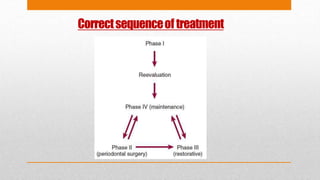
Correctsequenceoftreatment
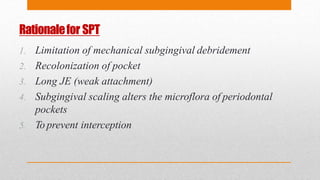
Rationalefor SPT
1. Limitation of mechanical subgingival debridement
2. Recolonization of pocket
3. Long JE (weak attachment)
4. Subgingival scaling alters the microflora of periodontal
pockets
5. To prevent interception
GoalsOf SPT
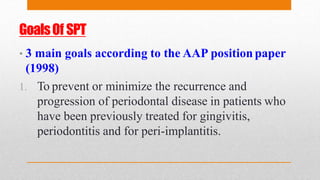
• 3 main goals according to the AAP position paper
(1998)
1. To prevent or minimize the recurrence and
progression of periodontal disease in patients who
have been previously treated for gingivitis,
periodontitis and for peri-implantitis.
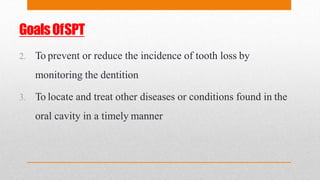
GoalsOfSPT
2. To prevent or reduce the incidence of tooth loss by
monitoring the dentition
3. To locate and treat other diseases or conditions found in the
oral cavity in a timely manner
Objectivesof SPT
General
• Assessment of the general
health status
• Encouragement of patients oral
hygiene efforts
• Continuation of patient education
• Establishment of the future
maintenance regime
Periodontal
• Preservation of bone
support
• Maintenance of stable CAL.
• Reinforcement of proper
home care.
• Maintenance of a healthy and functional oral
environment
Types ofSPT • Schallhorn and Snider (1981)
1. Preventive maintenance therapy
• Periodontally healthy individuals.
2. Trial maintenance therapy
• Mild to moderate periodontitis
3. Compromised maintenance therapy
• Medically compromised patients where active
therapy is not possible.
4. Post-maintenance treatment therapy
• maintenance for prevention of recurrence of
disease
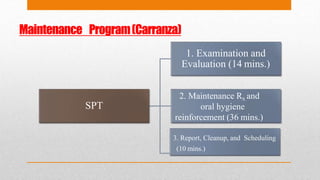
Maintenance Program(Carranza)
SPT
1. Examination and
Evaluation (14 mins.)
2. Maintenance Rx and
oral hygiene
reinforcement (36 mins.)
3. Report, Cleanup, and Scheduling
(10 mins.)
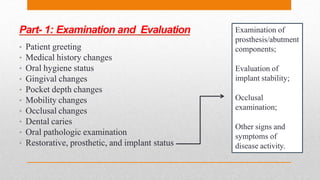
Part- 1: Examination and Evaluation
• Patient greeting
• Medical history changes
• Oral hygiene status
• Gingival changes
• Pocket depth changes
• Mobility changes
• Occlusal changes
• Dental caries
• Oral pathologic examination
• Restorative, prosthetic, and implant status
Examination of
prosthesis/abutment
components;
Evaluation of
implant stability;
Occlusal
examination;
Other signs and
symptoms of
disease activity.
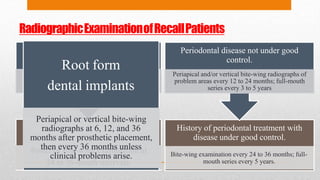
RadiographicExaminationofRecallPatients
Clinical caries and no high-risk factors
for caries.
Posterior bite-wing examination at
24 to 36-month intervals.
Clinical caries or high-risk
factors for caries
Posterior bite-wing examination at
12 to 18-month intervals.
History of periodontal treatment with
disease under good control.
Bite-wing examination every 24 to 36 months; full-
mouth series every 5 years.
Periodontal disease not under good
control.
Periapical and/or vertical bite-wing radiographs of
problem areas every 12 to 24 months; full-mouth
series every 3 to 5 years
Root form
dental implants
Periapical or vertical bite-wing
radiographs at 6, 12, and 36
months after prosthetic placement,
then every 36 months unless
clinical problems arise.
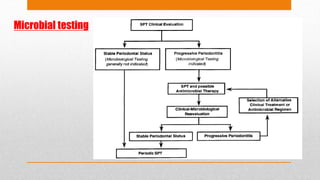
Microbial testing
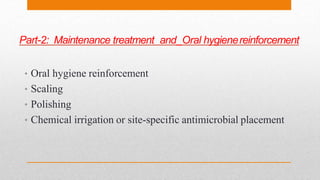
Part-2: Maintenance treatment and Oral hygienereinforcement
• Oral hygiene reinforcement
• Scaling
• Polishing
• Chemical irrigation or site-specific antimicrobial placement
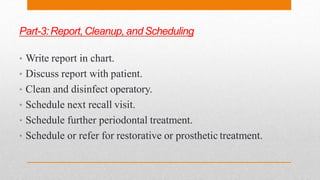
Part-3:Report,Cleanup, and Scheduling
• Write report in chart.
• Discuss report with patient.
• Clean and disinfect operatory.
• Schedule next recall visit.
• Schedule further periodontal treatment.
• Schedule or refer for restorative or prosthetic treatment.
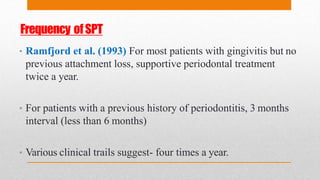
Frequency ofSPT
• Ramfjord et al. (1993) For most patients with gingivitis but no
previous attachment loss, supportive periodontal treatment
twice a year.
• For patients with a previous history of periodontitis, 3 months
interval (less than 6 months)
• Various clinical trails suggest- four times a year.
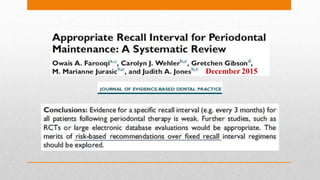
December 2015
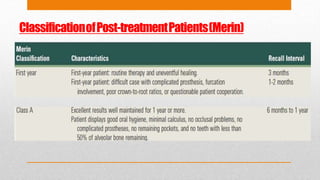
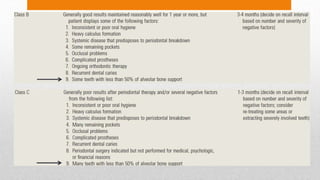
ClassificationofPost-treatmentPatients(Merin)
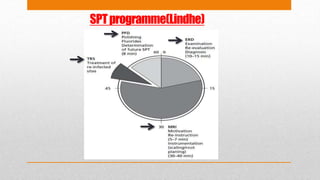
SPTprogramme(Lindhe)
Effectiveness of SPT
( for patients with Gingivitis )
• Axelsson and Lindhe (1974-1976): demonstrated that
gingivitis could be prevented by regular professional cleaningin
children aged 7 to 14 years.
• Axelsson and Lindhe (1981): reduced caries and BOP
• Badersten et al.(1990): Routine mechanical subgingival
debridement of shallow bleeding sites at SPT visits results in
attachment loss.
• Gingival conditions improved by 60% and tooth loss
was reduced by about 50% (Lovdal et al. 1961)
• The mean loss of probing attachment was only 0.08
mm per surface as opposed to 0.3 mm in the
control group (Suomi et al. 1971).
Effectiveness of SPT
(for patients with Periodontitis)
• Nyman et al. (1977) reported on 25 patients for 2 years (No SPT)
• Regular SPT at 3-4 times a year allows
disease monitoring
• Early detection and Rx
Nyman et al.
(1975)
Test
OHI and SPT
2 weeks
Control
OHI and SPT
6 months
• Dahlen et al. (1992) Professionally delivered supragingival
toothcleaning, in combination with self-performed plaque
control for 2-year period effectively change the quantity and the
composition of the subgingival microbiota
• Hellstrom et al. (1996) same protocol has a significant effect
on the subgingival microbiota of moderate to deep periodontal
pockets clinically.
• (Lindhe & Nyman 1984)
• 75 patients with extremely advanced periodontitis,
• recurrent infection occurred in only very few sites during a
14‐year period of effective SPT.
• recurrent periodontitis was noted at completely unpredictable
time intervals, in about 25% of the patient population (15 of 61)
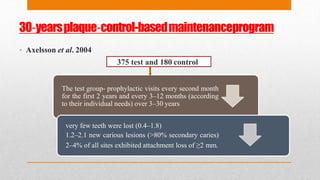
30‐yearsplaque‐control-basedmaintenanceprogram
• Axelsson et al. 2004
375 test and 180 control
The test group- prophylactic visits every second month
for the first 2 years and every 3–12 months (according
to their individual needs) over 3–30 years
very few teeth were lost (0.4–1.8)
1.2–2.1 new carious lesions (>80% secondary caries)
2–4% of all sites exhibited attachment loss of ≥2 mm.
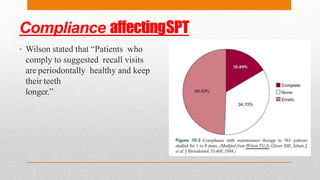
Compliance affectingSPT
• Wilson stated that “Patients who
comply to suggested recall visits
are periodontally healthy and keep
their teeth
longer.”
Improvingcompliance
• Wilson suggests:
• Counselling them about their condition,
the role of treatment and the importance of compliance
• Simplify instructions to patients
• Teach them self performed plaque control
• Acccommodating patient needs
• Positive reinforcement
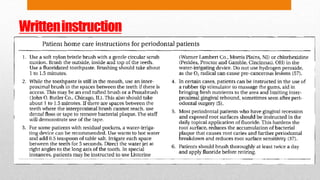
Writteninstruction
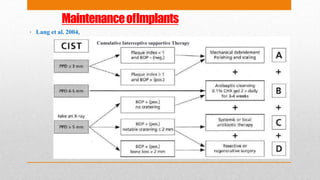
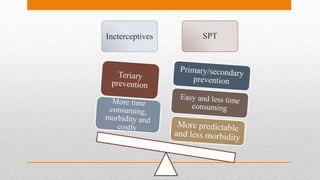
MaintenanceofImplants
• Lang et al. 2004,
Cumulative Interceptive supportive Therapy
Maintenance intervals for implant patients
1. Patients with both teeth and implants should see the
periodontist as often as necessary to keep the
periodontium and peri-implant tissues healthy.
2. Totally edentulous patients with implants should be
seen at least once per year.
Conclusion and recommendations
• SPT should be based on profile of risk assessment
• No scientific evidence for subgingival debridement of sites with BOP
without concomitant increase in pocket depth. (it should better be avoided)
• SPT minimizes the risk of periodontal disease progression and tooth
mortality
• In absence of long-term evaluation of SPT for dentalimplants, same
principles of SPT that is used for periodontitis is also apropriate
Recommendation for research
• Studies are needed:
1. to evaluate the efficacy of supragingival Rx alone as
compared to subgingival debridement
2. To assess the value of antibiotics as adjunct and stand alone
Rx during SPT
3. Patient based factors must be considered in analysis
4. Prospective and multicenter studies to findout efficacy of SPT
Incterceptives SPT
Refrences:
• American Academy of Periodontology. Glossary of Periodontal Terms. 4th ed.
Chicago: American Academy of Periodontology; 2001. p. 39.
• Kerry GJ. Supportive periodontal treatment. Periodontology 2000, vol. 9, 1995, 176-185.
• Renvert S. Supportive periodontal therapy. Periodontology 2000, vol. 36, 2004,
179–195.
• Hancock EB. Preventive strategies and supportive treatment. Periodontology 2000, vol. 25,
2001, 59–76.
• Wilson TG Jr. Supportive periodontal treatment introduction - definition, extent of need,
therapeutic objectives, frequency and efficacv. Periodontology 2000, vol. 12, 1996, 11-15.
• Slots J. Microbial analysis in supportive periodontal treatment. Periodontology 2000. Voz. 12,
1996, 56-59.
• Farooqi AO. Appropriate recall interval for periodontal maintenance:A
systematic review. J evid base dent pract 2015;15:171-181.
Spt ppt

Spt ppt

  • 1.
  • 2.
    Definition • Procedures performedat selected intervals to assist the periodontal patient in maintaining oral health. -GPT 2001. • Therapeutic measures to support the patient’s own efforts to control and to avoid re‐infection. - Jan Lindhe.
  • 3.
  • 4.
    Rationalefor SPT 1. Limitationof mechanical subgingival debridement 2. Recolonization of pocket 3. Long JE (weak attachment) 4. Subgingival scaling alters the microflora of periodontal pockets 5. To prevent interception
  • 5.
    GoalsOf SPT • 3main goals according to the AAP position paper (1998) 1. To prevent or minimize the recurrence and progression of periodontal disease in patients who have been previously treated for gingivitis, periodontitis and for peri-implantitis.
  • 6.
    GoalsOfSPT 2. To preventor reduce the incidence of tooth loss by monitoring the dentition 3. To locate and treat other diseases or conditions found in the oral cavity in a timely manner
  • 7.
    Objectivesof SPT General • Assessmentof the general health status • Encouragement of patients oral hygiene efforts • Continuation of patient education • Establishment of the future maintenance regime Periodontal • Preservation of bone support • Maintenance of stable CAL. • Reinforcement of proper home care. • Maintenance of a healthy and functional oral environment
  • 8.
    Types ofSPT •Schallhorn and Snider (1981) 1. Preventive maintenance therapy • Periodontally healthy individuals. 2. Trial maintenance therapy • Mild to moderate periodontitis 3. Compromised maintenance therapy • Medically compromised patients where active therapy is not possible. 4. Post-maintenance treatment therapy • maintenance for prevention of recurrence of disease
  • 9.
    Maintenance Program(Carranza) SPT 1. Examinationand Evaluation (14 mins.) 2. Maintenance Rx and oral hygiene reinforcement (36 mins.) 3. Report, Cleanup, and Scheduling (10 mins.)
  • 10.
    Part- 1: Examinationand Evaluation • Patient greeting • Medical history changes • Oral hygiene status • Gingival changes • Pocket depth changes • Mobility changes • Occlusal changes • Dental caries • Oral pathologic examination • Restorative, prosthetic, and implant status Examination of prosthesis/abutment components; Evaluation of implant stability; Occlusal examination; Other signs and symptoms of disease activity.
  • 11.
    RadiographicExaminationofRecallPatients Clinical caries andno high-risk factors for caries. Posterior bite-wing examination at 24 to 36-month intervals. Clinical caries or high-risk factors for caries Posterior bite-wing examination at 12 to 18-month intervals. History of periodontal treatment with disease under good control. Bite-wing examination every 24 to 36 months; full- mouth series every 5 years. Periodontal disease not under good control. Periapical and/or vertical bite-wing radiographs of problem areas every 12 to 24 months; full-mouth series every 3 to 5 years Root form dental implants Periapical or vertical bite-wing radiographs at 6, 12, and 36 months after prosthetic placement, then every 36 months unless clinical problems arise.
  • 12.
  • 13.
    Part-2: Maintenance treatmentand Oral hygienereinforcement • Oral hygiene reinforcement • Scaling • Polishing • Chemical irrigation or site-specific antimicrobial placement
  • 14.
    Part-3:Report,Cleanup, and Scheduling •Write report in chart. • Discuss report with patient. • Clean and disinfect operatory. • Schedule next recall visit. • Schedule further periodontal treatment. • Schedule or refer for restorative or prosthetic treatment.
  • 15.
    Frequency ofSPT • Ramfjordet al. (1993) For most patients with gingivitis but no previous attachment loss, supportive periodontal treatment twice a year. • For patients with a previous history of periodontitis, 3 months interval (less than 6 months) • Various clinical trails suggest- four times a year.
  • 16.
  • 17.
  • 19.
  • 20.
    Effectiveness of SPT (for patients with Gingivitis ) • Axelsson and Lindhe (1974-1976): demonstrated that gingivitis could be prevented by regular professional cleaningin children aged 7 to 14 years. • Axelsson and Lindhe (1981): reduced caries and BOP • Badersten et al.(1990): Routine mechanical subgingival debridement of shallow bleeding sites at SPT visits results in attachment loss.
  • 21.
    • Gingival conditionsimproved by 60% and tooth loss was reduced by about 50% (Lovdal et al. 1961) • The mean loss of probing attachment was only 0.08 mm per surface as opposed to 0.3 mm in the control group (Suomi et al. 1971).
  • 22.
    Effectiveness of SPT (forpatients with Periodontitis) • Nyman et al. (1977) reported on 25 patients for 2 years (No SPT) • Regular SPT at 3-4 times a year allows disease monitoring • Early detection and Rx Nyman et al. (1975) Test OHI and SPT 2 weeks Control OHI and SPT 6 months
  • 23.
    • Dahlen etal. (1992) Professionally delivered supragingival toothcleaning, in combination with self-performed plaque control for 2-year period effectively change the quantity and the composition of the subgingival microbiota • Hellstrom et al. (1996) same protocol has a significant effect on the subgingival microbiota of moderate to deep periodontal pockets clinically.
  • 24.
    • (Lindhe &Nyman 1984) • 75 patients with extremely advanced periodontitis, • recurrent infection occurred in only very few sites during a 14‐year period of effective SPT. • recurrent periodontitis was noted at completely unpredictable time intervals, in about 25% of the patient population (15 of 61)
  • 25.
    30‐yearsplaque‐control-basedmaintenanceprogram • Axelsson etal. 2004 375 test and 180 control The test group- prophylactic visits every second month for the first 2 years and every 3–12 months (according to their individual needs) over 3–30 years very few teeth were lost (0.4–1.8) 1.2–2.1 new carious lesions (>80% secondary caries) 2–4% of all sites exhibited attachment loss of ≥2 mm.
  • 26.
    Compliance affectingSPT • Wilsonstated that “Patients who comply to suggested recall visits are periodontally healthy and keep their teeth longer.”
  • 27.
    Improvingcompliance • Wilson suggests: •Counselling them about their condition, the role of treatment and the importance of compliance • Simplify instructions to patients • Teach them self performed plaque control • Acccommodating patient needs • Positive reinforcement
  • 28.
  • 29.
    MaintenanceofImplants • Lang etal. 2004, Cumulative Interceptive supportive Therapy
  • 30.
    Maintenance intervals forimplant patients 1. Patients with both teeth and implants should see the periodontist as often as necessary to keep the periodontium and peri-implant tissues healthy. 2. Totally edentulous patients with implants should be seen at least once per year.
  • 31.
    Conclusion and recommendations •SPT should be based on profile of risk assessment • No scientific evidence for subgingival debridement of sites with BOP without concomitant increase in pocket depth. (it should better be avoided) • SPT minimizes the risk of periodontal disease progression and tooth mortality • In absence of long-term evaluation of SPT for dentalimplants, same principles of SPT that is used for periodontitis is also apropriate
  • 32.
    Recommendation for research •Studies are needed: 1. to evaluate the efficacy of supragingival Rx alone as compared to subgingival debridement 2. To assess the value of antibiotics as adjunct and stand alone Rx during SPT 3. Patient based factors must be considered in analysis 4. Prospective and multicenter studies to findout efficacy of SPT
  • 33.
  • 34.
    Refrences: • American Academyof Periodontology. Glossary of Periodontal Terms. 4th ed. Chicago: American Academy of Periodontology; 2001. p. 39. • Kerry GJ. Supportive periodontal treatment. Periodontology 2000, vol. 9, 1995, 176-185. • Renvert S. Supportive periodontal therapy. Periodontology 2000, vol. 36, 2004, 179–195. • Hancock EB. Preventive strategies and supportive treatment. Periodontology 2000, vol. 25, 2001, 59–76. • Wilson TG Jr. Supportive periodontal treatment introduction - definition, extent of need, therapeutic objectives, frequency and efficacv. Periodontology 2000, vol. 12, 1996, 11-15. • Slots J. Microbial analysis in supportive periodontal treatment. Periodontology 2000. Voz. 12, 1996, 56-59. • Farooqi AO. Appropriate recall interval for periodontal maintenance:A systematic review. J evid base dent pract 2015;15:171-181.