Supply Chain
Management
5 Principles for Success
Prepared by:
John Hansen
MBA565 Supply Chain Management
Robert Loss
Concordia University
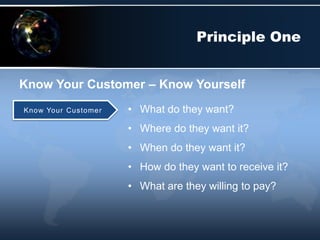
• What do they want?
• Where do they want it?
• When do they want it?
• How do they want to receive it?
• What are they willing to pay?
Know Your Customer – Know Yourself
Principle One
Know Your Customer
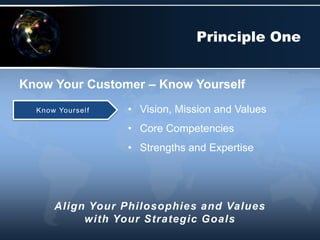
• Vision, Mission and Values
• Core Competencies
• Strengths and Expertise
Know Your Customer – Know Yourself
Principle One
Know Yourself
Align Your Philosophies and Values
with Your Strategic Goals
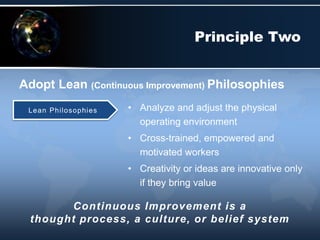
• Analyze and adjust the physical
operating environment
• Cross-trained, empowered and
motivated workers
• Creativity or ideas are innovative only
if they bring value
Adopt Lean (Continuous Improvement) Philosophies
Principle Two
Lean Philosophies
Continuous Improvement is a
thought process, a culture, or belief system
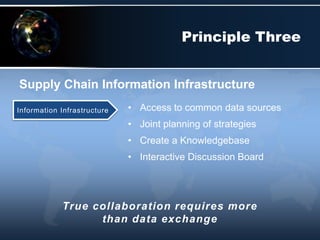
• Access to common data sources
• Joint planning of strategies
• Create a Knowledgebase
• Interactive Discussion Board
Supply Chain Information Infrastructure
Principle Three
Information Infrastructure
True collaboration requires more
than data exchange
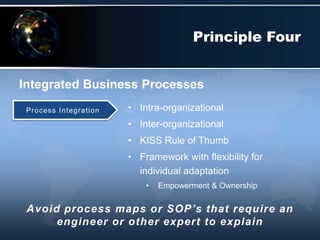
• Intra-organizational
• Inter-organizational
• KISS Rule of Thumb
• Framework with flexibility for
individual adaptation
• Empowerment & Ownership
Integrated Business Processes
Principle Four
Process Integration
Avoid process maps or SOP’s that require an
engineer or other expert to explain
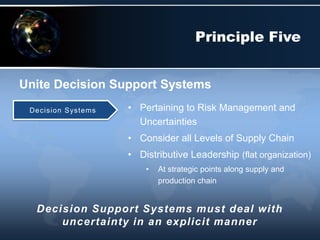
• Pertaining to Risk Management and
Uncertainties
• Consider all Levels of Supply Chain
• Distributive Leadership (flat organization)
• At strategic points along supply and
production chain
Unite Decision Support Systems
Principle Five
Decision Systems
Decision Support Systems must deal with
uncertainty in an explicit manner
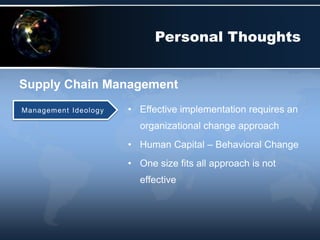
• Effective implementation requires an
organizational change approach
• Human Capital – Behavioral Change
• One size fits all approach is not
effective
Supply Chain Management
Personal Thoughts
Management Ideology

Successful Implementation of Supply Chain Management System

  • 1.
    Supply Chain Management 5 Principlesfor Success Prepared by: John Hansen MBA565 Supply Chain Management Robert Loss Concordia University
  • 2.
    • What dothey want? • Where do they want it? • When do they want it? • How do they want to receive it? • What are they willing to pay? Know Your Customer – Know Yourself Principle One Know Your Customer
  • 3.
    • Vision, Missionand Values • Core Competencies • Strengths and Expertise Know Your Customer – Know Yourself Principle One Know Yourself Align Your Philosophies and Values with Your Strategic Goals
  • 4.
    • Analyze andadjust the physical operating environment • Cross-trained, empowered and motivated workers • Creativity or ideas are innovative only if they bring value Adopt Lean (Continuous Improvement) Philosophies Principle Two Lean Philosophies Continuous Improvement is a thought process, a culture, or belief system
  • 5.
    • Access tocommon data sources • Joint planning of strategies • Create a Knowledgebase • Interactive Discussion Board Supply Chain Information Infrastructure Principle Three Information Infrastructure True collaboration requires more than data exchange
  • 6.
    • Intra-organizational • Inter-organizational •KISS Rule of Thumb • Framework with flexibility for individual adaptation • Empowerment & Ownership Integrated Business Processes Principle Four Process Integration Avoid process maps or SOP’s that require an engineer or other expert to explain
  • 7.
    • Pertaining toRisk Management and Uncertainties • Consider all Levels of Supply Chain • Distributive Leadership (flat organization) • At strategic points along supply and production chain Unite Decision Support Systems Principle Five Decision Systems Decision Support Systems must deal with uncertainty in an explicit manner
  • 8.
    • Effective implementationrequires an organizational change approach • Human Capital – Behavioral Change • One size fits all approach is not effective Supply Chain Management Personal Thoughts Management Ideology