1. Introduction to supply chain management
What is supply chain ?
It consists of all parties involved directly or
indirectly in fulfilling a customers request
Define supply chain
“a supply chain is a network of facilities &
distribution options that performs the functions
of procurement of materials transformation of
these materials into intermediate & finished
products & distribution of these finished products
to customers
Meaning of supply chain management
Definition of SCM:
It is the management of a network of all
business processes and activities involving
procurement of raw materials, manufacturing
and distribution management of Finished
Goods.
SCM is also called the art of management of
providing the Right Product, At the Right
Time, Right Place and at the Right Cost to the
Customer.
Other definition of SCM
• Oliver and Webber (1982) – SCM covers the
flow of goods from supplier through
manufacturing and distribution channels to
end user.
• Ayers (2000) – SCM is the design, maintenance
and operation of supply chain processes for
satisfaction of end users.
• Ellram (1991) – An integrative approach to
dealing with the planning and control of the
materials flow from suppliers to end users.
• Sunil Chopra and Peter Meindl (2001) – SCM
involves the management of flows between and
among stages in a supply chain to maximize
total profitability.
Objectives of supply chain
Efficient supply chain
1. To maximize overall value generated
2. To look for Sources of Revenue and Cost
3. Improving the visibility of the demand
4. Improving the quality
5. Minimizing the time
6. Reduces the transportation cost
7. Reduces warehousing cost
8. Expanding width/depth of distribution
9. Product Life cycle support
10. Rationalize supplier base
11. Service orientation
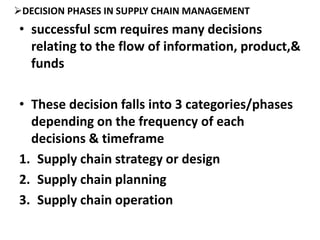
DECISION PHASES IN SUPPLY CHAIN MANAGEMENT
• successful scm requires many decisions
relating to the flow of information, product,&
funds
• These decision falls into 3 categories/phases
depending on the frequency of each
decisions & timeframe
1. Supply chain strategy or design
2. Supply chain planning
3. Supply chain operation
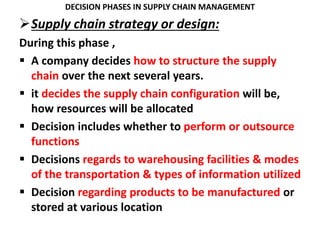
DECISION PHASES IN SUPPLY CHAIN MANAGEMENT
Supply chain strategy or design:
During this phase ,
 A company decides how to structure the supply
chain over the next several years.
 it decides the supply chain configuration will be,
how resources will be allocated
 Decision includes whether to perform or outsource
functions
 Decisions regards to warehousing facilities & modes
of the transportation & types of information utilized
 Decision regarding products to be manufactured or
stored at various location
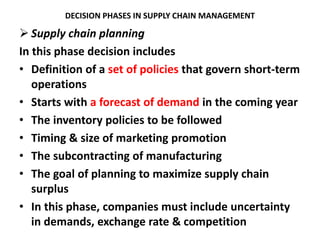
DECISION PHASES IN SUPPLY CHAIN MANAGEMENT
 Supply chain planning
In this phase decision includes
• Definition of a set of policies that govern short-term
operations
• Starts with a forecast of demand in the coming year
• The inventory policies to be followed
• Timing & size of marketing promotion
• The subcontracting of manufacturing
• The goal of planning to maximize supply chain
surplus
• In this phase, companies must include uncertainty
in demands, exchange rate & competition
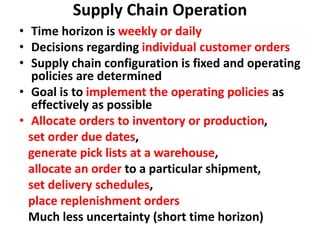
Supply Chain Operation
• Time horizon is weekly or daily
• Decisions regarding individual customer orders
• Supply chain configuration is fixed and operating
policies are determined
• Goal is to implement the operating policies as
effectively as possible
• Allocate orders to inventory or production,
set order due dates,
generate pick lists at a warehouse,
allocate an order to a particular shipment,
set delivery schedules,
place replenishment orders
Much less uncertainty (short time horizon)
Process view of supply chain
• Cycle view:
processes in a supply chain are divided into a
series of cycles, each performed at the
interfaces between two successive supply chain
stages
• Push/pull view:
processes in a supply chain are divided into two
categories depending on whether they are
executed
in response to a customer order (pull)
or
in anticipation of a customer order (push)
1-10
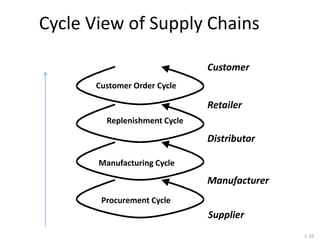
Cycle View of Supply Chains
Customer Order Cycle
Replenishment Cycle
Manufacturing Cycle
Procurement Cycle
Customer
Retailer
Distributor
Manufacturer
Supplier
1-11
Cycle View of a Supply Chain
• Each cycle occurs at the interface between two
successive stages
• Customer order cycle (customer-retailer)
• Replenishment cycle (retailer-distributor)
• Manufacturing cycle (distributor-manufacturer)
• Procurement cycle (manufacturer-supplier)
• Cycle view clearly defines processes involved and the
owners of each process. Specifies the roles and
responsibilities of each member and the desired
outcome of each process.
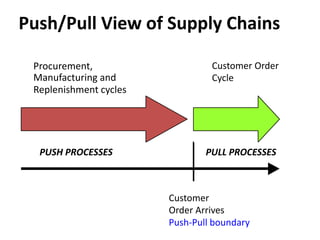
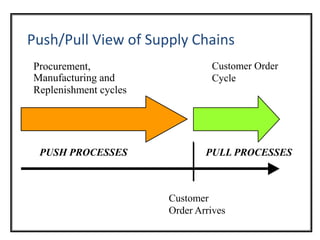
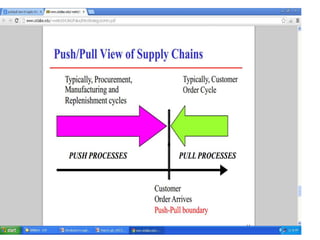
Push/Pull View of Supply Chains
Procurement,
Manufacturing and
Replenishment cycles
Customer Order
Cycle
Customer
Order Arrives
Push-Pull boundary
PUSH PROCESSES PULL PROCESSES
Push/Pull View of
Supply Chain Processes
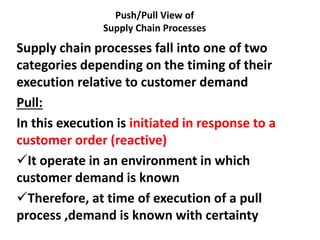
Supply chain processes fall into one of two
categories depending on the timing of their
execution relative to customer demand
Pull:
In this execution is initiated in response to a
customer order (reactive)
It operate in an environment in which
customer demand is known
Therefore, at time of execution of a pull
process ,demand is known with certainty
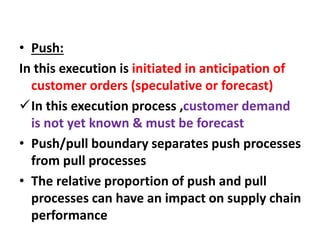
• Push:
In this execution is initiated in anticipation of
customer orders (speculative or forecast)
In this execution process ,customer demand
is not yet known & must be forecast
• Push/pull boundary separates push processes
from pull processes
• The relative proportion of push and pull
processes can have an impact on supply chain
performance
Push/Pull View of Supply Chains
Procurement,
Manufacturing and
Replenishment cycles
Customer Order
Cycle
Customer
Order Arrives
PUSH PROCESSES PULL PROCESSES
Supply Chain Management [SCM]
Customer Order
Cycle
Repl & Mfrg
Cycle
Procurement
Cycle
PUSH
Process
PULL
Process
LL Bean
Cust Order & Mfrg
Cycle
Procurement
Cycle
PUSH
Process
PULL
Process
DELL
Customer order arrives
Process View of a Supply Chain: Push – Pull View
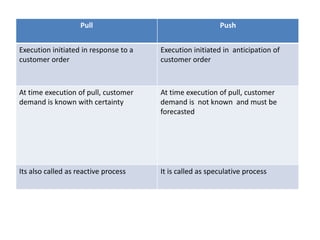
Pull Push
Execution initiated in response to a
customer order
Execution initiated in anticipation of
customer order
At time execution of pull, customer
demand is known with certainty
At time execution of pull, customer
demand is not known and must be
forecasted
Its also called as reactive process It is called as speculative process
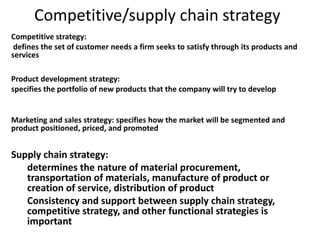
Competitive/supply chain strategy
Competitive strategy:
defines the set of customer needs a firm seeks to satisfy through its products and
services
Product development strategy:
specifies the portfolio of new products that the company will try to develop
Marketing and sales strategy: specifies how the market will be segmented and
product positioned, priced, and promoted
Supply chain strategy:
determines the nature of material procurement,
transportation of materials, manufacture of product or
creation of service, distribution of product
Consistency and support between supply chain strategy,
competitive strategy, and other functional strategies is
important
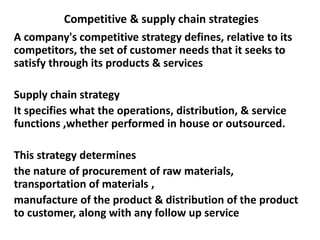
Competitive & supply chain strategies
A company's competitive strategy defines, relative to its
competitors, the set of customer needs that it seeks to
satisfy through its products & services
Supply chain strategy
It specifies what the operations, distribution, & service
functions ,whether performed in house or outsourced.
This strategy determines
the nature of procurement of raw materials,
transportation of materials ,
manufacture of the product & distribution of the product
to customer, along with any follow up service
Achieving strategic fit
• Introduction
• How is strategic fit achieved?
• Other issues affecting strategic fit
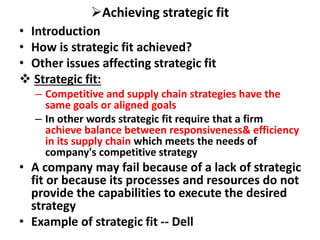
 Strategic fit:
– Competitive and supply chain strategies have the
same goals or aligned goals
– In other words strategic fit require that a firm
achieve balance between responsiveness& efficiency
in its supply chain which meets the needs of
company's competitive strategy
• A company may fail because of a lack of strategic
fit or because its processes and resources do not
provide the capabilities to execute the desired
strategy
• Example of strategic fit -- Dell
How is Strategic Fit Achieved?
• Step 1: Understanding the
customer and supply chain
uncertainty
• Step 2: Understanding the supply
chain
• Step 3: Achieving strategic fit
How is Strategic Fit Achieved?
Step 1: Understanding the Customer and
Supply Chain Uncertainty
Identify the needs of the customer segment
being served
Quantity of product needed in each lot
Response time customers will tolerate
Variety of products needed
Service level required
Price of the product
Desired rate of innovation in the product
Demand uncertainty & Implied Demand
Uncertainty
Demand uncertainty reflects the
uncertainty of customer demand for
product.
Implied demand uncertainty is the demand
uncertainty due to the portion of demand
that supply chain is targeting ,not the entire
demand
Impact of Customer Needs on Implied Demand Uncertainty
2-25
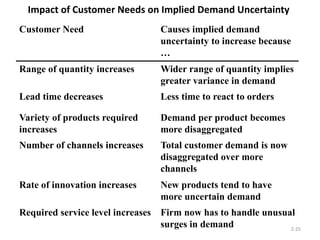
Customer Need Causes implied demand
uncertainty to increase because
…
Range of quantity increases Wider range of quantity implies
greater variance in demand
Lead time decreases Less time to react to orders
Variety of products required
increases
Demand per product becomes
more disaggregated
Number of channels increases Total customer demand is now
disaggregated over more
channels
Rate of innovation increases New products tend to have
more uncertain demand
Required service level increases Firm now has to handle unusual
surges in demand
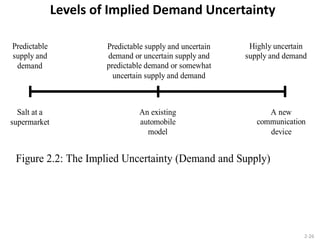
Levels of Implied Demand Uncertainty
2-26
Predictable
supply and
demand
Salt at a
supermarket
A new
communication
device
Highly uncertain
supply and demand
Figure 2.2: The Implied Uncertainty (Demand and Supply)
Spectrum
Predictable supply and uncertain
demand or uncertain supply and
predictable demand or somewhat
uncertain supply and demand
An existing
automobile
model
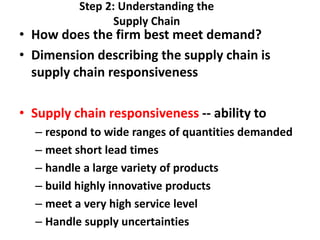
Step 2: Understanding the
Supply Chain
• How does the firm best meet demand?
• Dimension describing the supply chain is
supply chain responsiveness
• Supply chain responsiveness -- ability to
– respond to wide ranges of quantities demanded
– meet short lead times
– handle a large variety of products
– build highly innovative products
– meet a very high service level
– Handle supply uncertainties
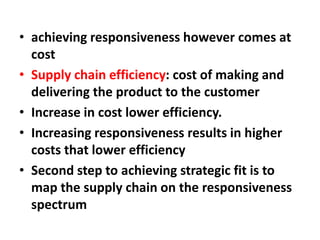
• achieving responsiveness however comes at
cost
• Supply chain efficiency: cost of making and
delivering the product to the customer
• Increase in cost lower efficiency.
• Increasing responsiveness results in higher
costs that lower efficiency
• Second step to achieving strategic fit is to
map the supply chain on the responsiveness
spectrum
2-29
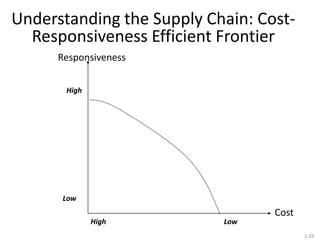
Understanding the Supply Chain: Cost-
Responsiveness Efficient Frontier
High Low
Low
High
Responsiveness
Cost
Step 3:achieving strategic fit
After mapping level of implied uncertainty &
understanding supply chain position on
responsiveness spectrum,
The third & final step is to ensure that the
degree of supply chain responsiveness is
consistent with implied uncertainty,
The goal is to target high responsiveness for
a supply chain facing high implied uncertainty,
&
high efficiency for a supply chain facing low
implied uncertainty
2-31
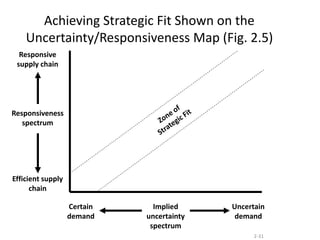
Achieving Strategic Fit Shown on the
Uncertainty/Responsiveness Map (Fig. 2.5)
Implied
uncertainty
spectrum
Responsive
supply chain
Efficient supply
chain
Certain
demand
Uncertain
demand
Responsiveness
spectrum
2-32
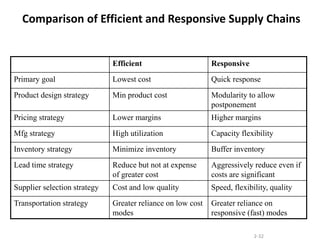
Comparison of Efficient and Responsive Supply Chains
Efficient Responsive
Primary goal Lowest cost Quick response
Product design strategy Min product cost Modularity to allow
postponement
Pricing strategy Lower margins Higher margins
Mfg strategy High utilization Capacity flexibility
Inventory strategy Minimize inventory Buffer inventory
Lead time strategy Reduce but not at expense
of greater cost
Aggressively reduce even if
costs are significant
Supplier selection strategy Cost and low quality Speed, flexibility, quality
Transportation strategy Greater reliance on low cost
modes
Greater reliance on
responsive (fast) modes
Other Issues Affecting Strategic Fit
Multiple products and customer segments
Product life cycle
Competitive changes over time
2-34
Multiple Products and
Customer Segments
• Firms sell different products to different
customer segments (with different implied
demand uncertainty)
• The supply chain has to be able to balance
efficiency and responsiveness given its
portfolio of products and customer segments
• Two approaches:
– Different supply chains
– Tailor supply chain to best meet the needs of
each product’s demand
2-35
Product Life Cycle
• The demand characteristics of a product and
the needs of a customer segment change as a
product goes through its life cycle
• Supply chain strategy must evolve throughout
the life cycle
• Early: uncertain demand, high margins (time
is important), product availability is most
important, cost is secondary
• Late: predictable demand, lower margins,
price is important
2-36
Competitive Changes Over Time
• Competitive pressures can change over time
• More competitors may result in an increased
emphasis on variety at a reasonable price
• The Internet makes it easier to offer a wide
variety of products
• The supply chain must change to meet these
changing competitive conditions
3-373-37
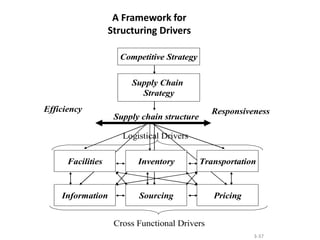
A Framework for
Structuring Drivers
Competitive Strategy
Supply Chain
Strategy
Efficiency Responsiveness
Facilities Inventory Transportation
Information
Supply chain structure
Cross Functional Drivers
Sourcing Pricing
Logistical Drivers
3-38
Drivers of Supply Chain Performance
• Facilities
– places where inventory is stored, assembled, or fabricated
– production sites and storage sites
• Inventory
– raw materials, WIP, finished goods within a supply chain
– inventory policies
• Transportation
– moving inventory from point to point in a supply chain
– combinations of transportation modes and routes
• Information
– data and analysis regarding inventory, transportation, facilities throughout the
supply chain
– potentially the biggest driver of supply chain performance
• Sourcing
– functions a firm performs and functions that are outsourced
• Pricing
– Price associated with goods and services provided by a firm to the supply chain

Introductiontosupplychainmanagement

  • 1.
    1. Introduction tosupply chain management What is supply chain ? It consists of all parties involved directly or indirectly in fulfilling a customers request Define supply chain “a supply chain is a network of facilities & distribution options that performs the functions of procurement of materials transformation of these materials into intermediate & finished products & distribution of these finished products to customers
  • 2.
    Meaning of supplychain management Definition of SCM: It is the management of a network of all business processes and activities involving procurement of raw materials, manufacturing and distribution management of Finished Goods. SCM is also called the art of management of providing the Right Product, At the Right Time, Right Place and at the Right Cost to the Customer.
  • 3.
    Other definition ofSCM • Oliver and Webber (1982) – SCM covers the flow of goods from supplier through manufacturing and distribution channels to end user. • Ayers (2000) – SCM is the design, maintenance and operation of supply chain processes for satisfaction of end users. • Ellram (1991) – An integrative approach to dealing with the planning and control of the materials flow from suppliers to end users. • Sunil Chopra and Peter Meindl (2001) – SCM involves the management of flows between and among stages in a supply chain to maximize total profitability.
  • 4.
    Objectives of supplychain Efficient supply chain 1. To maximize overall value generated 2. To look for Sources of Revenue and Cost 3. Improving the visibility of the demand 4. Improving the quality 5. Minimizing the time 6. Reduces the transportation cost 7. Reduces warehousing cost 8. Expanding width/depth of distribution 9. Product Life cycle support 10. Rationalize supplier base 11. Service orientation
  • 5.
    DECISION PHASES INSUPPLY CHAIN MANAGEMENT • successful scm requires many decisions relating to the flow of information, product,& funds • These decision falls into 3 categories/phases depending on the frequency of each decisions & timeframe 1. Supply chain strategy or design 2. Supply chain planning 3. Supply chain operation
  • 6.
    DECISION PHASES INSUPPLY CHAIN MANAGEMENT Supply chain strategy or design: During this phase ,  A company decides how to structure the supply chain over the next several years.  it decides the supply chain configuration will be, how resources will be allocated  Decision includes whether to perform or outsource functions  Decisions regards to warehousing facilities & modes of the transportation & types of information utilized  Decision regarding products to be manufactured or stored at various location
  • 7.
    DECISION PHASES INSUPPLY CHAIN MANAGEMENT  Supply chain planning In this phase decision includes • Definition of a set of policies that govern short-term operations • Starts with a forecast of demand in the coming year • The inventory policies to be followed • Timing & size of marketing promotion • The subcontracting of manufacturing • The goal of planning to maximize supply chain surplus • In this phase, companies must include uncertainty in demands, exchange rate & competition
  • 8.
    Supply Chain Operation •Time horizon is weekly or daily • Decisions regarding individual customer orders • Supply chain configuration is fixed and operating policies are determined • Goal is to implement the operating policies as effectively as possible • Allocate orders to inventory or production, set order due dates, generate pick lists at a warehouse, allocate an order to a particular shipment, set delivery schedules, place replenishment orders Much less uncertainty (short time horizon)
  • 9.
    Process view ofsupply chain • Cycle view: processes in a supply chain are divided into a series of cycles, each performed at the interfaces between two successive supply chain stages • Push/pull view: processes in a supply chain are divided into two categories depending on whether they are executed in response to a customer order (pull) or in anticipation of a customer order (push)
  • 10.
    1-10 Cycle View ofSupply Chains Customer Order Cycle Replenishment Cycle Manufacturing Cycle Procurement Cycle Customer Retailer Distributor Manufacturer Supplier
  • 11.
    1-11 Cycle View ofa Supply Chain • Each cycle occurs at the interface between two successive stages • Customer order cycle (customer-retailer) • Replenishment cycle (retailer-distributor) • Manufacturing cycle (distributor-manufacturer) • Procurement cycle (manufacturer-supplier) • Cycle view clearly defines processes involved and the owners of each process. Specifies the roles and responsibilities of each member and the desired outcome of each process.
  • 12.
    Push/Pull View ofSupply Chains Procurement, Manufacturing and Replenishment cycles Customer Order Cycle Customer Order Arrives Push-Pull boundary PUSH PROCESSES PULL PROCESSES
  • 13.
    Push/Pull View of SupplyChain Processes Supply chain processes fall into one of two categories depending on the timing of their execution relative to customer demand Pull: In this execution is initiated in response to a customer order (reactive) It operate in an environment in which customer demand is known Therefore, at time of execution of a pull process ,demand is known with certainty
  • 14.
    • Push: In thisexecution is initiated in anticipation of customer orders (speculative or forecast) In this execution process ,customer demand is not yet known & must be forecast • Push/pull boundary separates push processes from pull processes • The relative proportion of push and pull processes can have an impact on supply chain performance
  • 15.
    Push/Pull View ofSupply Chains Procurement, Manufacturing and Replenishment cycles Customer Order Cycle Customer Order Arrives PUSH PROCESSES PULL PROCESSES
  • 17.
    Supply Chain Management[SCM] Customer Order Cycle Repl & Mfrg Cycle Procurement Cycle PUSH Process PULL Process LL Bean Cust Order & Mfrg Cycle Procurement Cycle PUSH Process PULL Process DELL Customer order arrives Customer order arrives Process View of a Supply Chain: Push – Pull View
  • 18.
    Pull Push Execution initiatedin response to a customer order Execution initiated in anticipation of customer order At time execution of pull, customer demand is known with certainty At time execution of pull, customer demand is not known and must be forecasted Its also called as reactive process It is called as speculative process
  • 19.
    Competitive/supply chain strategy Competitivestrategy: defines the set of customer needs a firm seeks to satisfy through its products and services Product development strategy: specifies the portfolio of new products that the company will try to develop Marketing and sales strategy: specifies how the market will be segmented and product positioned, priced, and promoted Supply chain strategy: determines the nature of material procurement, transportation of materials, manufacture of product or creation of service, distribution of product Consistency and support between supply chain strategy, competitive strategy, and other functional strategies is important
  • 20.
    Competitive & supplychain strategies A company's competitive strategy defines, relative to its competitors, the set of customer needs that it seeks to satisfy through its products & services Supply chain strategy It specifies what the operations, distribution, & service functions ,whether performed in house or outsourced. This strategy determines the nature of procurement of raw materials, transportation of materials , manufacture of the product & distribution of the product to customer, along with any follow up service
  • 21.
    Achieving strategic fit •Introduction • How is strategic fit achieved? • Other issues affecting strategic fit  Strategic fit: – Competitive and supply chain strategies have the same goals or aligned goals – In other words strategic fit require that a firm achieve balance between responsiveness& efficiency in its supply chain which meets the needs of company's competitive strategy • A company may fail because of a lack of strategic fit or because its processes and resources do not provide the capabilities to execute the desired strategy • Example of strategic fit -- Dell
  • 22.
    How is StrategicFit Achieved? • Step 1: Understanding the customer and supply chain uncertainty • Step 2: Understanding the supply chain • Step 3: Achieving strategic fit
  • 23.
    How is StrategicFit Achieved? Step 1: Understanding the Customer and Supply Chain Uncertainty Identify the needs of the customer segment being served Quantity of product needed in each lot Response time customers will tolerate Variety of products needed Service level required Price of the product Desired rate of innovation in the product
  • 24.
    Demand uncertainty &Implied Demand Uncertainty Demand uncertainty reflects the uncertainty of customer demand for product. Implied demand uncertainty is the demand uncertainty due to the portion of demand that supply chain is targeting ,not the entire demand
  • 25.
    Impact of CustomerNeeds on Implied Demand Uncertainty 2-25 Customer Need Causes implied demand uncertainty to increase because … Range of quantity increases Wider range of quantity implies greater variance in demand Lead time decreases Less time to react to orders Variety of products required increases Demand per product becomes more disaggregated Number of channels increases Total customer demand is now disaggregated over more channels Rate of innovation increases New products tend to have more uncertain demand Required service level increases Firm now has to handle unusual surges in demand
  • 26.
    Levels of ImpliedDemand Uncertainty 2-26 Predictable supply and demand Salt at a supermarket A new communication device Highly uncertain supply and demand Figure 2.2: The Implied Uncertainty (Demand and Supply) Spectrum Predictable supply and uncertain demand or uncertain supply and predictable demand or somewhat uncertain supply and demand An existing automobile model
  • 27.
    Step 2: Understandingthe Supply Chain • How does the firm best meet demand? • Dimension describing the supply chain is supply chain responsiveness • Supply chain responsiveness -- ability to – respond to wide ranges of quantities demanded – meet short lead times – handle a large variety of products – build highly innovative products – meet a very high service level – Handle supply uncertainties
  • 28.
    • achieving responsivenesshowever comes at cost • Supply chain efficiency: cost of making and delivering the product to the customer • Increase in cost lower efficiency. • Increasing responsiveness results in higher costs that lower efficiency • Second step to achieving strategic fit is to map the supply chain on the responsiveness spectrum
  • 29.
    2-29 Understanding the SupplyChain: Cost- Responsiveness Efficient Frontier High Low Low High Responsiveness Cost
  • 30.
    Step 3:achieving strategicfit After mapping level of implied uncertainty & understanding supply chain position on responsiveness spectrum, The third & final step is to ensure that the degree of supply chain responsiveness is consistent with implied uncertainty, The goal is to target high responsiveness for a supply chain facing high implied uncertainty, & high efficiency for a supply chain facing low implied uncertainty
  • 31.
    2-31 Achieving Strategic FitShown on the Uncertainty/Responsiveness Map (Fig. 2.5) Implied uncertainty spectrum Responsive supply chain Efficient supply chain Certain demand Uncertain demand Responsiveness spectrum
  • 32.
    2-32 Comparison of Efficientand Responsive Supply Chains Efficient Responsive Primary goal Lowest cost Quick response Product design strategy Min product cost Modularity to allow postponement Pricing strategy Lower margins Higher margins Mfg strategy High utilization Capacity flexibility Inventory strategy Minimize inventory Buffer inventory Lead time strategy Reduce but not at expense of greater cost Aggressively reduce even if costs are significant Supplier selection strategy Cost and low quality Speed, flexibility, quality Transportation strategy Greater reliance on low cost modes Greater reliance on responsive (fast) modes
  • 33.
    Other Issues AffectingStrategic Fit Multiple products and customer segments Product life cycle Competitive changes over time
  • 34.
    2-34 Multiple Products and CustomerSegments • Firms sell different products to different customer segments (with different implied demand uncertainty) • The supply chain has to be able to balance efficiency and responsiveness given its portfolio of products and customer segments • Two approaches: – Different supply chains – Tailor supply chain to best meet the needs of each product’s demand
  • 35.
    2-35 Product Life Cycle •The demand characteristics of a product and the needs of a customer segment change as a product goes through its life cycle • Supply chain strategy must evolve throughout the life cycle • Early: uncertain demand, high margins (time is important), product availability is most important, cost is secondary • Late: predictable demand, lower margins, price is important
  • 36.
    2-36 Competitive Changes OverTime • Competitive pressures can change over time • More competitors may result in an increased emphasis on variety at a reasonable price • The Internet makes it easier to offer a wide variety of products • The supply chain must change to meet these changing competitive conditions
  • 37.
    3-373-37 A Framework for StructuringDrivers Competitive Strategy Supply Chain Strategy Efficiency Responsiveness Facilities Inventory Transportation Information Supply chain structure Cross Functional Drivers Sourcing Pricing Logistical Drivers
  • 38.
    3-38 Drivers of SupplyChain Performance • Facilities – places where inventory is stored, assembled, or fabricated – production sites and storage sites • Inventory – raw materials, WIP, finished goods within a supply chain – inventory policies • Transportation – moving inventory from point to point in a supply chain – combinations of transportation modes and routes • Information – data and analysis regarding inventory, transportation, facilities throughout the supply chain – potentially the biggest driver of supply chain performance • Sourcing – functions a firm performs and functions that are outsourced • Pricing – Price associated with goods and services provided by a firm to the supply chain