The participant willbe able to :
• Understand what a supply chain is and what it does.
• Identify supply chain drivers and components
• Explore the difference between Logistics and SCM
• Get introduced to SCM process and process view
• Demonstrate Decision Phases in SCM
• Acknowledge SCM Performance Measurement
• Get introduced to E-business SCM
Objectives
A supply chainis an entire system of producing and
delivering a product or service, from the very beginning
stage of sourcing the raw materials to the final delivery
of the product or service to end-users.
It refers to the entire network of companies that work
together to design, produce, deliver, and service
product
5.
Effective Supply ChainManagement has Positive effect
on:
Why Supply Chain Management
?
Profit Quality Customer
Experience
Efficiency
Maximize overall value created
Components of theSupply Chain
• Producers or manufacturers are
organizations that make a product.
• This includes companies that are
producers of raw materials and
companies that are producers of
finished goods
8.
• Distributors arecompanies that
take inventory in bulk from
producers and deliver a bundle of
related product lines to
customers.
• Distributors are also known as
wholesalers.
Components of the Supply Chain
9.
• Retailers stockinventory and sell in
smaller quantities to the general
public.
• This organization also closely tracks
the preferences and demands of the
customers that it sells to.
Components of the Supply Chain
10.
• Any organizationthat purchases and
uses a product.
• A customer organization may
purchase a product in order to
incorporate it into another product
that they in turn sell to other
customers.
• A customer may be the final end
user of a product .
Components of the Supply Chain
11.
• It isa third-party organization that
assists in the management of legally-
compliant supply chain operations by
providing services such as logistics,
transportation, inventory control,
warehousing and purchasing.
Components of the Supply Chain
The capacityof a supply chain to make products.
The facilities of production are Factories and Warehouses.
The trade-off between Responsiveness and Efficiency.
The more excess capacity that exists, the less efficient the
operation becomes
Supply Chain Drivers
Production
What, how, and when
to produce
Inventory management,is the tracking of inventory from
manufacturers to warehouses and from these facilities to
a point of sale.
The goal of inventory management is to have the right
products in the right place at the right time.
Supply Chain Drivers
Supply Chain Drivers
Inventory
How much to make
and how much to store
Location refersto the geographical setting of supply chain
facilities.
The responsiveness versus efficiency trade-off :
Centralize activities in fewer locations to gain economies of
scale & efficiency.
Decentralize activities in many locations close to customers
and suppliers in order for operations to be more responsive.
Supply Chain Drivers
Location
Where best to do what
activity
20.
Factors to beconsidered:
Cost of facilities.
Cost of labor.
Skills available in the workforce.
Infrastructure conditions.
Taxes and tariffs.
Proximity to suppliers and customers.
Supply Chain Drivers
Location
Where best to do what
activity
• The movementof everything from raw material to finished
goods between different facilities in a supply chain.
• There are six basic modes of transport that a company can
choose from:
1. Ship
2. Rails
3. Pipelines
4. Trucks
5. Airplanes
6. Electronic Transport
Supply Chain Drivers
Transportation
How and when to
move product
The basisupon which to make decisions regarding the other four
supply chain drivers.
The connection between all of the activities and operations in a
supply chain.
Information is used for two purposes in any supply chain:
1.Coordinating daily activities related to the other four supply
chain drivers: production; inventory; location; and transportation.
2.Forecasting and planning to anticipate and meet future
demands.
Information
the basis for making
these decisions
Supply Chain
Drivers
25.
Transportation
How and whento
move product
Location
Where best to do what
activity
Production
What, how, and when
to produce
Inventory
How much to make
and how much to store
Information
the basis for
making these
decisions
Supply Chain
Drivers
26.
SCM vs. Logistics
Bothare concerned with efficient and effective management of
physical flows, and matching supply & demand
SCM
Logistics
- Cost & + Customer
services
Scope
Decision
Level
Objective
Within a firm
Minimizing logistics cost
Entire supply chain
Tactical Strategic
27.
Product flow Cashflow
Down stream Up stream
Information flow
The Supply Chain Flow
•Material:
Product, Parts
•Information:
Capacity, DeliverySchedules
•Cash:
Finance, Invoices, Credit Teams
Down
Stream
Up
Stream
•Material:
Returns, repairs, after-sale services
•Information:
Orders, point-of-sale Data
•Cash:
Payments
There are 3 kinds of Flows in a supply Chain:
Material, Information and Cash
Activity
Instructions:
1. Trainees areto be divided into 5 groups.
2. Each group will be assigned a phase of supply chain management.
3. Each group will explain phase they worked on with examples.
4. Duration: 10 minutes for preparation.
2 minutes for presentation for each group
33.
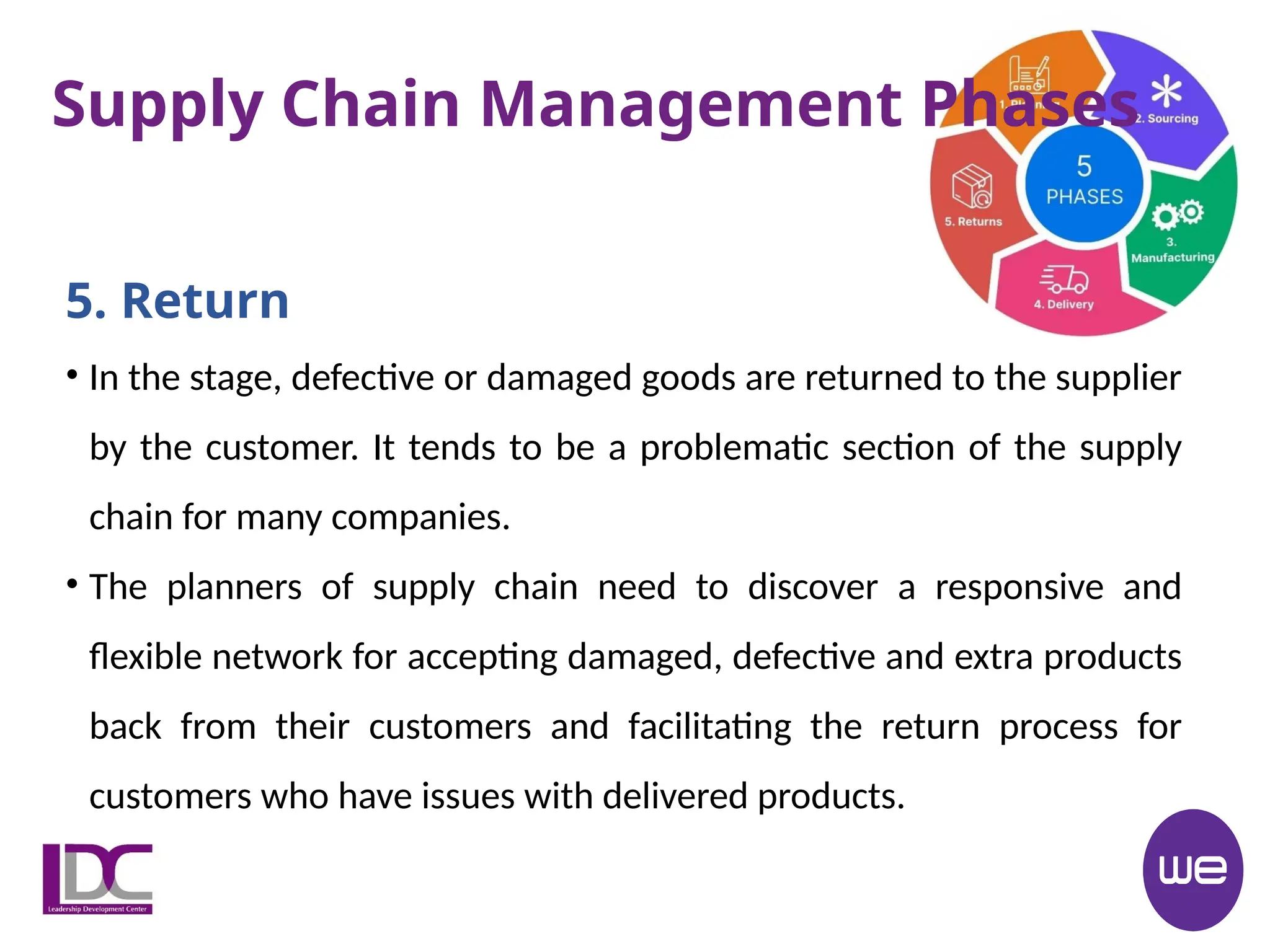
1. Planning
• Thisstage mainly focuses on designing a strategy that yields
maximum profit.
• Its aim is to set a strategy to manage all the resources required
for designing products and providing services.
• It focuses on developing a set of metrics.
Supply Chain Management Phases
34.
2. Sourcing (Developing)
•It mainly concentrates on building a strong relationship with
suppliers of the raw materials required for production.
• Prices, delivery and payment processes with suppliers are set
and the metrics for controlling and improving the relationships
are created.
• Goods and services inventory systems are set in this stage.
Supply Chain Management Phases
35.
3. Manufacturing (Making)
•In this stage, the products are designed, produced, tested,
packaged, and synchronized for delivery.
• The task is to schedule all the activities required for
manufacturing, testing, packaging and preparation for delivery.
• This stage is considered as the most metric-intensive unit of the
supply chain, where firms can test the quality levels,
production output and worker productivity.
Supply Chain Management Phases
36.
4. Deliver
• Herethe products are delivered to the customer at the
destined location by the supplier.
• In this stage firms collaborate for the receipt of orders from
customers, establish a network of inventories, pick carriers to
deliver products to customers and set up an invoicing system to
receive payments.
Supply Chain Management Phases
37.
5. Return
• Inthe stage, defective or damaged goods are returned to the supplier
by the customer. It tends to be a problematic section of the supply
chain for many companies.
• The planners of supply chain need to discover a responsive and
flexible network for accepting damaged, defective and extra products
back from their customers and facilitating the return process for
customers who have issues with delivered products.
Supply Chain Management Phases
38.
Process view ofSCM
There are 2 different view to the
process performed in a supply chain
• Cycle View
• Push / Pull View
39.
2. Manufacturer
4. Retailer
1.Supplier
5. Customer
3. Distributer
Customer Order Cycle
• Customer Arrival
• Order Entry
• Order fulfillment
• Order Receiving
Replenishment Cycle
1. Retail order Trigger
2. Order Entry
3. Order fulfillment
4. Receiving
Manufacturing Cycle
1. Order Arrival
2. Production Scheduling
3. Manufacturing/ Shipping
4. Receiving
Procurement Cycle
1. Selecting suppliers
2. Negotiating contracts
3. Placing orders
4. Receiving Material
1. Cycle view
Here, the transition
between each stage
is known as a cycle.
40.
In a Pushsupply chain strategy:
The order is executed according to
the anticipation of the orders of the
customers.
In the Pull supply chain strategy:
the order is implemented
according to the demand of the
customers.
2. Push/Pull View of supply chain
SCM - Performance
Measures
•Non-financial Measures:
Cycle- time (lead–time):
SC Lead-time – order-to-delivery
Customer Service level:
Order Fill Rate – Stockout Rate – Back Order Level
Inventory Level:
Raw Material – Work-in-Process – Finished goods – Spare Parts
Resources Utilization:
Manufacturing – Storage – Logistics – Human – Financial)
45.
SCM - Performance
Measures
•Financial Measures
Inventory holding costs.
Transportation costs.
Cost of raw materials and revenue from goods sold.
Activity-based costs like the material handling, manufacturing,
assembling rates etc.
Cost of expired perishable goods.
Penalties for incorrectly filled or late orders delivered to
customers.
Cost of goods returned by customers.
Credits for goods returned to suppliers.
46.
E-commerce Supply Chain
Digitalsupply chains are dynamic and able to adapt quickly to changing
circumstances. They function in real-time and are highly agile “value
networks” with integrated systems and processes.
Editor's Notes
#5 Effective Supply Chain Management drives Profits, Quality, and Efficiency in any business.
Profit Driver: Modern-day supply chain management identifies scope for automation, applies AI to predict demand and supply, and optimizes inventory movement to ensure the promised inventory is available and delivered reliably to the customer, be it an internal customer or an external customer.
Quality and Customer Experience Driver: Effective Supply Chain Management keeps the quality of product, reliability of delivery, and efficiency of operations at its heart. Today’s supply chains produce 50 times more data than the networks 5 years ago. Making use of this data to improve product quality, source from reliable suppliers, identify developing risks at the supplier end, manage risk to avoid disruptions, etc. are key responsibilities of supply chain management professionals today. This is vastly different from the earlier expectations of cost management and inventory keeping.
Efficiency Driver: Ever since Henry Ford commercialized the assembly line, and ever since globalisations swept across supply chains and transformed systems from being vertically integrated to being interconnected with third parties, efficiency has been at the forefront of business expectations from supply chains. AI, automation, robotics, and other such technologies are pushing supply chain management into its new era.
#12 Economies of scale apply to a variety of organizational and business situations and at various levels, such as a business or manufacturing unit, plant or an entire enterprise. For example, a large manufacturing facility would be expected to have a lower cost per unit of output than a smaller facility, all other factors being equal, while a company with many facilities should have a cost advantage over a competitor with fewer.
#13 Economies of scale apply to a variety of organizational and business situations and at various levels, such as a business or manufacturing unit, plant or an entire enterprise. For example, a large manufacturing facility would be expected to have a lower cost per unit of output than a smaller facility, all other factors being equal, while a company with many facilities should have a cost advantage over a competitor with fewer.
#14 If factories and warehouses are built with a lot of excess capacity, they can be very flexible and respond quickly to wide swings in product demand. Facilities where all or almost all capacity is being used are not capable of responding easily to fluctuations in demand. On the other hand, capacity costs money and excess capacity is idle capacity not in use and not generating revenue.
Business efficiency refers to maximizing the time, effort and resources you put into your functional departments. Efficient operations take fewer resources to deliver similar or increased results, reducing costs and maximizing the return on the investment you make into your organization.
Business effectiveness refers to the quality of the results you see from resource investments into functional departments.
#15 Economies of scale apply to a variety of organizational and business situations and at various levels, such as a business or manufacturing unit, plant or an entire enterprise. For example, a large manufacturing facility would be expected to have a lower cost per unit of output than a smaller facility, all other factors being equal, while a company with many facilities should have a cost advantage over a competitor with fewer.
#16 inventory
أ. قائمة الجرد, موجودات مخزون, جرد السلع, جرد, عملية الجرد
includes everything from raw material to work in process to finished goods that are held by the manufacturers, distributors, and retailers in a supply chain.
Holding large amounts of inventory allows a company or an entire supply chain to be very responsive to fluctuations in customer demand. However, the creation and storage of inventory is a cost and
#18 Economies of scale apply to a variety of organizational and business situations and at various levels, such as a business or manufacturing unit, plant or an entire enterprise. For example, a large manufacturing facility would be expected to have a lower cost per unit of output than a smaller facility, all other factors being equal, while a company with many facilities should have a cost advantage over a competitor with fewer.
#19 الاقتصاد المتدرج
Location decisions tend to be very strategic decisions because they commit large amounts of money to long-term plans.
#20 الاقتصاد المتدرج
Location decisions tend to be very strategic decisions because they commit large amounts of money to long-term plans.
#21 Economies of scale apply to a variety of organizational and business situations and at various levels, such as a business or manufacturing unit, plant or an entire enterprise. For example, a large manufacturing facility would be expected to have a lower cost per unit of output than a smaller facility, all other factors being equal, while a company with many facilities should have a cost advantage over a competitor with fewer.
#23 Economies of scale apply to a variety of organizational and business situations and at various levels, such as a business or manufacturing unit, plant or an entire enterprise. For example, a large manufacturing facility would be expected to have a lower cost per unit of output than a smaller facility, all other factors being equal, while a company with many facilities should have a cost advantage over a competitor with fewer.
#24 Available information is used to make tactical forecasts to guide the setting of monthly and quarterly production schedules and timetables. Information is also used for strategic forecasts to guide decisions about whether to build new facilities, enter a new market, or exit an existing market.
#34 After planning, the next step involves developing or sourcing. In this stage, we mainly concentrate on building a strong relationship with suppliers of the raw materials required for production. This involves not only identifying dependable suppliers but also determining different planning methods for shipping, delivery, and payment of the product.
Companies need to select suppliers to deliver the items and services they require to develop their product. So in this stage, the supply chain managers need to construct a set of pricing, delivery and payment processes with suppliers and also create the metrics for controlling and improving the relationships.
Finally, the supply chain managers can combine all these processes for handling their goods and services inventory. This handling comprises receiving and examining shipments, transferring them to the manufacturing facilities and authorizing supplier payments.
#40 Like producing winter clothing around the end of summer, predicting customers will need them soon as the winter is coming.
Like: Customized gifts are the basic and best example of this. They make a product only after the order is placed.
#46 1. Supplier
The supplier procures the raw materials needed to create the products, and delivers them to a factory or manufacturing plant for assembly. In some cases, the products themselves may be assembled already, and have no need for further fabrication processes.
Either way, these materials or products that are brought into the business are called inbound goods, and they will soon head towards the e-commerce warehouse.
2. Warehouse
As the second step of the e-commerce logistics process, the warehouse is where inventory is stored and managed until the time comes for them to reach their new owners: your customers!
Keeping track of inventory plays a significant role at this stage. Inventory management software can be used to enhance visibility into your stock in the warehouse, such as how much goods you have, where they’re located, and when to re-stock.
3. Fulfillment center
Once a purchase has been made on your e-commerce store, congratulations! The products purchased then move from the warehouse to the fulfillment center, one step down the line of your supply chain, closer to your hopeful customers.
A fulfillment center is where your goods are packaged and shipped, though in some cases the warehouse can serve as a fulfillment center as well.
4. Carrier
The carrier in the form of a courier service such as FedEx, DHL or UPS then takes your package for delivery to the final destination.
While you can handle e-commerce packaging internally, these courier services usually offer different packaging options you can choose from to keep your products safe and secure throughout the journey of e-commerce transit to your customers.
5. Customer
Customers are the last actor involved in the e-commerce supply chain.
Under normal circumstances, customers receive your products, enjoy them, and both of you end up satisfied.
However, you must still prepare for the possibility that purchasers will return your products for whatever reason (defects, issues, and sometimes even e-commerce fraud).
Reverse logistics — the process by which the purchased goods are returned to the seller — is therefore something that should be taken into account as well.