Supply Chain Risk Management
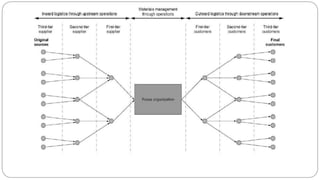
1- Overview on End to End Supply Chain Management
 Since the 1980s the term ‘supply chain management’ (SCM) has
been used increasingly by people who argue that ‘logistics’ does not
give a broad enough feel for the subject.
 Their feeling is that logistics is a somewhat narrower subject,
concerned with movements within a single organization, while supply
chain management takes a broader view of movement through all the
related organizations that form the supply chain.
 supply chain management described as a ‘holistic management
approach to integrating and co-ordinating the material, information
and financial flows along a supply chain’.
Definitions
Logistics - Logistics is that part
of the Supply Chain process
that plans, implements, and
controls the efficient, effective
forward and reverse flow and
storage of goods, services, and
related information between the
point of origin and the point of
consumption in order to meet
Customers' Requirements.
(CLM)
Supply Chain Management -
the systemic, strategic
coordination of the traditional
business functions and the
tactics across these business
functions within a particular
company and across businesses
within the supply chain for the
purposes of improving the long-
term performance of the
individual companies and the
supply chain as a whole. (2001)
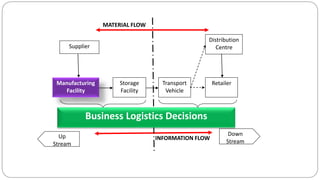
Production Planning &
Control Decisions
Supplier
Manufacturing
Facility
Storage
Facility
Transport
Vehicle
Retailer
Distribution
Centre
Distribution and Logistics
Decisions
INFORMATION FLOW
Down
Stream
Up
Stream
MATERIAL FLOW
Business Logistics Decisions
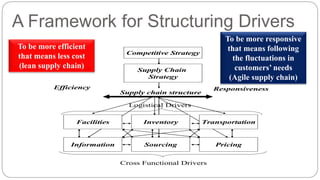
A Framework for Structuring Drivers
Competitive Strategy
Supply Chain
Strategy
Efficiency Responsiveness
Facilities Inventory Transportation
Information
Supply chain structure
Cross Functional Drivers
Sourcing Pricing
Logistical Drivers
To be more efficient
that means less cost
(lean supply chain)
To be more responsive
that means following
the fluctuations in
customers’ needs
(Agile supply chain)
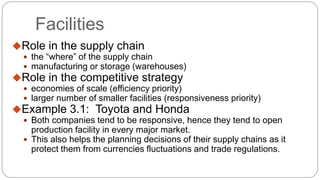
Facilities
Role in the supply chain
 the “where” of the supply chain
 manufacturing or storage (warehouses)
Role in the competitive strategy
 economies of scale (efficiency priority)
 larger number of smaller facilities (responsiveness priority)
Example 3.1: Toyota and Honda
 Both companies tend to be responsive, hence they tend to open
production facility in every major market.
 This also helps the planning decisions of their supply chains as it
protect them from currencies fluctuations and trade regulations.
Components of Facilities Decisions
Location
 centralization (efficiency) vs. decentralization
(responsiveness)
 other factors to consider (e.g., proximity to customers)
Capacity (flexibility versus efficiency)
Inventory: Role in Competitive
Strategy
 If responsiveness is a strategic competitive priority, a
firm can locate larger amounts of inventory closer to
customers
 If cost is more important, inventory can be reduced
to make the firm more efficient
Components of Inventory
Decisions
 Cycle inventory
 Average amount of inventory used to satisfy demand between shipments
 Depends on lot size
 Safety inventory
 inventory held in case demand exceeds expectations
 costs of carrying too much inventory versus cost of losing sales
 Seasonal inventory
 inventory built up to counter predictable variability in demand
 cost of carrying additional inventory versus cost of flexible production
 Overall trade-off: Responsiveness versus efficiency
 more inventory: greater responsiveness but greater cost
 less inventory: lower cost but lower responsiveness
Transportation: Role in the Supply
Chain
 Moves the product between stages in the supply
chain
 Impact on responsiveness and efficiency
 Faster transportation allows greater responsiveness
but lower efficiency
 Also affects inventory and facilities
Transportation: Role in the Competitive
Strategy
 If responsiveness is a strategic competitive priority,
then faster transportation modes can provide greater
responsiveness to customers who are willing to pay
for it
 Can also use slower transportation modes for
customers whose priority is price (cost)
 Can also consider both inventory and transportation
to find the right balance
 Example 3.3: Laura Ashley & FedEx.
Components of Transportation
Decisions
Mode of transportation:
 air, truck, rail, ship, pipeline, electronic
transportation
 vary in cost, speed, size of shipment, flexibility
Route and network selection
 route: path along which a product is shipped
 network: collection of locations and routes.
14-14
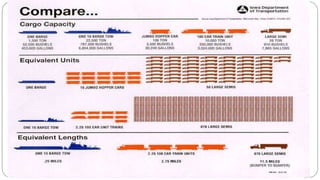
Transportation Modes
1. Trucks
TL
LTL
2. Rail
3. Air
4. Package Carriers (it is not really a mode of
transport)
5. Water
6. Pipeline
Information: Role in the Supply
Chain
 The connection between the various stages in the
supply chain – allows coordination between
stages
 Crucial to daily operation of each stage in a
supply chain – e.g., production scheduling,
inventory levels
Information:
Role in the Competitive Strategy
 Allows supply chain to become more efficient and
more responsive at the same time.
 What information is most valuable?
 Example: Dell
Components of Information
Decisions
 Push versus pull (demand information transmitted quickly
throughout the supply chain)
 Coordination and information sharing
 Forecasting and aggregate planning
 Enabling technologies
 EDI
 Internet
 ERP systems
 Supply Chain Management software
 RFID (Radio Frequency Identification.
Sourcing: Role in the Supply
Chain
 Set of business processes required to purchase
goods and services in a supply chain
 Supplier selection and evaluation, single vs.
multiple suppliers, contract negotiation
Sourcing:
Role in the Competitive Strategy
 Sourcing decisions are crucial because they
affect the level of efficiency and responsiveness
in a supply chain
 In-house vs. outsource decisions- improving
efficiency and responsiveness
 Example 3.6: Cisco
Components of Sourcing
Decisions
 In-house versus outsource decisions
 Supplier evaluation and selection
 Procurement process
 Overall trade-off: Increase the supply chain profits
Pricing: Role in the Supply Chain
 Pricing determines the amount to charge
customers in a supply chain
 Pricing strategies can be used to eliminate supply
surplus or decrease seasonal demand spikes.
Pricing:
Role in the Competitive Strategy
 Firms can utilize optimal pricing strategies to
improve efficiency and responsiveness
 Low price and low product availability; vary prices
by response times
 Example 3.7: Amazon (shipping pricing).
Components of Pricing Decisions
Pricing and economies of scale
 Quantity discounts.
 Single delivery place.
Everyday low pricing versus high-low pricing
 No change overtime.
Fixed price versus menu pricing (Amazon.com
Shipping pricing).
25
Supply Chain Collaboration
(Strategic Alliances)
 Quick Response:
◦ Vendors receive POS data from retailers, and use this
information to synchronize production and inventory
activities at the supplier.
◦ The retailer still prepares individual orders, but the POS
data is used by the supplier to improve forecasting and
scheduling.
◦ Example: Milliken and Company: The lead time from
order receipt at Milliken’s textile plants to final clothing
receipt at several of the department stores involved was
reduced from eighteen weeks down to three weeks.
Strategic Partnering: Types of RSP
 Continuous Replenishment: Vendors receive
POS data and use it prepare shipments at
previously agreed upon intervals to maintain
agreed to levels of inventory.
◦ Wal-Mart, Kmart
 Advanced Continuous Replenishment:
Suppliers may gradually decrease inventory
levels at the retailer’s store or distribution center
as long as service levels are met. Inventory
levels are thus continuously improved in a
structured way.
◦ Kmart
Strategic Partnering: Types of SP
 Vendor Managed Inventory (VMI):JITD
 VMI Projects at Dillard Department Stores, J.C.
Penney, and Wal-Mart have shown sales increases
of 20 to 25 percent, and 30 percent inventory
turnover improvements.
Strategic Partnering: Types of SP
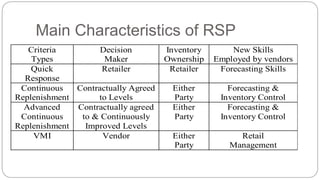
Criteria
Types
Decision
Maker
Inventory
Ownership
New Skills
Employed by vendors
Quick
Response
Retailer Retailer Forecasting Skills
Continuous
Replenishment
Contractually Agreed
to Levels
Either
Party
Forecasting &
Inventory Control
Advanced
Continuous
Replenishment
Contractually agreed
to & Continuously
Improved Levels
Either
Party
Forecasting &
Inventory Control
VMI Vendor Either
Party
Retail
Management
Main Characteristics of RSP
 Parts are shared across the distributor network
 Specialized service requests are steered to
appropriate dealers or distributors.
 What is required?
◦ Trust
◦ Guarantees from the manufacturer
◦ Advanced information systems
 Disadvantages
◦ Incentives for dealers – are they giving away competitive
advantages?
◦ Skills and responsibilities are taken from some
dealers/distributors.
 Examples - Caterpillar, Okuma
Distributor Integration

Supply Chain Risk Management

  • 1.
  • 2.
    1- Overview onEnd to End Supply Chain Management  Since the 1980s the term ‘supply chain management’ (SCM) has been used increasingly by people who argue that ‘logistics’ does not give a broad enough feel for the subject.  Their feeling is that logistics is a somewhat narrower subject, concerned with movements within a single organization, while supply chain management takes a broader view of movement through all the related organizations that form the supply chain.  supply chain management described as a ‘holistic management approach to integrating and co-ordinating the material, information and financial flows along a supply chain’.
  • 3.
    Definitions Logistics - Logisticsis that part of the Supply Chain process that plans, implements, and controls the efficient, effective forward and reverse flow and storage of goods, services, and related information between the point of origin and the point of consumption in order to meet Customers' Requirements. (CLM) Supply Chain Management - the systemic, strategic coordination of the traditional business functions and the tactics across these business functions within a particular company and across businesses within the supply chain for the purposes of improving the long- term performance of the individual companies and the supply chain as a whole. (2001)
  • 5.
    Production Planning & ControlDecisions Supplier Manufacturing Facility Storage Facility Transport Vehicle Retailer Distribution Centre Distribution and Logistics Decisions INFORMATION FLOW Down Stream Up Stream MATERIAL FLOW Business Logistics Decisions
  • 6.
    A Framework forStructuring Drivers Competitive Strategy Supply Chain Strategy Efficiency Responsiveness Facilities Inventory Transportation Information Supply chain structure Cross Functional Drivers Sourcing Pricing Logistical Drivers To be more efficient that means less cost (lean supply chain) To be more responsive that means following the fluctuations in customers’ needs (Agile supply chain)
  • 7.
    Facilities Role in thesupply chain  the “where” of the supply chain  manufacturing or storage (warehouses) Role in the competitive strategy  economies of scale (efficiency priority)  larger number of smaller facilities (responsiveness priority) Example 3.1: Toyota and Honda  Both companies tend to be responsive, hence they tend to open production facility in every major market.  This also helps the planning decisions of their supply chains as it protect them from currencies fluctuations and trade regulations.
  • 8.
    Components of FacilitiesDecisions Location  centralization (efficiency) vs. decentralization (responsiveness)  other factors to consider (e.g., proximity to customers) Capacity (flexibility versus efficiency)
  • 9.
    Inventory: Role inCompetitive Strategy  If responsiveness is a strategic competitive priority, a firm can locate larger amounts of inventory closer to customers  If cost is more important, inventory can be reduced to make the firm more efficient
  • 10.
    Components of Inventory Decisions Cycle inventory  Average amount of inventory used to satisfy demand between shipments  Depends on lot size  Safety inventory  inventory held in case demand exceeds expectations  costs of carrying too much inventory versus cost of losing sales  Seasonal inventory  inventory built up to counter predictable variability in demand  cost of carrying additional inventory versus cost of flexible production  Overall trade-off: Responsiveness versus efficiency  more inventory: greater responsiveness but greater cost  less inventory: lower cost but lower responsiveness
  • 11.
    Transportation: Role inthe Supply Chain  Moves the product between stages in the supply chain  Impact on responsiveness and efficiency  Faster transportation allows greater responsiveness but lower efficiency  Also affects inventory and facilities
  • 12.
    Transportation: Role inthe Competitive Strategy  If responsiveness is a strategic competitive priority, then faster transportation modes can provide greater responsiveness to customers who are willing to pay for it  Can also use slower transportation modes for customers whose priority is price (cost)  Can also consider both inventory and transportation to find the right balance  Example 3.3: Laura Ashley & FedEx.
  • 13.
    Components of Transportation Decisions Modeof transportation:  air, truck, rail, ship, pipeline, electronic transportation  vary in cost, speed, size of shipment, flexibility Route and network selection  route: path along which a product is shipped  network: collection of locations and routes.
  • 14.
    14-14 Transportation Modes 1. Trucks TL LTL 2.Rail 3. Air 4. Package Carriers (it is not really a mode of transport) 5. Water 6. Pipeline
  • 16.
    Information: Role inthe Supply Chain  The connection between the various stages in the supply chain – allows coordination between stages  Crucial to daily operation of each stage in a supply chain – e.g., production scheduling, inventory levels
  • 17.
    Information: Role in theCompetitive Strategy  Allows supply chain to become more efficient and more responsive at the same time.  What information is most valuable?  Example: Dell
  • 18.
    Components of Information Decisions Push versus pull (demand information transmitted quickly throughout the supply chain)  Coordination and information sharing  Forecasting and aggregate planning  Enabling technologies  EDI  Internet  ERP systems  Supply Chain Management software  RFID (Radio Frequency Identification.
  • 19.
    Sourcing: Role inthe Supply Chain  Set of business processes required to purchase goods and services in a supply chain  Supplier selection and evaluation, single vs. multiple suppliers, contract negotiation
  • 20.
    Sourcing: Role in theCompetitive Strategy  Sourcing decisions are crucial because they affect the level of efficiency and responsiveness in a supply chain  In-house vs. outsource decisions- improving efficiency and responsiveness  Example 3.6: Cisco
  • 21.
    Components of Sourcing Decisions In-house versus outsource decisions  Supplier evaluation and selection  Procurement process  Overall trade-off: Increase the supply chain profits
  • 22.
    Pricing: Role inthe Supply Chain  Pricing determines the amount to charge customers in a supply chain  Pricing strategies can be used to eliminate supply surplus or decrease seasonal demand spikes.
  • 23.
    Pricing: Role in theCompetitive Strategy  Firms can utilize optimal pricing strategies to improve efficiency and responsiveness  Low price and low product availability; vary prices by response times  Example 3.7: Amazon (shipping pricing).
  • 24.
    Components of PricingDecisions Pricing and economies of scale  Quantity discounts.  Single delivery place. Everyday low pricing versus high-low pricing  No change overtime. Fixed price versus menu pricing (Amazon.com Shipping pricing).
  • 25.
  • 26.
     Quick Response: ◦Vendors receive POS data from retailers, and use this information to synchronize production and inventory activities at the supplier. ◦ The retailer still prepares individual orders, but the POS data is used by the supplier to improve forecasting and scheduling. ◦ Example: Milliken and Company: The lead time from order receipt at Milliken’s textile plants to final clothing receipt at several of the department stores involved was reduced from eighteen weeks down to three weeks. Strategic Partnering: Types of RSP
  • 27.
     Continuous Replenishment:Vendors receive POS data and use it prepare shipments at previously agreed upon intervals to maintain agreed to levels of inventory. ◦ Wal-Mart, Kmart  Advanced Continuous Replenishment: Suppliers may gradually decrease inventory levels at the retailer’s store or distribution center as long as service levels are met. Inventory levels are thus continuously improved in a structured way. ◦ Kmart Strategic Partnering: Types of SP
  • 28.
     Vendor ManagedInventory (VMI):JITD  VMI Projects at Dillard Department Stores, J.C. Penney, and Wal-Mart have shown sales increases of 20 to 25 percent, and 30 percent inventory turnover improvements. Strategic Partnering: Types of SP
  • 29.
    Criteria Types Decision Maker Inventory Ownership New Skills Employed byvendors Quick Response Retailer Retailer Forecasting Skills Continuous Replenishment Contractually Agreed to Levels Either Party Forecasting & Inventory Control Advanced Continuous Replenishment Contractually agreed to & Continuously Improved Levels Either Party Forecasting & Inventory Control VMI Vendor Either Party Retail Management Main Characteristics of RSP
  • 30.
     Parts areshared across the distributor network  Specialized service requests are steered to appropriate dealers or distributors.  What is required? ◦ Trust ◦ Guarantees from the manufacturer ◦ Advanced information systems  Disadvantages ◦ Incentives for dealers – are they giving away competitive advantages? ◦ Skills and responsibilities are taken from some dealers/distributors.  Examples - Caterpillar, Okuma Distributor Integration