Supply Chain Management 1-
What is a Supply Chain? All stages involved, directly or indirectly, in fulfilling a customer request Includes manufacturers, suppliers, transporters, warehouses, retailers, and customers It includes all functions involved in receiving and fillin a customer request. Product development, Marketing, Operations, Distribution, Finance, Customer service) Includes movement of products, information, and funds in both directions 1-
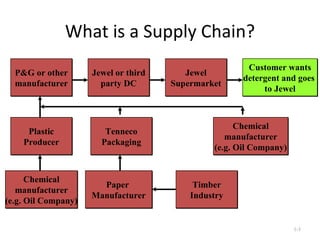
What is a Supply Chain? 1- Customer wants detergent and goes  to Jewel Jewel Supermarket Jewel or third party DC P&G or other manufacturer Plastic Producer Chemical manufacturer (e.g. Oil Company) Tenneco Packaging Paper  Manufacturer Timber Industry Chemical manufacturer (e.g. Oil Company)
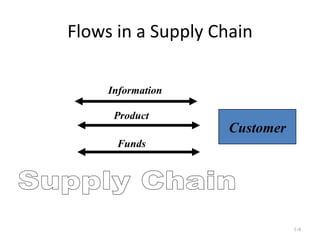
Flows in a Supply Chain 1- Customer Information Product Funds Supply Chain
The Objective of a Supply Chain Maximize overall SC value created Supply chain value =Final Product Value – Total Supply Chain Cost { Supply chain value  is strongly correlated with supply chain profitability.  } 1-
Decision Phases of a Supply Chain 1-
Supply Chain Strategy or Design Structure of the supply chain  Strategic supply chain decisions Locations and capacities of facilities Products to be made or stored at various locations Modes of transportation Information systems Supply chain design must support strategic objectives SC design decisions are long-term and expensive to reverse 1-
Supply Chain Planning A set of policies that govern short-term operations Fixed by the SC design Starts with a forecast of demand for the coming year 1-
Supply Chain Planning Planning decisions: Which markets will be supplied from which locations Planned buildup of inventories Subcontracting, backup locations Inventory policies Timing and size of market promotions Must consider demand uncertainty, exchange rates, competition over the time horizon 1-
Supply Chain Operation Time horizon is weekly or daily Decisions about individual customer orders Configuration is fixed and operating policies are determined Goal is to implement the operating policies as effectively as possible Allocate orders to inventory or production, set order due dates, generate pick lists at a warehouse, allocate an order to a particular shipment, set delivery schedules, place replenishment orders Much less uncertainty (short time horizon) 1-
Process View of a Supply Chain Cycle view Push/pull view 1-
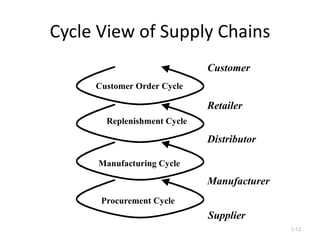
Cycle View of Supply Chains 1- Customer Order Cycle Replenishment Cycle Manufacturing Cycle Procurement Cycle Customer Retailer Distributor Manufacturer Supplier
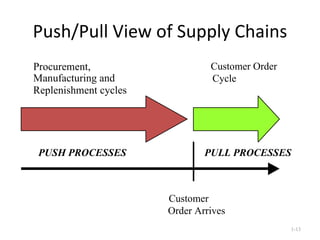
Push/Pull View of Supply Chains 1- Procurement, Manufacturing and Replenishment cycles Customer Order Cycle Customer Order Arrives PUSH PROCESSES PULL PROCESSES
Supply Chain Macro Processes in a Firm  Supply chain processes can be classified into (Figure 1.8): Customer Relationship Management (CRM) Internal Supply Chain Management (ISCM) Supplier Relationship Management (SRM) Integration among the above three macro processes is critical for effective and successful supply chain management 1-
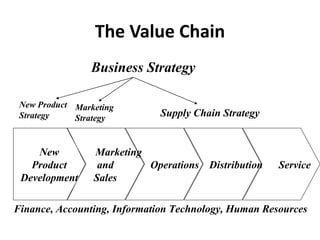
The Value Chain New Product Development Marketing and Sales Operations Distribution Service Finance, Accounting, Information Technology, Human Resources Business Strategy New Product Strategy Marketing Strategy Supply Chain Strategy
Competitive & Supply Chain Strategies Competitive strategy: defines the target market/customer needs. Product Development strategy: portfolio of new products to achieve competitive strategy.  Marketing and sales strategy: specifies how the market will be segmented and product positioned, priced, and promoted Supply chain strategy:  determines the nature of material procurement, transportation of materials, manufacture of product or creation of service, distribution of product Consistency and support between supply chain strategy, competitive strategy, and other functional strategies is important
Step 1:  Understanding the Customer and Supply Chain Uncertainty Identify the needs of the customer segment being served Quantity of product needed in each lot Response time customers will tolerate Variety of products needed Service level required Price of the product Desired rate of innovation in the product
Customers demand products with different characteristics  –  Cost    Customization  Quantity Quality Speed Service Flexibility Features 1-
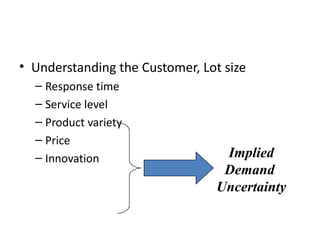
Understanding the Customer, Lot size Response time Service level Product variety Price Innovation Implied Demand  Uncertainty
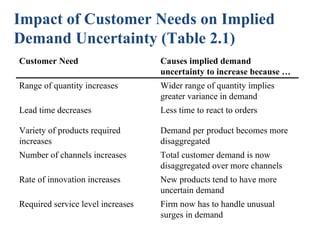
Impact of Customer Needs on Implied Demand Uncertainty (Table 2.1) Customer Need Causes implied demand uncertainty to increase because … Range of quantity increases Wider range of quantity implies greater variance in demand Lead time decreases Less time to react to orders Variety of products required increases Demand per product becomes more disaggregated Number of channels increases Total customer demand is now disaggregated over more channels Rate of innovation increases New products tend to have more uncertain demand Required service level increases Firm now has to handle unusual surges in demand
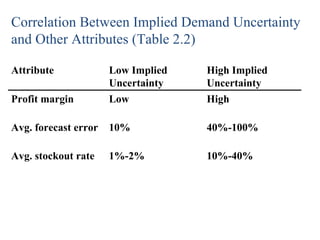
Correlation Between Implied Demand Uncertainty and Other Attributes (Table 2.2) Attribute Low Implied Uncertainty High Implied Uncertainty Profit margin Low High Avg. forecast error 10% 40%-100% Avg. stockout rate 1%-2% 10%-40%
Step 2: Understanding the  Supply Chain Second step to achieving strategic fit is to map the supply chain on the responsiveness spectrum
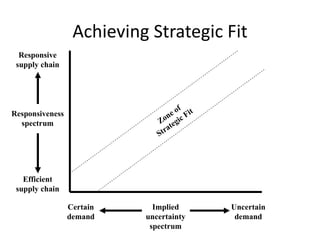
Step 3: Achieving Strategic Fit All functions in the value chain must support the competitive strategy to achieve strategic fit Two extremes:  Efficient supply chains and responsive supply chains
Achieving Strategic Fit Implied uncertainty spectrum Responsive supply chain Efficient supply chain Certain demand Uncertain demand Responsiveness spectrum Zone of Strategic Fit
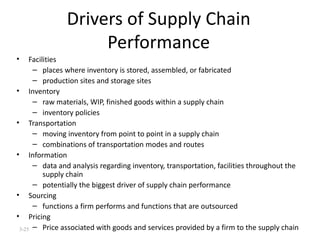
Drivers of Supply Chain Performance Facilities places where inventory is stored, assembled, or fabricated production sites and storage sites Inventory raw materials, WIP, finished goods within a supply chain inventory policies Transportation moving inventory from point to point in a supply chain combinations of transportation modes and routes Information data and analysis regarding inventory, transportation, facilities throughout the supply chain potentially the biggest driver of supply chain performance Sourcing functions a firm performs and functions that are outsourced Pricing Price associated with goods and services provided by a firm to the supply chain 3-
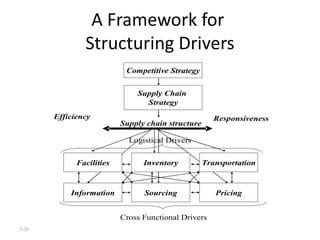
A Framework for  Structuring Drivers 3-
Facilities Role in the supply chain the “where” of the supply chain manufacturing or storage (warehouses) Role in the competitive strategy economies of scale (efficiency priority) larger number of smaller facilities (responsiveness priority) 3-
Components of Facilities Decisions Location centralization (efficiency) vs. decentralization (responsiveness) other factors to consider (e.g., proximity to customers) Capacity (flexibility versus efficiency) Manufacturing methodology (product focused versus process focused) Warehousing methodology (SKU storage, job lot storage, cross-docking) Overall trade-off:  Responsiveness versus efficiency 3-
Inventory:  Role in the Supply Chain Inventory exists because of a mismatch between supply and demand Source of cost and influence on responsiveness Impact on material flow time throughput 3-
Inventory:  Role in Competitive Strategy If responsiveness is a strategic competitive priority, a firm can locate larger amounts of inventory closer to customers If cost is more important, inventory can be reduced to make the firm more efficient 3-
Components of Inventory Decisions Cycle inventory Average amount of inventory used to satisfy demand between shipments Depends on lot size Safety inventory inventory held in case demand exceeds expectations costs of carrying too much inventory versus cost of losing sales Seasonal inventory inventory built up to counter predictable variability in demand cost of carrying additional inventory versus cost of flexible production Overall trade-off:  Responsiveness versus efficiency more inventory:  greater responsiveness but greater cost less inventory:  lower cost but lower responsiveness 3-
Transportation: Role in the Supply Chain Moves the product between stages in the supply chain Impact on responsiveness and efficiency Faster transportation allows greater responsiveness but lower efficiency 3-
Transportation:  Role in the Competitive Strategy If responsiveness is a strategic competitive priority, then faster transportation modes can provide greater responsiveness to customers who are willing to pay for it Can also use slower transportation modes for customers whose priority is price (cost) 3-
Components of Transportation Decisions Mode of transportation:  air, truck, rail, ship, pipeline, electronic transportation vary in cost, speed, size of shipment, flexibility Route and network selection route: path along which a product is shipped network: collection of locations and routes In-house or outsource Overall trade-off: Responsiveness versus efficiency 3-
Information: Role in the Supply Chain The connection between the various stages in the supply chain – allows coordination between stages Crucial to daily operation of each stage in a supply chain – e.g., production scheduling, inventory levels 3-
Information:  Role in the Competitive Strategy Allows supply chain to become more efficient and more responsive  at the same time  (reduces the need for a trade-off) 3-
Components of Information Decisions Push (MRP) versus pull (demand information transmitted quickly throughout the supply chain) Coordination and information sharing Forecasting and aggregate planning Enabling technologies EDI Internet ERP systems Supply Chain Management software Overall trade-off:  Responsiveness versus efficiency 3-
Sourcing: Role in the Supply Chain Set of business processes required to purchase goods and services in a supply chain Supplier selection, single vs. multiple suppliers, contract negotiation 3-
Sourcing:  Role in the Competitive Strategy Sourcing decisions are crucial because they affect the level of efficiency and responsiveness in a supply chain 3-
Components of Sourcing Decisions In-house versus outsource decisions Supplier evaluation and selection Procurement process Overall trade-off: Increase the supply chain profits 3-
Pricing: Role in the Supply Chain Pricing determines the amount to charge customers in a supply chain Pricing strategies can be used to match demand and supply 3-
Sourcing:  Role in the Competitive Strategy Firms can utilize optimal pricing strategies to improve efficiency and responsiveness Low price and low product availability; vary prices by response times 3-
Components of Pricing Decisions Pricing and economies of scale Everyday low pricing versus high-low pricing Fixed price versus menu pricing Overall trade-off: Increase the firm profits 3-

1

  • 1.
  • 2.
    What is aSupply Chain? All stages involved, directly or indirectly, in fulfilling a customer request Includes manufacturers, suppliers, transporters, warehouses, retailers, and customers It includes all functions involved in receiving and fillin a customer request. Product development, Marketing, Operations, Distribution, Finance, Customer service) Includes movement of products, information, and funds in both directions 1-
  • 3.
    What is aSupply Chain? 1- Customer wants detergent and goes to Jewel Jewel Supermarket Jewel or third party DC P&G or other manufacturer Plastic Producer Chemical manufacturer (e.g. Oil Company) Tenneco Packaging Paper Manufacturer Timber Industry Chemical manufacturer (e.g. Oil Company)
  • 4.
    Flows in aSupply Chain 1- Customer Information Product Funds Supply Chain
  • 5.
    The Objective ofa Supply Chain Maximize overall SC value created Supply chain value =Final Product Value – Total Supply Chain Cost { Supply chain value is strongly correlated with supply chain profitability. } 1-
  • 6.
    Decision Phases ofa Supply Chain 1-
  • 7.
    Supply Chain Strategyor Design Structure of the supply chain Strategic supply chain decisions Locations and capacities of facilities Products to be made or stored at various locations Modes of transportation Information systems Supply chain design must support strategic objectives SC design decisions are long-term and expensive to reverse 1-
  • 8.
    Supply Chain PlanningA set of policies that govern short-term operations Fixed by the SC design Starts with a forecast of demand for the coming year 1-
  • 9.
    Supply Chain PlanningPlanning decisions: Which markets will be supplied from which locations Planned buildup of inventories Subcontracting, backup locations Inventory policies Timing and size of market promotions Must consider demand uncertainty, exchange rates, competition over the time horizon 1-
  • 10.
    Supply Chain OperationTime horizon is weekly or daily Decisions about individual customer orders Configuration is fixed and operating policies are determined Goal is to implement the operating policies as effectively as possible Allocate orders to inventory or production, set order due dates, generate pick lists at a warehouse, allocate an order to a particular shipment, set delivery schedules, place replenishment orders Much less uncertainty (short time horizon) 1-
  • 11.
    Process View ofa Supply Chain Cycle view Push/pull view 1-
  • 12.
    Cycle View ofSupply Chains 1- Customer Order Cycle Replenishment Cycle Manufacturing Cycle Procurement Cycle Customer Retailer Distributor Manufacturer Supplier
  • 13.
    Push/Pull View ofSupply Chains 1- Procurement, Manufacturing and Replenishment cycles Customer Order Cycle Customer Order Arrives PUSH PROCESSES PULL PROCESSES
  • 14.
    Supply Chain MacroProcesses in a Firm Supply chain processes can be classified into (Figure 1.8): Customer Relationship Management (CRM) Internal Supply Chain Management (ISCM) Supplier Relationship Management (SRM) Integration among the above three macro processes is critical for effective and successful supply chain management 1-
  • 15.
    The Value ChainNew Product Development Marketing and Sales Operations Distribution Service Finance, Accounting, Information Technology, Human Resources Business Strategy New Product Strategy Marketing Strategy Supply Chain Strategy
  • 16.
    Competitive & SupplyChain Strategies Competitive strategy: defines the target market/customer needs. Product Development strategy: portfolio of new products to achieve competitive strategy. Marketing and sales strategy: specifies how the market will be segmented and product positioned, priced, and promoted Supply chain strategy: determines the nature of material procurement, transportation of materials, manufacture of product or creation of service, distribution of product Consistency and support between supply chain strategy, competitive strategy, and other functional strategies is important
  • 17.
    Step 1: Understanding the Customer and Supply Chain Uncertainty Identify the needs of the customer segment being served Quantity of product needed in each lot Response time customers will tolerate Variety of products needed Service level required Price of the product Desired rate of innovation in the product
  • 18.
    Customers demand productswith different characteristics – Cost Customization Quantity Quality Speed Service Flexibility Features 1-
  • 19.
    Understanding the Customer,Lot size Response time Service level Product variety Price Innovation Implied Demand Uncertainty
  • 20.
    Impact of CustomerNeeds on Implied Demand Uncertainty (Table 2.1) Customer Need Causes implied demand uncertainty to increase because … Range of quantity increases Wider range of quantity implies greater variance in demand Lead time decreases Less time to react to orders Variety of products required increases Demand per product becomes more disaggregated Number of channels increases Total customer demand is now disaggregated over more channels Rate of innovation increases New products tend to have more uncertain demand Required service level increases Firm now has to handle unusual surges in demand
  • 21.
    Correlation Between ImpliedDemand Uncertainty and Other Attributes (Table 2.2) Attribute Low Implied Uncertainty High Implied Uncertainty Profit margin Low High Avg. forecast error 10% 40%-100% Avg. stockout rate 1%-2% 10%-40%
  • 22.
    Step 2: Understandingthe Supply Chain Second step to achieving strategic fit is to map the supply chain on the responsiveness spectrum
  • 23.
    Step 3: AchievingStrategic Fit All functions in the value chain must support the competitive strategy to achieve strategic fit Two extremes: Efficient supply chains and responsive supply chains
  • 24.
    Achieving Strategic FitImplied uncertainty spectrum Responsive supply chain Efficient supply chain Certain demand Uncertain demand Responsiveness spectrum Zone of Strategic Fit
  • 25.
    Drivers of SupplyChain Performance Facilities places where inventory is stored, assembled, or fabricated production sites and storage sites Inventory raw materials, WIP, finished goods within a supply chain inventory policies Transportation moving inventory from point to point in a supply chain combinations of transportation modes and routes Information data and analysis regarding inventory, transportation, facilities throughout the supply chain potentially the biggest driver of supply chain performance Sourcing functions a firm performs and functions that are outsourced Pricing Price associated with goods and services provided by a firm to the supply chain 3-
  • 26.
    A Framework for Structuring Drivers 3-
  • 27.
    Facilities Role inthe supply chain the “where” of the supply chain manufacturing or storage (warehouses) Role in the competitive strategy economies of scale (efficiency priority) larger number of smaller facilities (responsiveness priority) 3-
  • 28.
    Components of FacilitiesDecisions Location centralization (efficiency) vs. decentralization (responsiveness) other factors to consider (e.g., proximity to customers) Capacity (flexibility versus efficiency) Manufacturing methodology (product focused versus process focused) Warehousing methodology (SKU storage, job lot storage, cross-docking) Overall trade-off: Responsiveness versus efficiency 3-
  • 29.
    Inventory: Rolein the Supply Chain Inventory exists because of a mismatch between supply and demand Source of cost and influence on responsiveness Impact on material flow time throughput 3-
  • 30.
    Inventory: Rolein Competitive Strategy If responsiveness is a strategic competitive priority, a firm can locate larger amounts of inventory closer to customers If cost is more important, inventory can be reduced to make the firm more efficient 3-
  • 31.
    Components of InventoryDecisions Cycle inventory Average amount of inventory used to satisfy demand between shipments Depends on lot size Safety inventory inventory held in case demand exceeds expectations costs of carrying too much inventory versus cost of losing sales Seasonal inventory inventory built up to counter predictable variability in demand cost of carrying additional inventory versus cost of flexible production Overall trade-off: Responsiveness versus efficiency more inventory: greater responsiveness but greater cost less inventory: lower cost but lower responsiveness 3-
  • 32.
    Transportation: Role inthe Supply Chain Moves the product between stages in the supply chain Impact on responsiveness and efficiency Faster transportation allows greater responsiveness but lower efficiency 3-
  • 33.
    Transportation: Rolein the Competitive Strategy If responsiveness is a strategic competitive priority, then faster transportation modes can provide greater responsiveness to customers who are willing to pay for it Can also use slower transportation modes for customers whose priority is price (cost) 3-
  • 34.
    Components of TransportationDecisions Mode of transportation: air, truck, rail, ship, pipeline, electronic transportation vary in cost, speed, size of shipment, flexibility Route and network selection route: path along which a product is shipped network: collection of locations and routes In-house or outsource Overall trade-off: Responsiveness versus efficiency 3-
  • 35.
    Information: Role inthe Supply Chain The connection between the various stages in the supply chain – allows coordination between stages Crucial to daily operation of each stage in a supply chain – e.g., production scheduling, inventory levels 3-
  • 36.
    Information: Rolein the Competitive Strategy Allows supply chain to become more efficient and more responsive at the same time (reduces the need for a trade-off) 3-
  • 37.
    Components of InformationDecisions Push (MRP) versus pull (demand information transmitted quickly throughout the supply chain) Coordination and information sharing Forecasting and aggregate planning Enabling technologies EDI Internet ERP systems Supply Chain Management software Overall trade-off: Responsiveness versus efficiency 3-
  • 38.
    Sourcing: Role inthe Supply Chain Set of business processes required to purchase goods and services in a supply chain Supplier selection, single vs. multiple suppliers, contract negotiation 3-
  • 39.
    Sourcing: Rolein the Competitive Strategy Sourcing decisions are crucial because they affect the level of efficiency and responsiveness in a supply chain 3-
  • 40.
    Components of SourcingDecisions In-house versus outsource decisions Supplier evaluation and selection Procurement process Overall trade-off: Increase the supply chain profits 3-
  • 41.
    Pricing: Role inthe Supply Chain Pricing determines the amount to charge customers in a supply chain Pricing strategies can be used to match demand and supply 3-
  • 42.
    Sourcing: Rolein the Competitive Strategy Firms can utilize optimal pricing strategies to improve efficiency and responsiveness Low price and low product availability; vary prices by response times 3-
  • 43.
    Components of PricingDecisions Pricing and economies of scale Everyday low pricing versus high-low pricing Fixed price versus menu pricing Overall trade-off: Increase the firm profits 3-

Editor's Notes

  • #4 Notes: Supply chain involves everybody, from the customer all the way to the last supplier. Key flows in the supply chain are - information, product, and cash. It is through these flows that a supply chain fills a customer order. The management of these flows is key to the success or failure of a firm. Give Dell & Compaq example, Amazon & Borders example to bring out the fact that all supply chain interaction is through these flows.
  • #13 The supply chain is a concatenation of cycles with each cycle at the interface of two successive stages in the supply chain. Each cycle involves the customer stage placing an order and receiving it after it has been supplied by the supplier stage. One difference is in size of order. Second difference is in predictability of orders - orders in the procurement cycle are predictable once manufacturing planning has been done. This is the predominant view for ERP systems. It is a transaction level view and clearly defines each process and its owner.
  • #14 In this view processes are divided based on their timing relative to the timing of a customer order. Define push and pull processes. They key difference is the uncertainty during the two phases. Give examples at Amazon and Borders to illustrate the two views