CHAPTER 4 Supply Chain, Enterprise Resources Planning, and Business Processes Engineering 4-
Learning Objectives Understand the concept of the supply chain, its importance, and management. Describe the problems of managing the supply chain and some innovative solutions. Trace the evolution of software that support activities along the supply chain. Define business processing reengineering (BPR) and understand its relationship with the supply chain.
Learning Objectives Describe the networked organization and identify its benefits. Demonstrate the role of IT in supporting BPR. Describe mass customization, cycle time reduction, self-directed teams, and empowerment. Define business alliances and virtual corporations. Understand the relationships among enterprise resources planning (ERP), supply chain management (SCM), and electronic commerce.
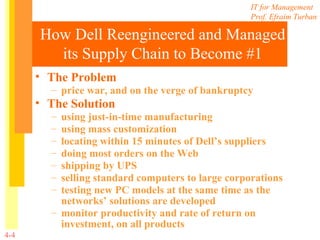
How Dell Reengineered and Managed its Supply Chain to Become #1 The Problem price war, and on the verge of bankruptcy The Solution using just-in-time manufacturing using mass customization locating within 15 minutes of Dell’s suppliers doing most orders on the Web shipping by UPS selling standard computers to large corporations testing new PC models at the same time as the networks’ solutions are developed monitor productivity and rate of return on investment, on all products
What Role did IT Play? electronic commerce with customers extranet for suppliers Using the Internet to create a community around its supply chain The Results become the number one PC seller be considered one of the world’s best-managed and profitable companies How Dell Reengineered and Managed its Supply Chain to Become #1
Essentials of the Supply Chains Dell case demonstrates that: by introducing a new business model one can change the manner in which business is done and may even capture the leadership in its industry by introducing major customer-related changes, one can  improve the communication and customer services by improving logistics system along the entire supply chain, Dell integrated its own suppliers into its supply chain, efficiently and effectively Dell created flexible and responsive manufacturing systems the changes are considered to be a complete reengineering Dell supports all of the above by extensive use of electronic commerce, the Internet, extranet and intranets
Essentials of the Supply Chains Supply Chain the flow of material, information, and services from raw material suppliers through factories and warehouses to the end customers Supply Chain Management (SCM) to plan, organize, and coordinate all the supply chain’s  activities
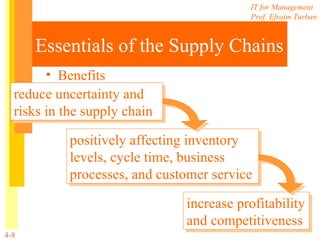
Essentials of the Supply Chains Benefits reduce uncertainty and risks in the supply chain positively affecting inventory levels, cycle time, business processes, and customer service increase profitability and competitiveness
Essentials of the Supply Chains The Components of Supply Chain Upstream supply chain includes the organization’s first-tier suppliers and their suppliers Internal supply chain includes all the processes used by an organization in transforming the inputs of the suppliers to outputs Downstream supply chain includes all the processes involved in delivering the products to final customers
Supply Chain 2 nd  Tier Suppliers 2 nd  Tier Suppliers 2 nd  Tier Suppliers 1 st  Tier Suppliers 1 st  Tier Suppliers Assembly/ Manufacturing and Packaging Distribution Centers Retailers Customers The Generic Process Upstream Internal Downstream Corrugate Paper Co. Lumber Company Label Manufacturing Grain Producer Processing Facility Distribution Centers Stores Customers The Cereal Manufacturing Process Packaging Grain Cereal Packaged Cereal Box Paperboard Labels
Problems Along  the Supply Chains Uncertainties demand forecast,  which influenced by competition, prices, weather conditions, technological development, and customers’ general confidence delivery times,  which depend on several factors ranging from machine failures to road conditions and traffic jams, that way interfere with shipments Symptoms of poor SCM poor customer service, which hinders people from getting the product or service when and where needed, or gives them a product of poor quality High cost, low (or no) profit
Some Solutions to  the Supply Chain Problems Vertical integration - building inventories Coordination of all different activities Use outsourcing rather than do-it-yourself during demand peaks ‘ Buy’ rather than ‘make’ production inputs whenever appropriate Configure optimal shipping plans Create strategic partnerships with suppliers Use just-in-time approach to purchasing Use fewer suppliers Use IT to support the above
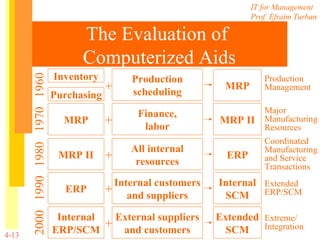
The Evaluation of  Computerized Aids Inventory Purchasing Production scheduling MRP 1960 Production Management + MRP Finance, labor MRP II 1970 Major Manufacturing Resources + MRP II All internal resources ERP 1980 Coordinated Manufacturing and Service Transactions + ERP Internal customers and suppliers Internal SCM 1990 Extended ERP/SCM + Internal ERP/SCM External suppliers and customers Extended SCM 2000 Extreme/ Integration +
Why Integration? Tangible benefits Inventory reduction, personnel reduction, productivity improvement, order management improvement, financial-close cycle improvements, IT cost reduction, procurement cost reduction, cash management improvements, revenue/profit increases, transportation logistics cost reduction maintenance reduction, and on-time delivery improvement
Why Integration? Intangible benefits Information visibility, new/improved processes, customer responsiveness, standardization, flexibility, globalization, and business performance.
Integrating the Supply Chain After the introduction of computer-based information, companies started to integrate the links of the supply chain New forms of organizational relationships and the information revolution, especially the Internet and electronic commerce, have brought SCM to the forefront of management attention
Enterprise Resources Planning (ERP) Objective to integrate all departments and functions across a company onto a single computer system that can serve all of the enterprise’s needs Results productivity improvement increases customer satisfaction
SAP - The Complete Solution SAP R/3 is comprised of four major application categories - accounting, manufacturing, sales, and human resources - containing more than 70 modules SAP R/3 allows companies to automate or eliminate many costly and error-prone manual communication procedures SAP implementation is very complex and consequently very expensive
Example of How R/3 Work Step 1  : Brazilian retailer orders, via the Internet, 1,000 shoes from International Shoe Co. A sales rep takes the order, routes it to R/3’s ordering module, R/3 checks the retailer credit, price, etc.  The order is approved. Step 2  : Simultaneously R/3’s inventory module checks the stocks and notifies the rep that half the order can be filled immediately from stock.  The other half will be manufactured and delivered in 5 days directly from the factory in Taiwan.
Example of How R/3 Work Step 3  : R/3’s manufacturing module schedules the production in Taiwan and instructs the warehouse (in Chinese) to ship the shoes to Brazil and print up an invoice (in Portuguese). Step 4  : R/3’s human resources module calculates labor requirements.  Due to a shortage, the personnel manager in Taiwan is instructed to get temporary workers. Step 5  : R/3’s material planning module notifies the purchasing manager about a shortage of purple dye.  A purchase order is automatically issued.
Example of How R/3 Work Step 6  : The customer logs on via the extranet to the company’s sneakers division.  He can see that 500 shoes were shipped from the regional warehouse.  This is done with R/3 tracing capabilities. Step 7  : Based on data from R/3’s forecasting and financial modules, the CEO can determine both demand and profitability per product.  The financial module also converts all foreign moneys to $U.S., whenever needed
ERP Pros provides a single interface for managing all the routine activities performed in manufacturing can integrate several hundred applications plays critical role in getting small- and medium-sized manufacturers to focus on business processes Cons need to change existing business processes to fit SAP’s the  format never meant to fully support supply chains difficult to build, operate, change and maintain
First Generation  ERP Supported routine transactional activities Excelled in transaction management Generated reports which provided a snapshot of the business at a point in time Did not support the continues refining and enhancing of plans as changes and events occur, up to the very last minute before executing the plan
Second Generation ERP Adds decision support and business intelligence capabilities Integration of database management systems (DBMS) and spreadsheets in Excel or Lotus 1-2-3 It is Web-based Integrates CRM and EC
Application Service Providers and ERP Outsourcing Application service providers (ASP) a software vendor that offers to lease ERP-based applications to other businesses offerings are evident in ERP-added functions such as electronic commerce, customer relationship management (CRM), datamarts, desktop productivity, human resources information systems (HRMS), and other supply chain-related applications
Global Supply Chains IT provides EDI, communication options, online expertise in sometimes difficult and fast-changing regulations IT can be instrumental in helping businesses find trade partners IT facilitates outsourcing of products and services, especially IT programming, to countries with plentiful supply of labor, at low cost
Business Process Reengineering (BPR) Fundamentally rethinking and radically redesigning business processes, in order to achieve dramatic improvements in quality, cost, speed and service
The Need for BPR Three Cs Customers  today know what they want, what they are willing to pay, and how to get products and services on their own terms. Competition  is continuously increasing with respect to price, quality, selection, service, and promptness of delivery.  Change  continues to occur.  Markets, products, services, technology, the business environment, and people keep changing, frequently in an unpredictable and significant manner.
Problem of the Stovepipe “ Stovepipe” because of lack of cooperation between functional areas (vertical dimension) Business process reengineering (BPR), which undertakes a fundamental change in specific business processes, integrates information required for good decision making
Need for  Information Integration Business processes across functional areas and organizational boundaries. Distribution Logistics, Services Purchasing Finance R & D Production Sales Distribution Vendors, Suppliers Organization Customers Product development Order fulfillment Planning, resourcing, and control Customer service
IBM Credit Corporation Reduced Cycle Time by 90% The old process took an average of seven days The reengineered process a simple DSS provides the deal structurer with the guidance needed the program guides the generalist in finding information in the databases, plugging numbers into an evaluation model, and pulling standardized clauses - ‘boilerplate’-from a file electronic communication and collaboration
The Enabling Role of Information Technology in BPR Shared databases, Internet client/server architecture, intranet Expert systems, neural computing Telecommunication and networks: client/server intranet Decision support systems, enterprise support systems, expert systems Wireless communication and portable computers, the web, electronic mail Interactive videodisk, desktop teleconferencing,electronic mail Tracking technology, groupware, workflow software, search engines High-performance computing systems, intelligent agents Groupware and group support systems,telecommunication, electronic mail, client/server CAD/CAM, CASE tools, online systems for JIT decision making, expert systems CAD/CAM, electronic data interchange, imaging processing Artificial intelligence, expert systems Robots, imaging technologies, object-oriented programming, expert systems, geographical information systems (GIS)
Retooling of IT for BPR Get a good understanding of the current installed base of information systems applications and databases Understand the existing infrastructure in terms of computing equipment, networks, and the like, and their relationships to the current available software, procedures, and data
Tools for BPR Simulation and visual simulation tools Flow diagrams Work analysis Rapid application development Other tools (e.g. CAD/CAM, imaging technologies, EDI, interorganizational systems and expert systems) Integrated tool kits Workflow software The Web
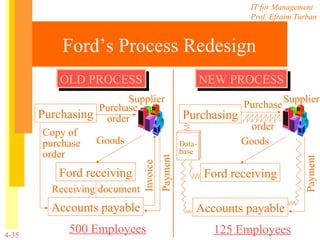
Ford’s Process Redesign Payment OLD PROCESS Purchasing Ford receiving Accounts payable Supplier Purchase order Copy of purchase order Goods Receiving document Invoice 500 Employees NEW PROCESS Purchasing Ford receiving Accounts payable Supplier Purchase order Goods Payment 125 Employees Data-base
From Mass Production to Mass Customization Mass production a company produces a large quantity of an identical standard product Mass customization a company produces large volumes, yet customizes each product to the specifications of individual customers
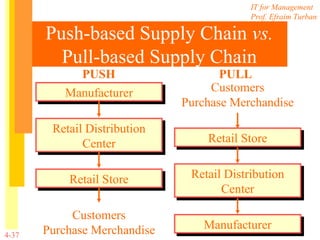
Push-based Supply Chain  vs. Pull-based Supply Chain PUSH PULL Manufacturer Retail Distribution Center Retail Store Customers Purchase Merchandise Manufacturer Retail Distribution Center Retail Store Customers Purchase Merchandise
Cycle Time Reduction IT allows the combination or elimination of steps, and the expedition of various activities in the process Telecommunications and especially the Internet and intranets cut communications time through the use of e-mail and EDI and allows collaboration in design and operations of products and services
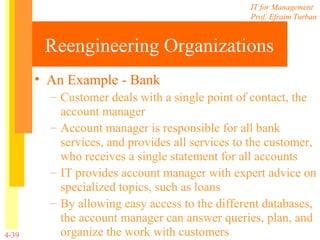
Reengineering Organizations An Example - Bank Customer deals with a single point of contact, the account manager Account manager is responsible for all bank services, and provides all services to the customer, who receives a single statement for all accounts IT provides account manager with expert advice on specialized topics, such as loans By allowing easy access to the different databases, the account manager can answer queries, plan, and organize the work with customers
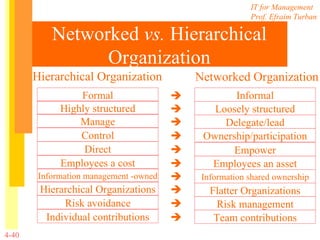
Networked  vs.  Hierarchical Organization Hierarchical Organization Networked Organization Formal Highly structured Manage Control Direct Employees a cost Information management -owned Hierarchical Organizations Risk avoidance Individual contributions Informal Loosely structured Delegate/lead Ownership/participation Empower Employees an asset Information shared ownership Flatter Organizations Risk management Team contributions          
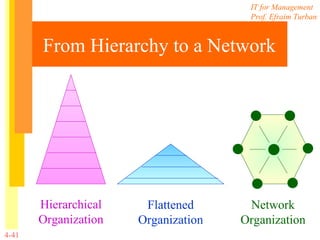
From Hierarchy to a Network Hierarchical Organization Flattened Organization  Network Organization
Empowerment The vesting of decision-making or approval authority in employees Giving permission to the workforce to unleash, develop, and utilize their skills and knowledge to their fullest potential, for the good of the organization as well as for themselves, and providing the framework in which this can be done
Empowerment’s Relationship to Information Technology IT provides the right information, at the right time, at the right quality, and at the right cost IT provides tools that will enhance the creativity and productivity of employees, so they can make self-decisions, as well s the quality of their work IT provides online training, uses multimedia, and even apply intelligent computer-aided instruction to employees who need more skills and higher levels of skills
Teams Types of teams permanent or work group teams problem-solving teams quality circles, participating teams management teams virtual teams IT plays a critical role in empowering team members and providing the necessary communication links among teams
Virtual Corporations Virtual corporation is an organization composed of several business partners sharing costs and resources for the purpose of producing a product or service Major attributes excellence –  full utilization opportunism –  lack of borders trust –  adaptability to change technology
How IT Supports  Virtual Corporation IT allows communication and collaboration among the dispersed business partners Standard transactions in the interorganizational IS are supported by EDI and EFT The Internet is the infrastructure for these and other technologies Modern database technologies and networking permit business partners to access each other’s databases ERP software is extensively used to support standard transactions among business partners
Buying and Selling Along the Supply Chain Upstream activities Bidding Consolidation of vendors’ catalogues in buyer’s site Onsite specialty stores Other purchases Buying knowledge Internal SCM activities Downstream activities Selling on your own web site  Auctions on your web site Upstream and Downstream combined
Implementing EC Solutions Along the Supply Chain Build in yourself, in house Outsource the job Integrate EC with ERP Integration with CRM and DSS Componentization
Copyright    2001 John Wiley & Sons, Incorporated.  All rights reserved.  Reproduction or translation of this work beyond that permitted in Section 117 of the 1976 United States Copyright Act without the express written permission of the copyright owner in unlawful.  Request for further information should be addressed to the Permissions Department, John Wiley & Son, Inc.  Adopters of the textbook are granted permission to make back-up copies for his/her own use only, to make copies for distribution to student of the course the textbook is used in, and to modify this material to best suit their instructional needs.  Under no circumstances can copies be made for resale.  The publisher assumes no responsibility for errors, omissions, or damages, caused by the use of these programs or from the use of the information contained herein.  IT for Management Prof. Efraim Turban 6-

Supply Chain Enterprise Resources Planning

  • 1.
    CHAPTER 4 SupplyChain, Enterprise Resources Planning, and Business Processes Engineering 4-
  • 2.
    Learning Objectives Understandthe concept of the supply chain, its importance, and management. Describe the problems of managing the supply chain and some innovative solutions. Trace the evolution of software that support activities along the supply chain. Define business processing reengineering (BPR) and understand its relationship with the supply chain.
  • 3.
    Learning Objectives Describethe networked organization and identify its benefits. Demonstrate the role of IT in supporting BPR. Describe mass customization, cycle time reduction, self-directed teams, and empowerment. Define business alliances and virtual corporations. Understand the relationships among enterprise resources planning (ERP), supply chain management (SCM), and electronic commerce.
  • 4.
    How Dell Reengineeredand Managed its Supply Chain to Become #1 The Problem price war, and on the verge of bankruptcy The Solution using just-in-time manufacturing using mass customization locating within 15 minutes of Dell’s suppliers doing most orders on the Web shipping by UPS selling standard computers to large corporations testing new PC models at the same time as the networks’ solutions are developed monitor productivity and rate of return on investment, on all products
  • 5.
    What Role didIT Play? electronic commerce with customers extranet for suppliers Using the Internet to create a community around its supply chain The Results become the number one PC seller be considered one of the world’s best-managed and profitable companies How Dell Reengineered and Managed its Supply Chain to Become #1
  • 6.
    Essentials of theSupply Chains Dell case demonstrates that: by introducing a new business model one can change the manner in which business is done and may even capture the leadership in its industry by introducing major customer-related changes, one can improve the communication and customer services by improving logistics system along the entire supply chain, Dell integrated its own suppliers into its supply chain, efficiently and effectively Dell created flexible and responsive manufacturing systems the changes are considered to be a complete reengineering Dell supports all of the above by extensive use of electronic commerce, the Internet, extranet and intranets
  • 7.
    Essentials of theSupply Chains Supply Chain the flow of material, information, and services from raw material suppliers through factories and warehouses to the end customers Supply Chain Management (SCM) to plan, organize, and coordinate all the supply chain’s activities
  • 8.
    Essentials of theSupply Chains Benefits reduce uncertainty and risks in the supply chain positively affecting inventory levels, cycle time, business processes, and customer service increase profitability and competitiveness
  • 9.
    Essentials of theSupply Chains The Components of Supply Chain Upstream supply chain includes the organization’s first-tier suppliers and their suppliers Internal supply chain includes all the processes used by an organization in transforming the inputs of the suppliers to outputs Downstream supply chain includes all the processes involved in delivering the products to final customers
  • 10.
    Supply Chain 2nd Tier Suppliers 2 nd Tier Suppliers 2 nd Tier Suppliers 1 st Tier Suppliers 1 st Tier Suppliers Assembly/ Manufacturing and Packaging Distribution Centers Retailers Customers The Generic Process Upstream Internal Downstream Corrugate Paper Co. Lumber Company Label Manufacturing Grain Producer Processing Facility Distribution Centers Stores Customers The Cereal Manufacturing Process Packaging Grain Cereal Packaged Cereal Box Paperboard Labels
  • 11.
    Problems Along the Supply Chains Uncertainties demand forecast, which influenced by competition, prices, weather conditions, technological development, and customers’ general confidence delivery times, which depend on several factors ranging from machine failures to road conditions and traffic jams, that way interfere with shipments Symptoms of poor SCM poor customer service, which hinders people from getting the product or service when and where needed, or gives them a product of poor quality High cost, low (or no) profit
  • 12.
    Some Solutions to the Supply Chain Problems Vertical integration - building inventories Coordination of all different activities Use outsourcing rather than do-it-yourself during demand peaks ‘ Buy’ rather than ‘make’ production inputs whenever appropriate Configure optimal shipping plans Create strategic partnerships with suppliers Use just-in-time approach to purchasing Use fewer suppliers Use IT to support the above
  • 13.
    The Evaluation of Computerized Aids Inventory Purchasing Production scheduling MRP 1960 Production Management + MRP Finance, labor MRP II 1970 Major Manufacturing Resources + MRP II All internal resources ERP 1980 Coordinated Manufacturing and Service Transactions + ERP Internal customers and suppliers Internal SCM 1990 Extended ERP/SCM + Internal ERP/SCM External suppliers and customers Extended SCM 2000 Extreme/ Integration +
  • 14.
    Why Integration? Tangiblebenefits Inventory reduction, personnel reduction, productivity improvement, order management improvement, financial-close cycle improvements, IT cost reduction, procurement cost reduction, cash management improvements, revenue/profit increases, transportation logistics cost reduction maintenance reduction, and on-time delivery improvement
  • 15.
    Why Integration? Intangiblebenefits Information visibility, new/improved processes, customer responsiveness, standardization, flexibility, globalization, and business performance.
  • 16.
    Integrating the SupplyChain After the introduction of computer-based information, companies started to integrate the links of the supply chain New forms of organizational relationships and the information revolution, especially the Internet and electronic commerce, have brought SCM to the forefront of management attention
  • 17.
    Enterprise Resources Planning(ERP) Objective to integrate all departments and functions across a company onto a single computer system that can serve all of the enterprise’s needs Results productivity improvement increases customer satisfaction
  • 18.
    SAP - TheComplete Solution SAP R/3 is comprised of four major application categories - accounting, manufacturing, sales, and human resources - containing more than 70 modules SAP R/3 allows companies to automate or eliminate many costly and error-prone manual communication procedures SAP implementation is very complex and consequently very expensive
  • 19.
    Example of HowR/3 Work Step 1 : Brazilian retailer orders, via the Internet, 1,000 shoes from International Shoe Co. A sales rep takes the order, routes it to R/3’s ordering module, R/3 checks the retailer credit, price, etc. The order is approved. Step 2 : Simultaneously R/3’s inventory module checks the stocks and notifies the rep that half the order can be filled immediately from stock. The other half will be manufactured and delivered in 5 days directly from the factory in Taiwan.
  • 20.
    Example of HowR/3 Work Step 3 : R/3’s manufacturing module schedules the production in Taiwan and instructs the warehouse (in Chinese) to ship the shoes to Brazil and print up an invoice (in Portuguese). Step 4 : R/3’s human resources module calculates labor requirements. Due to a shortage, the personnel manager in Taiwan is instructed to get temporary workers. Step 5 : R/3’s material planning module notifies the purchasing manager about a shortage of purple dye. A purchase order is automatically issued.
  • 21.
    Example of HowR/3 Work Step 6 : The customer logs on via the extranet to the company’s sneakers division. He can see that 500 shoes were shipped from the regional warehouse. This is done with R/3 tracing capabilities. Step 7 : Based on data from R/3’s forecasting and financial modules, the CEO can determine both demand and profitability per product. The financial module also converts all foreign moneys to $U.S., whenever needed
  • 22.
    ERP Pros providesa single interface for managing all the routine activities performed in manufacturing can integrate several hundred applications plays critical role in getting small- and medium-sized manufacturers to focus on business processes Cons need to change existing business processes to fit SAP’s the format never meant to fully support supply chains difficult to build, operate, change and maintain
  • 23.
    First Generation ERP Supported routine transactional activities Excelled in transaction management Generated reports which provided a snapshot of the business at a point in time Did not support the continues refining and enhancing of plans as changes and events occur, up to the very last minute before executing the plan
  • 24.
    Second Generation ERPAdds decision support and business intelligence capabilities Integration of database management systems (DBMS) and spreadsheets in Excel or Lotus 1-2-3 It is Web-based Integrates CRM and EC
  • 25.
    Application Service Providersand ERP Outsourcing Application service providers (ASP) a software vendor that offers to lease ERP-based applications to other businesses offerings are evident in ERP-added functions such as electronic commerce, customer relationship management (CRM), datamarts, desktop productivity, human resources information systems (HRMS), and other supply chain-related applications
  • 26.
    Global Supply ChainsIT provides EDI, communication options, online expertise in sometimes difficult and fast-changing regulations IT can be instrumental in helping businesses find trade partners IT facilitates outsourcing of products and services, especially IT programming, to countries with plentiful supply of labor, at low cost
  • 27.
    Business Process Reengineering(BPR) Fundamentally rethinking and radically redesigning business processes, in order to achieve dramatic improvements in quality, cost, speed and service
  • 28.
    The Need forBPR Three Cs Customers today know what they want, what they are willing to pay, and how to get products and services on their own terms. Competition is continuously increasing with respect to price, quality, selection, service, and promptness of delivery. Change continues to occur. Markets, products, services, technology, the business environment, and people keep changing, frequently in an unpredictable and significant manner.
  • 29.
    Problem of theStovepipe “ Stovepipe” because of lack of cooperation between functional areas (vertical dimension) Business process reengineering (BPR), which undertakes a fundamental change in specific business processes, integrates information required for good decision making
  • 30.
    Need for Information Integration Business processes across functional areas and organizational boundaries. Distribution Logistics, Services Purchasing Finance R & D Production Sales Distribution Vendors, Suppliers Organization Customers Product development Order fulfillment Planning, resourcing, and control Customer service
  • 31.
    IBM Credit CorporationReduced Cycle Time by 90% The old process took an average of seven days The reengineered process a simple DSS provides the deal structurer with the guidance needed the program guides the generalist in finding information in the databases, plugging numbers into an evaluation model, and pulling standardized clauses - ‘boilerplate’-from a file electronic communication and collaboration
  • 32.
    The Enabling Roleof Information Technology in BPR Shared databases, Internet client/server architecture, intranet Expert systems, neural computing Telecommunication and networks: client/server intranet Decision support systems, enterprise support systems, expert systems Wireless communication and portable computers, the web, electronic mail Interactive videodisk, desktop teleconferencing,electronic mail Tracking technology, groupware, workflow software, search engines High-performance computing systems, intelligent agents Groupware and group support systems,telecommunication, electronic mail, client/server CAD/CAM, CASE tools, online systems for JIT decision making, expert systems CAD/CAM, electronic data interchange, imaging processing Artificial intelligence, expert systems Robots, imaging technologies, object-oriented programming, expert systems, geographical information systems (GIS)
  • 33.
    Retooling of ITfor BPR Get a good understanding of the current installed base of information systems applications and databases Understand the existing infrastructure in terms of computing equipment, networks, and the like, and their relationships to the current available software, procedures, and data
  • 34.
    Tools for BPRSimulation and visual simulation tools Flow diagrams Work analysis Rapid application development Other tools (e.g. CAD/CAM, imaging technologies, EDI, interorganizational systems and expert systems) Integrated tool kits Workflow software The Web
  • 35.
    Ford’s Process RedesignPayment OLD PROCESS Purchasing Ford receiving Accounts payable Supplier Purchase order Copy of purchase order Goods Receiving document Invoice 500 Employees NEW PROCESS Purchasing Ford receiving Accounts payable Supplier Purchase order Goods Payment 125 Employees Data-base
  • 36.
    From Mass Productionto Mass Customization Mass production a company produces a large quantity of an identical standard product Mass customization a company produces large volumes, yet customizes each product to the specifications of individual customers
  • 37.
    Push-based Supply Chain vs. Pull-based Supply Chain PUSH PULL Manufacturer Retail Distribution Center Retail Store Customers Purchase Merchandise Manufacturer Retail Distribution Center Retail Store Customers Purchase Merchandise
  • 38.
    Cycle Time ReductionIT allows the combination or elimination of steps, and the expedition of various activities in the process Telecommunications and especially the Internet and intranets cut communications time through the use of e-mail and EDI and allows collaboration in design and operations of products and services
  • 39.
    Reengineering Organizations AnExample - Bank Customer deals with a single point of contact, the account manager Account manager is responsible for all bank services, and provides all services to the customer, who receives a single statement for all accounts IT provides account manager with expert advice on specialized topics, such as loans By allowing easy access to the different databases, the account manager can answer queries, plan, and organize the work with customers
  • 40.
    Networked vs. Hierarchical Organization Hierarchical Organization Networked Organization Formal Highly structured Manage Control Direct Employees a cost Information management -owned Hierarchical Organizations Risk avoidance Individual contributions Informal Loosely structured Delegate/lead Ownership/participation Empower Employees an asset Information shared ownership Flatter Organizations Risk management Team contributions          
  • 41.
    From Hierarchy toa Network Hierarchical Organization Flattened Organization Network Organization
  • 42.
    Empowerment The vestingof decision-making or approval authority in employees Giving permission to the workforce to unleash, develop, and utilize their skills and knowledge to their fullest potential, for the good of the organization as well as for themselves, and providing the framework in which this can be done
  • 43.
    Empowerment’s Relationship toInformation Technology IT provides the right information, at the right time, at the right quality, and at the right cost IT provides tools that will enhance the creativity and productivity of employees, so they can make self-decisions, as well s the quality of their work IT provides online training, uses multimedia, and even apply intelligent computer-aided instruction to employees who need more skills and higher levels of skills
  • 44.
    Teams Types ofteams permanent or work group teams problem-solving teams quality circles, participating teams management teams virtual teams IT plays a critical role in empowering team members and providing the necessary communication links among teams
  • 45.
    Virtual Corporations Virtualcorporation is an organization composed of several business partners sharing costs and resources for the purpose of producing a product or service Major attributes excellence – full utilization opportunism – lack of borders trust – adaptability to change technology
  • 46.
    How IT Supports Virtual Corporation IT allows communication and collaboration among the dispersed business partners Standard transactions in the interorganizational IS are supported by EDI and EFT The Internet is the infrastructure for these and other technologies Modern database technologies and networking permit business partners to access each other’s databases ERP software is extensively used to support standard transactions among business partners
  • 47.
    Buying and SellingAlong the Supply Chain Upstream activities Bidding Consolidation of vendors’ catalogues in buyer’s site Onsite specialty stores Other purchases Buying knowledge Internal SCM activities Downstream activities Selling on your own web site Auctions on your web site Upstream and Downstream combined
  • 48.
    Implementing EC SolutionsAlong the Supply Chain Build in yourself, in house Outsource the job Integrate EC with ERP Integration with CRM and DSS Componentization
  • 49.
    Copyright  2001 John Wiley & Sons, Incorporated. All rights reserved. Reproduction or translation of this work beyond that permitted in Section 117 of the 1976 United States Copyright Act without the express written permission of the copyright owner in unlawful. Request for further information should be addressed to the Permissions Department, John Wiley & Son, Inc. Adopters of the textbook are granted permission to make back-up copies for his/her own use only, to make copies for distribution to student of the course the textbook is used in, and to modify this material to best suit their instructional needs. Under no circumstances can copies be made for resale. The publisher assumes no responsibility for errors, omissions, or damages, caused by the use of these programs or from the use of the information contained herein. IT for Management Prof. Efraim Turban 6-