Supply Chain: Basic Concepts
• What is a Supply Chain?
• What are the problems involved in Supply
Chain Management?
• What are the levels of planning in Supply
Chain Management?
ISyE 3103 Supply Chain Modeling: Logistics Siddhartha Maheshwary
What is a Supply Chain?
• It is not a “one-way” chain, but a network
of stages
• Consists of all stages involved in fulfilling
customer demand
• Includes: Manufacturers, External
Suppliers, Vendors, Transporters,
Warehouses, Retailers, Customers
ISyE 3103 Supply Chain Modeling: Logistics Siddhartha Maheshwary
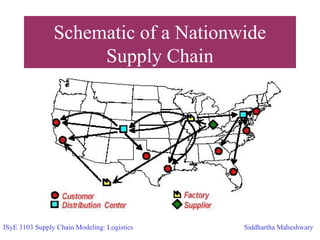
Schematic of a Nationwide
Supply Chain
ISyE 3103 Supply Chain Modeling: Logistics Siddhartha Maheshwary
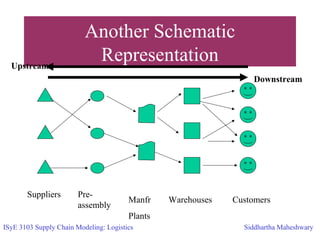
Another Schematic
Representation
Suppliers Pre-
assembly
Manfr
Plants
Warehouses Customers
Upstream
Downstream
ISyE 3103 Supply Chain Modeling: Logistics Siddhartha Maheshwary
Example: Dell
• Customer
• Website
• Assembly Plants
• Warehouses
• Dell’s suppliers and their suppliers
• Dell “builds-to-order”
• Dell does not have retailers, wholesalers
ISyE 3103 Supply Chain Modeling: Logistics Siddhartha Maheshwary
Example: Toyota
• Produces nearly 900,000 vehicles annually
• Over 35 manufacturing plants in 25 countries
outside of Japan
• For plants in the U.S., supply parts are shipped
across the Pacific, and transported on rail
• Deliveries are scheduled to the minute to keep
inventories low (Just-in-time)
• Complicated network with uncertainties
ISyE 3103 Supply Chain Modeling: Logistics Siddhartha Maheshwary
Problems in Managing the
Supply Chain
• Customer Service Goals
• Facility Location
• Inventory Decisions
• Transportation
ISyE 3103 Supply Chain Modeling: Logistics Siddhartha Maheshwary
Decision Levels
• Strategic:
– Long term, permanence of many years
• Tactical
– Intermediate time range, usually three months
to a year
• Operational
– Short range, week or less
ISyE 3103 Supply Chain Modeling: Logistics Siddhartha Maheshwary
Decision Levels: Examples
• Transportation
– Strategic: Mode Selection
– Tactical/Operational: Routing, scheduling
• Location
– Strategic: No. of plants and locations
– Tactical: Assigning inventory positions
• Warehouse
– Strategic: Layout, site selection
– Operational: Order picking
ISyE 3103 Supply Chain Modeling: Logistics Siddhartha Maheshwary
Logistics in Economy
(1990, 1996)
• Freight Transportation: $352, $455
Billion
• Inventory Expense: $221, $311 Billion
• Administrative Expense: $27, $31 Billion
• Logistics related activity: 11%, 10.5% of
GNP
ISyE 3103 Supply Chain Modeling: Logistics Siddhartha Maheshwary
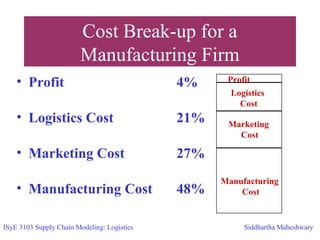
Cost Break-up for a
Manufacturing Firm
ISyE 3103 Supply Chain Modeling: Logistics Siddhartha Maheshwary
• Profit 4%
• Logistics Cost 21%
• Marketing Cost 27%
• Manufacturing Cost 48%
Profit
Logistics
Cost
Marketing
Cost
Manufacturing
Cost
Logistics: True Magnitude
ISyE 3103 Supply Chain Modeling: Logistics Siddhartha Maheshwary
• Compaq estimates it lost $0.5 billion to $1 billion in
sales in 1995 because laptops were not available when
and where needed
• P&G estimates it saved retail customers $65 million
by collaboration resulting in a better match of supply
and demand
• When the 1 gig processor was introduced by AMD,
the price of the 800 meg processor dropped by 30%
• Kmart versus Walmart

Supply chain concepts

  • 1.
    Supply Chain: BasicConcepts • What is a Supply Chain? • What are the problems involved in Supply Chain Management? • What are the levels of planning in Supply Chain Management? ISyE 3103 Supply Chain Modeling: Logistics Siddhartha Maheshwary
  • 2.
    What is aSupply Chain? • It is not a “one-way” chain, but a network of stages • Consists of all stages involved in fulfilling customer demand • Includes: Manufacturers, External Suppliers, Vendors, Transporters, Warehouses, Retailers, Customers ISyE 3103 Supply Chain Modeling: Logistics Siddhartha Maheshwary
  • 3.
    Schematic of aNationwide Supply Chain ISyE 3103 Supply Chain Modeling: Logistics Siddhartha Maheshwary
  • 4.
    Another Schematic Representation Suppliers Pre- assembly Manfr Plants WarehousesCustomers Upstream Downstream ISyE 3103 Supply Chain Modeling: Logistics Siddhartha Maheshwary
  • 5.
    Example: Dell • Customer •Website • Assembly Plants • Warehouses • Dell’s suppliers and their suppliers • Dell “builds-to-order” • Dell does not have retailers, wholesalers ISyE 3103 Supply Chain Modeling: Logistics Siddhartha Maheshwary
  • 6.
    Example: Toyota • Producesnearly 900,000 vehicles annually • Over 35 manufacturing plants in 25 countries outside of Japan • For plants in the U.S., supply parts are shipped across the Pacific, and transported on rail • Deliveries are scheduled to the minute to keep inventories low (Just-in-time) • Complicated network with uncertainties ISyE 3103 Supply Chain Modeling: Logistics Siddhartha Maheshwary
  • 7.
    Problems in Managingthe Supply Chain • Customer Service Goals • Facility Location • Inventory Decisions • Transportation ISyE 3103 Supply Chain Modeling: Logistics Siddhartha Maheshwary
  • 8.
    Decision Levels • Strategic: –Long term, permanence of many years • Tactical – Intermediate time range, usually three months to a year • Operational – Short range, week or less ISyE 3103 Supply Chain Modeling: Logistics Siddhartha Maheshwary
  • 9.
    Decision Levels: Examples •Transportation – Strategic: Mode Selection – Tactical/Operational: Routing, scheduling • Location – Strategic: No. of plants and locations – Tactical: Assigning inventory positions • Warehouse – Strategic: Layout, site selection – Operational: Order picking ISyE 3103 Supply Chain Modeling: Logistics Siddhartha Maheshwary
  • 10.
    Logistics in Economy (1990,1996) • Freight Transportation: $352, $455 Billion • Inventory Expense: $221, $311 Billion • Administrative Expense: $27, $31 Billion • Logistics related activity: 11%, 10.5% of GNP ISyE 3103 Supply Chain Modeling: Logistics Siddhartha Maheshwary
  • 11.
    Cost Break-up fora Manufacturing Firm ISyE 3103 Supply Chain Modeling: Logistics Siddhartha Maheshwary • Profit 4% • Logistics Cost 21% • Marketing Cost 27% • Manufacturing Cost 48% Profit Logistics Cost Marketing Cost Manufacturing Cost
  • 12.
    Logistics: True Magnitude ISyE3103 Supply Chain Modeling: Logistics Siddhartha Maheshwary • Compaq estimates it lost $0.5 billion to $1 billion in sales in 1995 because laptops were not available when and where needed • P&G estimates it saved retail customers $65 million by collaboration resulting in a better match of supply and demand • When the 1 gig processor was introduced by AMD, the price of the 800 meg processor dropped by 30% • Kmart versus Walmart

Editor's Notes

  • #8 Customer Service Goals: customer satisfaction is the key in success, low levels of service allow centralized inventories at fewer locations and less expensive transportation, allows long lead times. When service levels are pushed up, logistics costs rise, need higher inventory, faster (expensive) transportation Facility Location: Geographic placement of facilities has long-term impact, cannot change these decisions, are more permanent, need to decide where to locate, how many, which facility will serve which one, what will be the mode of transportation Inventory Decisions: Can either allocate (push) inventories to stocking points, or pull them as need arises. How much to store, what to store where? Key ingredient of sound logistical policy Transport Strategy: Mode selection, routing, shipment size, scheduling. Inventory levels also respond to transportation strategy
  • #9 Strategic: long term, characterized by their permanence and importance, usually there’s lack of quantitative and validated data, typically require “vision”, typically need long term forecasts with huge amounts of uncertainty need to be considered Tactical: 3 months to a year typically, typically based on a mixture of internal (like sales forecasts) and external data (like the economy, exchange rates etc.) Operational: typically have permanence of week or less, use of ERP systems etc have provide extensive operational data, savings or penalties associated typically affect the performance level (eg., lack of operational planning might leave some customers dissatisfied)
  • #11 This is in incomplete picture, it gives only a cost based estimate
  • #12 This is in incomplete picture, it gives only a cost based estimate Improving logistics does not mean that the company benefits by these amounts, the benefits are much more Similarly not handling logistics properly will not increase costs just by these amounts, the repercussions are far more Conclusion: Logistics affect overall business success, it should not be looked in isolation but should be considered together with other core competencies Companies can succeed or fail because of logistics: Kmart versus Walmart, Dell versus the rest
  • #13 This is in incomplete picture, it gives only a cost based estimate Improving logistics does not mean that the company benefits by these amounts, the benefits are much more Similarly not handling logistics properly will not increase costs just by these amounts, the repercussions are far more Conclusion: Logistics affect overall business success, it should not be looked in isolation but should be considered together with other core competencies Companies can succeed or fail because of logistics: Kmart versus Walmart, Dell versus the rest