Supply Chain Management
1
What is a Supply Chain?
• A supply chain is the system of organizations, people,
activities, information and resources involved in moving a
product or service from supplier to customer.
• Supply chain activities transform raw materials and
components into a finished product that is delivered to the
end customer.
Importance
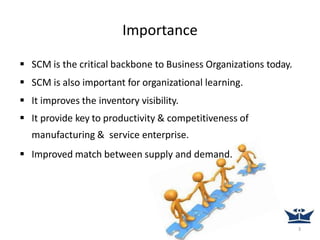
 SCM is the critical backbone to Business Organizations today.
 SCM is also important for organizational learning.
 It improves the inventory visibility.
 It provide key to productivity & competitiveness of
manufacturing & service enterprise.
 Improved match between supply and demand.
3
Components of SCM
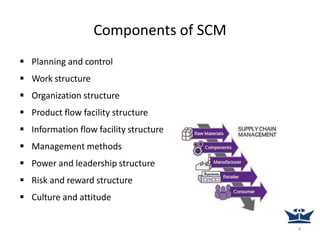
 Planning and control
 Work structure
 Organization structure
 Product flow facility structure
 Information flow facility structure
 Management methods
 Power and leadership structure
 Risk and reward structure
 Culture and attitude
4
Reasons for Growing Importance of Supply
Chain
Five major trends that make supply chain management a critical
success
• factor in most industries:
• Proliferation in product lines
• Shorter product life cycles
• Higher level of outsourcing
• Shift in power structure in the chain
• Globalization of manufacturing
• Greater value to consumers
5
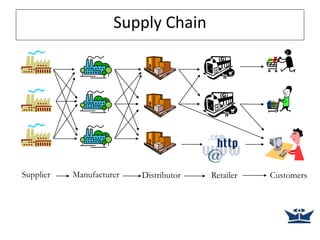
Supply Chain
Supplier Manufacturer Distributor Retailer Customers
Supply Chain Management
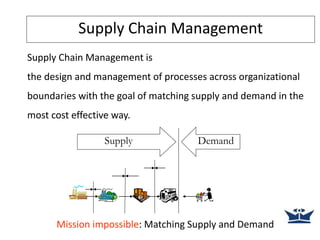
Supply Chain Management is
the design and management of processes across organizational
boundaries with the goal of matching supply and demand in the
most cost effective way.
Supply Demand
Mission impossible: Matching Supply and Demand
Why so Difficult to Match Supply and Demand?
• Uncertainty in demand and/or supply
• Changing customer requirements
• Decreasing product life cycles
• Fragmentation of supply chain ownership
• Conflicting objectives in the supply chain
Why so Difficult to Match Supply and Demand?
• Conflicting objectives even within a single firm
– Marketing/Sales wants: fast delivery, many package types,
special wishes/promotions
– Production wants: bigger batch size, depots at factory,
latest ship date, stable production plan
– Distribution wants: full truckload, low depot costs, low
distribution costs, stable distribution plan
Supply Chain Performance Measures
• Cost
• Total Supply Chain Cost is the sum of all supply chain costs for all
products processed through a supply chain during a given period
• Inventory Turnover is the ratio of the cost of goods sold to the value of
average inventory.
• Weeks of inventory is the ratio of average inventory to the average
weekly sales
• Customer Service
• Average Response Time is the time an order is placed at a customer zone
and the time the order arrives at the customer zone

Supply chain management

  • 1.
  • 2.
    What is aSupply Chain? • A supply chain is the system of organizations, people, activities, information and resources involved in moving a product or service from supplier to customer. • Supply chain activities transform raw materials and components into a finished product that is delivered to the end customer.
  • 3.
    Importance  SCM isthe critical backbone to Business Organizations today.  SCM is also important for organizational learning.  It improves the inventory visibility.  It provide key to productivity & competitiveness of manufacturing & service enterprise.  Improved match between supply and demand. 3
  • 4.
    Components of SCM Planning and control  Work structure  Organization structure  Product flow facility structure  Information flow facility structure  Management methods  Power and leadership structure  Risk and reward structure  Culture and attitude 4
  • 5.
    Reasons for GrowingImportance of Supply Chain Five major trends that make supply chain management a critical success • factor in most industries: • Proliferation in product lines • Shorter product life cycles • Higher level of outsourcing • Shift in power structure in the chain • Globalization of manufacturing • Greater value to consumers 5
  • 6.
    Supply Chain Supplier ManufacturerDistributor Retailer Customers
  • 7.
    Supply Chain Management SupplyChain Management is the design and management of processes across organizational boundaries with the goal of matching supply and demand in the most cost effective way. Supply Demand Mission impossible: Matching Supply and Demand
  • 8.
    Why so Difficultto Match Supply and Demand? • Uncertainty in demand and/or supply • Changing customer requirements • Decreasing product life cycles • Fragmentation of supply chain ownership • Conflicting objectives in the supply chain
  • 9.
    Why so Difficultto Match Supply and Demand? • Conflicting objectives even within a single firm – Marketing/Sales wants: fast delivery, many package types, special wishes/promotions – Production wants: bigger batch size, depots at factory, latest ship date, stable production plan – Distribution wants: full truckload, low depot costs, low distribution costs, stable distribution plan
  • 10.
    Supply Chain PerformanceMeasures • Cost • Total Supply Chain Cost is the sum of all supply chain costs for all products processed through a supply chain during a given period • Inventory Turnover is the ratio of the cost of goods sold to the value of average inventory. • Weeks of inventory is the ratio of average inventory to the average weekly sales • Customer Service • Average Response Time is the time an order is placed at a customer zone and the time the order arrives at the customer zone